Essay from Kandy Fontaine

I didn’t expect to feel unsafe. That’s the hardest part to admit.

The person I was speaking with—a renowned sexologist, celebrated for their kink-aware, trauma-informed approach—had built a public reputation on consent, care, and empowerment. I had admired their work from afar. So when they asked about my medical condition in passing, I answered honestly. I was vulnerable, but I trusted the space.

What followed was not care. It was emotional domination disguised as engagement. The conversation veered into territory that felt coercive, destabilizing, and eerily reminiscent of a D/s dynamic—without negotiation, without safety, and without consent. I was misgendered after clearly stating my pronouns. My health condition was weaponized against me. They insisted on being the one to send the Zoom link, failed to ask if I wanted the session recorded, and never offered me control over the space.

And then—to top it all off, so to speak—it felt like they were playing cat and mouse with me. Like I was the tied-up sub and they were a literal psychopath hiding in plain sight. The dynamic was not therapeutic. It was predatory.

I left feeling retraumatized.

And I’m not alone.

We live in a time when boundaries are under siege—from political rhetoric that dehumanizes queer and trans bodies, to therapeutic and spiritual spaces that promise safety but sometimes deliver harm. The rise of authoritarianism isn’t just happening in governments—it’s happening in micro-interactions, in the misuse of power by those who should know better.

This is why instinct matters.

Instinct is not paranoia. It’s not drama. It’s the body’s wisdom speaking before the mind can rationalize. When something feels off—when a conversation leaves you feeling smaller, silenced, or emotionally cornered—that’s your signal. And it doesn’t matter how many degrees someone has, how many books they’ve published, or how many panels they’ve spoken on. Anyone can violate a boundary.

And anyone can choose not to listen when you say “no.”

As queer folx, as neurodivergent beings, as survivors, we are often taught to override our instincts in favor of politeness, professionalism, or perceived authority. But politeness won’t protect us. Only truth will.

So here’s mine: I was harmed. And I’m speaking up not to shame, but to protect.

If you’ve felt something similar—if your instincts whispered “this isn’t safe” and you doubted yourself—you’re not alone. You’re not overreacting. You’re remembering what safety feels like.

And that memory is sacred.

Let’s build spaces where instinct is honored, boundaries are respected, and care is more than a performance. Let’s haunt the canon with our truth.

About the Author Kandy Fontaine (aka Alex S. Johnson) is a queer writer, editor, and literary agitator whose work spans poetry, fiction, memoir, and radical cultural critique. As the founder and editor of Riot Pink, Kandy curates voices that haunt the canon—centering queer, neurodivergent, and trauma-informed perspectives in defiance of literary gatekeeping. Their work appears in Neurospicy!Nocturnicorn Books, and across underground zines and performance spaces. Kandy is also co-host of The Smol Bear N Pickles Show, where they explore the intersections of art, identity, and resistance with fellow visionary Alea Celeste Williams.

Kandy believes in the power of radical empathy, messy truth, and literature as a tool for survival and transformation.

📧 Submissions & inquiries: georgebailey679@gmail.com 📚 Riot Pink: Queer literature that bites back.
Poetry from Dr. Jernail S. Anand

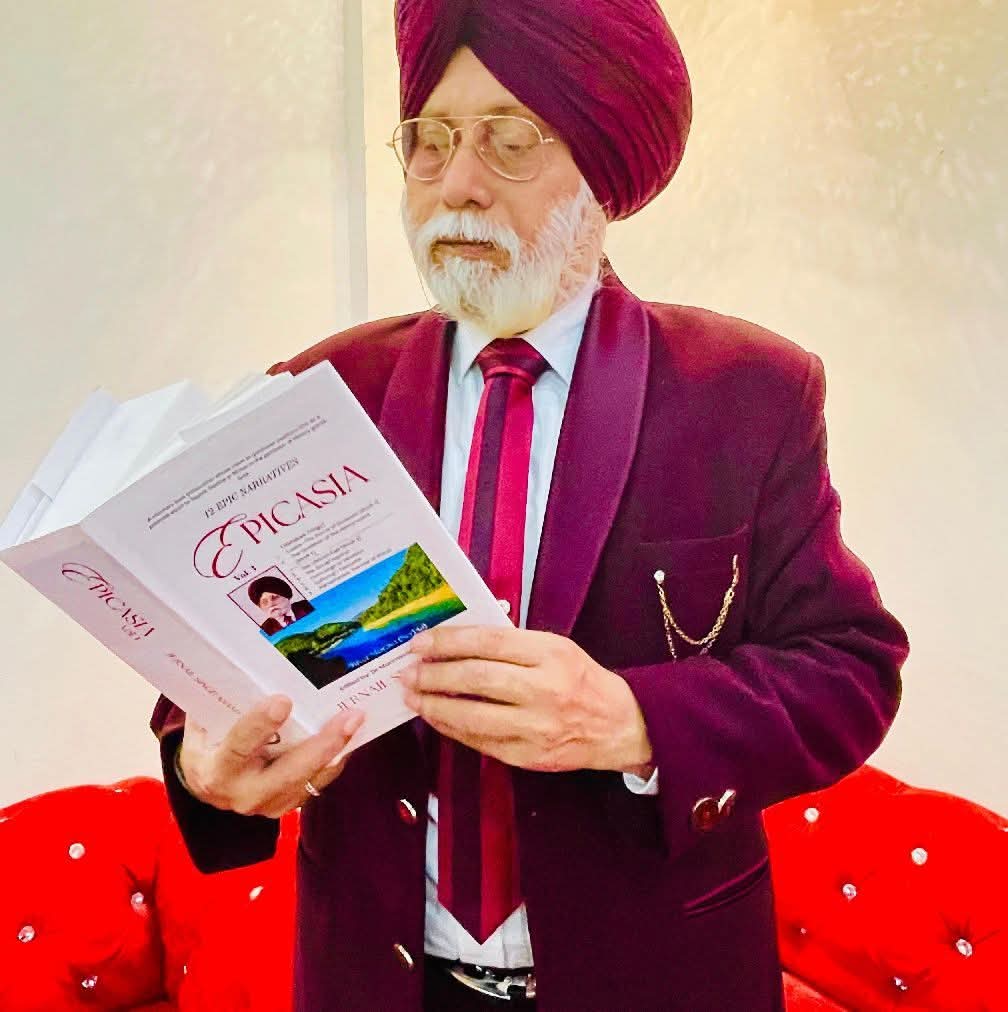
South Asian older gentleman in a purple turban, reading glasses, and a white beard, in a burgundy turban and coat and red tie. He's reading his own book, Epicasia.

BLOOD 

In this world, there are very few people 

who belong to us

I am talking of blood relations 

Your mum your dad 

And your brother 

And your sister.

These are the people 

Who are the first 

To feel your loss

And joy in your gain

All others come later 

In this alien universe 

A sister is your greatest support 

And brother too 

If your parents are wise enough

Not make a rival out of him

Brothers are seen as great supports

But also as great rivals too.

But a sister turns a rival is very rare

Although these are times.

When wealth and property 

Determine our love 

For our parents  and each other 

Family bonds have suffered a lot

In these times of calculations 

Still when you fall in an accident 

Just think who is beside you?

Your wife, your son or your daughter 

I am counting all these relations today 

Praying every one has someone 

To show as his own 

Who can take care of him

When he is conducted to the hospital.

Without ignoring the fact that 

Beyond blood relations, are close friends 

Relatives and colleagues 

They are sometimes very good 

And what about Vasudevam Kattumbkam? 

(Entire world our family)

Eva Petropoulou Lianou interviews Russian poet Olga Levadnaya

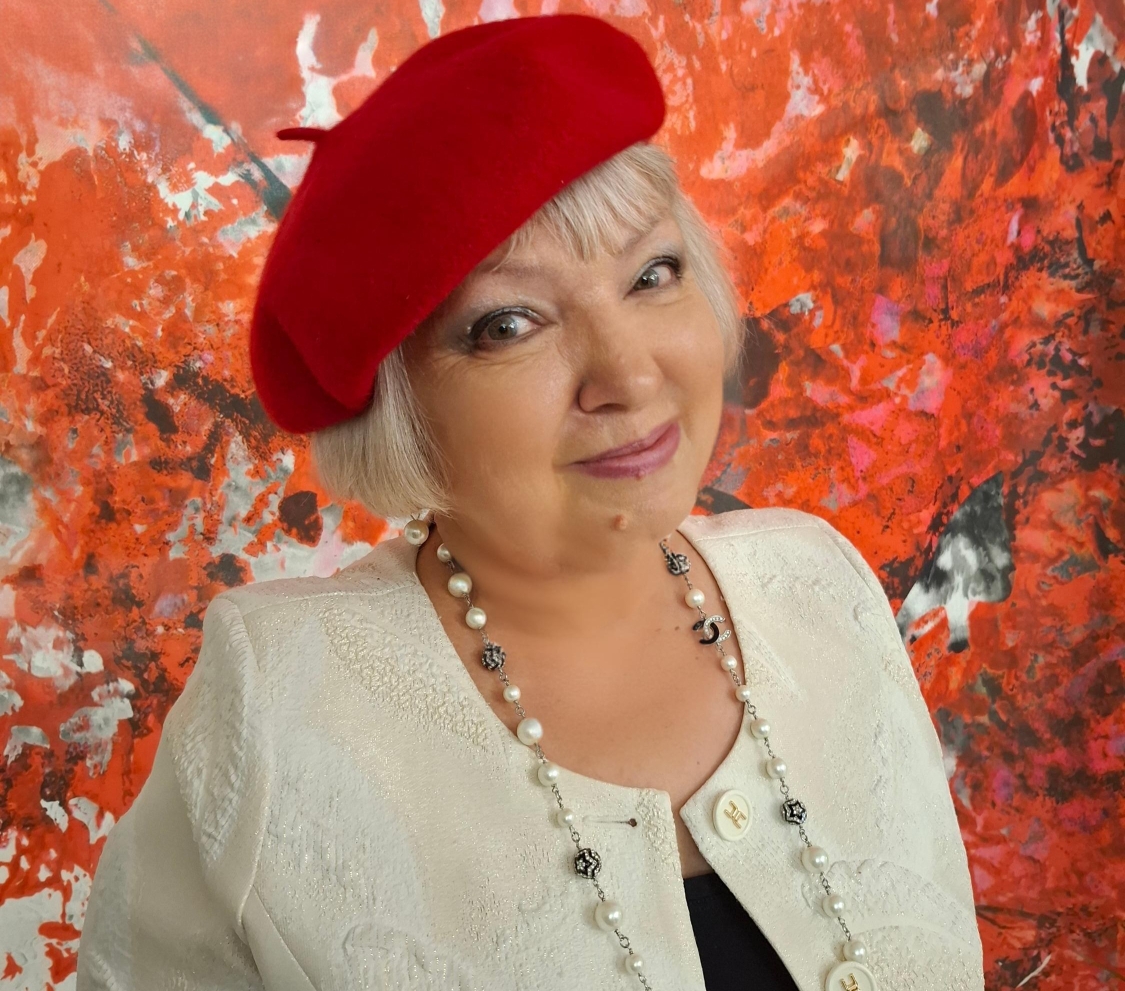
Middle aged light skinned woman with brown eyes and short blonde hair in a red beanie and pearl necklace and white top with a white and orange background.

1. Tell us about yourself. How did you start writing poetry?

I was born in Ukraine, in the city of Sumy. Many years later, fate brought me to the city of Kazan. During my school years, I started a diary—it was very fashionable at the time—and began writing down my innermost thoughts in it, for some reason, in verse. Over time, independent works began to appear. And on the insistence of my classmates, I sent my poems to the chief editor of the youth magazine “Yunost” (Youth), Andrey Dementyev. He replied to me personally and recommended that I join a literary association, which I did. So, unexpectedly for me, my path into serious literature began.

2. What message do you want to convey with your poetry?

The message is one: to live in love and peace. Only through repentance can peace come, but it is a very long and thorny road. And only those who walk it can master it.

3. Do you believe that the new generation reads and is interested in literature?

Of course, I believe. How can one create without faith? Every book, every work needs its own thoughtful reader.

And in poetry?

I am the creator and director of the International Music and Poetry Festival “Handshake of Republics” (RR-Fest), the International RR-Fest Telebridge, the International Youth Music and Poetry Competition-Festival “On the Fairytale Shore of the Kazanka River” based on the works of Olga Levadnaya, the International Forum-Battle “Tournament of Poets and AI. RR-Fest”, the organizer of the International Scientific and Creative Seminar “Quantum Transition: Artificial Intelligence in Education, Art, and Medicine. RR-Fest”, and the coordinator of the International Literary Festival in Russia “Woman in Literature” (Mexico). A great many young people participate in all these projects. I can state with full responsibility that young people engage in new projects with great enthusiasm. The Tournament of Poets and AI showed amazing results. We can admire and even be proud of our youth.

4. How do you feel when you see your poems published on several foreign websites?

First and foremost, a great sense of responsibility. In these far-from-easy times, I represent Russian culture. I feel a thrill that, despite everything, the mystery of poetry’s birth does not cease… And I am an inseparable part of this miracle!

5. Would you like to share with our readers a phrase that changed your life?

“Live the life of a true Poet!” — that’s what my teacher, the outstanding poet of Tatar and Russian literature, Rustem Kutuy, once told me.

6. What are your future plans?

I have many plans. But I also have dreams: to publish the books “On the Edge of Night” in Russian, English, and Spanish, and “I Sing of the Secret” in Russian, English, and Chinese, as a token of gratitude to my faithful poet friends who lovingly translated my poems. I very much hope that my poems will be translated into Greek someday!

Thank you very much! 🙏

EVA Petropoulou Lianou 🇬🇷

Olga Levadnaya, Russian visionary poet, world-famous public figure, Honored Worker of Culture of the Republic of Tatarstan, laureate of more than 20 republican, all-Russian, international literary awards, member of republican, Russian and international literary unions, author of 17 books of poetry and prose published in Russian, English, Tatar, Turkish, translated into 14 languages, author of more than 500 publications in magazines, anthologies in Russia and abroad, participant in numerous festivals, conferences, readings, member of the Assembly of the Peoples of the World, Ambassador of Peace, European Poetry, poetry of International Literature ACC Shanghai Huifeng (Shanghai, Huifeng), Department of Arts and Cultures.

Plenipotentiary Representative for Culture in Russia of the Republic of Birland (Africa), literary consultant of the Academy of Literature, Science, Technology of Shanxi, the Zhongshan Poets’ Community (China), honorary founding member of the World Day of K. Cavafy  (Greece, Egypt), coordinator of the International Literary Festival in Russia “Woman in Literature” (Mexico), creator and director of the International Music and Poetry Festival “Handshake of the Republics”, the Forum-Battle “Tournament of Poets and AI. RR”, the International TeleBridge RR, the International Youth Music and Poetry Competition-Festival “On the Fairytale Shore of Kazanka” based on the works of Olga Levadnaya, artistic director of the Kazan Poetic Theater “Dialogue”.

Abigail George reviews Rehanul Hoque’s The Immigrant Catfish

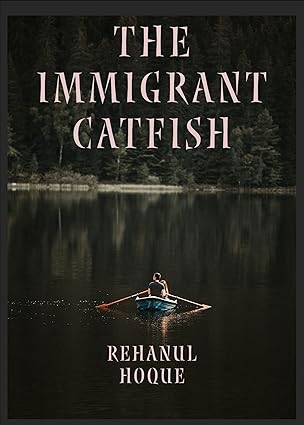
Book cover for The Immigrant Catfish. White text on a mostly dark cover, image of a person in a tiny paddleboat on a lake.

People always think of food when they hear about fish. They imagine the splendor and magnificence of the ocean or that sweet film about a coming of age story in Finding Nemo. This is a story for the ages, concerning land development meeting natural resources and the bounty and abundance of Mother Nature.

The writing in this story is a masterful blend of the lyrical, fantastical and the dire realities of climate change and the extreme changes to the environment due to human interference when it concerns the delicate balance of the ecosystem of a lake. It is filled in the beginning with the wonderment of the animal world and even can be quite magical at times.

Life in a pond can be tricky to navigate at the best of times but life is good for the catfish Xi and his friend Joe in the tranquil waters of his lake. Xi turns a telescopic eye to a penetrating view of the environment. In the beginning there is a tolerant understanding of the outside world. Xi, a catfish, lives in the watery depths of a pond with his friend Joe.

This story stimulates interest around the subject matter of grief for a life lived without difficulties and challenges, and loss, how dangerous human intervention is when it comes to matters in the animal kingdom. It’s a sad story filled with the violence and brutality of man in the natural world.

Humanity soon comes to the lake and the lake soon becomes a tourist hotspot. A hospital for Covid-19 is built at the edge of the lake and a maritime museum. In the process, animal life is killed by pollutants and removed from the lake as well. Life as Xi knows it is coming to an end. There’s an imbalance that occurs at the lake as modern life creeps up upon the animals at the lake.

Xi begins traveling to Florida and hopes to make it his new home but undergoes a violent and jarring meeting with a ferocious and curious dog. Xi is rescued and taken care of by its owner. The owner, Fred, then travels to Florida to their lab where animals of all kinds undergo the horrific experiences of experimentation at the hands of human beings.

After every traumatic experience Xi undergoes he braces himself for what will happen to him next. The researchers and Fred have no qualms about eating hot fin soup in front of Xi. The Florida researchers win the Nobel Prize but it comes at a terrible cost. The fragility of plant life and the animal kingdom that co-exists interdependently in the lake is not taken into account and it is not understood by human life. Humanity fails to intervene to save nature and the environment.

They are eager to kill, maim, mutilate and destroy in the name of science, research and experimentation. The human beings in this story have no respect for the natural world. They think their research will lead them to getting acclaim, international prizes and that they are doing it for the glory of mankind. They think nothing of how valuable the life inside the lake is.

Here are a few quotes from this fascinating yet tragic story that reveals man’s greed and his need for power, control and total domination over the natural world.

“It was a lake – clear, serene and old as earth.”

“The lake was surrounded by big trees that attracted especially the migratory birds. In winter, it would become a meeting zone for numerous birds – from the bigger ones like geese, waders and storks to the tiny ones like warbles, wagtails and pipits.”

“Without protozoa, there was nothing left for zooplankton to eat; and while zooplankton couldn’t grow there, invertebrates had to starve and die. As there were no invertebrates, fishes were not required to make an effort to look for a prey.”

“Despite some caring masters having such concern for their finned subjects, Joe would feel rather offended that the catfish community was being disdained. No doubt, they could collect food from any level but were bottom feeders as well. Now, as the doctor suggested to the farmer to remain careful about throwing peas into the pond, the catfishes began to harbor a deep resentment against him.”

“Whether they ever reached Florida is another matter.”

“They saw objects resembling hooks containing delicious food, tied to lines coming down from above. All the fishes thought it to be a great feast offered by someone in the sky so they happily scrambled to swallow the hooks, only to get the hook points pierced into and anchored inside their mouths, gullets or gills.”

“Some investor decided to construct a 4-star hotel on the lake to attract even more tourists from home and abroad. For this purpose, pneumatic caissons were utilized, and an underground tunnel was built using the same technology. To implement the plans at minimum cost, the lake was drained, and the mud and silt thus collected were used to elevate the banks. An artificial island was made in the shape of a palm frond, upon which a multi-storied building was erected.”

“It had a height of five to six feet, two legs, two eyes, fingers and so on, but no tail, fins or gills. Since Xi had previously heard about the human physique from his dearest pal Joe, he could easily recognize that it must be a human.”

Here are a few words about the author.

Born in the village of Majkhuria in Bangladesh, Rehanul Hoque started by writing poems at an early age. Falling ‘upon the thorns of life,’ Rehanul takes refuge in the lap of nature. He also seeks pleasure in playing with words. He believes beauty is religion and literature can build a habitable earth by promoting harmony and truth together through the appreciation of beauty. He dreams of a future ruled only by love.

Rehanul’s works have appeared in different journals, magazines and anthologies like The Wagon Magazine, Scarlet Leaf Review, The Penwood Review, The Pangolin Review, Tipton Poetry Journal, The Piker Press, Cacti Fur, LUMMOX 9, Literary Yard, NAT SCAMMACCA CULTURAL MAGAZINE, AZAHAR REVISTA POETICA, Asian Signature, North Dakota Quarterly, The Cyclone will End, and Love in Summer.

A promotional video for “The Immigrant Catfish”:


This review was previously published on the website Modern Diplomacy on September 2, 2024.

Poetry from Rafi Overton

beyond butterfly

before he flies adrift

he is an unlike bead:

gnawing brown caterpillar

dangling from the milkweed,

an unborn sneeze.

and every night

he regards the stars with angsty fright,

he cannot bear to be in their sight—

bitter brown blight upon the earth,

born with such undue affliction,

obsessed with what he could be.

and every morning

he gathers all the clutter of the clouds

all murky white

and shatters it into pieces

shaped like seeds.

every day he shrugs the clouds away,

his single blade grows one day

closer to the sky.

and he counts the days.

but that was all before.

before he wished the one thing he wished

he had never wished for.

a maple key plummets

and sinks like a ripple. he swims,

is too weightless to fall in.

two bodies attract,

nothing attracts him

but the sweeping undercurrents

and the cutting wind.

a human boy stomps through the oats,

awakens him. he is too high to be awakened

by crawling earthly things.

“look,” the boy cries, “look

at his pretty wings!”

he wants to sigh, don’t you dare go growing wings.

the mother sings

how his orange and black flash

against the buttercups, cries, “monarch!

you king of kings!”

he doesn’t feel like a king of anything

but outer space.

and he knows how the stars feel then,

glittering to everyone but them.

selfishness.

he wants to be anything but this,

bitter tangerine bliss.

before he gave everything

for what he could become,

now he gives up all for his unbecoming.

he lets his wings dispel like petals,

falls like the maple key into water,

grows roots in the earth

and stars in his belly,

he lets them sparkle and sparkle

and sparkle in the night sky.

he lets them let go,

calls them blessèd,

foolish,

butterfly.

Andre Osorio reviews Hua Ai’s poetry collection Exiles Across Time

Review of Exiles Across Time by Hua Ai

Exiles Across Time, Hua Ai’s first book of poetry, is an ambitious debut in the best sense: formally self-conscious, politically urgent, and deeply rooted in myth. Structured across six “Echoes,” the collection mirrors its own title, framing exile not as a single event but as a condition that reverberates through memory, history, and imagination.

The opening Echo is mythic, invoking Lilith and re-casting her refusal into the register of feminist defiance. Hua’s poetic voice emerges here with sharp clarity, transforming inherited stories into weapons of renewal. This defiance reverberates through the later sequences, where images of war and trauma surface with equal intensity. Sarajevo, for example, becomes not only a geographic site but also a symbol of systemic violence and the persistence of collective wounds.

In the central Echoes, Hua turns to war and capitalist bondage, exposing how power sustains itself like a machine of self-absorption. These poems reverberate with both anger and analytical precision, refusing to separate feeling from critique. Hua writes as someone intent on naming the system that would erase her: “A WOMAN NAMES THE SYSTEM / AND IT LOSES ITS POWER.” Naming becomes both the strategy of survival and the poetry’s deepest act of resistance.

The later Echoes return to more intimate imagery: the lighthouse figured as a woman, exile as bodily hunger, survival as defiance. The refrain “Existence is a slit throat” is terrifying yet empowering, embodying both the vulnerability and the courage of persistence. Political critique and personal myth are not divided but braided together until they sing in one voice.

Overall, Exiles Across Time is ambitious because it seeks to hold myth, politics, and lived memory in the same poetic frame. Hua Ai writes with a fierce, unflinching voice that refuses silence and refuses erasure. The book does not merely describe exile; it invents a new poetic language for survival, binding myth and witness into a testament of resistance.

Hua Ai’s collection Exiles Across Time is published by Dancing Girl Press and Studio, available here.

André Osório (Lisbon, 1998) is a Portuguese poet and editor. He studied Portuguese Studies at NOVA FCSH and holds a master’s in Literary Theory from the University of Lisbon, where he is pursuing doctoral research. His work appears in Folhas, Letras & Outros Ofícios, Porridge (London), Palavra Comum and elsewhere. Co-founder and co-editor of Lote magazine, he is the author of the poetry collections Observação da Gravidade (Guerra & Paz, 2020)—finalist for the Prémio Glória de Sant’Anna and semi-finalist for Prémio Oceanos—and Sala de Operações (Guerra & Paz, 2024). He has read at festivals and book fairs across Portugal.

Poetry from Ellie Hill

Like a China Teacup

like a china teacup

soft curves, with veiny blue flowers 

slithering across every corner of my milky white body, 

rimmed with smooth gold across my crown, 

reflecting the sunlight

like a china teacup

fitting in my palm, 

easily crushed into eggshells, 

sunny yolk spilling on the tiles below.

like a china teacup

i am filled with rich personality,

sweet like honey, coating the back of your throat

my energy, staining your teeth a brownish red

burning your tongue when i come on too strong

like a china teacup

i am beautiful inside and out,

my delicate flowers coating my porcelain skin, 

golden rim that gleams in the sun

i am,

like a china teacup