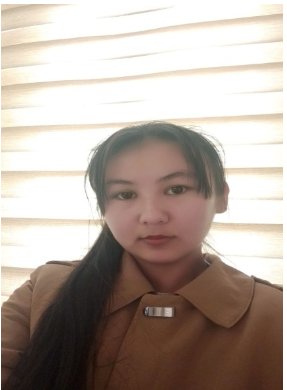
Eshmatova Charos is one of the most inquisitive students, deeply studying linguistic theory, and a holder of international certificates. She was born on August 18, 2007 in Uzbekistan. She is studying at Denau Institute of Entrepreneurship and Pedagogy Fields of activity: in depth of study the Uzbek language, gaining detailed knowledge of Turkish languages, and Early Achievements and Educational Path. She has obtained a national certificate in Uzbek language and literature (B level) and holds several international certificates. She graduated from secondary school with excellent grades and achieved notable positions in several academic subject Olympics.
So may I someday, sitting at play in my little unknown courtyard.
-A line from the poem “The Last Romantic” by John Ashbery.
May I, I pray,
someday, say TIME.
My mouth open, but breath stopped.
No air twisted by my language.
Not the word, but the event. TIME.
Its meaning will be conveyed by rote memory
directly into the minds of the people. TIME.
My name will be undead.
From then on, my name will be foreknown
by every baby born, by every deathbed rosary grip,
as the philosopher who knew how to tongue the name of Saturn
that no mortal had ever pronounced before. TIME.
The soundless rote memory of each molecule
and flexed in crystalline chirality. The turn of a closing sarcophagus jar,
screwed into the body of a helical protein. TIME.
The cousin of those twins, Heat and Pressure,
who would hear my call, and would answer,
by vibrating the hollow bones of birds, BIRDSONG TRIUMPHANT,
in simultaneous exultation.
Their talons on the ledges of the rows of ossuaries
that line the psychic riverbanks of the city.
Saturn returns a kiss. Lovingly.
Placing his expressionless lips on the forehead of my skull.
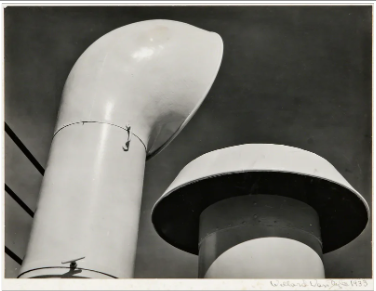
Willard van Dyke, Funnels, 1932
Photo in Phaidon, The Photo Book, p. 127.
If one is intake and the other is output,
they circulate ironies.
On the right, boater hat straight to the sky,
one attentively waits on an arrival.
On the left, face bending the first,
a gossip attends only to its companion.
Sky setting for HVAC,
Denver periscope and snorkel extended in ether,
either one pipe-fitted to purpose,
differently, anatomically differentiated,
completely interchangeable.
Below the photographer’s frame
there has to be a maze, anatomically has to be,
in architecture, on a rooftop, a circulatory system
and unseen rhythms of building inspectors,
repairers, roofers, breathers, odors,
all breathing in timetables, calendars, municipal bylaws,
chartable but not really charted except by Willard van Dye
who looked up to a sunless cloudless unbirdened sky
without the draw of church steeple or billboard or neon light
and the shadow of the pie-plate topper on the straight one
indicates the Sun it shining in its face and on van Dyke’s back
and from this angle he must be lying down on the roof,
Willard’s camera as far away from the base of the Funnels
as inches are between the soles of his feet and his eyes
the hypotenuse thereof ridden by the focus of his lens –
the only straight line of the entire picture
that is not hooked by a corner and recycled forever in circles.
Canadian farmer Terry Trowbridge’s poems have appeared in CV2, The New Quarterly, Dalhousie Review, Nashwaak Review, The Great Lakes Review, Pamenar Press, The Ex-Puritan, Studies in Social Justice, and ~200 more places. He is grateful to the Ontario Arts Council for funding during the polycrisis.
TEACHER’S MANAGEMENT ACTIVITIES IN THE EDUCATIONAL PROCESS OF PRIMARY SCHOOL
The participant is a preschool teacher at State Preschool Education Institution No9 the Department of Preschool and Primary Education of Jizzakh City
Shodiqulova Dilorom Niymatulla qizi
Abstract: This article examines the role and importance of the teacher’s management activities in organizing the educational process in primary school. The main management functions of the teacher-planning, organizing, motivating, controlling, and analyzing-are analyzed from a pedagogical and theoretical perspective. The effectiveness of these activities in improving the quality of education and supporting pupils’ personal development is highlighted.
Introduction Primary education plays a crucial role in shaping a child’s personality and learning abilities. At this stage, the teacher acts not only as a source of knowledge but also as a manager of the educational process. The effectiveness of teaching largely depends on the teacher’s ability to properly organize and manage classroom activities, taking into account the age-related and individual characteristics of pupils.
Main Part
The Concept of Teacher’s Management Activity
Teacher’s management activity refers to a set of pedagogical actions aimed at planning, organizing, directing, and controlling the educational process. In primary school, the teacher must manage learning activities in a way that ensures pupils’ active participation and supports their cognitive, emotional, and social development.
Planning and Organization
Planning is one of the key components of effective management. A primary school teacher should clearly define lesson objectives, select appropriate teaching methods, and use suitable educational tools. Proper organization of the lesson helps create a positive learning environment and increases pupils’ engagement and interest in learning.
3. Motivation and Encouragement
Motivation is a significant factor in primary education. Teachers should apply various motivational strategies, such as praise, encouragement, and positive feedback, to maintain pupils’ interest in learning. A supportive and friendly classroom atmosphere enhances pupils’ self-confidence and promotes active learning.
Control and Analysis
Control is an essential part of managing the educational process. Through continuous assessment and observation, the teacher identifies pupils’ learning achievements and difficulties. Analyzing these results allows the teacher to make timely adjustments to teaching strategies and improve overall educational outcomes.
Conclusion
In conclusion, the success of the educational process in primary school largely depends on the teacher’s management activities. Effective planning, organization, motivation, and control contribute to high-quality education and the comprehensive development of pupils. Therefore, developing teachers’ management competencies is an important task in modern primary education.
References
Darling-Hammond, L. (2017). Teaching for Quality Learning. San Francisco: Jossey-Bass.
Hoy, W. K., & Miskel, C. G. (2013). Educational Administration: Theory, Research and Practice. New York: McGraw-Hill.
Slavin, R. E. (2018). Educational Psychology: Theory and Practice. Boston: Pearson Education. Woolfolk, A. (2020). Educational Psychology. London: Pearson.
UNESCO. (2015). Rethinking Education: Towards a Global Common Good? Paris: UNESCO Publishing Biography
+


I'll wet my Ankles &
   Slip in
      To my knees

A pool has my Heart.
   Moonlight shattered
     in the
       Reflected shimmer.
A mouth of a fish thinks I'm
   dropping bait
    or just,
  Says Hello.

I don't talk fish tonight.
  I'll just be careful because
   there are more
       than fish in this pool.

The Air Laughs
           at my arrogance
by Brushing
  the leaves above my sight.

A star needs for nothing,
         sufficient of itself.
I volunteer for an
   adventure before
     even knowing what it
            is.
I cannot leave my Heart behind.
                   .....................................


Written February 3, 2026
  Tuesday Morning
by  John Edward Culp

 All Rights Reserved


+
The great Eastern sage Abu Ali ibn Sina, when asked, “Why is there so much evil in the world?”, replied: “The cause is you and us. By abandoning the struggle against evil due to ignorance or incompetence, we ourselves open the way for the widespread growth of evil.” Indeed, ignorance and indifference are among the greatest obstacles to the development of society. Therefore, in preventing such vices, it is of paramount importance first and foremost to thoroughly study the Constitution and to comprehend its essence and meaning.
The Constitution is the most important political and legal document of every state and the juridical expression of the will of the people. It reflects everything from the foundations that define the structure of the state, the form of governance, the principle of separation of powers, and the guarantees of human and civil rights and freedoms, to the general criteria that ensure social stability. The Constitution of the Republic of Uzbekistan is of particular significance because it embodies the ideas of building a democratic state governed by the rule of law, forming a free civil society, and prioritizing human interests. For this reason, it is recognized as a solid foundation of freedom, justice, and prosperity.
The term “Constitution” is derived from the Latin word constitutio, meaning “establishment” or “structure.” That is, the Constitution is the fundamental document that defines the structure of society and the state, the form, principles of operation, and powers of authorities and administrative bodies, as well as the basic rights and duties of citizens. The fact that all laws, codes, decisions, and decrees in the country are adopted in accordance with the Constitution is clear evidence of its supreme legal force.
The Constitution directly influences all spheres of social life—political, economic, spiritual and moral, domestic, and labor relations. The following words of President Shavkat Mirziyoyev vividly express the invaluable role of the Constitution: “It can be said with full confidence that the Constitution of the Republic of Uzbekistan is a high example of our people’s political and legal thought. It has been and continues to be a legal guarantee of living freely and independently, peacefully and securely, and in prosperity, without dependence on anyone. It serves as a solid foundation for building a legal democratic state based on market relations and a strong civil society.”
The significance of studying the foundations of constitutional law lies in the fact that a citizen clearly understands his or her rights and obligations, distinguishes between actions permitted and prohibited by law, and becomes aware of the ways and means of protecting legitimate interests. Most importantly, such knowledge instills firm confidence that justice can be achieved by observing the law.
In conclusion, the Constitution of the Republic of Uzbekistan is a noble document that regulates the life of the state and society, ensures the legal protection of every individual, and lays the foundation for a prosperous and just life.
Mother tongue is the most beautiful melody that comes from the heart of a people, the most sacred word. Every person first understands the world through their mother tongue, begins to speak with their mother’s lullaby, and feels life through this language. Therefore, mother tongue is an invaluable heritage for every nation, the most sacred wealth left by ancestors.
The Uzbek language is a language that embodies ancient history, rich culture, and high spirituality. Each of its expressions conveys the spirit, love, honor and dignity of our people. When a person hears words like “Love,” “Homeland,” “Mother,” “Friendship,” feelings of pride and honor awaken in their soul. Through these words, we understand our identity and our roots.
Alisher Navoi said, “A people who know their language will be a people, a people who do not know their language will not be a people.” There is deep meaning in these words. Because a nation without a language is like a tree whose roots have been cut. We must justify the trust of our ancestors by preserving, loving and cherishing our language.
Today, the Uzbek language, as the state language, is taking its place in all spheres of our country’s life. This is a source of pride and honor for us. As the younger generation, we must enrich our language further, and justify the trust of our ancestors by loving and cherishing it.
Language is a bridge. It connects the past and the future, the dreams of our forefathers with our noble goals. Therefore, whoever preserves their language actually preserves the history, honor, and pride of their people.
Let us also speak our mother tongue with love in every word, with pride in every sentence. Because “My mother tongue – the pride of the nation” is not just a slogan, but an eternal truth that lives in our hearts.