
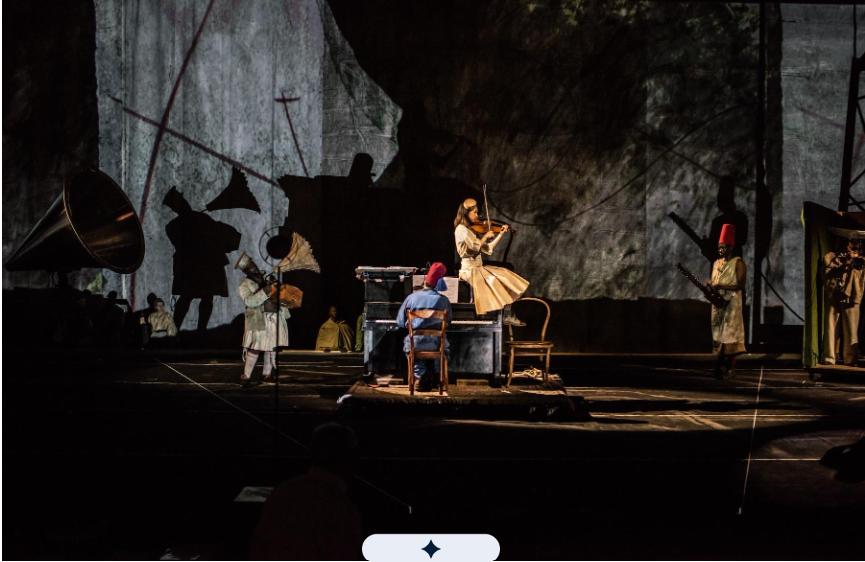
Pictured left to right: Nhlanhla Mahlangu, actor, vocalist, dancer; Vincenzo Pasquariello, piano; Mario Gotoh, viola; N’Faly Kouyate, kora (credit: Stella Olivier)
The Head & the Load
Henry J. Kaiser Center for the Arts
Oakland, California
A review by Christopher Bernard
LET’S TRY FOR ONCE NOT TO BE RIGHT
Does an artist have a moral responsibility to his viewers? Does he have a responsibility to his society aside from the ordinary duties of a citizen, for example, to pay taxes, stop at red lights, and not murder his neighbor? Must he be political? Must he be good? Must he appear to be good: must he be “a good role model”? Where exactly do his responsibilities end and begin?
Questions like these are often prompted by the work of contemporary artists, but none more so than the work of William Kentridge, who is not only one of the world’s greatest living artists but an impresario, a collector and organizer of other people’s talents, of almost daunting gifts.
The moral dimension of the arts is notoriously tricky: much appallingly bad art has been supported because it flatters the moral sensitivities and political biases of its time, and some very great art is periodically attacked, even physically, for offending the same (the Taliban and ISIS are hardly the only modern barbarians destroying monuments of humanity for being “blasphemous”; I’m reminded of a scion of righteousness in the U.K. who, unaware of the paradox of her behavior, took a knife to a classic painting she disapproved of because it depicted “violence”).
Much overtly political art suffers from the blatancy of its intentions, its obvious aim of changing our behavior via bullying joyfulness to emotional blackmail. It shares the aesthetic questionableness of other forms of advertising, precisely because its commitments are so bare.
On the other hand, when an artist takes even the trendiest, and therefore suspect, of political themes and creates before our eyes, like a work of alchemy, a modern, and modernist, masterpiece, a magnificent living collage of staggering dimensions, endless inventiveness, deep wit, and even deeper humanity, and a masterpiece precisely because it (for the most part) refuses the simplicities of propaganda that political art so often succumbs to, the rest of us can only breathe a sigh of relief and let ourselves be nourished by the sustenance, spiritual as well as aesthetic, that is art’s peculiar gift, without feeling moralized at or browbeaten. Our humanity is expanded, our spirit nourished, our hopes (even our political ones) made both clearer and stronger.
Which is why I felt so lucky to see Kentridge’s The Head & the Load when it received its West Coast premiere, as part of Cal Performance’s “Illuminations” series, at the Henry J. Kaiser Center for the Performing Arts in Oakland, California.
Like Kentridge’s other theater pieces, though in even more spectacular and space-defying fashion than most – it’s presented on a stage as long as a twenty-story building is high, three times the size of Cal Performances’ main stage at Zellerbach Hall – it combines the South African artist’s fertile, perceptive, and endlessly stimulating artistic work in gloriously clashing yet weirdly coherent fragments, with jolly live music, exuberant dance, poetry and rhetoric in languages European and African, torrents of glossolalia enacting the incomprehension that rules the world and pithy African proverbs on the tickling edge of meaning (“The head and the load are the troubles of the neck,” “Hunger never made a man wise,” “Let’s try for once not to be right”). There are photographs, film, a bricolage of Kurt Schwitters–like sets, cascading projections of rich plunder from the archives, piercing spotlights against seemingly endless circus-like parades in gigantic silhouette, the liberating irrationalities of Dada, and a profound sympathy for human suffering and indignation at man’s inhumanity to man.
An undercurrent of merriment is never far from Kentridge’s work and never fails to pierce through the somberness of the fundamental story the piece tells. Then, after ninety minutes of thrills and chills, there is a long moment of pure simplicity, a fading coda of sorrow, loss, and tenderness.
The work was, for this viewer, the most fully successful of Kentridge’s theater pieces, as it provides his endlessly inventive theatrical sense with a firm emotional anchor in human sympathy, something his other pieces sometimes struggle to attain, despite their dependable aesthetic excitement – and an anchor in human sympathy is, of course, what we really mean when use terms like “moral sense.” If politics approaches the world in fear, as an enemy, morality approaches it in sympathy, as a friend.
“This is all very interesting, if awfully vague. But what, after all, is the piece about?” I hear you asking impatiently.
I’ve deliberately delayed saying so because I didn’t want it to do to you what it did to me the first time I read it.
Most descriptions of the work begin by telling you, flat out, that it is “about” the role of Africans in World War II, when they were conscripted by their European masters to serve as carriers and porters during what was, up to that time, the bloodiest conflict in history. The introductions usually include a brief lecture on the manifest evils of European colonialism – which, however justified, is a very well-worn road. I admit that, after I read it, I thought, “Uh-oh. It looks like I am going to feel guilty again for all the crimes of humanity (read: of white men, of which I am [full disclosure] one) for the last millennium, or two, or five. Sigh! What’s on at the Roxie?”
Some of us who are allergic to all things PC (and “anticolonialist” themes are high on the list) might wonder: do we really want to spend another evening being lectured to and sermonized by one more righteous leftist (though one of genius), even when we, on the essentials, are actually on his side? Sometimes even the choir gets tired of the sermon.
Alas, the piece does occasionally fall into the propagandistic and easily Manichean: for example, the quotations, at the very beginning in the piece, from the psychiatrist and anti-colonial theorist Frantz Fanon, one of the left’s grimmer saints, that are projected in all caps onto the immense stage’s back wall like decals on a suitcase blaring the traveler’s cosmopolitan bona fides, were probably inevitable, given the piece’s theme and style, but I could detect no irony to season the sermon, no sense that Dr. Fanon might be something of an ambiguous emblem for the cause. The quotes come across as a bit of virtue signaling for the academic bien-pensants in the audience, to let them know they are unquestionably in the “right” hands.
But most of the performance worked at deeper levels of ambiguity and ambivalence, probing both issues of epistemology (how we know the world – more strictly, how we believe we know it) and, by implication, ethics (how we know what is right), attacking the piece’s overt subject in a complex, fragmented, deliberately incomplete way (which, I would suggest is, in the end, both more “honest” and more humane), with all the brilliance, not only of Kentridge, but of his collaborators, which include, according to his own assertions, everyone involved in its creation.
The piece, in the end, is not only about a specific injustice (and, as the piece develops, the sense of injustice deepens, especially when we learn that, after the war, the Africans were left out of most stories about it; their sacrifices and deaths not even honored, in some cases not even recorded in a deliberate – fortunately, unsuccessful – act of extinction). But it is about all human suffering at the hands of other human beings and the waste it leaves behind – waste that, paradoxically, can be used in the endless process of creation that reality, even at its most destructive, provides. There is a heroism at the heart of the disasters imposed on the subaltern from the center, historically on Africa from Europe and allegorically for all manifestations of human domination of the vulnerable, that nevertheless keeps transcendence as an option that is always available. And that transcendence includes not only personal acts of courage, love, and loyalty and works of beauty and grace, but also politics and political change.
Kentridge’s creative team includes the composer Philip Miller and composer and music director Thuthuka Sibisi; the music is an ever-evolving collage of European and African music from the era and the two composers’ own inventions, both played and sung. The team also includes Gregory Maqoma, who provides choreography largely based on African gestures and rhythms, to say nothing of a host of other theatrical wizards.
At one point, a fragment of battered film is screened across the enormous back wall, of a troop of Africans on parade outside their village as they prepare to be sent to war; it rolls across the wall again and again, in clever cuts and montage, some in the distance, some nearer, almost in close-up, blurred and haunting. It is (according to Kentridge in a conversation he had with a UC Berkeley professor before the performance) the only piece of film from the period of this event. It is eerily moving to see the colonized bravely marching in the uniforms and following the warlike choreography of their hard-hearted masters. It is a beautiful example of Kentridge’s use of fragment and collage and “the question” as he put it, “of how we understand through fragments, our complicity in making sense of the world.”
_____
Christopher Bernard’s most recent book is The Beauty of Matter: A Pagan’s Verses for a Mystic Idler.
Living near the coast changes how those abstract visuals affect my perception. A different locale might yield a unique reception to the work.