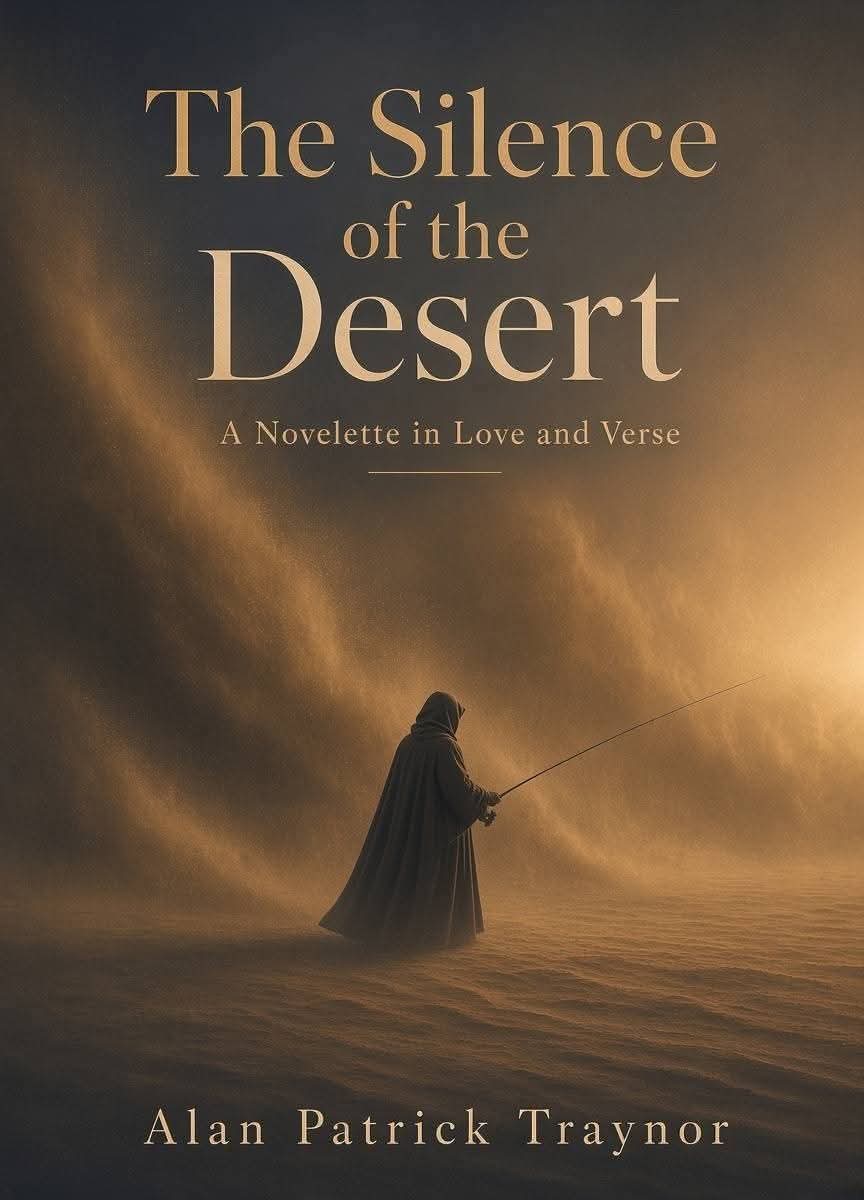
Alan Patrick Traynor is an Irish poet from Dublin whose work has been described as “the mystical galvanic paint that sets the fields of Provence on fire.” His poems shock the eyes and the soul at once; they are, in the words of one critic, “deep veridicous spears in a rachis sky of black feathers that will unlatch and unhinge you.” Traynor is the author of ‘Seven Days of Ashes’, a collection written on the spirit of the Holocaust and published by Albino Crow Press. He also has two other poetry collections published ‘Edit Not my Soul’ and ‘Until the Broken Clouds Answer’. His poetry has appeared in literary journals around the world, and he is held in high regard by his peers. Two of his own phrases—“Edit not my Soul” and “Edit not Blood”—capture the fierce integrity of his voice.
The Silence of the Desert is Alan Patrick Traynor’s first novella. It is a work of fiction and truth woven from the living fabric of his poems and life. The narrative follows Liam Bird, a solitary Irishman, and Elise Moreau, an Explorer and Swiss rider of motorcycles who loves mountains, as they travel from the light of Florence through the Atlas and the Sahara, across the Serengeti, into the Alps and the quiet of Vevey, through the rain-wet streets of Wicklow and Paris, the orange groves of Seville, the jazz sanctuaries of San Francisco, and finally into the long northern darkness of Norway under the aurora. At every stage the poems travel with them—read aloud under desert stars, mountain wind, and city lamps—while the music moves from Mozart’s elegant yearning to the searching, unfinished prayer of John Coltrane.
Traynor’s art is not confined to the page. He experiments with German Expressionist painting—its raw colour, its fractured vision, its insistence that emotion is a form of truth—and with jazz guitar, an instrument of listening as much as of sound. These dual fascinations shape the novella’s deepest current: the idea that love, like a poem or a Coltrane solo, is less a destination than a continuous act of attention and listening. The silence that follows every note, every line, every shared night under open sky, is itself a kind of music.
Readers familiar with Traynor’s poetry will recognise the landscapes, the birds, the winter roses, the broken branches that speak an Igniparous language, and the starling that sings in the soul.
Those who come to him for the first time will find a journey that is both outward and inward—a road that begins in solitude and ends in a listening so complete that the boundary between one soul and another grows thin. This is a novella for those who still believe that poems can hold a winter at bay, that motorcycles can carry more than just lonely people, and that the sceptriferous wind moving through the trees above a quiet grave is worth hearing with someone, especially in Vevey.
Through sleepless nights, her prayers rise for me,
She trusts my future more than I can see.
One gentle look from her becomes a prayer,
For mothers are heaven walking everywhere.
Your name upon my lips makes my voice shake,
A thousand thanks are far too few to take.
Your love—an endless ocean, deep and wide,
When storms surround me, you are still my guide.
You were my mother, father, strength, and light,
Allah’s greatest blessing in my sight.
Shokhida Nazirova — Andijan, Uzbekistan.
Ambassador representing Uzbekistan for several international organizations and a regional leader actively involved in ongoing social initiatives. At the age of 21, she joined Worldwide Professional Women, becoming one of Uzbekistan’s young and promising female leaders.
Through her volunteer work, unwavering determination, and selfless commitment to helping others, she continues to inspire and empower many young people across the region. She is fluent in Italian, German, Russian, Turkish and Kyrgyz.
Not misplaced, not wasted. Lost. She would be standing at the sink, or tying a shoe, or waiting for the kettle to click, and then the microwave clock would read 8:58. The missing interval left no dizziness, no memory, no sign that anything had happened. It was simply gone.
For six months she blamed sleep, then stress, then the microwave. She replaced the microwave. The new clock was equally accusatory.
One Tuesday, a cream envelope appeared beneath her apartment door. It contained a numbered ticket and an address three subway stops away. No letter. No logo. The ticket said: DEPARTMENT OF LOST MINUTES, WINDOW 4.
The address belonged to a narrow municipal building wedged between a dental office and a store that sold only lampshades. Inside, fluorescent lights flickered above rows of plastic chairs. A sign read: TAKE A NUMBER. Mara already had one.
Window 4 was staffed by an elderly man in a green cardigan. He examined her ticket, then her face.
“Eleven minutes,” he said.
“Every day.”
“Since February ninth.”
Mara gripped the counter. “You know about this?”
“We know where they go.”
He disappeared into a back room and returned with a gray file box. On the lid, in black marker, was her full name. Inside were hundreds of index cards, one for each missing interval.
He handed her the top card.
FEBRUARY 9. 8:47–8:58. SAT ON KITCHEN FLOOR. DID NOTHING.
The next card read:
FEBRUARY 10. WATCHED LIGHT MOVE ACROSS WALL.
Then:
FEBRUARY 11. REMEMBERED GRANDMOTHER’S LAUGH.
Mara looked up. “I don’t remember any of these.”
“That’s why they were removed.”
“Removed by who?”
The man adjusted his glasses. “You submitted the request.”
He found a form clipped to the bottom of the box. Her signature curved across the page. The date was February eighth. REQUEST FOR TEMPORARY RELIEF FROM NONPRODUCTIVE CONSCIOUSNESS.
Mara remembered February eighth. A performance review. A supervisor telling her she needed to optimize her mornings, protect her focus, eliminate dead time. She had gone home and searched for something—an app, a method, a planner. She did not remember this form.
“I thought it would make me more efficient,” she said.
“It did.”
“Can I have the minutes back?”
The clerk sighed and pointed toward a second sign: RESTORATIONS MAY CAUSE DELAY.
“How much delay?”
“For eleven minutes a day? Considerable.”
“Do it.”
He stamped three forms. Somewhere behind the wall, machinery started with the soft mechanical cough of an old elevator.
“Tomorrow morning,” he said, “stay somewhere safe.”
At 8:47 the next day, Mara sat at her kitchen table.
Nothing happened.
At first she panicked. Then she realized that nothing happening was the thing itself. The refrigerator hummed. A truck reversed outside. Sunlight touched the rim of her glass. She thought about her grandmother and could not remember the exact laugh, only the way everyone else had laughed after hearing it.
At 8:53 she looked at the clock. Six whole minutes remained.
Welcome, readers, to August’s second issue of Synchronized Chaos Magazine.
First, a few announcements.
One of our regular contributors, Jaylan Salah, whom I’ve known for nearly 20 years, is an Egyptian national and a feminist film critic in the Arab world. She’s spoken virtually on panels at professional conferences and has a few books of poetry published.
Her father, who has been a consistent and encouraging presence in her life, has heart disease and needs a lifesaving bypass surgery. In Egypt people can get this done for $3,500 USD even without insurance, so she’s put together a GoFundMe to raise this. She’d appreciate any contributions or people resharing the fundraiser.
The pieces gathered here live at the places where one thing meets another: technology and humanity, memory and the present, language and silence, homeland and identity, grief and renewal, love and loss. Their subjects are remarkably varied, yet together they suggest a simple idea: we understand the world most deeply at its points of contact.
That tension begins with artificial intelligence. Ochilova Zarnigor Zuhriddin qizihighlights the opportunities AI technologies can make possible, while Shodmonova Madina Bekzod qizi urges us toward its selective and wise use. Dr. Jernail S. Anand similarly encourages humanity to regard artificial intelligence as a tool rather than a replacement for human beings. Bahtiyar Hidayet expresses a similar idea regarding how people viewed the invention of the automobile, and Sotvoldiyeva Nargizaxon Abdurasulovna discusses user experience and data security for digital government services. Their perspectives establish an important balance for a technologically transformed age: innovation matters, but so does judgment. The question is not simply what machines can do, but what humans should choose to do with them.
That question of choice extends into language itself. Joshua Martin’s review of Neil Flory’s locust blindfold stompchant rain presents poetry as raw material—language shattered, recombined, musicalized, and made strange so that readers can no longer consume it passively. Grant Guy’s concrete poems discover the expressive force of what language leaves unsaid, while Ivan Pozzoni asks whether, in our modern world, speech still means what we think it means: are we actually communicating, and are we actually listening? Young-eun Kang offers a possible answer from another direction, suggesting that love can cross a communication gap that words alone cannot. Musharraf Hussain and Thi Lan Anh Tran’sLove Amidst Calculations makes the same case against the tyranny of measurement and productivity, finding connection, tenderness, and presence in the margins of quantified life.
The writers repeatedly demonstrate that when words fail, other forms of expression remain. Noah Berlatsky approaches Whitman’s poetry with wit, while Sunday David Kokoette reflects on the historical power of the pen and the great documents that have shaped civilization. Raida Jarjes, writing about Oscar Wilde’s The Nightingale and the Rose, reminds us that reading itself changes with experience: what once seemed one thing may, years later, reveal another depth. Mark Youngsimilarly explores reframing and the transfiguration of perspective as routes toward new understanding. In these works, interpretation becomes a form of transformation. We do not merely read the world; we continually reread it.
Memory is another place where past and present touch. Patrick Sweeney’smonostich poems place childhood memories beside the present, allowing the cosmic and the mundane to meet. Brian Barbeito’srecollections of a grandmother’s raspberries and crocheted objects suggest that love, once given, never entirely disappears. David Douglasquietly asks whether, if we could relive the best time of our lives, we would still belong there. Neidy Avila Ramirez explores the loneliness of outgrowing the circumstances that formed us. Together, these pieces recognize that nostalgia is not simply a desire to return. Sometimes growing means discovering that the place that made us is no longer the place where we can remain.
Other writers confront the darker dimensions of being human. J.J. Campbell’spoetry finds suburban suffocation, mortality, regret, and dark humor in bleak circumstances. John Grey, using taxidermy as a strange mirror, considers impermanence, insignificance, and the quiet absurdity of existence. Mykyta Ryzhykh’s speaker feels himself polluted and unworthy, imagining death as a cleansing of the world. Srijani Dutta writes from uncertainty, pain, rejection, self-doubt, and change while continuing to search for freedom, creativity, and meaning. Shah Jehan Ashrafi gives form to a different kind of struggle: the fragile yet unbroken person, quiet yet volcanic, carrying immense weight while still emitting light. Photini Karamouzis Chalkiasenters the digital age’s emotional terrain, portraying longing, toxic connection, and the loss of self in love. Türkan Ergör speaks to the ache of knowing where you belong but being separated from it and the quiet transformation that happens when you’ve glimpsed something (the rose) that redefines what “home” even means.
Yet despair is rarely allowed the final word. Stephen Jarrell Williams writes toward surrender—not defeat, but the willingness to be opened by nature and creative power so completely that one might create the words even one other person needs. Kushi Nanayakkara finds something beautiful or vital persisting amid decay and loss. Abigail George portrays addiction as a thief of family love and peace of mind, but also records the small acts—knitting, making coffee, praying—that can hold a person together when everything else is collapsing. Oruj Dadashi Elmanexpresses his lofty hopes and visions for his poetry as Graciela Noemi Villaverde offers up a powerful and beautiful rendering of human dignity, poetic, philosophical, and deeply resonant. Mohammed Al-Qaddafi Masoud, translated by Dr. Salwa Goda, speaks to stripping away pretense and getting to the elemental truths of reality, as Hong Ngoc Chau points out how some aspects of life ultimately cannot be analyzed, but simply felt. Ananya S. Guha enters the disorienting limbo of insomnia, where even the familiar rhythms of night seem to have vanished. This may seem depressing, but it is also deeply human, and sometimes witnessing and journaling through one’s challenging experiences allows us to survive. Shannon Scoates asserts that her soft heart is an inextricable part of her personality and finds the strength to hold onto it. Priyanka Neogiexpresses an artistic commitment to strictness, not as harshness, but as focus and discipline. Sumana Bhattacharjee chooses kindness and self-respect on her own terms, rather than worrying what a whole world of very different people will think of her. These works understand survival not as triumphal certainty but as the stubborn continuation of meaning.
Love, accordingly, appears in many forms. Mesfakus Salahinportrays it as simultaneously passionate and creative like the sun and contemplative and mysterious like the moon. Jacques Fleury’sdeeply personal letter to Faith addresses both a person and the quality of faith itself, finding gratitude, vulnerability, and emotional maturity in the ruins of collapsed piety—and discovering there a renewed belief in humanity, freedom, and collective peace. Driss Boukili El Hassani makes homeland itself a person: the beloved becomes the country. Sayani Mukherjee creates a love that brings together nature, city, sorrow, and joy, making something both eternal and earthly. Qahramonova Zaxro honors her beloved father with a tender poem in verse. Mahbub Alam’s piece suggests that true connection requires disorientation, a willingness to be lost alongside another. Dianne Reeves Angel’s poetic speakers move from guarded performance to exhausted, truthful surrender, when there’s nothing left to do but be seen. Milena Pčinjskispeaks to perfect synchronicity and oneness between two people. Milka J. Šolajaillustrates a relationship so supportive that both partners are free to be their authentic selves. And Bill Tope’sshort story reminds us that friendship is not necessarily created by proximity or shared interests but by the deliberate choice to remain present. Kozimjonova Saidakhon Alisher qizi highlights the need to balance being present for one’s social media followers with being here for one’s actual life.
Love also encounters history, culture, and identity. Nigora Tursunboyeva’s essay celebrates Uzbek poetessZulfiya, whose exploration of women’s inner lives accompanied her nation’s modernization and whose literary legacy remains powerful. Elmaya Jabbarovahonors the legacy of Azerbaijani poetess Burla Khatun.Jumayeva Gulasal argues that Uzbekistan’s traditional values for women and girls can coexist with modern education and participation in the job market.Farangiz Rakhmonovacelebrates the many different entrepreneurial ventures of young Uzbek women. Malika Rustaqizi Arziqulovadiscusses ways to turn one’s goals into reality through personal growth and learning as Anvarova Xursanoy Azizbek qizi encourages students to gain work and life experience while still in college. Yuldasheva Xadichaxon Bahodir qizi highlights the role of her university education in helping her achieve her dreams. Boqieva Naziraencourages us to make the most of whatever circumstances we encounter through resilience and responsibility. Abdukarimova Qadriya emphasizes cultural literacy as an essential component of education in English as a foreign language, while Matniyazova Gulizebo Adilbek qizidescribes proficiency in English as a lifelong goal. Oygul Shermamatovaconnects the historical greatness of Uzbek culture with the dignified and successful futures available to its young people. Rajabova Ruxshona Ibrahim kizi outlines the humanistic creativity, insight, and artistic genius of the European Renaissance. Danijela Ćuk dreams of peace in the world and in each family’s home.
That cultural pride appears vividly throughout the collection. Rayhona Hasanova celebrates the beauty, purity, and strength of her Uzbek homeland. Maxmatqulova Amira Alisherovna celebrates its natural and cultural beauty. Amina Sunnatullayevahonors its long history, crafts, moral values, and art. Elmurodova Charos Sunnat qizi remembers the legacy of Central Asian statesman and warrior Amir Temur. Mirzayeva Madina Asliddinovna provides a detailed overview of several Uzbek cities’ history and main attractions. Sharifova Saidaxon turns heritage into a question, asking whether we are living up to the sacrifices and legacy of our ancestors. In these works, history is not a museum behind glass. It is an inheritance that demands a response.
The Serbian critics’ defense and celebration of writer Maja Herman Sekulić broadens that principle beyond any single homeland. Their cultural commentary asserts the universal value of literature beyond nationality or ideology. Literature can begin in a particular country, language, memory, or political moment and still travel beyond those borders. It is at once rooted and migratory. In a similar vein, Eva Petropoulou Lianou’s preface to Lan Xin’s upcoming book Phoenix Nirvana elevates the book from a self-help or women’s growth title into a spiritual-cultural event, carrying the weight of cross-cultural healing, female empowerment, and universal love.
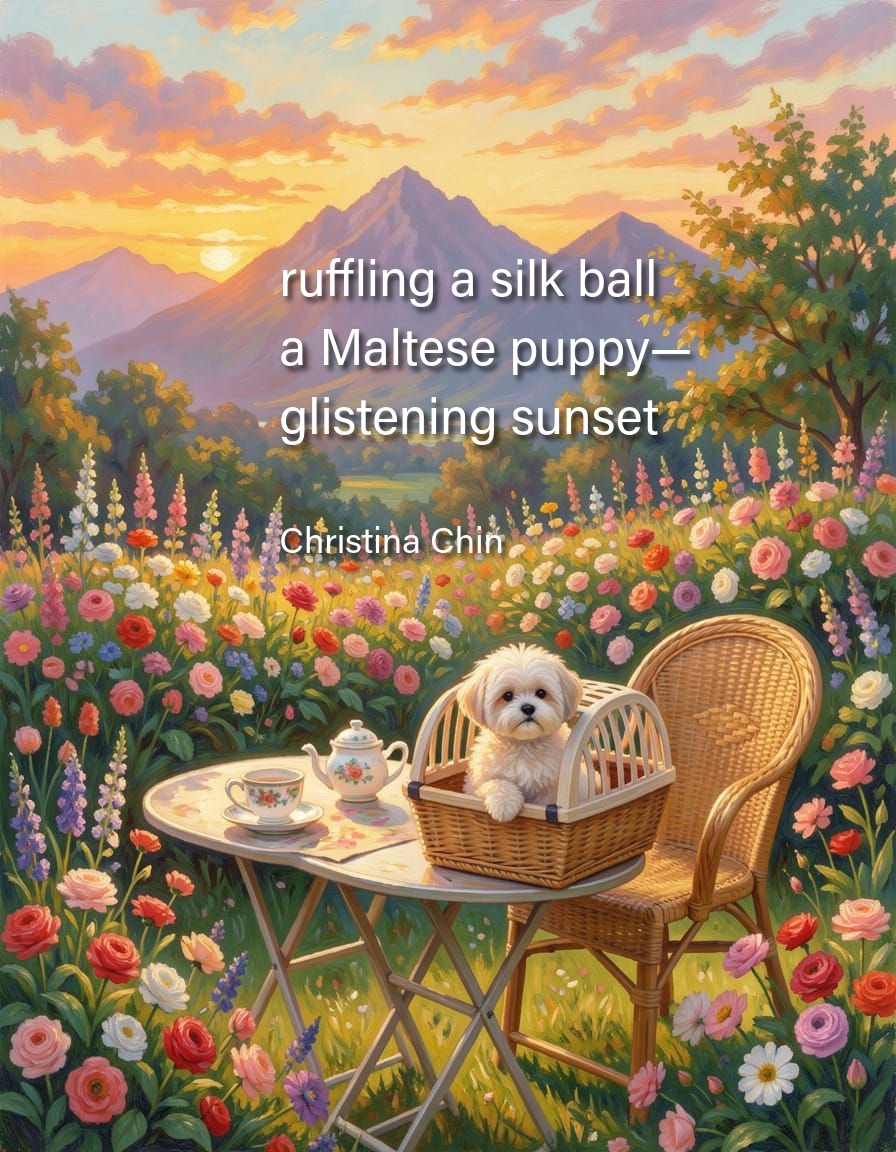
The natural world provides another meeting place. Jerrice Baptiste’s summer poems and paintings depict plant and animal life continuing relentlessly even amid human activity. Marjorie Thelen’sstory of caring for a magpie discovers trust, wildness, friendship, and the extraordinary grace of being chosen by a creature that could simply have flown away. Nidia Amelia Garcia describes a canoe on the river with the language of love and communion.Maja Milojkovic does something similar with gentle raindrops and roses. Christina Chin’s haiga and accompanying art preserve a gentle summer moment. Chidimma Ewelukwa gives voice to children and to the earth itself while counting the lingering costs of war.
Eva Lianou Petropoulou’sevocative short story turns to the effects of plastic waste on sea creatures, while her musical poetry reminds us that ecological concern can itself become art. Timothee Bordenave approaches the same environmental crisis through chemistry, arguing for a circular economy in which plastic waste can be transformed into high-performance, metal-replacing materials—an approach that is both economically viable and environmentally beneficial. Otamurodova Asalbonu Qodir qizialso discusses ways to reduce, reuse, recycle, and replace plastics. O’ktamova Sabrina Mahmud qiziaddresses soil degradation in Uzbekistan’s Kashkadarya region and bioremediation through mulch.
Science and medicine enter this conversation not as opposites to art but as other ways of caring for life. Kamolabonu Rasuljon qizi Inomova outlines modern therapeutic approaches to epilepsy treatment, while Jurayeva Muxtasar Ilyosovnadiscusses the prevention of viral respiratory infections. Feruza Boymurodova Jumanazar qizi considers digital monitoring of the efficacy of biological treatment for psoriasis. Their practical concerns remind us that knowledge has consequences beyond the page: understanding can protect bodies just as literature can illuminate minds.
The collection also repeatedly asks what happens when power is abused or suffering is ignored. Duane Vorhees examines power and the disturbing question of who gets to play God over the creations of others. Ri Hossain’s poem becomes a rebellion against polite silence, challenging the educated, comfortable observer who can look away from suffering and retreat into romance or consumerism. At the same time, the poem stages an internal conflict between the thinker who desires order and the poet drawn toward the messy, erotic, and unknown. Chidimma Ewelukwa’schildren and earth, still carrying the costs of war, make that silence even harder to maintain.
Ethical responsibility appears on a smaller, more intimate scale as well. Kozimjonova Saidaxon Alisher qizi’s story demonstrates the power of humble repentance: genuine amends begin not with excuses for the person who caused harm but with concern for the person harmed. Duane Vorhees’s questions about power and Kozimjonova Saidaxon’slesson about accountability ultimately meet at the same point: what we do to others matters.
The arts themselves become evidence of human resilience. Alex S. Johnson’sprofile of Morgan Riley, frontwoman of Blackwater Drowning,presents a band demonstrating that heaviness can be tender, genres can remain fluid, and brutal music can carry deeply human messages. Eva Lianou Petropoulou’s musical poetry, Jerrice Baptiste’scombination of poems and paintings, and Grant Guy’sconcrete forms similarly refuse to separate artistic beauty from difficult realities. Form becomes part of meaning.
Even technology, in the end, belongs to this larger human conversation. AI can generate, calculate, accelerate, and transform, but the works gathered here repeatedly insist upon qualities that cannot be reduced to efficiency: vulnerability, memory, cultural inheritance, compassion, repentance, attention, imagination, and love. The challenge is not to reject new tools but to remain human while using them.
That is their deepest kinship. They remind us that nothing meaningful exists entirely alone. Memory touches identity. Language touches silence. Science touches ethics. Technology touches responsibility. Love touches grief. Homeland touches history. Nature touches culture. Art touches survival.
And somewhere in all those crossings, something unexpected happens: things begin to speak to one another.
The result is not a collection of answers so much as a collection of encounters. Its guiding principle might therefore be stated in two words: Where Things Touch. It is at those points of contact—between past and future, human and machine, self and other, destruction and renewal—that understanding begins.
Every morning, the first thing Malika looked at was not the window, but her phone. For her, a new day did not begin with sunlight, but with the notifications appearing one after another at the top of her screen. Someone had liked her photo, someone had sent her a new message, and someone else had probably already written, “Where are you?” She could exchange messages with dozens of people before even getting out of bed, yet sometimes she failed to hear her mother’s voice from the next room: “Are you awake, my dear?”
Malika’s life online looked beautiful. Every photograph was carefully chosen, every frame had just the right light, and every caption created the impression that her life had already fallen perfectly into place. University, books, coffee, walks, friends, small victories, and thoughtful reflections on life—her page had everything. Her number of followers kept growing. Sometimes she found herself thinking that she had never even met some of the people she spoke to every day in real life.
Anyone who visited her page would have had no reason to doubt that Malika was happy. Only Malika herself sometimes did. For three years, she had spent more time thinking about how her life looked to others than about how it actually felt to live it.
One day at university, a professor gave the students a simple assignment:
— Turn off your phones for one hour today. Do not send any messages, take any photographs, or go on social media. Just look around you. Spend one hour observing people.
Laughter filled the classroom. Some thought it was a joke. Someone said, “Can we really survive an hour without our phones?” Malika laughed too.
But once she turned her phone off, the room suddenly looked different.
She noticed that the hands of the girl sitting beside her were trembling. Malika had always thought of her as cheerful and self-confident. Now she saw the girl repeatedly writing the same sentence in the corner of her notebook:
“Can I do this?”
Down the corridor, a young man who was usually joking and making everyone laugh stood alone by the window. Messages kept arriving on his phone, but he did not answer a single one. No one knew what was hidden behind the calmness on his face.
When the hour was over, the students turned their phones back on. Screens lit up one after another. Notifications returned. Everyone slipped back into their familiar digital lives.
But during that one hour, Malika had begun to understand something: people hide far more than they choose to show.
From that day on, she began looking at her own page differently. There were hundreds of photographs there. But not a single one showed her lying awake at night, staring at the ceiling. None showed the moments after she had argued with her mother and sat alone regretting it. None contained the words, “I’m afraid,” “I’m tired,” or “What if I can’t do it?” She had shown the world the most beautiful version of herself while hiding her most genuine self even from herself.
One evening, she decided to write a new post. She used artificial intelligence to help her draft it. Within seconds, the screen filled with beautiful, emotional, almost perfect sentences:
“Sometimes there is a silence within the human heart that even the closest person cannot hear…”
Malika stared at the text for a long time. The sentence was beautiful.
But those were not her own words.
She deleted everything and put the phone down. A few minutes later, she typed a single sentence herself:
“I’m not okay today.”
She did not post it either.
She turned off her phone and went into her mother’s room. Her mother was sitting on the bed, reading a book.
“Mom…”
“Yes, my dear?”
Malika was silent for a few seconds. Then she rested her head on her mother’s shoulder.
“I’m tired.”
Her mother closed the book. She did not say, “Everything will be fine.” She did not say, “This too shall pass.” She simply stroked her daughter’s hair.
That was when Malika realized that sometimes a person does not need advice. Sometimes they simply need someone willing to stay.
That evening, she spent a long time without her phone.
The next day, she received a message from the young man from the university.
“Excuse me, may I ask you something?”
“Yes,” Malika replied.
A few minutes later, his message arrived:
“I thought your life was perfect because that’s how your page looked.”
Malika stared at the screen for a moment. Then she wrote:
“I thought the same about yours.”
There was a pause before his reply came:
“So we both judged each other by the photographs on our pages.”
Malika laughed.
They eventually became close friends. Perhaps that was the strange thing about life: sometimes the person who understands you most is someone who has been living inside the same illusion as you.
After that, Malika did not abandon social media. She did not want to reject her entire online life or portray the internet as something bad. She simply changed one thing: she stopped living to show her life and began living it for real.
Some days, she posted nothing. Some days, instead of taking photographs, she called a friend. Sometimes she and a friend would simply walk around the city without their phones, talking and laughing. Over time, her number of followers decreased. But her real conversations increased.
A year later, she began going through the photographs stored on her old phone. There were thousands of them. Most were beautiful. But she noticed that the most precious ones had never been posted online.
A photograph of her resting her head on her mother’s shoulder. A candid shot of a university friend laughing. A simple photograph of her father walking home beneath an umbrella in the rain. And a picture of herself smiling genuinely on a day she had never shared with anyone. None of them had likes. None had comments. Yet Malika could see her real life in every one of them. She turned off her phone screen. The room grew quiet. There had been a time when turning off her screen made her feel as though everything had come to an end. Now, it was the opposite. The screen went dark, but her life went on. The wind moved outside. She could hear the dishes clinking in the kitchen. Her phone lay silently on the table. Malika smiled.
At last, she understood something simple: a person can always be online, but the greatest loss is not being disconnected from the network—it is becoming disconnected from life itself.
My name is Kozimjonova Saidaxon Alisher qizi. I was born on November 27, 2007, in Asaka District, Andijan Region, Uzbekistan. I am currently a third-year student majoring in Economics at the Faculty of Economics and Management, Andijan State Technical Institute.
From an early age, I have been passionate about numbers, analytical thinking, and economics. To me, economics is more than just an academic discipline—it is a vital field that helps us understand the development of society and improve people’s lives. For this reason, conducting research and pursuing lifelong learning have become an integral part of my life.
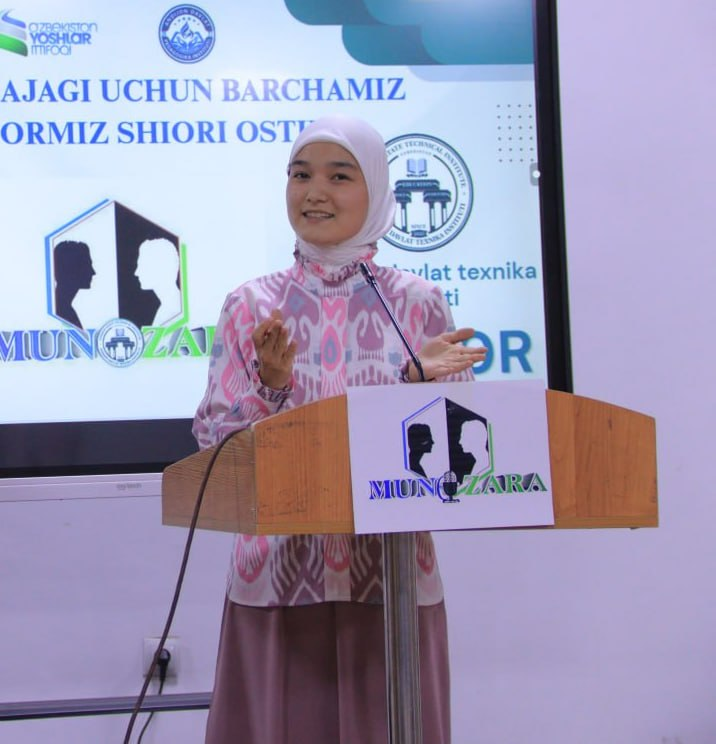
To date, I have published more than 30 scientific articles in national and international publications. I have also presented my research at six scientific and practical conferences. During my academic journey, I became the regional winner of the Economics Statistics and Data Analysis Olympiad and later represented my region at the national stage. In addition, I won first place in the institute stage of the “Zukko Kitobxon” (Intelligent Reader) competition, participated in the national “Munozara” (Debate) tournament, and have been an active participant and winner in numerous academic and intellectual competitions.
After entering university, my interests expanded beyond academic research to include creative writing. Reading books, participating in literary events, and creating stories that touch people’s hearts have become an important part of my life. Life Online, the story you are about to read, is my second work of fiction. I believe that every story I write should encourage readers to reflect, inspire kindness, and promote universal human values.
I am also actively involved in community service. I participate in volunteer initiatives and am the founder of a volunteer-focused startup initiative under Ko’ngilli.uz. To me, contributing to society is more valuable than any personal achievement.
Reading is one of my greatest passions. So far, I have read more than 50 books, each of which has broadened my knowledge, enriched my perspective, and inspired me to pursue greater goals.
My guiding principle is: “Seek knowledge from the cradle to the grave, acquire it, and share it with others.” I firmly believe that knowledge elevates individuals, while education has the power to transform society.
My greatest ambition is to become one of the leading specialists in the field of economics, further develop my academic career, and use my knowledge and experience to benefit others. If my writing or my work can make a positive difference in even one person’s life, I will consider that my greatest achievement.