Why are these poems called ‘Echoes?” Are you referencing echoes of themes throughout history, or the myth of Echo and Narcissus, or something else?
“The title ‘Echoes’ operates on multiple resonances. In Mandarin, we have a proverb from the Buddhist poet-monk Li Shutong (李叔同) of the late Qing dynasty: ‘A thought that’s constantly in mind comes with an echo in its might.’ This captures how persistent thoughts reverberate through time and consciousness.
For me, poetry exists as a trifecta—history’s weight, mythic truth, and individual experience. These three elements form an indivisible triangle; remove one, and the structure collapses. When this hybrid translates through memory into verse, it becomes an echo—not unlike the relationship between sound and its aftersound, between experience and its poetic afterlife.
The myth of Echo and Narcissus haunts these poems too, particularly in how exile creates a doubling: we speak, but hear our words return transformed by distance. Every poem here is both utterance and return, original cry and its distortion through time.
We make the echo first, in our bodies and memories, before we ever write it down. The page merely catches what’s already reverberating.”
How and why have Lermontov and Akhmatova become your inspirations? What do you see in their works that you admire, and how have you brought that into your own pieces?
I knew this question would come, and even arranging these words brings me to tears—because Lermontov and Akhmatova represent the two chambers of my heart, the systole and diastole of my poetic existence.
Akhmatova embodies the terrible arithmetic of staying. Her choice to remain in Soviet Russia while others fled mirrors my own negotiations with homeland and exile. In ‘Requiem,’ she transforms personal grief—lamenting her imprisoned son—into an indictment of state terror. What strikes me most is her austere precision: barely a league of emotion, yet each line cuts like winter glass. Her contemporaries in the Silver Age either genuflected to power or dissolved into their own despair. She alone maintained that devastating clarity. The Swedish Academy recoiled from giving her the Nobel precisely because her truth was too graphic, too unadorned.
Her sacrifice illuminates my own: the mother tongue I’ve had to half-forfeit (in China, to write freely means surveillance; in the West, to be heard means English); the treasures left behind; the solitude required to build an inner world strong enough for creation. This ‘elegant restraint’ you detect in my work is learned stoicism—a necessary armor. Yet beneath it pulses radical empathy for all exiles, geographic or internal. Though we’ve never met, I hear their scream: ‘I want to live!’
If Akhmatova is my yin—witnessing, enduring, distilling—then Lermontov is pure yang: the romantic who transmutes oppression into fury. Where she documents, he detonates. His ‘The Poet’s dead’ and ‘The Cloud’ demonstrate how anger can become incandescent art. Those unsettling, haunting images in my work? They’re Lermontov’s ghost teaching me that sometimes the only response to injustice is to set the page on fire, even at the cost of forfeiting one’s own homeland to uphold one’s self amidst divisive currents.
Together, they’ve taught me that poetry can be both scalpel and flame, both witness and warrior. In my work, Akhmatova’s ice meets Lermontov’s fire, creating steam—that vapor between staying and leaving, between silence and scream, where my own poems breathe.”
Interesting that you identify Western and traditional Chinese poetic styles and take elements of each into your poems. What has it been like to craft poetry as a bilingual person? Do you compose in English or Mandarin, do you think in both languages as you write? Do you find that languages themselves, and their rhythms, shape the content or structure of your poems?
The chasm between Chinese and English poetic traditions has shaped me profoundly. Chinese poetry luxuriates in indirection—every plum blossom speaks volumes, each bamboo bend carries philosophy. The poet becomes a humble conduit between nature and reader, never presuming to explain what moonlight on water means. We trust the image to carry its own enlightenment. A closing line merely ‘dots the dragon’s eyes’—essential, yes, but the dragon was already alive in the preceding verses.
English poetry, particularly contemporary Western verse, demands the opposite: clarity as virtue, economy as craft. The poet must architect meaning, not merely channel it. During my first three years writing in English, feedback was consistent: ‘Powerful images, moving emotions, but requires multiple readings.’ Even my lightest lines carried what readers called ‘fatalistic gravity’—that ancient Chinese sense that every gesture contains the universe’s weight.
I spent years trying to reconcile these approaches: the Western praise for accessibility versus the Chinese understanding that ‘nature and human are one’ (天人合一). Only through accumulated life experience—exile, loss, resistance—did I find my synthesis. Now I can achieve ‘readability’ without sacrificing depth, can make a vestment ‘smile’ without explaining why, can connect continents through a seagull’s flight rather than abrupt temporal markers.
I compose primarily in English now, partly due to my Western-focused studies, but mostly because writing in my non-native language offers productive estrangement. It forces me to reinvent rather than inherit, to forge new synaptic connections between sound and meaning. When I write, what emerges isn’t English or Mandarin but something pre-linguistic—an unmodified rumble from my core that chooses its own linguistic vessel. In those moments, we touch the pure pulse of living through sound alone.
Language itself has never been my architect—at most, a carpenter smoothing edges or filling gaps. Emotion, urgency, and message determine form. A protest poem might emerge as experimental fragments (like Echo IV’s compact brutality) or as prose poetry (Echo III’s voice flowing like water from one throat to thousands). The content births its own container, not the reverse. This is perhaps my deepest inheritance from both traditions: the Chinese faith that form follows spirit, married to the English insistence that spirit must find communicable form.”
I notice a theme of human suffering at the hands of others: a violent husband and refugees who flee violence and find themselves still marginalized in their new lands. What draws you to those themes?
It’s a delicate and profound question. I’m drawn to these themes because I’m deeply intrigued by how systems can deform individuals, transforming ordinary or even decent human beings into figures capable of profound cruelty. Often, an individual’s personal agency is eroded or contested when societal structures thrive upon their trauma or tacitly condone violence. To explore this phenomenon further, one must investigate educational, cultural, and economic factors that silently breed violence and perpetuate suffering.
Crime and tragedy serve as the quietest yet deepest reflections of a society’s wounds—visible only to those who dare look closely. Similarly, the experiences of refugees reveal another dimension of these wounds. Throughout seven years living in the UK, I’ve formed friendships with individuals from diverse global backgrounds. Their narratives of familial histories in London, wars in their homelands, and the existential struggles of reconciling dreams with harsh realities have profoundly impacted me. I’ve realized that we all inhabit a liminal space between war and peace, where understanding and empathy are always possible if we actively listen, both to ourselves and to the voices around us.
Ultimately, my poetry aspires to provide solace, however fleeting, to those who feel exiled or alienated, offering a momentary sense of belonging or home within the shared recognition of our collective struggle.
You mention in your author’s note that “nature is also a teacher.” How do the natural motifs and the natural world function in your poems?
Nature serves as both messenger and medium. Whenever I encounter emotions too visceral for straightforward speech, I invite the natural world to translate. Trees, flowers, and coastlines vibrate on the same frequency as those gut‑level feelings, bridging the space between stanzas—and between reader and poet.
Nature also acts as a critical mirror: it reveals that the so-called “survival codes” running through our societies did not blossom from some higher ethical soil but from the stark physics of scarcity and fear. By foregrounding that origin, I aim to question whether these codes are immutable or merely inherited habits we’ve yet to dismantle. When I return to the image of a red beacon strobing across a storm-dark shoreline, I’m less interested in its drama than in its dual function—how a safeguard doubles as a boundary, how protection can slip into quiet temptation to what’s beyond. In that uneasy glow, I probe the complicity between safety and sanguine, asking what the comfort of eternity cost and how the sense aliveness ultimately pays toll of solitude without regret.
Do you think your writing has changed over time? How would you describe your style, and how you’ve developed it?
Absolutely. Writing evolves like any living organism. My first English poems were dense with elusive imagery, and my abandoned early novel—steeped in Woolfian stream-of-consciousness—never balanced character and plot in a way that felt authentic to me at nineteen.
Since then, I’ve forged a dialogue between poetry and prose. Poetry lends my novels an unshakable moral backbone, distilling complex ideas into crystalline sentences that anchor entire volumes. Novel-writing, in turn, lets me dissect psychology in slow motion, testing poetic abstractions inside fully realized narrative worlds. The result is a style that marries lyrical precision with narrative clarity, allowing abstraction and realism to coexist on the page.
What are you writing now, and where do you hope writing will take you in the future?
I’m currently developing a work of literary fiction that grows directly out of the remnants of my earlier, shelved Woolf‑inspired experiment. Rooted in Eastern European culture, literature, and the region’s stark natural landscapes, the novel filters wider Eurasian geopolitics through the intimate lens of a single life. At the center lies a decent man whose unhealed trauma becomes the very fuel a rigid system uses to reshape him, asking: When the machinery of power profits from pain, how much freedom of choice truly remains?
Alongside his story runs that of a woman determined to carve and protect a private sanctuary—“a room of her own”—in a world where every pane of glass has been forged by the system that would surveil her. Their intertwined narratives let me probe two core questions: What inner resources does it take for a person to resist the constant pull of manipulation, and what must be sacrificed to guard even a sliver of autonomy?
I hope this project—and whatever follows—will lead me toward sharper, more honest inquiries rather than easy conclusions, using language to expose the complex textures of lived experience and to keep testing the fragile boundaries of individual freedom.
Ralph sat upright in his recliner, his legs splayed out before him. His hands, resting between his knees, quavered furiously. Ralph sighed. How, he thought, could he ask Elizabeth to marry him when he couldn’t even hold out the engagement ring without shaking like a cornstalk in the wind?
Would she laugh at him? he wondered. No, Elizabeth wasn’t cruel, but how could she possibly not feel the revulsion that Ralph felt for himself? She wouldn’t give voice to that emotion, but that only made it worse. Ralph had once owned a three-legged dog, but his father had scolded him, saying he should settle for nothing less than perfection, and dad had the dog put to sleep. When Ralph subsequently developed his tremor, his father had regarded him as something less than he had before.
In 1930s Germany, Ralph knew, he would have suffered sterilization so that his infirmity could not be passed on to future generations. Or, he might have himself been put to death. He let out a breath. Why me? he used to wonder. At length, he had conjured an answer: Why not me? Besides, by now, he was used to it. He took up the jeweler’s box and extracted the ring, weighed it in his palm, contemplated his intense, primal love for Elizabeth for a moment, then said aloud, “I’ll ask her. Tonight!”
They sat in his living room, a fire crackling in the fireplace on this, the night before Christmas. The tree scented the room with balsam. Ralph was nervous. He had never asked anyone to marry him before; he’d never had the nerve. Also, he had never been in love before. She sat beside him on the sofa, waiting expectantly, he thought. He held the jeweler’s box behind a throw pillow; he didn’t want to frighten her away. Could she really accept him? he wondered desperately.
He was not anyone’s idea of perfection, certainly not his father’s. His childhood rejection by his dad figured prominently in Ralph’s memory, and it’s what made him the man he was today. Elizabeth, on the other hand, was perfection itself. He had never known a nobler, more exquisitely lovely creature before. If she said yes, then she would be his mate, his lover, his wife. A bead of perspiration appeared on his brow. Nervously, he wiped it away with the hand holding the box.
“What’s that, Ralph?” Elizabeth asked unexpectedly.
“Huh?” he said stupidly, hiding the box again. But it was too late.
“What have you got there, Ralph?” she asked anew, pointing to the hand holding the ring box.
Ralph brought the box into view and murmured, “Liz, I was going to ask you…ask you to marry me.”
“Have you changed your mind?” she asked boldly.
He blinked. “No…No, I…Will you marry me, Liz?” he implored. “I know I have a lot of faults,” he began. “But, I love you, and…”
“Shut up, Ralph,” she said gently. “You had me at “Will you marry me?’ “
Ralph smiled, leaned in for a kiss, being careful not to bump Elizabeth’s walker.
Are you still 66? I’m 60 now. I’ve done the best I could since your death.
Do you remember when you told your friend that “only Leslie is unsettled”? I was 30 then, the night before you died. That’s when you said it, at the theater; I overheard you. I know you meant that you wanted me to marry and have a family. Later I broke up with Dany. I married Val, the one you thought had a nice voice, from Iran. You had a conversation with him once in the living room while I was in the kitchen. You told him that you had a relative from Iran, and I walked in when you said that, surprised.
Dad was very lonely without you. I thought he would never let me go. He convinced Val to move in when we got engaged. And after the wedding, he made it nice for Val to stay. Too nice! We finally moved to 53rd and 8th Avenue, all the way up on the 20th floor. I wish you could have seen it. I was close to Central Park and Lincoln Center and Coliseum Books and Lechters.
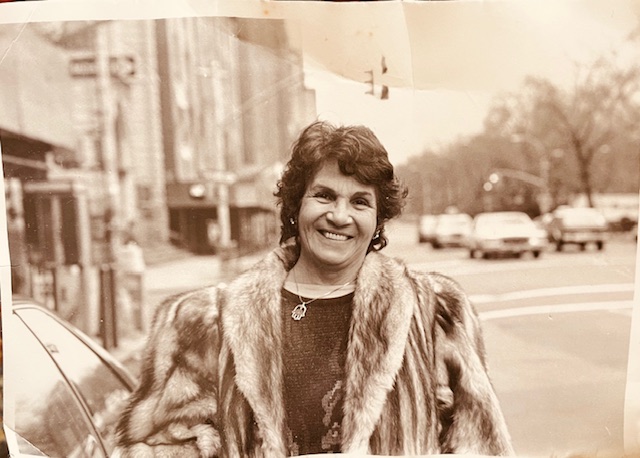
Debi and I used all your tickets to the opera. We didn’t like it at first, but we’d make a day of it: lunch with Susie, Martha, and Anna Burak, and sometimes Tower Records afterwards to get the CD of the opera we’d just seen. I wore your fur-lined coat and mostly took naps in your seat. Then, one night Placido Domingo sang Nessun Dorma, and I cried so much, but I was really crying for you. I feel, when I am at the opera house, that you are near me. It is almost unbearable.
Beatrice dated Dad for a few months. She wore your clothes, used your Dooney and Bourke wallet, like she wanted to be you. She even offered to brush my hair and I let her. They broke up, and a few years later her cancer returned and she passed away.
Aaron was born in the same hospital where you had me, and – can you believe it? – my OB was trained by Dr. Landsman. When I went into labor, I had to fill out forms at the hospital, and where it asked for the mother’s name, instead of writing my name, I wrote yours.
Aaron looked just like you when he was born, and I gave him the middle name Yves in your honor. I was out-of-my-mind in love with him. In all the blissful moments of his babyhood, I felt like you were a part of me, delighting in him.
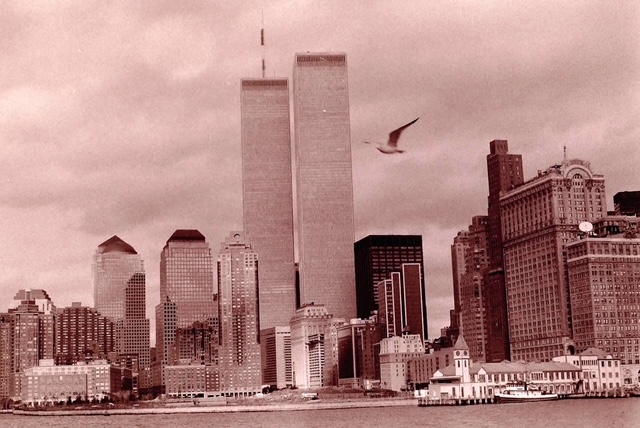
Oliver is your last grandchild. Again I was in love. We moved to the Parker Towers, a rental across the street from Debi’s building in Queens. It reminded me of our old Kew Gardens apartment. It was the same set-up: two-bedroom, two-bath, eat-in kitchen, balcony, a friendly doorman, the same whoosh of air when you closed the front door. I had a view of the World Trade Center, your favorite place to take out-of-towners.
Val and I split up soon after Oliver was born. Everything about being with Val became too difficult. Also, we didn’t have any help, and I had to do everything you did for me and work in an office as well. He moved out, and I was a single mother until Oliver’s fourth birthday.
Those were difficult years, with little money and a lot of loneliness. Debi was my constant companion, like a mother to me and also my best friend. Dorian was kind, leaving me cash in my junk drawer and paying for my airfare to visit him. He called me all day long. Once when I was in California visiting him, his cellphone rang and everyone looked around wondering who it could be because I was right there.
Dad married Anna Greenberg’s cousin Nina. After that, we were no longer welcome at his house unless we were expressly invited. If we were invited, I couldn’t even get a glass of water without asking. Once, when my boys were with Val for the weekend, I called Dad to see if he wanted my company. “Another time,” he said. He didn’t know that I was parked outside. Then I saw Anna’s son pull up with his family. He had Chinese food. He walked in as if the house were his.
After we divorced, Val and I fell in love again. He moved back to the Queens apartment, and Debi and Dad didn’t speak to me anymore. I was disowned. Birthdays and Jewish holidays were particularly painful. I once saw from my kitchen window Dad entering Debi’s building with flowers for Passover. When I turned 40, Val told me I had a call, and I ran to the phone while asking him if it was my father. The look on his face was pure pity, so I knew it wasn’t. Dorian was my champion, tried to mediate, and took my side as my protector. He always picked up the phone when I called him. It took three years before I convinced Dad to let me back into his life. Debi followed soon after.
Val and I bought a house together in Westchester. We remarried in the living room, our sons our only witnesses.
Aaron is grown now. He lives with his girlfriend in Washington Heights, and they talk of getting married. Oliver is 24 and home with us. He graduated from Queens College, like you and me.
I have a dog, Rhoda, whom I love more than anything in the world.
At the end of Dad’s life, he was sick for a month in the hospital. Every day the nurse asked him for his birthday, and he would proudly pronounce “3/25/25,” but on his actual birthday he couldn’t remember. In his delirium he called for you. “Ou est Yvette?” He is buried next to you in Mount Hebron. Soon it will be his 100th birthday.
We sold the house after Dad died. That was hard. Debi and I packed 40 years of memories with nowhere to put them. I still regret throwing out the shearling jacket you bought me in Italy and Dad’s certificate from the New York Institute of Technology.
Sometimes I wonder what you would make of the world I live in now:
Manicures and pedicures can cost $85 with tip.
Donald Trump is President.
The Twin Towers are no longer standing.
It is fashionable to live in Brooklyn.
There are no more phone booths and fewer and fewer parking meters.
Coins are insignificant.
Loehman’s and Lord & Taylor don’t exist, but Saks does.
No one dresses up or wears pantyhose. You would think they leave the house in their pajamas.
People hardly go to the movies. Miraculously, the Paris Theater is there. That’s where we saw Crossing Delancey, or maybe it was Cousin Cousine. The Ziegfeld, too. We saw Star Wars there with Dad on a hot summer night.
I get my hair colored by Javier, your colorist. I sought him out because I always loved your hair color.
I still go to Carmel on 108th Street to get lebne and pita and kashkaval cheese and sambousek.
All your friends are gone except for Vally. Do you remember when Val and I met you and Vally at the theater to see Three Tall Women, and we thought it was so funny that they had such similar names. She looks the same, by the way.
May died of cancer; all your sisters, too. They died after you, even though you were the baby.
Debi lost Stanley, and he is also buried in Mount Hebron.
Dorian will be 75 next month. He is still in Walnut Creek, although in a different house. He and Claudia had twins.
Debi is 70 and is in the same apartment. Alix Austin lives with her. Remember how she broke his heart when they were teenagers?
You have a great-grandson, Benjamin. He is three and looks like Chloe, and a little bit like Debi.
Dany never married.
I write a lot about you. It is like having you with me, especially how you laugh or the sound of your gold bangles. How you got mad at me for imitating your accent when I said, “When you are right, you are right.” How you couldn’t stop yourself from eating cheese and drinking the whole container of kefir.
I can cook almost all of your food, like gratin and mejadra, but not the rice pilaf.
I live in New Rochelle. I remember you used to go shopping there for clothing, and I thought it sounded so fancy. My house is shelved with all your precious books, and on the walls is the artwork you collected. I framed your library card with your signature, and I have it on my desk.
Laurie Anderson is still performing.
Spalding Gray died by suicide.
Pavarotti died, too. I had a chance to see him on stage at the Met.
Woody Allen continues to make movies, and he married Soon Yi.
I went to a dinner and Salman Rushdie was there. He wore a patch over one eye because he had been stabbed.
I won a prize for my writing. That was one of the times I missed you the most.
I also missed you when I got married and then when I got divorced. I missed you when I had Aaron and then Oliver. I missed that they didn’t know you. I missed you when I got fired from the bank because I couldn’t do it all, at least not well.
I miss you when I read a really great book and I can’t share it with you. Do you remember how we read all of Paul Auster’s books, one after the other? He is gone too.
I used to be afraid that I would forget your voice, but I now know I never will.
Love,
Lellybelle
Leslie Lisbona was featured in the Style section of The New York Times in March 2024.
Aside from Synchronized Chaos, the first journal that ever accepted her work, she has been published in JMWW, Smoky Blue Literary & Arts Magazine, and Welter. Her work has been nominated for Sundress Publications’ Best of the Net 2024 contest and won the nonfiction prize at Bar Bar Magazine (2024 BarBe Award) https://bebarbar.com/2025-barbes/
She is the child of immigrants from Beirut, Lebanon, and grew up in Queens, NY.
In today’s career-focused world, people have different views as to whether paying salary to workers depending on their productivity is a better approach to motivate them to work harder, particularly in professionally advanced communities. While there is a wide range of alternatives for encouraging employees to work harder, I firmly assert that paying salary based on their production and sales plays a crucial role for both employees and organizations.
First and foremost, there are obvious alternatives for motivating workers to work better. Once companies enforce free holiday opportunities for those who work efficiently, this makes a big difference in terms of a greater feeling of agreement and contentment, leading to a productive working process. So, workers are highly likely to be motivated easily. Furthermore, building a collective responsibility among colleagues in companies can be another method for encouragement. To be more precise, if workers learn how to collaborate, it seems unsurprising for them to experience a sense of leadership while simultaneously trying to show off their capability to their boss, thus resulting in a greater number of sales or production.
Meanwhile, despite these arguments, proponents of paying salary to employees based on their productivity cite compelling reasons to support their stance. To clarify further, productivity has been prevalently acknowledged for its effectiveness—a feature that sets it apart from other job sectors that pay all workers equally. As a result, it seems logical for companies to impose a certain amount of salary based on how much an employee produces, thereby motivating them to work harder. The more they produce or sell, the more income they earn. A good case in point can be my country, Uzbekistan, where a new initiative has been set up so that even part-time workers earn more due to their high amount of production or sales than full-time ones.
To sum up, although other initiatives such as cooperation among colleagues and free holiday chances offer some benefits, I strongly believe that only by paying workers based on their production or sales can we ensure that they take responsibility for working effectively.
Jasmina Rashidova, daughter of Bahodir, born on November 23rd, 2008, in the Shakhrisabz district of Kashkadarya Region, Uzbekistan. Currently, I am a 10th-grade student at the 74th school. I have earned recognition in various educational grants and have actively participated in international MUN conferences and meetings. I have also won several education-related contests and competitions, and I am a finalist in “BBG”, “FO”, “Katta Liderlar granti’25” and “VHG.” In addition, I run my own online teaching channel. I am also proud to be the recipient of a major leadership grant for my #pixelart & JR | INTELLECT project.