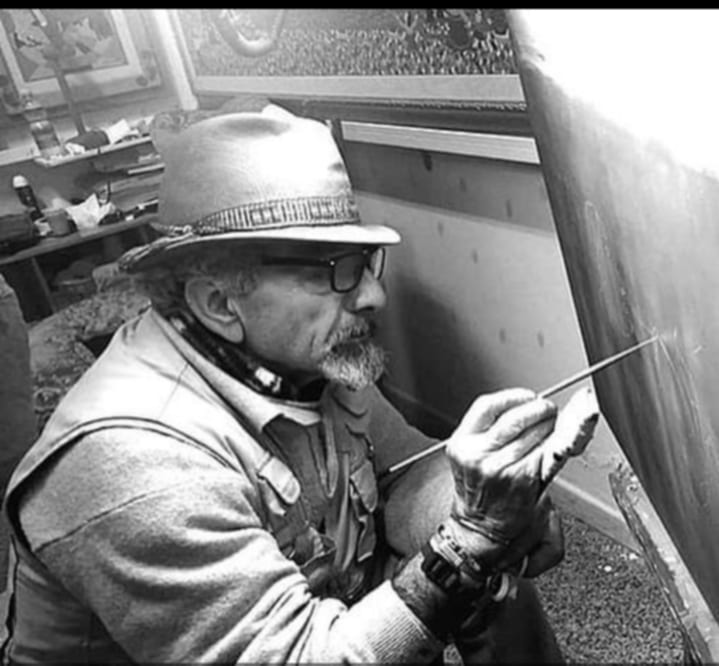
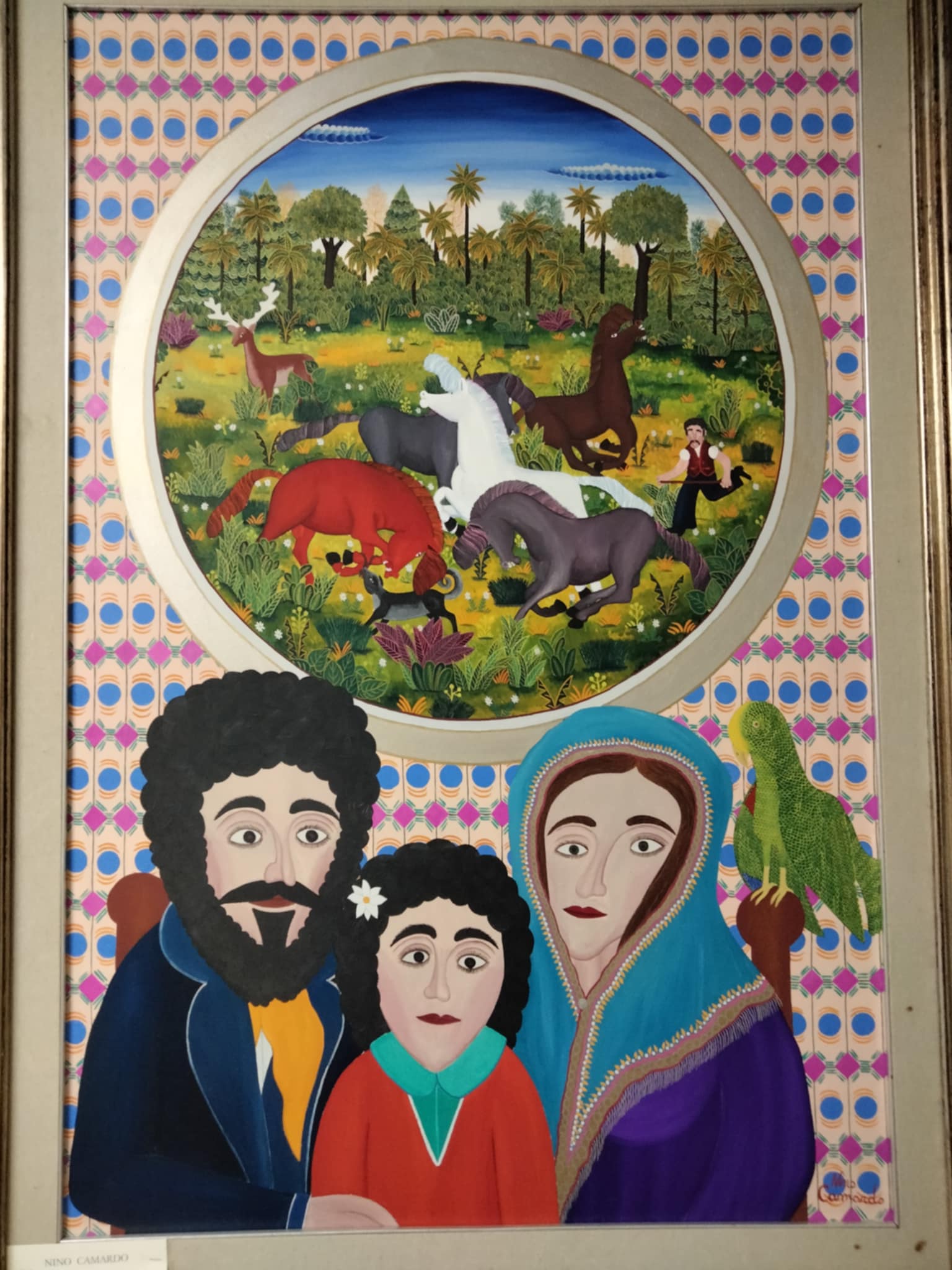
We have decided with his son Alessio Camardo, to share important moments about the great personality, master painter Nino Camardo, so the people will know more about his amazing and very important artistic work.
…
EVA Petropoulou Lianou
Official ambassador for
Maestro Nino Camardo
AS
Responsible
Media partner
Personal curator
Of master
Nino Camardo
Great artist
Alessio Camardo
….
An extract from the CV of Maestro Nino Camardo
He emigrated very young, at just 13 years old, crossing skies, seas in search of a life different from the one that presented itself before his eyes, hoping to be able to realize my dreams, his wonderful world, his essence his pride his humanity his dignity and on the gift. Nino Camardo, in the 70s, still young compared to other painters, participated in major events of naive painting, which had created highly successful personal exhibitions and events and distinct artistic movements of naive painting, in Italy and abroad. Famous writers wrote that he was the first Italian naive known in the world, something that few painters could boast.
In the 1960s he received national and international awards such as the award from the Centro di Studio di Roma, an award for art studies, art in the world and loyalty to art, silver medal from the Italian President Giovanni Leone, Honorary Academician of the Vatican State, Ambassador of art in the world, Knight of the Cross of Malta and many other awards and first prizes, medals, cups, diplomas, certificates he was also given a horse.
Inserted in the Getty Museum, Wikipedia in several languages. Numerous were the personal exhibitions. He was one of the first to export his art in the world such as New York, Miami, San Francisco, Mexico, Toronto, Los Angeles etc.. in Italy he was one of the first to have a personal exhibition in the Palazzo delle Esposizioni in Rome, department of antiquities, fine arts and cultural problems of the municipality of Rome and many other personal exhibitions in Italy, his works have been sold all over the world.
My father has known a lot in the world of art from Picasso, Giorgio de Chirico, Salvador Dalì, Jo Pomodoro, Guttuso, Giovanni March, etc… being the youngest he defines them as their fathers in interviews made by national radios such as Vatican Radio live from Rome and broadcast in several languages and I attach the others. He was a friend of Mike Bongiorno, the golden couple of comedy Sandra and Raimondo Vianello, Franco and Ciccio Ingrassia, etc.. also singers like La grande Mina, Riccardo Cocciante, Renato Zero and many others.
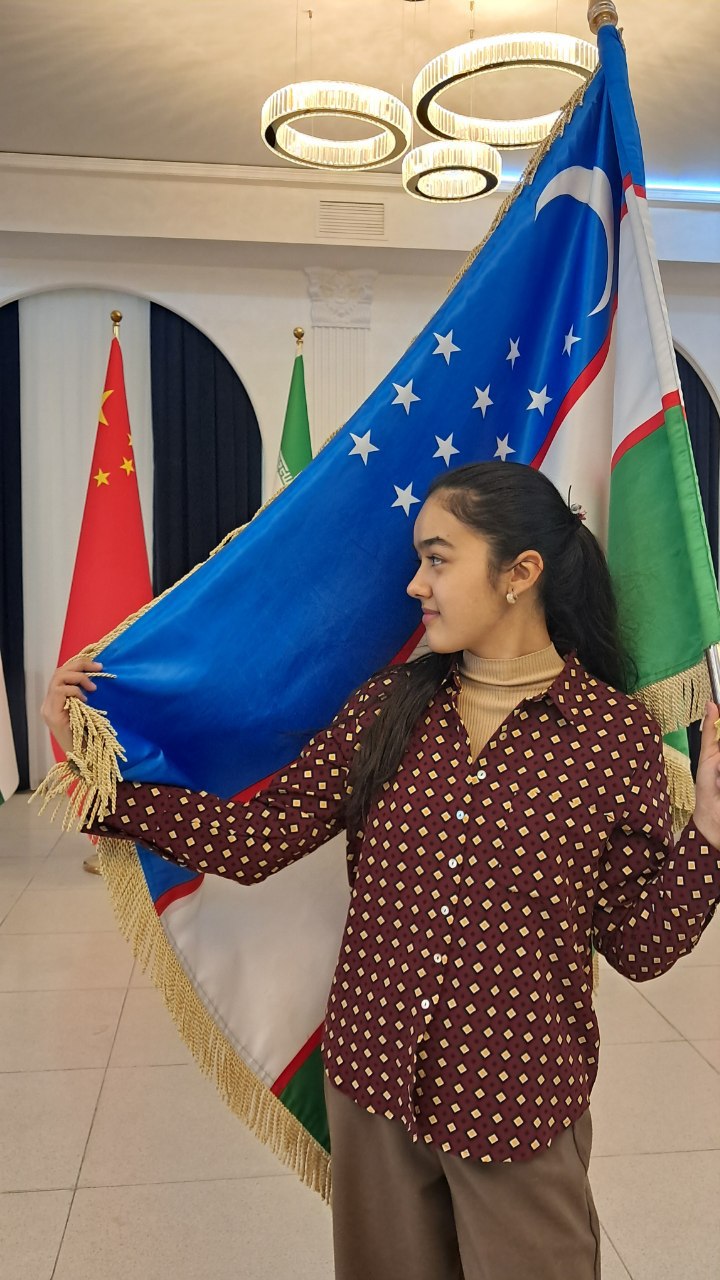
Rahmiddinova Mushtariy Ravshan’s daughter was born on March 1, 2011 in Gulistan district of Syrdarya region. Now she is a student of the 8th grade. Mushtariy is interested in reading poetry, reading books, drawing. She appeared on television in kindergarten at the age of three and is still appearing on television. Participated in the Bilimdon competition. She took the 2nd place in English in the 2nd grade. Participates in many contests and projects. In the future, she will become a dentist. She is preparing for admission. Her dream is to make everyone proud of Mushtariy. She also participated in many anthologies and webinars.
The Straight Path: In Praise Of Israeli and Palestinian Poets
I am writing this to honour the dead. Every single person that’s experienced affliction during this, what they call, the Israeli-Palestinian conflict.
Like Yehuda Amichai, I “believe that all poetry is political because it deals with a human response to reality”. King Netanyahu, King Palestine, I bow before you. War builds new empires, genocides build new countries. In a heartbeat poets are immortalised during war. This has taken place since ancient times. This has been a bad year. Israeli and Palestinian poets and writers are chasing hope, peace of mind. Mosab Abu Toha writes, “I have these stories with me. The hard part was reflecting on my feelings, not my experience. There are two parts to any story, the experience and the feelings…And this is what poetry is to me”.
A poet understands the blank page because they are a philosopher. The night sky isn’t an airstrike, it turns into starlight, a constellation beyond becomes a wildflower, a hostage becomes a freedom fighter. A poet has no country, a poet belongs to the world, and they speak on behalf of humanity, for the generation that came before, and the one that will follow.
It isn’t war, it is a fight for humanity, for the return of a divine power to set the record straight. It isn’t conflict, it is more of a human nature to amplify the genetic predispositions for chronic illness, mood disorder, and manic depression. In that meeting room, that place, that space, holding the laws, in that tender room lies the rhythm and vibration of eternal rest. The poet is the holder of a moral compass.
In the poet’s hands a straight path becomes a detailed map encompassing vision and interior, shapes of consolation that carry divine power.
What is this vision
this interior
these shapes of consolation
men, women, children
turn into a wave
their body becomes
a ripple in a sea
this poem lands in a river
for all eternity
Poets have a sacred language
every word is from the divine
All life is sacred
Poetry nourishes. In conflict, we confront and sabotage.
I fade into your hurt
into this poem
into your collective pain
to build a home
to build a country
to build a sanctuary
in war, it takes peace
a collective peace of mind
words, the poems
of Israeli and Palestinian poets
it is only death that parts us
in war there are tanks
but also summer and wildflowers
I suppose if you can
handle melancholy (see depression)
you can handle anything.
Death is neither
just or fair. Life is neither just
or fair. In war, in the Israeli-
Palestinian conflict there are still
novels, plays, films. In war, poetry
is a saint. Poetry is truth.
Poetry is meant for humanity
Death can wait. I write this journal entry as if I found a journal that belonged to a poet in the rubble of the aftermath of an Israeli airstrike. Perhaps it is the journal of a poet who is studying at an Israeli university. They left this journal behind on a bench found on the campus. Poets want the same thing. Poets believe in the same thing. They believe in truth.
I am underground in this dream
Underground they tell me
that there’s a tunnel
that will lead me to your body
I take seed with me
Next Spring wildflowers
will grow in that tunnel
to commemorate the departures
of both the dead and the living
A child, a young bride doesn’t know the meaning of instability, or how to handle emotional triggers in war. Poetry is not meant for enlightened beings, beings of light or only dark, poetry is an act of defiance, a source of justice and integrity. Poetry is meant for humanity. I turn the page. Death can wait but not life.
I am, I was
You are, you were
and so, a new chapter begins
I give in to gravity
to madness and despair
to this book of lives
Look how this poem
becomes a river
and look how every
ripple turns into a ceasefire
Poets and novelists understood, understand what was meant by personal freedom, every artist that ever lived, dead or alive, those remembered, those whose work have turned to dust.
The following is an extract taken from my essay “The Hypomanic, And Unquiet Mind Of The Tortured Poet” published on LinkedIn.
“Here are some life events, people found in the unquiet imagination of a thinker, intellectual, philosopher, activist, that a female poet from Africa envisions. Reading poetry is a sensation that is fluid. It is nourishing, this thin activity. It reminds us of our survival. That our survival is found in our blood, and the ladders of our genes. Survival is also found in the unquiet mind of the tortured poet. Death is just another location. To be oblivious to someone is like being in an alternate universe (paralysis). How do you communicate with this person, people that you love if you can’t embrace them, talk to them and it torments you. I think you give them a signal. When you’re in love it is almost like an illness, this stupor, this nameless disturbance. And the poet writes, but what do other people do who aren’t poets? They let life happen to them. They find that concentrated quiet word ‘love’ beneath them, complicated, and unnatural to them. The body of a woman is art. The body of a man is art. Art has both physical and spiritual dimensions to it like an empty mountain, the rural countryside, unbroken communication, old men and women reliving their childhood through flashbacks, memories and dreams and their own grandchildren.”
I write as a poet, as humanity for the children, men and women of Israel and Palestinine but especially for the children and this is my prayer for all who are affected by the Israeli-Palestinian conflict. No one is immune to pain. Perhaps more so, a vulnerable child who cannot defend themselves against a tank.
Let us pray for small children. Let us pray for new beginnings for them. Their expressions of laughter, enthusiasm and glee from a novel discovery. Let us pray for the affection of small children. Let us pray for mothers and matriarchs. Let us pray for single parents and grandmothers. Watch them as they smile. Watch the innocence in their eyes. Ideas transform society and so we become an unlimited and united family who no longer feel triumphant and arrogant by material accomplishments in the world but whose body consciousness becomes much more spiritual.
We feel that we are no longer devoted to or expressing spiritual poverty. Protective wings sheltered us when we were young. We were lotus flowers and so we began to discriminate between the two images. The images of arrogance and success. The images of success and humility. Let us pray for the vicious, negative vibrations that we cannot escape in war, in conflict, in occupation, in genocide. Let us pray for the leaders of Israel and Palestine, and for the setting of goals. Humanity needs to release him/her/every child from anxiety, loneliness, bitterness, resentment, regret, past humiliation and weakness, past mistakes that have been made in a moment of passion, anger, outrage, violence, brutality, depression and stress, frustration and a feeling of being pathetic in a situation that you had no control over.
Let it go. Release it. Surrender it to the universe. Now we come to rewards. We pray for a clear intellect. We pray for a lack of ego. We pray for a clarity of vision. Goals that will lead to rewards and a flow of concise language. In the human drama that everyone has a role to play a part in be careful what you feed the intellect. Pray for your children, pray for your family, pray for humanity, pray for the plant kingdom that nurtures the human family, pray for the animal kingdom that protects you and your folk and kin, pray for your guardian angels, your spirit guides, your earth angels, your family who have crossed over into the hereafter.
Humanity is concerned with the ego and not with the lack of it. The brothers and sisters of your human family whether they are believers and non-believers are concerned with atonement, and charity. The easiest ways to love, honor, cherish and obey in hardship and struggle is realising that it is all a part of your journey, your destination, the fork in the road, the open road, the pathway. These are all beautiful things to realise. Almost as beautiful as statues. Are we living life the way we should? Are you being very careful with what we are feeding the intellect? With our thought processes?
There will always be people to uplift you. Look to the poets and novelists to enrich and uplift you. Do you have a tendency to panic when things do not go your way? This happened in apartheid South Africa. This happened to Mandela and other freedom fighters. In war, all soldiers are freedom fighters. Appreciate the fact that life is sending you obstacles and challenges and opportunities. Realise that sometimes you are limited in the help you can give other people but know that you will eventually empower and uplift other people with the simplicity of your humility.
The Christian prays the following: God, sovereign Lord, sweet Christ, our caretaker, language and protector. We pray that you will help us value our achievements on this planet earth with a clarity of vision, with effortless and with constant love, a grateful heart and humility. Make me realise that a situation is only as difficult as I want it to be and that we all need someone to lean on in hard times. When we are going through trials, let us learn that a problem shared is a problem solved.
The members of this family in their own way have, like all people around the world, felt lonely, vulnerable, different, rejected, the outsider for their faith, their religion, stigma, addiction, the spirit of brokenness in relationships and they do not want this exposed because it is a sign of weakness.
The energy of this world is becoming more and more unstable (for example, climate change and the talk of social cohesion, and there is a lack of respect that young men and young women have for their elders, they worship the material life, the physical).
But in war, all children are extraordinary. They have the intention and the potential to do the impossible. A mother’s work like a community leader’s work is never done. She is the nurturer. With her constant unconditional love, she is working with the classical ingredients to make a home. She uses her energy and her resources; the source is her unwavering faith. If you are a child in war, then you are an exceptional, extraordinarily built child. If you are a mother, then you are special beyond words, lovely beyond imagination, intelligent that goes without saying, and elegant.
Let us pray that we will change old patterns, spark new and magnificent breakthroughs, take on adventure, a leap of faith and make the perfect landing.
Dearest Humanity, it takes one person, one enlightened being, one poet to start a movement. Remember that. King Netanyahu, King Palestine, and the powers that be, I kneel before you and ask for a ceasefire.
Published on the Modern Diplomacy website in the blog African Renaissance on December 5, 2024.
Role of time management and habit formation in education
UzSWLU, foreign language and literature 1st faculty
Shukurilloyeva Lazzatoy Shamshodovna
Annotation: This scientific article presents information about ways of habit formation, time management, punctuality and their role in education.
Key words: speed age, time management, taylorism, polymath
Living in the speed age is requiring us to manage our time more smartly than ever before. Otherwise, we will end up getting chased by clocks. Unfortunately, many people in our distracting world are failing to shape that habit of punctuality.” Lost time is never found again” – says Benjamin Franklin—American polymath. Our future depends on what we do now. If we want it to be bright, starting from now we have to appreciate it and manage properly. As the lost time cannot be found we have to make use of that when we have. The history of planning time goes back to very ancient times, over 1,500 years ago, human beings discovered many ways of managing time. It was the monks who used planning and strict schedules to boost productivity. Frederick Winslow is the person who has used the term “time management ” and considered to be the father of this field. His motto was: “Work smarter, not harder”. Thanks to his book “Principles of time management in 1911”, written with the association of Frank and Lillian Gilbreth people started thinking about the ways of doing things quickly and more productively. Taylor’s ideas are popular as Taylorism, and they are a crucial part of business administration.
The world has seen many of such professionals since then. One of them is James Clear, who showed the importance of habit shaping in time management with obvious examples in his book, called “Atomic Habits”. He says that, habits ended by satisfying results are highly likely to be repeated over and over again. Vice versa goes with the ones started by unsatisfying results. James Clear states that, every human behavior experiences this process:
Try ➡ fail ➡ learn ➡ Try differently
Which means, when you try to do something or build a useful habit you might encounter failure at the start. Then you learn the effective and proven ways of doing that, which makes you try again but differently. Ultimately, you find a way to be an achiever, not a loser. You have to do, try, rest, do again, learn, do, but should never stop along the way. Moreover, you have to make it enjoyable and engaging for yourself so you keep up with the habit.
There are a lot of ways to do to be labeled as a productive person. You are supposed to manage not only time, but energy too. It works like a paradox as you manage your energy, you will get your time managed too. Imagine, you finished 20 projects in the morning within five hours, would you go for an 80 minute lecture at the university? “No” without a doubt, you are already run out of your energy. So you cannot have other tasks done in the next following hours of the day.
James Clear strongly states that consistency is a key to achieving any success at any age. So you are supposed to be disciplined first before being productive. If you want to change yourself, you cannot do that gradually but over time with practice and patience. However, the writer recommends changing the atmosphere you have, first. It’s really important when you want to be another, best version of yourself. It is, actually, scientifically proven that habits can easily be changed when you are in a new environment. It makes it easy to escape from the subtle triggers that motivate you to do your current habits again and again. It is very difficult to read books on the same couch where you are prone to surf the internet, or to choose healthy food when at the cafe where you eat only junk food. In such cases, new environments can help greatly to form a good habit without interruption.
The same goes for the study habits you want to build: completing assignments before deadlines, constant engagement when learning a new language, being on time for classes. All of these goals need a new environment to become your habit. If you want to be productive academically but always see yourself struggling to get up early because of staying up late it will be hard to be referred to as “early bird”. Proof of this point is made by— David Allen, whose version of the Two-Minute Rule states, “If it takes less than two minutes, then do it now.” This rule helps us to start, whatever the situation is, because our mind knows that we will be able to finish that process within 2 minutes only, then it can do whatever wants. In two minutes as you finish you get very happy because you finished one project successfully. That thing creates dopamine in your brain and pushes you to do another thing in this kind of quick way.
Waking up earlier in the morning, which is quite hard to do easily is a very great opportunity to use this method. When your clock alarms, you have to say yourself: if I cannot stop being sleepy even after washing my face I will sleep. This method makes our brain to be fooled, as you wash your face, you realize you could wake early as you wanted. It is highly unlikely that you sleep again after such a big achievement of the day. And James Clear’s “1% percent better” strategy can also be helpful in this case.
If you want to be perfect, you will not be able to reach that level overnight, but with consistency and practice, he says. If you want to be a morning person you cannot be an early bird the day after you want to be, but you have to start with small steps like getting up 30 minutes earlier than you usually wake. Then with 1% change within 1 week, or 1 month, you will get a lasting habit. If the vice versa goes with you, however, you’ll get 1% worse each day. This technique not only helps you to get up early but also to start your day with a fresh and amazing mood that will come in handy both in academic and social spheres.
In management of time one of the most effective way is using “To-do lists”, as your mind feels itself organized. Once you finish doing things one by one you will put check marks next to them which makes you have a sense of accomplishment and makes you finish all the tasks on time. You can do that either in the traditional way (with pen and notebook) or with e-version of notebooks which are available in every smartphone, nowadays. This method not only helps you cope with all of the things you have to do throughout the day but also to balance your academic and social lives. As a student or employee, you might not spend a bunch of time with family members, who are a great source of stress relief.
Katherine Lee, an American poet, once said: “Quality family time is important for strengthening family bonds, improving self-esteem, creating happy memories, and reducing stress”. Balancing our day properly helps to have happiness, there will be no need to wait for some specific day to be happy but each minute will be significantly filled with joy and happiness once we start following this rule.
Energy management is very crucial when productivity is concerned, which ultimately leads to solid success that lasts forever. Plus, it is a double-edged sword that works both positively and negatively. That is to say, if you allocate your fresh and full energy period to something that is beneficial to your overall health and life that makes you to be motivated. Unfortunately, if you spend them consciously or unconsciously in a bad way like, surfing the net, chatting with friends and such kind of bad habits that work against yourself, you will end up having a distracted lifestyle. All of these depend on you, you chose to be successful or failure in the end. Both of them contribute to your overall motivation of life.
Time management, habits, punctuality, balancing day are all interconnected to each other. Once you possess strong habit of punctuality you can easily follow time management and can successfully balance your day. To start building all of these habits one should change current environment and never stop trying. Balancing academic life and family times are really important factors to achieve success of any kind.
REFERENCES
1) “The history of time management” https://www.taylorintime.com/history-of-time-management/#:~:text=The%20History%20of%20Time%20Management%20Dates%20Back%20to%20the%20Late%201800s&text=But%20it%20wasn’t%20until,the%20father%20of%20scientific%20management.
Author’s Note: I wrote this essay originally in the fall of 2020 and publish it here with a few cosmetic changes and updates. It seems even more relevant today, after the assassination of Brian Thompson, CEO of United Healthcare—a figure who was an example of a vicious healthcare system where it has finally been proven that when healthcare is driven by whatever “the market will bear” and the desire to increase “shareholder value” at whatever cost, the purveyors of that system will, at some point, irresistibly, ask the following question of their customers:
“How much is your health, your spouse’s health, or your children’s health, worth to you”?
And who will be surprised to hear the answer: “My health? My spouse’s health? My children’s health? Why, they are worth everything to me.”
And few will be shocked by the response from the boardrooms of the healthcare “industry”:
“Oh it is, is it? It’s worth everything to you? Really? Well then, good people—in that case, we’ll takeeverything from you! And thank you very, very much!”
It does not take long for the logic of this statement to become fully apparent when it leads to the next equally candid exchange, heard in the confines of many a winterized boardroom:
“We who are in the healthcare industry are in the business of making money—are we not?”
“Indeed we are.”
“And our job is to make even more money in every quarter than we did in the quarter before it, is it not?”
“Our shareholders will certainly let us know it if we do not!”
“And we have two ways, and only two ways, of making more money—we sell more of our product, or we decrease our expenses. Is this not so?”
“Never a truer word was spoken!”
“We can decrease our expenses by, for example, laying off workers.”
“And a good thing too!”
“Now, protecting the health of our customers costs money.”
“Indeed it does!”
“So—what, gentlemen, if we did not? After all, we can’t save everybody all the time even with every procedure under the sun, from aspirin to brain surgery. And we never pretended we could do so. Just read over our contracts!”
“You’re right there! And we’d save a lot of money!”
“We’d make a lot of money, you mean. But to ask the question is to answer it. Is it our problem if our customers, those innocent boobies, forgot to read the fine print in the policies they bought from us—the fine print that tells them we do not guarantee payment for all or indeed for any medical procedure we do not, in our infallible judgment, thoroughly and completely approve of? No! So, if we deny covering any given medical procedure, and they suffer, is it our fault?”
“Of course not!”
“If we deny covering any given medical procedure, and they go bankrupt, is it our fault?”
“Never!”
“If we deny covering any given medical procedure, and they die, is it our fault!”
“What a perfectly ridiculous idea! (And anybody who claims otherwise we’ll sue to the ground for endangering our good name, our reputation, and, above all, our profits!)!”
“Exactly! They should have read their contract—and if they didn’t like it, they were FREE to go elsewhere—even though every healthcare insurance contract contains, by an extraordinary coincidence, exactly the same stipulations as ours does!”
(The board roars with laughter.)
One sentence below begins as follows: “We surveyed the death toll over the last half-dozen decades and more: from the tobacco industry to the opioid crisis, the fossil-fuel to the gun industry, arms manufacturers to social media….” I would now make a substantive change: “We surveyed the death toll over the last half-dozen decades and more: from the tobacco industry to the opioid crisis, the fossil-fuel to the gun industry, arms manufacturers, to social media, to our crippled, and crippling, healthcare system….”
*
A friend and I took a walk across downtown San Francisco that autumn day. We were wearing masks and keeping (at least most of the time) a medically correct six feet apart. After weeks of unbreathable air, stultifying heat, and an eerie day of pink burnt-orange skies, we could, finally, breathe cool, deep lungfuls of a briny marine breeze off the Pacific under a clear, almost tangibly blue sky.
The city was cautiously reopening: cafes and restaurants were allowed to serve at sidewalk tables or cheerful pavilions built on the streets and fenced about like little biergartens, stores could let in customers, masked and a handful at a time, and in a few weeks, museums would be allowed to reopen with safety precautions greenlighted by the city.
We had been spared the fates of many of our fellow Californians and others living in the Pacific northwest: the millions of acres of wildland burning, the conflagrations reducing towns to ashes, the thousand fleeing for their lives. It was only far south of us that the bodies of dead birds trying to migrate south for the winter were falling from the skies, littering the land by the hundreds, even thousands. The birds here, though sometimes confused by the long darkness of smoke-clogged skies and dawns that only end at sunset, were still flying, the crows that had begun to dominate neighborhoods like North Beach and Hayes Valley strutted cockily down the sidewalks.
Yet it was difficult to maintain one’s calm, even on a good day like this, when the world, even nature itself, seemed in the midst of a murderous rampage—despite the fact many of us saw it coming for decades, since humanity was its primary cause. So my friend and I both knew that our lovely walk through the perfect afternoon was only a pause in the terrifying year of 2020.
We talked about it—because what else was there to talk about? Disasters around us and a looming electoral catastrophe before us: Trump and the Republican Party had given ominous signals they were prepared to burn American democracy to the ground if they couldn’t claim victory in November. The climate crisis had been staring us in the face after two generations of denial by the powerful and their deluded followers. The economy was in a coma while billionaires became even more absurdly, obscenely, wealthy, and shareholders aspired to their condition of insouciant arrogance. There was a seemingly unstoppable run of racist police killings and, in response, increasingly violent eruptions of righteous fury. Social media were completely out of control, causing a tempest of despair in the young: loneliness, depression, bullying, suicides, at least one of these, goaded by some monster, live streamed to a shocked audience.
We surveyed the death toll over the last half-dozen decades and more: from the tobacco industry to the opioid crisis, the fossil-fuel to the gun industry, arms manufacturers to social media, and one of us suddenly came up with a truly horrifying thought: an entire layer of society is making money, deliberately, knowingly, purposely doing serious injury to people. Worse than that: they are making money from killing people . . .
There is a descriptive phrase for this that may seem on the surface sensationalist and hyperbolic. The phrase is “mass murder capitalism.” The Romans of the empire entertained the populace through, among other things, cheering on gladiators as they killed each other in the arena and applauding as Christians and other misfits were torched and crucified en masse. The modern world has learned how to kill people, when necessary to increase profits and drive up their share price. And people are killing themselves so that titans of social media can increase their stock price by a few points.
It is not altogether intentional (though one can make the argument that, in some cases, it is; how else describe the worst offenses of health insurance; of the fossil-fuel industry, which has been aware of the dangers of carbon-induced climate change since as long ago as the 1950s; or the tobacco industry, which has been murdering people for profit since the ’60s? If this is not “Auschwitz for profit,” what else might such a horrendous beast “look like”?
Yet the people who run the capitalist Juggernaut are hardly Nazis deliberately planning on murdering most of the human race so they alone can rule the earth. This catastrophic eventuality is merely part of a nefarious effect, an “unintended consequence,” of extractive capitalism. There is in fact a legal term one might use to describe it: manslaughter.
Voluntary manslaughter involves the intentional killing of another person in the heat of passion and response to provocation, whereas involuntary manslaughter is the negligent causing of the death of another person. Perhaps one might call the passionate pursuit of profits an instance of “heat of passion,” and the “provocation” leading to this crime passionel being the irritating habit of ordinary people not to get out of the way quite fast enough of the pursuit of the highest return on investment.
Then there is involuntary manslaughter: killing people without realizing it, though one might, and indeed should, have known what you were doing could very well have such lethal effect.
But what do you call it when an “unintended consequence” has been revealed for all to see; when the fact that you are murdering people for the sake of ever-increasing returns is blatant, is even flaunted—and you keep on doing it anyway?
You would then be called a murderer. A first-degree murderer. And in America we have an array of specific punishments for that, from life in prison to the death penalty.
It may have been the tobacco industry that taught modern American capitalism that, as long as what an industry manufactures makes someone a great deal of money, it can get away with harming, even killing, in the long run, many, and even most, of its customers. The fossil-fuel industry was not far behind. Big pharma has been doing it more discreetly for years, to say nothing about what is sometimes suspected of for-profit hospitals. The arms industry has always done it for a living. The gun industry, with its front organization the NRA, is almost embarrassing in a hypocrisy that even its supporters don’t pretend to believe.
My friend and I dug around a little more. We were playing a mind experiment—what had we to lose? We might even develop one or two insights worth sharing with others more qualified and knowledgeable than ourselves, who might use them to have deeper, keener, and more valuable perceptions, genuine discoveries – something the rest of us can act on, even fight for.
There seemed to be something driving both the obsession with accumulating ever greater piles of cash that has no other purpose than acquiring more cash (money is useless for anything else, being inedible, ugly, and a hopelessly poor building material)—something called “hoarding” in other circumstances, and considered a medical condition requiring discreet but firm intervention, not celebration, social power, or political control by the syndrome’s victim—and, for example, the same thing that was driving some young girls to harm themselves, even kill themselves, as a result of the amoralism and cruelty found in social media.
They all share something we decided to call “the infinity complex” or infinity trap, depending on whether the internal compulsion or the outer effect is being emphasized – in either case, it is shorthand for a perverse fact about human psychology.
It is a well-known fact that we human beings feel less pleasure acquiring something we want than pain at losing something we have. There is also an addictive pattern to acquisition: the more we get, the less pleasure we often get from each equivalent addition, though this does not keep us from obsessively seeking the old thrill we remember from the good old days of our possessing minority.
Applied to the accumulation of money, cash, or “capital,” this translates into the wealthy becoming addicted to acquiring money without ever being able to attain satisfaction: they never have “enough”; they are always trying to add one more zero to the end of their financial balances, and to feel that little thrill that still comes with it. And avoid the pain of the loss of one, no matter how many zeros there already are in that quagmire of a financial account. And it is always possible, no matter how many zeros are already there, to add one more zero. Desire for money is infinite because the number series is infinite; thus, the infinity complex. And a wealthy man can never have enough once he is caught in the infinity trap.
Social media addictions have the same psychological source: a young girl (for example), who is naturally insecure and needs reinforcement from her peers to be reassured of her own value, gets a “like” on Facebook. All well and good. She gets more likes. Even better. She really likes getting likes, soon she becomes practically addicted to them—so much so that, at a certain point, when one of her posts, for some reason or for no reason, doesn’t get any likes at all, or even gets fewer than before, she feels a moment of panic . . .
Yet, no matter how many likes she gets, she becomes increasingly frightened she will not get as many of them next time. And what if she reaches the point of getting no likes at all? (Believe me, I know this can happen; more and more of my Facebook posts these days get no likes, and even I feel vaguely hurt and unsettled by this.)
Since most of this young girl’s social interactions happen online and not face to face, as a result her feelings about her own worth, which are insecure at best during these years, hang on the very thing that is making her miserable. She may easily spiral into feelings of despair, which she tries to cure by getting more likes on all her social media. But this makes her even more desperate. The addictive cycle has been secured; she too has fallen into the infinity trap.
For evidence of this, we learned that suicide rates of older teenage girls have doubled, and for younger teenage girls have tripled, since the first successful social media platform, Facebook, was introduced.
We have created an economy, a culture, and a society that exploit this weakness in human psychology to the hilt, all because it makes a small number of people a vast amount of money. It has reached the point where it is wreaking havoc on the young; it is destroying impoverished communities across the U.S. through opioid addiction; it has affected the health of several generations of people across the globe through tobacco addiction, and now is having a similar effect through vaping; it is ruining political and cultural discourse through a perpetual tsunami of misinformation inundating the internet—and most criminally and ultimately catastrophically, it is destroying the planetary ecosystem through global heating, destruction of natural habitats, and ripping to shreds the ecological network that makes human life on earth possible.
It is painful to admit this, and many will deny it or accuse me of exaggeration, but I believe the evidence has become too clear to remain silent. The core of world capitalism, which includes the fossil-fuel industry and all other industries connected to it, many internet companies, and big pharma, has become a global criminal syndicate, a Murder Inc. beyond the most violent and brutal dreams of any organized criminal network. And we have become addicted to an entire array of triggers that feed an insatiable human capacity: the drive never to be satisfied.
We must begin by ending the neoliberal project of global capitalism now. Not tomorrow. Not next year. Not in the next decade.
Or many more will die like the flocks of birds falling from the sky in their thousands over the southwestern states, like our fellow human beings, most of them innocent of creating this catastrophe, who are perishing from the heatwaves blanketing the world every summer and crushed beneath new forms of authoritarianism driven by a toxic blend of neoliberal ideology and information technology we have lost control of, to a conclusion in social psychosis and suicidal destruction.
____
Christopher Bernard is a novelist, poet, critic, and essayist. His book The Socialist’s Garden of Verses won a PEN Oakland Josephine Miles Award in 2021.