Too Many of Us . . .

     I hear a shaking of wings.
     When I open my eyes, what I see
     is what I see no more.—Cavafy

The gentle ones retreat into the dark
without a flourish.
They leave behind a smile
naked and surprised.

Their kind eyes are embarrassed;
death is not only tragic; it is tactless;
it reminds of everything the living want to forget.

The line of footprints in the sand
stops here . . .
                       But how can this be?
As though a hawk
(or an angel, if you believe in angels)
fell, seized the walker with its talons,
then soared away with him into the sky.


for Carlos Ramirez, Stephen Mackin, Don Brennan, Stephen Kopel,  Iván Arguëlles, and Marvin R. Hiemstra


Christopher Bernard is a San Francisco poet, writer, and essayist.
I was born in Asaka district of Andijan region, in a family of intellectuals.
All my achievements today are due to the support of my parents since childhood.
My parents taught me to read and write, they brought me books every week, my childhood was spent in social activity, participating in various contests, and working on myself.
The doors that were closed in my face encouraged me to be stronger, to act more boldly towards my goal, and I achieved all this.
The award is not important for me, it is important that I can do it and be recognized.
When I graduated, I grew up as a strong person. During this period, I rediscovered myself as a person. Although I am a positive person, my first year as an applicant was somewhat difficult. But it was the process of adaptation that opened up new horizons in my psyche. I devoted my time to learning more. My efforts to study and research were not in vain.
For the first time, with the intention of going abroad, I took a course in the subject that I had studied little. The fact that I gained experience in different directions has a great role in my financial independence.
My parents have a big role in everything. Since childhood, I have always strived for the best in everything. I thank my parents, who did not put pressure on me and did not set limits saying, “You are a girl.”
“My daughter knows very well what to say and which way to walk, no matter where she is,” they say.
My parents have a great role in my success.
From my parents, I learned to be honest and truthful, to constantly work on myself, to make the most of every moment. For this reason, I did not suffer financially.
Since I was 16 years old, I tried to support myself and cover my needs.
My lifestyle, dreams and goals, which I have always promised myself, give me strength and motivation.
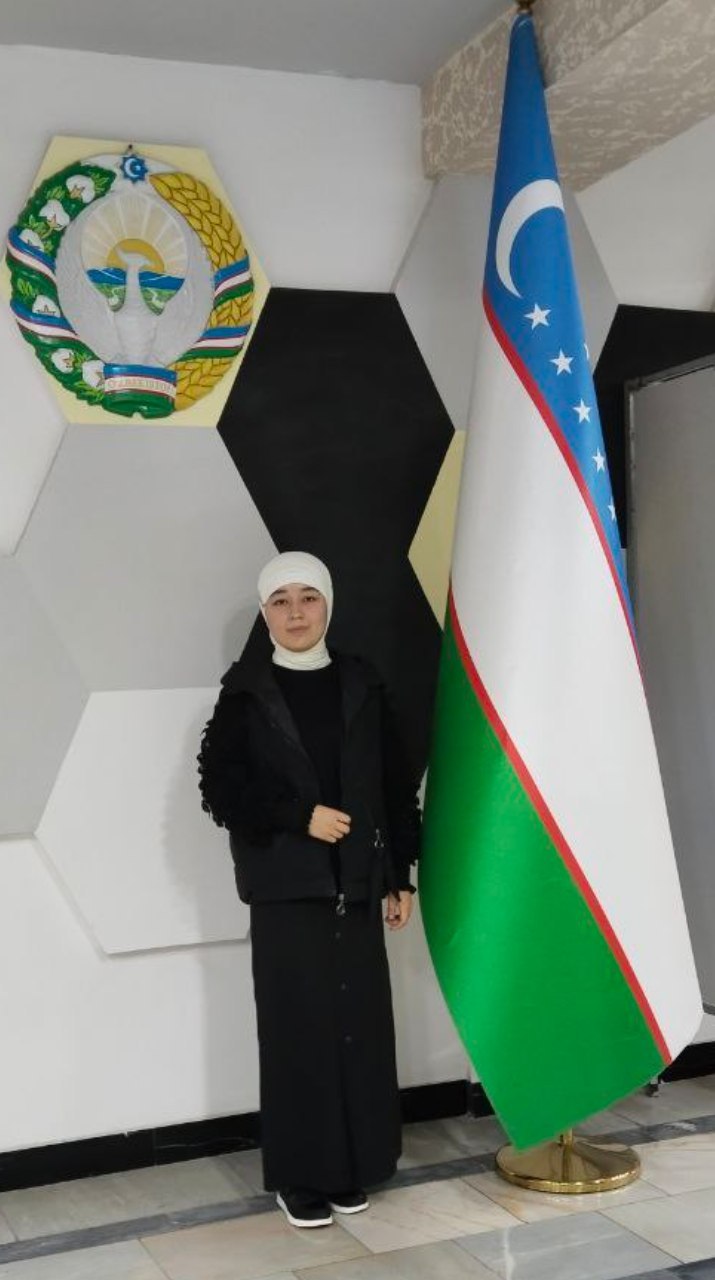
Olimova Muslima Odiljon’s daughter was born on 07.08.2007 in the city of Asaka, Andijan region. She graduated from the 13th school of Asaka district with a gold medal. Andijan Mechanical Engineering Institute. 1st year student of Information Systems and Technologies, Faculty of IB and CT.
For wide is the gate, and broad is the road that leads to destruction, and many enter through it. But small is the gate and narrow the road that leads to life, and only a few find it.
The Holy Bible
Matthew 7:13
There was an eastern town, and an old man watched the rain from the window, his Bible on a small table beside. He sometimes wore a brimmed hat in the outdoors but only went out to get food from the grocery store. He had a little Christmas Tree, a Charlie Brown Christmas tree, small enough to go on a little table. Each year it came out. I liked this tree.
He had very few visitors but sometimes a soul would show up, someone from the old days. These people, most of them, grew up poor. It was nice that their children wanted more, wanted to succeed. There is no harm in that. But some of their children’s generation went crazy w/it, and took it all too seriously, breaking relationships, family bonds, trust, even any measure of happiness, over monetary gain. The world of others didn’t laugh outwardly at him but didn’t respect him, for his worldly accomplishments were not great or even pronounced. The affluent wanted to keep their money and get more and the poor wanted to be wealthy. The man wanted me to shave his face because he couldn’t do this any longer as he was getting shaky at ninety three years of age.
So he sat in an old chair, I think one of the very chairs I used to sit in as a child when he fed me lunch. I carefully shaved his face. Outside it rained. I could hear it against the glass and knew it was making its way into the earth here, mixing with the soil, disappearing somewhere there, but in some places went through gravity to fall down industrial grates built into the roads. He had chosen to never grow a beard. That choice in a man has always been strange to me. Though an orphan or mystery at birth in actuality, my people must have had beards, and there must be some spiritual or genetic memory of such, somewhere, somehow. But to each his own. Some people are like that, and most all people have their ideas about what is the right way to dress, to look, to speak, et cetera, and what is not. Each secretly and not no secretly thinks they are right. When I was a child he made me soup, and there were many cans of soup in the cupboard.
One day his wife said, ‘Where is the child’s drink,’ to which he replied, ‘Soup is liquid he doesn’t need a drink.’ This was a mistake. The woman scolded him and was vexed. That’s a word they used, ‘vexed.’ She said, ‘Get him a drink, and this child is never to be served a meal without a drink again.’ Time passes. He used to tell me stories of a ranch where someone is stealing in the night. But the ranch owner stayed up and watched and caught the person. It was determined the thief needed some livestock so the ranch owner gave it to him, gave him some livestock. Cormac McCarthy the old man was not. When I finished shaving the man he said thanks. He said once in those late life days, ‘It is lucky you are here.’ That was nice. I didn’t mind. His wife had long left the world and he was not long for the earth as is said.
Now, I suppose someone else lives there. Some soul or souls. That’s the way it goes. The man had fashioned his own necklace to help his soul. It was a piece of yard and on it were medallions of various Catholic Saints. And he had received the last rites two or three times, even in the days when he was healthy if elderly. One’s soul is their own responsibility in a way. I wonder if that saint necklace still exists somewhere. I wonder whatever happened to it. I wonder what happens to things, and to souls and old chairs and even cans of soup.
Paul Edward Costa is an award-winning poet, spoken word artist, organiser, and teacher. He is a former Poet Laureate for the City of Mississauga and has published many poems in journals such as NoD Magazine, DarkWinter Literary Magazine, and Blank Spaces Magazine. He’s released a book of poetry, “The Long Train of Chaos” (Kung Fu Treachery Press – 2019) and a book of flash fiction, “God Damned Avalon” (Mosaic Press – 2021). As a spoken word artist, he’s featured at many poetry series across Canada. He currently organises the monthly Outer Haven Poetry Series in Toronto’s Imperial Pub.