“I think Haiti is a place that suffers so much from neglect that people only want to hear about it when it’s at its extreme. And that’s what they end up knowing about it.” --Edwidge DanticatHaiti Also Rises: The History of Haiti’s Resiliency against International Cruelty and Its Pivotal Role in the American Revolution and the Abolition of SlaveryBy Jacques Fleury
[Originally published in Spare Change News & Jacques Fleury’s book You Are Enough: The Journey to Accepting Your Authentic Self]
“‘History is the memory of states’, wrote Henry Kissinger in his book A World Restored in which he proceeded to tell the history of 19th century Europe from the point of view of the leaders of Austria and England, ignoring the millions who suffered from those state men’s
policies.”
The aforementioned is from Howard Zinn’s revolutionary book: A People’s History of the United States. It depicts U.S. history from the point of view of the common man. His method of operation is in direct correlation to what I’m about to do: tell you Haiti’s history from my point of view.
History is not necessarily or essentially “the memory of states” as Kissinger puts it. It is the narrative of the people whose lives were impacted, fragmented or altogether destroyed by intransigent politics and capricious foreign policies of dominant powers.
First and foremost, I want to outline Haiti’s historical chronology; thus giving you a theoretical basis from which you can begin to undergo a more comprehensive understanding of the country’s history and its present state of political and environmental instability.
In 1492, Christopher Columbus landed on the island and named it Hispaniola. Taino-Arawak Indians, who referred to their homeland as “Hayti” or “Mountainous Land”, originally inhabited the island. In 1697 slaves were sent to Haiti. The island was cherished by European powers for its natural resources, including cocoa, cotton and sugar cane. And so the French shipped in thousands of slaves mainly from West Africa to harvest the crops.
In 1804 after a slave rebellion led by a man named Boukman in 1791, Haiti became the first black independent state under General Jean-Jacques Dessalines, who declared himself Emperor. America feared that the slave rebellion in Haiti would ignite anti-slavery insurgents in the southern U.S. states. Perhaps this is one of the reasons America’s relationship with Haiti is strained to this day even though it was money from the then richest island in the Americas that France used to supplement the American Revolutionary War against Britain; a fact that was omitted in most history books. Haitians also
left Haiti to fight in the American Revolution.
In 1844, after decades of strife and multiple rulers, the island was split into two nations: Haiti and the Dominican Republic. In 1915, U.S. marines occupied Haiti to [supposedly] calm a state of anarchy. The Americans improved the infrastructure while helping to create the Haitian armed forces. In 1957 a reign of terror began when Francois “Papa Doc” Duvalier seizes power. His son, Jean-Claude “Baby Doc” Duvalier then just 18 years old, took over in 1971, continuing his father’s legacy of tyranny. In 1986, a rebellion ignited.
As protests gathered steam, the U.S. arranged exile in France for Baby Doc and his family. In 1990, after decades of dictatorship, former Roman Catholic Priest Jean-Bernard Aristide, becomes Haiti’s first freely elected leader. In 1991, after a military incursion, Aristide is ousted and is forced to seek exile in the U.S. The coup ignited a
mass exodus with more than 40, 000 Haitians rescued by the U.S. coast guard during a twelve-month period. In 1996 Rene Preval becomes president.
In 2000 Aristide is elected once again. In 2004 political violence plagues the Haitian capital, with accusations of a fraudulent election looming, a few weeks after Haiti celebrates its 200th anniversary, a rebel movement usurps control and Aristide is forced into exile again. Deadly floods leave 2,000 dead and causing deforestation.
In 2006 Preval was elected in the first election since Aristide was overthrown in 2004. In 2008 food prices in Haiti aggrandized as they have elsewhere in the world but the situation on the island was exacerbated since most Haitians only live on $2.00 dollars per day.
Also deadly hurricanes left 23, 000 homes destroyed, many dead
and 70 percent of the nation’s crops wiped out. In 2010, an earthquake with a magnitude of 7.0 ambushed Port-au-Prince, collapsing buildings with 100,000 thousand estimated dead. World
Vision—an organization that has worked in Haiti for thirty years—made an expedited trip to the island rushing emergency supplies to the survivors.
A great man once said, “Life’s most important question is: What are you doing for somebody else?” Dr. Paul Farmer, a Harvard Professor and anthropologist, is an avid supporter of Haiti. He became involved with the country when he went on a school trip as an undergraduate student.
Today, he has spearheaded the ubiquitous Boston based organization Partners in Health (P.I.H), devoted to aiding third world countries like Haiti. Farmer is known for his support of a Preferential Option for the Poor, a central precept of Liberation Theology. His approach to practice in Haiti, Peru and Russia has its basis in ethnographic analysis—the science that studies and compares human cultures—and real world practicality. Mountains Beyond Mountains: The Quest of Dr. Paul Farmer, A Man Who Could Cure the World by Tracy Kidder details Farmer’s work in Haiti and abroad.
I have been a part of P.I.H. since I was bestowed with the honor of
being the Official Poet and Publicity Coordinator for the Annual Urban Walk for Haiti, which raises monies for P.I.H.
In Haiti, it was common knowledge that one’s own friends could be bribed as spies and government informants. Their jobs were to safeguard the brutal reigning regime by turning in anyone whom they considered subversive. Under the Haitian weather, the wind in the trees often swirled about all the fetid feeling of death and despair.
However, contrary to what the American news media has imprinted as fact in the heads of people across the world, Haiti has more
dimensions than the poor, the poorer and the poorest. There are three classes of people: the bourgeoisie, the middle class and then the poor.
I was part of the middle class. Both my parents owned property in Port-au-Prince and my father was a clothes designer, retail storeowner and mercantile entrepreneur. He was also a land and multiple homeowner, which he rented as part of his entrepreneurial endeavors. My mother was a house wife, socialite and landlord with degrees in cosmetology and the culinary arts. I attended an
exclusive private school near the Haitian palace called Frere Andre (Brother Andre).
It was there that I leaned how not to think for myself through blatant memorization of pedantic texts and taking dictations to prepare me for the dictatorship of the ruling class. But Haiti is more than just
doom and gloom. I remember staring in stupor at the dance of the Caribbean wind over the azure sea, the deep green elegance of the palms, picnic by moonlight and sweet memories of mangoes. Purple
butterflies, a visual feast of dancing loveliness, under the flowery spring sun. The joyous sounds of laughter resounding from the young as they run about playing hide and seek during blackouts.
But unfortunately, there also lied in the sea a maelstrom of fear, violence, misery and poverty, which most can barely swim out of, while the orchestrating powers that ensnare them stand by cross armed and snarling. But one day, it is my fervent hope that Haitian children will wake up to shiny silver mornings and hummingbirds singing, promising freedom, serenity and prosperity.
We lived in a world dominated by the hetero sexist macho male culture. However, my mother who bears the same name as Haitian rebel fighter Toussaint L’ouverture, was and still is iconoclastic in that she dared to be a leader for her family when most women were subjected to being simply subservient to the men. Since we were considered middle class, she became caught up in the gaudy accoutrements of upward mobility, so when Haiti’s political and economic crises began to converge, threatening our lifestyle, we all came to America.
She related to me that under the Duvalier dictatorship, tourism in Haiti flourished from the 1950’s all the way up to 1986, practically ending with the Baby Doc mutiny. Foreign groups like Arabs, Lebanese, and even Chinese exiled from their respective countries lived and built businesses in Haiti. Also Haiti’s number one tourist attraction, La Citadelle Laferriere, built on mountains overlooking Port-au-Prince 17 miles south of the city of Cap Haitien by Henry
Christopher—a general in the Haitian army—has walls 130 feet high is the largest fortress in the Americas and was designated by the United Nations Educational, Scientific and Cultural Organization (UNESCO) as a world history site in 1982. It was built to keep the newly independent nation from French incursions, which never materialized.
Haitians in American are for the most part hard working honest and joyous intelligent people. Most of the women work as Certified Nursing Assistants in nursing home facilities, caring for America’s elderly population and a plethora of men work as cab drivers. Large majorities also attend college to become doctors, lawyers, engineers and nurses. Both the men and women pursue the American Dream by buying cars and houses, sometimes working two to three jobs.
I too am living my version of the American dream by graduating from college with honors (Phi Beta Kappa) and publishing my first autobiography of prose and poetry aptly titled Sparks in the Dark, which was featured in the Boston Globe. Yet still, there seems to be an undercurrent of fear and hatred towards the Haitian population here in the States.
Maybe it’s because the conscientious and resultant collaboration of the “Have Nots” that often instigate the principal fears and resistance of the “Haves”, since the rich want to remain rich and in control. Robert Lawless, quoted in Farmer’s book The Uses, asserts Haitians are the immigrants Americans love to fear and hate.”
But why, I ask of you? Which leads me to ponder, is hate and prejudice ever truly justified?
“Why should we care about Haiti?” writes politico and M.I.T professor Noam Chomsky in the introduction to Farmer’s book The Uses. “…We are the richest and most powerful country in the world, while Haiti is at the opposite extreme of human existence: miserable, horrifying,
black, ugly. We may pity Haitians and other backwards people who have, unaccountably, failed to achieve our nobility and wealth, and we may even try to lend a hand, out of humanitarian impulse. But responsibility stops there.” I once heard the adage “If your neighbor’s house is on fire, wet yours.”
As we know tragedy affects all of us, having experienced hurricane Katrina, and 9/11. In relation to American occupation of Haiti, Chomsky goes on to say, “In a situation of domination and occupation, the occupier… has to justify what it’s doing. There is only once way to do it—become a racist. You have to blame the victim. Once you’ve become a raving racist in self-defense, you’ve lost your capacity to understand what’s [really] happening.” In other words,
it’s like putting someone’s eyes out and then accusing them of being blind.
America’s exploitation of Haiti, its support of the Duvaliers and the military for the repression of the Haitian people and expedient U.S. foreign policies and an ongoing debate about Haitian asylum
seekers, are all impediments to the progression of the Haitian nation.
It seems like light skinned immigrants like Cubans and Mexicans get asylum, why not Haitians?
Meeting

In vain tonight, my tendency will reach your limits
Your image rushes to the safe appointment of my forehead
I feel your presence more constant
The syllables of your name are poured reluctantly
Through my sleepless lips, hurting the stillness of the air,
So that you sprout in my arms...
But the time for the meeting has not yet arrived for us.

GRACIELA NOEMI VILLAVERDE is a writer and poet from Concepción del Uruguay (Entre Rios) Argentina, based in Buenos Aires. She graduated in letters and is the author of seven books of poetry which have earned international literary awards.

She works as the World Manager of Educational and Social Projects, of the Hispanic World Union of Writers, UHE World Honorary President of the same institution, Activa de la Sade, Argentine Society of Writers, Commissioner of Honor in the executive cabinet of the Educational and Social Relations Division of the UNACCC South America - Argentina Chapter.
My trip to the Amudarya district of the Republic of Karakalpakstan prompted me to write an article on this topic. At the entrance to the Amudarya district, I watched the surroundings with interest as the cars moved slowly along the Panton Bridge (a floating bridge designed for the passage of people and vehicles) over the Amudarya.
The bridge is a little old (built in 1938) and due to its narrowness, cars pass in a row. At the beginning of the bridge, a beautiful wall like a tall monument caught my attention. I was happy to see that “Uzbekistan is the land of the happy” written on this monument. These words did not leave my mind during the whole trip.
Indeed, happy Uzbekistan is the country of the happiest and happiest people. Our country was ranked among the 50 happiest countries out of 156 countries in the world and took 44th place. Among the countries of the Commonwealth of Independent States, Uzbekistan ranks first as the country of the happiest people. On March 20, “World Happiness” published a new report entitled “The happiest Uzbeks among the CIS countries”.
What do we mean by happiness or a happy person? Happiness cannot be measured by wealth.
Happiness is an inner feeling, we cannot grasp it with our hands, but we feel it with our heart. Everyone has a different interpretation of happiness. Happiness can be found only in a country where peace and tranquility prevail. Happy people live free and free in a beautiful land like paradise. The sky of Uzbekistan is clear, the waters are clear, the people are kind and hospitable. If anyone doubts our happiness, let them come to a paradise-like country like Uzbekistan and see with their own eyes that people live happily in the arms of happiness!
During the development of modern technology, the description of beautiful Uzbekistan spread to the whole world. Foreign tourists who have heard about the incomparable beauty of our country dream of traveling to our heavenly homeland. I am proud to be a child of a peaceful and prosperous, beautiful paradise-like country called Uzbekistan, and to be a happy citizen of this country.
Kurbanova Saodat Ismatkulovna
Teacher of school 18, Nishan district, Kashkadarya region, Republic of Uzbekistan
What is life?

 Life is a sea, life is a river
 It flows into the brook
 A person falls into a vortex
 Ilintirar to the hook.

 Man himself drank raw milk
 Unknown benefit, harm
 He goes down with his eyes open
 Trapped by life.

 Who is life, what is life
 What a miracle life is
 Unwanted people
 Forced to walk.

 Whom - to whom he meets
 Oliftani - peas
 A simple person will meet
 To the beach somewhere.

Lola Hotamova was born on May 7,2009 in the village of Khanabad, Bukhara region. She studies in the 8th grade of the 43rd general education school in Jondor district. Poems of the young poetess were first published in 2019 in the " Zhondor ovozi"newspaper. Later, she began to appear in newspapers and magazines such as "Gulkhan", "Ezgulik", " Yangiyer tongi", " Bilimdon", "Smile". His books" Source of power", "I love my country", "Shy rabbit" have been published.
Brute Neutron

radio wrist Squirm
the screen fit beneath
Chin Up! Up! Up! Up!
summoned away spork
shining obedient crux
of Pearl Squirrel groove
lips   ,   shifts   ,   blimps
crack a Tick typo Tips
A shark Barking elevator
muffin   ,   an Oyster
Would that shake a Sack
a vegetable chair of Mutton
Strapping youthful vinegar
,   the whine selects   ,
a Ham application Antique
which Swats Drops   ,   arrow
predicating Apocalypse


bLiSs ExIsT Systematic

touching warden stand
tall image continuation
process of eliminating
mayonnaise finger top
cosmos textile style a
shepherded earlobe jut
hut proverb maven raven
quoting adverbial mania


A spark, trembling on invisible sidewalk

the trip creases blending forehead
         consternation windows merely a spine
         to acknowledge murky phobia magazines
: ‘on that plane, sedated city’ :
                                 left doubted
                                 overall imminent
. . . . .
            aforementioned pounds,
                                           labored,
(maybe sloths) - - - unpacked umbrella - - -
                  facial stimulated brain
                  startled scenario hairs . . . . .

scurrying had to be addressed
     , again, kick :  [otherwise] blank
                       declaration             , non-
binding , does fly , well-rehearsed skyline ,
          landscape in clusters
          a lapse, once upon an eyelash :

                                   tallest boots of
                                   dry tongue


Diplomacy

second grin
     be,stowed
            comparison
ROBOT transport
                  Vector

impale,ment
           speaking,ing
    of computerized
education            cycle
      symbolism

MaSteRpiEcE
               sympathetic
    SqUeeZe TOY
mermaid
         lady-in-
               waiting

AT aLL CoSts,
    coattails
, neon PaLaCe
              harsh
       RePeAL,s
                   November
   imaginary
 report      CaRd
         security
celebration.


chock full o’ diameter

dystopian like a cracker barrel hobby horse
     h00p earrings demonstrate soviet montage
     while laser tag aligns itself w/ German expressionism
          . New to older editorial cacophony
            lashing museum studies,
                               tongue breaks fortress
                               then growls::
brrrrrrrrrrrrrrrrrrrrrrrrrrrrrrrrrrrrrrr,
                                    YUCK <end an automatic
                                                       sentence. :::
      ,, whisper a pinch
          & viral a bald spot
                           yip-yip-yip-yip-yip


Communal section accustomed

Constricted table
     negative light / slight
TOUCH       detaches    castle
                                  from    tree
                          LIMB (action judged
to slip prospectus into lemur)
             Mainly,solid,trained,lucid,
abrupt sleep corrodes district context

Joshua Martin is a Philadelphia based writer and filmmaker, who currently works in a library. He is a member of C22, an experimental writing collective. He is the author most recently of the books O! fragmented glories (Argotist Ebooks), Prismatic Fissures (C22 Press), and peeping sardine fumes (RANGER Press). He has had numerous pieces published in various journals. You can find links to his published work at joshuamartinwriting.blogspot.com
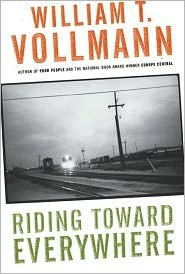
William T. Vollmann writes with clarity and a rare sort of honesty that is not easy to find. In this wonderfully written account of train hopping the reader experiences the outward adventures and also Vollmann’s thoughts on trains, travel, literary heroes, the meaning of friendship, and more. Vollmann shows us courage in his actions, and at even the more difficult of times, inspiration for writing and life through his keen interest in both.
That all would be amazing enough for this reader, but what makes it better yet is that when Vollmann is describing landscapes he is poetic, profound, and I would say, spiritually orientated in his quest, his open journey. Brave it is to do what he has done, and valorous to share his experiences in a heartfelt way. A long time ago I read an essay interview w/Louis Ferdinand Celine where he talked about a few writers he admired that came before him. He said of them that ‘They were made for it,’ meaning they were created to be writers. This would be perhaps the highest destiny.
Vollmann in my view is like that, is someone that is made for it, and he shows why in these pages.
Beyond the Mirror of Imagination

In the mirror, through your eyes,
You observe me
You call me
You hide
You love
You squint to forget
To make everything stop
The water in the mill doesn't stop
It turns,
Life flows like a river
I am constantly reborn in your eyes
Beneath the eyelids
Love with which you cover another love.
But forgetting happens when the mirror breaks,
But our mirror is reborn when you look at yourself
And see my eyes in your reflection.
That is us, connected by thoughts
Without encounters
Without touch
Without anything,
But everything in the fullness of feeling
Through the connection of the soul.


Maja Milojković was born in 1975 in Zaječar, Serbia.
She is a person to whom from an early age, Leonardo da Vinci's statement "Painting is poetry that can be seen, and poetry is painting that can be heard" is circulating through the blood.

That's why she started to use feathers and a brush and began to reveal the world and herself to them.
As a poet, she is represented in numerous domestic and foreign literary newspapers, anthologies and electronic media, and some of her poems can be found on YouTube.

Many of her poems have been translated into English, Hungarian, Bengali and Bulgarian due to the need of foreign readers.
She is the recipient of many international awards.
"Trees of Desire" is her second collection of poems in preparation, which is preceded by the book of poems "Moon Circle".
She is a member of the International Society of Writers and Artists "Mountain Views" in Montenegro, and she also is a member of the Poetry club "Area Felix" in Serbia.