One of the most prominent figures in Uzbek sports is Bahodir Jalolov, who competes in the heavyweight division of boxing. Jalolov’s accomplishments on the international stage are remarkable, not only for his formidable strength but also for his technical prowess, strategic acumen, and psychological resilience. Each match sees him, meticulously analyzing his opponents, formulating tailored strategies, and executing them with precision and confidence. His endurance is unparalleled and physically demanding contests.
Jalolov’s success transcends physical capability: it embodies mental fortitude. In high-pressure situations, he maintains composure, concentrates intensely, and make decisions that demonstrate strategic insight. His victories at prestigious competitions, including the Olympic Games and World Championships, have solidified his reputation as a role model for Uzbek boxers and aspiring athletes worldwide.
Equally remarkable is Abduqodir Husanov a central defender who has emerged as one of Uzbekistan’s most promising football talents. Husanov’s gameplay is characterized by rapid decision-making precise ball handling, tactical awareness, and seamless collaboration with teammates. His defensive skills, combined with a strong understanding of the game’s dynamics, have rendered him indispensable to both his club and national team. For young football enthusiasts, his journey underscores the necessity of combing physical aptitude with strategic thinking and adaptability.
In the realm of women’s sports, Diyora Keldiyorova stands out as a paragon of dedication and skill judo. Her achievements in international competitions, including the Olympic Games, reflect a synthesis of physical strength, technical mastery, and mental resilience. Keldiyorova’s victories have not only advanced the statues of Uzbek women in sports but have also provided in inspiration to countless young girls, encouraging them to pursue their ambitions with confidence and determination. Her commitment illustrates the importance of integrating mental discipline with physical capability, highlighting the multifaceted nature of true athletic excellence.
Moreover, these athletes contribute significantly to the social and cultural identify of Uzbekistan. Their accomplishments foster national unity, instill pride, and motivate citizens, particularly the younger generation, to pursue their goals with diligence and integrity. The narratives of Jalolov, Husanov, Keldiyorova extend beyond the arena of sports: they serve as enduring examples of how talent, discipline, and resilience can transform personal ambition into collective inspiration.
In my conclusion, athletes embody the values of dedication, excellence, and national pride. Their achievements inspire young people like me to pursue knowledge, cultivate resilience and aspire to contribute positively, I aim to emulate their commitment, integrating the lessons of discipline, strategic thinking and perseverance into my own life. As Qahramonjonova Jasmina, I am motivated by these exemplary figures to engage in sports, uphold a healthy lifestyle and commit to purposeful and meaningful personal growth.
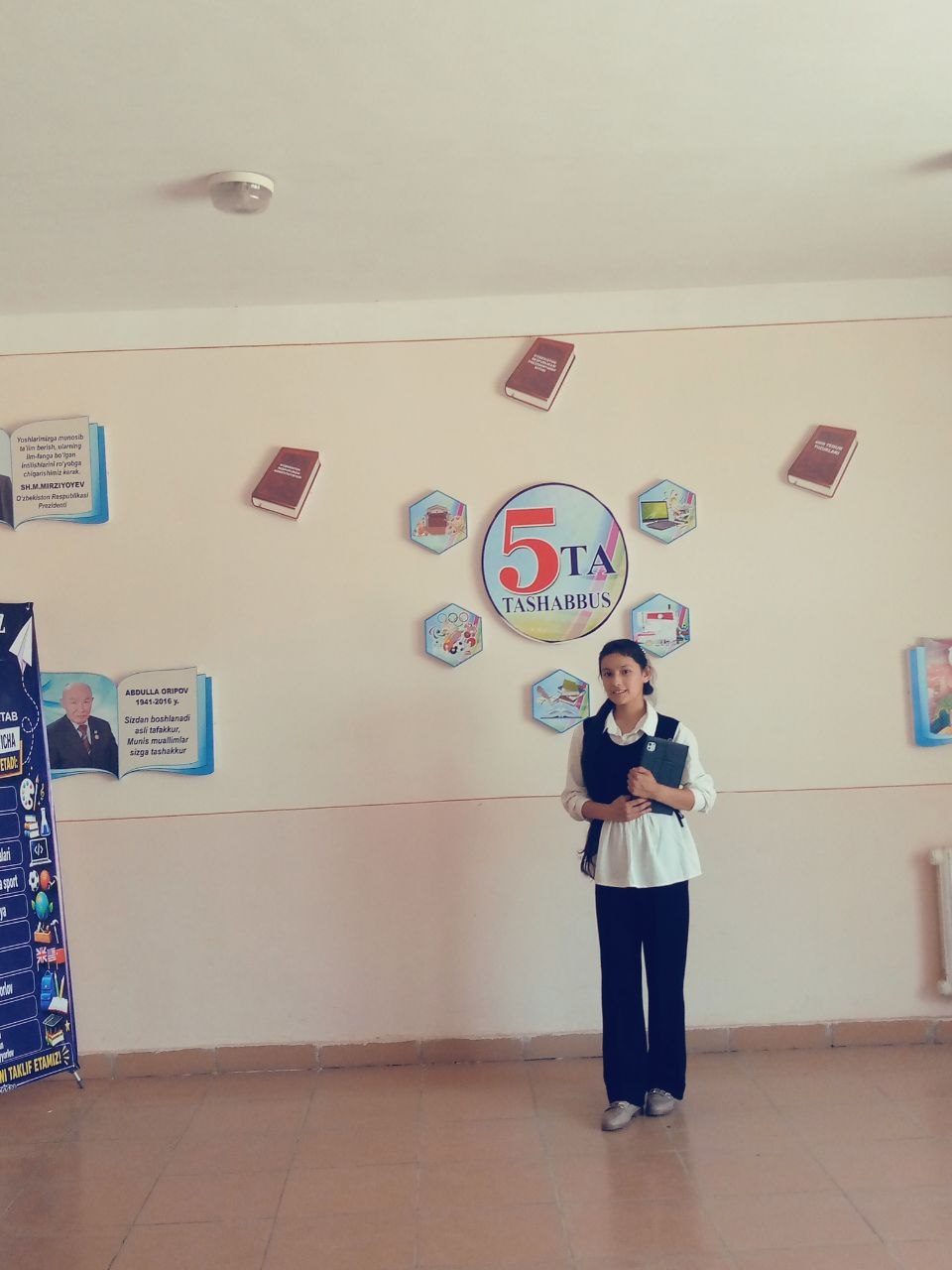
I am Jasmina Qahramonjonova, a citizen of the Republic of Uzbekistan. I currently reside in Shahrisabz district, Kashkadarya region. I have a strong interest in the field of law, and I am actively engaged in academic and research activities. I continuously develop my knowledge and skills by studying and analyzing various legal issues and writing scientific articles. In the future, I aim to study at the Faculty of Law of the University of Bonn and become a qualified international legal specialist. At present, the increasing level of legal violations in society in negatively affects legal awareness and values. Therefore, I aim to work in law enforcement bodies and contribute to ensuring the rule of law, protecting human rights and freedoms, and strengthening justice in community. In addition, I provide legal advice and guidance to support children’s personal development and help them build a strong future. Nowadays, I take part in several legal competitions in my country and have many awards and certificates.
J.J. Campbell (1976 – ?) is a three-time Best of the Net nominee and a two-time Pushcart Prize nominee. He has been widely published over the years, most recently at The Beatnik Cowboy, Yellow Mama, The Rye Whiskey Review, Night Owl Narrative and Misfit Magazine. His most recent book, to live your dreams, published by Whiskey City Press, is available at Amazon.com by going here: https://a.co/d/0eFsH7fe
In today’s rapidly changing world one of the most pressing topics is the great importance of books in developing children’s thinking. We can say that by reading books, children are finding solutions to the world’s most complex problems, thereby contributing to the development and future of our countries.
Today, the only thing that leads children to perfection and success is the book. In my opinion, every child has read a book at least once in their life. For example, a piece of work, a novel, a drama, or simple literature from a book. By this, I mean that books primary invite children to reading and literacy. Furthermore, through reading books children are enhancing their mental intellect and critical thinking in serious areas. That is to say, easy solutions to the economic, social, and spiritual-culture problems of our countries are being found with the help of books. Another aspect is that the gems of Uzbek literature teach children the roots of our history; the reason is that it shows how humanitarian, brave, and most importantly, patient the Uzbek people are. Based on this, I want to say that to build the future, one must look back at history; as a result, history will pave your way to success, drawing from it is own hardships. This opinion of mine is, on the contrary like a battle on a reflected stage.
Because in the war, thousands of our grandfather fought putting their lives in the line, and if necessary, sacrificing them. Do you think they did not have fathers, mothers, spouses, or children waiting for them anxiously at home? Of course they did! But they possessed pride, honor, and a sense of responsibility. I can say with confidence that these books will help children take steps toward a great future.
Furthermore, children learn how difficult life can be and how to respond to it appropriately. In, reading books can be useful not only for children but also for adults. For instance, Yu Hua’ s famous work “To Live” helps to further increase the patience and resilience of our women today. In my perspective, this book reflects the hardships of an entire family, and even the suffering of a woman who lost all her children and her ability to endure these difficulties. I believe that this story can serve as an example for our women.
In final conclusion, a book is not just an object that leads people to perfection, but rather a guide that shows them the way. It is known that for many children, a books a source of knowledge and one of the most enjoyable activities
My name is Ismatova Dilnura. I was born on October 11, 2010, in Shahrisabz district of Qashqadaryo region, Uzbekistan. Moreover, in order to expand my worldwide and mental capacity, I have been learning various languages and reading books. In addition, thanks to my knowledge of foreign languages, I have been participating as a volunteer in my events, festivals, and large pavilions. And also, currently, I am continuously developing myself and further increasing my knowledge in order to realize my many dreams.
Working for 18 years for the best boss ever a 30-something hot blonde divorcee alone in the Big Apple sent by a headhunter to a wealthy financier his team of assistants lawyers, traders a masseuse every day she schedules them in her private office in his brownstone in his home setting dates, times travel plans, meals, gifts girls, young girls and their friends her own life suburban a husband in Connecticut a baby on the way a doubled salary to stay a car, a nanny, a loan and an NDA the girls come and go she keeps arranging payments, visas flights, schedules island vacations very famous men very young women she sees nothing knows nothing does nothing says nothing at her hearing after the fact.
a fascist is a fascist is a fascist
Night town white town deep snow deep cold color white but here we all are hybrid nation of individual freedoms blackbooted stomped and kicked aside laws, norms, civility under hard ice feet glorifying the crush the masks the heavy arms bulked up brutality colorless cruelty attack dogs clawing what stands in the way of a bulldozed morality while the red rose pools red red red on the soft white snow.
The Enigmatic Everybody
I am become an enigma to myself.—St. Augustine
Everybody does what everybody does with a lunatic’s clarity building the same billionaire bunkers on green plastic grass the same shiny luxury cars on the Italian stone drive on the razor’s edge between boredom and suicide everybody does what everybody does the same Mar-a-Lago face under the same blunt cut the same slink, sassy shoes inflated breasts and lips the muscles maxxed worked up, injected the same dark shades hiding eyes without occupancy on the razored border between lived and lost everybody does what everybody does same movies, shows, media slop thoughts and conversations the endless drive for more attention, goods, money talking to itself it is all anyone can do to be alive, a self, awake as the lands burn as the seas rise as the species die off as the planet wobbles on this razor’s edge everybody does what everybody does until they do something else.
Waray Literature and Kimball’s Critique of Contradictions in Eagleton’s Work
III
The Leyte Samar Heritage Center has a cozy bookstore called Kaaradman Library & Bookshop, which specializes in Visayas literature. They carry titles like Pinili: 15 Years of Lamiraw, Tinalunay: Hinugpong nga Panurat nga Winaray, and Sa Atong Dila: Introduction to Visayan Literature. I picked up Bagulaya’s Writing Literary History there. Afterwards, I headed to Dunkin’ Donuts on Salazar Street and devoured the book over donuts and iced coffee. It was dusk. The first page I read was Bagulaya’s critique of modernist literature.
Both Brooks and Richards obviously privilege the language of poetry. But this privileging denies practical logic which makes poetry anti-logic. It reduces the poem to New Critical sophistry. No wonder Brooks appreciated Donne’s poem for its paradox: “The lovers in rejecting life actually win the most intense life” (Brooks 1972, 38). From the above sophistry, it is obvious that New Criticism is not only anti-practical logic, it is at the same time metaphysical. They are able to resolve the apparent contradictions not in the material reality, but in metaphysical space of the poem. Moreover, the notion that poetry is different from the normal prose language because it uses metaphor is also unacceptable. As critic Terry Eagleton counters, “the idea that there is a single normal language, a common currency shared equally by all members of a society, is an illusion” (1983, 5). (Bagulaya 100 emphasis added)
IV
The following applies Kimball’s critiques, originally directed at Eagleton, to Bagulaya’s “The Ideology of Modern Waray Poetry,” examining the parallels point by point.
Forcing Everything into a Marxist Framework
Kimball’s criticism of Eagleton: His discussion of aesthetics “transforms a philosophical innovation into a dramatic example of class warfare… as if reason were a feudal lord oppressing the serfs of sensation” (24). Bagulaya does exactly this. He takes poems that appear to be about personal, intimate experiences – such as Victor Sugbo’s “Kan Margaret,” which is simply about an uncle leaving his niece (Bagulaya 110) – and forces them into an allegory of “city vs. countryside,” “center vs. periphery,” and “semifeudal exploitation.” Just as Kimball accused Eagleton of twisting Baumgarten’s aesthetics into a narrative of political oppression, Bagulaya reduces every line of poetry to a symptom of economic relations. He assumes that everything (the choice of subject, the use of imagery, the decision to write about private life) must ultimately be explained by the “semicolonial, semifeudal” structure of the economy. Bagulaya posits that “Modern Waray poetry has so far been argued as the most recent cultural development of the persistent semicolonial, semifeudal Philippine economy (120). To Kimball, this is not analysis; it is ideological projection: seeing only what your theory tells you to see, regardless of what the work actually says or means.
Misinterpretation and Distortion of Meaning
Kimball’s criticism of Eagleton: “[He] drastically misreads the philosophers he discusses” misunderstanding Schopenhauer’s pessimism as a product of ‘class history’ rather than an essential feature of existence (24). Bagulaya fundamentally misrepresents the meaning and value of modern Waray poetry. He interprets its focus on the private realm, intimacy, and personal emotion as a sign of indifference, political unconsciousness, or support for the status quo. But as Kimball would argue, this is a total misreading. The turn toward the personal is not necessarily a “failure” or a hidden political stance; it can be a deliberate choice to explore human experience, beauty, memory, or individual truth, which are valid and meaningful in themselves.
Bagulaya claims that because these poets do not write explicitly about revolution or class struggle, they are “unconscious” or trapped in “split modernism.” This is like Eagleton saying art is only valuable if it serves a political end. Kimball would point out that Bagulaya judges the poetry only by his own political standard, completely missing its literary, emotional, or cultural value. He mistakes literary autonomy (the freedom of art to be about things other than politics) for a flaw or a contradiction.
Obsession with “Contradictions” That Exist Only in the Theory
Kimball’s criticism of Eagleton: “One must always be suspicious when a Marxist uses the term ‘contradiction,’ because it usually means that some aspect of reality is not conforming to his vision of things” (24). The entire analysis revolves around the idea of “split modernism,” the claim that modern Waray poetry is contradictory because it mixes modern techniques with traditional or romantic themes, and because it is caught between feudalism and modernity. Kimball would argue that this “contradiction” is not a flaw in the poetry, but a flaw in Bagulaya’s model.
There is nothing contradictory or wrong about a culture or literature blending old and new, local and foreign, personal and social. This is normal in every living tradition. But because Bagulaya measures reality against a rigid Marxist model of historical development (where things should move from feudal to modern in a straight line), he calls it a “split.” As Kimball said about Eagleton: “Minus that [Marxist model], it is merely a complex process that refuses to accommodate itself to the predictions of philosophers.” Bagulaya creates the problem himself, then blames the poetry for it.
Reducing Art to Ideology, Denying Intrinsic Value
Kimball’s criticism of Eagleton: “[He does not] care much for literature except in so far as it is an instrument for social change” (24). This is the core of Bagulaya’s argument. For him, poetry has no intrinsic value. It is good or bad, progressive or backward, only based on how well it reflects or challenges the economic base. He writes: “Modernist aesthetics is not enough… It takes a twenty-first century socialist revolution to transform poetry.”
To Kimball, this is the ultimate reductionism. It means that art is nothing more than a tool or a symptom. Bagulaya dismisses the beauty, skill, imagination, and emotional power of Waray poetry as secondary or even irrelevant. Just as Kimball rejected Eagleton’s view that aesthetic experience is “as coercive as law,” he would reject Bagulaya’s view that a poem about family or nature is actually just a hidden statement about surplus value or feudal exploitation. He would say: This tells us nothing about poetry, but everything about the critic’s obsession with politics.
Obscurantism and Dogma
Kimball’s criticism of Eagleton: His writing often becomes obscure and forced; full of jargon that keeps reality at bay. Bagulaya relies heavily on abstract terms like semicolonial semifeudalism, political unconscious, split modernism, ideological position, center vs. periphery, terms that function like a closed system. Once you accept these definitions, his conclusions follow automatically. But as Kimball would note, these are not discoveries; they are assumptions built into the language. By using this kind of jargon, Bagulaya avoids actually engaging with the poetry on its own terms. Instead of describing what the poems mean, he describes only how they fit (or fail to fit) his theory. And like Eagleton, he ends with a dogmatic conclusion: only a socialist revolution can save it, a solution that comes straight from ideology, not from literary analysis.
This analysis is a perfect example of what happens when literary criticism is swallowed whole by Marxist ideology. Bagulaya reads every poem as a coded document about class and economics, misinterprets the legitimate choice of personal themes as political failure, invents ‘contradictions’ that exist only in his own theoretical framework, and reduces the rich, diverse tradition of Waray poetry to nothing more than a reflection of the economy. It is not an analysis of literature, it is ideology in action. It tells us almost nothing about the poetry itself, but a great deal about the rigid, reductive worldview of the critic.
V
Bagulaya’s Writing Literary History gives space to Sugbo’s Waray verses. On page 277, you’ll find the opening lines of Sugbo’s poem “This Anticipation for Poetry”.
How wearisome this search for poetry
More so when neither moon nor sun on you shines
The speaker is describing that looking for, creating, or seeking out poetry feels tiring, tedious, and exhausting. The act of trying to find or write poetry is difficult and draining; it feels like a heavy, unending effort. The sun and moon are metaphors of light, hope, clarity, inspiration, and guidance. The speaker is saying that the effort to find or make poetry is already tiring, but it becomes even more difficult and disheartening when there is no inspiration, guidance, or hope. Without that “light” (creativity, meaning, or motivation), the search feels pointless, bleak, and heavy. It describes the frustration of trying to create or find art when there is no inspiration or reason to keep going.
Short Biography
Fhen M.’s essay “Waray Literature and Kimball’s Critique of Contradictions in Eagleton’s Work” appears in Synchronized Chaos, an interdisciplinary journal focused on art, music, culture, science, and literature. Literary Heist also publishes his prose “Imagination of Disaster in the Major Works of Henry James: A Study by Genotiva.” From 2016 to 2017, he worked as an academic writer at Zeveral Academic Consultants Inc. in Pasig City, Metro Manila. During his tenure, his team leader gifted him a copy of the 2014 animated film The Prophet, adapted from Kahlil Gibran’s 1923 book. The film follows Mustafa, a poet and activist under house arrest in Ottoman-era Lebanon, as he engages in profound conversations with the townspeople on topics like work, love, and death. One of Gibran’s notable poems featured in the film is “On Work”.
war is not a protest but a lack of protest death is not a protest but a lack of protest laughter is not a protest but a lack of protest peace is not a protest but a lack of protest revolution is not a protest but a lack of protest life is not a protest but a lack of protest
a soldier cannot say no a citizen cannot say no a suicide cannot say no a lonely shadow cannot say no