Essay from O’ktamova Sabrina Mahmud qizi

Degradation Processes in Irrigated Soils of the Kashkadarya Region, Ecological Challenges in Achieving High Crop Yields, and Strategies for Mitigation Using Biological Mulching Methods

Student of the Faculty of Geography and Agronomy, Department of Ecology, Karshi State University

ABSTRACT

This scientific article analyzes the ecological degradation processes occurring in the irrigated soils of the Kashkadarya region, particularly secondary salinization, soil erosion, and the depletion of humus content, which represent the main challenges in achieving high agricultural crop yields. Under the sharply arid climatic conditions of the region, the ecological and economic efficiency of applying local organic waste (wheat straw, cotton stalks) and the “Eco-Mulch” technology to restore soil fertility and optimize water resource utilization is scientifically substantiated.

Keywords: Kashkadarya soils, degradation, secondary salinization, humus, water scarcity, biological mulching, Eco-Mulch, sustainable agriculture.

——————————

1. INTRODUCTION

The sustainable development of agricultural production and ensuring food security in the Republic of Uzbekistan, particularly in the Kashkadarya region, directly depend on soil fertility and the rational use of water resources. However, in recent years, due to global climate change, rising temperatures, and acute water shortages, various ecological problems and soil degradation have been intensifying in the irrigated lands of the region.

The specific hydrogeological and climatic conditions of the plain areas in the Kashkadarya region require special agrotechnical and ecological approaches to maintain soil fertility. Studying the main factors hindering high and quality crop yields and developing innovative, environmentally friendly methods to eliminate them is one of the most urgent tasks of today.

——————————

2. MAIN ECOLOGICAL CHALLENGES IN ACHIEVING HIGH YIELDS (RESULTS AND DISCUSSION)

Conducted scientific observations and analyses show that the following main ecological and agrotechnical challenges exist in obtaining high crop yields from the soils of the Kashkadarya region:

1. Secondary Salinization and Mineralization: Due to high groundwater tables in the irrigated lands of the region (especially in Kasbi, Nishon, Mirishkor, and Muborak districts) and intense water evaporation during hot summers, capillary salts rise to the upper soil layers. This causes secondary salinization and severely damages the root systems of crops.

2. Water Scarcity and High Transpiration: Limited water sources for irrigation and the traditional furrow irrigation method result in 40–50% of water loss through evaporation, causing crops to experience water stress.

3.Depletion of Humus (Organic Matter) Content: Due to long-term monoculture cultivation (cotton and wheat), insufficient organic fertilizer application, and the inefficient practice of burning straw and stalks in the fields after harvest, the humus content in the topsoil has dropped to 0.8–1.1%.

4. Soil Compaction and Erosion: The frequent movement of heavy machinery, along with excessive use of mineral fertilizers and pesticides, destroys soil microfauna (beneficial microbes and earthworms) and disrupts soil structure.

——————————

3. STRATEGIES FOR RESTORING SOIL FERTILITY AND ENVIRONMENTAL IMPROVEMENT (SOLUTIONS)

To overcome the above-mentioned problems under the conditions of the Kashkadarya region and to obtain abundant and environmentally clean crop yields, the following complex ecological and innovative measures are proposed:

1. Implementation of “Eco-Mulch” (Biological Mulching) Technology:

   Shredding and sterilizing wheat straw and cotton stalks, which are traditionally left as waste in fields after harvest, and applying them as a protective layer between crop rows.

• Result: The mulch layer reflects sunlight and reduces water evaporation from the soil surface by 35–40%. Once water evaporation stops, salts do not rise to the surface, successfully preventing salinization.

2. Organic Humus Formation:

   The applied straw and organic mulch gradually decompose, enriching the soil with biological humus. This improves soil structure, water permeability, and aeration.

1. 

Natural Barrier Against Weeds:

   Because the mulch layer blocks sunlight, it prevents weed growth. This frees farmers from using expensive and toxic herbicides.

2. 

Drip and Mulched Irrigation Complex:

   Combining drip irrigation with mulching in small areas and greenhouses makes it possible to increase crop yields by 25–30% and cut water consumption in half.

——————————

4. CONCLUSION AND RECOMMENDATIONS

To obtain abundant and sustainable crop yields from the irrigated soils of the Kashkadarya region, increasing the dosage of chemical fertilizers is not sufficient; rather, restoring the ecological and biological health of the soil is essential.

Research shows that utilizing the “Eco-Mulch” technology made from local organic waste:

• Allows for the conservation of irrigation water and the curbing of secondary salinization;

• Increases organic humus content in the soil and boosts crop yields by 20–25%;

• Establishes an environmentally clean and resource-efficient agriculture model.

It is recommended to widely introduce these recommendations in farms and household plots throughout the region.

——————————

REFERENCES

1. Decree of the President of the Republic of Uzbekistan. (2020). On the Strategy for the Development of Agriculture of the Republic of Uzbekistan for 2020–2030. No. PF-5853. Tashkent.

2. Hasanov, M.H., & Raupov, B. (2019). Hydromorphic and ecological condition of irrigated soils in Kashkadarya region. Tashkent: Fan va texnologiya nashriyoti, pp. 142-150.

3. Oktamova, S.M. (2026). Eco-Mulch: Smart Mulching Technology for Enhancing Soil Fertility and Water Conservation. Synchronized Chaos International Journal, California, USA.

4. Ismailov, A., & Sattarov, J. (2021).

Soil science and problems of soil degradation. Tashkent: “Uzbekistan”, pp. 210–225.

5. Smith, P., & Gregory, P.J. (2018). Soil fertility and climate change mitigation strategies in arid zones. Journal of Environmental Management, 245, 112–120.

6. FAO. (2022). Status of the World’s Soil Resources: Salinization and Organic Matter Loss in Central Asia. Rome: Food and Agriculture Organization of the United Nations

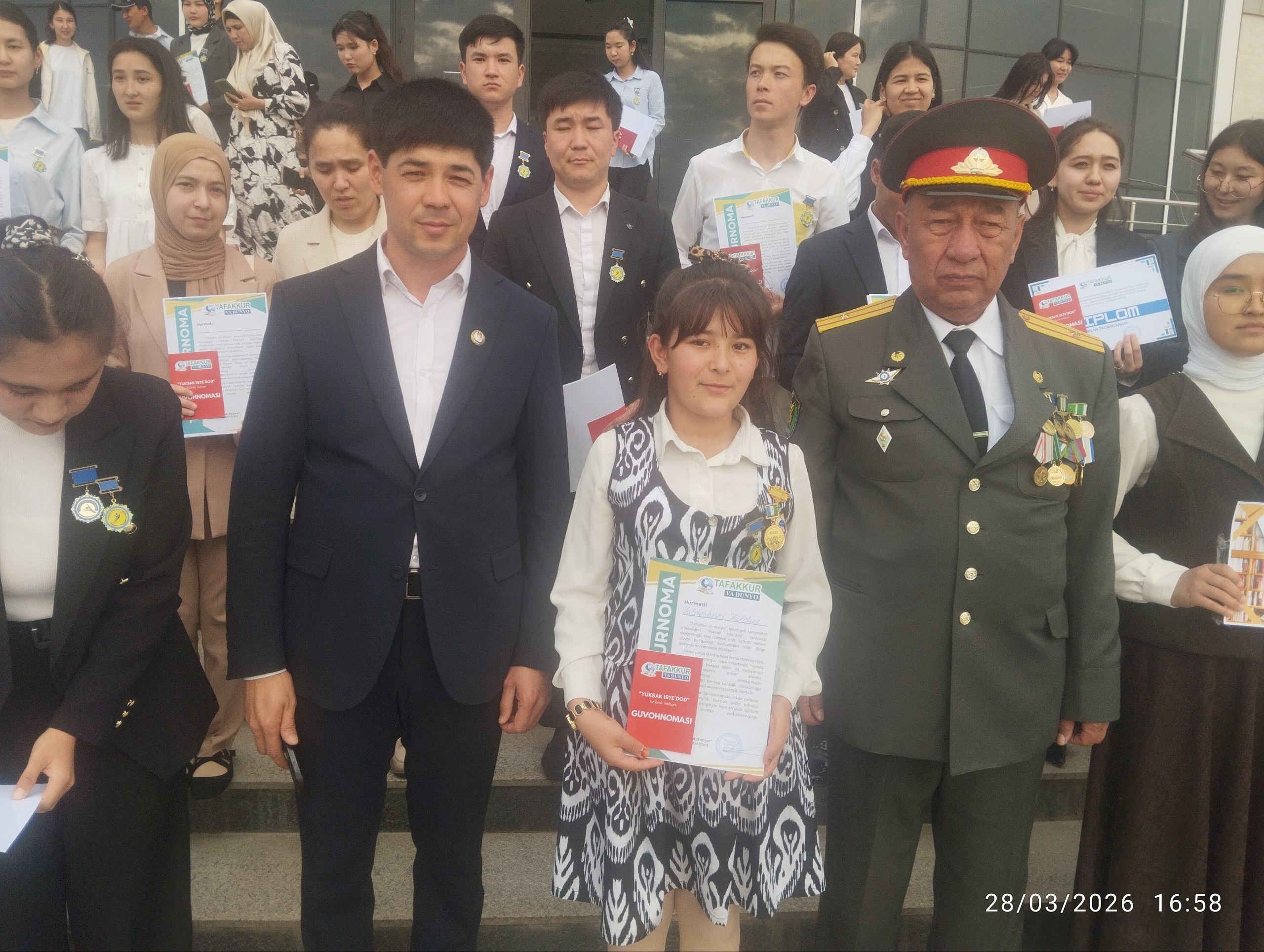
Oʻktamova Sabrina Mahmud qizi is a prominent and highly intellectual young representative of modern Uzbek youth, distinguished by her thirst for knowledge, social activism, and ambitious goals for the future.

Born on March 24, 2007, in Karshi city, Kashkadarya region, into an intellectual family, Sabrina graduated from school with excellent grades. She gained admission to Karshi State University (QarDU) on a state grant, where she is currently pursuing her bachelor’s degree in Ecology.

Despite her young age, Sabrina’s ability to fully capitalize on opportunities and achieve remarkable success is greatly supported by her parents, Islomov Mahmud and Geldiyeva Shahnoza. Her elder sister, Jasmina Makhmudovna, has been a key mentor and a significant source of inspiration in fostering Sabrina’s profound passion for knowledge and excellence.

Sabrina’s current achievements include:

• An active Eco-Volunteer and Social Volunteer.

• Regional winner of the Vociep project.

• Member of the “Children and Youth Support Movement” and a recipient of its special badge.

• An active member of the People’s Democratic Party.

• Recipient of over a hundred certificates from various educational and extracurricular programs.

• Participant in several international forums.

• An active participant and international certificate holder in the recent International Eco-Zakovat competition, recognized as a talented and active student and leader.

• An active member of the Kashkadarya “Golden Wing” Organization and the Youth Golden Wing initiative.

• Recipient of multiple Machine Learning (ML) grants.

Sabrina embodies a dynamic spirit, combining academic excellence with a strong commitment to social and environmental causes, making her a highly promising future leader and expert in the Field of Ecology

Essay from Sunday David Kokoette

Most civilizations that ever thrived under the sun preserved and even transferred their history through an art called writing, from the Egyptian hieroglyphs to the Ibibio’s Nsibidi, these people used their art to record significant events, convey coded messages and inscribe their existence on the sands of time. Since then, the pen has always been some force if you like, philosophers and quote giants have asserted that the “pen is mightier than the sword”. Civilizations where the pen has moved the polity abounds in history. It was because of the pen and its force and binding authority that European powers sat amongst themselves and shared the continent signing formulated treatises that allows them to exploit these colonies. It was because of the pen, and its force that Martin Luther broke out from the corrupted mother catholic church protesting with his Protestants. It was because of the pen and its force that we have the honour of enjoying the melodious lingua franca of Shakespeare which holds heavier meanings and connotations than contemporary English language. The writer is the record keeper of every civilization, every movement towards change and comfort have always been sparked by the force of the pen, so the poets, playwrights and lyrics writers are the train that conveys people towards this steady movement towards change and comfort. Sometimes, the movement might be stressful. Nicoloio Machiavelli gave the Prince a blueprint, a guide on governance and leadership, even though the end justifies the means, the price may be too big to pay. The force of the pen is the reason why America thriived as a civilization.

In societies bedridden by decadence and impunity, the pen could be the only doctor capable of  healing the society of these decadence. These privilege is only available to the curious minded, the man that seeks for solution in the midst of chaos, anarchy and injustice. Just hindsight can give a man a measurable amount of knowledge required to solve a problem. My comparison of men have compelled me to place him under two umbrellas which are:

1. The man who reads
2. The man who doesn’t

The man who reads is considered an elite, like a computer updates itself, this man has become aware, not just of himself but of his environment as well as its problems. This is seen in his demeanor and probably action, but this may be subject to his environment as the famous saying that says. “When one is in Rome, one is required to behave like a Roman”.

The man who doesn’t read is like a clone, a blind follower who has refused to think for itself as a species but rather steps in the footprints of failure and the darkness of being outdated. The most notable trait among such men is their tendency to create problems and hard times.

Conclusion
The pen and its force are the pillars of every society, it may not be popular but underestimating its impact and value might be a very big mistake, like missing your Queen on a chessboard. 

Essay from Timothee Bordenave

This essay will explain one of the ideas I have, very dear to my heart now, that we could use the chemistry to solidify and ameliorate the plastics materials, in order to use them in many more applications than today they are. And that we could do so as per a new utility for our plastic waste widespread across the world.

*****

The solidified plastic component.

In the daily use of items made of metal—and often, around me, of that rust-proof metal that allows for longer service life and offers the properties associated with metals and alloys (specifically resistance to pressure or torsion—or, to put it another way, solidity, at least as far as I can observe)—a very simple thought occurred to me (which you might deem naive): many of these metal alloys, or metals rendered rust-proof through chemistry, could easily be replaced by other materials for the same purposes and with virtually the same utility—often, I believe, with even greater practical utility—and, from what information I gather, at a much lower cost! Specifically, they could be replaced by some of the plastic materials that modern chemistry enables us to create!

Indeed, given that we can now easily engineer very hard thermoplastics—producing materials like polycarbonates that are incredibly strong, rust-proof, and virtually impervious to water—and given that we can (or so I understand) readily make plastic materials that are nearly fireproof and highly heat-resistant, we have—easily and cheaply—a plastic component that could be molded for many applications usually reserved for “stainless metal”…

One could design components for door and window fittings. Interior and exterior cladding components—such as vehicle bodywork or fuselage sections—or even structural elements like armor plating and furniture (as is already common), and perhaps even machinery parts, such as engine components, drive shafts, or gears.

Also, a wide range of household tools—hammers, shovels, screwdrivers, kitchen mills, and many others.

And perhaps even structural or framing elements for construction?

The primary immediate benefit would likely be a reduction in production and assembly costs. Naturally, the chemical composition of such hard, durable plastic elements would need to be designed first; this would likely yield a range of formulas, allowing for the creation of materials ideally suited to specific applications.

An entrepreneur looking to cut production costs might well consider reclaiming plastic waste—melting and reprocessing it for this purpose. We are well aware of the vast quantities of plastic waste scattered across the globe or sitting in landfills. It was actually while discussing my project—using nets to capture plastic waste at river mouths—with friends that the idea struck me: we could easily derive new uses from this existing mass of composite plastic waste through minor modifications—specifically heating, adding chemical solutions, and employing processes such as the thermosetting of polycarbonate compositions (which could also be engineered to be fire-retardant).

This same approach could—perhaps for different purposes—be applied to various other materials, such as vitrified ceramics and, most notably, wood; after all, it is well understood that wood can relatively easily be made extremely hard and resistant to heat, fire, and wear. Today, there are stylish watches made of wood, featuring a lacquer finish that protects them from moisture and corrosion…

And if I mention here the processing of plastic materials—specifically to make them fire-resistant and exceptionally hard and durable through thermodynamic methods, notably in the form of “polycarbonates”—it is to reiterate a key point: plastic waste and scrap can be found all over the world. While not biodegradable in their raw state, once recovered and reprocessed—simply by melting them down and applying chemical treatments—they could provide a vast supply of potential industrial components or even manufactured tools of genuine commercial value.

This was my idea—admittedly very simple, and perhaps you might even consider it naive. It turns out that plastics—in the form of waste or scrap—are now deemed dangerous to our natural balance and the environment by scientists and environmental advocates alike. In my view, one could easily develop a business model based on reusing them for this purpose—one that would serve the cause of the environment while also delivering social and economic value.

Born in 1984 in Paris, France, Timothee Bordenave is a French author of fiction and essays, and a poet. He has published many books, about 25 to date, and his literary works have been translated in large parts to about 20 languages… He is also a visual artist, whose photographs and paintings have been shown in France and in various international locations.

He used to work directing libraries in Paris, and then nowadays he is a full time creative. Timothee Bordenave has received several awards and distinctions, from around the World.

Poetry from Maja Milojkovic

Younger middle aged white woman with long blonde hair, glasses, and a green top and floral scarf and necklace.
Maja Milojkovic

Raindrops

Raindrops fall silently from the sky,

The rose in the garden gently unfolds its petals.

And love, like a river, flows deep,

Entwined with rain and flower, in an endless dance.

Gracefully, the rain kisses the rose in the night,

Gently illuminating it with its droplets.

And the rose, like a lovestruck maiden,

Receives rain kisses with joy and a smile.

Love, like the scent of a rose in the air,

Softly envelops the heart, making it strong and tender.

In this union of nature and emotion,

We discover the beauty of love that doesn’t fade even when the rain stops.

Maja Milojković was born in Zaječar, Serbia. She is the deputy editor at “Sfairos” publishing house in Belgrade, Serbia.  She is the vice-president of the association “Rtanj and Mesečev poetski krug”.  She is the author of 2 books: “The Circle of the Moon” and “Trees of Desire” She is the editor of the International Anthology “Rtanjski stihopevi” One of the founders of the poetry club “Area Felix” from Zaječar, Serbia and the editor of an international e-magazine for creative literature and culture “Area Felix”.

Poetry from Qahramonova Zaxro

To My Dear Father

You are everything I have in this world,
My pride, my patience, my honor unfurled.
My shield, my strength, my greatest treasure,
My dear father, whose love knows no measure.

You have endured so much pain in this life,
Yet faced it all with courage, without strife.
You gave your strength and soul for your children,
My dear father, whose love has never weakened.

You raised us with care, never letting us ache,
With patience, each difficult day you would take.
You showed us the world, took us far and wide,
My dear father, always there by our side.

With your advice, you gave us love and light,
A love so magical, pure and bright.
May you always live surrounded by your children’s affection,

My dear father, whose love is beyond perfection.

To My Dear Father

With my tiny hands raised in prayer,
I ask Allah for your life to spare.
May my prayers reach the heavens above,
For all I wish is your long life, my beloved father.

What have you not seen in this bright world?
How much pain, how many hardships unfurled?
With patience, step by step, you carried on,
And finally, the days we dreamed of have come.

Never say, my dear father, that you are less,
Never bow your head to those who bring distress.
Look upon the world with kindness and care, dear father,
For with you, this bright world blossoms fair.