Faleeha is a poet, teacher, editor, writer, and playwright born in Najaf, Iraq, in 1967, who now lives in the United States. Faleeha was the first woman to write poetry for children in Iraq.
She received her master’s degree in Arabic literature, and has now published 26 books, her poems have been translated into English, Turkmen, Bosnian, Indian, French, Italian, German, Kurdish, Spain, Korean, Greek, Serbia, Albanian, Pakistani, Romanian, Malayalam, Chinese, ODIA, Nepali and Macedonian. She is a Pulitzer Prize nominee for 2018 and a Pushcart Prize Nominee for 2019.
She is a member of the International Writers and Artists Association, the Winner of the Women of Excellence Inspiration award from SJ magazine 2020, the winner of the Grand Jury Award (the Sahitto International Award for Literature 2021), one of the Women of Excellence selection committee members, 2023, the winner of Women In The Arts award 2023, a member of Who’s Who in America 2023, on the SAHITTO AWARD, JUDGING PANEL 2023, and a Cultural Ambassador – Iraq, USA.
Molly softly shut the door to her bedroom, in pursuit of elusive but precious privacy. She didn’t like her stepbrothers just barging in on her. Butch was mostly okay, but the other one was — dangerous. Mostly he was just ignorant, and plainly didn’t know how to live with civilized folks. She plopped down on her bed, took out her yearbook and glanced through the photos of fellow students from her sophomore class last year. So immersed was she in her reverie that she didn’t hear the knob turn and the door open silently. She didn’t see the shadow fall across her prone form and she didn’t understand what was happening, as she was seized from behind by strong, brutal hands. Her dress was forced up her body and she was soon naked from the waist down; then her assailant penetrated her. She opened he mouth to scream in pain, but rough hands clamped around her lips to silence her.
. . . . .
When Sergeant Mike Dudley glanced out into the waiting room of the police station, at first he didn’t spot the child. But then, there she was, standing quietly before the window. Dudley frowned, looked beyond the girl and sought out an adult who must be accompanying her. There was no one. He peered over the small ledge abutting the window.
“Can I help you, miss?” he asked.
She spoke right up. “I have been raped,” she said.
Dudley frowned more deeply, then he went to the door and invited the girl to enter. “Follow me,” he said, and she fell into his wake. He took her to an interview room, sat her down, and then introduced himself. “What’s your name?” he asked softly. She gave it to him. “How old are you, Molly?” he asked next.
“Sixteen and a half,” she said bleakly.
Dudley went on to ask Molly her address, telephone number (her family had no phone), her parents’ names, who else lived with her and her parents, and the garden salad variety of questions that the police asked everyone who passed through their portal. Finally, he got down to brass tacks. But for her brief answers, she was remarkably subdued.
“Who assaulted you, Molly?”
Molly looked down at her shoes. “I can’t tell you,” she replied quietly, peeping out of a well of shame and self-rebuke.
“Why can’t you tell?” Dudley inquired.
“Well, I want to know what would happen, if they got arrested. Would they have to go to jail? Can’t we discuss it like a ‘what if’?” She asked. Dudley blinked at her, but relented, and gathered the speculative particulars of the incident. Gently, he extracted the 16-year-old’s horrific account of the ordeal. Had the rapist beaten her? No. Had he threatened her with harm? Not really. Had he overpowered her? Yes, he was very strong.
After conducting the interview for some little time, Sergeant Dudley excused himself to Molly to consult with the watch commander. He leaned in through the commander’s open door.
“Captain Davis,” said Dudley, “I’ve got a teen out here, a Molly Devereaux, said she was raped by someone she refuses to name.”
The commander regarded his Sergeant incuriously. “What does she want us to do about it?” he asked bluntly. “It’s already happened, can’t take it back. Besides, think of what pressing charges would do to whoever did it. Probably another randy teenager.” He shook his head dismissively. “In this state, they’re talking about introducing ‘sex education’ in high schools.” He chuckled. “Tell her to consider this her advanced placement.” Dudley didn’t smile, but stood there and stared at his superior. Davis went on thoughtfully, “I guess sixteen is old enough to get knocked up…”
“She said he used a rubber,” Dudley spoke up.
“And now she wants to claim rape?” asked the watch commander incredulously. “What did she do, help him slip it on?” He snorted “She was complicit, you ask me.”
“So what do you want me to do? How should I handle it?”
“The parents, they got a phone?” the other man asked. Dudley shook his head no. The commander rolled his eyes. Still, Dudley stood there expectantly, waiting. “I tell you what, Mike,” said Davis. “Blow it off. Tell her to keep it under her hat, that she can get into serious trouble spreading lies. She only wants attention. But, that’s no reason to take it out on everyone else. How was she dressed?” he asked. Mike shrugged. “It’s a mare’s nest; just sit on it, Mike.”
“No police report?”
“Hell no!”
Mike nodded and exited the watch commander’s office. Returning to the desk where he’d left Molly, he observed the teen earnestly watching him approach. She looked awfully small and vulnerable, he thought. Pretty young girl, no wonder she got raped. It’s asking a lot of a healthy young man to resist a normal temptation, he reflected, recounting his own youth.
“I talked to my captain, Molly,” began Mike. She looked up attentively, but peering closely, he could see she was trembling slightly. “And he said you should just try to forget about it. The boy probably didn’t mean any harm. He didn’t actually hurt you, right?” He peered into her beautiful but troubled green eyes.
She took a great breath and released it. “No, sir,” she murmured softly. “He didn’t hurt me. But, I’m scared of him now. Now he can do it again, anytime he wants. That’s why I reported it,” she explained. “I was reading this book…”
“No, Molly, I don’t think he’ll ever do it again. Boys are like that, they experiment, take dares, act out, you know. He probably only wanted to show off for his friends.” He smiled kindly. Without another word, Molly climbed to her feet.
Mike stared at her as she walked away, buttoned her jacket, and swiftly departed the room. He heard her footsteps echo as she walked across the tile station floor and out the door.
“What,” thought Mike tiredly, “could I have done?” After a moment, his interest in the girl faded and he proceeded onto important police business: he had to monitor the Deale Street parking meters this afternoon, he remembered.
2
“Get to bed, Molly; it’s near midnight,” said her mother Debra from the doorway of her daughter’s bedroom. Molly rolled her eyes impatiently, but rose from behind the deak, closed her textbook with a snap, and prepared to comply. “Come give us a kiss, babe,” said Mom. Molly walked into the living room and bussed her mother’s cheek.
“How ‘bout one for dad?” asked Don, her stepfather, sitting at the end of the dining room table, smoking a cigarette. Molly visibly hesitated for an instant, but once more, complied. Don patted her rump and Molly stiffened for an instant, then danced off to her bedroom, glad to be alone again.
. . . . .
At practice on Thursday afternoon, Lucy noticed that her best friend just wasn’t with it. In fact, the cheerleading coach upbraided her for inattention and lack of concentration. “This is the game of the season, ladies, and we want to do our seniors proud,” crowed Mrs. Buchanon. They went through their routine yet again.
Afterwards, in the girls’ gym dressing room, as they changed out of their costumes, Lucy asked her friend, “Mol. what’s eating you?”
Molly looked up from tying her laces and shrugged. “Dunno. Just not into it today, I guess.”
“Trouble with Bobby?” she asked with a malicious twinkle.
Molly smiled wryly and shook her head. Bobby was the fullback on the football team and their best player. “My life is a mess,” she admitted, but Bobby is my rock. Nothing would count without him.” She could never let Lucy believe there was anything wrong between Molly and Bobby; she would grab him in a hot minute. Bobby was all Molly’s!
“Brothers?” inquired Lucy with an arched brow. “Again?
With a frown, Molly nodded. “Before Mom and Don got married, we only got together for like, dinners and stuff, but since the wedding they’re always in the way, you know?”
“Yeah,” agreed Lucy. “Butch is sort of a terror, but I think that Tod is pretty cute.” Molly froze, and took shallow breaths as Lucy went on about Tod’s sculpted arms and shoulders, from all the weightlifing he did.
“You wouldn’t think so, if you had to live with him,” she remarked, finishing tying her sneakers and springing to her feet. It felt good, just to talk about it, if only superficially. She couldn’t tell the whole truth, not even to Lucy.
. . . . .
At the football game that Friday night, Molly was clearly distracted, and it showed. The next morning, Mrs. Buchanon suspended her from the cheerleading squad for one game, unheard of discipline that the coach hoped would jolt her awake.
“You can’t take me off the squad, Mrs. B,” pled Molly, tears welling in her eyes. “Cheerleading is the only thing I have going for me right now,” she said, her voice breaking.
“Molly, I’ve got counseling to do right now; we’ll talk this afternoon,” and she picked up a tote bag filled with files and left the office.
. . . . .
“They scrubbed you off the cheerleader squad?” exploded Bobby, wiping sweat from his brow. They were meeting at the practice field, where he was working out. “What kind of shit is that?”
“Mrs. B thinks my mind isn’t on my workouts,” she explained. “She suspended me for a game.” She shrugged helplessly. “She thinks maybe I’ve got too much on my mind.”
“Bogus,” snarled Bobby, then approached Molly and encased her in his strong fullback’s arms. She nested her head against his chest. “I mean, what could possibly be on that pretty mind of yours? You want, I can tell Coach to talk to her. He got her the job.”
She pulled back from his chest. “He did?” she asked, surprised.
“Yeah, they had a thing going, back in the day, and he recommended her,” replied the student athlete. And Coach was on the team with the Superintendant, like a thousand years ago. They go way back. That’s the only way you get anywhere,” he said ponderously, tipping up Molly’s chin with his finger. “It’s not what you know, but who you know,” he declared knowingly.
“But I don’t know anyone,” she lamented. My dad is the garbage man.”
Bobby chuckled and said, “You know me. And I take care of what is mine. You’ll be back on the squad by tomorrow, I guarantee it. By the way,” he said winsomely, “I love you, Molly Devereaux.” Molly gazed into the distance and frowned thoughtfully.
. . . . .
“Molly, I love you; I love all my girls and I want to help you to be the best you can be. Cheerleading is the highest crest that a girl can reach, and I want you to appreciate the opportunity — and bear the responsibility — you hold as a student leader.” So said Mrs. Buchanon later that afternoon.
Molly stood in the girls’ athletic office, quietly sobbing. Mrs. Buchanon spoke again, in a kinder voice, “Tell me, Molly. I know something serious is bothering you. Are you doing alright in your classes?” Molly nodded. “Then,” said Mrs B, “are you having problems outside of school?” Molly said nothing. “Talk to me girl,” she coaxed. And so she did. Mrs. Buchanon was probably the only person she could trust. So Molly opened up. The last thing she said was that “he’s done it twice, so far. Once in my bedroom and once in his.” Mrs. Buchanon grew quiet as stone and pondered.
3
Molly lay flat on her stomach across her bed, reading the Maya Angelou book that she’d found in the school library. This new writer was really good. She paused suddenly in her reading and froze. Turning back a page, she read and read again. She had stopped breathing. Suddenly a weight fell heavily across her body and she shouted in alarm.
“What’re you screaming at?” asked Tod, grabbing her hands and playfully holding them behind her back. As she struggled, he laughed hoarsely. Into the room burst her stepfather Don, who made Tod release his stepsister at once.
“What the hell?” Don demanded.
Tod was still laughing. “We’re just roughhousing,” he explained, getting up off the bed and sauntering blithely out of the room.
Molly lay there shivering. “You alright, Mol,” he asked tentatively. But she wouldn’t speak and she wouldn’t look at him.
. . . . .
“Mom,” began Molly, catching her mother alone in the kitchen, “did you think about what I asked you?” Her mom was peeling carrots, holding them under the water, and then dropping them into a steaming kettle of water.
“I did, Molly,” she replied. “Don and I discussed it and he feels that putting a lock on your door would be a mistake.”
“But why?” she inquired, frustrated.
“He said that when he was growing up, he never had locks on his doors, and he just doesn’t think it’s a good idea. He thinks it would be — unfriendly.”
“But, he grew up with four brothers.”
Mom shook her head. “I’m sorry, Molly, I talked to your father like I told you I would, and he said no. And he’s the man of the house, so he’s the boss.”
“He’s not my real father,” she mumbled crossly.
“Molly Devereaux!” admonished her mother. “You know Don tries, and so do the boys. You just need to loosen up, let them love you. They do love you, you know!”
Molly could only shake her head. “Thanks for asking, Mom,” she said in defeat, and picked up a carrot and began peeling it.
4
“Molly,” said Mom, stepping boldly into her daughter’s bedroom. Molly jumped, then gulped some air. “What’s wrong with you?” asked her mother sharply. “You’re on pins and needles.”
“Nothing, why? You just surprised me is all.”
“Something’s going on,” accused Debra. “Mrs. Buchanon, your guidance counselor, called today. Molly thought for a moment. Mrs. Buchanon was also her cheerleading coach. “She said that your chemistry teacher told her that you’re failing her class.” Molly looked annoyed. “Science is your best subject, Molly, and now your bottoming out in a basic science course. You wanted to be a doctor.”
“You wanted me to be a doctor,” Molly corrected her.
Debra frowned. “And you’ll be bumped off the cheerleading team too, if you fail a course. And,” she added sternly, “there’ll be no more Bobby.”
At this, Molly’s eyes grew wide with alarm. “Not Bobby,” she fairly squealed. “He’s the only reason I can go on,” she cried. “He’s the most popular boy in the school and he’s the best football player, and he’s so gentle…”
“Maybe you’re seeing too much of that boy,” Debra suggested. You spend every weekend with him, when you need to be studying chemistry.”
“You don’t understand the pressures I’m under, Mom,” she said wretchedly, as tears welled up once again.
“Then explain them to me,” she said. Molly said nothing. “Well,” said Debra, I’m having a parents/teacher conference with your guidance counselor tomorrow.” Molly’s face fell. “I’ll ask her what to do,” said Mom.
“You’ll be seventeen years old in three months and in a year you’ll be going off to college.”
“I don’t want to go to college anymore,” said Molly peevishly. “I want to drop out of school and get married.”
“Oh no you don’t,” snapped Debra. “That was my plan too, and look at me, scrubbing tight-fisted women’s filthy floors for $2 an hour. No, Molly Devereaux, I demand so much more for you, because you’re smart. Not like me.” Molly’s heart melted. “Don feels the same way about the boys; he doesn’t want them to grow up to be a garbage man like him! That’s why I’ve always been so hard on you. I will have more for you! We’ll talk again tomorrow night.” She paused in the doorway for a moment and murmured, “I love you, Molly.” Clutching her dish rag, she walked out of the bedroom.
Would the B tell Mom what had happened? What they had talked about was confidential; she couldn’t tell!
5
Debra appeared as if by magic at Molly’s door, before supper the next evening. She stood in the doorway for some time before Molly looked up from Maya Angelou. Molly jumped in surprise. “Mom,” she began, did you and the…Mrs. Buchanon talk?”
Debra said nothing, but entered the room and sat next to Molly on her bed. To Molly, this felt heavy. Then Debra spoke. “Molly,” she said, “I’m really disappointed in you.”
“Why, what do you mean?” she asked.
“Mrs. Buchanon told me what was happening with you and Bobby,” she replied.
“Mom,” she interrupted, “I wanted to tell you, but….”
“You didn’t think I could understand?” conjectured Debra.
“No, I knew you’d understand.”
“Molly, are we talking about the same thing?”
“You love Don,” said Molly. “And I know that he forces you to have sex with him at night, after you’ve both been drinking.”
Debra’s face grew dark as a thundercloud. “Stop it! Shut up! Don’t you dare talk about your father like that!”
Now Molly was confused. “But, I’ve heard it before,” she said plaintively. “IThe sounds, the voices, coming from your bedroom. I just thought that’s what married people did. People who loved each other. I’m sorry, but it doesn’t feel right to me.”
“We’re not talking about the same thing,” said Debra.
“Well, what did Mrs. B and you talk about, then?” asked Molly.
She told me she talked to you, and you confessed that you were trying to get yourself pregnant by Bobby, so he would drop out of school and miss college, to marry you and raise up some bastard.” Molly could only stare at her mother, aghast. Debra went on, “You may decide you have no future, but that boy will amount to something. He’s signed a letter of intent to play football for an Ivy League college next fall, and we’ll be damned if we let you get away with it. Mrs. Buchanon also got a call from a Captain Davis, with the police department, and he said you filed a bogus rape charge against poor some unnamed student. He wanted to know if there was anything to it. She told him there wasn’t.”
“I filed the complaint after I read this book,” said Molly, holding up “I Know Why the Caged Bird Sings.”
Debra huffed. “And there’ll be no more of this nonsense,” she said, seizing the book and confiscating it. “You’ll not get away with this, girl. There’s a penalty for lying!”
gets you. They think you are normal, you’re not. You are splitting apart on the inside.
as you sink more and more into aloneness,
they pass judgement on your actions.
they say insensitive things
like; chill out, take a pill, see a
shrink or they distance themselves.
they think you’re out of character,
they don’t know there is a struggle
going on inside of you, a real struggle
where tears flow and make puddles in
your soul… and nothing works; no Hail Marys,
no affirmations, no nothing.
you wait for an episode
to pass to get relief, that’s if you are
lucky, cuz for some, relief doesn’t come.
you see the severely affected on the streets
far gone, listening to the voices in their heads,
sometimes succumbing to them. It’s a
daily struggle that only those feeling the ache knows. Give a care.
Sheila’s writing style can best be categorized as Visual Poetry, blending emotion and vision into a poem or story of color. Her poems and short stories are featured at Spillwords Publications, Literary Yard, Cafe Lit magazine.uk, Imspired Magazine and Clarendon House Publications Poetica 2 and 3. She is a featured poet at PoetrySoup. Her work is also featured in several anthologies and in the youtube series Poetica 2. She was Author of the Month at Spillwords.
a mind in a marble


in an echoing, wide open world far far away from you, i run.

only then

to stop suddenly.

and a shout rings out as i cry in circles…


turning into a tune, that begins to play,

splintering from the last letters of scream.


 and I'm thrown into a nightmare.

my breaths beating,

unsteady.


imagining the end,

of everything.

the tune,

the world,

the screams,

my life,

you.


who waits at the end,

holding a gift wrapped in red,

that melts when i reach out

causing the iron stench of blood

to pinch my mouth

from nowhere and everywhere

all at once.


this isnt something i want.

just something given to me,

something expected of me,

but not quite

not yet

me.


nevertheless,

i take this gift for now.

because something else

red

taints my vision.


love or possibly hate

for the tune,

the world,

the screams,

my life,

you.


who has,

given everything,

knows everything,

loves everything.

just as i will.


but you, are not quite,

and never will be

me.
The Chander Gare ( one kind of roof opened van) with eleven young men has just stopped. The place is crowded. Many vehicles from the opposite side come and stop here for Sometimes . Different kinds of shops are busy with their customers. Some children are uttering different words to attract the customers to sell their handicrafts, fruits and foods. Among them a boy with unbrushed hair but innocent and with deep eyes of near about eleven comes to Chander Gare to sell bananas. His two hands are full with fresh and big bananas. He says:
– Sir, please buy my bananas. These are fresh and testy. These are also medicine free. One of the eleven young gentlemen says – How do you know all these things. Have you eaten any of them? The boy is laughing half with two lips and says with sweet sound -Sir, these bananas are from my banana tree. Who knows well about these more than me? You can take without any confusion. -Who will give guarantee about your story?
-Guarantee? Guarantee has no guaranty but look at my eyes. These eyes do not misguide you. My mother does not teach me to tell a lie. If I tell you lie my trees will die and Nature will take revenge. – You are more mature than your age. -I don’t understand what you are saying. – What is the price of your banana? -8 taka per piece, but one pair is 15 taka. – ok. Give us 11 pieces. – Sir, that will be difficult for me to calculate. – We are eleven and we need eleven pieces.
Don’t worry. I shall give you 8 taka per piece. Give us the best eleven pieces. – Here you are, Sir. -Thank you. Take your money.
The Chander Gare starts to move very fastly. The boy counts the money. It is one hundred taka. He is in a fix. He wants to return the excess money but the Chander Gare is out of his sight. He is thinking what to do. He shares the incident with his friend, Alex. Alex says -Jon, you have nothing to do. You are not responsible. Keep the excess money to you.
Jon says – I do not agree with you. I want to return the excess money. – It is impossible. But I have another idea. Jon asks Alex – What is it? Please tell me. – You can give the excess money to a beggar. I think it will be better. Jon says with high voice – I have got an idea. Alex comes to him and asks
– What is it? -I have to go. Time is very short. – Where do you want to go? – I want to go to the next and final stoppage. I think I shall get him there. – That will be impossible. -Pray for me. Jon starts his journey by a bus. All the vehicles stop in the next stoppage. This place is border area between two countries. People of two countries come and go from here. So they have to stay for some formalities of the offices. After maintaining the formalities they can cross the border.
Jon reaches the place but it is too late. He sees the eleven young men but they are far away. They have just crossed the border. They are walking. Jon says with high sound, -Sir, please take your money. I am here only to return your money. I do not want to take your money. The eleven stars shine brightly. One of them looks back. He becomes surprise to see Alex. He stops for a while and says – You have come here to back money. We are happy to see you here. We praise your honesty. We do not want to take money from a boy like you. We are pleased upon you.
-I have come here to back your money. Please take your money. I don’t want to take excess money. My mother has taught me not to taka extra money from any customer. -We have not enough time to come back and you can not cross the border. So keep the money. -No, I don’t. I am very poor but not beggar. I need money but I do not need money of others. Please forgive me. -We have no option. Alex collects a stone. He binds the money with the stone and throws the stone to the eleven young men. The stone crosses the boundary and it floats in the air of honesty. Alex sees the stone where he see the face of his mother.
What function does mise-en-scene play in the composition of the atmospherics of a film? Substantiate with examples from the prescribed texts in the paper.
Mise-en-scene is the design and arrangement of actors in scenes for a theatrical or film production, both in the visual arts through storyboarding, visual themes, and cinematography and in narrative story telling through direction. It can be contextualized as the environment or milieu of the physical setting of an action [as of a narrative or a motion picture]. Light and camera, prompts and gadgets, costumes and apparel wear, pantomime and mime essentializes the abstraction of cinematic aesthetics—-mobilized and virtual gaze of the bodies and objects by sequential cluster or constellation of images [image fields] through kinesthetics of the montage in filmic frame is the canon of mise-en-scene—cinematic movements and cinematic effects within the cinematic tourism vistas; offering endowment of internationalization or hybridization of locales and cultures through cross bordering portability of diasporic films by digital reproducibility in montage or film editing [diffusion, dispersion, disruption, inversion, transportation, recontextualization] technique. The composition of the atmospherics of a film acknowledge negotiation between Albert Einstein and Walter Benjamin which can be explained in filmic language and cinematography. Einstein propounded the theory of the fourth dimension, extrapolating the intersections and overtones of visual and aural dynamics; Walter Benjamin characterizes this interweaving of body and images in digitally technologized reproducibility as the reception-of-a “state of distraction.” Mise-en-scene in a nutshell fosters the fundamental transferrable skills to the production and reception of a film and establishes the pragmatics semantic field of literary history and cultural memory.
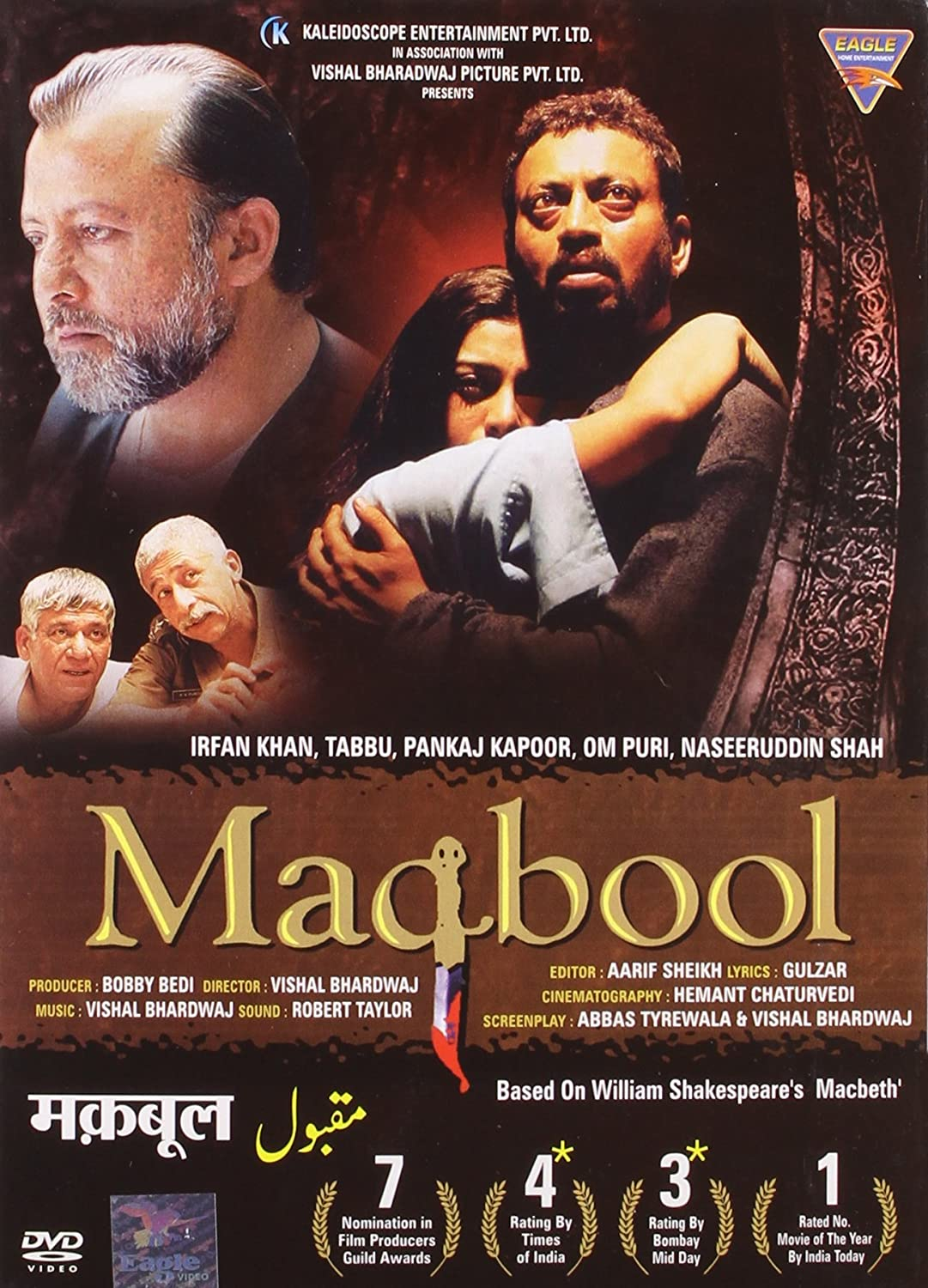
Reconsidering English playwright William Shakespeare’s Macbeth to the recontextualized adaptation of Indianized film production hybridizes Shakespearean Elizabethan England with the post independence and post colonialism mise-en-scene. “Maqbool” [2003] is critiqued by the directorial sententiousness in altruism of humane temperament which digresses the hegemony of cultural imperialism and/or cultural resistance as resonated in another blockbuster Bollywood cine picture talkies “Agneepath” [1990]. [Lord Hardinge, as governor-general, issued a resolution on October 10, 1844, declaring that for all government appointments preference would be given to the knowledge of English.—the instance of colonialism as symbol of the hegemony and /or resistance of imperial culturalism becomes the quintessential reference in film narratives.] Amitabh is the star cast heroic protagonist, gestures appeasement for the mother as lady of the hearth’s fiery temperament is immortalized with the imperative in the diegetic: “All the waters of Bombay will not cleanse the blood from your hands” resonates Shakespearean dialogism of somnambulistic Lady Macbeth. On the contradistinction, Vishal Bhardwaj’s Maqbool [2003] “Pure as the naked new born babe […] Shall blow horrid deed in every eye/ that tears shall drown the wind” in exemplification of treachery of the treasonous felony of Maqbool [slaughtering of Jehangir Khan Elias Abbuji] is the after effects/ aftermath of the seedlings of ambition matured by the profanation in the epiphany of Nimmi and the investigating law enforcement agency to a certain extent. This transgressivity is the depolarized effect in connotative diction that contextualizes futility of nihilistic anarchy in the “Throne of Blood” [1957]. Akira Kurosawa’s adaptation of Macbeth in the “Throne of Blood” [1957] illustrates the fruitlessness of worldly ambition and the limitations of free-will in Shakespearean rhetoric of the trajectory of Macbeth’s downfall—Macbeth’s tragic flaw is not the blind lust for power or vaulting ambition but the hamartia beneath the presupposition; that he was a free agent in a world where his actions are ultimately predestined or circumscribed; that tracks his degeneration from a poet-warrior into a merciless power hungry tyrant; hereby, shifting the mise-en-scene from medieval Scotland to postimperial post feudal Japan. Samurai Lord Tsuzuki resembles the cherubic-angelic saintly king—the prey of assassination by felon Washizu — the superimposed agent depraved of human agency and this masochistic emasculation blooms the impotency in a functionary character.
Since original Shakespearean film productions apparently disharmonize the audience of post colonial Indian subcontinent or Japanese post feudalism, hence the theatre drama has been altered through manipulation and interpolation of scenes, characters, actions, settings and plots—a frontality of presentation, declamatory and histrionic vocalization with rhetorical and visual flamboyance in hybridized performative of vernaculars—either pure and pristine or bowdlerized and indigenized. The mise-en-scene of long shots, deep focus, panning and tracking shots of Western realism and static frame and hard-edge wipe of Oriental formalism coalesces. Erin Suzuki’s “Lost in Translation: Reconsidering Shakespeare’s Macbeth and Kurosawa’s Throne of Blood” notes, “Kurosawa’s Shakespeare is inevitably—-and fortunately more Kurosawa than Shakespeare. With blunt and vital irreverence, the director has translated Shakespeare’s words into Japanified images, Shakespeare’s lords into Japanified barons […] the spectator scarcely has the time to realize, that the images deafen and the noises colour his imagination, that he is experiencing the effects of cinema seldom matched in their masculine power of imagination.” Nonetheless this hybridization and fusion of mise-en-scene in “Maqbool” [2003] is justified in the language of Vishal Bhardwaj “My film is not meant for Shakespeare scholars […] My interpretation is not text-bookish […] I have tried to remain true to the plays spirit than to the original text.”
How do literature and cinema intersect each other? Explain through the examples of literary and cinematic texts in this paper.
“Margarita With A Straw” interweaves themes and motifs of Charlotte Bronte’s “Jane Eyre” through mise-en-scene of canonical hermeneutics of the aesthetics and cultural anthropological readings by paradox: gendered expectations and gendered realities. Gender and disability studies of “Margarita With A Straw” can be recontextualized in the montage of filmic feminine narrative of the Victorian bildungsroman in the critical lens of Sandra Gilbert and Susan Gubar, “seems to be the projection of their own despairs into the passionate and even melodramatic characters, who act out the subversive impulses that every woman feels when she contemplates the deep-rooted evils of patriarchy.” Kalki Koechlin [Laila] the cerebral palsy undergraduate faces rejection and disavowal by the lead singer of the musical society whom both of them workshops. She, nonetheless, casts spectacle and marvel in the wonderment to fulfill a prospective semester to dreamland destination: New York University. Jane Eyre’s narcissistic rage, forlorn depression, habitual mood swings, epistemological anxieties, solitary solipsism as embedded in virulent passion, maverick temperament and rebellious mutiny are implicated to be strains of femininity with the protagonist of “Margarita With A Straw”. As literary history and cultural memory traces us to ponder the literariness of the Brontean novelistic textual adaptation becomes the quest of figurative language of filmic interpretation: “A Christmas frost had come at midsummer; a white December storm had whirled over June; ice glazed over ripe apples; drifts crushed the blowing roses; on hayfields and cornfields lay a frozen shroud”—-this dialogism is recontextualized in the spirit of Jane Eyre’s personae as linnet, imp, fairy, sylph, brownie, pixie, sprite, salamander and even a thing; whose clandestine bigamous love affair in Thornfield with Edward Fairfax Rochester blooming by the foreshadowing of fruitlessness and futility is objectified in the subjective gaze of the filmic diagesis as Kalki Koechlin [Laila] consummated into romance and sexual relationship with Jared in New York—resonances of the heroine as corrupted and dismantled sylph like fairy of gendered expectations. In terrains of gender and disability studies, subaltern and marginalized voices akin to the narratorial perspective and point of view in Laila [Kalki Koechlin] culminates the dichotomies by the polarities between taboos and conventionalities or stereotypes and bigotries in context of relationship and wedding, love and romance, puberty and pregnancy. Gendered realities have thwarted the expectations of a betrothal for the feminine disability as harmonized by the unification of the myths: undesirability and asexuality. Recollections and impressionistic readings gleaning from archives and documentaries of the film production incarnate to resurrect marginalized disability voices of the feminine gendered expectations dispelling the myth of undesirability or asexuality.
From creative writing classes with Jared to activism with foible like personage in Khanum, Laila [Kalki Koechlin] reinterprets relationship as if her life visualizes envisioning of the Jane Eyre’s exposure of liberty and egalitarianism when the Brontean heroine reclaims: “I am no bird; and no net ensnares me; I am a free human being, with an independent will: which I now exert to leave you.” Cinematic gaze of the subjective focus in the close up of Laila and Khanum as depersonalized care-givers of altruistic triumphalism reechoes the allusion to Jane Eyre and St. John River’s associationism. St. John Rivers—the missionary apostle, epitome of pilgrimage to sainthood and divine destination implores in exhortingly assertive tone: “A missionary’s wife, you must — and shall be. You shall be mine; I claim you— not for my pleasure, but for my Sovereign’s service” Or even alternative reading would suggest Helen Burns’ and Miss Maria Temple’s as influencers of Jane Eyre’s philosophical transcendentalism sermonizing preachings of morality and integrity, which sanctifies the memorial of their ultimate detachment. “to gain some affection from you[Helen Burns], or Miss Temple, or any other whom I truly love, I would willingly submit to have the bone of my arm broken, or to let a bull toss at me, or to stand behind a kicking horse, and let it dash its hoof at my chest.” “ “If all the world hated you[Jane Eyre] and believed you wicked, while your own conscience approved you and absolved you from guilt ,you would not be without friends”—this aphorism of Helen Burns later leads to fruition in the blooming springfield of Laila with the deep focus and subjective close up of fantasizing despite past of tempestuous upheaval in the brink of discontinuities, complexities, intricacies, ironies and subtleties such as the bereavement of advanced stage colon cancer affected mother and entanglement of detachment by dissociating her camaraderie with the former romancers and coquettes. Walter Benjamin’s inevitability of the on-screen camera to the receptivity of filmic audience extrapolates, “While facing the audience, he knows that ultimately he will face the public, the consumers, who constitute the market.” This filmic language can be relocated in the epilogue of the denouement: “Margarita With A Straw”. Interestingly this expressionistic freedom of choice creates vivid and impressionistic reading of Jane Eyre: “Do you think, because I am poor, obscure, plain and little, I am soulless and heartless? You think wrong!-I have as much soul as you ,-and full as much heart! And if God had gifted me with some beauty and much wealth, I should have made it as hard for you to leave me, as it is now for me to leave you.” Intertextuality of the close critical reading emphasizes that Laila would have a life of alienation in existentialist formalism unless God favours in privileging the bestowal to alleviate her deformity along with redemptive potential of individual agency.
Film critic Walter Benjamin notes of the screen actor’s relationship to the camera never enables him to forget the audience: “While facing the camera, he knows that ultimately he will face the public, the consumers who constitute the market”. Examine the Charlie Chaplin’s Modern Times [1936] in the age of mechanical reproduction.
Charlie Chaplin’s trump as silent pantomime of the film production is the flopping mise-en-scene in contrast to the talking pictures burgeoning popularity that diminishes the former’s familiarity. David James suggests that “a film’s sounds and images never fail to tell the story of how and why they were produced—–the story of their mode of production”; in Modern Times the same holds true of the story whose images tell about how they were received, the story of their mode of consumption. Opulence of the mass production of Americana materialistic consumerism stages the grandiosity of mise-en-scene in the departmental store sequences, that projects feminine proprietorship as satirized in the eagerness to satisfy the gamin’s needs and wants harboured by the contrasting daydream of the home ownership by the Trump phantasmagorial spectre.
Walter Benjamin, Paris, 1938
Film critic Walter Benjamin distinguishes between the theatrical and cinematic performances as: “The artistic performance of the stage actor is definitely presented to the public by the actor in stage, that of screen actor, however, is presented by a camera…Guided by the cameraman, the camera continually changes its positions in relation with the performance. Thus in filmic language, close up of the glaring talking industrialist capitalist [president of the Steel Factory Trading Inc.] imperative “Quit stalling, get back to work!” to the misdemeanour of the employee—- langorous solitude of cigar’s privacy is a poignant dramatization. The factory worker not only oversee as omniscient purveyor scrutinizing through digital surveillance but also appears as a magnified ubiquitous mighty power through his focal subjectivity on the screen. Even emphemeralism of the short-lived respite acquired through lunch break is flummoxing when Trump is exploited as a guinea pig on whom the President of the Steeling Inc. thrust to the impetus of experimental Billow’s Feeding Machine. Swashbuckling Charlie Chaplin’s friend Douglass Fairbanks wrecks havoc spotlighting the carnivalesque of the ‘misfit’ which society prescribes as a stint in the sanitarium.
“Science finds, industry applies, man conforms” Chicago’s century of progressive technocracy movement in the epochal boosterism reflect counterveilling pessimistic outlook towards such radical and revolutionary advancement —–automaton replacement of labour market. Trump personae is polarized between the Taylorites’ advocacy for enhancement and enrichment of the labour forces’ practical efficiencies favoured by cinematic exposition and the Edisonian disdain for entertainment of filmic broadcast—–Trump personifies humour, pathos, romance for compelling audience’s gaze. Nihilistic monotony and gruesome grumpiness pervades factory experiences of the assembly lines and firm working stations from pastoral countryside by the cinematic montage form shifting perspectives of spatiotemporality as imbued by cultural memory and literary history —–allegorizing “a story of industry, of individual enterprise——humanity crusading in the pursuit of happiness.” There and then, Charlie Chaplin’s projection of the destabilization of machine-making culture of contemporaneous society achieved spectacle in the marvellous film entertainment industry as depicted by the outcast Trump personae ostracized by the follies of frailties, institutional authorities and dumb luck.
Further Reading
Lawrence Howe’s Charlie Chaplin In The Age of Mechanical Reproduction: Reflexive Ambiguity In “Modern Times”, College Literature, Winter 2013, Volume 40, No. 1, pp. 45—–65.
Examine the relationship between literature and cinema in the context of intertextuality with references to Macbeth and Throne of Blood.
“Kurosawa’s Shakespeare is inevitably—-and fortunately——involves more Kurosawa than Shakespeare. With blunt and vital irreverence the director has translated Shakespeare’s words into Japanese images, Shakespeare’s lords into Japanese barons […] the spectator scarcely has time to realize, as the images deafen and the noises decorate his imagination, that he is experiencing the effects of cinema seldom matched for their headlong masculine power of imagination.” Film critic Jerry Blumenthal suggests that Throne of Blood was no pale imitation of Shakespearean tragic film Macbeth but “a serious, dynamic and autonomous work of art.” The scenarist’s vision is constant with Kurosawa transforming poetic language into visual imagery. New York Times film critic Bosley Crowther found the adaptation to be “grotesquely brutish and barbaric” since Kurosawa’s cross cultural and cross medium adaptations of Macbeth is neither merely a grotesque Japanified version of Shakespeare’s tragedy not a tragic transposition of the play’s essence into the universal visual images, rather, it stages a historically specific negotiations between traditionalist Japanese and imported Western culture. Kurosawa’s adaptation of Macbeth in the Throne of Blood illustrates the fruitlessness of worldly ambition and the limitations of free-will in Shakespearean rhetoric of the trajectory of Macbeth’s downfall—–Macbeth’s tragic flaw is not the blind lust for power or vaulting ambition but the hamartia beneath the presupposition and preconception that he was a free agent in a world where his actions are ultimately circumscribed, that tracks his degeneration from a thoughtful poet warrior to a merciless power hungry tyrant. Samurai Lord Tuzhuki resembles the guiless King Duncan “whose virtues plead like angel trumpet tongued” is assassinated by the treachery of the felon Washizu through theatricality of a naturalized chain of events since Washizu is even depraved of free human agency and this emasculated masochism blooms the impotency as a merely functionary character. Frozen Washizu’s grimacing face of the warrior mask, Heida’s possession by the spirit of the cinematic apparatus and the zeno’s paradox. The use of long shot, deep focus, panning and tracking shots emphasize the realistic style championed by Kurosawa’s Western contemporaries such as film critic Andrew Bazin and director Houston, while the use of static frame and hard edge wipe comes from Japanese cinematic practice. Peter Donaldson suggests that the juxtaposition of Western realist and Japanese formalist traditions in the Throne of Blood represent Kurosawa’s temptation by, but ultimate disavowal of “Westerns modes of representation and Western values.”
Agneepath mafia don Amitabh’ sanitizing and disinfecting of hands as oblationary obeisance in mother’s presence as a gesture of appeasement is ironically bemused by the filmic dialogue quoted from Shakespearean theatricality that “all the waters of Bombay will not cleanse your hands […]!”—-obvious and succinct lines of Shakespeare from the sleep walking scene of Lady Macbeth. The commercial Hindi pot boiler chooses to borrow lines from as canonical a figure as Shakespeare—-a unique appropriation, intertextuality and absorption of the conjugality between Shakespeare and the Bollywood mainstream Indian cinematic film production and reception. Nonetheless Shakespeare’s Jacobean England did not harmonize with the post colonial Indian subcontinent since the plays were being altered through interpolation and manipulation of scenes, characters, actions, settings, plots—-a frontality of representations, a declamatory and histrionic vocalization with a rhetorical and visual flamboyance in the hybrid performative mode of vernaculars—either pure and pristine or bowdlerized and indigenized. In 1844 Lord Hardinge, the Governor General of British colonial India, passed a resolution assuring preference in government employment for those who acquainted with European Literature; might be implicated as an act of cultural resistance , upstaging the hegemony of the imperialist Englishness. Maqbool [2004] postcolonial and post independence reimaginings of literary heritage turning war torn Scotland into Mumbai gangland presided over by the aging Jehangir Khan Elias Abuji and his right hand man Maqbool. Vishal Bharadwaj critiques: “My film is not meant for Shakespeare scholars […] My interpretation is not text bookish […] I have tried to be true to the play’s spirit than to the original text.” Treacherous transgressivity of Maqbool is the after effect of the seeds of ambition challenging manhood through the feminized sexuality of Nimmi. The transposition and illustration of the utmost graphic and aural scene is visualized in the dramatization of “Pity like a naked new born babe […] shall blow horrid deed in every eye/that tears shall drown the wind”
Further Reading
Erin Suzuki’s [University of California, Los Angeles] “Lost in Translation: Reconsidering Shakespeare’s “Macbeth” and Kurosawa’s “Throne of Blood”, Literature/ Film Quarterly, 2006, Volume 34, No. 2, pp. 93-103, Salisbury University
Poonam Trivedi’s [University of Delhi] “Filmi” Shakespeare, Literature/ Film Quarterly, Volume 35, No. 2, pp. 148-158, Salisbury University.
Examine the Americana production of Ridley Scott’s Thelma and Louise in filmic language.
Thelma Dickinson [Geena Davis] and Louise Sawyer [Susan Sarandon] is best reviewed as a feminist manifesto [the heroines are ordinary women driven to extraordinary ends by coercion of patriarchy] and as profoundly antifeminist [the heroines are dangerously phallic caricatures of the macho violence they are supposedly protesting]. This entertaining and picaresque tragicomedy is a vivid portrait of contemporary Americana where women are still struggling to redefine their individualities; it is a symbol of feminine inconsistencies. Louise Sawyer [Susan Sarandon] and Thelma Dickinson [Geena Davis] are symbols of mimetic female escapism —-urgent undercurrent of American society that seems to cultivate a mostly unfulfilled yearning for women to run away the boredom and sexual entrapment which they are condemned; ie Jimmy [Michael Madsen]’s infatuation disillusions the romance in the former and Daryl [Christopher McDonald]’s eroticism exasperates the amorousness of the later. J.D. [Brad Pitt] exclaims Thelma’s husband as an asshole which she confesses in the affirmative of “he is an asshole. Most of the time I let it slide.” Connotes the burlesque of the pun and staccato humour in the screwball tradition. Burglary of Thelma stunningly shocks Louise , who later reunites through mingling in the spell of exhilaration as the screwball couple goofs to ride the motorcycle together as outlawed persona. Thelma and Louise have no flashbacks and flashforwards, and hence bereft of voice-over. The butchering Harlan and the escapement of the girls from the investigating police is the fissure launching parallel montage in the sustained and fleeing to facing off at Grand Canyon. Thelma after murdering lies inert on a motel room, then sits in a glaze by the pool; Louise after the theft of the money sits on the floor of another motel room in a stupor.
Further Reading
Harvey R. Greenberg, Carol J. Clover, Albert Johnson, Peter N Chumpo II, Brian Henderson, Linda Williams, Marsha Kinder and Leo Braudy’s “The Many Faces of Thelma and Louise”, Film Quarterly, Winter 1991-1992, Volume 45, No. 2, pp. 20-31, University of California Press.
one murph ammonia the corn cob pipe of sss-ss-ssss
—
sādhanā minestrone moon
—
you lean back a presto phenom
—
bio/graf
J. D. Nelson’s poems have appeared in many publications, worldwide, since 2002. He is the author of ten print chapbooks and e-books of poetry, including *Cinderella City* (The Red Ceilings Press, 2012). Nelson’s first full-length collection is *in ghostly onehead* (Post-Asemic Press, 2022). Visit his website, MadVerse.com, for more information and links to his published work. His haiku blog is at JDNelson.net. Nelson lives in Boulder, Colorado, USA.