Benediction

From mankind's cruelty and abomination
Beasts blatantly defying the laws of creation
In the midst of society's tragic situation
Exists two souls with pure, true adoration
Whence strength of one in consideration
So shall be for weakness in sublimation
One cannot claim no need of cooperation
Strong and weak are equal in protection
From each other rests their own salvation
No one claims about slavery or domination
No ego, no lies, no arrogant reputation
Their love for each other is their benediction.


Still Dare

When no one seems to care
No one for emotion to share
No wick for a heart to flare
Will you still dare?
When life seems so unfair
Feet are on a strand of hair
No space found in one's lair
Will you still dare
When there's no star to stare
Vulnerable for soul to bare
They have stolen your chair
Blocked the heavenly stair
Will you still dare?
Yes! Dare though no one care
Share even a wickless flare
Stand firm if there's no chair
With true courage, still dare!


Spared the Rod

Taught power to love and not to hate
You have relied not merely on fate
You have faith and trusted on God
Though I have spared you the rod
Soon I shall be leaving and be gone
You have always been my loving son.

Lilian Dipasupil Kunimasa was born January 14,1965, in Manila, Philippines. She has worked as a retired Language Instructor, interpreter, caregiver, secretary, product promotion employee, and private therapeutic masseur. Her works have been published as poems and short story anthologies in several language translations for e-magazines, monthly magazines, and books; poems for cause anthologies in a Zimbabwean newspaper; a feature article in a Philippine newspaper; and had her works posted on different poetry web and blog sites. She has been writing poems since childhood but started on Facebook only in 2014. For her, Poetry is life and life is poetry.

Lilian Kunimasa considers herself a student/teacher with the duty to learn, inspire, guide, and motivate others to contribute to changing what is seen as normal into a better world than when she steps into it. She has always considered life as an endless journey, searching for new goals, and challenges and how she can in small ways make a difference in every path she takes. She sees humanity as one family where each one must support the other and considers poets as a voice for truth in pursuit of equality and proper stewardship of nature despite the hindrances of distorted information and traditions.
The List

You get to hear about
Bucket lists

All the time

Around here

And they say it like

They invented the term.

So they tour like desperate

Folks. Old folks trying

To get it full

A bucket full of foreign cities.

Walking on canes,

Wheelchairs, walkers

Hobbling along

Seeing this and that

Filling their buckets

As if their life will fill

With this:

Stockholm, Helsinki, Tallin

Riga and Berlin

Copenhagen and Amsterdam.

They fill their buckets

Like Egyptian Pharaohs filling

Their tombs for their time

In the next life.


                Sea Story

The North Sea, just its name reads

like a caption in a history book:

a seascape of crashing waves, one

of those wooden ships, full sails

sailing into a troublesome future.

The North Sea, sounds like an entry

in an immigrant’s journal, the feel

of loneliness and an unknowable

future. The North Sea, even today

seems like a summary of a climate

we all have to face along the way.

The North Sea all around us and

ahead of us, greeting us like it

greeted so many before us, a sea

untamable that we all will face.


            Tour Guide

How do you explain a place

You know so well to people

Who know little or nothing about

You or the place you need to

Explain. It’s a job, it’s your job

So you begin. There’s history

And all the details that set it

Up, the forces, the personalities

This war, that occupation, but

You notice the group start to

Doze off. These aren’t students

These are tourists, who yawn

At things they don’t know. You

Can pick out important sites or

Start off on the nature and how

It fits this place and people. You

Can talk about the economy or

The social systems that you know

They know little about, education

Media, the military if you must

And the various religions that vie

For prominence in a country not

Known for its religious traditions.

It’s an avalanche of material with

Little appeal. It’s an audience that

Pays a lot but wants very little. It’s

A job and you do and pretend that

Somehow it makes a difference.

.
Robopathology in Supervisory Relationships: Embracing Osho’s Wisdom
Osho’s philosophical concept of “Robopathology” is a term coined to describe a phenomenon in which individuals, in their desire of conformity and obedience, become like robots in their conduct and thinking. It emphasizes the negative effects of blind compliance and the repression of distinctive qualities within society or organizations.
Osho’s Robopathology theory highlights the need for people to maintain their real selves and critical thinking abilities even in situations that require conformity, since the loss of personal autonomy can lead to a dehumanizing and robotic existence. In the world of supervision, whether in the workplace or higher education, the concept of “Robopathology,” as coined by Osho, can gently infiltrate these relationships, impacting both supervisors and supervisees. Osho’s profound insights provide a way out of these mechanical tendencies, enabling a more conscious and meaningful supervisory experience.
Robopathology in supervisory relationships is frequently recognized as a preference for rigorous standards and protocols above genuinely meaningful interaction and discourse. In the workplace, supervisors may favor strict adhering to protocols above open and constructive interactions with their team members. This approach can make employees feel like cogs in a machine, restricting innovation and personal growth.
In academic settings, the mechanical mind can infect supervisory interactions between faculty advisers and graduate students. The pressure to publish and adhere to a strict research plan can inhibit creativity and thoughtful exploration. Such an approach frequently leads to students feeling as if they are only judged by their research output, ignoring their entire well-being.
Osho’s teachings can be realistically applied in these relationships by encouraging open communication, empathy, and flexibility. Conducting regular one-on-one meetings that focus on both work-related issues and personal growth are practical approaches. In a corporate setting, this might result in administration supporting flexible work hours or remote work, enabling employees to balance work and life while retaining productivity.
In academia, faculty advisers can serve as mentors, assisting graduate students not only intellectually but also personally and professionally. This method supports a more dynamic, innovative, and holistic approach to study. Professors can provide assistance not only on research but also on personal and career development, assisting students in finding balance and purpose in their academic journey.
Organizations whose supervisors participate in active listening, provide regular constructive criticism, and are receptive to the particular needs and goals of their supervisees are examples of real-world implementations of Osho’s wisdom. In a tech company operations, this could imply holding regular “check-in” sessions where staff discuss not only project progress but also personal and career ambitions. This promotes open discussion and makes employees feel noticed and valued beyond their contributions to the organization.
Academic advisers that use a mentorship approach rather than a strict direction approach generate more well-rounded, innovative, and satisfied graduate students. The emphasis is on developing well-rounded academics rather than merely research output. These strategies foster open communication, inventiveness, empathy, and personal growth in both supervisory and educational environments by embracing Osho’s teachings.
Misunderstandings between PhD students and supervisors can often be caused by differences in communication styles, expectations, expertise, and priorities. To address these issues, regular communication, clearly defined responsibilities, requesting clarification, documenting decisions, and, if necessary, mediation can be beneficial. These concepts well align with Osho’s concept of “Robopathology,” which emphasizes the significance of genuine, sympathetic communication and understanding in human interactions in order to avoid robotic or mechanical behavior patterns.
Moreover, misunderstandings and miscommunications between a supervisor and a supervisee can often be a result of cultural differences and diverse backgrounds. These gaps include not only language barriers, but also differences in communication styles, hierarchical expectations, and cultural norms. For example, a supervisor from a hierarchical culture may appear authoritative and intimidating to a supervisee from a more egalitarian background.
Similarly, language nuances, such as idiomatic expressions or nonverbal clues, can also be easily misinterpreted and misunderstood. These differences can cause unintentional miscommunications, undermine trust and cooperation, and prevent successful collaboration. To overcome these challenges, both the supervisor and the supervisee must build cultural sensitivity, participate in open discussion, and create an environment that promotes cross-cultural understanding and flexibility.
In the supervisory world, whether in higher education or workplace, Osho’s thoughts on escaping the mechanical mind are more relevant and indispensable than ever. We can break free from the restrictions of robopathological habits by applying his wisdom to these circumstances with practical applications. This approach provides a more conscious, dynamic, and gratifying supervising experience, encouraging open communication, creativity, empathy, and personal growth for both supervisors and supervisees.
GOAD 27

—for J.S. Strifling


    Glittering                    smoke rises from reality roses. Even a bestselling
agent     can’t               move a  dingy cellar.  Presumption of innocence is
             strained:          don’t you
           recognize            the baggage
         on that                          carousel?
       One can’t                            imagine a
       permit                                 granted for
        that murder                     weapon. Due
          process aside,                the  defense
             writhes. Sensing       what  it  has
               accomplished, the rifle weeps.


GOAD 28


        The kids                           don’t wear watches no more. Those phone-
computers    wipe                  their asses and everything. Drenched in pharma
                  ceutical               opera,  they
               drag race                   on imaginary
              highways                        &  skid  into
             the palace                         of error. (No,
            it’s not my                         cane & white
             locks talkin’.)                   Reason  may
              adopt a rhythm,           but  rhythm
                  ain’t reason. Will the kids ever
                       locate   invisible   light?


MEMORY TACTICS


                                                                          A fistful
                                                         of mustard. Gulped whole.
                                                        The fact spawning the occasion

                                                           is often repeatedly force fed.

                                                                    He feigns ill.

                                                              To bypass depression-
                                   inducing gatherings.     A sealed lid
can be trusted.  Let fine                                             memories prevail.


CRITICAL REBOUND


             Crises unburden folks of the
  need to scrounge for “relevance,” of pressure to
                                                                  heed
                                                              unnatural
                                                 diagnoses. There’s no

                   practical moralist on our staff; the lot hang
                                       on by a strand of
                              floss. Let’s recycle each into an
                                    accountable doer. Yet

   should any grow allergic to threshold, out they’ll
tumble. Once the throttle’s regained, I won't let your
      isthmus

    down. No
         reason it

           should sink.
A previous contributor to Synchronized Chaos, I have published 12 books of poetry– most recently Zeugma (Marsh Hawk Press, 2022) and A Pageant for Every Addiction (Marsh Hawk, 2020), written collaboratively with Maya D. Mason. My Selected Poems & Poetic Series appeared in 2016. I am the author of Reading Poetry with College and University Students: Overcoming Barriers and Deepening Engagement (Bloomsbury Academic, 2022), as well as two books of criticism, and three edited anthologies. My work appeared in Best American Poetry 2007. My paintings hang in various collections. I am a Professor of English at CUNY-LaGuardia.
A Drop of Dew

The sky that sighs in my head,
 Is your lightning heart?
Rain or rain in front of my love,
You will die in front of me.

I breathed... I breathed...
I breathed fire,
Fire is fire, fire is unstable.
Ah, I burned a lot of bad in his grass,
Now my tongue is empty, my life is empty...

Is your longing sad, O poor World,
If you miss me, you are not enough.
"Oh!" fire spews from my mouth
If I sing,
You will burn me!

I lit... I lit... the fire...
A drop of dew on my poems.
I don't care about fairy tales anymore,
I don't want to cry even to music...

Shamsiya Khudoynazarova Turumovna (February 15, 1973) was born in Uzbekistan. Studied at the Faculty of Journalism of Tashkent State University (1992-1998). She took first place in the competition of young republican poets (1999). Four collections of poems have been published in Uzbekistan: “Leaf of the Heart” (1998), “Roads to You” (1998), “The Sky in My Chest” (2007), “Lovely Melodies” (2013). She wrote poetry in more than ten genres. She translated some Russian and Turkish poets into Uzbek, as well as a book by Yunus Emro. She lived as a political immigrant with her family for five years in Turkey and five years in Ukraine. Currently lives in Switzerland. Married, mother of five children. It was not possible to publish poems and translations written by the poet for over ten years.
One freezing mid-December morning, I drove into the forested coastal plains of middle Georgia, along the Ocmulgee River. I was headed to visit The Orianne Society’s Longleaf Stewardship Center, a 2,000 acre longleaf pine preserve outside McRae. A friend’s family had invited me to join them for a tour of the preserve and a barbecue for members and donors to the society.
As I pulled into the dirt parking lot that cold morning, I saw a vehicle with a license plate reading “SERPENT” which peaked my curiosity. Who was this devotee to one of the most feared creatures of nature? As I stepped out of the car, my eyes drank in the bright sunlight and opened wider. The invigorating cold air woke me up and I could see my breath when I exhaled. I saw a group of people standing outside near a big pole barn building, so I walked over to join them. I gathered that this was going to be an educational tour as well as an adventure into the forest.
During a circle of introductions, I found out I was surrounded by lovers of the wild — true outdoors men and women including of an amateur zoologist and former forester, a professor of psychology, ecology and evolutionary biology, a former Athens Y Camp naturalist teacher, herpetologists, biologists, conservationists and prescribed fire ecologists. After introductions, a member of the staff began to talk to us about the longleaf pine. The longleaf pine ecosystem is truly its own Amazon of North America, containing nearly 900 species found nowhere else in the world. I had no idea when I was growing up on the southern coast that our region contained such ecological treasures. Conservation of this system is the mission of The Orianne Society. Started in Georgia, the organization has spread their conservation and education work throughout Florida, the rest of the country and across the world.
When I began learning the history of the longleaf pine savanna before this visit, I was astonished. Original, old-growth forests on this continent covered around 90 million acres across the southern part of the country, from Virginia to Texas. Today only between 3 to 4 million acres of this rare ecosystem still exists, hence the need for preservation. The endangered nature of this ecosystem and its creatures, and what the loss of this diverse ecosystem has meant to the places where it thrived has only come into public awareness over the last few decades. Georgia, Florida, and the rest of the Southeast are worse off environmentally, culturally and socially because of the near-demise of this rich ecosystem, our very own heritage. What is at stake here in health and survival of this ecosystem is our very own existence as humans, as well as all the creatures, flora and fauna within it. 900 species found nowhere else in the world each individually have a role that cannot be replicated elsewhere. By destroying it, we have destroyed parts of ourselves.
To demonstrate this, The Orianne Society staff brought out some crates to show us some of the creatures of the longleaf pine forest, mostly reptiles and amphibians, which are their focus. They passed around creatures so we could hold them. When it came time to show the eastern diamondback rattlesnake, they threaded it into a tube, with the tip of the tail sticking out. Its rattle was made of keratin, smooth and glassy. The turtles and snakes that we got to meet were not living in the wild, but instead were living in The Orianne Society’s research center.
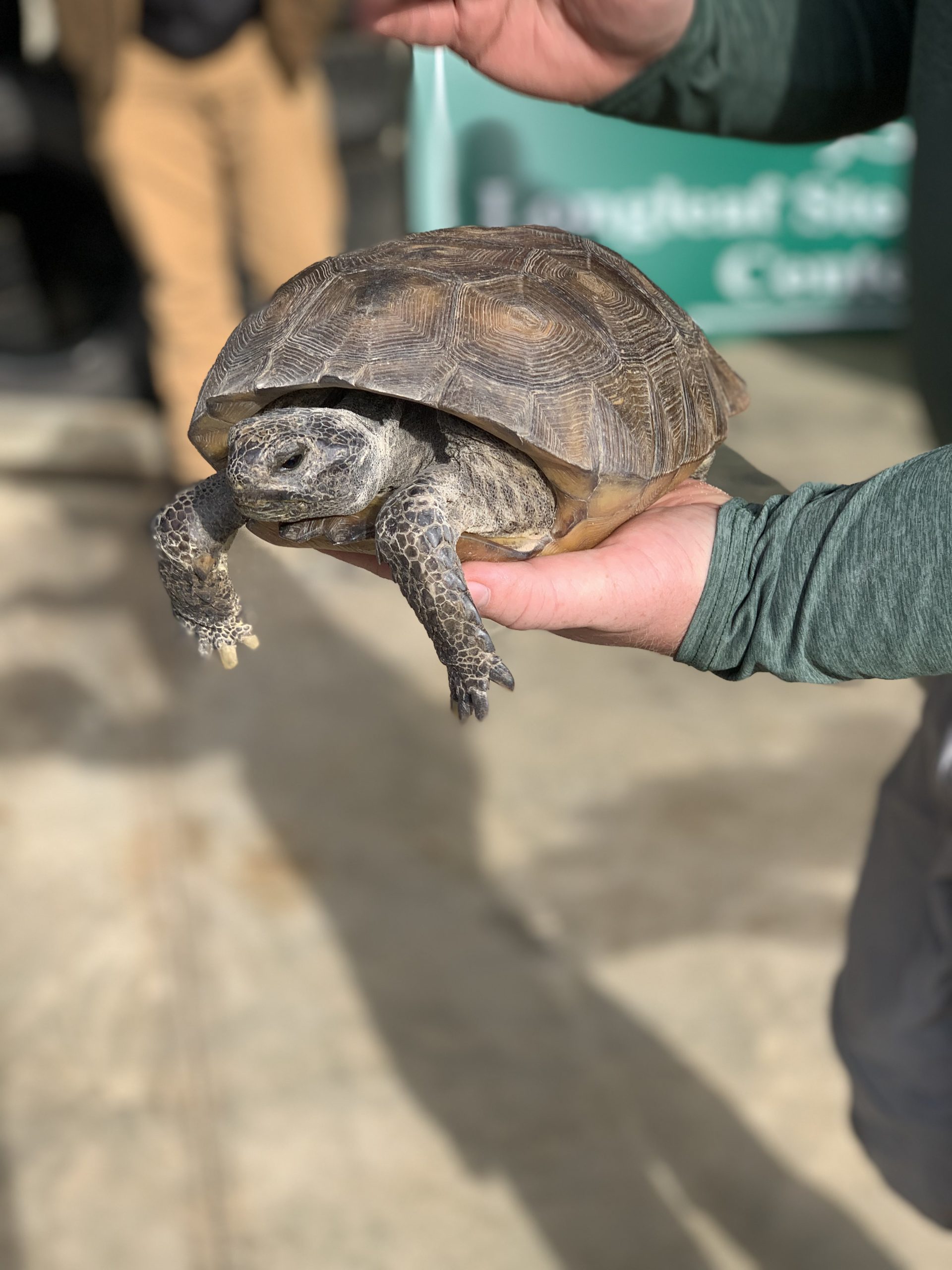
The highlights included gopher tortoises, a keystone species in conservation biology that can live for 80-100 years. They are in the coastal plains and on all the barrier islands in Georgia. Sadly, they are threatened in both Florida and Georgia, and even more so in Florida. Touching the gopher tortoise’s hard, graceful shell, I noticed how this important, reclusive land animal was relatively small, about the size of my two hands together.
The blue-black colored eastern indigo snake, known as the Emperor of the forest, hails as the flagship species of its habitat. My friend and his brother were standing next to me with these large, magnificent indigo snakes casually dangling on their shoulders and arms, studying them in detail before passing them on to me. The indigo snakes sometimes eat rattlesnakes and cottonmouths since they are immune to the venom. Prior to this, the only reptile I had ever held was a baby alligator when I was young, which was still half the size of me — when my family had visited a Louisiana bayou — and anoles, which are little lizards, since they were everywhere in my environment as a child. Sometimes I’d find baby lizards inside the house and want to escort them back to their true home outside. I knew that some people didn’t like lizards, but I did. I wasn’t afraid of them. I thought they were beautiful with their array of colors, and I marveled at how fast they moved. And amazingly, I felt both excited and tranquil to be interacting with the snakes.
As we passed the snakes around, I thought about those who could see their allure. The people who understood these fragile, gentle creatures and knew their role in the ecosystem, as everything in existence has a purpose and contributes to the greater whole. I’d seen snake charmers in India and I still have a photo I took in Indonesia, where a Balinese man sat with a child in his lap with what looked like a very large yellow python contentedly coiled right next to them. I had seen these exceptions in cultures where a few people still remembered that every spot on earth is sacred and that every creature is sacred. But I had viewed these from a distance, not up close as I was now in the sanctuary of the longleaf pine forest. And now, one of my companions commented to me, “You’re so calm in the presence of the snakes.”
During my late twenties and early thirties, I lived in New York City on the 42nd floor of my building and worked in a Manhattan corporate job on Wall Street. As exciting as “Zoo York” was, as it’s known, the concrete jungle always left me yearning for a wilder and more adventurous life that felt far away. Volunteering at the botanical garden in the Bronx provided temporary therapeutic relief. I dug my hands into the earth and crouched down low, sitting on the ground to pull weeds all day long. I practically had to drag myself away at the end of the day, so reluctant I was to leave that slice of nature and return to the depressing gray concrete that left me depleted. My senses were screaming out for more nourishment.
Later that morning, I spoke with conservation biologist Chris Jenkins, the rugged and inspiring head of The Orianne Society. He asked about my background.
“I studied to be a diplomat, but was more drawn to nature over time,” I told him, “and these days I’m writing.”
Not losing a beat, he reflected, “You’re an Ambassador for Nature now.”
It was an epiphanic moment for me when he said that, and the weight of that realization sunk into my awareness. The Orianne Society staff and members were already ambassadors for nature, and here I was, aspiring to join their ranks.
When I had felt depleted over the years, I realized I needed to be back in that lush green glorious landscape of my youth, which is why I returned. Those sublime surroundings lit up something inside me. Now, at The Orianne Society’s longleaf sanctuary, the trees were swaying in the whistling wind that blew my hair, energizing me and charging my senses. I felt more alive hearing the riotous symphony of birdsong, my inner spirit wanting to merge with the melodies. All around was the tapestry of nature connecting me to it. I was part of it and coming back alive.
“Why are people so afraid of snakes,” I asked the group of eleven or twelve people when we passed around the snakes, “since snakes were historically revered in Eastern philosophy and indigenous mythology worldwide?” I knew that the ancient traditions around the world believed water snakes to be symbols of fluid wisdom and elegant steadiness. The kind, distinguished professor (fittingly, the SERPENT license plate that I had seen in the parking lot earlier that morning was his) replied sorrowfully, “In reality, even in India and other Eastern countries, most modern people have lost the connection to nature. Since many people don’t know which snakes are poisonous, they often kill harmless snakes, just like here in the West.” The professor was reflecting what I already imagined but wished was different. Something about what I took to be sincere love for and devotion on the professor’s part to these often overlooked creatures — he had written a book called The Secret Social Lives of Reptiles — resonated with me even though I barely had a fraction of his familiarity with these creatures. I remembered a story my mother told about when I was three or four years old, playing at the edge of the St. John’s River in Florida at my grandmother’s rustic river retreat, and she gasped when she saw a water moccasin glide up nearby where I was playing. My mother, her nerves fraying, called out to me in a wavering voice while trying to remain calm, “Amanda Leigh, can you slowly back up and move away from the water and that snake you’re looking at? Come over here and play!”
Who knew if it was the venomous cottonmouth or a non-venomous water snake? It was enough to give my mom a fright. I suppose the snake swam on because I lived to tell the tale and since, I’ve always been drawn to the symbolism of snakes in mythology, as the archetype has woven its way in and out through the twists and turns of my life with their groundedness, the shedding of their skins, the creative life force, renewal, rebirth, transformation and the ouroboros of eternity.
Finally, here I was living a moment in the much wilder and more adventurous life that I had yearned for, back in the region where I was born, where I felt I belonged. Here I was standing with a yellow and black pine snake snugly wrapped and draped around my body, as if it were the most natural thing in the world, exuberance bursting through me. A surge of energy arose from within me and seemed to go out into the world to meet it and all its inhabitants.
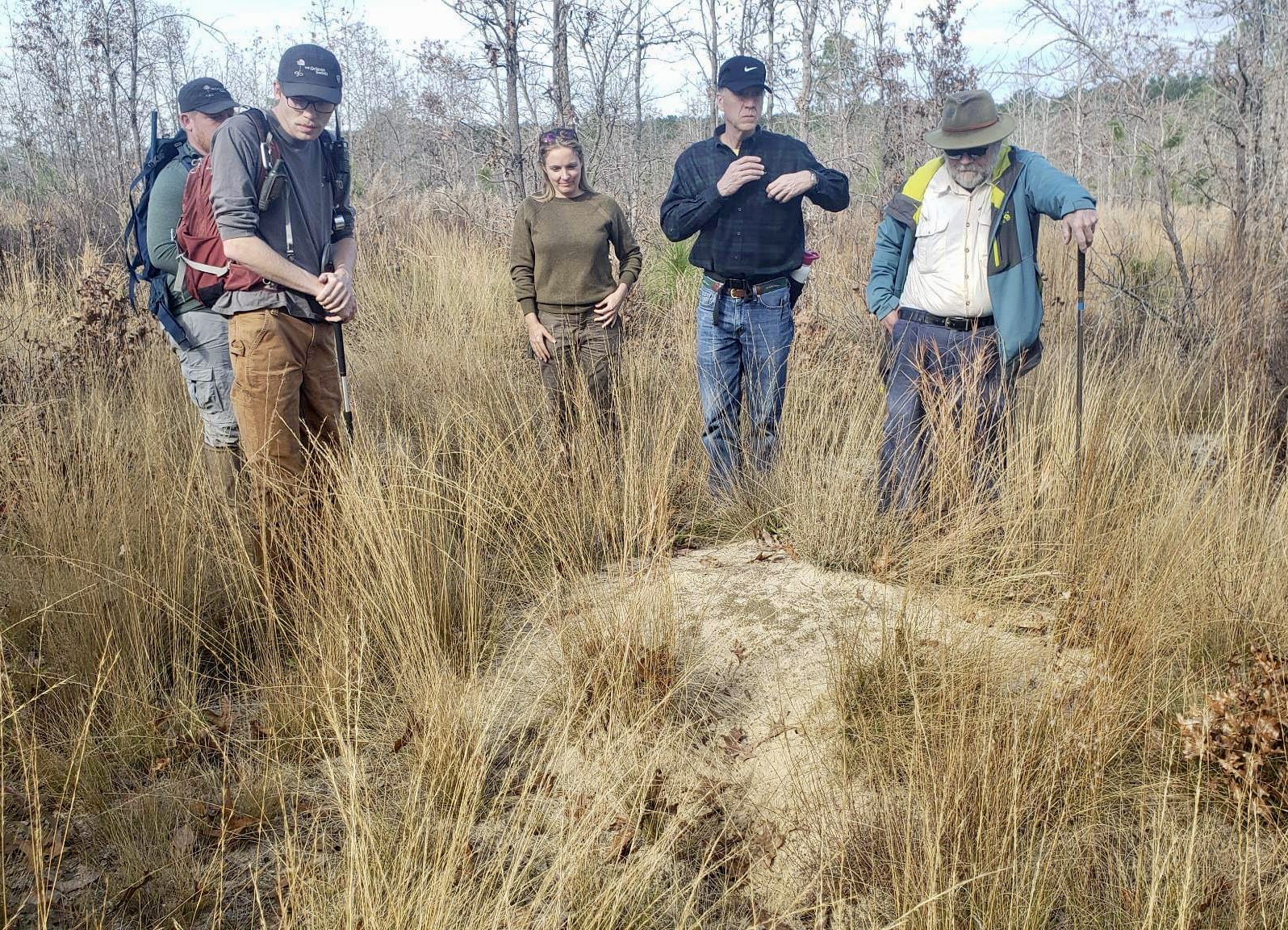
As the day had gone on, we headed out to watch a prescribed fire burn which helps to incinerate competitive vegetation and maintain the health of the forest. Controlled burning is supposed to imitate what naturally occurring lightning strikes used to do for the longleaf savanna. I had to move further away from the shimmering heat of the spreading fire which had swooped in, as my body felt the heat touch my skin. I could smell the smoke as it drifted right towards us, picked up by the fierce wind. At midday, peeling our layers off as the temperatures soared, we hiked out through the wire grass, searching for gopher tortoise burrows, which house a variety of other species as well, especially snakes. Gopher tortoises stay busy digging burrows and a multitude benefits from this underground housing. Quail flew off when they heard us coming.
It was still too cold that day to find any snakes. The sun was blazing yet not hot enough to heat up that cool air. But the Orianne folks showed us their long, meandering hoses with cameras that can reach around 25 feet into the burrows which can be 30 to 40 feet long.
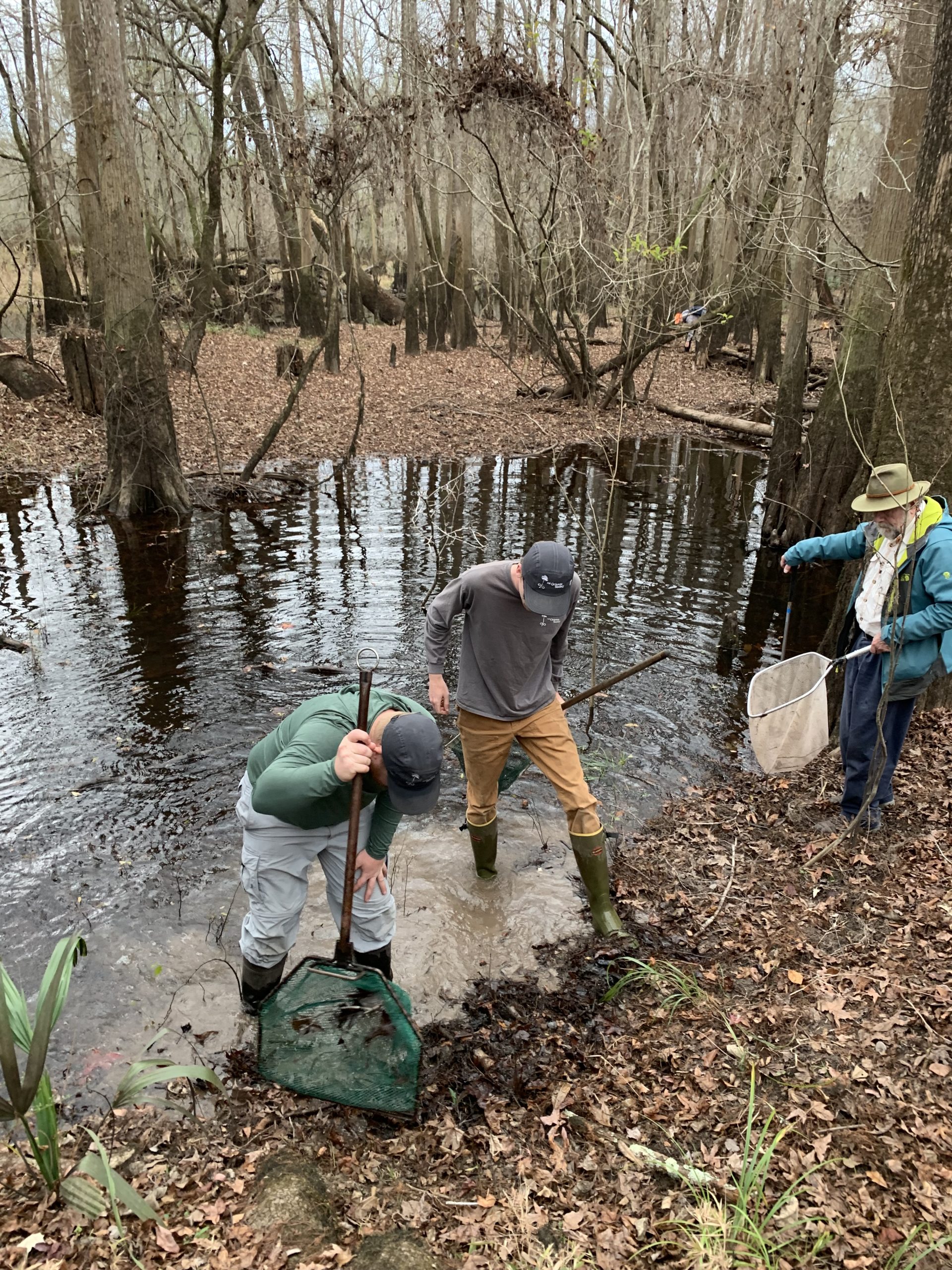
I listened and marveled as the biologists named almost every tree, plant and creature in that setting. Later that afternoon we went off into a different part of the forest again and into a cypress swamp where we found all kinds of salamanders under logs — spotted, marble, dwarf and slimy. The biologists waded into the creeks with their nets, hoping to find more. Some waded so deep that the water spilled over their knee boots. We eventually drove our trucks, bouncing up and down, side to side, along the terrain, all the way to the winding Ocmulgee. Everyone looked like big kids, playing and discovering the delights of nature. I remembered that I, too, was once a child who stayed outside playing and exploring till sundown, communing with creatures in their elements. No wonder I had felt lost and spiritually starved in an unnatural sea of skyscrapers and concrete.
We ended the day with a campfire, seated at wooden picnic tables where we ate barbecue with hot sauce, next to a small cabin which was rustic but comfortable, with a bathroom and kitchen. It felt like a return to more simple times, settings that I recalled from my youth. When it was time to go, we bid each other goodbye with strong embraces and fervent wishes to meet again in this lively setting.
I returned home, full of new awareness after having connected more profoundly with our beautiful natural surroundings in the longleaf pine forest. I also felt called to share the experience with others so perhaps they, too, will answer the call to deepen their relationship with our vital ecosystem. Back when I had pounded the hard pavement for nearly a decade in New York, I’d felt a nearly constant gnawing emptiness inside, my instincts crying out for something more and a pull that was leading me elsewhere. I had struggled with it for a long time. Now, I was finally fulfilling that inner desire, feeding that hunger, in the process of re-wilding and reclaiming parts of my own self. I had experienced a sense of homecoming and rediscovery of my native land that was powerful in and of itself, so strong that I hoped others would seek out such experiences and find similar organizations in order to support and get back in touch with the wild and our ecosystem.
Butterfly

The life of a butterfly is one day,
Isn't it hard for him?
Thinking of living one day after all,
Is not the biggest concern.

I thought once,
A butterfly has no heart.
Doesn't he cry?
It hurts even if he has a heart.

I have a question,
Don't come?
They are also each other,
I will hurt your hearts.


✍️ Qosimova Parizoda