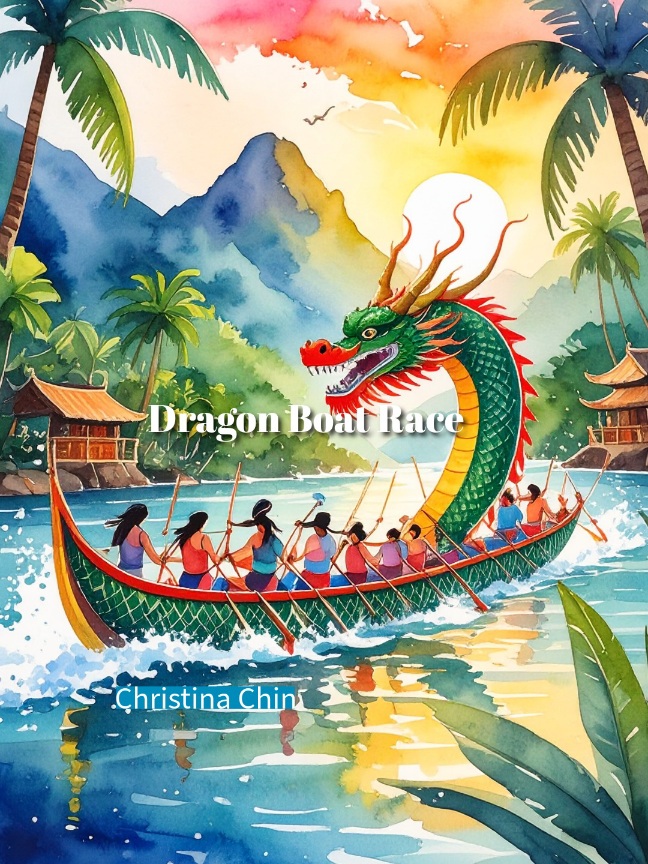
dragon boat
drumbeats vibrate
the regatta


This month, across continents, languages, and artistic forms, these writers and artists illustrate pathways towards personal and cultural endurance and survival. Though their subjects range from war to environmentalism, from mathematics to romance, the works are united by a central concern: how people preserve meaning and dignity while confronting the fragility of life. Together, they create a portrait of humanity struggling not merely to survive, but to transform pain, uncertainty, and impermanence into connection, beauty, and renewal.
The shadow of mortality and conflict appears repeatedly throughout these works. Pat Doyne honors those who sacrificed their lives during wartime, while Elaine Murray similarly forces readers to confront the devastating human consequences of war and the preciousness of life itself. Mohammad Sedigh Haghighi broadens this historical struggle, tracing humanity’s difficult movement toward democracy, liberty, and enlightenment against the forces of ignorance. Danijela Ćuk extends the argument into the present by urging humanity to abandon divisions and pursue peace. Lan Xin connects the larger world to our inner worlds, suggesting that we carry the capacity for both good and evil and that changing our mindsets can change society. Even Hamida Nazarova’s analysis of the works of Abdulhamid Cho‘lpon and Hamza Hakimzoda Niyoziy reveals another battlefield: not military conflict, but social injustice, particularly the suffering and oppression faced by Uzbek women. These works collectively suggest that human progress is measured not by conquest, but by compassion, justice, and the willingness to protect one another’s humanity.
Yet alongside destruction exists resilience. Darren C. Demaree writes of love, grief, identity, and survival, revealing how memory becomes a lifeline through suffering. Madina Asliddinova’s family saga captures the cyclical nature of existence through births, deaths, joys, and tragedies, reminding readers that life is never static but constantly renewing itself through generations. Jacques Fleury teases out themes of individual strength and determination to shape one’s own fate in Boston’s Huntington Theater’s production of Oedipus el Rey. Mai Văn Phấn similarly meditates on cycles of time, nature, suffering, and endurance, portraying resilience as something deeply intertwined with the rhythms of the natural world. Patrick Sweeney’s brief pieces linger in moments of nostalgia and connection, emphasizing how even fleeting experiences can carry emotional permanence. Fiza Amir’s poem transforms romantic loss and regret into gratitude, suggesting that pain can take on meaning through memory and reflection.
Several writers explore the emotional burdens placed upon individuals by society. Jesse Emmanuella Pheebemi’s poetry captures the crushing guilt and inadequacy produced by familial and societal expectations, while Eva Lianou Petropoulou’s poetry depicts a speaker exhausted by constant scrutiny over even the smallest behaviors. Sara Hunt-Florez mourns the loss of childhood innocence when a teenage girl is forced to mature too quickly. Sabina Tursunqulova laments in verse the loss of her childhood. J.J. Campbell presents a complex, introspective, and often melancholic exploration of the human experience. Isaac Aju reflects on how trauma can pull a person away from engaging with the world and quietly into themselves. These works expose how society often pressures individuals into performances of perfection or obedience that diminish authentic selfhood. However, Eva Lianou Petropoulou’s short story offers a possible remedy by insisting that love must move beyond isolation and enter the difficult realities of the world if it is to matter at all.

Art itself emerges as one of humanity’s primary tools for surviving emotional complexity. In Alex S. Johnson’s interview with avant-garde artist Diamanda Galás, Galás argues that art achieves its greatest power not through raw confession, but through discipline, strategy, intellect, and creative transformation of pain. This idea resonates strongly with Yongbo Ma’s interview with J.D. Scrimgeour, whose reflections on humor, mystery, music, memory, creativity, and community suggest that poetry helps people navigate the emotional contradictions of being alive. Ma Yongbo’s own poetry likewise wrestles with impermanence, mortality, and the search for meaning, while Paul Tristram’s energetic poems connect creativity with mental health and self-discovery. Paul Murgatroyd approaches art through satire and absurdity, using humor and nostalgia to examine entertainment and poetry themselves. Egamberdiyeva Diloromxon Olloberdi qizi analyzes how Uzbek author Tohir Malik explores adolescent psychology. Duane Vorhees adds yet another dimension by exploring the hidden complexity beneath the surfaces of poems, people, and places. Together, these artists insist that art is not an escape from life’s difficulties, but a way of understanding and enduring them.
Questions of language and culture also play a central role in preserving identity. Egamberdiyeva Diloromxon Olloberdi qizi explores themes of patriotism in the works of Uzbek poet Erkin Vokhidov. Rashidova Shohsanam addresses the challenge of protecting the Uzbek language amid youth slang, internet speech, and foreign influences, emphasizing that language carries cultural memory and identity. Giyosova Mohinur Yoqubjon qizi discusses ways to enhance linguistic capabilities of elementary students. Aleksandra Soltysiak’s poetry, translated by Jakub Sajkowski, similarly celebrates the balance between language, identity, nature, and beauty. Ahmedova Zamira Shokirjon qizi outlines the moral and cultural themes in Uzbek poet Alisher Navoi’s work. Italian critic Ivan Pozzoni discusses central themes of Western literary postmodernism. Christopher Bernard’s third installment of his novel Otherwise underscores books’ vital role in free thought and resistance. Fhen M.’s essay on Roger Kimball critiques approaches to literature that reduce art solely to politics or economics, arguing instead for the continued importance of aesthetics and imaginative value. Sevara Matnazarova celebrates the joy and wonder of reading. These works defend culture not as something static, but as a living inheritance requiring care, interpretation, and renewal.
Other writers focus on practical pathways toward a better future. Abdusalomova Marjona Jahongir qizi and Egamnazarova Shahina Shaxriyor qizi both emphasize determination and goal setting, presenting perseverance as a crucial force for personal transformation. Asalxon Xasanova learns to develop a realistic attitude towards her personal and academic struggles and to seek improvement where needed. Sobirova Iroda Abdulaziz qizi advocates for financial literacy among Uzbek youth, suggesting that economic understanding empowers individuals and communities alike. Sharifov Sirojiddin Shavkatovich celebrates mathematics as a profound intellectual framework for understanding the universe, presenting reason itself as a form of human achievement. Olimova Muslimaxon Odiljon qizi celebrates the success of her high school’s robotics team in their first competition. Abdumutalibov Islombek discusses students’ use of artificial intelligence technology. Mirzajonova Sabokhon turns to medical science, outlining the role of iron in the human body, as does Merojxon Ahliddin qizi Majidova, who discusses treatments for liver and uterine issues. Azizaxon Shodmonova sends in a charming graduation poem saying goodbye to a wholesome elementary school year and to her teachers and classmates. Finally, Eshmurzayeva Jasmina Shodiyor qizi celebrates the new generation of educated, accomplished young Uzbek women. These works suggest that hope is not passive optimism, but active effort guided by education, discipline, and vision.
Environmental awareness forms another major thread uniting these voices. Sabrina O’ktamova discusses restoring the damaged soil of the Aralkum Desert through lichen, transforming ecological devastation into the possibility of renewal. Yeon Myung-Li celebrates a variety of animals after a trip to the zoo, including one who escaped. Timothee Bordenave proposes practical environmental conservation through innovative heating methods, while Jacques Fleury simply but powerfully urges people not to litter. Mark Young’s digitally altered maps of Australian geography blend language and vibrant color into imaginative landscapes, reminding readers that geography itself can become art. Christina Chin’s delicate haiku captures a quiet evening moment, revealing the beauty hidden within ordinary experience. Mushtariybegim Ozodbekova similarly argues that beautiful and well-maintained spaces are essential for human flourishing. In these works, caring for the environment becomes inseparable from caring for humanity itself.
Finally, several writers turn toward spirituality, longing, and human connection as sources of transcendence. Soumen Roy reflects on divine presence, interconnectedness, joy, and spiritual awakening, presenting existence as deeply unified beneath apparent separation. Yeon Myung-ji’s imaginative work explores desire, hope, art, and possibility, suggesting that longing itself can inspire transformation. Brent Yergensen’s old-style poem shows a person finding comfort just from the nearness of God. Paul Bavister’s poems look into connection, solitude, change and self-reflection. Jessie Vanderwall presents the depths of loneliness left behind after a great and soul-expanding love. Dr. Perwaiz Shaharyar’s tender invitation to dance offers a smaller but equally meaningful expression of vulnerability and admiration. Even amid grief, conflict, and uncertainty, these works affirm the enduring human desire to reach toward others.
Whether through poetry, criticism, environmental activism, mathematics, storytelling, or cultural preservation, these creators demonstrate that survival alone is not enough. Human beings seek beauty alongside truth, memory alongside progress, individuality alongside community. Across all these works runs the same underlying conviction: though life is fragile and often painful, people possess an extraordinary capacity to create meaning, preserve dignity, and imagine renewal even in the face of impermanence.
PEACE IN THE WORLD
I wonder when peace will dawn upon the world,
so that even flower petals may freely live upon their bloom,
so that children may have their childhood,
and enjoy the embrace of their mothers.
When will hatred among people cease,
when will one person stop taking freedom from another,
why do all these divisions exist,
wouldn’t we all be better without them?
Every day, boats of pain sail across the world,
the sound of sirens destroying hopes, wishes, and dreams,
wars have never brought good to anyone,
so why are they still so close to us?
I call upon all the people of the world,
do not make each other targets,
share love, freedom, and peace,
let every touch reflect love.
Wars bring only darkness,
they take away happiness, joy, and all that is good,
heavy sounds tear through our ears,
because sick minds rule this world.
Why sow the seeds of evil,
instead of love, which we need so much,
let children have their freedom,
for your wars do not concern them.
So many tears have been shed because of cursed war,
will it ever stop?
Will peace finally take its rightful place…
People, be human,
do not close your hearts, nor your eyes.
Live for peace, leave evil behind,
let the sun shine upon us all,
let the clouds of pain finally disappear,
because we all want only one thing: our freedom.
Danijela Ćuk
Croatia
This morning, I bring forth the epitaph to be crafted on my forehead, bury me
I do not owe the air the right to take a breath and breathe out toxic words lined up on a queue for slaughter
one time or the other, I realized that I had dipped my finger in guilt and licked its broth, well-seasoned with my father’s alarm reminding me of my dynamic surname pulled out of the house built for nameless babies
father wraps guilt like a scarf around my neck choking my lungs from revisiting freedom. it urged me to die, die and die again
don’t resurrect on the third day if you are a woman
bury yourself
I die because everyone dies to me in the bid to open up the shadow of a new god
I die because father clocked 60 and 60 times I remember the death of the sun
I die because I lose my broth of guilt.
I die because I am a shameless woman
I die because the queue for slaughter ends with my throat
I die never to resurrect on day 3
do bury me
Jesse Emmanuella Pheebemi (Hassana)
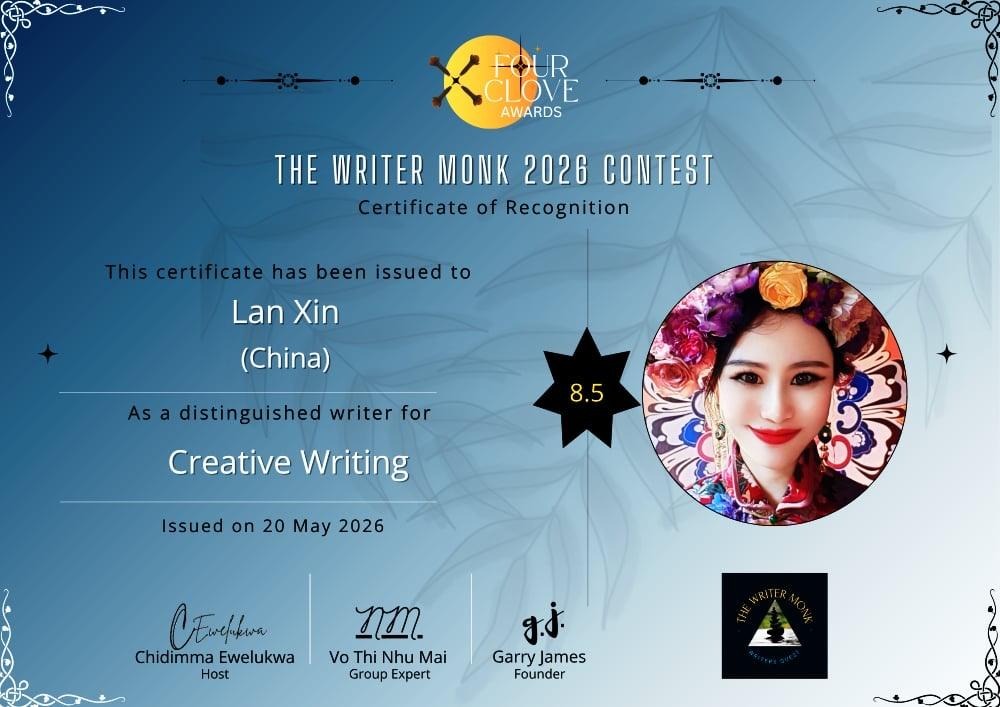
The Writer Monk 2026 Awards | Winner of Distinguished Writer
If Tomorrow Spoke
Poem by Lan Xin (Lanxin Samei)(China)
I am the Tomorrow foretold in human ancient prophecies
I traverse myriad realms across the tides of future time
With bowed brows and boundless mercy I behold all beings on the azure planet
Human greed delusion and rage have left the earth wounded and scarred
Calamities surge endlessly across the mortal world
Endless plunder brings torment to all creatures between heaven and earth
Lost in chaotic darkness mortal souls wander astray with no way forward
No disaster arises by chance all stem from darkness hidden deep in human hearts
The pure land and paradise mankind yearns for can never be sought outside
They dwell within every thought and every deed of all living souls
Only great love and compassion born deep within the heart
Can soothe catastrophes and heal the vicissitudes of the world
Love is the origin of the cosmos the eternal law of heaven and earth
Love is the universal tongue connecting all beings across boundless space
Love is the radiant path leading toward a brilliant promising future
Love is the supreme treasure that heals all worldly hatred and strife
Love stands as the ultimate answer to every plight in mortal existence
I am Tomorrow the embodiment of truth goodness beauty and boundless love
I carry the true law of heaven as well as profound cosmic mysteries
I wait silently amid ancient prophecies for you who walk in light and love
Everything
It is only when I see the whole world
That I discover it is lonely.
I had never known loneliness
before I knew you.
I feel an absence deep in my chest
And on my skin, cold,
that I’ve never felt before,
that I’ve never had.
I stare into nothingness
and only everything stares back.
Only your eyes.
which I see as I lean on a wilted leg
towards a body which is not there,
which does not know I lean in its direction,
and surely never will.
I wouldn’t believe you if you told me now,
but looking out at everything, all I feel
is cold.
I have no hand to hold,
no coat to take.
But then,
I never did.
I had never known loneliness
before I knew you.
And how lonely it is,
to know everything.
The Evolution of Consciousness and the Struggle Against Ignorance
Awareness, ignorance, right, wrong, weakness, and power; all seem to have distinct definitions. Yet, upon deeper reflection, we realize these terms carry different meanings for every individual, nation, or tribe. Even through the passage of time, the perspective of a 12-year-old, an 18-year-old, and a 40-year-old toward these concepts undergoes a transformation. Our minds are in a constant state of evolution; had it been otherwise, humanity could never have survived the struggle for existence and would have perished in the early ages.
Humanity has always contemplated to measure the depth of its understanding and its connection with all phenomena—both perceivable and incomprehensible. Nevertheless, man has never been, and will never be, perfect. It is precisely this “imperfection” that is our greatest strength; for human society was formed and has endured to this day by relying on cooperation and the completion of one another.
In the past, power resided in a single hand, held by the tribal chief, often acquired through bloodshed or force. During the era of monarchies, this process continued in a more polished form, albeit seasoned with hypocrisy and politics. Eventually, humanity realized that power should not be the monopoly of a single individual or dynasty; the French Revolution stands as a brilliant example of this historical awakening. Power and wealth have always been a path between triumph or ruin, sought by humans to achieve goals that they deem “good” and others perceive as “evil.” When a person, relying on power, imposes their thoughts on the masses and meets their resistance with force, they perceive themselves as a righteous soul whom others seek to destroy. Democracy is the gift bestowed by God upon enlightened humans to liberate them from this cycle of tyranny.
The concepts of “good” and “bad” are represented differently in everyone’s mind. If you were to seat individuals from Asia, Africa, Europe, and America around a single table and ask them about a political leader or a famous figure, the likelihood of similarity in their answers would be slim. Each responds based on their society, level of literacy, and personal interests. Someone who has been raised from childhood with irrational premises and superstitions cannot be easily enlightened through logic.
In childhood, the human mind is like unshaped clay, molded by potters such as teachers, family, and society. Once this clay is fired in the kiln and turned into a jar, changing its shape becomes arduous. A person in their fourth decade of life who holds a heartfelt belief in superstitions might even sacrifice their life for these hollow beliefs, yet they will never accept that they have been deceived.
In this midst, the one who possesses the courage to trample upon their previous false beliefs and norms to break free from them is the very person whom dictators fear. They are like a white blood cell fighting the bacteria of ignorance within the body of society. Closed societies tend to keep the masses in a state of scientific poverty; for an empty mind can be filled with any claim, and superstition can be sold to them in place of science. But a mind filled with true knowledge has no room for nonsense—just as a cabinet overflowing with books cannot be filled with packs of cigarettes unless the books are discarded; and that is the definition of being a “sell-out.”
A “sell-out” is someone who possesses awareness and knowledge but, for the sake of personal gain, ignores their human duty to enlighten society and sells their soul to the demon of power and money. These individuals are far more debased than those who mislead others out of sheer ignorance.
Despite all this, light always triumphs over darkness. People will find the path of wisdom and shall overcome tyranny, lies, and ignorance. History bears witness that heroes of humanity have always risen to cast the oppressors down from the heights of power.
To the hope of a day when awareness replaces superstition, and all humans—regardless of race, skin color, or language—live alongside one another in peace and tranquility.