Sin

There was a singer named Tarashanker,
He wanted to treat singer as a 1st number.
One day a man came to him to compete against him,
The man was such a good singer Tarashanker seem.
To defeat the man,
Tarashanker hit upon a plan.
There was a jharbati where the man sit,
To untite the jharbati a man was fix.
By untiting Tarashanker killed the man,
Tarashanker said the people he stopped the accident as long as he can.
The man's wife wanted to God the justice,
The man's son's start singing practice.
God has came to the earth as a stranger,
God has become the man's son's singing teacher.
God made the boy a good singer,
The boy went to Tarashanker and raise his finger.
Tarashanker wanted to the boy removal,
The boy through a singing proposal.
But there was a deal,
He who can defeat ,will give poison and kill.
Tarashanker listened the boy,
Listening the boy, he lost his joy.
Now the cruel man again did that as he did with the man,
But God (stranger) unsuccessful all his plan.
The boy became winner,
He gave the poison to the sinner.
God gave them justice,
By understanding God's justice they pray and practice.

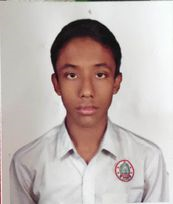
Robiul Awal Esa is a 1st year student of Diploma in Nursing Science & Midwifery Course in  Government Nursing Institue, Chapainawabganj, Bangladesh.
+


Soothes
             the
                 LOVE of Experience

                    Lifts from the start

Continuity is Always Beginning

              I See Something Good
         & there was good
 Nothing Wasted  My LOVE

      ♡  Well along I see  ♡

Continuity always Beginning

 Soothed my presence LOVE
       Gifts await the Star
             in the sky
                    ☆

                                                                  ...


by  John Edward Culp
       April 24, 2023
My Glorious Flag
In the blue color of Turkisness,
In the red of Independence,
In the green of religion Islam,
It is combined in three colors!
Your moon and star is beautiful.
It's a call to the universe,
Peace, justice, reconciliation,
In three colors that are together !
It's look gorgeous as world It dazzles the eyes,
Makes the beholder jealous
There is a magic in three colors!
You are holy, our oath,
You are always on high peak,
Is waving at the border
Our Flag in its three colors!
it is rising ,
At the rostrum of the Supreme Council
İt presents the statement, says the word,
Azerbaijan in its three colors!
He turned to longing in the heart that is far from the eyes!...
Longing is a superhuman power that keeps people alive by believing in the tiniest sparks! @e.c.]LONGİNG
You are in front of my eyes in my vision,
My eyelash hangs from my eyelid,
I'm so afraid to blink,
Your image will disappear from my heart garden.
What a trouble this world of love is!
Not everyone could stand it,
The Hell can't erase the luck given by God,
Segah, Rast rises from my soul room!
I built a world in my singing roots,
I made a thousand patterns for my eternal love,
I kept talking about failed love, his image is seeking from my growing longing
The color of love is not clear,
It turns black after while!
Desire awakens in my longing heart,
Beloved comes from my youth.
DARKNESS
Those who do not work for a deed,
Your voice is coming from the swamp!
Those who do not get used to the light like a bat,
Come out of the darkness into the light!
From the dawn, sun and moon,
Do not be afraid of light, brightness,
Mind, hard work, skill, but also conscience,
Brings everyone out of the darkness!
May your wish come true,
So that your pure deed will be heard
So that your spirit and convictions remain pure,
Get out of the basement, out of the dark!
People have lost their way,
There is a barrier to the truth, times have changed,
He's playing with a lie, don't give up
Disgrace be gone, from the darkness!
What comes will go from the mortal world,
Get out of ignorance, old-fashioned,
Live so, leave so that from life,
Don't let the moaning sound come from the darkness!
Short creative biography
Elmaya Jabbarova was born in Azerbaijan. She is poet, writer, reciter, translator.
Her poems were published in the regional newspapers «Shargin sesi», «Ziya»,
«Hekari», literary collections «Turan», «Karabakh is Azerbaijan!», «Zafar»,
«Buta», foreign Anthologies «Silk Road Arabian Nights», «Nano poem for Africa», «Juntos por las Letras 1;2», «Kafiye.net» in Turkey, in the African's CAJ magazine, Bangladesh's Red Times magazine, «Prodigy Published» magazine. She
performed her poems live on Bangladesh Uddan TV, at the II Spain Book Fair 1ra Feria Virtual del Libro Panama, Bolivia, Uruguay, France, Portugal, USA.
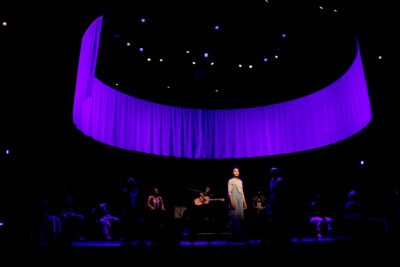
Octavia E. Butler’s Parable of the Sower, May 5-6 in Zellerbach Hall (Photo: Ehud Lazin)
A Seed on Rich Soil
Octavia E. Butler’s Parable of the Sower
Cal Performances
Berkeley
Exactly thirty years ago, a novel appeared, with little fanfare or publicity, that would have disappeared under the ocean of similar books that die on the day they are born if it hadn’t been for the kind of chance that has saved more than one book from oblivion.
It found a handful of readers – just the right, lucky handful – who passed the word along to other readers, who did the same for others, until it created a union of enthusiasts who found its disturbing vision compelling and entirely too plausible, yet strangely beautiful. The author continued to work in obscurity for many years, and was just attaining recognition as a significant voice in American literature when she died, at 59, in 2006.
The book in question is Parable of the Sower, the author Octavia E. Butler. And the vision that commands it, and its sequel Parable of the Talents, is the basis of the gospel plus rockabilly opera written and composed by Toshi Reagon and Bernice Johnson Reagon and performed at UC Berkeley’s Zellerbach Hall that I saw on this year’s Cinco de Mayo.
The 1993 novel is set in Los Angeles in 2024, its sequel a few years later. And its vision, at the time it quietly entered the world, must have seemed at the margins of plausibility, a Mad Max version of California fed with cocaine, speedballs, and the rest of the paranoid arcana of the drug culture. Seeing the story play out in 2023 – after the bedlam of covid, the compulsive self-harming of San Francisco, capital of the worldwide technological empire that is shredding society while spewing billionaires like an army of combines across a field of ripe wheat, the descent of America into a cold civil war between the impossibly wealthy and the politically disenfranchised, culturally despised, and economically impoverished – makes one believe the notion of the oracular power of art may not be entirely a professor’s dream and a teenager’s nightmare, but mere palpable reality.
The opera the story has spawned, through the brilliant talents of the Reagons (a mother-and-daughter team of writers and composers – excuse me, but isn’t that the most inspiring and heart-warming thing ever?) and a much-talented ensemble of instrumentalists, singers and dancers (the two last often the same), created a thoroughly inspiring evening for a packed and extremely diverse audience in the heart of the UC Berkeley campus.
The opera plays without intermission for a little over two hours; a probably wise decision, since a lengthy break between the two parts may well have weakened the tension built up so skillfully in the first hour. Though the performance is called an “opera,” it feels more like an oratorio, since there is less emphasis on an involved plot and dramatized action than on a series of musical and dance numbers presenting states of mind, moments of crisis, experiences of trauma and loss, and brave attempts to make sense of them and take away, in the teeth of destruction and chaos, some shred of moral and spiritual guidance, some basis for faith and hope.
The plot insofar as there is one revolves around a young woman of color, named Lauren Oya Olamina (a luminous Marie Tatti Aqeel), who lives with her family in a poor community walled away from a collapsing outside world and trying to find meaning in an old-time religion under the leadership of the girl’s reverend father. Between musical numbers that fluctuate between the young girl’s fears and longings and the anguish (alleviated by a strenuous but sometimes forced optimism) of her community, she retreats to a notebook where she gathers her thoughts in search of a meaning her father’s faith has failed to give her.
The tensions within the community, exacerbated by having no escape to the outside world, explode at last, destroying the wall that has been both protection and prison, and scattering a group of destitute survivors, among them Lauren, wandering across a landscape devastated by the forces of the postmodern world, toward a nameless destination “to the north.”
When the wall falls, Lauren loses her family and, joining in destitution and poverty in her march across a California wilderness while hiding her vulnerable youthfulness and femininity behind a masculine cloak, she leads her group – a “chosen family” of the homeless, despairing and forlorn – with a new faith, a new religion that she calls “Earthseed,” with a text written by herself: “The Books of the Living,” and a central doctrine exalting “change” as the essence of the divine.
But there is desperation in her new faith. Indeed, it is a tragic doctrine, one that Lauren herself does not seem willing to face. Because to worship change for its own sake is to worship death. Those who exalt “change” seem to think that “all things change (but I’ll still be here).” But that is not so: if all things change, it is precisely you who will not be here.
The resemblances between the 2020s imagined in the mid-90s and their actualities today are often uncanny. And Butler’s vision, conveyed with both passion and enchantment by the Reagons and their ensemble, gripped this viewer with a persuasiveness, long after the last chord, that is rarely sustained for so long. Here indeed (to use Keats’s famously controversial phrase) beauty was truth, truth beauty.
The performance, despite the grimness of the story, ended on a note of hope that avoided both bromides and fraudulent optimism (a curse of much serious art with popular pretensions). It concluded with a rousing musical version of the biblical parable that gives the work its title. For those who don’t recall it, it amounts to the basic truth that, though many seeds of the sower fall on barren ground, on rocks and among thorns, some few fall on rich soil and fertile land, and these take root and thrive and grow to flower and fruit “a hundredfold.”
Toshi Reagon served as both introducer and guide into Butler’s world; she was also lead guitar and commenting “folk singer” bringing Butler’s vision up to date in a way the author would no doubt have enthusiastically approved. Toshi was aided by a strong singing duo, Abby Dobson and Shelley Nicole, and a backup band that sounded far larger than its five members.
After the show, there was a wide-ranging discussion with five of the performers. Toshi left us with much wisdom to savor, not the least of which was this: “There are those who believe what they know, and those who deny what they know. Whatever you do, believe what you know.”
Amen to that.
_____
Christopher Bernard is a co-editor and founder of Caveat Lector. He is also a novelist, poet and critic as well as essayist. His books include the novels A Spy in the Ruins, Voyage to a Phantom City, and Meditations on Love and Catastrophe at The Liars’ Café, and the poetry collections Chien Lunatique, The Rose Shipwreck, and the award-winning The Socialist’s Garden of Verses, as well as collections of short fiction In the American Night and Dangerous Stories for Boys. His children’s stories If You Ride a Crooked Trolley . . . and The Judgment of Biestia, the opening stories of the Otherwise series, will be published later in 2023.
The Sky

Sky is a part of nature.

It is a great gift from the creature. The earth is cover the world around.

And we see it from the ground.

In the morning sky, sunrays given by the sun.

I think, the sun is glowing with fun. Sometimes, the clouds make so dark.

And give boundaries to the sunrays, to reach on the earth.

In the morning sky, the birds are flying.

I think that they are jolly with the morning.

The night darkness covers the sky.

But, the moonlights remove the darkness from the sky.

In the sky, the planes are flying.

We use planes for traveling.

In the clear sky the white clouds are floating.

Like that the cottons are flying.

I think, if I could be one of the clear clouds

I will fly on the sky around.


Don Bormon is a student of grade 8 in Harimohan Government High School, Chapainawabganj,
Bangladesh.