
Lessons from the Masters–And This Could Include You!
By Alex S. Johnson
In a career that has encompassed more than thirty years and sliced from pre-digital chapbooks and (my earliest) self-published graphic novels and collections from age 12 up, I’ve met, performed and published with and spent intimate moments with some of the most distinguished names in modern culture. This did not happen by accident.
There’s some common threads working through these names and, at the risk of sounding like Reader’s Digest, factors that, while not guaranteeing success, they share and certainly did not hurt them.
1. They kept their head down and did the work. Among the most fascinating authors I’ve had the pride and pleasure to work with is two-time Bram Stoker Award and World Fantasy Award-winner Caitlin R. Kiernan. A trans woman who has weathered all sorts of controversy and maintained a robust publishing output, Caitlin makes her primary living as a vertebrate paleontologist working for the University of Birmingham in Alabama. She’s discovered some dinosaurs of her very own and written numerous scientific papers published in journals when not writing bestselling unclassifiable novels and short fiction collections that have earned her praise from icons like Clive Barker and institutions like The New York Times.
While characterized as fierce, imperious and deadly by the likes of the late great Peter Straub (Ghost Story; The Talisman with Stephen King), others, such as my dear friend horror master Mort Castle (Horror Writers Association Lifetime Achievement Award-winning author and editor of On Writing Horror) characterize her as “quite shy.” While she certainly does not suffer fools gladly, she has shown me over time great courtesy and kindness and been a source of inspiration and a font of strength considering her own challenges, including well-documented (by her) struggles with mental health. Caitlin strikes me as a sort of mythical monster from the depths who arises in my email in box when I least expect her to, providing treasures such as the Introduction to my Clive Barker tribute anthology, Le Fantastique, before escaping back to a more comfortable sea shelf, the better to spend time with both real and imaginary monsters.
2. Tom Sullivan. For those of us who grew up in the 70s and 80s, Tom Sullivan was an inescapable presence, appearing on everything from telethons to Circus of the Stars to Oprah Winfrey to mainstream movie hits like Black Sunday (based on the thriller by Silence of the Lambs author Thomas Harris) and Airport 77 featuring the iconic James Stewart (It’s a Wonderful Life). Tom has shared his story with many audiences around the world and in many forums, including Seeing Lessons: 14 Life Secrets I’ve Learned Along the Way, co-written and edited by me.
In this memoir, Tom shares stories such as being labeled as fit only for institutions like a home for the blind (blind since birth, he was enucleated–had his eyeballs removed–at an early age) only to reverse all expectations, going on to becoming a high school wrestling powerhouse, removing his glass eyes as a psychological terror tactic and utterly unnerving his opponents, a Harvard scholar, multiple Emmy award-nominated actor with repeat visits to Mork and Mindy and WKRP in Cincinnati and close friendships with Martin Luther King, Jr. and Mohammad Ali (not to mention his legendary collaborations with Betty White). It was a great privilege to work with Tom, and I learned from him that disability truly doesn’t make a difference when it comes to achievement–hard work and humility (plus a bit of cheek) can and does make the difference. Tom entered life with a profound deficit and has emerged into the sun from a very early age to dazzle with his kindness, extraordinary visions and tales of meetings with the greatest humanity has known. My main takeaway from him–be bold, step aside from yourself and let the genius flow.
3. Iris Berry. Iris Berry, the co-founder of Punk Hostage Press and the founding songwriter of The Ringling Sisters with Pleasant Gehman (Rock and Roll Witch; The Casserole Club, The Runnin’ Kind starring Juliet Lewis of Natural Born Killers fame) began life in a dirt-poor neighborhood in the San Fernando Valley area of Los Angeles–Pacoima to be specific.
She’s described her coming of age as “right out of an S.E. Hinton novel,” complete with switchblade fights, murders and substance use as a way of life. Her performances include a cameo in the Guns N Roses “Welcome to the Jungle” video which consists of a four second burst of her strutting down Sunset Boulevard in stilettos and fishnets like she owned all of Hollywood, one of the first sights Axel Rose sees when he steps off the Greyhound and realizes “you’re in the jungle now, baby…you’re gonna die.”
For all the legend and lore surrounding her, Iris barely graduated high school, yet has been anthologized in such landmark collections as The Outlaw Bible of American Poetry alongside the likes of Che Guevara, William S. Burroughs, Ellyn Maybe and Jack Kerouac. Her work ethic is formidable and in 2012, the year I first met and performed with her at Coffee Cartel in Redondo Beach(later that year at the invitation of Ellyn Maybe and then Executive Director Richard Modiano, I performed at the iconic Beyond Baroque Literary Arts Center), she created Punk Hostage Press with A. Razor to provide an opportunity to publish their own work and, later, those of others (recently, Nicca Ray), without gatekeeping and through the lens of Berry’s 1920s old Hollywood aesthetic.
She came to Hollywood as a teenager to, in her own words, “become a stripper,” only to find herself sharing rock and roll stages with The Runaways and Guns N Roses and Motley Crue and being signed to A&M Records by legendary producer Lou Adler. Her battles with addiction notwithstanding, Iris has produced a steady stream of powerful work, ranging from record albums to collections to, recently, a co-publication with me, For Iris: The Los Angeles Poems, with a Richard Modiano Foreword and praise from Henry Rollins-published poet and “the Giggling Goddess of Spoken Word,” Ellyn Maybe (“a truly magnificent collection”). Iris exemplifies all that is majestic and fierce about a truly sovereign creative, and shrugs off detractors with “Shoo, Fly.”
The soul of kindness who always has a good word and, at times, shockingly hilarious revelations, her name was recently invoked on my Youtube broadcast, The Kandy Fontaine Show, by Francesca Lia Block, the creator of the iconic and award-winning Weetzie Bat series, as someone who welcomed her in the 80s not just as a hanger-on to the early punk rock era, but someone worthy in their own right. My admiration for Iris is a matter of record and a 150 page love letter to her; I encourage readers of Synchronized Chaos to pick up a copy of For Iris on Kindle–it also contains several poems and a prose piece by Iris herself!!! The big takeaway from Iris: you don’t need a Harvard degree to make cultural history; just a lot of fire and determination to spread the beatific vision.
These are just a handful of the legends I’ve met and worked with; I’ve also worked with Lemmy Kilmister from Motorhead; Jarboe from Swans and David J. Haskins from Bauhaus and Love and Rockets. But those are stories for another time.
Meanwhile, there’s you–yes, you, the reader of this article. Step away from the computer, drink your favorite beverage and put your own vision down on paper, or inscribe it in architectural space, or as a computer model, or a dance, or a thought. Because sometimes the corniest, old fashioned advice you would get from your parents and theirs before them to the beginning of history is just plain good…you alone can determine your future. If you haven’t found your voice yet, there is always time. I just turned 60 on Halloween Day, and my best years are in front of me.
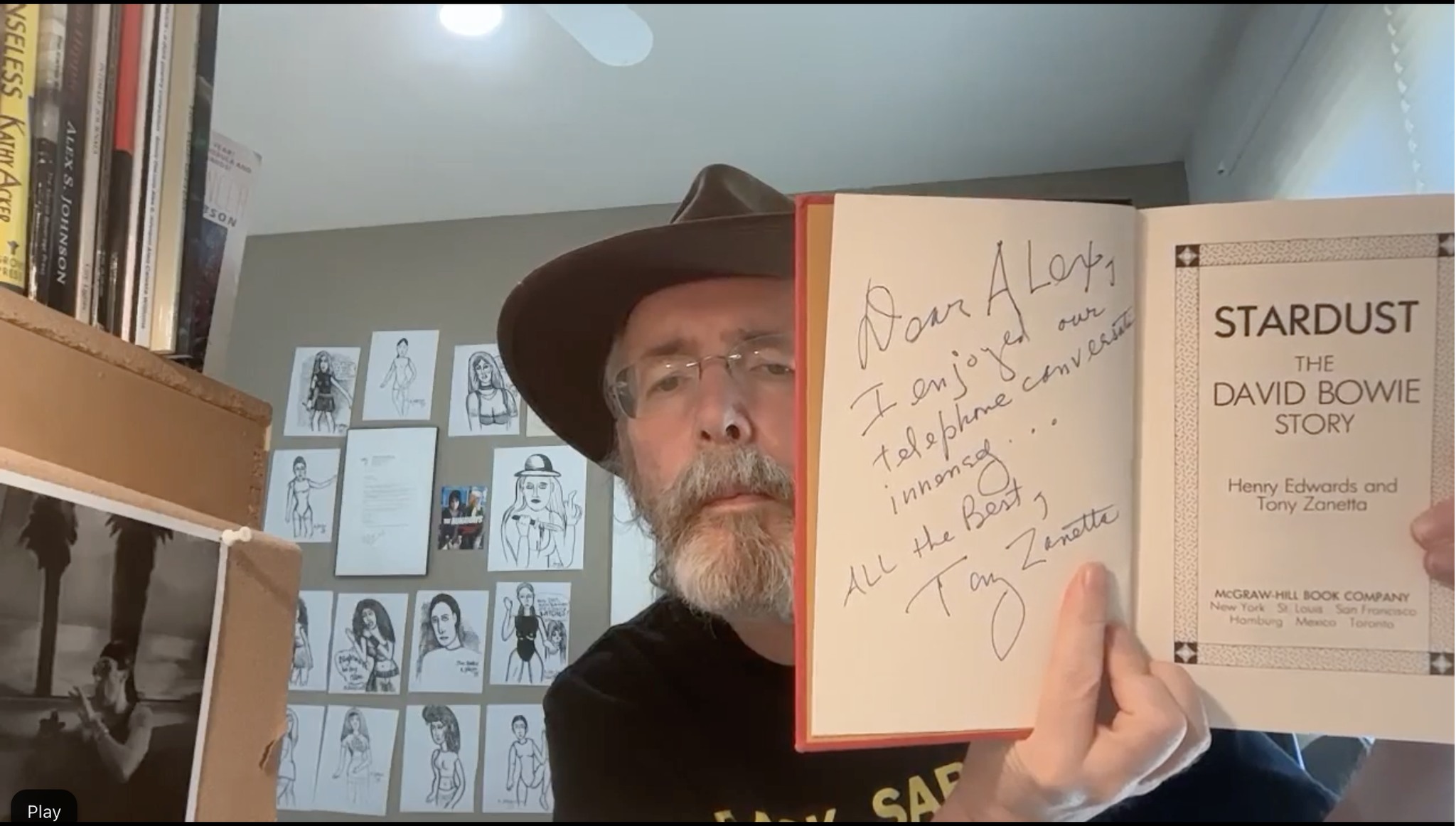
Bio: Alex S. Johnson’s work is archived at Harvard’s Widener Library; he’s shared stages both digital and physical with people who have shared stages with Exene Cervenka, Jackson Browne, Henry Rollins, Joan Jett, Hubert Selby, Jr. (“Cubby” to his friends) and Rob Halford (Judas Priest; Fight; Halford; aka “The Metal God.” He tends the fires of Nocturnicorn Books and Kandy Fontaine Show from his home in Carmichael, a suburb of Sacramento, California. His interview subjects include Andy Warhol actor and David Bowie manager Tony Zanetta.