
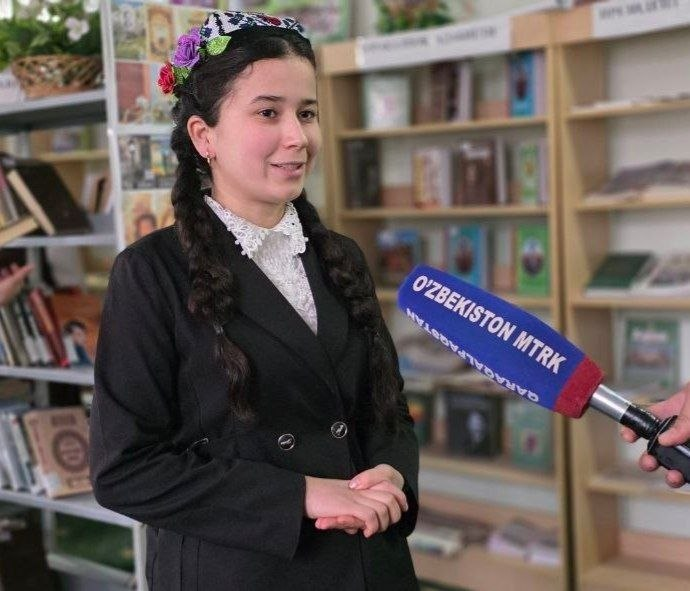
Charos Yusupboyeva was born on July 10, 2010, in Qirqqizobod mahalla, Ellikqal’a district, Republic of Karakalpakstan. Despite her young age, she stands out for her active involvement in educational activities, promoting reading culture, and encouraging young people to pursue knowledge.She is currently the founder of the “Qirqqizobod” journal. Through her “Book Readers Club” project, she has brought together around 200 students, creating a strong community of young readers. She is also a prize winner of the republican stage of the “Zulfiyaxonim Izdoshlari” competition and a young writer whose poems have been published in international journals. Through her passion for learning and strong initiative, she continues to inspire her peers.
Bridging the Distance: The Transformative Role of Online Education in Remote Areas
In the contemporary world, education has become one of the most powerful instruments for social progress and sustainable development. However, geographical isolation continues to limit access to quality education for many learners living in remote areas. With the rapid advancement of digital technologies, organizing online education has emerged as an effective solution to reduce educational inequality. When properly implemented, it not only overcomes physical barriers but also creates new opportunities for students and teachers.
One of the most significant factors influencing the organization of online education in remote regions is the availability of reliable internet infrastructure. Without stable connectivity, digital learning platforms cannot function effectively. Therefore, improving broadband networks and expanding internet coverage are essential steps toward making online learning accessible to everyone.
Governments and technology providers must collaborate to ensure that even the most distant communities can benefit from modern communication technologies.Another crucial aspect is the provision of digital technology for both students and teachers. Access to devices such as laptops, tablets, or smartphones allows learners to participate actively in virtual classrooms. Equally important is equipping teachers with the necessary technological tools and training so that they can deliver high-quality lessons. When educators are confident in using digital platforms, they can create interactive learning environments that encourage creativity, critical thinking, and collaboration.
The impact of organizing online education in remote areas can be profound. First and foremost, it significantly expands educational opportunities. Students who previously faced limitations due to distance or lack of resources can now access a wide range of courses, educational materials, and global knowledge networks. This not only improves academic achievement but also empowers young people to pursue their ambitions and contribute meaningfully to society.
Moreover, online education fosters lifelong learning and professional development. Adults living in rural communities can acquire new skills, participate in training programs, and adapt to changing economic conditions without leaving their homes. As a result, communities become more resilient, innovative, and economically active.
In conclusion, organizing online education in remote areas is a transformative step toward building a more inclusive and knowledge-based society. By improving internet infrastructure, providing digital technologies, and supporting both students and teachers, societies can ensure that education reaches every corner of the world.
Ultimately, the expansion of online learning does not merely connect people to information—it opens doors to opportunity, empowerment, and a brighter future for entire communities.
Key words:Online education, remote areas, digital technology, internet infrastructure, students and teachers, virtual learning, educational opportunities, lifelong learning, digital literacy, community development
She is very creative Girl in the world💕
Эта статья сочетает в себе как полезные, так и интересные сведения, которые обогатят ваше понимание насущных тем. Мы предлагаем практические советы и рекомендации, которые легко внедрить в повседневную жизнь. Узнайте, как улучшить свои навыки и обогатить свой опыт с помощью простых, но эффективных решений.
Получить дополнительную информацию – https://vivod-iz-zapoya-2.ru/