
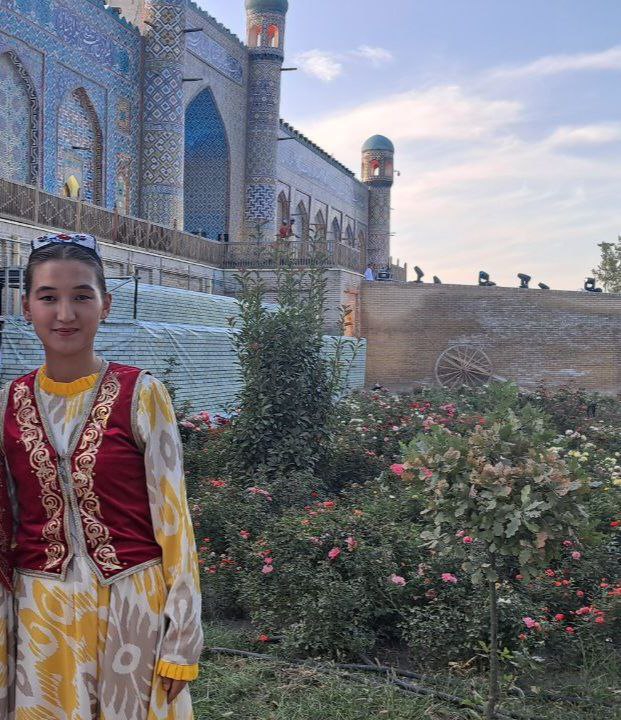
Islomova Maxsudaxon Axrorjon qizi
Qo‘qon State University
Faculty of Primary and Technological Education
Second-year student, Primary Education Program
In 2025, she transitioned from a contract to a grant during the Grand-Contract selection stage.
She is a member of the “Council of Leading Girls”.
She holds 3 international and 21 official certificates.
She has participated in 2 international scientific-practical conferences.
She took part in the III International Handicraft Festival.
She received a Level B certificate in the National Exam for the Mother Tongue subject.
Pedagogical Foundations of Moral Education and Worldview Formation in Primary School Students
Islomova Maxsudaxon
Qo‘qon State University
Faculty of Primary and Technological Education
Primary Education Program, Group 05/24
Abstract:
This article explores the pedagogical foundations of moral education and the formation of worldview in primary school students. The primary education stage is a crucial period in personality development, during which moral education, norms, social values, and initial worldview are formed in students. The article analyzes the essence and content of moral education and worldview, as well as their role in the development of the student’s personality. It is concluded that a properly organized pedagogical process contributes to the formation of positive moral qualities and a broad worldview in students.
Keywords: primary education, morality, moral education, worldview, pedagogical foundations, educational methods.
Primary education is the main stage where a student’s attitude toward knowledge, tendency to imitate, interest in learning, and activity are formed. Therefore, instilling moral virtues and embedding national and universal values is an important pedagogical task. The integrity of education and upbringing processes plays a key role in forming a positive worldview in students.
Today, in the context of globalization, educating the younger generation to be morally mature, with strong beliefs and a correct worldview, is one of the most pressing issues. From this perspective, studying the pedagogical foundations of moral education and worldview formation in primary school students is of significant scientific and practical importance. The country’s education system, i.e., academic institutions, not only provide theoretical knowledge but also focus on raising morally educated youth, which is currently a requirement of the times. It is no secret that the importance of moral education is steadily increasing worldwide.
Morality has a historical and changing character; moral norms are defined by social conditions and vary across different strata of society. A moral norm is recognized by society and is a rule whose compliance can be obligatory or voluntary. To ensure that primary school students remember and understand morality easily, it can be defined as follows: “Morality is behaving politely, respecting elders, helping friends, speaking truthfully, and doing good deeds.”
Moral education is a purposeful pedagogical process aimed at developing in students the moral norms, behavior, and values accepted by society. Moral education in primary education is particularly important because at this stage, children begin to form an understanding of behavior, habits, and worldview. Through observation and imitation of teachers and parents, children quickly acquire moral qualities.
When forming moral education in primary school students, it is important to consider the ideas of great thinkers, as our ancestors highlighted high virtues such as human perfection, morality, honesty, justice, compassion, and patriotism in their works. Their perspectives have retained their value over the centuries and still serve as a strong theoretical and moral basis for educating the younger generation. The lives and activities of these thinkers serve as exemplary models for students because they demonstrated a pursuit of knowledge, diligence, and moral excellence. Furthermore, the universal and national values promoted in their works help form a correct worldview, national pride, and moral maturity in primary school students. Therefore, using the heritage of great thinkers in moral education is pedagogically important and effective. The ethical views of Eastern scholars help cultivate humanity in students’ hearts.
Along with moral education, students’ worldview gradually develops. Modern psychology considers worldview as a part of personal development. The foundation of worldview is formed by scientific knowledge.
Worldview is the system of a person’s knowledge, concepts, values, and beliefs about existence, nature, society, humanity, and the meaning of life. It determines a person’s attitude toward events, behavior, and life position. Worldview is not just a collection of knowledge; it also encompasses inner beliefs, attitudes toward values, and goals. Its formation is a continuous process influenced by education, social environment, family upbringing, and personal experience.
The foundation of worldview is laid during primary school years. At this stage, children perceive surrounding events in a simple but emotionally intense way. Therefore, education provided at this stage directly influences their future perspectives. Students learn mostly through observation, imitation, and practical activity. Their worldview develops through the teacher’s personality, family environment, classroom processes, and social surroundings. In particular, a teacher’s personal example, fair and caring attitude contributes to forming positive perspectives in students.
The following methods are used to develop worldview in students:
Integrating education and upbringing;
Ethical conversations and educational hours;
Explaining through tales, stories, and instructive proverbs;
Group games and activities;
Instilling national and universal values.
In addition, fostering independent thinking, encouraging questioning, and teaching problem-solving also broadens students’ worldview.
Conclusion:
Primary education is the foundation of personality development. At this stage, students begin to form moral virtues, national values, and worldview. In shaping these qualities, it is essential to use the works of great scholars and thinkers to guide children correctly and teach knowledge they will apply throughout life. Properly organized education and upbringing contribute to the development of a positive worldview, strong moral values, and well-rounded personalities in students.
References:
Yoldoshev O’. Didaktik prinsiplar tizimida tarixiylik. Tashkent: Fan, 2005.
Yoldoshev J. Hayot va tafakkur sayyorasi. Tashkent: Fan, 1991.
Yoldoshev O’. Ta’lim nazariyasi asoslari. Tashkent: Fan, 2006.
Khodjayev B.X. Umumiy pedagogika nazariyasi va amaliyoti. Tashkent: Sano-standart, 2017.
Yoldoshev O.J., Ziyayev A., Yusupov M., et al. Umumiy pedagogika. Tashkent: Fan va texnologiya, 2017.
Mavlonov V. Development of vigilance and awareness in students based on neuro-linguistic programming technologies. Pedagogika, TDPU, 2017/3.
Nurmatova M. History of Origin and Social and Pedagogical Need of Tutor’s Activity. International Bulletin of Applied Science and Technology, 3(2023):151-154.
Nurmatova M.O.Q. Is’hoqxon Ibrat’s Contribution to Knowledge and Enlightenment. Academic Research in Educational Sciences, 3.NUU Conference 2(2022).
Nurmatova M.O.K. Psychological and pedagogical features of older preschool children. Youth and the XXI Century (2015).
Nurmatova M. Teacher-Leader in Education. Current Scientific Research in the Modern World, 2018.
Nurmatova M. Work “Odob vs-Salihin” – a Handbook on Politeness and Rules of Conduct. Current Scientific Research in the Modern World, 2018.