
THE MASTER-APPRENTICE TRADITION: AS A NATIONAL PEDAGOGICAL HERITAGE
Fergana State University
Mohizoda Xurshiq qizi Roziqova
1st-year student, Department of Fine Arts and Engineering Graphics
Scientific Supervisor: Ahadjon A’zamjonovich A’zamjonov
Abstract: This article analyzes the role of the master-apprentice tradition as a national value, its historical roots, pedagogical essence, and significance in youth education. It also highlights the place of this tradition in the rich spiritual heritage of the Uzbek people and justifies the necessity of its development within the modern education system.
Keywords: master-apprentice, national value, national education, pedagogical heritage, tradition, spirituality, mentorship, apprenticeship, Uzbek pedagogy.
Introduction.The spiritual image of every nation is manifested through its values. One of the most important values of the Uzbek people, formed over centuries and preserved to this day, is the master-apprentice (Ustoz-Shogird) tradition. This tradition is not only an integral part of the educational process but also a vital expression of national consciousness and thinking. In today’s era of globalization, preserving national values and instilling them in the minds of the younger generation remains a crucial task. From this perspective, studying the master-apprentice tradition as a pedagogical heritage holds particular importance.
Historical Roots of the Master-Apprentice Tradition.The master-apprentice tradition has played a significant role in the historical development of the Uzbek people. Since ancient times, young people have been brought up under the guidance of masters in fields such as craftsmanship, agriculture, art, and science. In our national culture, respect for the teacher is regarded as the highest virtue. The wisdom, “The master is greater than your father,” is not said in vain; it expresses the profound reverence our people hold for mentors. This relationship also occupies a special place in Uzbek classical literature and scientific heritage, where great thinkers emphasized loyalty to the master, love for knowledge, and ethics.
Pedagogical Significance of the System.From a pedagogical standpoint, the master-apprentice system is one of the most effective forms of education. Its primary characteristic lies in its individual approach and direct communication. This system is distinguished by:
Person-centered education.
The harmony of theory and practice.
The unity of upbringing and education.
Formation based on national values.
An apprentice learns not only knowledge from the master but also life experience, patience, and human virtues, which shape them into a well-rounded individual. National Education and the Master-Apprentice Tradition.National education is a system based on the historical experience, customs, and values of a people. The master-apprentice tradition is a vital component of this system. Through this tradition, the following qualities are formed in the younger generation:
Respect for elders.
Striving for knowledge.
Love for the Motherland.
National self-awareness.
Spiritual purity.
The master does not merely teach a profession but raises a person to be a useful member of society, which is a key factor in national progress. Development in Modern Education.While today’s education system is enriched with modern technologies, it is essential not to forget national values, but rather to harmonize them with modern learning. To develop this tradition today, it is important to:
Widely introduce mentoring systems.
Integrate national values into the curriculum.
Preserve traditional methods in art and craftsmanship.
Educate youth in the spirit of respect for mentors.
The National Image of the Master
In Uzbek society, a master is not just a professional, but a promoter of spirituality, an educator, and a guide. They serve as the main bridge conveying national values to the next generation. A true master must possess high knowledge, loyalty to values, honesty, justice, and selflessness. An apprentice raised by such a master becomes the pride of the nation.
Conclusion.In conclusion, the master-apprentice tradition is a rich national and pedagogical heritage of the Uzbek people. It plays a crucial role not only in imparting knowledge but also in the moral and spiritual upbringing of the individual. In the context of globalization, preserving this tradition and integrating it with modern education is a vital task. A society that does not rely on its national values cannot develop sustainably. This tradition remains a priceless heritage that transmits human virtues and professional excellence from generation to generation.
References
Karimov I.A. High Spirituality — Invincible Power. Tashkent, 2008.
Navoiy A. Mahbub ul-qulub. Tashkent, 2005.
Forobiy A.N. The City of Virtuous People. Tashkent, 1993.
Abdulla Avloniy. Turkiy Guliston or Morality. Tashkent, 1992.
Theory of Pedagogy. Tashkent: O‘qituvchi, 2010.
General Psychology. Tashkent, 2018.
PDF formatiga kelsak: Men AI model bo’lganim
Rozikova Mohizoda was born on November 6, 2007 in Beshariq district, Fergana region. Currently, she lives in Oltiariq district, Fergana region.
Education and scientific achievements
Mohizoda graduated from secondary school No. 23 in Oltiariq district with honors in 2025 with a gold medal. Currently, she is a 1st-year student at the Faculty of Pedagogy, Psychology and Art History of Fergana State University, majoring in “Fine Arts and Engineering Graphics”.
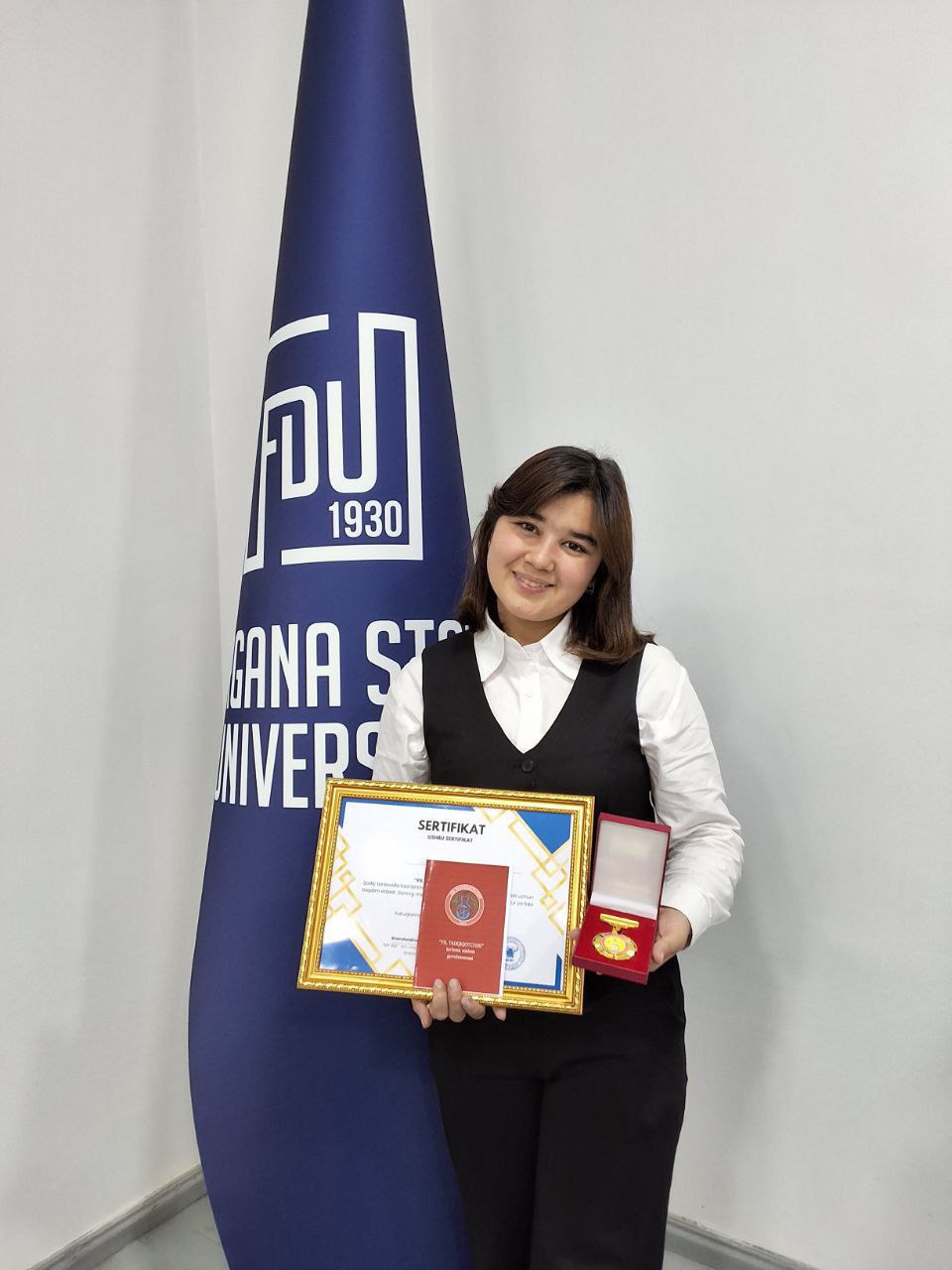
She conducts her research in the scientific field under the guidance of A’zamjonov Ahadjon, based on the tradition of a teacher-student relationship. In 2026, she was awarded the “Researcher of the Year” badge for her fruitful scientific research and published articles.
Public and creative activities
M. Rozikova is active not only in science, but also in the media and arts:
Media: Creates content promoting national values on social networks under the pseudonym “Do‘ppili kiz Mohizodam”.
Project: Acts as the host of the popular “Sirli Qon‘ng‘iroq” project.
Social activity: One of the active youth of the faculty, a member of the “Kizlarjon” club and the youth team of the People’s Democratic Party of Uzbekistan (PDPU).
Art: As an artist with many years of experience, she has been deeply studying the secrets of fine arts.
Skills and goals
She is highly skilled in working with digital technologies, in particular graphic design and engineering graphics programs. Her main goal is to combine national art with modern technologies, bring it to the world level, and introduce innovative methodologies in the field of pedagogy.