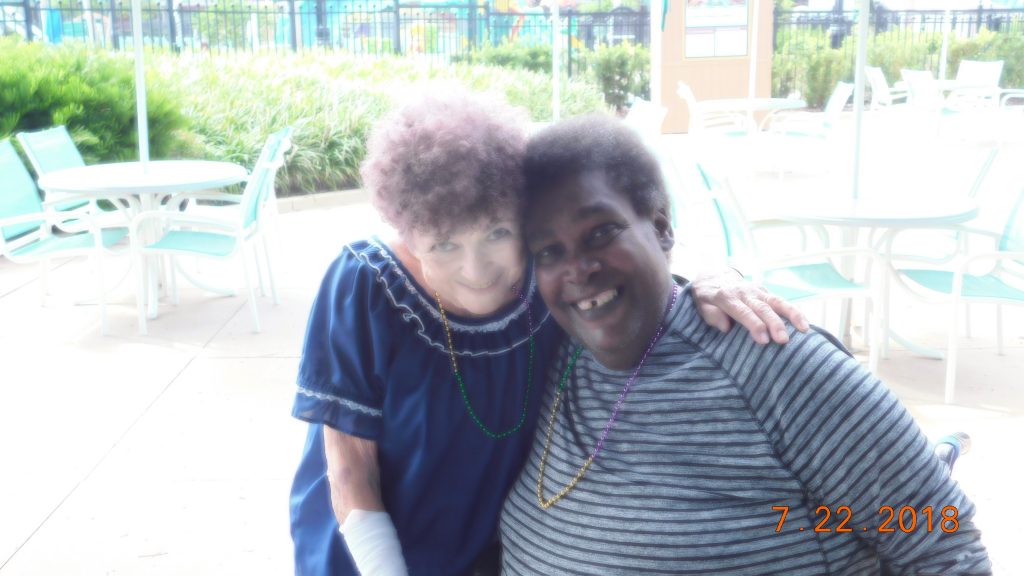
Essay from Michael Robinson

Middle aged Black man wearing a tee shirt hugging an older White woman, fellow contributor Joan Beebe, to his left. They're standing on concrete in front of some bushes and chairs near a swimming pool and both have necklaces of Mardi Gras beads.
Michael Robinson (right) and fellow contributor Joan Beebe.

It seemed to be hot the night Dr. King was assassinated. In April of 1968, I was eleven years old and I watched on the television that he had been shot. My foster father’s apartment was across the alley from my foster mother’s apartment. The alley was cool, not hot this time of the year. As I walked through the alley, someone said, “King is dead!” I yelled back something to the effect “yea!” I did not know that what was to follow that night would change not only the world, but my corner of the world. “Niggers not going to stand for this!” my foster mother cried out. She was a lady in her late sixties maybe early seventies at the time. A chill ran down my body. I was frozen in time. It was as if the world were going to end.

Living in the nation’s capital for eleven years, I had witnessed so much violence: shootings, people who had their throats cut and survived. My foster sister’s husband Richard was one of those who had survived having his throat cut. I could see the scar around his neck. I had no idea as to the reason, but it was clear to my young eyes the mark that the straight razor left. These weren’t the only memories I had of living in the streets of Chocolate City, as the black inhabitants called it. The only white faces in my neighborhood were owners of the corner stores and the priest at Holy Redeemer Catholic Church. The blacks had no need for whites except for those who owned the stores and hired neighborhood residents. The majority of the neighborhood shopping was on Seventh Street in Washington: the day-old dollar bread store, the farmer’s market, and clothing stores along a mile radius of Rhode Island Avenue, extending down towards P street and beyond.

My life was going to JFK Playground on P street across from Seventh Street, Northwest Washington. A giant slide curled around and down from the top of the hill to the dirt bottom, there was a tank we could climb on, and the biggest toy for me was a gutted fighter-jet plane which I would climb into and pretend I was a fighter pilot. My foster father loved to watch television shows such as Combat and Twelve O’clock High along with Rifleman and a variety of other shows. It was the war shows that I enjoyed watching and loved acting out on the tank and fighter jet. Across the street from the playground would be the book-mobile on Mondays, where I would go get books with pictures in them. Unable to read, I would lay them out on the floor and look at the pictures in my foster father’s apartment.

It all seemed so innocent before that night that Dr. King was murdered. I mean, I had been robbed and had my money taken by older kids by age ten. I had worked around prostitutes and walked in the alley with broken glass bottles and rocks we threw at one another for fun. I had witnessed car accidents leaving blood on the streets and then there was that kid they found in the abandoned apartment across the alley from my foster father’s apartment the summer before the riots of 68. But the following weeks were a blazing inferno that raged without mercy.

It started, as I recall, with a mob of people chanting in the streets “Burn, baby, burn!” I hid in my foster father’s apartment and I don’t recall if he were home. It all seemed so unreal that first night of the riots. The crowd was chanting words out of fear that I don’t remember. I didn’t want to remember. I had been afraid of black people ever since I could remember. The beatings at home and the beatings in the streets and the violence always there in the neighborhood on the weekends. However, this was different because everyone seemed enraged. The crowd moved within the neighborhood, setting cars on fire and shouting “Burn, motherfucker burn!” They set cars on fire and shouted, “If you don’t want your house burned down, you’d better put “Soul-brother” on your door!” My foster father used shoe-polish on a sheet of notebook paper and wrote “Soul-brother,” and posted it on the green door of the apartment. This is the only time I remember him being in the apartment with me.

After a day or two, I’m not clear about the sequence of events, but I remember the burning down of my neighborhood and the Seventh Street corridor. I was out there with the looters, police, National Guard while the helicopters circled overhead. The mobs had come together after burning down the neighborhood stores. As I walked through the rubble and the broken glass, I smelled smoke; it filled my lungs and burned my eyes. I was so afraid of life, of people, of dying in the fires. I don’t remember any firetrucks coming as my neighborhood burned to the ground.

The walk to Seventh Street was long as the smoke circled around and up. The rubble smoked, and the smell of plastic and wood lasted for months and months afterwards. Cookie and some of us kids went to Seventh Street during the riots. As we approached there were people carrying TVs and stereo equipment, arms full of clothes, any and all things that one could want. “Go get you some; it’s free!” I heard. Walking around as bricks flew into windows and the glass shattered and the ground shook as guards stood with their gear prepared for war. The police were there as well as so many military vehicles.

Everything smelled of smoke. It wasn’t just the smell. It was the sight that my neighborhood was destroyed. Nothing existed that I knew; was all gone. Nothing was of use or value after the fire storm in my world. The canister landed and exploded, and the crowd yelled. “Tear gas, tear gas!” Cookie said, “Hold your breath.” Trying to run holding your breath is difficult as my eyes were burning, and the tear gas soaked my clothes. I remember turning the corner and running.

The water was cold as my foster mother washed me. My clothes were useless, and it all added to the experience that I was in a war-zone. The world seemed to have stopped. There wasn’t any school, nor was there anything to eat but canned goods, and the water was cold to bathe in. It all began to just fade. Each visit outside was a reminder that my world was destroyed. There was a curfew and the military-jeeps with the radio antennas with mounted guns raced through the streets. It was extremely dark since there was no power. Nothing seemed to be real; nothing felt alive, and I was just stuck in a place and time that had been destroyed. This feeling of those images came to me in the night as I slept and peed the bed. I don’t remember the following months in my life. The world had a glaze to it. JFK playground melted in the storm of fire. There had been fires in the neighborhood prior to the riots, which always frightened me, but this was different. I was numb.

The pews in church were a caramel color; the statue of Mary, the Mother of Jesus, stood guard, and the stations of the cross had a different meaning for me. The candles burned and there was no smell of smoke in the air. It smelled fresh with the smoke from the burning frankincense. It was different from riot smoke. I stared at the murals above the altar of angels with their wings opened as if they wanted to hold me. I would sit there for what seemed like forever. It was the only place that made sense to me and even then, I knew what was beyond the doors. Nothing mattered. No signs of life; it was if everyone were a shell. The neighborhood was a shell and the destroyed buildings were a reminder of what had happened that April of ‘68. I was so empty inside waiting for something, for someone, to make it all go away; however, that was not the case. The killing of Dr. King brought so much destruction. There were 13 people killed, according to one source and 900 businesses destroyed. I find it hard to believe that only 13 people died in D.C. During that period, more blacks died in the city on the regular weekends full of drinking and violence.

The memory of the riots did not fade as I sat in the church alone. It was all a bad dream that never went away for me. No one talked about what had happened that week, those months, and years later. No one said, “These people have been through a war and they are suffering from Post Traumatic Stress.” No! there was no talk about all that was lost. It wasn’t just the riots. It was a generation of young people that had been affected by having the military standing there with those rifles, with machine guns mounted on jeeps, helicopters roaming in the airspace. I often wondered what had happened, and like all the other difficulties that has been presented to my race (blacks), I wonder what we could have done if the city had not been destroyed.

I think of what my life would have been if I had not been through the war of ‘68. As the Vietnam War raged, we back here in the cities were fighting for our freedom. It was a collective voicing that we had been denied a chance for life. I often remember not only the riots of “68, but the city and the harshness of inner-city life. The riots were just a result of injustice, and a plea for fairness, dignity, and a chance for a meaningful life. While white America watched my city and many other cities burning, no one came to help rebuild a country that had been torn apart by racial injustice.

It was a long night on April 4, 1968. It was the night that a part of me died when my city died. My city, my neighborhood, and my home. It was what I knew; It was my place even with all the prior violence and threats to my life. It was a place where I had learned to be safe, until the riots. Forty-nine years ago, this week, a part of me died when the army marched through my neighborhood with machine-guns mounted on jeeps. This wasn’t the TV show Combat, this was my home.

An aerial view showing clouds of smoke rising from burning buildings in northeast Washington, D.C., on April 5, 1968. The fires resulted from rioting and demonstrations after the assassination of Martin Luther King Jr. 
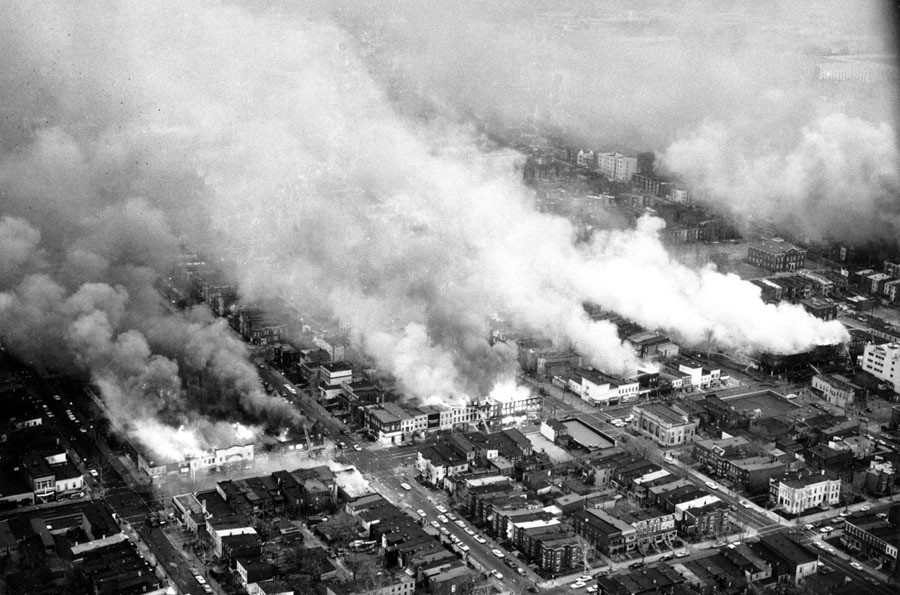
Black and white photo of smoke rising from burning buildings in Washington D.C. Aerial view over several city blocks.

https://www.theatlantic.com/photo/2018/04/the-riots-that-followed-the-assassination-of-martin-luther-king-jr/557159/

President Johnson called federal troops into the nation’s capital to restore peace after a day of arson, looting, and violence on April 5, 1968. Here, a trooper stands guard in the street as another (left) patrols a completely demolished building. 
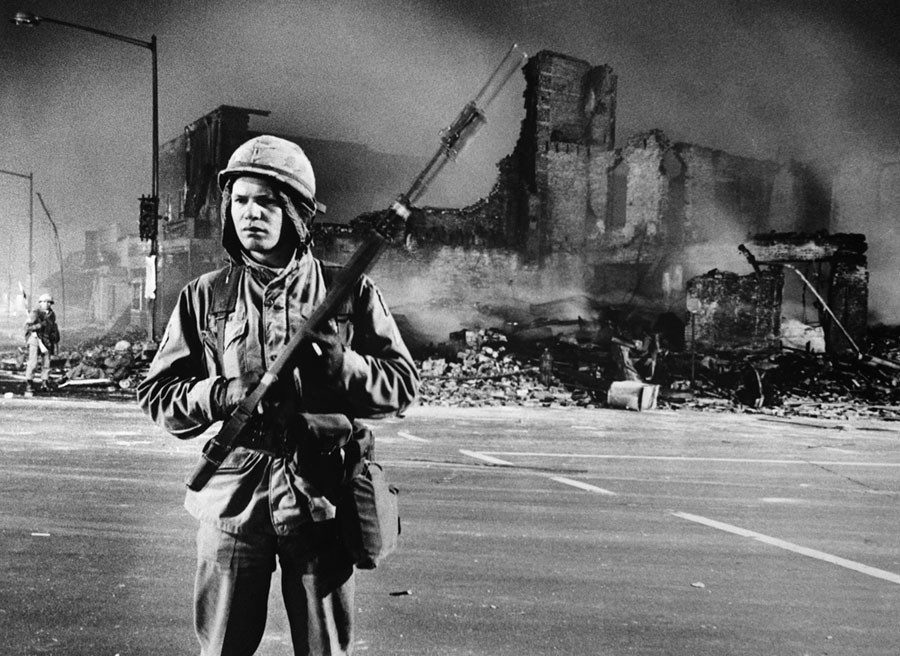
Here, a trooper stands guard in the street as another (left) patrols a completely demolished building. White man with a large gun and a helmet stands on a street corner in front of a pile of rubble.

https://www.theatlantic.com/photo/2018/04/the-riots-that-followed-the-assassination-of-martin-luther-king-jr/557159/

A soldier and civilians walk near a destroyed newsstand at 14th and Kenyon Streets in northwest Washington, D.C., on April 6, 1968, following rioting after the assassination of Martin Luther King Jr. 
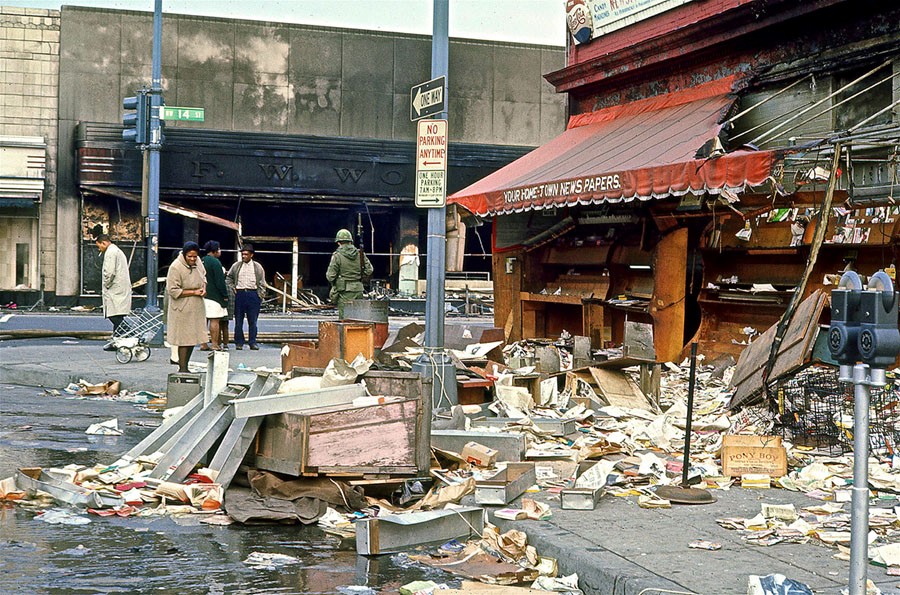
A few Black people with coats peruse a destroyed newsstand. Paper and wooden crates are strewn everywhere on the sidewalk and street in front of the storefront. Water pools in the street.

https://www.theatlantic.com/photo/2018/04/the-riots-that-followed-the-assassination-of-martin-luther-king-jr/557159/

People stand near a destroyed and burned-out building on 14th Street and Kenyon Street in northwest Washington on April 6, 1968. 
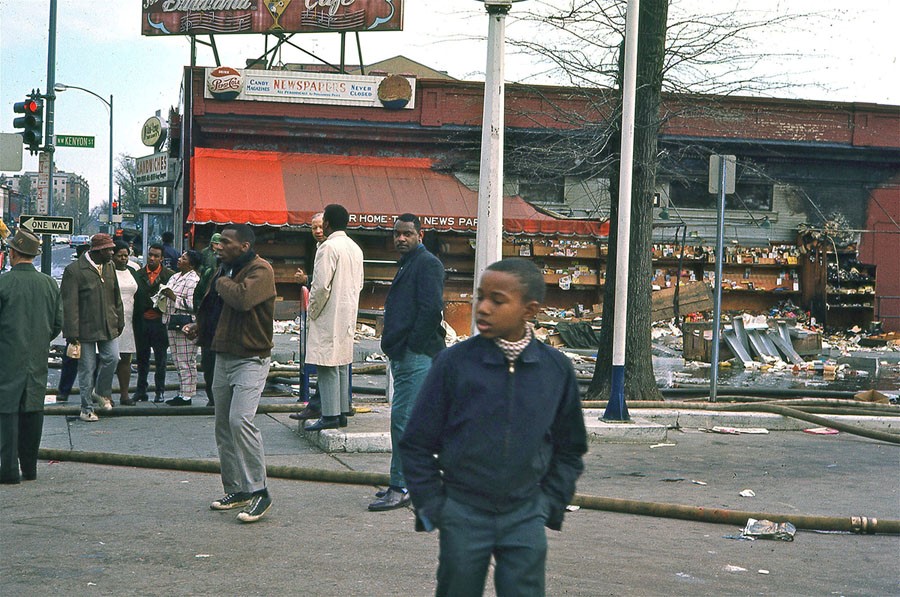
Young Black boy with a coat and jeans looks off to the side in another shot of the destroyed newsstand. More people are present, Black adults in coats and jeans.

https://www.theatlantic.com/photo/2018/04/the-riots-that-followed-the-assassination-of-martin-luther-king-jr/557159/

National guard troops stand at the intersection of 7th and K Streets in northwest Washington, D.C., on April 6, 1968. 
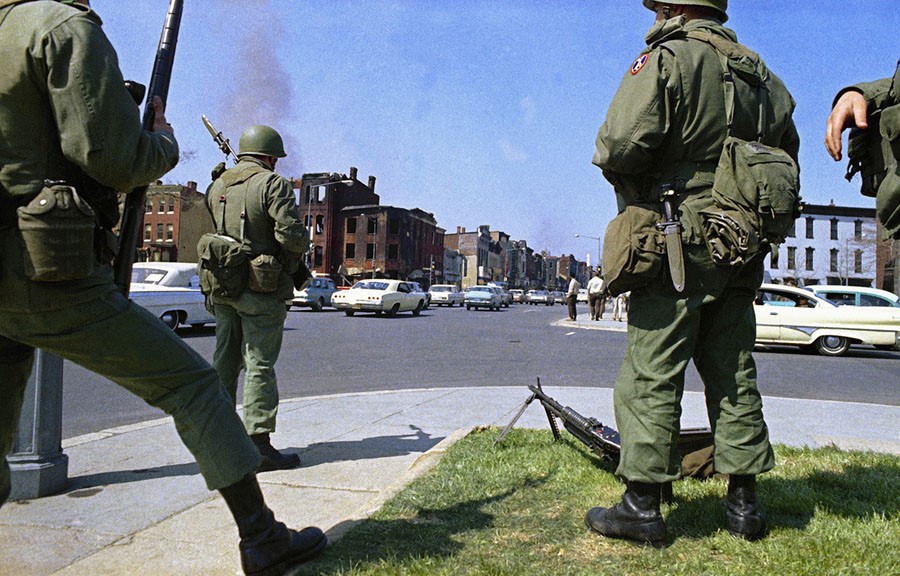
Green-uniformed National Guard troops stand guard with long guns on a street corner, facing some burned-out buildings.

https://www.theatlantic.com/photo/2018/04/the-riots-that-followed-the-assassination-of-martin-luther-king-jr/557159/

A pedestrian is waved away from an area by a gas-masked national guard soldier guarding an area near 7th and K Streets in northwest Washington, D.C., as rioting continued in the city on April 6, 1968. 
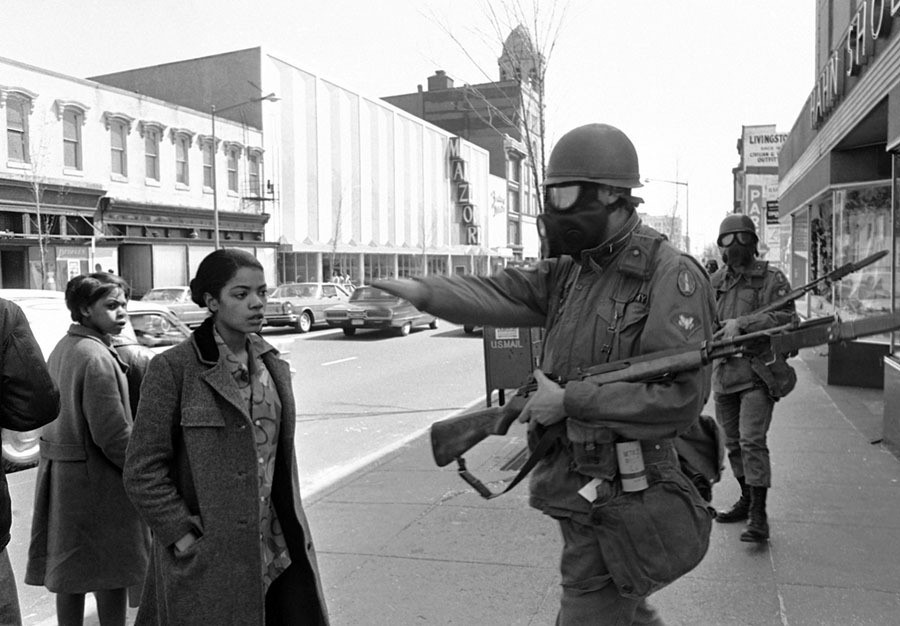
An armed, helmeted, uniformed National Guard officer waves away a young Black woman in a long coat as she looks back towards an area she's not permitted to enter.
https://www.theatlantic.com/photo/2018/04/the-riots-that-followed-the-assassination-of-martin-luther-king-jr/557159/
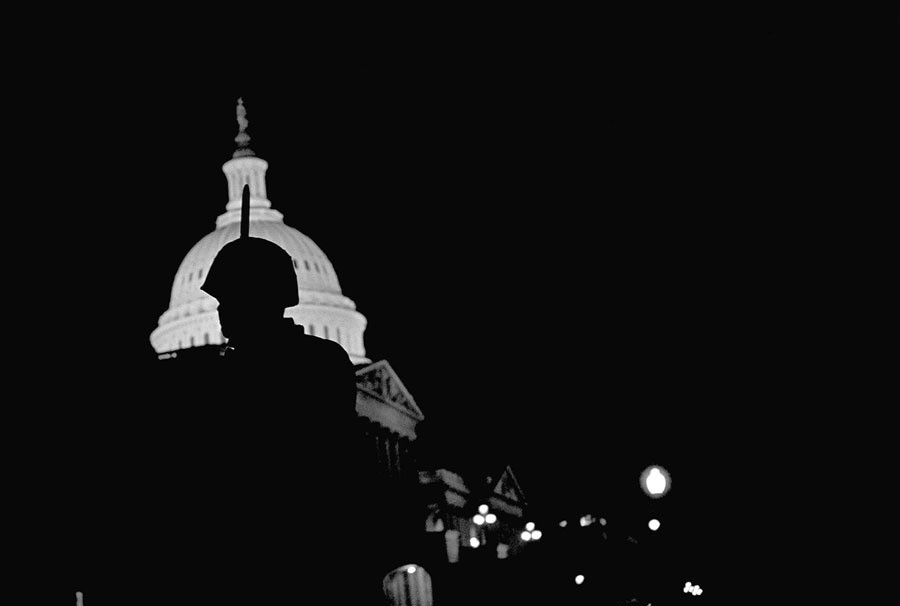
Silhouette of a National Guard officer standing up with his gun in his hands in front of the white lit-up Capitol building at night.
https://www.theatlantic.com/photo/2018/04/the-riots-that-followed-the-assassination-of-martin-luther-king-jr/557159/

Remember that time Uncle Sam gave D.C. kids a tank and jet airplanes to play on?

Taylor, Alan. “The Riots That Followed the Assassination of Martin Luther King Jr.” The Atlantic, 12 Apr. 2018, www.theatlantic.com/photo/2018/04/t+e-riots-that-followed-the-assassination-of-martin-luther-king-jr/557159/.
Poetry from Ahmad Al-Khatat

Depression

Ahmad Al-Khatat

My eyes are numb from crying, 
my hand hurts from writing, 
my head is slowly attaching 
my neck to the cords of death, 
-due to the sorrows, I have 
adopted by myself.

Drop the Curtain

Drop the

curtain, please?

The slam poetry

is finally over

The ones with

the sad faces

Will finally

pull the trigger.

The Limits of the Sun

Take me to the limits of the sun
Away from the miserable nest
-of skeletons, simply because
they remind me of my thirty-five years

Take me back in your warm dream
Where life’s bitterness appears more
like a blooming rose in the direction
of the cemetery, in which we can smile

Take me to the sorrows of our home
To learn how to love without weeping
To learn how to raise you to the rainbow
And learn about each other as we are one heart

Take me somewhere far away so
You and I we are one route to the darkness
Nobody can get in our way, nor damage us
The ones who are in, they will win and the

-ones who escape will die for being lonely
If you cannot take me anywhere near you
Then allow me to sip on some of the best
-poison, since I am weak to go on my own

to the limits of the sun…

My New Bio

Ahmad Al-Khatat was born in Baghdad, Iraq. His work has appeared in print and online journals globally and has poems translated into several languages. He has been nominated for Best of the Net 2018. He is the author of The Bleeding Heart Poet, Love On The War’s Frontline, Gas Chamber, Wounds from Iraq, Roofs of Dreams, The Grey Revolution, and Noemi & Lips of Sweetness. He lives in Montreal, Canada.

Poetry from Susie Gharib

 Thrills
  
 Let me introduce beauty in a non-physiognomical form:
  
 A ripple lapping reclusive toes
 that have shunned the elements for a century or so,
 that never graced the ground with silken soles
 for barefootedness is only common among the low
 in this sad part of the globe.
  
 A tremor running through my bones
 Upon meeting the eyes of a life-sworn foe,
 having repented his gall,
 replenishing his ocular liquid with sheets of gold,
 intricately woven by a contrite soul.
  
 A shadow that was banished decades ago
 before I could utter my very first words,
 before I could even walk,
 conjured up from the other world,
 gliding into my dreams to illumine their void.
 
 Downfall
  
 Of all his traits, furtiveness repelled me most,
 a secretive nature that coveted moss,
 that concealed the truth,
 and cloaked every action with a surreptitious look.
 I could never digest his oxymorons,
 his classy puns and tinsel tropes.
 I was straightforward. I always spoke
 not from the depth of my heart
 but from the bottom of my stomach.
 Un-arrayed, the words came naked,
 unchaperoned by punctuation modes,
 with un-softened tones,
 unfiltered by social codes
 or decorum protocols,
 unabashed and bold.
 This capacity to divulge my innermost thoughts 
 brought about my downfall.
 
 Domestic Eloquence
  
 He wants her utterly silent around the house.
 She wonders whether her utterances are full of discordant sounds,
 for his persistent repudiation of her voice
 has begun to aggravate knots of nerves.
 He says she is always very loud,
 but when she softens her tone, 
 her words produce the same impact:
 a face full of repugnance and some articulate spite.
 She recalls being once told by the only man 
 with whom she fell in love
 that he would be contented with listening to her voice 
 for the rest of his life,
 a relationship of the verbal type
 if it should come to nothing else.
 Others had intimated that she possessed mellifluence
 suited to some public broadcast,
 or perhaps singing if she had the gift!
 Such remarks make his revulsion even worse.
  
 She examines their daily interchange 
 to see what stimulates his undisguised disgust.
 She usually speaks of long-needed repairs 
 that derail the orbit of their life,
 of grease-stained plates that he loves to pile 
 for his favorite germs,
 of expenditure that taxes her every hard-earned pence.
 Now she realizes after years of domestic eloquence
 that what unsettles the parasitic in him is not her voice:
 It is finance.
  
 
 What About
  
 We tend to dwell on the sorrowful
 what renders us lachrymose,
 what piques and wounds our pride,
 what robs us of cheerful discourse,
 but what about the precious moments
 that we snatched despite all vigilant foes,
 the bouts of hearty laughter
 the cordial episodes,
 the communions we held with surroundings,
 the ripply warmth,
 the feelings that no matter how fleeting
 can buoy us up until our final repose.


 Burdens
  
 I wonder how the Swiss can cope
 with their surplus of annual gold.
 It must be a burden on one’s thoughts
 to have much more than one can hold.
  
 I wonder how the glib dispense
 with their surplus of sugared words.
 It must be a burden on one’s tongue
 to feel the trickle that audiences shun.
  
 I wonder what Arabia would do
 to its surplus of petroleum fuel.
 It must be a burden on one’s secretion
 to pump such liquid to warring nations.
  
 I wonder what new world orders can do
 to combat their surplus of nuclear feuds.
 It must be a burden on one’s mind
 to save the planet from spurious wile.
 
   
 When there’s so much
  
 When there’s so much ugliness in our daily norm
 where can we purchase beauty in an undiluted form,
 neither canned, modified, nor cloned?
  
 When there’s so much hate in our daily debates,
 where can we excavate love that’s not outdated,
 neither a relic nor reincarnated?
  
 When there are so many fumes in our modern rooms,
 where can we distil pure air into our tubes,
 with no filters sticking out of our throats?
  
 When there are so many creeds scattered like seeds, 
 where can we worship without excludees,
 a temple for all, at home and overseas?


Synchronized Chaos June 2020: Hermetic Thoughts

Hermetic thoughts. These words, taken from Henry Bladon’s imagistic poem, reflect the state of many of us, sealed up in quarantine.

Whether we have gained longer hours to spend in reflection, or just changed up our schedules and daily rhythms, we’re likely living and thinking in different ways.

Each contributor’s creative works in this issue are highly distinctive and personal.

Some writers meander into nostalgia. Ian Copestick remembers vibrant young love while reflecting on mental and physical aging. J.D. DeHart depicts the loosely shifting sense of space and time on a road trip.

Others look within themselves and to their pasts for a sense of self-understanding. Norman J. Olson recollects his favorite styles of painting and the development of his personal aesthetic, while Robert Ragan’s protagonist wonders whether he could have done more to prevent an old friend’s suicide.

Some of the ruminations turn sorrowful. J.J. Campbell contributes subdued pieces on aging, weakness, melancholy and death, Abigail George writes of heartbreak, abandonment, and the vertigo of hospitalization.

Sometimes the same pieces, or collections of work, vacillate between hope and despair. Chimezie Ihekuna’s personal essay describes how he developed the inner self-worth to withstand social exclusion due to a facial disfigurement, and how practicing the craft of writing gave him strength and a different focus and source of identity.

Mahbub’s poems speak of a fanciful romance out in nature, yet also criminal and ethnic violence and dangerous weather within his homeland of Bangladesh. Ahmad Al-Khatat brings us the death and grief of the refugee experience, yet the potential for rest and healing for humans and the rest of the natural world while sheltering in place.

Steven Croft conveys the tension of war and other disasters by illustrating the small visual details that can loom large when strong emotions distort our perception of time and space. A glimpse of a woman’s hair under her headscarf, the sight of church windows overlooking an empty baseball diamond, and a rescuer replacing his shoes after saving a swimmer in distress draw and keep us within Croft’s scenes.

Another piece harnesses details and objects to illustrate larger themes: Daniel DeCulla turns a single high-heeled shoe into a meditation on the power and grace within traditional femininity.

Tidbits of ordinary life take on artistic meaning within the films of independent director and university professor Dina Abd Elsalam, profiled by Jaylan Salah. Elsalam’s movies often portray regular people, sometimes elderly people, enjoying and making the most of their lives, and celebrate friendship and neighborliness.

Joan Beebe reaches out to all of our readers in a spirit of caring, with a gentle poem about roses, an expression of sympathy for our neighborhoods with empty streets, and a prayer to the Virgin Mary for an end to the pandemic.

Ike Boat offers up a radiant celebration of life, reciting a spoken word piece that’s an ode to the beach where he stands on a brilliant summer day in his native Ghana. A man of faith, Boat gives thanks to God for his existence.

Other contributors are also spiritual, or at least philosophical. Ken Rutkowski ruminates through drawings on his time abroad in Vietnam, where the people he met lived with equanimity and optimism. Hongri Yuan lets his imagination penetrate the heavens with a lengthy bilingual English/Mandarin vision of a golden city and supernatural statues, flowers and trees.

Christopher Bernard comments through poetry that the pandemic-emptied streets have reduced our urban crowds to a more human and manageable size, where we can actually see each other – and the return of nature and wildness.

Other pieces from J.D. DeHart describe how isolation affects our creative minds. Uniquely, he reviews a book through poetry, shifting among artistic forms just as our lives are shifting with the pandemic.

Mark Young’s artwork also shifts our expectations, combining the abstract and the concrete, lines and curves, defined and implied shapes and spaces. He incorporates text that’s meant to be aesthetic rather than literal and readable into his fanciful and at times humorous images.

We hope that readers resonate with the aesthetics of this issue, whether in the abstract visual art or poetry or in the concrete images or emotions or the narrative storytelling.

Everyone has different ‘hermetic thoughts,’ we all experience this season of isolation in our own ways and follow our own trains of thought. This issue points towards making space for all our varied mental states and different pathways towards co-creating a healthier future.

Poetry from Christopher Bernard

Two Poems

by Christopher Bernard

 Urbi et orbi
 
Myself, I prefer a city with no one in it,
or, if not exactly no one, only a few.
 
It’s like being in an enormous sculpture garden,
immense minimalist slabs
of glass and concrete throwing shadows
dark as poetry across streets grown modest
with stillness and opening trustingly as a child’s hand.
The few people there look less grotesque
when teased out of the crowd –
the way a solitary farmer turning his field,
a pair of friends or lovers, a daydreaming
hiker, seen in a summer countryscape
between bays of woods and folds
of pastureland and field, under
an ingenuously immense sky
make the dignity of humankind,
its vulnerable nobility,
palpable, and not the poorly spun joke
it seems so often
in a city hysterical, delirious, and crammed.
 
No: our monuments, our things,
the traces of care in the woodwork,
the shadow of a mind molded from a sun –
tools and toys and trinkets, engines and edifices,
the shape of a hand on a prehistoric cave wall,
a flute played shyly on a Sunday morning –
make me less ashamed of being human.
 
I wander the empty city like a hunter
in a wilderness, except that I have found
the object of my hunt, and hold it close
inside my coat, where I can feel its heart
beating, and its warmth, and its wings.


*****
 
The Coyotes of North Beach
 
Sunset, spring: a strange wailing
rises from the gorge under our house
cautiously balanced on a cliff edge
as on a knife
above a valley where coyotes are gathering.
Strange indeed for a city
(our neighborhood, part declivity, part escarpment,
is strange enough for any city).
But maybe not strange for a city
largely emptied from a malady
emptying much of the world –
and giving meaning to the "pan" 
in panache, panama, pancake, panjandrum,
Panglossion, Pandragon, pandemic –
and so giving way to wilderness
seeping back into the streets,
crows appraising the roof tops,
mountain sheep strolling about in Wales,
curious spiders measuring bus shelters
with their delicate silks,
coyotes gathering at cross streets
and dancing in the glimmering streetlights
as they flicker on in the dusk
and making their coyote-like noisings,
as sweet as they are uncanny,
in the city's deepening twilight.
 
Why are they wailing so?
Is it from fear, or loneliness, or need for love?
 
How did the coyotes know
that they are speaking for us?

*

Christopher Bernard is co-editor and poetry editor of the webzine Caveat Lector. His new novel, Meditations on Love and Catastrophe at The Liars’ Café, appeared in January 2020.

Poetry from Mahbub

Author Mahbub
Mahbub. Bangladeshi man in a light blue collared shirt and glasses with a pen in his pocket

Rohingya Repatriation

It was left no stone unturned

Doctors, nurses, relatives all engaged

How to restore to life

Having them all behind the spirit flies away silently

This carefulness we serve for the humanity

Humanity cries for humanity

But what can we see on the other part of it?

Thousands and millions of people left to experience death and suffering

Rohingyas living in Rakhine with a severe torture on their body flew away

Took shelter in Chattogram of Bangladesh

A pathetic Asian history

Passing their days in the sun suffering from starvation and rain

Under the open sky in unsafe and shaky habitations

Every day the earth blooms pale and grim

Like the old brown leaves in the tree, we see

Every day they would like to go back to their home

But ignored as the citizens or any ethnic group

People flee from the forests in fear of the tigers and the lions

Along the edge of a sea to not to get lost on the vast waters

What a sigh to be deprived of the right!

Not to be able to say

It’s my own land, my own country

The rulers serve people, delivering much of love

Ironically say again and again the same

Deceive them; kill them, a scene of massacre

From this clutch who can save themselves anyway

Try to take the breath fleeing to the other place

Sorry to say its second time failure the attempt-repatriation

Of the Rakhine people living in Bangladesh.

Chapainawabganj, Bangladesh
29/08/2019

Lots of Rain but No Clouds

The sky turns into black from the blue

All seem to be dark and glue

What a restless time!

Though so many fans are running

In this unbearable hot

What feels the mind and body?

The scent of rain through the nostrils

Change the thought to envisage

We see the sky but from black to white

In the meantime the sun shines

We hoped a lot but there is no drop of rain

The world always gains some moments

Our hearts rejoice, beside the heavy rain drops

There floods the rivers causing deaths and sufferings

Where I stand here I see the sky with much of hope

But this overhead is always covered with drought and fog.

Chapainawabganj, Bangladesh
06/09/2019

O My Love

When you love me in true sense

The waves of the river flow in tune

I see and see the full moon in the sky

A sign of love in the rainbow

What a rising after the rain, a new glow

Grasp me all my body and soul

A dream in reality

A promise to reach my destiny

O my love; please hold me in tongue

A wriggle never to be lost

O my heart, my love.

 Chapainawabganj, Bangladesh
 06/09/2019

Backlash Fear

He turns his face like a ghost

The victim standing before him forgets all

She mumbles and recollects the lashing and dashing to her

A rosy beauty

The cop with his gang stings

The rose full of fragrance and attraction

Torn into —– on the soil

Soft and blooming

The burning eyes encircling her

The mischievous roles a iron rod

The helpless victim reclines silent

The broken heart fumbles on the board

Mr. Judgment is hung on the wall.

Chapainawabganj, Bangladesh
 09/09/2019

The Love Shrine

There is no shrine except you

I lie and fondle in the jungle

This mound is only for you and me

Shakes my hands and heart

In this shrine there will be no goddess or god

At the ultimate point of joy

You are my soul mate, my all

Our blood is running too fast

Leaning over I see you on my hands

A full bloomed rose, a full moon starry sky

We wander and enjoy

In this heavenly lagoon

What is more than this idyllic beauty?

Where you and I

In this coral island the blue water sparks into your eyes

The water color eyes, fix into

I find no other heaven in this world

Wherever I see, I see this coral island

You are my atolls

Only you and I this entity century after century

Round over body and soul

After the burial of hundreds or thousands of years

The archeologists may find out

Engraving on the gate ‘The Love Shrine’.

Chapainawabganj, Bangladesh
29/08/2019