the stereo that ravishes the flimsy fiber of my walls
every second of the day,
the periodic cleaning of the communal toilet,
the frugal, frozen meals,
the droning laundry that churns my brain with twisted
sleeves,
the window-shopping that constantly reminds me of
aesthetic needs,
the constricting shoes that are past their retirement age
have all decidedly urged me to go on a three-day
retreat.
I arrived in Largs on a very gusty, snowy day.
A female taxi-driver kindly waved at me
I inquired whether I could walk to the Benedictine
Monastery.
Viewing the piling snow, my slender frame,
she shook her head negatively.
I boarded the vehicle banishing all thoughts about the
fare.
I was always on a budget but it was high time I
loosened care.
Instead, I focused on the beauty of a snow-puffed
affair.
The first thing that conversed with my languid eyes
was the crow which rescued St. Benedict from harm,
serenely perching upon the saint’s shoulder.
Warmly received with the Madonna smile,
I was preceded by the Sister up the stairs,
then having inadvertently tripped over her habit of
grace,
I was instantly forgiven before I blinked a single,
apologetic phrase.
I had learnt from a song that silence has a sound.
It was true indeed of that realm of the devout,
so with attuned ears I began to learn how to hearken
to the peace of the un-worded.
Dinner was served with guesthouse mates.
No students’ broils, no mounds of plates,
but my days were spent swirling with snowflakes.
In a pair of navy Wellington boots,
I crunched my way up and down the unsullied coast,
a single tiny blemish on unbroken snow,
except for a visible dog now and then,
being walked to execute its needs.
The Sisters must have marveled at my eccentric need
to be constantly outdoors
when life was freezing to its very core.
I was bent on braving an inner storm
when people sat snug in cozy homes.
Grasmere
I constantly think about his inward gaze
that sees beyond all feminine grace
and the flamboyant phrase,
but Winter seduces him with voluptuous peaks
and Alpine skiing has never been my expertise.
Instead, I yearn to nestle to April’s daffodils
in Grasmere’s dales.
He loves to hear the wind buffet his lateen sails,
to expose his nimble limbs to mischievous air elves,
when I prefer to float on the placid lake
that Wordsworth and De Quincey used to contemplate.
A Water-Sphinx
I moon away my swimming hours
flirting with fish who dare approach,
viewing some seaweed or a fleet of clouds,
rippling the sea with arms grown bronze.
The lane I’ve chosen in this mass of waters
is the darkest, deepest and quite aloof.
An occasional splash from an efficient diver
or a professional swimmer would beat my course.
With a soft stroke I caress the flowers
that ripples have weaved with straying foam.
No need to speed or brave the miles,
no race to win, no end in view.
But whose breath has now agitated the quiet,
ruffling the surface with rhythmic moves?
Attuned, each ear begins to marvel
at this consistent, persistent tune.
The surge that precedes a Leviathan towers
before my eyes that catch a glimpse
of a figure resurrected from Roman times,
a Triton or Spartan, a moving myth.
Two orbs that see through films of water
assess the nymph that within me dwells.
A commanding glance beckons me to follow
to race this legendary water-Sphinx.
With eyes mesmerized by a giant’s biceps,
my hands then whisk the sweet sea’s blue.
An unwinnable race it is but now,
I have a mate with an end in view.
A Historian
Benignity resides in the gleam of his eye
that calmly views a slumbering mankind,
too loath to unfurl.
Anger has never diluted his avowals
against the falsification of historic files,
the forgery of dates,
ecclesiastical guile,
and Truth’s demise.
He wonders what makes most people so blind
to every de-shrouding he has espoused.
Is it a complacent way of life?
An ancestral dread of the Inquisitor’s styles!
A shield against psychiatric art!
Or the plights of irretrievable Snow Whites!
Celestial
Grant me that purple cloud
for a funeral shroud,
some Autumn rain
to anoint my name,
a pyre of rays
for immolation in space,
a harp of stars
to play my rites,
a chariot of doves
my celestial hearse,
a headstone of light
for my burial site,
a wreath of beams
above remains.
Comeliness
Comeliness does not gather dust.
Its innateness surpasses must
and the intricacy of rust.
Ornate is the translucent facade
that glows with jovial smiles,
and the efficacy of a glance.
Melifluous is its lingual form,
resonating through spinal cords,
a euphony of throbs.
Redolent is its lingering scent,
regaling the mind in its absence,
a cerebral incense.
My Umbrella
The story of my umbrella is not a romance.
It has nothing to do with recreation, leisure, or class.
Floral as it may look, it is a weapon that defends,
derails, defuses, debars and deters.
Though I’m nearing retirement, my feet still serve an end.
The sun is quite hot-tempered in this portion of the world,
so my umbrella is the armor that shields my arms and head,
but not my legs.
Though incongruous with my sartorial façade,
it has become an appendix,
a perennial blemish on elegance,
derailing the gentility of an academic.
For some it has defused many feuds
over the efficacy of learning.
If knowledge cannot purchase one a car,
then one can fare better as a clerk,
a plumber, a sailor, or attending a bar.
As for my gender, a housewife.
This colorful nebula encircling my head
has debarred and deterred the ones to wed
who seek in a nuptial life more than a bed,
a financial credit.
Susie Gharib is a graduate of the University of Strathclyde with a Ph.D. on the work of D.H. Lawrence. Her poetry and fiction have appeared in multiple venues.
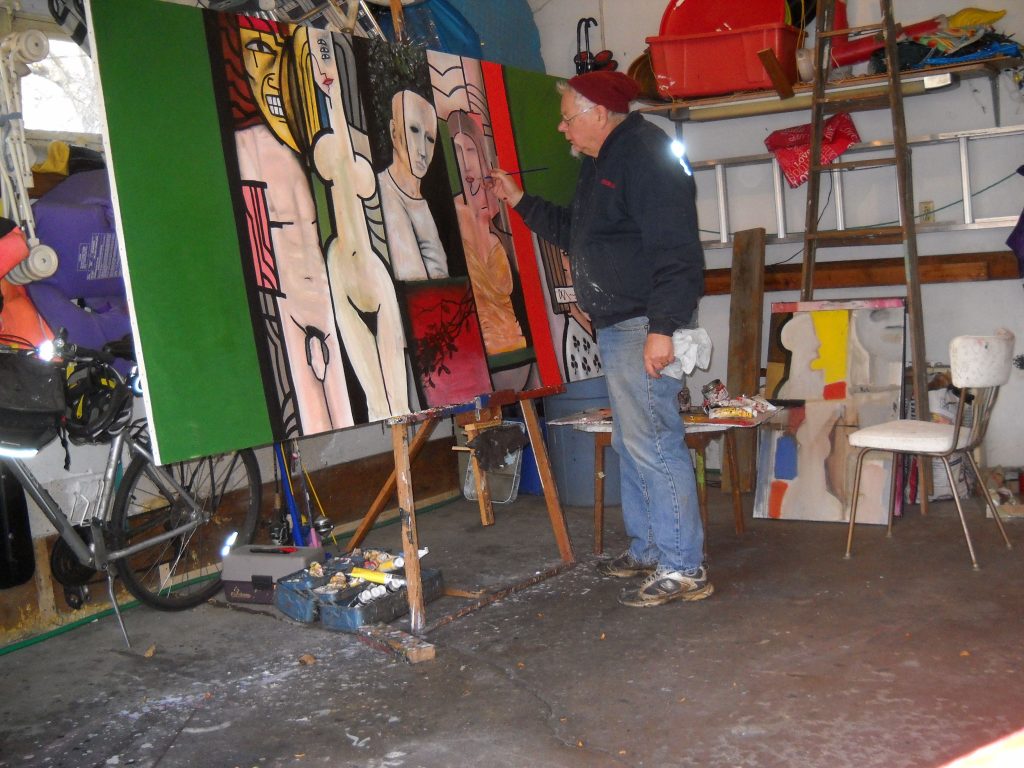
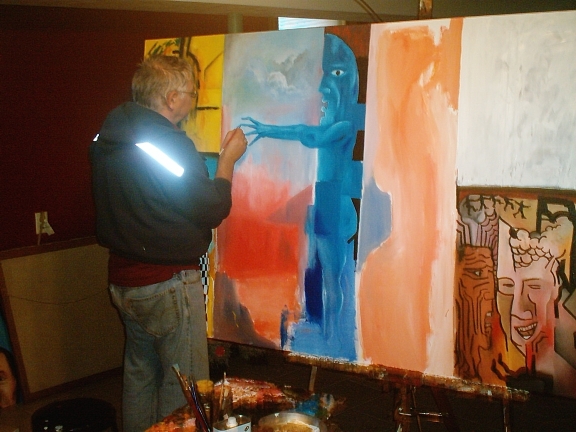
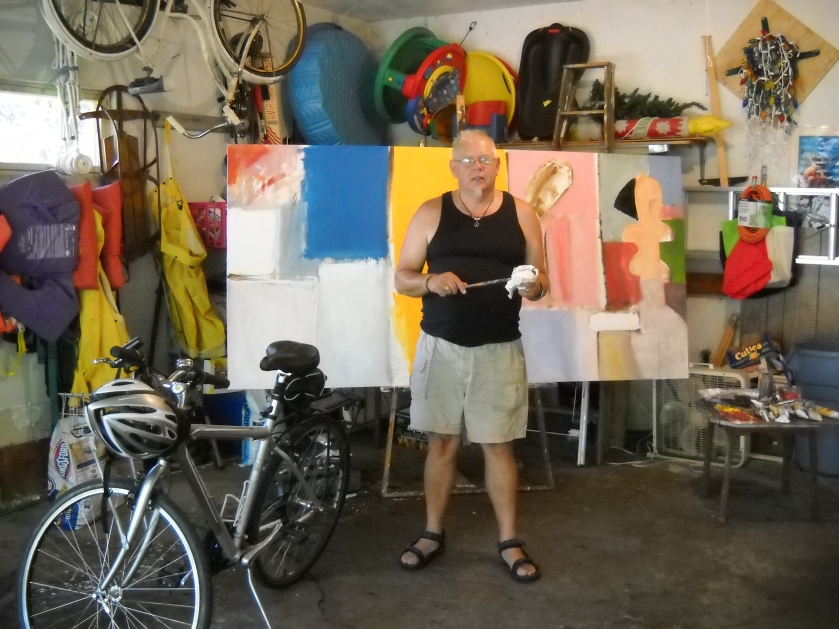
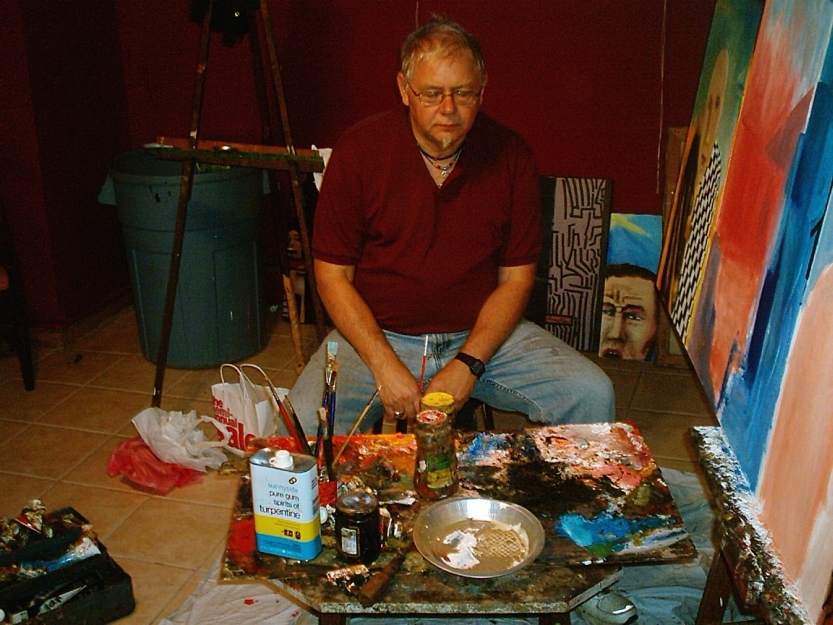
I tell people that I am an intuitive artist… I make art by starting with a surface,
putting some marks on it and using the medium at hand to keep working on the
piece until I feel that it is done, or it “feels right,” whatever that
means… I am not a naïve or self taught
artist, as I have a Masters degree in painting and have studied art history all
my life… my area of study for many
years has been Pre Raphaelite art and I have traveled extensively to see the
original works by those artists… ever
since I was a child, I have loved looking at art, especially old master,
European art and more recently, 19th Century academic and Victorian
art… my roots as an artist are firmly in
the late 19th Century and I use materials and techniques from that
era… many people say that they see the
influence of Picasso and Duchamp in my art and I’m sure that is there as in art
school, I was given a heavy dose of Picasso and I have always thought Duchamp
was the only really great artist of the 20th Century…
I remember that I discovered the magic of drawing as a pre
schooler, drawing in the margin of books and on whatever paper I could
find… when I got to grade school (there
was no kindergarten in the country school I attended) I discovered the
encyclopedia which was full of information that fascinated me and pictures that
I loved… I began studying old time
sailing ships and tried to use the diagrams and pictures in the encyclopedia to
make crude drawings of my own invention which had the right sails in the right
places….
In 6th grade, I discovered Michelangelo and a
book called Anatomy for the Artist and spent the next six years studying
anatomy and attempting to learn to draw people by learning the names and
locations of all the muscles, sinews and bones… when I got to the University of
Minnesota, I discovered life drawing which I loved loved loved… I don’t know if they even do that in art
schools any more, but in those days (late 1960s) a life drawing class would
have a person come into the class naked for us to look at and draw… I learned to draw what I saw and
surprisingly, I learned that men and women naked do not look as different from
one another as I would have thought… and
in fact, from across the room in many poses, it was not obvious what gender the
model was…
so, given the importance of the nude in the art that I
studied and loved, old master and Victorian drawings and paintings, and my
fascination with how people look without clothes, I spent most of my artistic
life making drawings and paintings more or less centered on images of naked men
and women… I very early on realized that
this kind of art was never going to be very popular, would always make people
more or less uncomfortable and would not bring me much in the way of commercial
success in the greater world of art galleries and art shows… I also knew that
my sort of old fashioned way of working, making drawings and paintings which
were not formally innovative was out of step with what was going on the world
of contemporary galleries and museums
so, I decided to work first for 20 years in a factory printing telephone books
and then for 20 years in a civil service job and continue to do art as a hobby
i.e. something one does for reasons other than to earn a living…
Hewlett-Packard
I never expected to have an audience for my art work at all
so continued on through the years, making drawings and paintings, working
intuitively, trying to let images flow from my unconscious mind without
thinking much about it… I have always
loved music of every kind and found that listening to and thinking about music
seemed to facilitate the flow of images from my brain through my fingers onto
the surface of the drawing or painting that I was working on… I have not done actual “life drawing” from a
nude model for many years, but continued to make images of figures because that
is what my subconscious seemed to want to do…
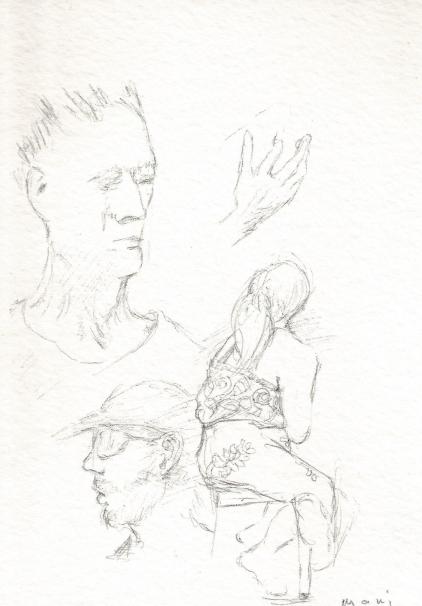
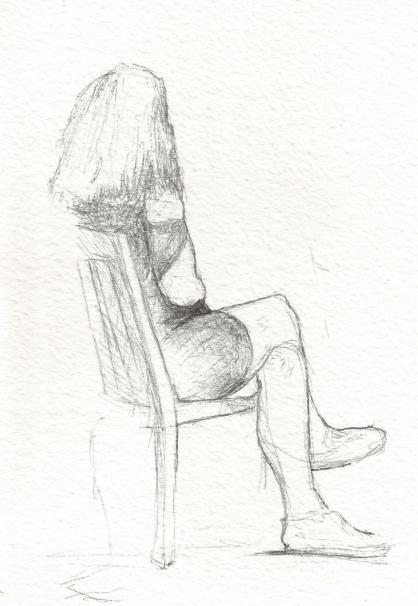
I often carry a small sketch book with me and find myself making
sketches of people I see around me, especially when traveling… I also found many years ago that I like making
imaginative drawings in public places, where there are people around to look at
and especially if there is music playing in the background… so, while traveling, I have made many many
drawings in the shade sitting by a pool at a Las Vegas hotel, or on the deck of
a cruise ship for example… sometimes using India ink and/or watercolor, more
often using ballpoint pen… just because
it was handy and I had developed a technique of chiaroscuro using ballpoint pen
over many years while sitting on an ink can in the corner behind the old
Wood-Hoe Telephone Directory Letterpress that I worked on for 20 years,
watching the rolls of paper wind down, waiting to splice the new roll onto the
old one… drawing with a ballpoint pen on
telephone book cover stock…
anyway, I was always a poet as well as an artist and after many years of regular submission and rejection of my poetry, I finally started having poems regularly published in the early 1990s and realized that some of the journals were using art and that the art they were using seemed less interesting than the drawings I was making… so I started photocopying the drawings and submitting them along with poetry… I found to my amazement that the literary people loved my art (while art people had never shown any interest in it whatsoever) and so now, nearly all of my 600 plus mature works of art have been published in the literary press – one place or another… and I have a small audience that is interested in my work… I also find that when I am drawing in public, people are fascinated by the images and want to talk about them… this, I guess is for me, the same kind of public interaction that a gallery or museum artist would get from their vernissage… people ask me “what does it mean” and I tell them, either, “I don’t have any idea what it means” or “it is an art work and you as the viewer have to decide what it means…”
Hewlett-Packard
so, what I was trying to do here was to write about my philosophy of art, my aesthetic, I guess you would call it, and what I wound up talking about was the history of my practice… which is to allow my intuition to work on a painting or drawing until it “feels right” or, “seems to be done…” until the piece feels done, until it feels right, I can as easily tear a piece up/destroy it, as keep on working on it but if I do not do one or the other, the piece will keep on bothering me until I make it right or destroy it… other than that, the only thing I have to say about my philosophy of making art is that it has to feel honest… if I am trying to force it, or fake it, I usually wind up throwing the piece away once I realize that it feels dishonest… also, the older I get (I am now 71) the more I realized that I do not understand art, life or philosophy very well at all and although I am a somewhat introspective person, I am not sure I really understand myself that well either… I do however think I get insight about these things by looking at my artworks and trying to figure out what they mean and, why they exist… and seeing them published here and there…
Henry Bladon is based in Somerset in the UK. He is a writer of short fiction and poetry with a PhD in literature and creative writing from the University of Birmingham. He is the author of several poetry collections and his work can be seen in Poetica Review, Pure Slush, Truth Serum Press, Lunate, and O:JA&L, among other places.
Celebrity,
“cultural attention,” fame (“that last infirmity of noble mind,” as Milton said
in “Lycidas,” another elegy), is fickle, often very strange, sometimes
preposterous. Andy Warhol may have been an optimist: in the future everyone
will be famous for no more than fifteen seconds, with anyone famous for longer
than that in serious danger of being trolled by the envious until they wish
they had never been heard of.
Yet
there was, at one time, a point to fame: the holding in memory by a culture, a
nation, a people, of exemplary beings whose deeds inspired the rest of us to
strive to shape ourselves into something truer, nobler, finer—proofs of what a
person is capable of for good. We have examples enough of the contrary, their
“fame” one more proof of our eternal human folly.
The
noble spirits among us go almost unseen, unregarded; condescended to with a nod
here, an award there, but taken for granted for the sake of the mad men, the
mirrors of our weakness, who genuinely fascinate us. We are of course free
either way—but, born ignorant, needy and weak, and needing as we do to learn
everything from the darkness of our beginning, we require examples to teach us
which to choose: nobility, infamy, indifference, golden mediocrity? Or?
One
criticism of democracy has always been that it pretends the ordinary person,
the “common man,” capable of few or no superlative acts, nor claiming to be so,
is an ideal. And yet perhaps it is one, an ideal worthy of respect and value:
the basic decency of the ordinary person—once the adolescent manias have been
seared off via an acid bath in reality, leaving a rooted awareness of vulnerability,
our ultimate powerlessness—is surely closer to the reality of the human
condition than the brief exhilarations of conqueror, genius and saint.
The
exceptional person inspires us to demand more from ourselves, sometimes more
than is possible—they can be as cruel to those around them who are less able to
endure it, as toward themselves. The ordinary person reminds us that our limits
are as absolute as our promise; that the greatest of all human beings will be
never more than human: that all of us live in bodies that are born, are
vulnerable to vicissitudes we can neither prevent nor even know the existence
of till they strike us, and that perish as completely as if they had never
been.
Which
makes it all the more revelatory of our painfully contradictory position—as
vulnerable, mortal, and limited beings of flesh, blood and bone who at the same
time have the minds and spirits, the gifts of gods, demons and angels, and the
will, in our small way, to use them—when we see a direct expression of the
nobility of our spirits meeting the nothingness and cruelty of our bodies, and
the meeting does not end in stalemate, but in an eloquence that, while only a
partial victory, is nevertheless a sign of the holiness of existence, of life
and mind, of humanity and the world.
Such
a revelation I believe can be found in this book. For the poet Ivan Argüelles
has given us a book of great beauty and emotional power, heart rending and
moving, because we see enacted in it a human nobility in stark confrontation
with ultimate human weakness—in woe and wonder, bafflement, grief, and a
strange and grateful joy.
Early
in 2018, the poet and his wife lost their son Max. Max had suffered for almost
four decades from encephalitis, an inflammation of the brain contracted when he
was ten years old. He spent most of his life with his parents, moving from
crisis to crisis, in and out of hospitals, severely challenged in mind and body
if not in spirit. In recent years, the poet had also lost his brother and
identical twin, José Argüelles, about whom he has written eloquently. But this
new death, though long expected, clearly wounded at an even deeper level,
calling up an anguish not only over the loss of what was, from all accounts, a
loving and gentle soul, but over the mystery, the apparent cruelty and
senselessness of his son’s fate.
The
result has been an anguished outpouring of poetry, a despairingly eloquent
questioning of life, the universe and the emptiness suffusing it, of himself,
the world, and the void; of “the Unknown,” as he puts it—a hopeless yet
determined quest for an answer he knows, believes, suspects, and fears cannot
be found. The poems have been collected into this, his most focused and moving
book – “HOIL” was a word of unknown meaning that (according to the poet) Max
wrote on various drawings in his early childhood, and thus especially
appropriate for this book.
In
these poems Argüelles displays what anyone who knows his work would expect: a
seemingly limitless inventiveness of startling imagery, a gift for paradox
seducing assent, surrealist elisions of logic that seem as natural as
breathing, and a near perfect ear—coupled with a mastery of condensed statement
that demands, and rewards, close attention, to say nothing of a depth of personal
feeling and illumination, vulnerability, in some ways unique to his poems here.
There
are poems “spoken” by Max:
I
can’t tie my shoe strings
my
pulse is fluttering madly
black
spots devour my left eye
and
people randomly assembled
all
with someone else’s hands
what
are they doing and saying
where
is the illuminated globe
and
the scissors that cut the wind
—from SHORT CIRCUIT
And
poems spoken to him:
tell
me you’ve just gone
to
a temporary Elysium
where
flowers are made of paper
in
colors that last a day
a
place where they burn water
because
death does not exist
tell
me that on the other shore
your
hands are still making
shadows
that the blind can feel
—from MAGIC MAX
There
are poems about Max:
great
and splendid the mornings when
in
your magic chair you greeted the first light
.
. .
and
with joy bush herb grass tree leaf
beloved
of bug and bird alike you blessed
.
. .
and
when you reached your happy hand forth
to
greet and bless the homeless and hungry
who
in their morning passage came to you
a
benediction in their grateful smiles
—from SAINT MAX
And
about his child’s game of traveling through outer space, powered by a favorite
toy:
. . . I was a miconaut
in
my plastic toy sailing the galaxies
—from MAX: A SHORT AUTOBIOGRAPHY
There
are poems about the basic mystery of being:
all
the schools of thought
fit
into a blade of grass
the
heat and magma of the past
the
very turbulence of the cosmos
a
dew drop a petal in the wind
all
expressions of the seen and felt
are
nothing in the sweep of time
.
. .
. . . the rapacious gods
flash
their gaudy crowns
parading
magnificent see-through
bodies
like shadows of alabaster
they
too are nothing but absence
—from IN PERPETUITY
.
. . and the mystery of death:
where
does one go when the door shuts
are
there windows inside or a trap-hole
hidden
in the ceiling or secret words
to
transport the soul to its next destiny
.
. .
does
it feel like an ancient ruined temple
the
feel of moss the scent of damp grass
blind
statues representing the gods
of
futility and longing . . .
.
. .
is
it easier to sleep again to forget what
it
was that was being sought—a hand?
—from AVERNUS
There
are poems made up, partly or all, of questions with no answers:
how
many is number? who talks to the comb?
who
are the zero? what letter comes second?
who
counts the echoes? who sets light in the glass?
who
emerges in the cloud? who sleeps with the child?
who
wakes in the well? who pronounces the moon?
—from THE PURVEYOR OF SOUND
And
poems about the anguish of this death:
the
discarded comb
the
useless shaving brush
and
what the mirror no longer holds
distance
of immeasurable hours
nowhere
now in the spent landscape
of
discarded talismans
—from THE REMAINS
you
have become sleek a streaking flash
in
the night heavens which we scour looking
for
the brilliant dust of your swift passage
into
eternity a micronaut at last
—from MICRONAUT II
And
there are poems about the responsive questioning and questionable responses of
poetry:
when
they wrote that page
who
was at the window watching?
who
could restrain the hands of the wind?
it
came from a chasm of ink
illegible
words of a rotating night
errors
in punctuation and syntax
what
could be the one way forward
if
not opening the side door
and
going directly into the woods
—from FATE
Above
all, there is the embrace of mind, spirit and heart of a noble soul (when will
fame come?) speaking from the depths of sorrow and grace:
you
reached out for a handful of air
to
define your true being the essential inner you
great
internal blossoming of sand and rock
imprinted
with the hearsay of the archaic
enormous
unfolding waves of letters
missives
from secret gods hidden in liquid gold
what
their mouths were telling you in a language
of
fever and ancient fingerprints HOIL
which you wrote in your mysterious passage
to
the underworld riding the enigmatic thunder
—from CHILD-OF-MY-HEART
____
Christopher
Bernard is co-editor and poetry editor of the webzine Caveat Lector. His new novel Meditations
on Love and Catastrophe at The Liars’ Café will appear in 2020.
whatever broken spanish i remember she whispers to me in spanish when she’s feeling sexy i try my best to respond with whatever broken spanish i remember from school her kisses are like the sweetest candy of course, i’m a diabetic
the human condition i don’t mind the pain i have grown to accept it it’s part of the human condition it’s the price for not killing myself as a child my penalty for allowing myself to be stepped on, have my heart trampled and be constantly reminded that i was never good enough to begin with
this weird void another christmas alone stuck in this weird void all my friends live too far away there’s no woman on this earth willing to even take the chance with me too bad, i’m still a fucking dreamer skin tough enough to no longer give two shits
endless strings of lights i remember the dysfunction from my youth at christmas the eventual argument while putting up the fake tree and endless strings of lights i learned all the dirty words by the time i was five hated all the holidays before i reached ten years old not exactly good while trying to incorporate yourself into the world
the last hope i have i look in her eyes and see all the fantasies i never got to have in my youth the last hope i have at ever finding love her neon soul brings what little joy i can actually feel these days maybe one day i’ll convince her there’s actually a future we could share
J.J. Campbell (1976 – ?) is currently trapped in suburbia, wondering where the lonely housewives are hiding. He’s been widely published over the years, most recently at Red Eft Review, Under The Bleachers, Horror Sleaze Trash, Chiron Review and Yellow Mama. You can find him most days on his mildly entertaining blog, evil delights. (https://evildelights.blogspot.com)
Listen Time howling Withering Time Dreaming Time Sleeping
Where we dance Upon our Night’s desires Until the end Of days
DARKLANDS “Ashes to ashes we all fall down holy is the machine”
Into this world We come & go Descend Into history Or madness Or love A longing Hate With A vengeance
So into the Journey The voyage The abyss We go Searching For something Greater than Ourselves
Perhaps A faith A truth A religion Or heroes lost But in the dark The darklands There are no Gods No beauty No voices Muses Or inspiration There is only Fame & money Politics & wealth Control War Devastation Where your Existence Means Nothing But there Is a magick A force greater Than all this Called Truth That is More powerful Than any Darkness Any monarch Or any God Within you
FUCKING SUGAR
There are times That living downtown Walking down streets At night when you hate The noise, the traffic The world as you experience Mankind at it’s finest Going down the shitter
The fat lady Screams on her Speaker phone at Her man who I imagine In my mind To be a skinny little nervous Chain smoking weasel like creature Who flinches at the Slightest tone of her voice The loud fat lady Is asking him questions That sound more like an Interrogation like where Were you? Where did you go? Did you go grocery shopping Like I told you to? Did you Pick up my sugar? My sugar My sugar? There is an immeasurable Almost an eternity Of silence And then, a meek sound A squeak emits back as The mouse man replies “no” I.. I ….I … forgot it.
What?! The fat lady’s voice Goes up ten octaves What!? You stupid fuck Fucking idiot Fucking wasted a trip Out to the store you forgot To get my fucking sugar?! You forgot To get my fucking sugar?! You stupid you stupid Fucking asshole my Fucking Sugar Fuck FuckFuck I’ll get my fucking Sugar myself! I’ll get my fucking Sugar myself! I’ll get my fucking Sugar myself!
And as I walk By her I smile And shake my Head as she Gives my an ugly Stare from her ugly Eyes & ugly face And then It occurs to Me that no matter What I do, who I Help or save that Humanity Is doomed
POLKA WILL NEVER DIE
I was born Raised on Johnny Cash And Herb Alpert
Became a man Listening to metal Punk & goth But over the Years the darkness Came And all I have is Southern Goth Now & memories Of years, days gone by Nostalgia Oldies music Blairs from the old Radio MotownStill kicking Ass the blues still Screaming truth But Polka Will Never Die Because it is The true music Of Satan Proof There is A hell Used To violently torture The guilty souls Of men Second Only to Square dance Which The devil Created Himself
BENEATH THIS BODY
You arise awake Early in the morning The sun Its light Rises Upon the Forests The cities The beach Upon Your face
We Become Motion into Moment Distant thoughts In our minds Telling us That something Is not right But wrong This life This world This song Trapped Within a self A world of Our own Making Our voices Suppressed Our hearts Denied But we go on Ignore the Impulse to Run Escape from The cages of Reality Reckoning
But beneath This flesh this Exterior this body The spirit still Breathes the Voice still exists The soul that Merely waits For you to Find it the Poem that waits For you to Write it the Heart that Tells you to Find your true Self For Beneath this Body there Are no cages No restraints No laws Only sanctuary Only refuge Only words The light Through the Window Of the prison Wall
AUTHOR’S BIO:
R.M. Engelhardt is an American Poet and Writer who is the author of several books over the last two decades including Coffee Ass Blues & Other Poems, The Last Cigarette: The Collected Poems of R.M. Engelhardt, The Resurrection Waltz and others. His work has also been published by such journals as Retort, Red Fez, Rusty Truck, Sure! The Charles Bukowski Newsletter, Thunder Sandwich, Fashion For Collapse, 2nd Avenue, The Angry Poet, Winedrunk Sidewalk, Full of Crow, The Outlaw Poetry Network, The Rye Whiskey Review & in many others. His new book of poetry is entitled ” Dark Lands” published by Whiskey City Press, 2019.