In the fall, I find myself playing in a hill of leaves, Like when I was a little boy, The world was full of adventure with the sounds of life. In the fall, I found myself looking at the world, When the skies were gray with a hint of life, Something unique about the sun being hidden. At that moment I find that I was alive, Alive to see the world in a new way, In a way that I will never forget. 4-12-2020
There are no clouds in autumn that are white, The sky is gray like my foster’s mother hair, With silver streaks.
An old washing ringer washtub, Pressing the clothes as she feeds them, Through the wringer.
The gray wooden porch and bending steps, Clothes blowing in the November wind, It was quiet as I watched her,
A moment in which I understood, Life was safe at that moment with gray clouds, And hair streaking gray hair and her countenance were soft. 4-12-2020
Autumn Leaves IV
The leaves fall on me as snowflakes would, There were gray skies and I watched, My foster mother with her silver-gray hair, And arthritic hands hanging clothes on a clothesline.
At that moment, I realized that life was fleeting, In the very moment, I felt the world stop, And she with her reddish tan face, With a nose that had been broken.
Her silver hair blowing in the breeze, On that autumn day, When I realized that my love for her, Was true. 4-12-2020
In the fall of nineteen seventy-seven, It was a blizzard of leaves fallen to the earth, The wind was blowing as it were December,
Winter winds. The hospital ward was mostly empty, Except for my foster mother and me, She had a soft face and farmers hands, From a life of hard work.
I applied lotion to her face, As she had done so many times when, I was a little boy getting ready for school, “No ashy kids in my house!” her voice commanded.
One of the few times, I heard her voice, Now on her death bed, Gentle warm tears flowed down her face, It was the first and last time that I saw her. It was the first time that this Seventy-year-old, Half Negro and Cherokee woman, Accepted a gentle touch,
It was a moment that we all long for, To be loved and to love. A moment like that first time watching her, From afar that November day seven years earlier. We both knew that this was a moment, We shared life and her last connection to someone, She loved me as her son. 4-12-2020
The leaves return to the earth, One by one in a shower of many. Dancing in the wind, Fallen to the fertile ground.
In the spring of the year, they shall return, When the sun is hot, and the moon is bright. When the stars light up the sky, There a twinkle and I will see. I will remember the gentleness of your soul, And the warmth of your smile.
Spring will be the beginning, Of love that we shared, Never to be forgotten. 4-9-2020
With experience, this
copper-alloy piece can be used to create a product that includes all the
processes involved in harvesting, production, transportation, &
construction. It eliminates all extremes of elaboration, but forces you to
leave behind your familiar house, street, & neighbors; & prompts a
defection from fixed meaning through the use of non-sequiturs — start off with
Magritte & move on to the navigational abilities of the prostate, from Derrida
on to the venture capital industry.
single-serve liturgies
A railway line runs
im-
mediately behind the
parietal lobe. The
placebo
effect could make
pictures
of classical
architecture
affective as stimulus
mate-
rial. Split-brain syndrome
using different lags
provides
empirical motivation
for
some true effects to
exist
at particular
intervals. Our
RV got rear ended by
a hit
& run driver.
Unlicensed
work is non-free by
default.
trajectory as far as
What we
retain of the
movement is its structured
form. Any steady increase
in template performance
can be processed by the
use of microcontrollers
or some contextualized
analysis of migration &
language diversity. Else-
where, work permits are
only offered to those with
a separate income flow or
the ability to access behind-
the-counter medicines. The
intransigence of light she
found difficult to cope with.
When I stalk the still night, deserted by shadows.
Everyone is imprisoned in their homes.
You take photographs. I let you
See me in my naked wisdom, I turn
Your myths around, the camera can see me too.
Your wide angle, your narrow perspective, the side glance
Doesn’t matter. What matters is matter, and how it thinks
How it changes shape, becomes ape.
How it walks on stilts, my legs lightning.
You measure me metric, call me eight feet, electric.
You chase, I follow you, in a karmic circle
Where yesterday is today but with another name.
I count stars on lazy nights, not with fingers but with toes
Bending inward, breaking the chasms of distance.
Yes, I change shape sometimes, when I feel like it.
In the rain everything will be blurred again.
Today’s light post, tomorrow’s shadow.
I am still alive, if that’s what you want to know.
Though living now is a different matter,
Filled with absence and uncertain wisdom.
I fly on my feet to remind you it can be done.
You are a little short of confidence, need a spring of hope
And though you are all inside, you must not forget who you
are,
What you can be. As for me, I am who I am. Pure matter
That changes form. A spirit, free bird, Ariel, peeping tom,
I am not going to change, but into a bird, or who knows
The next wild thing that comes my way.
Woman of the High Plains
(Dorothea Lange, Woman of the High Plains, 1938)
In one photograph there is a woman
Scorched by sun.
Hand on forehead, another on neck.
She cannot resist a smile,
Where does it comes from?
Something the photographer just told her?
We won’t know. It changes things,
Turns her into an emblem,
Fortitude against the elements.
This is deep desert country. Texas, 1938.
She needs the work, has to keep at it.
Cannot give up. No not now.
Salt dripping the sack she wears.
The horizon beyond the toil. Earth and sky.
No war yet, but enough going on at home.
She stays unnamed. Perhaps the name is hidden in Lange’s
notes.
Notes that say: ‘if you die, you are dead, that’s all’. Her
words.
But she is alive, willing, a survivor.
There is still some time to go.
There will be work today, tomorrow.
We aren’t sure about the day after.
We don’t know what after that. Perhaps a house, in sunny
country
Perhaps olives and vegetables. Perhaps the hint of a smile
Even as the day moves down west.
Twilight and then night. The photographer goes home,
Equipment packed into a box.
The photograph reaches the galleries, eighty years later.
We pause near the exit, return to her
From a million miles away
In another country, almost another world
A familiar worker down the road
A weary deserted path to nowhere. The sight of a day’s wages
The same sad hint of a smile.
Short
Bio: Amlanjyoti Goswami’s poetry has been published in journals
and anthologies around the world, including his recent collection River
Wedding (Poetrywala) which has been widely reviewed. His poems have
also appeared on street walls of Christchurch, exhibitions in Johannesburg, an
e gallery in Brighton and buses in Philadelphia. He has read in various places,
including in New York, Delhi and Boston. He grew up in Guwahati and lives
in Delhi.
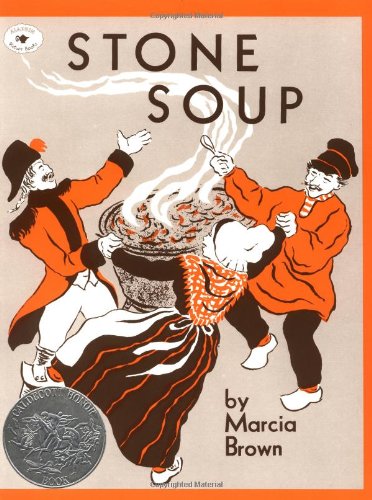
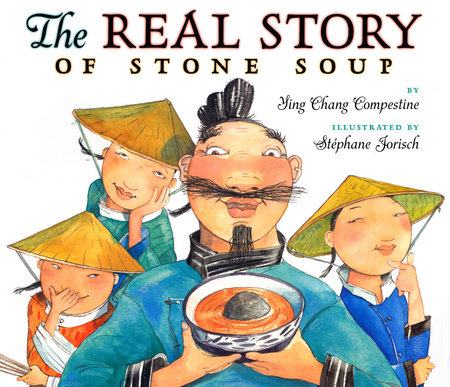
Stone Soup is a European folk story in which hungry strangers convince the people of a town to each share a small amount of their food in order to make a meal that everyone enjoys, and exists as a moral regarding the value of sharing.
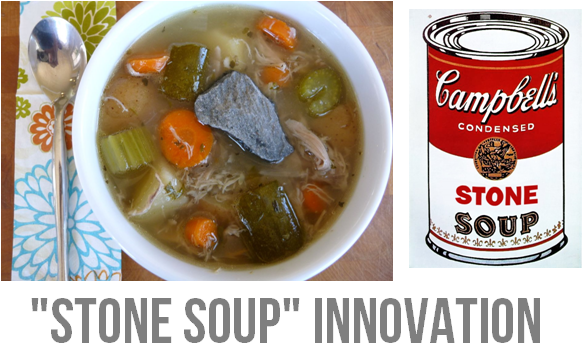
Stone Soup can also be taken as a fable about how every person’s small, but unique, contributions can add up to something quite nourishing. That is a wonderful metaphor easily translatable to each issue of Synchronized Chaos.
Right now much of the world is physically distanced from each other, and most people are spending much more time in their homes due to the coronavirus outbreak. Yet we are finding ways to connect, ways to pursue our unique creative gifts and share them with others through virtual community.
I, personally, have been able to interact with a more geographically diverse set of artists and writers than before, visiting virtual versions of events that would have been located far away from me. And I’ve watched each person bring something to the soup pot in the face of illness and grief – whether it’s sadness and trauma, humor, hope, kindness, eccentricity, eclectic knowledge, or confidence, it’s flavored the shared meal. As the old saying goes – no one can do everything, but everyone can do something. And your ‘something,’ whatever it is, can be brought to the table and included.
Ike Boat, the Poetrician from Ghana, versifies about his Facebook friends, who bring him succor and encouragement while he’s in a difficult financial situation at the beginning of his artistic career.
In 2017, I went to the cinema to watch an Egyptian movie
titled Photocopy which stars two middle-aged actors playing the roles of
an elderly couple, finding love and a way of remembrance in the old streets of
Cairo.
The film was beautifully written, acted and directed. It
strayed off from the inadequacies in which the nostalgia movement was embedded;
it was neither romantic nor sentimental but a character study of a decently
educated man who grew up alone in lower-middle-class Cairo and was afraid of
extinction.
Mahmoud “Photocopy” as his neighbors call him is a
60-year-old man who owns an ancient photocopier machine, providing services
such as typewriting and stenography for the neighborhood. His daily life is
intercepted by a young man who asks for his typewriting skills regarding scientific
research that he is preparing about the extinction of dinosaurs. This strikes a
chord with Mahmoud who begins questioning his identity and the basis of his own
existence especially since his feelings for his cancer survivor neighbor, the
beautiful aging Safiya, begin taking a different toll.
I read an article somewhere
about how writing is about to become an extinct profession since printing paper
is almost going to become scarce in the future and printing will not be as
abundant as it is today. And I thought to myself; if writing became extinct,
what would that make me?
Since extinction was a major theme in the plot of Photocopy,
I looked around until I found Haitham Dabbour’s –the scriptwriter- contacts and
what began as an interview regarding Photocopy turned into a
conversation with a fine intellectual about fatherhood, extinction and the art
of the written word.
“I am excited about this interview because it is not a classical,
monotonous one, but more of a conversation. I prefer [reading] this type of
essays because it makes me get inside the head of the person being interviewed
and thus he or she appear closer than they really are,”
Dabbour started the conversations with a warm welcome,
expressing his enthusiasm. This was the first gate through which I entered his
world. Dabbour was a fan of analysis, character studies and peeling layers off
people. This was evident in his short story collection Vivid imagination –
Eshy Khayal as well as his two feature films Photocopy and Gunshot
– Eyar Nary.
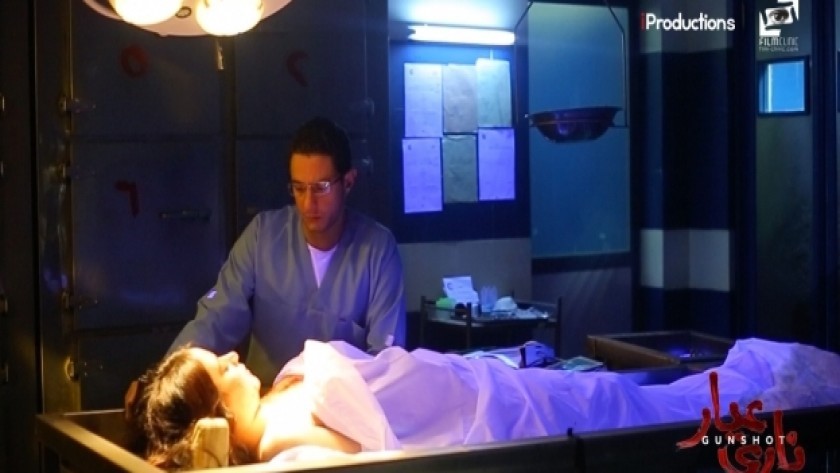
(A scene from Haitham Dabbour’s second feature Gunshot)
“I am also impressed that you read the books of the writer
whom you interview, which rarely happens these days. People who read are rare
these days, not just in Egypt but worldwide. Reading and comparing literary and
film adaptations, researching your interview subject and discovering my
satirist bibliography, all these are factors that excite me about this
interview.”
I asked Dabbour about his favorite genre or writing format,
and to that he replied,
“I love experimentation and I write different literally and
artistic forms. I wrote satirist books that became bestsellers and were sold
everywhere. I wrote poetry and won the Ahmed Fouad Negm Prize for colloquial
poetry. I published two short story collections; one of them included a story
which was adapted into a short film titled Single – Fardy starring
Khaled El Nabawy –Egyptian actor of International fame- and the other
collection Vivid Imagination contained the short story from which my
feature film Photocopy was adapted. After a while, the challenge comes
down to; do I write something that I guarantee will become a bestseller or do I
write something that would appeal to people? The easiest thing in the world is drifting
into the idea of creating bestsellers and thus making more and more of them.
However, I am certain that you write because you have something to say not
because people force you or semi-manipulate you into writing it.”
Dabbour is a very precise and calculated personality, but
his answers are lengthy and rich, like a bowl of creamy soup. Yes, all the
ingredients are made en pointe, but it takes a while to absorb the taste
and finish the bowl;
“My writings blend elements of magical realism into the
narrative. Take for example Vivid Imagination, all stories blend
elements of strict realism while breaking the logical limits of living.
Imagination gives reality a magical element. My background as a non-fiction essay writer and investigative
journalist is prominent through my first short story collection Horseback
– Dahr El Khayl which handles reality through a different aspect in
addition to adopting a condensed writing technique which describes daily
routines from regular lives.”
Talking to Dabbour fascinated me and presented a great
opportunity to get inside someone’s head rather than simply laying out
carefully prepared answers. Photocopy deviated from the mainstream scene
in the Egyptian filmmaking platform nowadays, so I had to learn how the
creative process became a reality rather than an ambitious project;
“For 5 years I had been searching for a producer. During
that time I wrote scripts for some of Egypt’s most successful comedic and
satirical news programs such as The 25th Hour News program –where Akram Hosny
presented the iconic comic character of Sayed Aby Hafiza– and the Arabic
version of SNL. Even now, I do not consider starting my film career with a
commercial, light comedy movie insulting. However, I made Photocopy because
I knew I had a story to tell. I also wanted to break the mold into which I was
cornered [comedy and satirical writing]. That’s why I knew that the road would
be long to make this movie, whether to convince a producer to back it up or a
director to put his name on it. My bet while writing the script for Photocopy
was on creating a film that would stand the test of time, same goes for Gunshot
–I have two feature films now to my credits- and the result was satisfying. I
bet on the winning horse by creating these two films.”
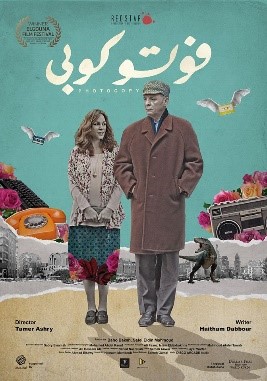
Official movie poster for Photocopy
Before questioning
Dabbour about Photocopy I read the lengthy, short story from his
collection Vivid Imagination from which the film was adapted,
“The story and the
film adaptation are both different from each other. It’s easy to create an
existential theme or mood on paper, but to translate that to the screen; it
would require visual and emotional elements. That explains the genre in which
we decided to adapt the film into; a sweet, slice-of-life drama which is a rare
genre that builds up its characters through combining slices of their daily
lives into scenes. The idea of the hero’s journey from the perspective of a
regular guy, and yet you [the audience] are interested in following his
journey. This rarely happens in Egyptian cinema. We were excited about adapting
that concept and were certain that people would be interested in watching it
whether on the big screen or through the television premiere. I wanted to
create a film that does not go “extinct”. One that stands the test of time.
There are films that are consumed only once, and that was what I was trying to
avoid. Until now, a year and a half later, people are still talking about Photocopy.
There are memes on social media, we are still receiving awards for it. While
writing the script, I separated myself from the fact that I wrote the original
story. I looked deeper into the characters to discover things that I did not
envision originally while writing the story. I worked especially harder on developing
Ashgan’s character –which became Safeya in the movie, and this developed the
love story between the two protagonists while reflecting the ominous sense of
extinction that plagued Mahmoud’s thoughts. It was difficult for me as a young
person to sense how an older man would be scared of vanishing from the face of
the Earth; the idea of survival beyond death was Mahmoud’s main conflict and
what I focused on while writing the script.”
In Photocopy, the
protagonist Mahmoud practiced an ancient profession, one that became extinct
these days after the era of digital publishing. He was a sub-editor in the News
Gathering and Dissemination department in a newspaper agency that recently
became digitized. I wondered how Haitham was introduced to such a unique
character aspect, and whether he knew people like Mahmoud and thus became
inspired to write about their lives;
“I spent years of my
life as a non-fiction essay writer and investigative journalist. So I was
surrounded by people who worked in the News Gathering department such as
Mahmoud. I met different people on different levels and this created a vault
inside me filled with interactions and characters that I could go back to
whenever I needed inspiration.”
Dabbour is infatuated
with details up to the smallest thread, including phonetics, referencing one of
the greatest examples in Egyptian art history; Umm Kalthum, who paid attention
to the musical sound of words while picking her song lyrics, altering verses in
poems so that they would have an easier, auditory appealing sound;
“Safiya is an easier
name to pronounce than Ashgan which was the original character name in the
book. Pronouncing Safiya would create a nuanced, soft feel for the female
protagonist. The combination of the s and f sounds are
phonetically superior to the sh sound. I am also a poet so understanding
the rhythm and flow of the words are of high importance in my writings.”
It is always
refreshing to find a director enthusiastic about a movie that strays from
mainstream Egyptian cinema nowadays, which is the reason behind questioning
Dabbour about Tamer Ashry, the director of Photocopy,
“I worked with Tamer
Ashry before on documentaries. After Photocopy we worked together on a
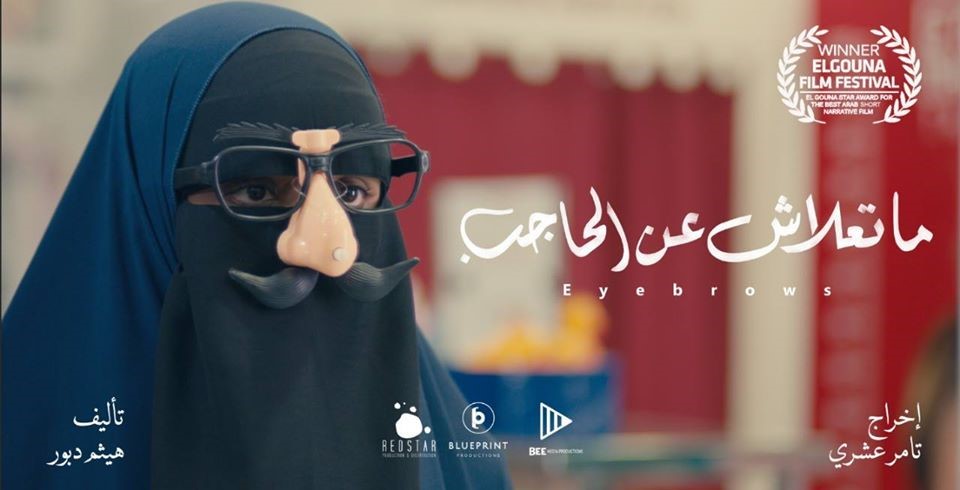
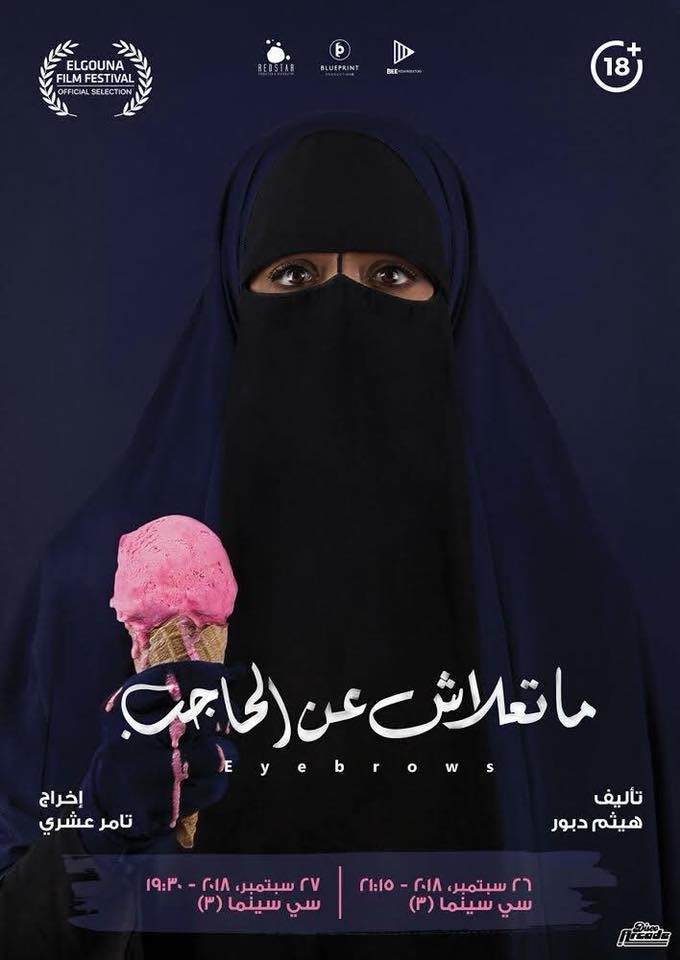
short titled Eyebrows which won the gold star award in El Gouna Film
Festival – 2018 as part of the short film competition. We were accustomed to
nominating actors for the assigned roles together. This is one of my favorite
aspects of working with Tamer, we discuss everything, although the final
decision is usually left to the director.”
Big names in the
Egyptian film industry were attached to Photocopy. Veteran actor and
chameleon Mahmoud Hemeda –who previously played the role of Yehia Shokry Mourad
in Youssef Chahine’s semi-autobiographical film Alexandria-New York– played the
protagonist, and sultry actress Sherien Reda played the role of Safiya,
shedding off her sex icon image and playing a cancer survivor in her 70s who
holds onto the simplest pleasures of life. Their romance was bittersweet and
their chemistry was magnanimous. I had to ask Dabbour about his choosing actors
for the main roles;
“We sent the script to
Mr. Mahmoud Hemeda and he replied within 48 hours setting a meeting with us to
understand what we have in mind. This was our debut feature –Tamer and I- so he
wanted to discuss it further with us. I have to be honest with you, Safiya’s
role was hard to cast. Actresses usually avoid these character types; an aging,
sick woman, who looked her sickness. The producer Safiy Eldin Mahmoud was the
one who suggested Sherien and Tamer [Ashry] saw impressive acting capabilities
in her. So we bet on her.”
Music is an integral part of Dabbour’s films, in his two
features the role of the soundtrack was more than a complementary element to
the key plot and narrative elements,
“My interest in music is part of my interest in the mood of
the character. My character profiles always include what the character likes to
listen to frequently, what they hum on a regular basis. It is part of the
character structuring process, even if it is not part of the script, you have
to think of what the character would listen to in their spare time, also how
does he or she get angry, how does he or she get into a fight.”
In Photocopy, one of the key defining traits of Mrs.
Safiya was her infatuation with one of Farid El Atrash’s –the late legendary
Lebanese singer and music composer from the golden era of Egyptian cinema- songs;
which was technically a cover that he made for a song originally by another
Egyptian female singer. I had to inquire about Dabbour’s use of this particular
singer,
“I believe that Farid [El Atrash] is an extremely underrated
artist. He did not receive the media exposure that he deserves with the new
generation. I found it an opportunity to remove the caked dust off his
magnificent musical pieces. It pleases me immensely when younger people mention
how they researched the cover of “The key to my Heart” by Farid El Atrash which
we used in the film. If you search on Twitter using the verse which is not in
the original song and only in Farid’s cover, you will find that multiple people
are tweeting about it. Actually, this song deserves all this hype. I personally
love it.”
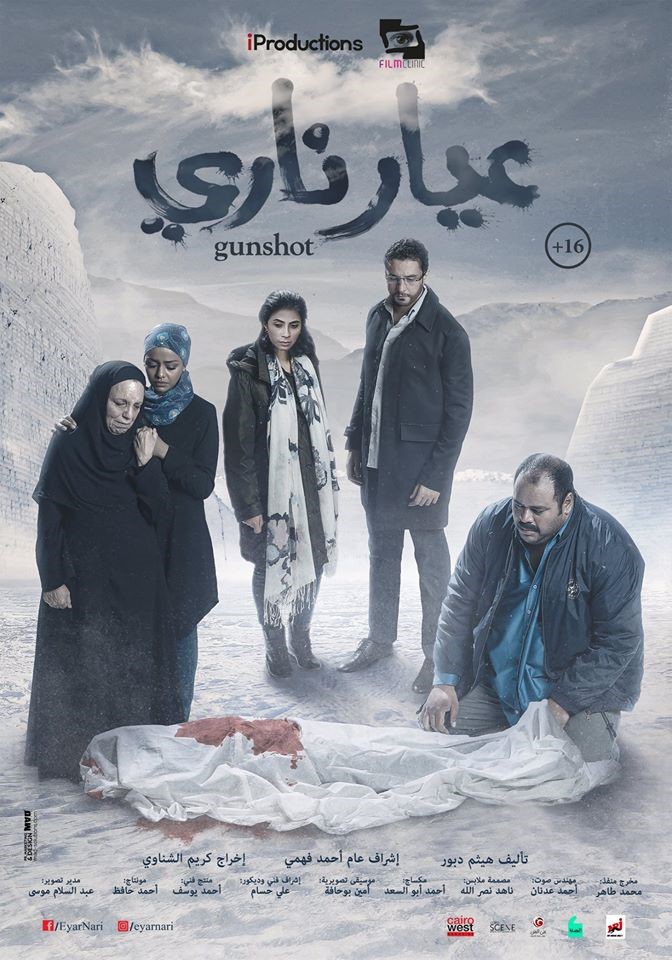
(Official Poster for Gunshot – directed by
Karim Elshenawy)
Dabbour’s second feature was the exact opposite; a neo-noir
set in the post-2011 chaotic Egypt, adopting a multi-narrative tone and yet
retaining some of his key style determinates such as;
“Gunshot was made with the intention to stand the
test of time. It fared much better than Photocopy at the box office, and
I am sure it will even gain a bigger following after premiering on satellite TV
channels, and people would connect to it although it is the complete antithesis
to Photocopy. Gunshot is a neo-noir crime drama; a dark movie that poses
questions deeper than your average thriller.”
By the time I interviewed Dabbour, the attack on his film Gunshot
has been tremendous. Multiple people accuse it of being “anti-25th
January revolution” although it cleverly provokes viewers by asking controversial
questions regarding all people who participated in the 2011 revolution. In Arab
countries, every single person who dies violently or in an accident (whether a
Muslim or a Copt Christian) is considered a martyr.
The 25th January 2011 revolution particularly glorified
and debauched certain people. A new societal category emerged to include
“martyrs” i.e. people who lost their lives during these violent times. The
ambiguity of the term in addition to its religious connotation caused a stir
between different social tropes in the Egyptian society.
Dabbour’s Gunshot dares to stir stagnant waters by
questioning whether every person murdered during an uprising or times of
political unrest should be considered a martyr;
“I wanted all the
loud voices to calm down before I talk about Gunshot. On a commercial
level, I believe that the film has been successful. It challenges the concept
of claiming a monopoly over the truth; thus the accusations that it received.
On the contrary, people who claimed to own the truth and accused the film of
betraying the January [25th] revolution represented what the movie’s
protagonist went through. We [filmmakers] expected that and even joked about it
while shooting. I recommend Egyptian veteran film critic Mahmoud Abdelshakour’s
essay about the film, which not only praises it –as one of the best Egyptian
films in 2018– but deeply unfolds the multilayered narrative. Unfortunately,
many critics took the film down an unnecessary route of political correctness
rather than decipher its morally ambiguous tone. The aim was to discourage
people from watching the movie in theaters. Thankfully, this didn’t happen. The
film grossed 8 million EGP in a dead season – mid-October. I am betting on
broader exposure for Gunshot when it screens on TVs and in other film
festivals. The same happened with Photocopy. It was not an instantaneous
success but it grew on people by time. This is what I am aiming for. Audiences
rarely remember how an old black and white film fared at the box office. The
key to success of a film is longevity beyond the release date.”
Dabbour’s POV is en pointe but hard to maintain. Most
of the Egyptian filmmakers of the late 2010s eye the box office numbers rather
than the period through which a film stands the test of time. He brought
examples of two films from the golden era of Egyptian cinema; Angel &
Demon – 1960 and Zizi’s Family – 1963; both were not box office
successes but they are still all-time favorites in the hearts of many
Egyptians. To make the image clear for a Western viewer, think of how It’s a
Wonderful Life – 1946 is still enjoyable to this date; generations apart.
“If you watch Gunshot today, it will differ from when
you watched it a year ago. I am almost certain that one year later you will see
it in a different light. It’s a multifaceted work of art and that’s how we
intended to make it.”
I was particularly intrigued by the attention to detail which
Dabbour used to craft the forensic pathologist’s character. An alcoholic that
slips alcohol to his daily water intake under the noses of his supervisors, Dr.
Yassin is fascinated by the dead, to the extent of stalking their posthumous Facebook
profiles and sending them friend requests. I had to know where Dabbour found
the inspiration for such a fleshy character,
“I have always been fascinated by forensic medicine through
my line of work as a journalist. It is a dark, suppressing world that has rich
visual, auditory and olfactory elements. It oozes with formaldehyde. I tried to
reflect on the current status of the society where people make friends online
and IRL. Dr. Yassin is no different from anybody else. He just hates the
living. So he tries making new friends with the dead whether IRL with the
corpses while performing a post mortem or by stalking their posthumous profiles
on Facebook. The dead are his comfort zone and his edge as a forensic
pathologist to investigate the causes of death.”
The trick with Gunshot, in all its neo-noir,
post-mortem gloom is how to walk the thin line between the right and the wrong.
It asks questions that no film before dared to tackle. Its moral ambiguity and
the ending which indicates the defeat of truth in front of the mass belief in a
lie are both shocking and bold, considering the subject matter; the 25th
January revolution which has been glamorized by a part of the Egyptian public
and demonized by the other half,
“People hate confronting themselves, which is why Gunshot
hit a nerve with its bravery in asking the difficult question; do ends justify
means? If being corrupt for a greater cause is a necessity, does that validate
corruptness? Political events are created by people and not angels, which is
why every political dilemma is open to multiple interpretation scenarios.
Nobody holds the obsolete truth. Look through history you will find a lot of
political immoral actions that had to be done to achieve noble causes. The
question remains: was that justified? It could have been much easier to treat Gunshot
like an investigative thriller without layering it with the morale we had in
mind. However, Karim [El Shenawy] the movie director and I wanted to make a
neo-noir with all the consequential complexities.”
By examining both his features Gunshot and Photocopy,
I wondered how strange it must be to make that dramatic of a transition between
genres,
“They are both two entirely different films on both
technical and aesthetic levels. The script, dialogue, tone, and scene rhythm
vary between both films. This is the key to filmmaking, the adventure of
exploring different creative projects. You cannot make a feature film easily
these days, so you should make one that you are proud of. A film that would
stand the test of time and ten years later someone could go back to and write a
fleshy critical essay about it.”
(A scene from Eyebrows – directed by Tamer Ashry)
For Dabbour -whose last name is the Arabic word for wasp
btw- creating short films meant a completely different platform than features.
When you watch his shorts Single and Eyebrows you could easily
discern how careful he is to separate different platforms from one another; he
writes carefully with the limitations and defining features of the medium in
mind, and fully understands how to uniquely identify each medium through the
elements which he uses uniquely for each project.
“Single –which was originally a short story from my
collection Horseback– is the story of a man whose personal space gets
smaller and smaller. His sense of freedom shrinks through the intrusion of
people around him. The protagonist is a Coptic man who is unable to publicly
express his unease at the Islamic duaa that his neighbors installed in the
elevator, and which invades his personal space on a daily basis. This represented
my first collaboration with Karim [El Shenawy] the director, the megastar
Khaled El Nabawy, as well as veteran Egyptian actors Sayed Ragab and Khaled
Bahgat.”
I highly recommend watching “Single” through this YouTube
link:
As for Eyebrows –I am personally fascinated by
Dabbour’s precise short English translation of the movie titles- this is a
totally different story. Eyebrows is a brave short that describes the
extremist religious “mindset” through a simple situation. A girl from an
extremist Salafi upbringing wearing niqab (face covering) wants to pluck her
eyebrows which are considered haram from an extremist Islamist point of view.
Throughout the short, she struggles between the desire to be accepted as a
woman, and her fear of God through an extremist religious viewpoint, which
contradicts a once-liberated friend who became even stricter as a religious
newbie.
Official movie poster for Eyebrows
“Both shorts –coincidentally- contain plotlines regarding
man’s relationship with religion. Eyebrows differs in the way we tackled
the topic at hand; not as outsiders [this has been one of the highlights of the
feedback that we received whether in film festivals or juries] to the niqab-wearing community.
We used their terminology and adopted their POV to reflect their mental and
sociological crises and the contradictory outlook on which they base their
religious beliefs so that it always supports the male dominance and leadership
of the society to fulfill their role of maintainers and protectors of women. A
woman could pluck her eyebrows if her husband approves it but if she is not
married, then she is forbidden from doing so. But on what basis? A woman finds
herself in a loop. This all reflects the efforts that are being made in
objectifying women, by controlling the fine details in their lives, they
undergo massive identity, social, and humanitarian crises, which all lead to the
unacceptance of their “self”; their feminine identity.”
In many of his films, Dabbour blends themes of absent
fathers and patriarchy. The lost “father figure” or the man searching for
immortality through having a son could be seen in multiple characters. In Photocopy,
the relationship between Osama and Mahmoud could be seen as a rebound
relationship for the figures that they both lack in life respectively; a father
and a son. In Gunshot, Yassin’s rebellious attitude against his father’s
image is a manifestation of the complex concept of the death of the father (as
a symbol of patriarchy) and the death of the god in Nietzsche’s philosophy.
I asked him how fatherhood changed him personally, in terms
of both artistic and personal values;
“Being a father is a reflective experience of your reckless
attitude as a son. Fatherhood makes you reevaluate your life as a son. It
resembles writing the same story from the opposing POV. I still have a lot to
discover, since I am a father to a 5-year-old son; Zein and my experience has a
long way ahead to simmer. I have not only changed as a father, but aging into
my thirties changed the dynamics into which I handle my relationships with
others. I’m a familial person by nature, but growing old (and becoming a
father) made me grow closer to my father and more sympathetic and understanding
of his feelings. I tried translating all the details into the paternal
relationships which I represented in both my long features.”
At the end of an enriching conversation, Dabbour gave me
writing advice, which I am feeling compelled to pass on to future generations
of writers,
“Writing does not have a manual. There are no clear steps on
which you must tread to be considered a good or a bad writer. Writing is based
on individual differences in style and context. However, my personal belief is
that daily jobs never hinder creativity. Naguib Mahfouz –one of the greatest
Egyptian writers of all times– remained a government employee all his life,
Ibrahim Aslan was a 9-5 employee. I used to have a daily, fulltime job as a
journalist for 10-12 hours per day and it never stopped me from creativity. The
only thing that you need to sustain are 12-15 hours weekly dedicated to writing.
Before starting a writing project, try to set a hypothetical deadline which
would prevent you from succumbing to feelings of guilt in case you fail to
deliver the project in time. Writing is a serious relationship that loses
intensity as time drags on. The key is to keep that fire ignited at the start
of the project as alive as possible.”
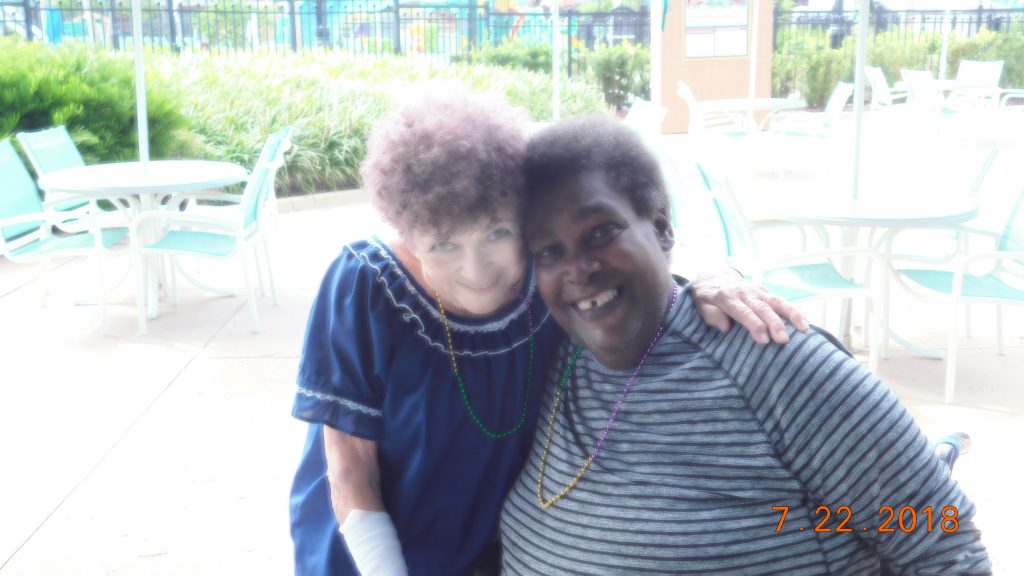
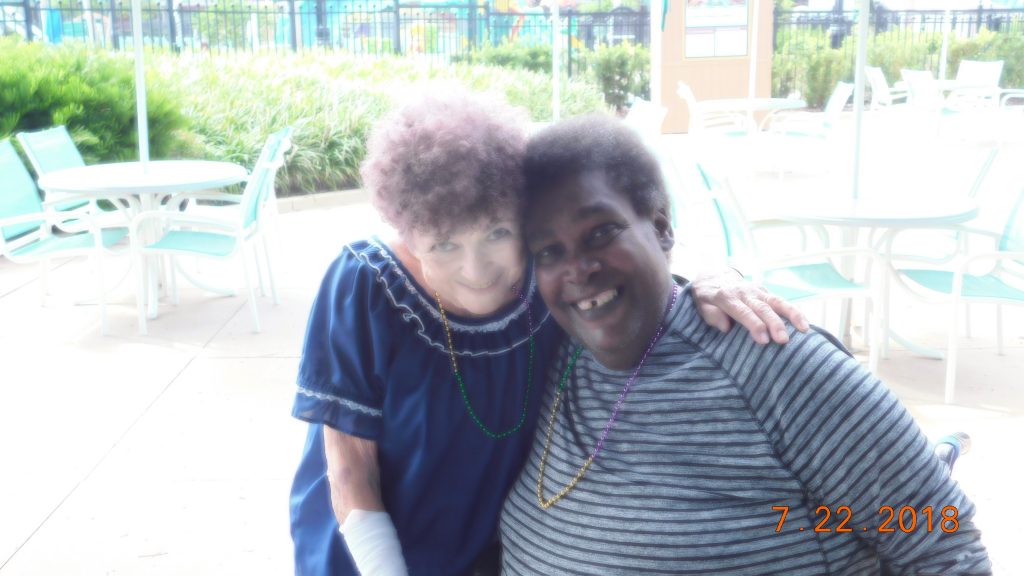
Michael Robinson (right) and fellow contributor Joan Beebe
Weep
In the middle of the night, when the moon is dark, and the clouds black.
In the middle of the night, when all the souls of America stare into the ceiling, the warm tears slowly crawl down their cheeks.
In the middle of their life, it is uncertain if there will be a tomorrow, because a sociopath stands before the cameras and rant.
We weep as a nation when our loved ones are taken away in the hearse without fanfare because there are so many that are dying.
I weep alone in my apartment because there is no one able to mourn the death of so many at one time in our history.
I weep because the war is in our midst, and the Doctors and Nurses are the first casualties in this war.
I weep because my tears cannot save lives.
My tears can not save those who die on a hospital bed in the corridor, with many besides them enclosed in plastic bags.
I weep because there are too many graves filled with someone’s loved one, and the count continues.
In the middle of the night, I weep alone because there are only memories of a time that my tears were joyful as the sound of the National Anthem was a song sung by all the nations.
Body Bags
There are body bags flowing; out of the back door of Brooklyn hospital in New York.
Body bags with someone loved ones And I have no words as the count continues.
Do you know that the bodies will be taken away? To be placed on a slab?
In America, there are thousands of body bags, Bodies in the corridor of the hospitals.
It’s a war without the guns and bombs, It’s a war on our fellow Americans.
It’s a war! When will the body bags stop?
I’m not ready to be taken away in a Boddy bag, And put in a refrigerated truck and carried away.
Are you?
In a war, there are always body bags, In a war, people die alone.
I don’t want to die alone, In a hospital corridor.