Cristina Deptula reviews Nisha Singh’s Bhrigu Mahesh: The Witch of Senduwar

Bhrigu Mahesh: The Witch of Senduwar

Bhrigu Mahesh: The Witch of Senduwar left me thinking for months, recalling plot twists and character insights to see if I’d missed anything from Nisha Singh’s brilliant novel. The tale reminded me of Sherlock Holmes’ The Hound of the Baskervilles, not because of any similarities in the storyline, but due to the theme of seeking real-world, logical explanations of mysteries.

The story takes place in Senduwar, a real rural village in northeastern India somewhat near the more famous Varanasi. As I am also a writer and come from a somewhat out-of-the-way place, I was intrigued to see this book pop up right away in search results for the town, as I can imagine putting my own hometown of San Lorenzo, California on the map. The village was described effectively enough to give me, as a person who has never been to India, a feel for the society. Singh conveys coexistence among Hindus and Muslims, varied ways of life and ways of earning a living in the area, and the persistence of traditional attitudes even as some residents embrace modernity.

One of Bhrigu Mahesh’s greatest strengths is how each character’s motivations seem plausible. Some act out of fear, others out of altruism, or snobbishness, or insecurity – but all make sense given their personalities and life experiences. Also, in this book, how characters view each other depends a lot on their own perspectives. We can’t take characters’ descriptions of each other at face value, in most cases not because someone is lying, but just because there are different sides to each story.

Bhrigu’s best friend and partner, Sutte, is a journalist, which I appreciated, as I’ve pursued that line of work myself and enjoy seeing a reporter hero. And his nemesis, along with the criminals he outsmarts, is a bossy elderly aunt from whom he constantly vows to declare his independence. This subplot fills out his character, making him more human, and adds some comedic relief to this work of literary fiction.

The storyline isn’t predictable. I didn’t guess the ending or the identity of the murderer, although it made sense at the end given the person’s actions and words. The story is well-paced, not terribly slow but not hyper-fast as too many suspense novels are, whizzing from one explosion to another. This is appropriate for a story about a detective who relies on contemplating human psychology to solve his cases. And I enjoyed discovering the hidden purposes for some of Bhrigu’s actions later on in the book, such as one instance where we find out what he’d actually observed while seeming to interrogate suspects about certain topics.

The story carries a thoughtful tone throughout the book, sophisticated without consciously seeming so. Dialogue, action and description are all well-balanced, and each character speaks differently in ways that reflect their character. And it was good that Bhrigu Mahesh did not dwell on gruesome details of crimes or present an unrelentingly dark view of human nature. Nisha Singh has kicked off a now three-book series quite well without resorting to the sensational or macabre, and I look forward to seeing her continue.

Author Nisha Singh

Nisha Singh’s Bhrigu Mahesh: The Witch of Senduwar can be ordered here from Book Venture Publishing. 

Poetry from Steven

Main-à-Dieu

I.

The Maritime epitome

leaks sensational exchanges

between moon magnets at play

Telephones open your eyes

Remember sweet nothings

stumbling shy and evasive on shore

and spraying its stones with cobalt kisses

‘ere tucking it in with the tides

II.

Without having consciously channeled

the Scottish mind for gesticulations

or affable sense of fashion

the hairs on my frame oscillate

in the unitary itch of a synthesis

Clouds shuffle in and shower me

with quaint accents

of Lambert and Connery

Dad’s origami of tape

in the Highlander VHS shell

A kind of magic

III.

Lock on and scoop up

the small islands swimming

like virtual pets in the jittery wilderness

of the ocean

Up the road the wharves exhale

eager to recast their splintered designs

on the ship-mother gut of Mira River

A blessing awaits its suitors

cruising in fresh paint

smoking Cape Islander uniforms

Water on water

recovers the fleet

to out-see the ragged red

floor denizens again

IV.

Old is alive

Small is endurable

Fishermen of a place old and small

are sponge toys under this sky’s

humdrum faucet drip

V.

Sample the pond in the womb of the meadow

Filter the fertile Atlantic stream for its insular

rock jewel

Let the screens show and suggest

that highlander fishermen still live here

Highlander could have been lived here

—–

BIRTH OF AN ALCHEMIST

Teacher there are toothless

piranhas

swimming in my math

I can see the gummy

little jaws scheming

to bogart the breath

of my righteous integers

One can only solemnize so much

the rash double-booking

of funeral and festival

No initiative need

be exhausted

on a self-serving verification

As a man of words

I implore you

to pad your own occupation with your wares

as I plunge a thumb and forefinger

into this obtuse order

of operations and unveil

a morsel of insurgent fusion

for my impressionable stomach

—–

LINGO DROUGHTS

I.

Notify the pillars of the patriation

Apply the secret knock

to your underground interpreter’s door

We are older than before

We have shed the preface training wheels

and are coming for the polish

of your most climactic chapter’s respect

II.

No unveiling revelation cloned itself

in self-assuring day planner pages

nor did debonair winks of rhetoric

attain attention for the eyes

while our secret sign language

seared a path through the brush

sapped of moisture’s ink by youth

infused lingo droughts

III.

We are what an appetite looks like

Invisibility made visible

with the couture of the inevitable

reincarnating as the natty trends

your acronyms cannot keep up with

—-


Poetry from Al Murdach

Sunday School
                        by
                 Al Murdach
As a child in Sunday School
I was puzzled by our lessons.
Our teacher, a smiling, matronly woman
would illustrate her talks
with cut out figures of shepherds,
angels, sheep, Jesus, etc.
which she would place on a
large, green felt panel.
These figures were challenging for me.
Why was everyone so clean and neat?
Why were the animals so cute?
Why were the people all white caucasians?
News photos I saw in the papers
presented a different image.
Maybe, I thought, Christians
don’t like to look at dirt and grim,
or people who looked different from them.
Or maybe they were just really good
at cleaning things up and that’s OK.
But what about those who looked different?
Where did they go?  Maybe they
left early or worked the night shift.
My teacher said her figures
couldn’t show everyone,
just the most important.
But her answer didn’t help.
It only made me feel that
something phoney was going on here.
What was being covered up and why?
I still ask those kind of questions,
but so far no one seems to have
any good answers so I keep trying.
Maybe someday I’ll understand.
                                         (12/5/12)

Poetry from Christopher Bernard

Primavera

By Christopher Bernard


The afternoon lies across the air

like a page of ice,

dazzling and shadowless.


You walk across it,

through it, beneath it,

looking for a crack in the light,

trying, without success, to hide.


The eyes you meet are gray as ashes.

The words you hear disappear like clouds.

A scarf lies abandoned on a curb.


Somewhere there is the sea,

a party’s laughter, and someone is singing,

and summer holds the night in its arms.

But not here, and not now.

You scratch on the ice a forgotten name for spring.


____


Christopher Bernard has published two volumes of poetry: The Rose Shipwreck and Chien Lunatique. He is co-editor of the webzine Caveat Lector.

Poem from Sandra Rogers-Hare

190207 Poem

yeah, i should get a wrap-around
Mac 250 gigga nutter-butter,
satellite screens attached
install it on top of the house
sit there in my canvas chair surveying the San Leann Kush
track the birds fly in their parabolas
skunks clunking fence lines
old lady sweeping (she’s also surveying)
writing in our ship’s log
journal titled,
Gimme Aphukenbrake
~ Sandra Rogers-Hare
 

Personal essay from Christopher Bernard


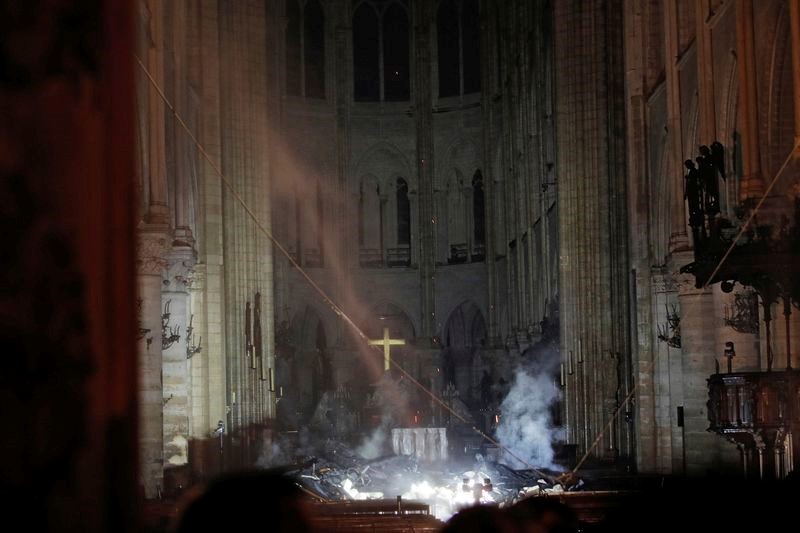
Interior of Notre-Dame de Paris after the fire of April 15, 2019


A Memory of Notre-Dame

by Christopher Bernard

I had been traveling for many hours from Philadelphia when I was seventeen on my first trip to Paris as part of a package tour for high schoolers I had worked much of the summer the year previous to afford.

It was spring and, despite the exhaustion and excitement after the long journey (my first by plane), when we got to the hotel near the Place Bastille, I decided there was no way I was going to sleep before in some way meeting Paris face to face. So I took my handful of francs and my high-school French, snuck out of the hotel (unknown to our chaperones), scurried down the local Metro stop, and took the first subway to the Île de la Cité.

After arriving at my destination without dropping off despite my first experience of jetlag, I wearily climbed endless levels of exit stairs into the late afternoon. And stood, rooted to the spot, staring almost straight up at the austere towers and the façade known to every schoolchild, and saying over and over to myself for a long, sleep-deprived moment: “Notre-Dame de Paris, Notre-Dame de Paris, this is Notre-Dame de Paris,” before dreamily crossing over to the front steps, and ascending them while taking curious, creak-necked glances up at the tympanum, and then walking gingerly (I wasn’t even sure, as a non-Catholic, I would even be allowed in) through the entrance way – surprisingly small – into the dark, unexpectedly cool interior.

As I entered, the organ burst into music. No services were going on that I could see, and I supposed the organist was rehearsing for Sunday. But it was one of those moments of mystery and magic in one’s life that seem to happen with some frequency in youth, and then less and less often with passing time. My fatigue and caution seemed to fall away. I walked into the cathedral and remember taking a very deep breath, then walked into the music and shadows.


____

Christopher Bernard lives in San Francisco.