
Poetry from Henry Bladon

The Paradoxical World of R D Laing
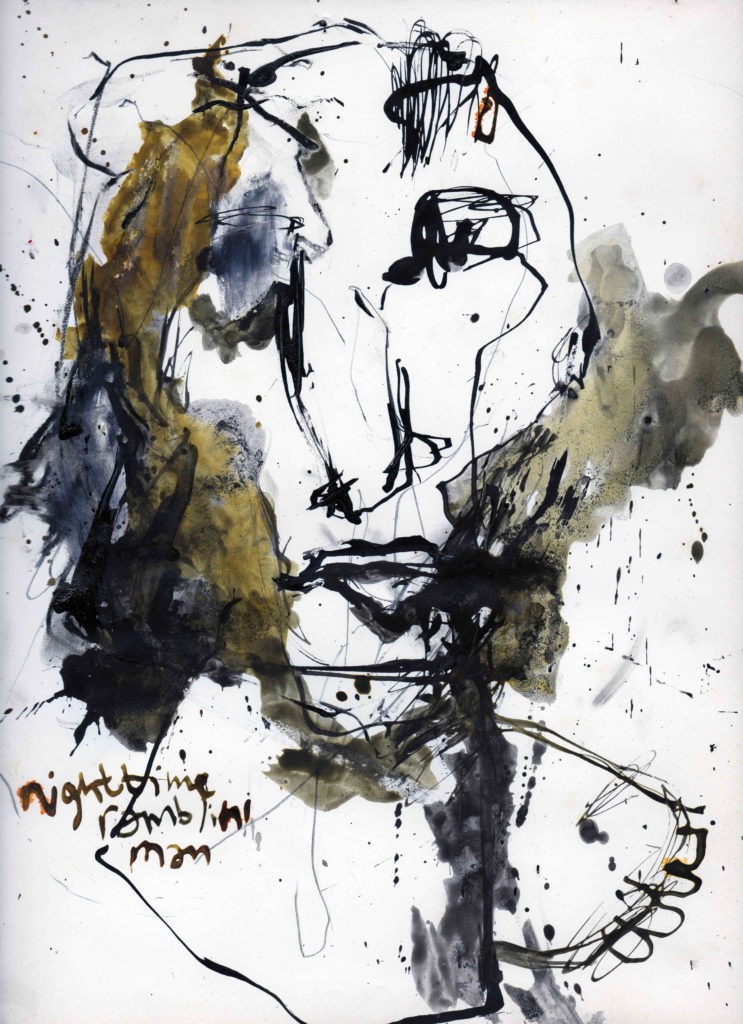
Nighttime Rambling Man by Marcel Herms (Netherlands, marcelherms.nl)

You, who talked of a heart full of ashes and lemon peel, you swept through the world in a flurry of words you pulled apart and reconfigured. You, who wielded an unconventional mind and stole fragments from the universe. Sometimes the journey of your existence looks like one long paradoxical interjection. Your maverick rhetoric was synchronized chaos washed down with a tide of LSD and claims of insight and breaking through. Smoking your way through session after session, you once said that existential psychiatry was just: ‘talkin’ to a bloke and listenin’ to what he says.’* You knew it was never that simple. It’s good to challenge, though and you questioned what is real. You even said that expression of distress was the way to real self-knowledge, that it was the way to change and develop. Yet you left some people more confused than they were before, and I can’t help wondering whether the whole thing was a huge double-bind.

*This is a line from the book ‘Zone of the Interior,’ by Clancy Sigal. Sigal was a good friend of R D Laing, and fictionalised his experiences with Laing in the book.


Henry Bladon is a writer of short fiction and poetry based in Somerset in the UK. He has degrees in psychology and mental health policy and a PhD in literature and creative writing. His work can be seen in Potato Soup Journal, Entropy, Mercurial Stories, thedrabble, Tuck Magazine and Spillwords Press, among other places. His novel, Threeways, was published in 2017 and his recent collection, Donald Trump’s Hair and other stories, published by Alien Buddha Press, came out this year. Henry also runs writing support groups for people with mental health issues.

Poetry from Luke Kuzmish

sleep shatters


my sleep shatters

neath a diamond moon


my eyes sting

in dim bedroom light


white walls like velvet

welcome me home


my embrace

is only warmth


my heart is a vacuum

hoping against dawn,

hoping

at least

for a longer night


cheap nights


the Law & Order theme

reminds me of

blood stained walls,

little flecks

faded orange,

from a dull needle

as I pushed

water through


smoke alarm calling

to disinterested occupants

increasing the panic

and then

hunting a girl

who cut herself

where no one could see,

love

just a mirage

in a personal

desert


hand rolled cigarettes

built

from the tobacco of acrid butts


waiting for the continental breakfast

at a hotel

I couldn’t afford

learning

hunger trumps

shame


the Law & Order theme

the most natural beauty

found

of cheap

nights

in rented

rooms


lady justice


“There is far too much law for those who can afford it and far too little for those who cannot”

Derek Bok


it’s not a crime

to tell a cop to go

fuck himself, not a

crime to film a cop

as he arrests a bum

nor is it a crime

to appear in court

wearing a lip ring

but crimes are betrayals

of the law and nothing

to do with justice.

the law does not care

to have its heart broken

and the jails are full

of proof

the juvenile delinquents

piped in

the people stuck in the system

for 10 years on a 1 year

probation sentence

are proof.

roads are built and police

cruisers are bought with

the fees and fines given

verity by the honor bestowed

to a man with a badge

and the dishonor

we are born with when

we are born

without money.

lady justice,

behind that blindfold

she just weeps.


Poetry from Adesina Ayobami Idris

A LADY THAT KNOWS ALL HOW TO BE HAPPY FOR ALL AND A POET

By: Adesina Ayobami Idris


  1. what do you do for fun? death has a name

it’s called.

loss is a picture in

a lettered quill.


  1. when do you have fun? 00:59 & every time

birds make mouth

of everything that

left & never returned,

the wind finds my head

a worthy stop

or it rains in the pages

of a book.


  1. how do you have fun? silence has a thousand

noise, i gather each &

dress on a white leaf.


  1. where do you have fun? well, the cloud is too wide

to measure for distance.


  1. with whom do you have fun? i have said before, that

loss is a picture in

a lettered quill.


Poetry from Alan Britt

WHAT I ASSUME

I assume much the same as you assume,
& I regret as much as you do,
but I’ll be damned before I rocket a brutal stone
above the eye socket of innocence.

I won’t do it,
& if you know what exists in the uncertain hour,
just before, just before,
& after all that,
before sliding fetus-like into the ether,
just before & afterwards;
afterwards I promise
I’ll sing the blues
like Muddy says,
It’s nine below zero
with nowhere else to go.

[Italics by Muddy Waters]

Continue reading

Poetry from Joan Beebe

Echoes of the past

Joan Beebe (left)and fellow contributor Michael Robinson

When I am alone in the early morning darkness,
My mind takes me back to the times when
I was growing up with my family.
It was a time of nurturing, tears and laughter.
The warmth of love, encouragement and the
Sounds of a family taking care of each other.
The house was always filled with the kindness of
My mom and dad who took in friends, a relative and
A family who was forced out of their home due to
The flooding of our river each year.
Time has passed quickly and I only have my memories
But they are sweet, comforting and full of gratitude.

Poetry from Mahbub

Not A Bird’s Eye View

Mahbub

A bird flew just touching my head over
It flew away flattering its feathers
I looked again and again
It spoke to me how and what I do
And should do
It’s my love, O bird
You wanted to whisper that I can’t
Flew away over my head
The shade before my eyes
While flying to the sky
Draws hundreds and thousands miles to go ahead
I observe and move forward till I reach my destiny.

Continue reading

Poetry from Janine Canan

Cycle of Civilizations


I have always felt like a shoot on a branch of a long tradition—

a legacy continuing from the Paleolithic and beyond—

that rose out of Mother Africa hundreds of thousands of years ago

peopling the Earth in waves that spread over Arabia,

round India to Indonesia and aboriginal Australia; migrating north—

a few, twenty thousand years later—to the Caucasus

and several thousand years later forking East over the Bering Strait

to Turtle Island—heading south to the tip of Tierra del Fuego—

and West throughout Europe—always leaving their life-prints,

thoughts and visions etched and painted on rock,

leaf, ice or wood, eventually printed on paper

bound in books, read on computers.


But now it seems that computers, libraries and forests

may soon litter deserts as snowless mountains crumble

into dust in the naked blaze of the Sun—

and carpet the vast ocean that covers most of our Earth.

And who among the remaining will remember

the thousands of languages so long and painstakingly preserved?

And who will even know how to find the wild edibles,

the unsalted water, and prepare the grassy grains?

Will they gather round a fire under dazzling skies

telling stories they barely recall—singing, dancing and praying

to Mother Moon and the myriad stars, waking before dawn

to go hunting for berries, fruits, nuts, roots and mushrooms,

greens, fish and clear water—marking the caves

with their signs as they pass?


This has happened before.

Will the cascading stream of human culture—of song and story,

medicine, science and sacred knowledge—run dry,

narrow as the once mighty Saraswati River

that today yields only a few drops?

Continue reading