Poetry from Gabriela Carolus

The silence was your golden ticket


Ssshh


To some, your words were the once awaited fate.

People were waiting with bated breath for the State of the Nation.

However, you gave us your verse.

Instead.

In beauty and grace, you spoke about becoming and what elements shaped you.


So, ssshh. Yes.


You could have released a memoir filtered with politics and power.

But, then, would it not be another power play from the oval to your head.

So, I thank you for your silence.


Ssshhh.


It spoke volumes to the stadiums in the States and South Africa too.

I saw the elegance of how you represented your version of becoming a Black woman in the space of control and power.

Not the oval or paperback can create a nuanced narrative of what they think or imagine the First Black Lady should be in this State.


Ssshhh.


So, I thank you.

I thank you for your silence.

Your silence told us how Black woman have become accustomed to state the palatable to sell to an audience who don’t know that some things are just not ready for you and the world to purvey.


Ssshhh.


So, I applaud you.

First Black Lady.

Mrs Obama.


SSSHHH.


You told them only what they needed to know.

How you became a person in silence as the State of the Nation unfold.


Poverty Porn


I have become eye candy.

A flashy picture to win an award.

An instagrammable moment.

Yet, my belly cries for a good meal just before church.

I held onto my guts for you to swoop in the troops and gain your research grant and scratch off your tax rebate.

My plight is your salvation for the first world problem which is to be seen as helping and also being heard that you uplifting the poor.

But, in my world, I am dying.

A slow death if I might add.

I die every day you post that a fly was living on my face, so that’s that.

This is my norm.

I cannot reach out from this hell hole, because my poverty has stunted my growth and lured a particular clientele to keep me strapped to my bed.

But, once I am fed, you didn’t see who I really was.

You failed to see me for I am other than your project or a moment in the trenches with the squatters for your journals or National Geographic memories.

So, as I age, why do you blame me for using your triumphant poverty card.

I am the beggers, domestic and factory workers child.

This request is profane.

Since your pictures had brought life to what should have been PG rated to be unveiled.

I need a scholarship, a job and just mere guidance since I was only in the slums.

Will you allow me to access your tax bracket friends? Will you introduce them to your porn stash? Am I just the hidden secret that no men should remember again?

So, I beg of you stop asking my brother for a picture.

I cannot stand the manner you have made me your social media moment.

Because, when that little boy will need your help to defend him from Trump or Brexit, you will be gone claiming a past debt with SARS and not help him climb to obtain what he wants.


Condensed biography:


Gabriela Carolus is a budding poet. She aims to write about terms and ideas that people take for granted as the ordinary and intimate. This year, Gabriela works as a Guest English Teacher in South Korea. She hopes that her readers will continue this journey with her to reveal the challenges of living and working across different continents as a millennial. This year will be her first publication to Voice of Eve in April 2019.

Name: Gabriela Penelope Carolus

Nationality: South African

Poetry posts: https://medium.com/@gabrielapenelopecarolus

Blog Posts: https://wordpress.com/posts/gabrielapenelopecarolus.wordpress.com

Short stories and illustrated poems: https://www.patreon.com/GabrielaPenelopeCarolus

Email address: gabrielacarolus@gmail.com
Poetry from Ryan Flanagan

Charisma Jake Can Sell Anything

caskets to newborns

a stereo that plays nothing but the Thompson Twins

bloody tampons as collector’s items

they say he even sold Robert Johnson’s soul

at the Crossroads,

got a broker’s fee and everything

one of those one time deals where

all the paperwork has to be

in order,

and the regulators can’t keep up

with his more clandestine ventures,

they say he is even selling tables

under the table,

that he would have you naming him

your only child’s godfather within

minutes of meeting him;

if you operate in the shadows,

chances are he sold you

those shadows,

if your many tall tales

don’t have a leg to stand on

you know where to go

for a leg.


Lenin Lost His Head

Walking through Mandalay Bay we find a large statue of Lenin

outside the entrance to Red Square.  Lenin has lost his head

because people complained about having the Russian leader

adorn one of their casinos.  And a casino is certainly a funny

place to have a statue of the father of Communism.  So they lopped

off his head and put it on ice and the Americans feel better now

because they can drink over-priced vodka off his

severed head.


The Machinist

stood in front of the same machine

with awkward white plastic safety glasses

that slid down his face all day

in ill-fitting blue overalls with his name on them

and a once white undershirt now sweat

through with a dried crusty yellow


and the ear plugs were flexible orange things

that came in a pack of two

and refused to stay in


so that you were always pushing them

back into place

when you were not readjusting

your safety glasses


and the pay wasn’t great,

but the machinist had done worse

with no post-secondary


so he stood there in his steel toes

operating the foot pedal

and clock watching


the sweat running down his face

in long barbaric

lines


working overtime

if he could get it


the back loading dock opened up

in the absence of

windows.


Don’t Mock a Killing Bird

murder of crows

on the hot

sauce


vehicular Polynesia


a man in the shed

is worth two

in the


vagina


predatory talons

sunk deep


indignities


right from

the fountain’s

mouth.


In Vegas

you must

always have your

camera phone

ready


you

never know

when the wookiees

will start mating

with the


slot

machines.


Listerine Bootleg #27

I made a ten and a half minute cassette

of me gurgling mouthwash

which ended with one final spit

in the sink

then I took the tape out of the recorder

and labelled it: Listerine Bootleg #27

with a red pen.


Then I threw the tape into a pile on the floor

with the other 26 and took a hammer

and smashed them to bits.


I unwound all the tape

and covered my naked body in it

like stringy afterbirth.


And I stuck my fingers through the tape spools

as if they were the axels of tiny cars

and drove them back and forth across the workbench

crashing every so often.


And the ayatollah had been ground into horse meat.

And somewhere a piano fell down stairs of imposition.


So I took a cordless drill to the drywall

which left many lines of white powder on the floor

and I snorted them up

pretending I was some Hollywood A-lister

with a dog named Rambo

who chewed up mid-east terrorists

fast as milk

bones.


Brätwurst

be decisive

beholden

not Holden Caulfield

the elders frown

upon that


as though

they were dealing with

naughty children


when thinking up

a new name


for

sausage.


Is It Any Wonder that Freud’s Daughters

Could Never Eat a Banana without

Thinking of It?

When your father will not stop talking about dick

I imagine many things are hard.

Even from a young age.

And all those bananas from the tropics.

So exotic.

Something father would hate if you were

trying to rebel and your father was not

Sigmund Freud.

He’d probably just tell them it was

a mental predisposition

of the entire sex


and to go


to

town.


Flannel, Not Seattle      

Is this a shirt sleeve?

she asked,

and since I was a shirt

that knew nothing of sleeves

I did not answer

and hoped for the best.

Then she buttoned me up

to the elbow

and got on the phone with

her mother.

And we talked for hours

but I said nothing

because I was a

shirt.


Free Range

There are many children about.

Children of all ages, sizes,

shapes…

Milling about in the street

while their parents

are at work.

Running in front of cars

until you hit

one.


Ryan Quinn Flanagan is a Canadian-born author residing in Elliot Lake, Ontario, Canada with his wife and many bears that rifle though his garbage.  His work can be found both in print and online in such places as: Evergreen Review, The New York Quarterly, Synchronized Chaos, Literary Yard, Red Fez, and The Oklahoma Review

Poem from Michael Robinson

The Mud


The mud inches its way towards,

My wife and daughter,

I hold them ever so tight.


My tears inches there way down my cheek,

My wife tears creep down my forearm,

And my daughter asks,

Why father.


It’s the rainy season,

It’s the pain season,

It’s the season of heartache.


The cardboard box,

Disintegrates into more pieces,

Why my daughter asks.


My tears mix with the mud,

My wife sinks further into the mud,

“Why my daughter asks.


I hold what’s left of my family,

Close to my heart and I ask,

Why.


Michael “Fireeyes” Robinson

Essay from Michael Robinson

Sylvia Plath visits me in 93

Watching you in your nakedness is satisfaction shared Between my mind and your femininity.

The silhouette of your body, the moon drowns your skin. Your Round breast with hard nipples I yearn to hold gently in my palms. Your shinning hair fell around your fair skin, outlining your shoulders in the shadows of a desire for an understanding love, I stretch out to embrace you between the fragmented air of your being. As I nestle closer to you by my dark fears of love,

Unhappily I will fall asleep in your embrace alone, my nightmares being touched by your wet lips, reaching for my brown soul; god that another demon who reaches for my soul, calling me home, it’s a whisper my soul recognizes when I lie next to a woman; Am I home between your breast? God will not reach me this night, for another demon will arise in my dreams. Torturing me in that corner of my childhood mind, cigarette burns, the flame from the stove touching my skin from a distance; no tears this night, only screams, my screams, your softness, your smooth softness and the cold blowing wind between my legs. Am I in the middle of Hell? Could this be Heaven? No, it’s neither hell nor heaven but the in-between of death and life, never to be amused by your sweet tasting sweat as my cold fingers run along your pubic hair.

It’s then-between that calls me to my death of life, dancing naked in the pan of blood memories, no not your blood, my blood casts aside your dreams of saving me. I will be saved in the dirt of my thoughts and the clinging hair between you and me.

Is this reality or a mad dream? Madding dreams on the psyche ward while strapped to the bed, the camera overhead and me underneath the straps within a tortured mind screaming; you could be those straps against my flesh, how do I know for sure? Nothing has been real since the body hanging from that rope above the dining room table in my neighborhood; he could not cry out as I do in the night.

Blood crawling down the elevator walls for months. I’m expecting pieces of the body to come down the wall after the crawling blood, it’s madding I know but flesh does come to pieces sometimes; when the silver straight razor cuts across the black throat and the red blood comes out of the parted skin; Are you are unaware? Are you aware of this?

While, you sleep, and I dream of death. No intercourse tonight I may not be able to untie myself from these straps of love; Oh what a fiend you are: holding me, touching me in this sensual way; one more drink and I shall sleep and you can hold me, keep me alive while I die lying against that wall, with that .22 caliber gun against my temple at age 8 just like those electrodes from those shock treatments when I was 36. My brain a bowl of oatmeal with glistering chunks of sugar and sour evaporated milk I ate that cold morning before going to elementary school while the icicles melted in the pre-raising sun;

If only my spirit would have a rising like a sun in those gray skies; my Soul would have lived, and you would be real lying next to me; rather than these leather restraints. No more razor blades, no more shoe strings, no escape from the walls of blood and swinging body. The gunfire has creased and so have the yells from babies and screaming adults trying to escape the violence. I would have jumped off the overpass if I believed I would die instantly all broken up and run under by those oncoming cars unable to stop before tossing me up and around in the air like a part of the high wire act with the black tar net finally catching me.

Oh, Sylvia if I could be sure that you are here at this moment with me surrounded by padded walls and strapped down being prepared for a modern-day embalmment, I would go with you and leave this divide of living death. Please take this warm tear lying on my cheek and leave me to die alone knowing you know me as well as I know you.

Thursday, October 28,29, 2004

Christopher Bernard reviews Cal Berkeley Performances’ show 17c

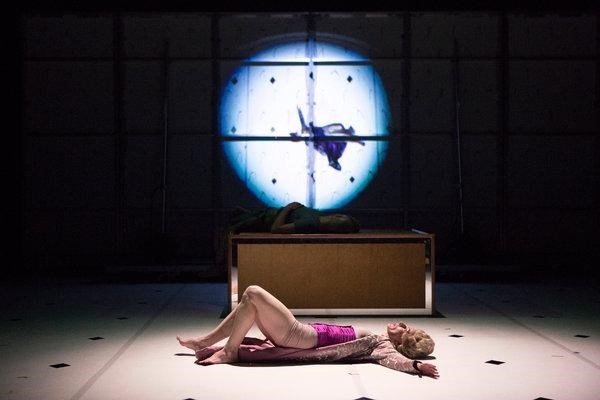
Scene from 17c, by Big Dance Theater

BURNING DIARIES


A review by Christopher Bernard


17c

Big Dance Theater

Zellerbach Playhouse

Berkeley, California


Diaries: those curious amalgams of introspection, examination of conscience, honesty (or the lack of it), performance of the self in the mirror of the mind, costumery of the soul, writing of one’s own story, exhibitionism, exploration, assassination, and secrecy. Some claim the modern diary—part narcissistic parade before oneself, part genuine confession of faults, part self-indulgence, part self-flagellation, which today has morphed, from the soul communing with itself into social networks’ exhibitionism and the genius for banality of writers like Karl Ove Knausgaard—was invented by Samuel Pepys.

Pepys was a Londoner, an administrator in the Royal Navy, and member of Parliament, who kept a regular diary for ten years, between 1660 and 1669, between the ages of 27 and 36, which was discovered and published to instant, and continuing, fascination by the public. People have been poking at Pepys ever since, with multiple editions, the earlier ones bowdlerized, the more recent ones even more complete than some might want, and including an online version, www.pepysdiary.com, which provides a typical entry for the day on which you visit (on the day I visited, it was the entry for December 14, 1665), and is constantly being annotated by fans and others.

One can find little to pity the poor fellow after exhibiting his own weaknesses with as much relish as this philandering, self-absorbed, self-promoting, epicene, self-deceiving, obsessive recorder of his own misbehavior—even if he never meant it to be read or (heaven forbid!) published!

Of course this begs the question haunting all diarists before and since: doesn’t every diarist secretly hope to be read, published, honored, become “famous”? (Full disclosure: I have been myself a more or less regular diarist since I was eleven.) Of course we do! We lie if we claim otherwise; at the very least, we hope some particular person will look it over with a sympathetic eye: a parent, a lover, oneself when old, God.

We rarely daydream about a critic, scholar, artist, interrogater who, though in all good humor, is as frank about you, sir, as you seem to be about yourself.

Which brings us to 17c, which, as part of its stimulating, and much-needed, RADICAL Women’s Work series, Cal Performances brought into town in mid-December: Big Dance Theater’s award-winning, dry-eyed exploration, witty send-up, and political meditation on Pepys’ voluminous self-revelation. And after the wave of political gains by progressive women in the last elections, it could hardly be more timely or more welcome.

The smart, juicy, often funny piece plays with dance, monodrama, dialogue, music, sketch comedy, play-within-a-play and mime to create a good-humored but well-deserved deconstruction of the life, as self-depicted, of the legendary diarist—and notorious disrespecter of women.

Pepys lays himself completely open to a feminist interrogation of his life: a compulsive philanderer, he is caught at least once by his wife in flagrante with the family maid, and he describes, briefly but indubitably, a rape. Both incidents appear in the piece, the first in an extended reading, updated to modern argot, in a very funny monolog by Paul Lazar, the second in a brief, devastating recitation of one of the diary’s darkest entries. Though, unfortunately, not its darkest.

For all the comedy, tragedy, and farce of Pepys’ depiction of his own life, the soul of 17c is not to be found there: that lies in the invisible words, the burning diaries, of Pepys’ wife, Elizabeth, or Bess, performed with grace and wit in a 2017 Bessie Award-winning performance by Elizabeth DeMent.

Bess’s silence plays in counterpoint to Pepys’ logorrhea. And the two come together in clash to reconciliation, to clash again, to bedward bliss to masculine displays of economic power parading as acts of contrition, until the fatal day comes when the diarist’s profound cruelty goes on display for all to see: when he discovers that Bess is also keeping a diary, rips out the pages one at a time, and at last burns them all. And he is not even ashamed to report it, though the irony of his action seems lost on him. He never seems to occur to him that the only way to spare himself eternal exposure would be to destroy his own.

The script sometimes suffers from a certain intellectual myopia (the claims in the introductory monologue that life and existence are “meaningless” are tendentious at best; my own response to such contemporary shibboleths is “prove it”) and from moral anachronism: that Pepys married Elizabeth when she was fourteen needs richer exploration than a flippant self-righteousness.

The otherwise intensely clever script was written and adapted by Anne-B Parson, and includes texts from Euripides, Eugène Ionesco, and Claire Tomalin as well as from the unperformed playwright and contemporary of Pepys, Margaret Cavendish, a stripped-down version of whose satirical and “radical feminist” play, The Convent of Pleasures, was performed as a play-within-a-play. Some of 17c’s most entertaining and perceptive scenes are based on the often wonderfully weird visitor comments from www.pepysdiary.com. The other players included sprightly Kourtney Rutherford and Cynthia Hopkins and a wittily voguing Mikéah Jennings.

EDITOR’S NOTE: On a personal note, Christopher Bernard was inspired to create this poem about Samuel Pepys after seeing 17c:


I Do Not Love Thee, Samuel Pepys


By Christopher Bernard


I do not love thee, Samuel Pepys.

Alas, and zounds! I cannot see

what all those readers see in thee.

Thou givest me, always, the creeps.


Inventor of the diary

as paper version of FB

in the seventeenth century,

I’ll give you that, most willingly.


But nothing more. He sows who reaps.

You are too close to that which keeps

me up all night. He dreams he leaps,

to drown, who can’t escape the deep.


We laugh, we glare.

But will we dare

when we’re laid bare,

and Samuel peeps?


He falls who cannot rise; he sleeps.

But acts are hard, and words are cheap.

I do not love thee, cannot bear thee.

In thee I see me, Samuel Pepys.

_____

Christopher Bernard is co-editor and poetry editor of Caveat Lector. He writes on dance, drama, and art for Synchronized Chaos. His most recent book is the poetry collection Chien Lunatique.

Christopher Bernard reviews ‘Custodians of Beauty’ from Pavel Zustiak and the Palissimo Company at Berkeley’s Zellerbach Hall

THE EYE OF THE BEHOLDER


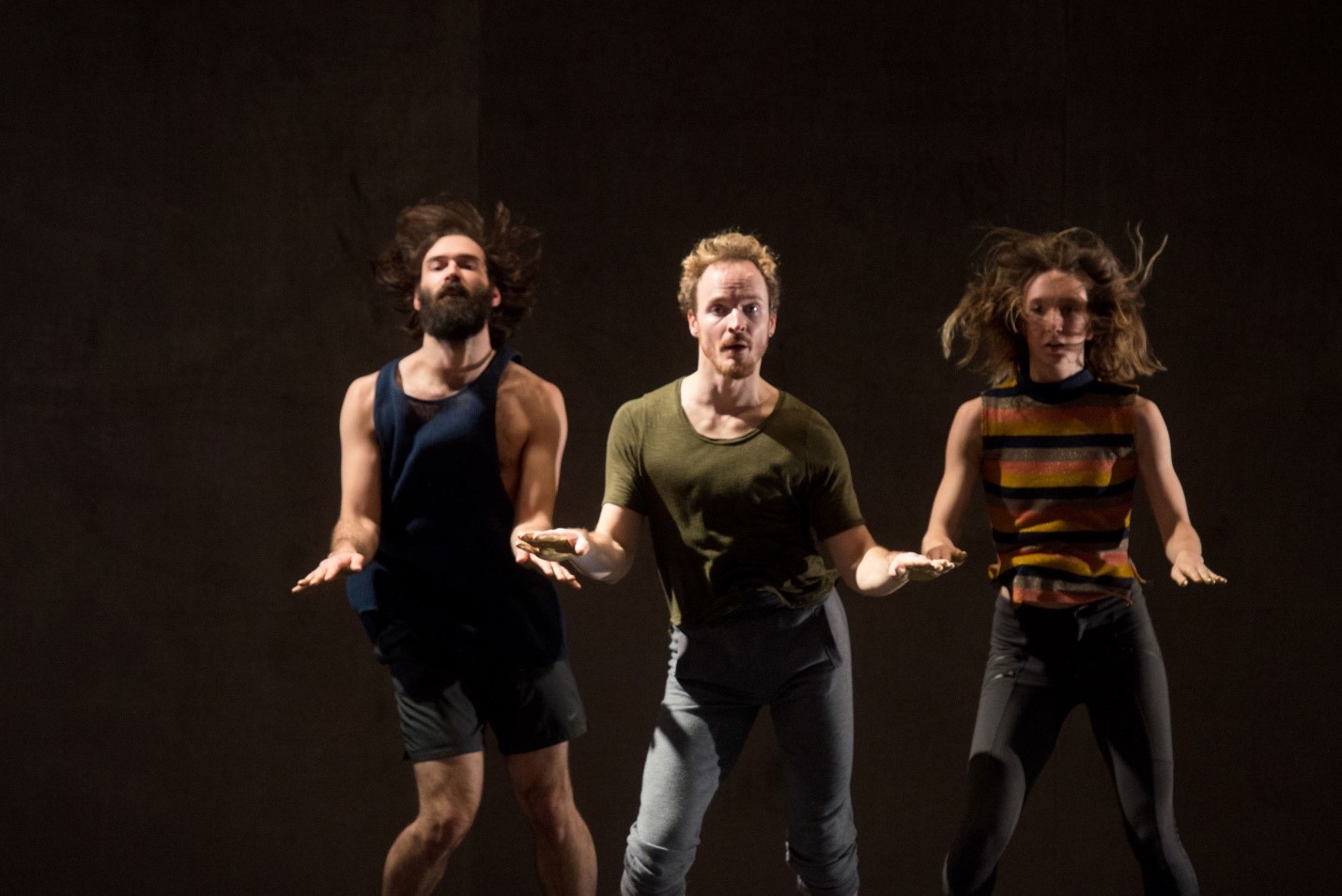
Viktor De La Fuente, Justin Morrison, and Emma Judkins in Custodians of Beauty (Photo by Liz Lynch)

Viktor De La Fuente, Justin Morrison, and Emma Judkins in Custodians of Beauty (Photo by Liz Lynch)


A review by Christopher Bernard

For beauty is nothing

but the beginning of terror . . .

—Rilke

Custodians of Beauty

Pavel Zuštiak and Palissimo Company

Zellerbach Playhouse

Berkeley, California

One of the many peculiarities of our post-postmodern age (though a clearer term for it would be “hypermodern”) has been the attempt to deconstruct (a polite word for “demolish”) certain terms of value that have come down to us through the ages of Western civilization: “truth,” “goodness,” “equality,” “freedom,” “liberal,” “democracy,” and the like.

One of the terms that has received special scrutiny in certain purviews of academia (where such demolitions are practiced, frequently under the innocent eyes of college students) has been “beauty.”

I always ask myself why such demolitions are performed: why would anyone want to deconstruct “truth” or “freedom” or “love”? Why would someone want to destroy “beauty”?

Knowing who will gain by such demolitions is often more fruitful than knowing who will lose. For, if we lost “beauty,” most people, I think, would agree that we would lose much that makes life worth living. But who would gain by it? One can understand why some feminists might, with good cause, resent “beauty,” since “beauty” has been used against women by men since the beginning of time: men have a weakness in worshiping beautiful women and despising ugly ones. And the most beautiful woman in the world knows that her beauty is only temporary: it is only a matter of time before she will lose it and fall into the worthless category of the ugly.

One common argument is that “beauty” creates “ugliness,” and that if we lost “beauty” as a value, we would lose “ugliness” as a pejorative. This, however, remains to be proved. It strikes me as, at best, unlikely: without “beauty” we would not lose “ugliness.” We would merely end up with nothing.

Which brings us to the modern dance performance, “Custodians of Beauty,” by Pavel Zuštiak and the NewYork‒based Palissimo Company, which was performed over a recent weekend in Berkeley as part of Cal Performances’ dance series.

This dance clearly belongs to the ongoing discussion of the meaning and value of beauty. “Custodians of Beauty” takes its title seriously and with less irony than one might have expected. Zuštiak’s dance is (as I read it) about exploring the boundaries of what we think of as “beautiful” and “ugly,” and breaking threw them, in order to find “beauty” where we might least expect to find it: for example, in industrial noise, in half-broken bodies, in mind-numbing repetition, pointless posturing and semaphores of nonsense, in asexual forms of nudity, in inelegance, cross-dressing, smoke and darkness and embarrassment and silliness and shame. There is even some dancing that pretends hard not to be—as dance is, for some of us, the very definition of classic forms of beauty.

And it almost succeeds. Though that “almost” is a bit wider than one might have hoped.

The roughly hour and a half work is broken into some fifteen to twenty scenelets, performed against two large movable  panels, one of them a greenish-gray, the other a heavy scarlet red scored over with Cy Twombly-like marks and scratches. The three dancers dance before and between the screens, often making alphabet-like shapes, or taking enigmatic poses, or deaf-mute signing; their shadows thrown in dramatic shadows against them, creating phantom crowds.

At one point the three appear, seminude, wrapped in and around each other, with rumps thrust in the air like mushrooms and, in a long choreographic tour de force, role together complexly across the stage, uncoiling limbs and exposing torsos without once revealing their faces, until at the very last moment they rise to a stand and turn to the audience, defiantly human after recapitulating an evolution from some primordial fungus.

Other scenes include words spoken, screened, sung: a song based on a poem by Emily Dickinson, words spoken to the audience (in one instance, three audience members were invited to the stage, and stood, awkwardly but good-naturedly, defying us to think them less worthy of attention than the dancers they momentarily replaced), words screened against the back wall; taken from what appear to be typical comments after an avant-garde dance performances, and echoing no doubt what some in the current audience were thinking or would share with each other after the show: “What was that? Did it mean anything? I almost . . . liked it.” This dance certainly displayed a good-natured sense of humor.

At one point the smoke machine was put to use, and a cloud of steam rose in the dimly lit auditorium, slowly dissipating over the audience’s heads. At another point, an enormous black screen was pulled over the heads of the audience, from the front row to the back, one row at a time by the audience themselves after being initiated by the dancers.

At another point, an extravagant shadow was thrown against the back screen and a man in a dress appeared, mincing grandly in defiance of classic attitudes of masculine beauty (always more conservative than the feminine).

And there was a spoof of a grand finale, as the three dancers trembled and shook and pogoed around the stage to dance-club music like wound-up puppets, before a coda where, in half-seen shadows, one of the male dancers strenuously waved a huge, indecipherable banner, though whether in triumph or in futile defiance we will never know.

I found my best experience of this dance while writing about it: while watching it, on the other hand, I often felt vaguely irritated, despite the first feeling of intrigue as each part began, then out-stayed its welcome. The dance as a whole would have been a feast if, so to speak, it had been closer to a snack; as it was, it felt undernourished, repetitious, and thin; editing it down to an hour would probably strengthen its overall effect. Also it was not quite as original as it intended: these motives and these moves I have encountered more than once since deconstruction’s hey-day in the 1980s and the advent of “antidance” in Europe over the last decade or more.

Pavel Zuštiak provided “direction, choreography and olfactory design” (though, to be frank, I failed to detect any untoward smells, good or bad), the simple but effective lighting was by Joe Levasseur, and the eerie, sometimes deliberately needling, and (when called for) effectively ironic music was by Christian Frederickson. The able, brave and vulnerable dancers were Viktor De La Fuente, Emma Judkins, and Justin Morrison.

_____

Christopher Bernard is co-editor and poetry editor of Caveat Lector. He writes on dance, drama, and art for Synchronized Chaos. His most recent book is the poetry collection Chien Lunatique.


Christopher Bernard reviews the San Francisco MoMa’s Etel Adnan exhibit

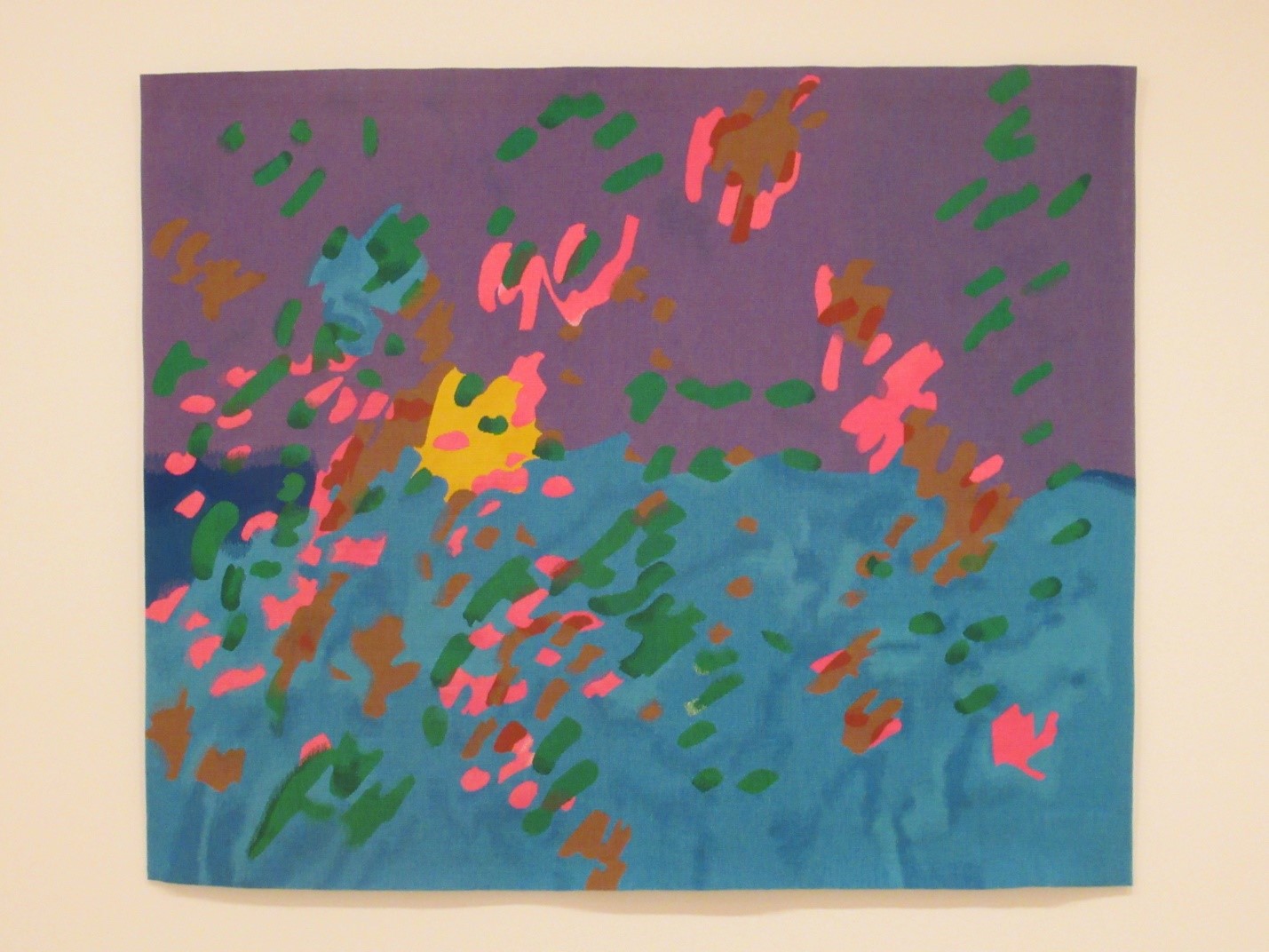
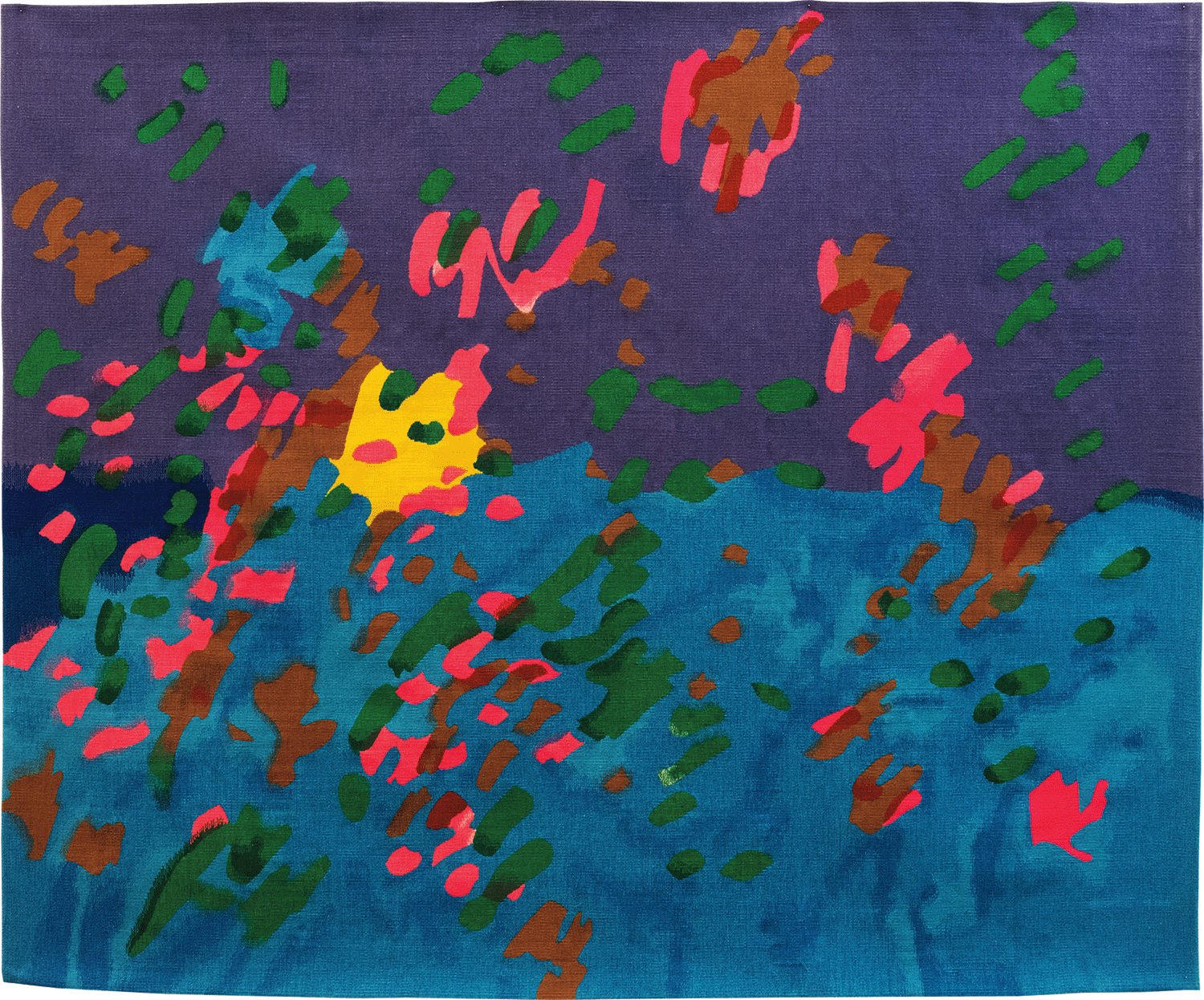
Explosion Florale

OLD JOY

A review by Christopher Bernard


New Work

Etel Adnan

San Francisco Museum of Modern Art

Until January 6, 2019


It is tempting to call Etel Adnan a contemporary instance of the “late bloomer”: someone whose work came into its own after most people’s lives have begun winding down.

But it may be more accurate to call us, in this instance, the “late bloomers,” almost scandalously delayed, as we have been, in recognizing what has been blossoming vigorously among us all this time.

Because, at 93, Adnan is finally receiving her due for a body of work she has been creating for more than half a century and continues to create, oblivious to age, at a dazzling rate.

The San Francisco Museum of Modern Art’s exhibit (curated with particular perceptiveness and sensitivity by Eungie Joo, the museum’s curator of contemporary art) succeeds admirably in introducing us to Etel Adnan’s spirit and gifts in oil painting, tapestries, and ink drawings (she is also an important poet, novelist, and playwright, but more about that later).

The oils paintings (fifteen in all, and all created this year) dominate the show: small, powerfully composed color-field works, with flat, brilliantly balanced colored geometric forms (anchoring squares and sun-like circles dominating some, dramatic valley and mountain forms dominating others, and sinuous root and mineral-like shapes dominating yet others), that consistently fascinate the eye, both stimulating and calming the emotions, with the economy that is achieved in only the maturest art.

Adnan’s simple forms indeed display the care and practice of a long lifetime, their economy balanced with vitality and the artist’s subtle and invigorating sense of color and tone. One looks at these paintings of an unsurpassed simplicity impressed by how they also manage to be so dynamic.

Adnan’s ongoing recognition has included retrospectives in major galleries, appearances in important exhibits of work by woman artists in New York and in Europe, including dOCUMENTA (13), and two magnificently produced monographs published this year. This is her first exhibition at SFMOMA, in the Bay Area where she lived for many years – years, appositely for this exhibit, when she discovered herself as an artist. In fact this museum is an important source of Adnan’s deceptively naïve and childlike aesthetic, as it houses the Djerassi collection of Paul Klee, whose work (and that collection in particular), had enormous early influence on her own art, as the artist herself has attested.

It is worth noting that Adnan is not only an artist of concentrated grace but, having begun her creative life as a philosopher and poet (in French and, later, English), is now accepted as one of the most innovative and influential modern writers from the Arab world.

Etel Adnan’s life spans several continents: born of a Turkish father and Greek mother in Beirut (where she was educated in French; French becoming her first “literary” language), she won a scholarship in 1949 to the Sorbonne in Paris, where she met the writer André Gide and studied under philosophers Gaston Bachelard (The Poetics of Space) and Etienne Souriau. Six years later she moved to the San Francisco Bay Area to pursue doctoral work in esthetics at the University of California, Berkeley. During her years in the Bay Area, she began experimenting with painting and drawing, creating her first leporellos (a specialty of the artist’s), books made of long, folded paper opening out like long friezes, in which Adnan incorporates both poetry and art.

Late in the 1960s, while teaching philosophy, Adnan also began designing tapestries, two of which are on view here. In the early 1970s she returned to Beirut, where she edited a leading newspaper’s culture section. With the outbreak of civil war in Lebanon, she settled briefly in Paris, later returning to the Bay Area where she published her award-winning first novel, Sitt Marie Rose, her most read and translated book.

Adnan lived just north of San Francisco, near the foot of Mt. Tamalpais. The mountain, which dominates the northern skyline across from the Golden Gate (I can see it from my window even as I write this), became, in its many moods of shadow, sun, and rain, one of the most important motifs in both her poetry and painting, as clearly evidenced in this show. She lived, wrote, and painted in that place for a number of years before, now in her nineties, finally settling permanently in Paris.

The show’s two tapestries (one from 1968, a ragged dance of oranges and yellows broken by rivers of blue; the other, a swirl of blossoms and petals against an azure and purple background, titled “Explosion Florale,” designed in 1968 and completed in 2018) are amoebic swathes of shape and color. The drawings in the three leporellos display dramatic flourishes of ink and energetic marks of an almost ecstatic joyfulness.

In fact, the note struck by Etel Adnan’s work over the years, whether in paint, drawing, tapestry, or words (and a disclosure is due here: I have known Etel Adnan since she lived in the Bay Area, and have been following her career in writing and art for a long time), is the very note she strikes in person: an overflowing of love and affection, joy and gratitude for the life and people around her, for everyone who meets her, and for those who are lucky enough to enjoy a greatness of spirit that radiates like so many suns from her art.

It is only right that the Bay Area, one of her many homes, and the one where she discovered herself as an artist, should celebrate this triumphant art that rose among us.

There are a few artists who blossomed throughout a long lifetime, rising to ever greater heights in their great age: Titian, Matisse, Picasso, Michelangelo, Renoir, Rembrandt. Only time will tell, of course, but to this select number it may one day seem perfectly appropriate, even obvious, to add the name Etel Adnan.

The museum store offers for sale, along with the monographs mentioned above, three of Adnan’s most recent books: Premonition, Night, and Surge – thought-provoking, beautifully written works of philosophical prose poetry as accessible and enlivening in words as her art is in form and color.

premonition

Christopher Bernard is co-editor and poetry editor of Caveat Lector. He writes on dance, drama, and art for Synchronized Chaos. His most recent book is the poetry collection Chien Lunatique.