THE AUTISM APPARATUS: Corbett, Lanni, and the Institutions That Shape the Narrative, by Alex S. Johnson

Alex S. Johnson

The story begins in the polished corridors of Vanderbilt University, where autism research is treated as both a scientific frontier and a moral mission. Within this environment, Dr. Blythe A. Corbett built a career studying autistic minors, focusing on their stress responses, emotional regulation, social behavior, and the delicate architecture of identity formation. Vanderbilt and its medical center provided her with everything a researcher could want: grant infrastructure, IRB pathways, participant recruitment channels, and a steady stream of graduate students eager to attach their futures to a well‑funded lab.

Among those students was Dr. Kimberly Lanni, who completed her doctoral training under Corbett’s supervision and co‑authored research with her. Their collaboration was not incidental; it was formative, a direct transmission of methods, frameworks, and institutional logic.

The relationship between advisor and student becomes especially significant when considering the lawsuit filed in June 2025: Wisniewski v. Vanderbilt University, Vanderbilt University Medical Center, and Dr. Blythe A. Corbett. In this case, the parents of an eight‑year‑old autistic girl allege that their daughter, enrolled in a Corbett‑run research study, was subjected to identity‑related psychological assessments—including gender‑identity probes—without their informed consent. They describe a child who emerged from the study traumatized, confused, and in need of ongoing treatment, a child who experienced the research not as a neutral inquiry but as an intrusion into her sense of self. The lawsuit treats Corbett’s research as a form of clinical intervention, collapsing the boundary between experiment and care and revealing how easily a vulnerable minor can be swept into procedures she cannot fully understand or resist.

Years earlier, before the lawsuit and before the public controversies surrounding Corbett’s research practices, I encountered the other half of this lineage in a very different setting. In 2019, I underwent neuropsychological testing at Kaiser Permanente under the care of Dr. Kimberly Lanni. At the time, she was not a researcher but a clinician embedded in one of the largest healthcare systems in the country, a system where a single clinician’s documentation can shape a patient’s life for years. What unfolded during and after that evaluation would later echo, in structure if not in content, the concerns raised in the Corbett lawsuit.

I reported contradictory diagnostic narratives, chart entries I did not consent to, and the application of a “dangerousness” designation that followed me through the system like a shadow. Attempts to correct or challenge these entries were met with institutional inertia, as if the documentation itself carried more authority than the person living inside the body being described. The experience revealed how easily a patient’s identity can be rewritten within a clinical bureaucracy, and how difficult it can be to reclaim one’s own narrative once it has been overwritten by institutional text.

The parallels between the two situations are not a matter of speculation; they are structural. Corbett and Lanni worked side by side on autism research involving minors. Corbett shaped the frameworks that defined what counted as appropriate behavior, risk, impairment, or identity development. Lanni carried those frameworks into a massive clinical system where documentation becomes institutional truth. The same conceptual language that once guided research protocols in a university lab now informs clinical interpretations in an HMO, where a single note can determine how a patient is treated, believed, or dismissed.

The controversies surrounding Corbett and Lanni reveal a shared architecture of power. Vanderbilt and Kaiser, though different in mission and structure, both operate on the assumption that their professionals are reliable narrators of reality. Both systems tend to protect their own, to treat written interpretations as authoritative, and to minimize or reinterpret the distress of autistic and neurodivergent individuals. In both settings, the person being studied or treated can find themselves overshadowed by the institutional narrative, their own account of events struggling to gain traction against the weight of documentation.

The apparatus that emerges from these intertwined stories is not driven by malice but by structure. It is a system in which research ambition, clinical authority, and institutional self‑protection converge, often at the expense of the very people the system claims to serve. Autistic minors in research settings and autistic or neurodivergent adults in clinical settings face similar vulnerabilities: their voices are discounted, their distress reframed, their identities interpreted through frameworks they did not choose. The line between research and care, already blurred in the Corbett lawsuit, becomes even more porous when research‑born frameworks migrate into clinical environments through the careers of those trained within them.

Understanding this apparatus—its lineage, its incentives, its blind spots—is essential for imagining a more transparent and humane system. The stories of Corbett’s research participant and of my own experience as Lanni’s would-be patient are not isolated incidents. They are connected by a shared institutional logic, one that must be examined if it is ever to be changed.

Biographical Notes

Alex S. Johnson

Alex S. Johnson is an author, editor, and cultural critic whose work spans fiction, poetry, journalism, and investigative nonfiction. He is the author of The Kandy Fontaine Chronicles, Brides of Doom, Bizarrely Departed, The Vivids, The Doom Hippies, Drag Cola & Other Stories, and For Iris: The Los Angeles Poems. Johnson serves as editor‑in‑chief of Black Diadem magazine and as publisher and curator at A Collective Paw. His work has appeared alongside Patrick Califia, Carol Queen, Caitlín R. Kiernan, Michelle Tea, Jan Steckel, and Poppy Z. Brite. Known for his incisive cultural mapping and high‑intensity prose, Johnson brings a unique blend of literary craft and investigative clarity to his nonfiction writing.

Dr. Blythe A. Corbett

Dr. Blythe A. Corbett is a professor and researcher at Vanderbilt University and Vanderbilt University Medical Center, where she directs the SENSE Lab. Her work focuses on autism in children and adolescents, with an emphasis on social behavior, stress responsivity, emotional regulation, and identity development. Corbett has published widely and secured significant research funding throughout her career. She is a named defendant in a 2025 healthcare liability lawsuit alleging that an autistic minor was subjected to identity‑related assessments without proper parental consent during participation in a research study.

Dr. Kimberly Lanni

Dr. Kimberly Lanni is a neuropsychologist trained at Vanderbilt University, where she completed her doctoral work under the supervision of Dr. Blythe Corbett and co‑authored autism research involving minors. She later joined Kaiser Permanente, working within its integrated clinical system. In 2019, she conducted neuropsychological testing on author Alex S. Johnson, who later reported disputed diagnostic narratives and contested chart entries associated with her clinical practice. Lanni’s career reflects the movement of research‑based frameworks into large‑scale healthcare environments, where clinical documentation carries significant institutional weight.

Essay from Hilola Sharipova

The Rise of Internet Stars and the Reality Behind the Screen

Today, the internet has moved far beyond being a simple means of communication and has become an essential part of human life and a vast information space. With just a phone, a person can become known to the whole world and gain the attention of millions. In the past, it took years of hard work to achieve fame, whereas today even a few seconds of video can turn someone into an internet star.

In this way, a new generation known as “internet stars” has emerged. They are becoming increasingly influential in today’s society. Young people admire their style of dressing, way of speaking, and lifestyle. Social media further enhances this fame by presenting an attractive image: expensive cars, luxurious living, constant smiles, and apparent success draw people in. However, the reality behind the screen is not always visible.

One of the main reasons for the popularity of internet stars is that they appear closer and more relatable to ordinary people than traditional celebrities. Through daily videos, live streams, and posts, followers feel as if they personally know them. This creates a strong emotional connection. As a result, internet influencers can shape opinions, trends, and even people’s dreams.

Internet stars also have a positive side. Some of them encourage people to study, learn languages, and engage in sports. Others raise awareness about social issues such as environmental protection, charity, education, and mental health. Many young people have found motivation and inspiration through online creators who share useful knowledge and life experiences. In this sense, the internet has become a field of great opportunities where talent can be discovered regardless of background or social status.

Moreover, the internet has opened doors for creativity and self-expression. People who once had no opportunity to share their talents can now present their art, music, writing, or ideas to a global audience. This has made the modern world more connected and dynamic. Some internet stars even use their influence to support charitable projects and help communities in need.

Nevertheless, there is another side to the issue. Today, many people consider fame to be the same as success. Some internet stars resort to showing a fake life, creating artificial personas, or using emotions merely to increase followers and views. In many cases, the content people see online is carefully edited and designed to appear perfect. Expensive lifestyles, luxurious vacations, and endless happiness may not reflect reality at all.

What is even more concerning is that young people often perceive this as real life and genuine achievement. They begin comparing themselves with unrealistic standards and may feel dissatisfied with their own lives. Some become obsessed with gaining likes, followers, and online attention instead of focusing on education, personal growth, and real relationships. This can negatively affect confidence, mental health, and values.

As a result, it sometimes seems that a person’s online image has become more important than their inner world and true identity. Many people, instead of preserving their authenticity, try to create an image that pleases others. Artificiality is gradually becoming normal. In the race for popularity, honesty and sincerity are sometimes sacrificed.

Another important issue is that internet fame is often temporary. Trends change quickly, and public attention can disappear overnight. A person who is admired today may be forgotten tomorrow. Therefore, building one’s entire identity around online popularity can be dangerous and unstable. Real success should be based on knowledge, character, kindness, and contribution to society rather than temporary internet attention.

In reality, fame does not make a person great. A person’s true value is measured by their manners, thinking, honesty, and contribution to society. The number of followers is temporary, whereas humanity is an enduring value. A kind and educated person who helps others leaves a far more meaningful impact than someone who is only popular online.

In conclusion, internet stars have become an inseparable part of modern society. They can have both positive and negative effects depending on how they use their influence and how people respond to them. The most important thing is that individuals should not lose their identity while using the internet and should pursue meaning, knowledge, and values rather than appearance alone. Trends pass, fame is forgotten, but a person’s true character and good deeds remain forever.

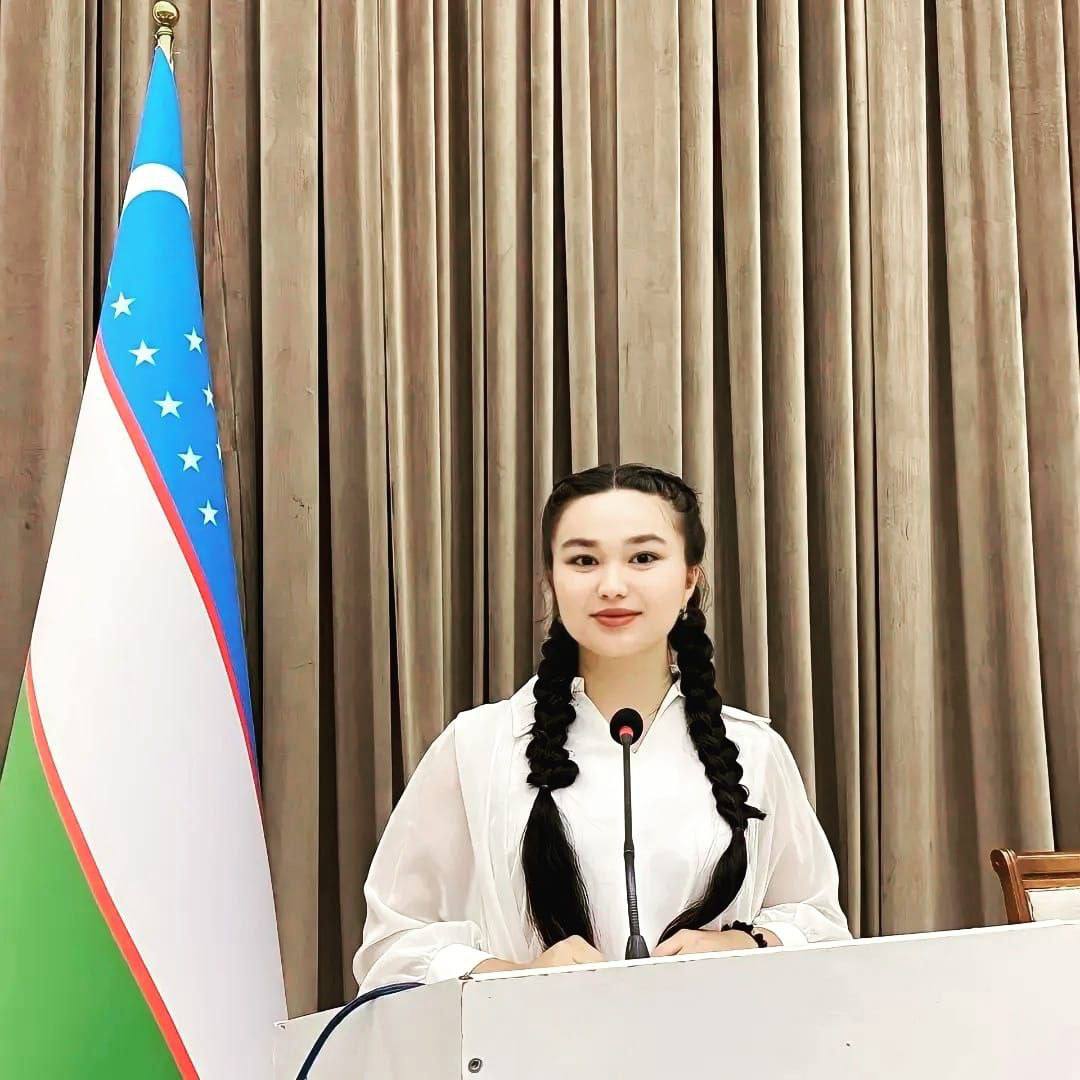
Hilola Sharipova was born on June 30, 2007, in Urganch, Khorezm region, Uzbekistan. She is a student at Urganch Ranch Technology University, majoring in Economics. She has a strong interest in economics and banking activities.

She is also actively involved in sports, particularly handball. She is the winner of 1st place in the Uzbekistan Championship in handball. In addition to sports, she is interested in poetry and literature. Her book titled “Dadamnı sog‘inib” has been published.

Hilola knows two languages, English and Turkish, and she holds certificates in both languages. She is a very talented and ambitious individual with a wide range of interests and achievements.

Poetry from Patrick Sweeney

tree frog

making ends meet

        *

he had the directional uncertainty

of a clouded sulphur butterfly

        *

when the Talkies came in,

Squeaky got the gate

        *

deer have eaten the day-old morning glories again

        *

even though I never was, I identify with the has-beens

        *

her first tart strawberry

in a world of ‘try this’

        *

irises rain-shower wet

how gloriously transitory, the bearded purple 

        *

the alluvial age of the lost galoshes

        *

the summer I had to look up every word

        *

I learned the dead man’s float

in the Upper Darby creek

        *

he wasn’t the kind of guy

anyone would miss

       *

he thought the strength of the dragonfly

must be in her shoulders

        *

he had the late August posture

of a sunflower

        *

people make me nervous,

yet I think about them constantly

when they’re gone

        *

the black bread of quiet study

Poetry from J.K. Durick

Airports

There’s something “counter” about airports –

Those bustling crowded places where strangers 

Are momentarily bonded together by a common

Goal – to get away from the present and get on

With the lives they are going into, something new

Or back to, happily or reluctantly. This is what

Transitory means, a fleeting moment we all get to

Pass through on our way to something we hoped

For when we bought that ticket, that boarding

Pass that feels so momentary folded up in our

Pockets waiting to help us escape the lines we

Become part of here in a place remembered only

By its abbreviated name – LHR, PHL, and BTV.

                   Souvenirs

Souvenirs are as hard to predict

As they are to explain afterwards.

Friends ask, and you barely remember

The why and therefore of the decision.

They were there just at the right moment

And you fell under their spell and ended

Up at the cashier with your selection in

Hand. Watching them get wrapped up

Or rung up were as close to hypnotic as

Anything you have experienced. This is

How they sell their place. This is how we

Buy our latest trip and bring it home with

Us to put on display and try to explain

What motivated you to buy yet another

Pen or another turtle figure.

                Today’s Poem

It’s out there bouncing on the waves

Starboard side this time.

Yesterday’s was short and abrupt

Quickly taken in, quickly dismissed.

But today’s has a different look –

Ready to engage, ready to enlighten.

Yesterday I was embarrassed to bring

It to everyone’s attention – pointing,

Pretending promising it would be worth

Their efforts at understanding.

Of course yesterday was yesterday

We don’t need to remember.

Today will be something new, something

Worth mentioning in the future

And then I’ll be able to say – I brought all

This to everyone’s attention

And they are better for it.

Poetry from Mark Young

An eponymous skateboard

My clamshell tilts to the left
like an offkilter ice cream
cone. Born & bred in the state

of Bosnia & Herzogevina,
from whence its name, Arch-
duke Franz Ferdinand. Also

from whence its major draw-
back, the fear of assassination
while wheeling down the road.


What the Dickens?

Nicholas Nickleby
escaped the pages
of that eponymous

novel & went off &
joined a boxing troupe
where he achieved

great success fighting
under the name of
Nickelass Knuckleby.


in bed, in lederhosen

Bertolt Brecht stirs beside me,
muttering something about Die 
Moritat von Mackie Messer. On 
the other side, in a mini dirndl 
with white school sox, Lotte Lenya 
murmers the words in a kind of
Sprechstimme, speak-singing the 
English call it, as a means of dis-
guising the deterioration of her
voice. Kurt Weill is currently not
around; but the words, the mutter-
ings, impersonate his presence.
All this because it is extremely 
uncomfortable sleeping in leather.
Even though it's soft, it sometimes 
chafes the thighs, plus experts 
warn that it stresses the material
& the seams. But I find that cer-
tain music will alleviate all dis-
comfort. Tonight it's Die Drei-
groschenoper. Tomorrow maybe
Bach, or Concierto de Aranjuez. A
few days in the nude will follow, 
or up until the weather changes.

The / Manchurian Candidate / in another demographic

Project artichoke was a CIA 
mind control program which
sought to determine if a sub-
ject under the influence of one
of many drugs could be made
to carry out an assassination.


Whiting moments, angry. (Psalm 69)

The Buddha said: "Touchy
people become offended, pay
their wrath forward." In
other words, some people

want shit to happen; & if it
doesn't, they do just enough
to make certain that it does.
Buddha won't be happy that

that's how it turns out; but
elsewhere, King David will
be overtaken by paroxysms

of delight. "Pour out your
wrath upon them; let your
fierce anger overtake them."

Essay from Jumanazarova Nafisa

IS ONLINE LEARNING MORE EFFECTIVE THAN OFFLINE LEARNING?

Author: Jumanazarova Nafisa

Email: davlatmuradovna@gmail.com

ORCID:0009-0001-5442-4349

University: National university of Uzbekistan

Field: Foreign language and literature

Annotation: This study examines the effectiveness of online and traditional education. The relevance of this topic is due to the rapid development of technology and the widespread adoption of distance learning in recent years. The main objective of the research is to identify the advantages and disadvantages of both online and offline education and to evaluate their impact on the learning process. The study employs comparative, analytical, and generalization methods. Both forms of education are explored, and their distinctive features are highlighted. The findings indicate that online education provides convenience and flexibility, whereas offline education enhances direct interaction and supervision.In conclusion, both forms of education are important, and their combined application can lead to more effective outcomes.

Keywords: Online education, traditional education, distance learning, educational effectiveness, learning process, educational technologies, interactive learning, flexibility, quality of education, digital education.

Annotatsiya: Ushbu ishda onlayn va an’anaviy  ta’limning samaradorligi tahlil qilinadi. Mazkur mavzu hozirgi kunda texnologiyalarning tez rivojlanishi va masofaviy ta’limning keng tarqalishi sababli dolzarb hisoblanadi. Tadqiqotning asosiy maqsadi — onlayn va offline ta’limning afzallik va kamchiliklarini aniqlash hamda ularning o‘quv jarayoniga ta’sirini baholashdan iborat. Ish davomida taqqoslash, tahlil va umumlashtirish metodlaridan foydalanilgan. Tadqiqotda har ikkala ta’lim turi o‘rganilib, ularning o‘ziga xos jihatlari yoritib berilgan. Natijalar shuni ko‘rsatadiki, onlayn ta’lim qulaylik va moslashuvchanlikni ta’minlasa, offline ta’lim bevosita muloqot va nazoratni kuchaytiradi. Xulosa qilib aytganda, har ikkala ta’lim turi ham muhim bo‘lib, ularni uyg‘unlashtirib qo‘llash samarali natija berishi mumkin.

Kalit so’zlar: Onlayn ta’lim, an’anaviy ta’lim, masofaviy o‘qitish, ta’lim samaradorligi, o‘quv jarayoni, ta’lim texnologiyalari, interaktiv o‘qitish, moslashuvchanlik, ta’lim sifati, raqamli ta’lim.

Аннотация: В данном исследовании рассматривается эффективность онлайн- и традиционного  образования. Актуальность темы обусловлена быстрым развитием технологий и широким распространением дистанционного обучения в последние годы. Основная цель исследования — выявить преимущества и недостатки онлайн- и офлайн-образования, а также оценить их влияние на учебный процесс.В ходе исследования использовались методы сравнения, анализа и обобщения. Были изучены обе формы обучения и раскрыты их отличительные особенности. Результаты показывают, что онлайн-образование обеспечивает удобство и гибкость, тогда как офлайн-образование усиливает непосредственное взаимодействие и контроль.В заключение следует отметить, что обе формы обучения являются важными, и их сочетание может привести к более эффективным результатам.

Ключевые слова: Онлайн-образование, традиционное образование, дистанционное обучение, эффективность образования, учебный процесс, образовательные технологии, интерактивное обучение, гибкость, качество образования, цифровое образование.

 INTRODUCTION 

In recent years, the education system has undergone significant transformations under the influence of rapidly developing technologies. In particular, the widespread adoption of online education has created the need to compare it with the traditional (offline) education system. This article is specifically devoted to analyzing the effectiveness of online and offline education, aiming to determine their role and significance in the learning process.

The relevance of this topic lies in the fact that today many pupils and students are faced with the necessity of choosing between two modes of learning—distance and traditional. The development of digital technologies, the expansion of internet accessibility, and the increased popularity of distance education in the post-pandemic period have made this issue even more important. Therefore, identifying which type of education is more effective has become a crucial matter not only for learners but also for teachers and the education system as a whole.

At the same time, although existing studies have separately highlighted the advantages of online and offline education, there remains a certain gap in directly comparing their actual effectiveness and drawing clear conclusions. In some cases, the convenience of online education is highly valued, while in others, the effectiveness of traditional education is considered superior. This indicates the need for a more in-depth investigation of the issue.

The main objective of this article is to analyze the effectiveness of online and offline education, identify their strengths and weaknesses, and justify in which situations each type of education is more effective. Furthermore, the study examines the impact of both forms of education on students’ learning processes and, based on this analysis, provides general conclusions.  

 RESEARCH METHODOLOGY

This study aims to determine the effectiveness of online and traditional (offline) education and employs a mixed-methods approach. This approach allows for a comprehensive examination of the research problem from multiple perspectives. During the study, the impact of different modes of education on learning outcomes was analyzed using both qualitative and quantitative data.

The research design is based on comparative and survey methods. Through this approach, the differences between online and offline education, as well as their effectiveness, were systematically compared.

The main research problem is to determine how effective online education is in comparison to offline education. Based on this, the following research questions were formulated: How does online education affect learning outcomes? What is the level of achievement in offline education? Which type of education do students prefer? In addition, the study proposes the following hypothesis: there is no significant difference between the effectiveness of online and offline education.

The participants of the study were students enrolled in higher education institutions. The sample was formed using a random sampling method.

Data collection methods included surveys, observation, and statistical data analysis. Surveys were used to examine students’ opinions, observation helped to analyze learning activities, and statistical data were applied to evaluate academic performance.

To ensure the reliability of the research results, the survey questions were pre-tested, multiple sources were cross-checked, and the findings were statistically verified. This contributed to enhancing the validity and reliability of the study.   

 LITERATURE REVIEW 

In the last 5–10 years, due to the rapid development of digital technologies in the education system, a significant number of scientific studies have been conducted comparing online and traditional  education. In particular, the widespread use of distance learning during the COVID-19 pandemic further increased academic interest in this topic. In general academic literature, online education is characterized by its flexibility and independence from time and place. In contrast, offline education is valued for its advantages in direct communication, teacher supervision, and the formation of a social learning environment.

Among recent studies, the work of Means (2013) indicates that online education in some cases produces equal or even higher outcomes compared to traditional education. According to their analysis, well-designed online courses with interactive materials can significantly improve students’ academic performance.

Similarly, Broadbent and Poon (2015) found that self-regulated learning skills are a crucial factor for success in online education. In other words, the effectiveness of online learning largely depends on the learner’s level of independence and ability to manage their own study process.

From another perspective, Bernard et al. (2014), based on a meta-analysis, argue that there is not always a significant difference between the outcomes of online and offline education. They emphasize that educational effectiveness depends more on teaching methodology, instructional quality, and course organization, while the mode of delivery is considered a secondary factor.

Post-COVID-19 studies, particularly the work of Adedoyin and Soykan (2020), highlight that online education ensured the continuity of the learning process; however, challenges such as reduced student motivation, technical difficulties, and limited social interaction were observed. In contrast, offline education is distinguished by a more stable learning environment and higher student engagement through face-to-face interaction.

Local studies conducted in the context of Uzbekistan also examine the implementation and effectiveness of online education. The results of these studies indicate that although online learning has expanded access to education, many students still prefer traditional education. This preference is mainly attributed to direct interaction with teachers, a disciplined learning environment, and easier comprehension of materials.

At the same time, some researchers argue that excessive reliance on offline education may limit the development of modern digital skills. Therefore, in recent academic literature, blended learning is increasingly considered the most optimal approach, as it combines the advantages of both online and offline education.

Overall, the literature review shows that there is no definitive conclusion regarding the effectiveness of online versus offline education. Both forms have their strengths and weaknesses, and their effectiveness largely depends on teaching quality, student engagement, and contextual factors.

 RESEARCH RESULTS 

In the present study, the activities of students enrolled in both online and offline education systems were analyzed. The collected data showed that students in the online learning group demonstrated higher performance in independent learning and time management skills. However, in the offline learning group, the level of classroom engagement and direct interaction with instructors was significantly higher.

According to statistical analysis, no substantial difference was found in the overall academic performance (test scores) between the two groups. The average results were nearly identical, with a difference of approximately 5–8%. This indicates that not the mode of education itself, but rather teaching quality and individual student characteristics play a more significant role.

The survey results revealed that the majority of respondents considered online education to be convenient and flexible, with 74% of students identifying time and location independence as its main advantage. At the same time, 69% of respondents stated that direct interaction with instructors in offline education helps them better understand learning materials.

Observations also showed that students in online education rely more on independent learning, whereas offline education is characterized by higher classroom participation and more dynamic question-and-answer interactions.

 DISCUSSION 

The obtained results indicate that both online and offline education have their own advantages and limitations. Online education provides students with flexibility, opportunities for independent learning, and access to a wide range of resources. These findings are consistent with previous studies, confirming that the effectiveness of online education largely depends on the learner’s self-regulation abilities.

Offline education, on the other hand, supports deeper understanding of knowledge through face-to-face communication, teacher supervision, and a structured social environment. The results of this study show that many students perceive offline education as more understandable and effective due to the possibility of receiving immediate feedback and answers to their questions.

Based on statistical findings, it can be concluded that there is no significant difference in overall academic performance between online and offline education. This suggests that teaching methodology and student motivation play a more crucial role than the mode of education itself.

Furthermore, some challenges were identified during the study. In online education, reduced concentration and motivation were observed, while in offline education, time and location constraints created difficulties for some students.

Overall, the results of this study suggest that the most effective approach is a blended learning model that combines the advantages of both online and offline education. This approach contributes to improving educational quality and meeting diverse student needs.

 CONCLUSION 

The main objective of this study was to compare the effectiveness of online and traditional  education and to determine their impact on the learning process. The results of the research showed that both forms of education have their own specific advantages: online education primarily enhances independent learning and flexibility, while offline education contributes to deeper knowledge acquisition through face-to-face communication, active classroom participation, and teacher supervision.

Based on the findings, there is no significant difference in overall academic performance between online and offline education. However, their impact is manifested in different skill areas. This indicates that educational effectiveness depends not only on the mode of delivery but also on teaching methodology, student motivation, and individual learning characteristics.

The results of this study have important practical implications for improving the organization of the educational process. They suggest that educators should consider the strengths of both learning formats when designing instruction. In particular, combining digital resources from online education with interactive communication from offline education may enhance overall learning outcomes.

Accordingly, the blended learning model is recommended as the most appropriate approach in the education system. This model integrates the advantages of both online and offline education and helps create an effective learning environment tailored to students’ needs.

Future research should explore this topic on a broader scale, including different age groups and educational institutions, as well as analyze the long-term impact of digital technologies on the quality of education.

 REFERENCES

  1. Means B., Toyama Y., Murphy R., Bakia M., Jones K. Evaluation of Evidence-Based Practices in Online Learning: A Meta-Analysis and Review of Online Learning Studies. — Washington, DC: U.S. Department of Education, 2010.
  2. Bernard R. M., Borokhovski E., Schmid R. F., Tamim R. M., Abrami P. C. A meta-analysis of blended learning and technology use in postsecondary education. — Review of Educational Research, 2014. — Vol. 84(1). — P. 1–35.
  3. Broadbent J., Poon W. L. Self-regulated learning strategies & academic achievement in online higher education learning environments. — Internet and Higher Education, 2015. — Vol. 27. — P. 1–13.
  4. Adedoyin O. B., Soykan E. COVID-19 pandemic and online learning: The challenges and opportunities. — Interactive Learning Environments, 2020. — P. 1–13.
  5. Moore M. G., Kearsley G. Distance Education: A Systems View of Online Learning. — Boston: Cengage Learning, 2012.
  6. Hrastinski S. What do we mean by blended learning? — TechTrends, 2019. — Vol. 63(5). — P. 564–569.
  7. UNESCO. Education in a post-COVID world: Nine ideas for public action. — Paris: UNESCO Publishing, 2021.
  8. OECD. Education at a Glance 2023: OECD Indicators. — Paris: OECD Publishing, 2023.

Essay from Alimardonova Gulsevar Sirojiddinovna

COMPARATIVE ANALYSIS OF ENGLISH AND UZBEK TERMINOLOGICAL SYSTEMS: A CROSS‑LINGUISTIC AND CROSS‑DOMAIN STUDY

Alimardonova Gulsevar Sirojiddinovna

Denau Institute of Entrepreneurship and Pedagogy, Student

Email address: alimardonovagulsevar10@gmail.com

Phone number: +998885064007

Annotation. This article investigates a comprehensive comparative analysis of the terminological systems of English and Uzbek, two languages occupying distinct positions in the global linguistic landscape. English, as a well‑established language of science and international connection, possesses a mature, largely standardized, and globally influential terminology. Uzbek, a Turkic language facing active modernization and lexical development post‑independence, represents a dynamic case of terminology formation, balancing native resources with historical borrowings and modern international influences. Employing a qualitative contrastive methodology based on illustrative terminology theory, this article analyzes term‑formation processes, semantic structures, and standardization mechanisms across selected disciplines, including information technology, law, tourism, ecology, and business. The analysis reveals that while English terminology leverages Graeco‑Latin roots and compounding within an analytic‑synthetic system, Uzbek predominantly deploys its agglutinative morphology for derivation, alongside strategic calquing and selective borrowing.

Keywords: Terminology, contrastive analysis, English, Uzbek, term‑Formation, standardization, language planning, lexicography.

Terminology, the specialized vocabulary denoting concepts within specific subject fields, functions as the cornerstone of precise knowledge depiction and effectual professional communication. In an increasingly interconnected world, the analysis of how different languages enhance and systematize their terminological resources is not merely an academic exercise but a practical necessity for education, translation, technology transfer, and international cooperation. This article assumes a systematic comparison of the terminological systems of English and Uzbek, a pairing that offers a compelling lens through which to present the interplay between a global lingua franca and a national language in a phase of active lexical modernization.

English terminology, with its profound historical roots in Graeco‑Latin scholarship and its contemporary role as the primary language of science, technology, and global business, demonstrates a highly codified and diffused system. Its development has been relatively organic over centuries, bolstered by the output of major Anglophone research institutions and the actual standardizing role of international organizations and publications. Contrary, the Uzbek terminological system is characterized by a dynamic and deliberate process of progress. The modern literary Uzbek language, based primarily on the Karluk (Chagatai) dialect group, has experienced crucial lexical transformation throughout the 20th and 21st centuries. Its terminology shows layers of influence: a Turkic base, a stratum of Arabic and Persian borrowings associated with classical learning and Islam, a substantial influx of Russian terminology during the Soviet period, and a modern wave of borrowings and calques from English, particularly in developing domains.

Literature Review

The English Terminological System

The advancement of English terminology is well‑documented. Its power and flexibility stem from its hybrid Germanic and Romance lexicon. For terminology creation, English demonstrates a strong preference for:

  1. Graeco‑Latin Roots and Affixes: A vast reservoir of international combining forms: hydro‑, bio‑, micro‑, ‑ology, ‑scope.
  2. Compounding: Both nominal – noun + noun: software, website and adjectival – adjective + noun: hardware, smartphone.
  3. Conversion (Zero‑Derivation): Using words from one grammatical class as another: to google, a download.
  4. Borrowing and Adaptation: Direct adoption of terms, especially in cutting‑edge fields: algorithm, angst, zeitgeist.

The Uzbek Terminological System

Uzbek terminology analysis have evolved through several phases. The Soviet era saw enormous Russification and loan translation from Russian models. Post‑1991 independence contributes a state‑led movement for linguistic sovereignty, seeking to “purify” and expand Uzbek terminology. Key characteristics incorporate:

  1. Agglutinative Derivation: Heavy usage of native suffixes to generate new terms: ‑chi for agent nouns: sayyoh – tourist; ‑lash for verbal nouns: umumiy – general, umumiylash – generalization.
  2. Revival and Semantic Extension of Turkic Roots: Using existent roots to name new concepts: yadro – core for nucleus; tarmoq – branch for network.
  3. Direct Borrowing: From Arabic/Persian: qonun – law, iqtisod – economy; Russian: apparat – apparatus, stansiya – station, and increasingly from English: kompyuter, marketing, blog.

  During this study, some articles, writings are mastered profoundly. They included:

“An Introduction to Modern English Lexicology” by Jackson, H., and Amvela, E. Z. serves as informative source for understanding English lexicology system.

V.A. Tatarinov`s “Theory of terminology” can give detailed information about terminology, which assist to realize underlying of study.

“The Development of Terminological System in the Uzbek Language” by Shukurov Sh. interprets Uzbek terminological system. 

Methodology

This study utilizes a qualitative contrastive analysis based on the frameworks of descriptive terminology. The focus is on identifying, categorizing, and explaining similar and diverse sides in how the two languages construct and organize specialized vocabulary.

Data Analysis

The collected terms were analyzed along three primary axes:

1. Morphological Analysis: Each term was categorized by its formation process: derivation-prefixation/suffixation, compounding, borrowing-direct/adapted, calquing, acronymy.

2. Semantic‑Conceptual Analysis: Terms were mapped onto conceptual diagrams to recognize levels of equivalence:

   · Full Equivalence: One‑to‑one conceptual correspondence: oxygen – kislorod.

   · Partial Equivalence: Overlapping but non‑identical conceptual boundaries: law may correspond to qonun [statute] or huquq [law as a system/right].

   · Zero Equivalence (Conceptual Gap): A concept lexicalized in one language but not the other, requiring a definition, explanation or neologism.

Comparative analysis. This analysis could reveal that the English and Uzbek terminology system are evolved by distinct linguistic typologies, historical pathways, and socio-cultural priorities, leading to fundamentally various approaches to term creation and standardization.

 Results

 According to comparative analysis of term‑formation processes, English:

Compounding is King: The most effective method, especially in IT and business.

Graeco‑Latin Formatives: Ubiquitous in science and technology: ecosystem, biodiversity, telecommunications, microprocessor. These often act as internationalisms.

Phrasal Terms: Common in law and tourism: force majeure, last‑minute booking, intellectual property right.

Uzbek:

Agglutinative Derivation is Core: Suffixation is the primary generator. For instance, to create abstract nouns: barqaror (stable) → barqarorlik (stability); for agents: dastur (program) → dasturchi (programmer).

Calquing as a Strategic Filter: A prime response to English influence. It preserves the morpho‑syntactic construction of Uzbek while importing the concept: bulutli hisoblash (cloud computing), yashil iqtisodiyot (green economy), aqlli telefon (smartphone).

Selective Direct Borrowing: Common for highly specific, globally instantiated concepts: kompyuter, internet, blog, broker, drone. Borrowings from Russian often denote Soviet‑era institutional concepts (instruksiya, departament).

Noun‑Noun Compounds: Increasingly popular, mirroring English but with Uzbek word order: ma’lumotlar bazasi (data base), foydalanuvchi interfeysi (user interface).

Comparative Analysis of Semantic Structures

The analysis showed domain‑specific patterns of equivalence:

  1. Information Technology: High degree of full equivalence for core hardware/network terms. For newer concepts, Uzbek employs calquing: kechikish – latency or borrowing. Partial equivalence exists where English employs metaphor absent in Uzbek: mouse is fully calqued as sichqoncha, losing the original metaphorical link.
  2. Law: Significant partial equivalence and conceptual gaps an account of different legal traditions. English general law terms like trust, equity, or tort have no direct Uzbek equivalents and require explanatory translation. Huquq coats both law and right, leading to ambiguity. Calques from Russian law dominate the existing terminology: jinoyat kodeksi – criminal code.
  3. Tourism: High degree of full equivalence for concrete services. English utilizes many French/Italian borrowings such as cuisine, concierge, while Uzbek may use Persian like mehmonxona or create descriptive compounds, such as suv osti safari – underwater safari.
  4. Ecology: Many international Graeco‑Latin terms are borrowed directly into Uzbek like ekologiya, biodiversitet. For newer concepts, calquing is active: iqlim o‘zgarishi – climate change. Uzbek also utilizes native vocabulary for local ecological concepts, such as qumtepa – sand dune.
  5. Business: A mix of direct borrowings like biznes, marketing, leasing and calques. English terminology is fluid and slang‑prone: bull market, unicorn startup, whereas Uzbek official terminology inclines towards formal calques or borrowings.

Conclusion

This comparative analysis has delineated the fundamental contours of the English and Uzbek terminological systems. English terminology, characterized by compounding, classical formatives, and a decentralized, usage‑based standardization model, serves a global, adaptable tool. Uzbek terminology, conversely, is defined by agglutinative derivation, strategic calquing, and a state‑led standardization drive, reflecting its dual mission of facilitating modern communication and affirming linguistic identity.

Recommendation

  1. In university, teaching the principles of terminology and comparative analysis for future linguists and specialist can guarantee successful and usable development of terminology system.
  2. Centering on standardizing terms in key, fast-changing fields like technology and low first enhances advance lexical adaptation.
  3. When translating new concepts, prioritize creating clear Uzbek calques over simply borrowing the English word, which assists to develop Uzbek language.

Reference

1. Tatarinova V. A. “Theory of Terminology”.  Moskva: Nauka, 2015.

2. Shukurov Sh. “The Development of Terminological System in the Uzbek Language”. Toshkent: National University of Uzbekistan, 2020.

3. Jackson, H., and Amvela, E. Z.  “An Introduction to Modern English Lexicology”. Bloomsbury Publishing, 2007.

4. Cambridge University Press. (2019). Cambridge Dictionary of Education.

5. Crytal D. “English as Global Language”. Cambridge University Press, 2012.

6. Nurmonov A. “Development of Uzbek terminology”. Publisher: O`qituvchi, 2008.