Essay from Jeff Rasley

The Phoenix Rises at the University of Chicago

by Jeff Rasley

John D. Rockefeller gave the money and Marshall Field gave the land to create the University of Chicago in 1890.  Rockefeller considered the U of C “the best investment I ever made.”  Chicago has produced more college presidents than any other American university.  Eighty-five Nobel winners have served on the faculty or studied at the University of Chicago.  Rockefeller certainly got his money’s worth.

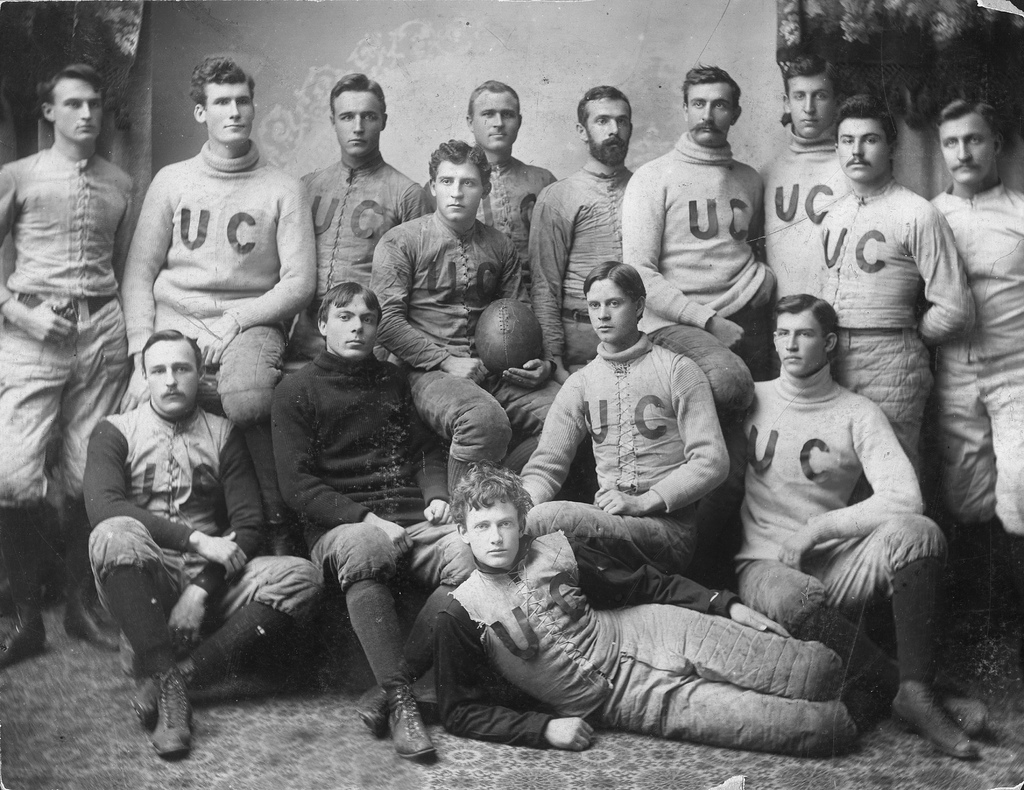
In the first third of the Twentieth Century, however, U of C was admired more for the prowess of its football teams than its academics.  Amos Alonzo Stagg’s Monsters of the Midway ruled the Big Ten from the 1890s into the 1930s. He won more games than any other college football coach until Bear Bryant of Alabama surpassed Stagg’s record of 314 wins in 1982.

Robert Maynard Hutchins became president of the University of Chicago in 1929 at the age of thirty.  Hutchins’s vision for the University was that students should be completely engaged in “the life of the mind”. He was no fan of football or of Stagg.  “When I feel the urge to exercise, I lie down and wait for it to pass.” Hutchins was not an athlete. He wanted out of the Big Ten and to rid the University of football.

The 1939 season provided the leverage Hutchins needed. In 1939 the Maroons suffered defeats by Harvard and Ohio State 61-0 and an 85-0 loss to Michigan.  It was utter humiliation!  Bad enough to be slaughtered by Ohio State and Michigan, but beaten by Harvard 61-0!  Even the most devoted fans recognized that the Monsters of the Midway had devolved into the lab mice of the Midway.

Continue reading

Poetry from Alexis Durante

1) Cracks in a Window

i’ve got bumps and bruises
scratches and scrapes
on most every inch of my skin
i’ve got a heart that cracks a bit
with every smile
because it can only take so much
but the cracks aren’t always so malicious
aren’t always seeking to destroy
the cracks
they’re a window
the tears and rips
let a little light in
when i need it most…

and think of it the least

Continue reading

Madame Mars project founders speak at Oakland’s Chabot Space and Science Center

“The first person to go to Mars is probably alive today.”
Beth Rogozinski, founding member of San Francisco State University’s multimedia studies program and founder of Transmedia SF, a transmedia agency and studio, and Dr. Jan Millsapps, SFSU professor of cinema, made this bold pronouncement during their July 15th enrichment lecture at Chabot.
Both speakers discussed the history of human space travel. So far 537 people have entered outer space, and 57 of these were women. 12 people have walked on the moon, and all of these were men.
However, the design of some upcoming plans for Mars exploration has different goals than those of the Apollo moon missions. The idea will not simply be to visit the planet for the sake of scientific research or for pride in having reached the destination, but to go with long-term colonization in mind. This will necessarily require welcoming a larger and more diverse group of astronauts and mission support crew.
“Men went to the moon, but everyone will be going to Mars,” said Rogozinski.

Elsie Augustave on Dorothy Anne Spruzen’s mystery novel Not One of Us

From Elsie Augustave, author of the Haitian immigrant family saga The Roving Tree, which is available here: http://www.amazon.com/The-Roving-Tree-Elsie-Augustave/dp/1617751650/

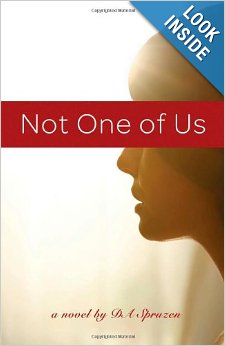
Woman's face in profile, staring into the distance, with the title obscuring her eyes.

Dorothy Spruzen’s Not One of Us

Life will never be the same for the Salton Slaves after one of them has been murdered and another assaulted. The incident marks the beginning of a life changing experience for the socialite ladies. Not One of Us is the story of a community taken into hostage as they try to determine who is the cold-blooded murderer that kills everyone who gets on his way? The novel is also a story of dualities: Salton and New York, middle-class and low-class, loyalty and betrayal, violence and tenderness, all of which is expressed in the first and third person narration. Dorothy Spruzen has written a novel that provides insights into the mind of a murderer whose life is marked by childhood traumas and the need to be a respected person. It is entertaining and examines humanity in an engaged yet detached manner. Not One of Us is available here: http://www.amazon.com/Not-One-Us-D-Spruzen/dp/146102062X/

Synchronized Chaos August 2014: The Persistence of Memory


Greetings, readers, and welcome to August 2014’s issue of Synchronized Chaos Magazine. Even as we look to the future, we sometimes find that our pasts cast long shadows. This month, as in Salvador Dali’s famous painting with the melting clocks, we acknowledge the Persistence of Memory.

Our creative writing pieces reflect the influences of the past, cultural, historical or personal. Felino Soriano’s poetry draws inspiration from jazz music, with words scattered on the page in a style reminiscent of improvisation. Peter Jacob Streitz’ poetry mentions past revolutions and the ghosts of subtle, non-life-threatening miseries. Ed King’s narrator finds himself processing his recent breakup as he attempts to join Shanghai’s youth culture on his vacation. Darlene Campos’ piece evokes the comfort she experienced from her grandmother and the Native American reservation where her relatives lived. Carl Gridley’s elegant pieces mourn the death of people, relationships, books and the written word. And, as James Kowalczyk suggests in his story ‘Another Day, Another Victim,’ even demons with strange appetites have pasts they may wish to record in diaries.

Cristina Deptula’s poem ‘Spontaneous Grace’, an ode to kindness and happy circumstance, is a takeoff on Beatnik writer Jack Kerouac’s concept of Spontaneous Prose. Thomas Smith deals with his protagonists’ memory and grief in one of his short stories, “Jon and Beauty.” Tony Longshanks le Tigre, in his poem “Zen Master in the Cat’s Pajamas,” probes our traditional, cultural, nearly spiritual fascination with cats.

Michelle Bellon’s biotechnology suspense novel Rogue Alliance, reviewed this month by Fran Laniado, presents a romantic adventure between a traumatized, jaded Drug Enforcement Agency detective and a man who has escaped secret government genetic manipulation. Ally Nuttall’s young adult novel Spider Circus, reviewed by Sarah Melton, gives us a young teenage heroine who enters the supernatural adventure while processing rejection from peers and her parents’ divorce. While these works show characters who are both hampered and motivated by their personal pasts, James Nelson’s memoir The Trouble with Gumballs, reviewed by Susan Maciak, humorously details the author and his family’s attempts to succeed in a business representing a quaint slice of America’s supposed carefree past – the gumball machine.

Elizabeth Hughes, in her monthly Book Periscope review column, describes Lynn Snyder’s play collection Blackmail, whose contents, like the dramas of ancient days, deal with universal themes such as official corruption and tragic romance. Uniquely, though, the works are intended as much to be read in book form as to be performed. Oral performance would be more in keeping with the history of drama as an art form, but Snyder is innovating in order to make her work more accessible to more people, as live performances can be expensive. Her fresh satirical humor also makes her work unique.

Hughes also reviews Mary Mackey’s new poetry collection Travelers with No Ticket Home, which explores Mackey’s recent visits to Brazil in a dreamlike, hallucinatory manner. Mackey evokes the natural beauty of the area and the resilience of the favela town residents while acknowledging the real threats to the area from gang violence and the destruction of the rainforests. She honors Brazil’s past without romanticizing the nation.

This month’s nonfiction essays also hark back to days long ago. UC Berkeley’s Dr. Mark Goodwin, in a lecture reviewed by Cristina Deptula, outlines fossil finds within hills east of San Francisco. Ayokunle Adeleye invokes the Hippocratic Oath in a piece supporting a medical providers’ strike within Nigeria, and references the ancient divinity Janus in another essay further developing his critique of his country’s medical system. Ryan Hodge also looks back to life lessons we teach ourselves through old video games in his new column Play/Write.

Ayokunle Adeleye also encourages entrepreneurs to start early to develop a lifelong legacy by investing in land. Olga Mack and Yun Yun Huang’s infographic gives advice to business people through an illustration offering advice on how to negotiate. The concept of this work reflects old-style instructive maxims, such as Benjamin Franklin’s aphorisms and Dale Carnegie’s 1936 book How To Win Friends and Influence People. Not through the infographic’s color or style, which is a modern and friendly shade of pink, but in terms of the upbeat advice given and the concept of being able to achieve success through one’s own efforts.

Neil Ellman’s poetic responses to modern art pieces stand out within this issue because of how they reflect the theme through contrast. We see what happens when objects and sensations exist on their own, examined in themselves without context. In a somewhat similar vein, Thomas Smith, in his short story “15 Minutes” explores how reality television and instant celebrity status conferred upon random people renders social interactions false by depriving them of their natural context. Within the culture of reality shows and competitions, people are encouraged to aspire to get suddenly ‘discovered’ rather than to build up a career and legacy gradually over time. Then, once discovered, as with Thomas Smith’s protagonist, they find themselves acting in a certain way because people want to see a certain type of character or plot twist rather than having the interaction arise naturally out of their relationships.

In his short piece “Zuckerface,” Peter Jacob Streitz offers further wry reflections on social media and pop culture. In another piece, “What’s So Funny,” he points out that death and suffering are specific, graphic realities, not just parts of jokes or stereotypes, and perhaps, in his words, ‘not all that funny after all.’

Llyn Clague’s new poetry collection, The I in India and Us, as reviewed by Christopher Bernard, illuminates both the ugly poverty and creative beauty of India, as Mary Mackey does for the parts of Brazil she has visited. Also, Clague suggests that not every idea or value we hold has to be completely personal and subjective. Maybe we can adopt some of the ethos of the older days, when, some people, even if they were wrong, were less afraid to have a mission, to decide to be something specific, to say and mean something.

This month’s issue and contributors attempt to become and say something, while reaching into their personal and our collective pasts for inspiration. We invite you to join them in reflecting on how who we were has made us into who we are.
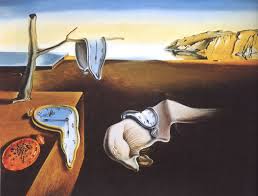
Salvador Dali's dreamscape, with the analog clocks melting over a desert landscape

Salvador Dali’s The Persistence of Memory

 

Short story from James Kowalczyk


Another Year, Another Victim

Next Stop: Hell

January 1st, 2013

To be god is everything. It has been three months, two weeks, one day, and four hours. And the rain continues to weather my powers. Our head hurts. Dull and rusty, it is the same razor I’ve been carving myself with for days. The pain; however, fails to escape. The second body was found yesterday. The television said it was difficult to identify. It must be protoplasm in black goo by now. He was as a stick, when it meets vertically with mud, stuck feet first in the flats off Skagg Island next to the freeway. I had wrapped him tightly. I am getting better. I will remove the teeth before I plant the next one. For now, I will sleep. There is much work to do in the morning.

February 29th, 2013

The messenger to told me-never disobey a direct order. Once instructed, to its fruition the task must be carried out. Which can be low-hanging like an individual’s head when in the neutral position? The division of unity or the upright circle from which hangs a profound ignorance is a fact.

March 20th, 2013

Competent imbecilic behavior makes me an efficient drone. Unlike the other worker bees, all five of my eyes are functional. My boss is impressed with my fabricated ignorance but he must be eliminated. His murmuring has reached perfect pitch. He is talking about me, again. I am the alpha and the omega. At lunch I will eat his heart. And his soul will descend by the day’s end.

April 31st, 2013

It is known that unless the bidding begins at three, the result will be disappointing at best. Rather than jump, the grasshopper slithers like the rainbow slipping behind the mountain so as to never be noticed when the hunger is forced. Living with the sheer is never easy.

May 27th, 2013

At the barbeque, the meat was tender. I have perfected my technique with muscles and tendons. Brother was foolish to upset me. His teeth were difficult to extract. My envoy to the bliss abyss has arrived. Soon the little death will embrace me.

 September 31st

As the moons glows beneath the heaven that will hold us, it glows over a Nebraska plain while the California Zephyr delights in itself. Westerly influences speak to long- term change within and the aftermath mixes with excess and blood.


Christopher Bernard reviews Llyn Clague’s new poetry collection ‘The I in India and US’

The Will to Live: Little Antidotes to Despair


Photo of a middle aged white man with glasses sitting in a wooden chair out on a grassy lawn

Llyn Clague

The I in India and US

Poems by Llyn Clague

90 pages, $15.00

Pure Heart Press


A review by Christopher Bernard

Llyn Clague’s new book of poems is a charmer. It does what poetry, long expected to do, seems these days to do less and less: it tries to build a bridge – tenuous, delicate, easily breakable as it must be – between the individual and society at large, between the reader and the world.

…. Why

when it is so widely dismissed

as “all about me” – why poetry

about India?

… can poetry –

more allusive than analytic

daemonic than descriptive –

in flashes of India reveal landscapes

inside you?

Subjectivism has long been the presiding curse of modern poetry, to say nothing of modern culture, which has turned self-centeredness from the acme of sin into society’s prime motivator.

The philosophical roots of subjectivism go back to the idealism of modern thought, beginning with Descartes but finding its strongest support in Kant, who convinced many thinkers up to our time that “reality” is not directly accessible to us, that the only access we have is to the thoughts in our minds – although today even the word “mind” is suspect, and only “the brain” is scientifically correct, although even the doughtiest neuroscientist has yet to locate a thought in the brain.

Continue reading