Mind Your Own Business: Ayokunle Adeleye’s entrepreneurship column


The POTENTIAL V: Assets, Liabilities

Potential is life; and life is potential; since potential is the
ability to be and to do. Life is itself a collection of cells, after
all, the cell is the basic structural and functional unit of life. A
cell is that device that converts (inherent) chemical energy into
electric charge – even the biological cell generates charges:
phosphates, in ATP and DNA, for example.

The fuel cell, like solar energy from the Sun, itself a mega cell, is
the future – at least for transportation. Therefore the cell, like
each of us, has potential: The potential of a cell, a battery, is a
measure of the (electromotive) force acting across its terminals; it
is the force experienced by a unit charge as it moves from one pole to
the other.

The cell, like everything else with potential, has assets, raw
materials, and liabilities, wastes. For non-rechargeable cells, the
waste clogs the system, hinders the reactions, stops power generation,
stops productivity- and usefulness; now you know why your wall clock
or torch battery leaks water in the long run. For rechargeable cells,
passing current in the reverse direction undoes the hindrance of
productivity by forcing precipitates back into solution, liabilities
back into assets.

At this juncture, I consider it rather repetitive to again say every
business has potential, and rather instructive that I say that, like
every cell, each business has assets and liabilities, and that
businesses run down when liabilities clog the system, when the point
of rechargeability is crossed. And rather than agitate words and prove
theorems like I did in The Profit PERCENT, I shall simply share a
common scenario and hope you sift the grain from the chaff:

Mr. A started a business and in a short while, he hit the jackpot. What
should he do with the proceeds? Most people would agree that that
money ought to be spent; the dichotomy is invariably in how! (Yes, a
few people would advocate saving and seeing how the business next
fared.)

Of those in support of spending, some would suggest he pay himself for
his time and effort and sacrifice, that he share his good fortune with
family and friends, that he spread the wealth, that he buy an
automobile to feel among…, maybe even marry (another) wife, or build
(another) house.

Some would suggest that he reinvest the money, that he put it back
into the business.

I would not suggest any of the aforementioned options, however, and this is why:

Common sense suggests that Mr. A not spend the money needlessly. Need I
say more? What happens if the market crashes? What happens to having a
little savings, a little backup? As Jesus said, a wise man builds on
a rock in anticipation of the storm; a wise man keeps money in fishes’
mouths.

In modern times, markets are ever dynamic, a factor that continues to
produce Recession after Recession. That the market is profitable today
does not speak for tomorrow: anything can happen; the future is not
written in stone.

If Mr. A invests his profit in his business, he will increase his
stock, but not likely his carrying capacity. This of course will
affect his business. Cramming goods affects presentation, appeal,
marketability, as well as shelf life and durability.

But whether or not that happens, this is sure to: More people will
flock into Mr. A’s business. (Who doesn’t like a profitable business?)
Consequently there will be a glut: supply increases, prices fall, and
profits crash, just when Mr. A has increased stock! Lóbátán!

Hence, there is no doubt that Mr. A must keep his money. But how? In
hand, in banks, or in something else?

As a bird in hand is worth more than two in the bush, is cash in hand
worth more than bonds and cheques, bank drafts and promissory notes,
in emergency and especially in robbery? (The latter case however may
be one reason to be cashless.) On the other hand, while cash in banks
is safe, it does not appreciate as such, and can easily be trapped.
Ever queued at a bank or an ATM point?

In essence, Mr. A should keep his profits in a venture that is secure,
that appreciates over time, that can be easily converted into cash or
used as collateral. And that, more importantly, can be useful to him
(and his business) in the future.

A car is what everyone thinks of first. The first “asset” Father had
was a car, for which he paid dearly in envy and rents – and, of
course, cars depreciate. (And just before you laugh, please be
reminded that he remains the best businessman I know.) He subsequently
kept me off his cars, the best thing he did for me besides education.
(Now you may laugh: at moi.) The rest is history, story for another
day… Maybe in the next article in this series, The POTENTIAL VI: The
Way You Eat Your Mango.

That said, the only venture that comes to mind is LAND. And that to me
is the ultimate asset…

Yes, that business can yet be salvaged if you will treat it as a
rechargeable battery, pass life into it and see it revive: Break
forth, stay within limits, mind your own business, and stay true to
purpose. If you will build assets and part with liabilities, and see
your business thrive.

Catch my drift?… Assets; not liabilities, not luxuries, not cars.
And you may even buy for two; you and me nooni, I need it just as much
as you do.

Why land? It secures the future. It makes for a good collateral. It
appreciates over time. It is not commonplace, not replaceable, not
destructible. It is the future.

Of course, there are rules pertaining to where and how – and where NOT
– perhaps in a future article (if) prompted by popular demand.
However, suffice it to say at this time that one must get his
documentations right, and NEVER forget to hire a good lawyer – his
commission will never kill, it merely makes you stronger.

For legal aid, contact me; I happen to know just the lawyer for you.

#Youths, Save Nigeria. Start businesses. Acquire assets (and no forget
me o). It’s our turn!

Ayokunle Adeleye.
Sagamu.
Synchronized Chaos July 2014: Dancing with Circumstance


Welcome, readers, to July’s issue of Synchronized Chaos International Magazine. This month we find ourselves asked to dance.

We begin with the gentle invitation of Michele Johnston, whose poetic speaker imagines joining in with the scenes unfolding outside her window.

As we begin to move with the push and pull of life, we often first observe what’s happening. This process doesn’t have to be passive, and can involve great concentration. A speaker in Jim Davis’ first set of poems cleans and denudes his mental environment to have space to listen to the world around him, and later finds himself asserting his existence through quiet thought. Other poetic work, from Jim Davis and Tony Longshanks le Tigre, involves small intellectual vignettes where the writers have noticed and meditated upon aspects of our existence.

Seeing and considering what is actually going on in front of us is important. Virginie Colline, in her short poem, suggests the danger of getting so caught up in one’s imagination that one does not pay attention to reality. Memorialized in her poetic subject’s tattoo, Ophelia and Hamlet both met tragic ends. Sometimes we need to follow whatever music is playing in our lives, even if we would prefer a different tune.

Thoughtful observation, although a crucial first step to understanding life, is often not enough to forestall chaos and brutality. In a dramatic sketch, Christopher Bernard laments that even the intellectual and philosophical achievements of Europe, the heights of their creative imaginations, could not prevent them from descending into the depths of World War I.

Sometimes we just react, struggling to keep up with life’s steps and movement. Christian Sorensen’s poetry includes a speaker who responds in staccato bursts to the world’s imperfections, from air raids to his lost keys. Hannah White’s speaker stumbles over a whole list of thoughts, wondering how to connect to herself and others in a healthy way without arrogance. 

As we become more confident, we begin to respond more actively, at times taking the lead. Evan Almon’s protagonist in “Life after Bungee” leaps out to overcome his fears. Ayokunle Adeleye urges his fellow Nigerian entrepreneurs to cling to their principles rather than abandoning ethics in the pursuit of cash, and his fellow young compatriots to work hard, study and live within their means. Elizabeth Hughes’ Book Periscope column presents a mixture of action and thriller novels and memoirs written as suspense narratives. Her column suggests that we can become heroines and protagonists in the daily dramas of our lives, make something out of even the challenging experiences.

Sometimes we can even anticipate life’s larger twists and turns. As Oakland astronomer Gerard McKeegan’s recent lecture, reviewed by Cristina Deptula, demonstrates, we are starting to be able to find and deflect asteroids headed for our planet. Through diligent research and its application, researchers hope we may delay the end of life as we know it.

Societies, as well as individuals, can choose steps that protect and affirm their members and allow everyone to move forward towards positive goals. As Mary Mackey discusses in her interview with our staff concerning her new poetry collection Travelers with No Ticket Home, Brazil is a beautiful country facing significant challenges, but where the standard of living has steadily improved in recent years. Linda Baron-Katz’ memoir Surviving Mental Illness: My Story, reviewed by Holly Sisson, reflects the moral and psychological support she at last received from her traditional Jewish faith and community as she obtained a diagnosis and treatment. Joe Klingler, in an interview with our staff, brings home the point that the technologies he describes in his suspense novels RATS and Mash Up can be developed for war and destruction or the betterment of civilization. Our music sharing, smartphones and computers can separate or connect us, depending on how we choose to use them.

Life, at times, takes us on unexpected backflips. Poet and novelist Mary Mackey describes finding a vampire bat in her sleeping bag on a Central American camping trip. There are also more painful steps backward, such as the loss of love related by Kamila Bogedal’s poetic speakers. She captures the self-loathing and nausea of rejection along with the grief and loneliness.

There is danger in stasis, in standing still and flat footed, even during the most unpleasant movements of life’s dance. An element of the suffering in several pieces comes from the dreary sameness of difficult situations, from being stuck for one reason or another. Hannah White’s pieces depict the weariness of chronic illness, showing the repetitive cycle of feelings and hospitalizations of a patient with an eating disorder. Evan Almon’s short story “The Sound of Loathing” comes from the point of view of a young child hearing his parents’ continual, unresolved arguments. Powerless in that situation, he reflects the harshness of the situation by painfully biting his nails. In another Almon piece, “The Gauntlet,” the protagonist gets humiliated and injured in a fraternity initiation that goes too far. Although he is old and strong enough to leave, he stays, out of determination not to feel or look weak to the group.

Finding ways to follow the dance, wherever it leads, can help us to stay on our feet. In Christian Sorensen’s final poem, “My Imperfect Car” he affirms his acceptance and even affection for his old and somewhat broken vehicle.  In Elsie Augustave’s novel The Roving Tree, reviewed by Leah Dearborn, the lead character Iris follows her heart and travels to Zaire, where she is able to learn more about her heritage. Although her experience there is complex and not totally positive, she makes strides towards creating a life that makes sense for her.

We hope that these submissions will inspire you to leave your seat and join the dance! Whether you are experiencing a ballet, a tango, a foxtrot, a square dance, a jive or a rumba, you have steps and turns to add to the scene.

** Announcement: Thursday July 10th will be our next reception event, from 6-9 pm at Berkeley Espresso (corner of Haste and Shattuck, near BART). Feel free to come and chat with other creative types, bring work to share or books to sell, or just bring yourself. RSVP encouraged but not required. Here’s the invite page: https://www.facebook.com/events/578554668926919/

Poetry from Michele Johnston


To One Looking out of a Bay Window

The flower of the sunset caresses your cheek with its orange-rose hand,

the velvet of its fine nap kissing the same on your skin;

to utter that I wish to follow is too much, too much;

and so with a lover’s heart crouched behind the eyes of a friend,

I’ll gaze without jealousy

as you reach for the warmth of her slender fingers beneath the steadily falling curtain of autumnal dusk.


Ambitious

I am a silly courtesan. I am a flower dried of her perfumed strength, a dog sitting patiently at the door in the rain,

sighing without imposition. I will become unseen; I will wait on a chain of my own choosing; on the floor speckled in

stunning shattered glass, a parched paint-stroke blooming to be overlooked. A rose in your lapel—is this the beauty

that trains the cogs of your ambition? Dried petals beneath your feet, and no sweetness scattered through pellucid

shards; don’t pause when I snatch up sunbeams in my hands—leave, brush your palms clean, tread past the door and

keep walking—it is merely a trick of the moon.

Dramatic scene from Christopher Bernard

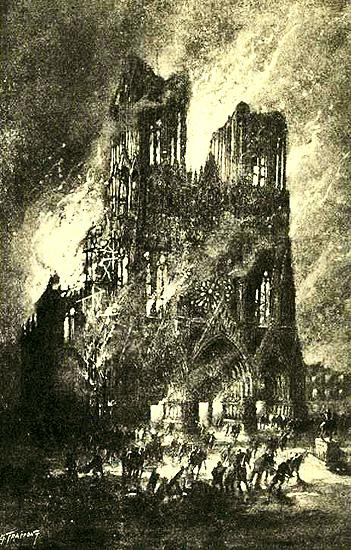
Rheims Cathedral on fire, black and white artistic image

Rheims Cathedral Burning

Rheims Cathedral, burning during the early days of World War I (G. Fraipont, 1915)


The Beast and Mr. James (an excerpt)

A play about Henry James and World War I, by Christopher Bernard


Act 2: 1914


London. Evening. A lobby in Covent Garden with stairs sweeping upward in the background; “Libiamo” from Verdi’s La Traviata is playing in the background.

HENRY JAMES is anxiously pacing the lobby, occasionally chewing a thumbnail. His hat and cane lie on a nearby lobby bench. He is dressed, with subdued elegance, for the opera – dark suit, light vest, elegant cravat, patent leather shoes, etc.

The music fades a little; a box door has closed.

HENRY JAMES (to himself): What did dear, kind Edith call me? A nervous nelly, with the imagination of disaster. Oh fie! I’m as nervous as a young cat. The worst can’t possibly be upon us – not now. They must settle something between them. They can’t be so mad as not to. They must see the stakes. Our countries are no longer run by lunatics and the brain-dead spawn of in-bred families. Common sense must have come to count for something in this bloody epoch.

USHER enters.

USHER (with a deeply reproving look; very loudly): Please, sir, be quiet so that the members of the audience can enjoy the music! Thank you, sir!

He leaves with a departing scowl at HENRY JAMES, who glares after him.

BURGESS, JAMES’s valet, dressed in outdoor ware, enters, carrying a newspaper.

HENRY JAMES (with a flushed hope, takes the paper; in a loud whisper): Thank you, Burgess, forgive me for driving you out in the middle of the night, but I just could not … (At sight of the front page, he lets out a cry, almost a shout.) No! … The Kaiser, that … no, no! …

He reads the column with moments when he pauses and stares over the top of the paper in despair, as the music continues in the background.

HENRY JAMES (with no attempt to be quiet): He’s mad! They are all mad!

He then takes his hat and cane and leaves hurriedly, with a gesture to BURGESS to follow, as the USHER re-enters, looking like thunder at them as they depart. “Libiamo” swells to a climax and ends, with wild applause.

Continue reading

Poetry from Jim Davis


Horseback Riding in the Jungle


In the incandescent madness of an organic grocer

a figure shadows over the threshold.

Cloister of red kuri squash in penitent rows.

Pine nuts & brown rice. Swiss chard & white

fish under halos of fluorescent palm trees, bamboo

baskets, sesame crickets. He rubs himself

clean of three days beard & the sincere hope

that he’ll be doing something better

come winter. The next round of Jeopardy is Fun

& Games & 3 Is seem too many. You’ll have to buy

a shrimp tempura taco, spin instead of guessing

consonants in the arid wake of vowels,

couples episode – she claps & spins & hands

her cerulean section labeled Vera Beach & under

her breath she thinks the reason we weren’t good

is three parts sympathy, one piece I wouldn’t eat

well in front of her, unless I was drunk & crushing tacos.

The guy at the sushi counter’s a dead-ringer

for the bald boyfriend of that girl who’s friends with

the thick blonde in Divas, a reality show I’ve seen

more than once & I’m sorry. I want to go.

I’m sorry to have this wayward moustache, limp

like I’m just bucked from an Andean pack horse. Raw

from peeling off the shoes I wouldn’t wear to save

a crocus from a blade for my lapel. Now’s the time to say

I’ve never been to the private institution on the hill.

But there’s a cot & a cup of soup there waiting. White

apron spotted with soy sauce. I’ll sell my leather belt.

Else find me purple, moon-eyed in the morning,

swallowed by the incandescent madness of the jungle.


Giraffe on fire, go to sleep, we’ve happenstance in the morning.


Jim Davis

  Continue reading

Short story from Mary Mackey

Vampire Bats Make Strange Bedfellows

The moment I woke up, I could hear the bat crawling toward my cot, dragging itself across the wooden floor of the tropical field station with a low hiss and an occasional squeak. That’s how I knew it was a vampire bat. Unlike other bats who fly at your face like teenagers on motorcycles playing chicken, vampires like to use their wings like paddles so they can sneak up on you, nip you on a bare toe or exposed shoulder, inject an anesthetic under your skin, and then bite down and do what vampires in horror films do: drink your blood. Unfortunately, unlike Dracula, vampire bats can be rabid, and getting medical attention if this one bit me would mean flying out of the Costa Rican jungle on a small plane held together with bailing wire and duct tape if I were lucky enough to be able to contact San Jose on the shortwave radio which never worked when you needed it to.

Continue reading

Short story from Evan Almon

THE SOUND OF LOATHING

Evan Almon

Curling his fingers into his palm in a limp fist, the son examined his fingernails.

The son had a bad habit of cutting his nails a bit too short so they were pink and sensitive; he fell into this habit because his father did the same. A real manifestation of hereditary OCD if ever there was one.

His fingernails had grown out an off-white opaque about the length of the bend in a staple. He would know, for at his age, he thought it brilliant to use a staple to just try and dig out the dirty brownish-bluish streaks which were probably ink and the other crud of life all wedged underneath, like dust bunnies in their dens. Time to trim. Things grow, and you cut them down to a suitable size, so it goes.

Continue reading