Poetry from Carl James Gridley


IN MEMORIAM

after Verlaine


This evening, I do not like the way the sun sets in gray ash on the horizon, or how the twilight leaves such a bitter taste, like tears mingled with a shiver. I do not like the smell of roses picked to be braided into crowns or gathered into garlands, nor the lingering scent of a violet born in the shadow of cypresses. Tomorrow on the green hill, there will be a new grave with a new name because death blew on a budding flower and a tempest broke a sapling. If your weight is light to those whose age has overwhelmed too many days and nights, I find you quite heavy, O inexorable earth, when you weigh thus.


A WHOLE BASKET FULL OF DEAD SNAKES


The Mistake won’t stop blogging about me, I say.

No one reads blogs, The Dark Lady says, adding,

No one reads poetry either. Why should you care?

I ignore the dig because she has a point,

But then again, so do I.

Why can’t she be more like you? I say.

Jesus. I wish we could just get divorced twice,

The Mistake can’t even get being an ex-wife

Right. Charming, The Dark Lady says.

Exactly, I say, though technically I’m not

Agreeing with her, charming in much the same way

That Marburg virus is charming.

Whatever, The Dark Lady says.

No, seriously, I say, forgetting about The Mistake,

Marburg is an awesome thing,

And now, since there’s no stopping me,

The Dark Lady takes a deep pull and snorts

Menthol smoke like a bored, middle-aged dragon

With giant fake breasts.

It’s a zoonotic filovirus related to Ebola,

Possibly vectored through Egyptian fruit bats—

These are cute little cat/rat/bird beasties,

I say, that work hard to pollinate the ageless Baobab,

Whose fruit wanders the continents of flavor

From vanilla to pear to grapefruit.

At this point, I give her the jazz hands,

And she takes another drag in resignation.

It’s a hemorrhagic fever that makes you vomit

And cry blood until all of your organs fail

And you die. The Soviets even tried to turn it

Into a weapon, but they didn’t do so well

And some dude croaked in the process.

Charming, The Dark Lady says. And I know

Exactly what she means.


LIBRARY


This forgotten bookshelf indicts the heads

Of failed lovers: how dare they give way when

So much consolation, so much inspired

Sweetness insists in stronger dependencies?

How these volumes ache with every unturned

Emptiness—just the stack behind the bed

Is full of mysteries, strange and burned

Letters sink into silence, dried and dead.

De-collated edges and flyspecks,

Mountains of words wilt from one century

To the next: beautiful faces, a vortex

Of sweet pilgrimages to some grassy

Tomb. Unfamiliarity is a gate

That keeps all would-be lovers from their fate.

Essay from Ayokunle Adeleye

CONSULTANT, My FOOT!

Everyone wants to be a doctor, yet not everyone wants to be a
“medicine man”. Every parent wants to have a doctor as a child, to be
called Mama Doctor, Papa Doctor; even if such child is actually a(n
unlicensed) patent medicine dispenser. Yes, ours is a society of
vanities, so that even the dumb politician pays (for his credentials)
to be doctored– not nursed. And now that “doctor” has become a dime a
dozen, they have set eyes on Consultant.

It all started many years ago when other health students were taught
that Medical Students were no better than them, that they had all it
took to compete with us and displace us, that the ELEMENTARY human
anatomy, physiology, pharmacology, pathology, paediatrics, obstetrics
and/or gynaecology that Medical Doctors taught their forebears to
upgrade them from Diploma holders to BSc carriers are enough armament
to fight us. So much for gratitude!

They were told that they are the generational ones, as against the
previous, orthodox, ones. They were told to give us hell. And why
shouldn’t they? After all, knowledge puffeth up– as does ignorance.
They were told they could be us. Yet, if we were no better, why then
be us?

The reason is obvious. It is half-knowledge. And it is all they
possess. It is half, not because it did not spend so long in school,
which it didn’t; or because it did not have a curriculum half as
comprehensive, which, again, it didn’t. It is half because it cannot
cure the patient; because it needs the Doctor (for it) to function
optimally; because it is, as my pharmacy wife put it, la cram, la
pour. And as the Yoruba observe,

Wúrúkú làá yírìnká
Gbọ̀ọ̀rọ̀-gbọọrọ làá dọ̀bálẹ̀
Kúná-kúná làá fọ́’jú
Kùùnà-kuuna làá d’étẹ̀
Ojú àfọ́-ìfọ́tán
Ìjà níí dááálẹ̀

And as with everything indoctrination, it was swallowed hook, line and
sinker by every Tom, Dick and Harry– and still is. The first symptom
was the protracted arguments with any medical student they could find,
ranting about how we know the same things, GENERATIONAL (emphasis
theirs) nurses that they (now) are; BSc nursing students more so than
School of Nursing folk… The first sign was conducting their own ward
rounds. And finally the chameleon has shown us its colour:
Consultancy.

I have not bothered to read the numerous (read: innumerable) reasons
they must have given. I am a Nigerian; I know how manifestos are
written for and crammed by– la cram, la pour–; I know that the leaf
dancing atop the river dances to tunes from beneath the waters. They
feel that spending a lifetime with myriads of doctors makes them at
least as good as one. Yet, spending a lifetime in court does not make
one a Judge; for the robes do not make the Pope, neither does the hat.
Or does it now? now that we have GENERATIONAL blah-blah-blah– emphasis
mine.

And again, if we are no better, why do male nurses so want to be us?
Could it be because they feel so out of place in an overwhelmingly
feminine profession that injures their ego, that will not even allow
them be midwives, or is it midhusbands? Could it be that the title
Consultant will soothe such injured ego hitherto (barely) bandaged by
CNO-ship? No, it is not personal– yet.

He who comes to Equity must come with clean hands, and not protect
their own interests, their own traditions, while they fight others’
status quo: Nurses, for example, hold onto their tradition that
midwifery is the exclusive domain of females; how then can they
protest our tradition that Consultancy is the exclusive reserve of
Doctors? Shall we talk about pharmacists, technologists, and whoever
else waka come?

Personally, I do not mind having C. Nurses, Pharmacists,
Technologists, or whoever else waka come. Already, na the whole world
sabi say no be only Doctors waka come. Plus, eventually there will be
only one Consultant, and that will be the one that always was: us. Yet
have I found myself wondering if they just have hidden agenda, if
coveting our Consultancy a step toward much more sinister objectives!

So that I fear for the consequences of this theft. I fear for our
society. I fear for posterity. For our society is one where every
chemist shop is a hospital, where “doctors” are seen, injections given
and abortions done; where everyone working in a hospital is a Doctor,
even a brown-uniformed orderly (that instructed one patient to X-ray
his infant’s testicles; and another, his wife’s pregnancy; yes, I said
X-RAY, not ultrasound); where a Nurse forgets a tight tourniquet on a
neonate for so long that she nearly ruins his arm; where Pharm D is
misconstrued to be a means of turning pharmacy students into Medical
Doctors as against PhD-holding pharmacists. Alas, everyone wants to be
a Medical Doctor, even when they say we are no better!…

No, this is not to say Doctors are perfect; we are only a lot safer. I
for one have been in Medical School for 9 years and I’m finally in
final year! Na beans? All so I can be a lot safer; abegi just leave
ASUU out of it. If I had read Nursing for instance, even at BSc level,
I would be a lot more than I am: I would have been in the Civil
Service for some four years, I should be a Professor by now! Yet am I
still here saying Yes, Ma to even nurses I am older than and way
better than, saying Sorry, Ma to nurses that were in SS-what when I
was already in Med School. Abegi, no provoke me o!

Sentiments aside, If our purpose of working in the Health Sector is
the wellbeing of the patient, how does the (overbloated ego of the)
C. Nurse/Pharmacist/Technologist help the mission, other than creating
the proverbial two-captains-in-a-ship?– and we all know how that ends.

And it is in this spirit that I salute the ongoing NMA strike action.
It is not at all sentimental; it is not to show the superiority
complex that Doctors are said to have; it is not to display that
we are gods on earth
that they say we are
bearing in hands the powers of life and death
that we actually do bear;
it is to verify what the others have said.

They have said that Doctors are no big deal. They have said they can
do our work. They have even said they are more important. Well, this
is Nigeria: all talk and no walk. Or can they walk the talk? Can they
admit patients? Can they manage patients on their own, or even
together sef? Can they discharge patients? Whatever happened to
‘Nurses own the wards but Doctors own the patients’?

Yet that will not be all: They have eyes on the position of Chief
Medical Director. Being Permanent Secretaries of Ministries of Health
is not enough, they want to run hospitals and own them. So they can
kill unsuspecting masses– like they already do in the chemist shops
cum abortion centres some of them run, even orderlies?

Yet this is past nipping in the bud: they have become an undying
hydra-headed monster; cutting off a head, an ambition, only brings two
in its place!

Oh, where are the eyes of Medusa?

Ayokunle Ayk Fowosire.
Sagamu.

And peradventure my position is yet ambiguous, nurses own the wards,
techs own the labs and Doctors own the patients. Which is the
greatest?: wards, labs or patients?; which would YOU rather be?

Abegi, anyone that wants to be a Consultant (and particularly Chief
Medical Director) should enroll in a Medical School o jare; JAMB is yet
conducting UTME. And when you don’t make that annoyingly high score,
don’t quit, don’t go to School of Nursing or School of Health, keep
writing JAMB every year. Trust me; you will get in– eventually…

And by the time you have finally wriggled out of Med School and
Residency having failed many an exam, you will have understood why
many a parent screams Praise the Lord at Inductions into the medical
profession, and why Chief Medical Director remains the exclusive
reserve of Doctors.

And only then can you truly be a Consultant– without My FOOT!

Poetry from Darlene Campos

A Small Journey
Darlene P. Campos

Grandma took me to a place I did not know.

Like the rez, it was cold and in the middle of nowhere.

She showed me her new home and baked me bread the way she used to.

Grandma left me when I was 15 and gave me the key to her house.

Take me out, she said, before I rot.

She asked if I missed her or if I missed her bread instead.

I said I missed her even though she hated my father.

And always told me I was just like him.

Grandma led me to the exit.

Like the rez, it was warm and welcoming.

I asked why I had to leave so early and she told me,

You’re not ready yet,

But I will see you soon.


Poetry from Felino Soriano

 burn this etch of modal memory

interior to what examines a self

of momentary

            rhythm

—of sound thus

tongue

exposes

triangular scriptures of

                             this          /          there

                                            /

                                         now

& with abbreviated timelines

my escape & wholly wrapped

knowledge cannot fulcrum

simultaneous to

a paradigm of parallels

plurals

              pulses—

& my legs are no more

more so

nouns

than the description

of my name

in the mislabeled

culture

                    attached

to

its

freeing

                              exhibitions, —


harp & halo

across          from          where          the          harp

expands its

                                                        circulating

shape, & like its

elongated purpose

pulls

                                 with vibratory hands

a

charisma         unusual to                 its calm

                                          mist of

                       Sunday

              penetration


Felino A. Soriano is a member of The Southern Collective Experience.  He is the founding editor of the online endeavors Counterexample Poetics and Of/with; in addition, he is a contributing editor for the online journal, Sugar Mule.   His writing finds foundation in created coöccurrences, predicated on his strong connection to various idioms of jazz music.  His poetry has been nominated for the Pushcart Prize and Best of the Net Anthology, and appears in various online and print publications, with recent poetry collections including Mathematics (Nostrovia! Poetry, 2014), Espials (Fowlpox Press, 2014), and watching what invents perception (WISH Publications, 2013).  He lives in California with his wife and family and is a director of supported living and independent living programs providing supports to adults with developmental disabilities. Links to his published and forthcoming poems, books, interviews, images, etc. can be found at www.felinoasoriano.info.

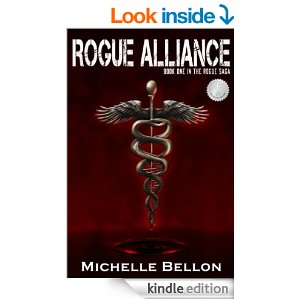
Fran Laniado on Michelle Bellon’s Rogue Alliance


Michelle Bellon's Rogue Alliance cover

 The first thing to give author Michelle Bellon credit for, is knowing how to grab her reader’s attention right away. Her novel, Rogue Alliance, opens in a facility known only as “The Institute”. There, a man is imprisoned. He cannot remember his name, how he got there, or who he was before. He’s named himself Brennan Miles. At the Institute, he is subjected to torturous experiments at the hands of Dr. Shinto (I guess the name Frankenstein was already taken), who has altered his genes to make him a sort of human-vampire hybrid. He’s stronger and faster than any human, but dependent on blood for survival. This blood is given to him via infusions which are periodically withheld to see how he responds. Why would Dr. Shinto do this? As the doctor explains to his guest, Victor Champlain, he did it because he could.

Victor Champlain runs a major drug operation and has hired Dr. Shinto to develop a new street drug. He also has a lot of enemies and is in the market for a good bodyguard. When he sees Dr. Shinto’s project, he thinks Brennan might fit the bill. So he helps Brennan escape the Institute, and in doing so earns Brennan’s loyalty.

Elsewhere, DEA Agent Shyla Ericson has just gotten a promotion. She’s heading up a team of local cops trying to gain enough evidence against Victor Champlain to put him away for good. She’s thrilled- until she learns that Victor has recently relocated to the idyllic Northern California town of Redding. While the small town intimacy, beautiful scenery and slow pace might be lovely for some, for Shyla it’s a place of nightmares. It’s where she spent her hellish childhood and adolescence, where she became both a victim and a pariah in the eyes of the locals, and where she left as soon as she could. Needless to say she’s not happy to be going back even if it is technically a promotion.

As an adult, Shyla has a drinking problem and an inability to allow anyone to get close to her. That can make her hard to work with, but she gets her job done. When the job calls for her to go undercover and be Victor’s new girlfriend, that’s just what she does, hoping to learn as much as possible about his operation. Brennan is ever present and he and Shyla soon become attracted to one another. She is the first person who makes Brennan question his loyalty to Victor.

However, things begin to get troublesome in the last third of the book, when Shyla’s cover is blown, Brennan chooses to protect her in spite of his loyalty to Victor. At this point their relationship takes on some uncomfortable dynamics. For example, while trying to deal with a hitman Brennan hits Shyla, when she gets in the way. The blow was for the purpose of keeping her away for her own safety when she was being reckless, but it still doesn’t quite sit well. It becomes potentially more problematic as the two characters spend more time together and such incidents pile up. The relationship starts to take on some sadomasochistic dynamic. In spite of this, it is usually portrayed as romantic (Brennan does this to protect Shyla) and we’re told that this is a good, healthy relationship for both characters. The author makes it very clear to the reader that Shyla and Brennan are in love and meant to be together. However, some readers might be find this relationship troubling.

These problems are frustrating, because Rogue Alliance is a good story and had the potential to be a much better book. It’s very easy to get caught up in Brennan’s mysterious past and his current condition; which has roots in sci-fi (genetic manipulation) and fantasy (vampires, sort of!) but is made to feel quite plausible. Shyla’s attempts to take down Victor and his operation are also a suspenseful narrative. Few readers will have much problem with the Brennan/Shyla romance either, until it takes on some potentially uncomfortable dynamics. If a reader can get past that, there is a lot to enjoy.

The book ends with several plot lines unresolved, but since Michelle Bellon writes at the beginning of the novel that this is intended as book one in the “Rogue Saga” there’s every reason to expect that these points will eventually be resolved in later installments. 

Elizabeth Hughes’ Book Periscope

Cover of Lynn Snyder's book Blackmail

Lynn Snyder’s Blackmail and Other Stage Plays

Blackmail and Other Stage Plays is a compilation of seven plays that would be perfect for small town and city theaters. Each one is written with clear, concise and captivating dialogue and they all capture the interest of the readers. I hope to see them produced and acted out on stage some day. I highly recommend this book and rate it 5 out of 5 stars and 2 thumbs up.

Mary Mackey's Travelers with No Ticket Home

Travelers With No Ticket Home: Poems by Mary Mackey

Travelers With No Ticket Home is a collection of deep and beautiful poetry. The poems flow from page to page. Some of my favorites are the “Kama Sutra of Kindness” poems beginning on page 64, “To My Mother On Her Second Non-Birthday” on page 59, “Under a Yellow Porch Light” on page 57, “Dreaming of the Dead We Have Loved” on page 56. This book is must-have for all poetry lovers. If you aren’t into poetry, give this book a try, it will make a poetry lover out of you. I highly recommend this book and give it 5 out of 5 starts and 2 thumbs up.

Short story from Ed King

Shanghai

I went to China partly to try and get away from everything and find time to write, but when I got there I found I was so lonely that I couldn’t. I stopped going to class and spent my days wandering the streets of Chengdu, looking for something interesting—coffee shops, pool halls, temples. Not writing a word, hostile to everyone I met.

In April, I signed up to go on a school trip to tour Hangzhou and Suzhou, two reputedly beautiful cities in the east of China.

I was nineteen and in love for the first time, really, with a girl I left back in Colorado, Anne. Before I left, I sent her an email telling her everything I felt. On the train to Suzhou, after everyone in our group was asleep, I spent a long time with a flashlight, trying to write love letters to her and crumpling them up.

On the trip, I was invited by two Russian classmates to leave before everyone returned to Chengdu to travel on to Shanghai. It sounded like an adventure, and I thought it would be stupid to refuse.

So with two Russians I barely knew, I fled a bus into the pouring rain and hailed a taxi that would drive us through the afternoon traffic of Hangzhou—with scattered glimpses of the city, which really was quite beautiful, in the rain at least—to take us to a train to Shanghai.

The Russians were called Natasha and Ivan. Natasha was self-conscious of her English, I think, and she was quiet with me for a long time; but she and Ivan periodically broke into bouts of musical Russian together.

Ivan wanted to see some of my fiction, so I brought it up on my phone while we were on the train. He read through it carefully.

But why did the man give the diary back at the end? And what is this ‘Grand Pavilion’? What country is this meant to be set in?”

He was supposed to meet up with a girl he had met when he was in Shanghai before. Ivan was twenty-five—to me, a paragon of weary experience—but his eyes lit up when he spoke of her.

It was a speed train, and looking out the window made me feel nauseous.

Natasha.” I was unable to pronounce her name, but I did my best. “If you tell someone that you love them, and they say that they love you back, but then later on say that they were drunk, and apologize—what does that mean?” I’d been checking email feverishly while we were on the trip.

She was reading a magazine in Chinese, which amazed me. “I don’t know… why are you asking me this? Who said this to you?”

I saw that I had piqued Ivan’s interest, and it was important to me that he think I was capable of being tough.

Nothing. I’ll tell you later.”

It was already dark when we arrived in Shanghai. We had stayed up all night the night before, and we were tired. We checked into our hotel and tried to find a bar that Ivan had been to before, but it had been closed for a while. We walked back to our hotel, where there were two double beds. Ivan talked his way into sharing one of them with Natasha, and I lay in the other, straining for the sound of any fooling around between the two of them before I fell asleep.

I did not sleep well. I kept thinking about Anne, but especially about the email I had sent to her and her email back and what she really felt. Just as it was getting light, I got a horrible cramp in my leg. I rolled out of my bed and onto the floor. I actually cried out with pain. I was in between the beds, on the side closer to Natasha, and I was so close that I wished I could just pull myself up there. Natasha woke up halfway, turned over, and met my eyes for a second. I think I apologized. She didn’t say anything, but rolled over, leaving me in my agony.

I decided to give up on sleep and take a walk outside, in the direction we had gone the night before. There was a long raised promenade along the other side of the street that I hadn’t given much notice to.

I climbed the stairs and found myself looking out over a river with all the financial towers of Shanghai on the other side. I stood there, looking across the river at Shanghai through the morning haze, unable to believe it. I thought about writing a novel set in Shanghai, and about the Cultural Revolution, and all kinds of other things. I bought a Coke and wandered way down the promenade. There were runners and couples holding hands and kids playing around on skateboards. Eventually, the promenade ended, and stairs led back down to the street. I threw away my Coke and started back to the hotel.

They were still asleep, so I sat in bed and read for a while. Ivan got up to take a shower. Natasha started to check emails.

She saw that I was awake. “Ed, who were you talking about on the train?”

I had just started to explain when Ivan came out of the shower. “Man, get ready,” he said. “We only have one night here, we can’t waste any time.”

Walking down the waterfront of Shanghai was the first time I can remember feeling inadequate in the way that I dressed. Walking along the river, you are flanked by European colonial buildings on one side and the financial skyscrapers on the other. I felt like I was a part of something historical and eternal. Walking with these two Muscovites, I felt like the poor bumpkin, seeing the big city for the first time. Ivan convinced me to buy new shoes. I threw my old ones in the trash.


That night, Ivan went to meet up with the girl that he knew, and Natasha and I got dinner together by ourselves. As technically I had broken up with Anne, I wanted to see this as a date, but my hopes pretty much crumbled through the night.

“I have to hook up with as many girls as I can while I’m in China,” I told Natasha when we were outside.

“What? Why?”

“Because she’s going to, while I’m away.”

We were walking along quiet, European-style streets. Shanghai and Chengdu were worlds apart.

I know it doesn’t make sense. She likes to party a lot. I never liked to party that much before I knew her.”

Ed, it’s not a competition,” she said. “These are real feelings. You can’t try and live up to someone else’s expectations.”

But I have to. I love her.”

We met up with Ivan again and we all took the elevator up ninety floors to the bar at the Hyatt and drank cognac looking out over the lights of the city. I felt like an Egyptian king. We took the ferry back across the river and sat at a bar with a good view of the skyscrapers on the other side.

Ivan had led me to believe that we would be getting drunk at bars like these, but when we looked at the menu we both ordered one bottle of the cheapest beer and retreated back outside to the patio. We spent a long time taking in the view. Ivan said that there was nothing spiritual about Chengdu—it was all grey skyscrapers and noise and litter. In Shanghai, the streets were more spacious—there was room to breathe and think.

I thought about a temple I had visited in Chengdu early one Sunday morning, and how the streets came alive in the evenings when everyone came out to eat. But I thought he had a point—in Chengdu the good parts were hard to find. They seemed to be hidden among blocks and blocks of concrete. In Shanghai they were on display, panoramic.

I woke up early again the next morning, and daydreamed about coming back to Shanghai, about reuniting with Anne and convincing her to move out here, and living in an apartment and starting to write a book. I felt optimistic.

In the morning, we had to pack our things quickly and rush to get on the train back to Chengdu. All of us slept the whole way back on the train.


I had to go back to Shanghai at the end of May to submit some paperwork for my visa. In the meantime, things with Anne picked up and then cooled off again. I had a picture of Shanghai’s skyline up in my room in Chengdu.

I dropped my passport off at the office and then I had a few days to myself. I bought another Coke and wandered down to where the boardwalk ended.

That night, I got dressed up and went out to find a club that Ivan had told me about. I had very poor directions. I took a taxi to the block I thought it was on, expecting there to be people milling around outside. Instead, the streets were empty. The taxi driver dropped me off with a shrug, but I was wearing my new shoes, and some nice jeans I had bought, and I was determined. I started to zigzag through the streets in the direction I thought it might be.

I wandered for hours. When at last I found the club, it was in the middle of a park, overlooking a man-made lake. It was black and cubic, like the monolith from 2001: A Space Odyssey.

I went inside and looked around for the dance floor. The club was like a maze, all glass and pulsating with colors. I wove my way through tables with glass ice buckets and bottles with brands I recognized from rap songs. I went up a flight of stairs and found the bathroom. The bathroom was like the rest of the club, only eerily quiet. The upstairs was the same as the downstairs; I passed through people sitting and drinking without them noticing me. I went back downstairs, but I wasn’t sure if I had taken the same flight of stairs as before. Eventually I knew I was back at the entrance from the cool air.

I walked outside and into the man-made park. It wasn’t lit up at all; the lake and the trees were dark. I started to make my way towards the line of taxis at the edge of the park. I passed someone vomiting onto the ground.

On the way back to my hostel, the taxi drove through another neighborhood where there were people out. There was another club down the street named “Party Time.” It was lit up garishly in neon, and I could hear music coming from upstairs.

I asked the taxi driver to stop, and I paid him and got out. I peered in through the entrance of “Party Time.” There were concrete steps leading upstairs and it smelled dank. On an old couch with its cushions missing, sat two kids about my age who eyed me as I passed. They said something to each other in Chinese I didn’t understand.

I walked through a sad security checkpoint and into the main room. It was loud and bright. A few people were dancing in a small area of the club. At the bar stood six or seven women, not wearing much. They stood facing outwards, a few of them swaying softly from side to side.

A large, gruff, pot-bellied man was sitting down in a chair against the wall. He stood up and approached me warily.

“What are you doing here?” he said in English.

“I can speak Chinese,” I said.

He turned to his companion and laughed. “He’s a student,” he said.

His friend indicated the girls and said something back to the first.

The first man eyed me carefully. “He seems like a good person,” he said.


Leaving the club, or the brothel, I noticed that it had started to rain. I noticed that a smell of perfume clung to me. I walked around for a long time, leaving the street with the clubs, not thinking about where I was going, until I found a taxi to take me back to my hostel. I had deliberately chosen the one closest to the river this time. I passed by the doorway and walked down the well-lit streets, cobbled alleyways, street food peddlers with steaming carts, all reflecting in the rain. I climbed the steps and looked out over the river. I thought about what Ivan had said about Shanghai being spiritual. I walked down the street all the way to the end, paying no attention to the few people that were still there—lovers, people selling souvenirs.

On the way back to the hostel, I bought a plate of noodles from one of the stands. I stood in the steam and chatted to the man who sold them to me. He was cheerful. A platoon of workmen ambled down the street underneath umbrellas.

I got back to the hostel and sat in the common room, eating my plate of noodles. The nightwatchman was dozing in a chair, and everything was quiet. I thought about Anne. I wondered how I would explain this to her.