Poetry by Neil Ellman

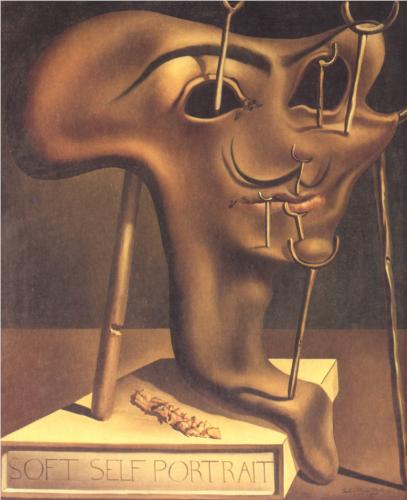
From WikiPaintings.com, Salvador Dali's Soft Self Portrait with Fried Bacon

From WikiPaintings.com, Salvador Dali’s Soft Self Portrait with Fried Bacon

Soft Self-Portrait with Fried Bacon

(after the painting by Salvador Dalí;  found poem

based on quotations by the artist)

At the age of six

I wanted to be a cook.

At seven I wanted to be Napoleon,

and my ambition has been growing

ever since.

There are some days when I think

I’m going to die

from an overdose of satisfaction.

I don’t do drugs, I am drugs.

Take me, I am the drug;

take me

I am hallucinogenic.

It is not necessary… to know

whether or not I am joking

or whether or not I am serious.

There is only one difference between

a madman and me. The madman

thinks he is sane. I know I am not.

I am not strange,

I am just not normal.

I am Surrealism.

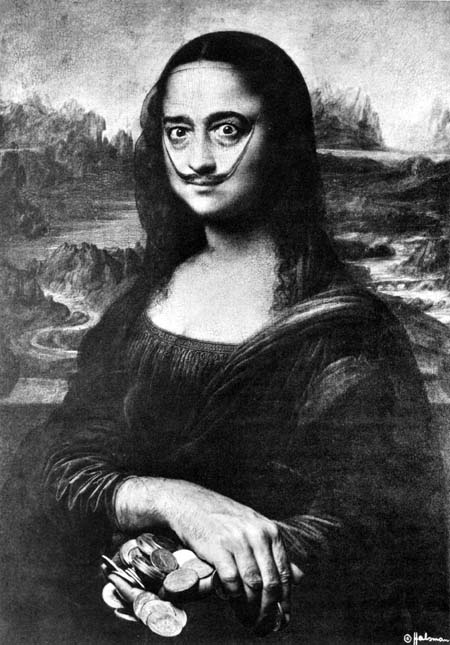
Salvador Dali as Mona Lisa

Salvador Dali as Mona Lisa

Self Portrait as Mona Lisa

(after the painting by Salvador Dalí)

I’ve shifted paradigms

so many times

my head reels

my mustache curls

I split my personality

the one who’s me

the others not

nor knowing where I stand

sinking knee-deep in a bog

or on solid ground

or if, in fact, it’s even me

believing that the earth

is flat then round

or, just thinking,

why not square

that the earth revolves

around the sun

or the sun around

the earth

or that there is no sun

why not

in a universe

one of many where

anything is possible

I am La Gioconda

or possibly not

I think therefore I am

or even her.

Self Portrait - Basquiat

Self Portrait – Basquiat

Self-Portrait

(after the painting by Jean-Michel Basquiat)

Do you know me, who I really was

or only as a photograph on the cover

of a dog-eared magazine?

You know the one, whats-his-name,

the kid with a spray paint can

and an appetite for death.

News at Five:

“The kid who banged Madonna

fucked himself in a rush

of heroin. Story at eleven.”

b., 1960, d., 1982

“The art world celebrates his life

and auction price

rising from his death”—

my resurrection of sorts

in a life of highs and lows

I came too close to the sun

and it burned my soul

a fateful black.

Now you know me, or you don’t.

No matter, man,

what goes up must come down.

Poetry from Bea Garth

Bea Garth

Bea Garth

Reflections at Chief Looking Glass

We go into the river knee-deep

then tread the rocks underneath

pulling ourselves along in the current

like crawdads.

Two days ago I sat on a rock

in Rattlesnake Creek

icing my foot in the cold mountain water

having hurt my ankle going downhill.

You sat next to me

and kissed my ears, lips and neck

and observed the little water bugs

who had made shells out of the tiny rocks

covering their bodies like mosaics.

I said, “They must secrete a saliva

that makes the sandy rocks stick”

–like my emotions all sticky

attracting memories and sensations

of the present like so many colored rocks:

rose and green and gray-blue and black and mahogany

encasing me in a kind of ready-made shell,

my feelers out and tingling, smelling the currents.

Now I look at the river reflecting the sun

and wonder whether or not to let you in,

my toes feeling the water’s edge

as I dry myself off with a towel.

I think of taking a picture of you

on the sandy spit – but I can’t

since the image of my old lover

pops up like some reminding ghost.

Old Chief Looking Glass winks at me,

the wide Montana sky opening up in a huge arc

reflecting off the river

reflecting off the you and me standing under it

and I cannot say or do anything

but pull away into my shell.

 —–by Bea Garth

Milfoil

He lies with me

a descendant of the Aegean,

his head looking like

that on an ancient golden cup.

Son of the Minoans,

the hair on his chest and back

dark and curly and sensuous

as tender green shoots

of milfoil—healing all wounds

except the one in my deepest heart.

He is a more than friend

friend, this traveling companion:

we kiss and caress, our passions rising,

yet we turn apart:

he feels such love would be immoral,

he feels he will only share himself fully

with the one he loves

beyond friendship, beyond sensuality.

In the darkness he cries out,

he has had a nightmare:

he is lying naked and someone is poking him,

violating him with sticks.

I would love him but must leave him alone

despite the fact that I love his touch and kiss:

he drives me mad with pleasure,

he drives me mad with his fears,

descendant of the Aegean, descendant of Thalos.

Those eyes look at me so clear blue, gray, green

as if they were reflecting the ocean,

his hair like tangled seaweed

capping that face.

This is an adventure being with him

sharing this time and space,

our bodies holding each other

as if we were at sea while remaining apart

about to swim to separate destinations.

For now I take mental pictures

and explore the feel of the currents

and the taste of salt.

Note: Milfoil is another term used for the herb Yarrow, also known as Achillea Millefolium, or Soldier’s Wound Wort—referring to Achilles who reportedly staunched his and his soldiers’ wounds with it.

—–by Bea Garth

Long Johns

I remember

how it was

with your long johns,

your bony body

inside its cocoon

of tightly drawn sheets,

my hand

slowly drifting towards yours,

you starting to rub

against my thigh

and soon

that skin

under all that cotton,

the current

buzzing and rippling

between us,

your smile edging

that tongue nibbling

the entire bed seeming

to submerge

–our unsheathed bodies as innocent and sly

as sea pups in paradise.

—–by Bea Garth

Bio: Bea Garth is known for creating visually rich narrative poetry as well as for her unique figurative ceramic sculpture, drawing and painting. Early on Bea was influenced by her grandfather’s love of poetry as well as her great aunt’s love of  Asian art plus her parents’ early occupation as archaeologists. This has given Bea a real feel of living in a multicultural and multi-leveled world. She has been an extemporaneous poetry and arts organizer off and on for many years in the San Jose, California area after also organizing many such events and small press magazines in Eugene, Oregon. For the last few years she has been editing Eos: The Creative Context, an online progressive e-zine devoted to poetry, visual art and social, political and health commentary. She is now often found painting and writing in her new studio in her fiance’s garage and kept company by her three cats. She has previously had poems and artwork published in a variety of small press magazines including Alchemy, Poetic Space, Denali,Coyote’s Dance, The Other Paper, Writing For Our Lives, Caesura, Fresh Hot Bread, Sparring With Beatnik Ghosts and the poetry anthologies Elegant Stew and Women’s Dreams/Women’s Visions.

Her work can be found online at https://bgarthart.com/

Writing from G.K. Brannen


The Transplant by G. K. Brannen

Time is of the essence here,

To live, someone must die.

God’s breath must return to origin

for that same respire to continue.

The body must return from which it came

for another to remain.

This knowledge is aggressive, and

thought by some to be against the

Laws of God and Nature.

It is stated that man is born in God’s own

Image. In Genesis, the Image is plural.

Therefore, man has the right to live in

duality. The time thread of the gods may be

clipped and retied. The time thread of man

may be clipped and reshaped.

Fate is our fate. It cannot be: altered, bent,

reshaped, or undone.

If spare-parts are necessary, so be it.

The path is written. The die is cast.

We, who have been left alone to strive

forward, can only guess as to the details.

All is not final until the finish line is

crossed.

_____________________________________________________________________________

Blessed


Blessed? … I’m not sure. That’s such an awkward word for me. I’ve searched back through boyhood, young manhood, adulthood, and now. Like I said, I’m not sure.

This question of religious epiphany struck me at the oddest moment. I was lying on a gurney just outside the O.R. at The Transplant Center. The time was late evening. I remember lying there listening to the banter between the surgical nurses and other personnel. Why won’t my attention act right? What? What did they say? I felt I was moving in and out of the conversation; my mind wandered back to earlier.

I’d been prepped for surgery by a big seasoned nurse who had no shame at all. Honest to God, you’d have thought I was a piece of pork being prepped for a bar-b-que pit. “Turn over, spread your legs, you’re such a baby, there ain’t no reason to be shy now … you ain’t got noth’n I ain’t never seen before, … don’t you get none of that on my clean sheets, … you ain’t never give yourself an enema?

GIVE me that!”

What were they saying … something about a party? I kept wanting to become part of the conversation; but I was like … the “invisible one.” Lying there with IV’s hanging out of my arm, no clothes on except that sheet, my head in a nylon bag … Hell, I wanted to go to a party. My thoughts were bounding like jack rabbits. It sounds like a great idea to me. It was probably just the premeds kicking in. … What was that about a thong?

Lights turned on. I was being rolled into the operating room, with a gallery, I might add. Being I was at a university teaching hospital, they had asked if I would sign a waiver so any intern interested in liver transplantation could watch. I figured it may be interesting to look at people that were looking at me ─ anything for science. Everything had happened so fast since I got to the hospital, I would have signed anything. And then, there was that prep nurse … jeeze ─ talk about irony. I was rolled around and jostled up next to the operating table and: “1-2-3” hoisted across, then gently arranged on, what kind of table is this? It was like being laid on a piece of stainless steel with an enormous rise in the center about lower mid-backbone. One of the surgeons introduced himself and his team to me. He asked me a few basic questions: “do you know where you are, do you know why you’re here, and are you comfortable?” “Comfortable?” I remember asking. No, I wasn’t comfortable. I would find out later after surgery that the table used was specially shaped to maximize the opening of the torso after they cut across the abdomen. They would then use a special medical hoist to lift and separate the ribcage. I figured it was kind of like opening up a “top fuel” dragster, so they could get at whatever they wanted to change out. And, then there were all those folks up there in the gallery. I wanted to wave, but … no, no sense in being my normal smart-ass self now. I did however look at a guy working at a shallow basin nearby, and the surgeon who was talking with me said that the newly acquired organ they were about install was “a good fit, and it would serve me well.” I was then draped, masked, and drawn on.

So, with that, we were ready. It was show-time. The young nurse that had been outside talking about the party leaned over me and told me she would be doing the catheter. How weird. Then, with a little snicker, she whispered that she was wearing a bright red thong … What… not now!

* * *

Is somebody crying? I can’t quite figure out … is somebody crying? I remember it was dark and I kept hearing that crying and it was so far away. I figured someone had died. Hell, maybe it’s me. … Is somebody crying?

* * *

George …George … can you hear me?”

Now, who the hell is that? … Yeah, I can hear you. Why is it so dark? Where is that voice coming from? The voice I heard was close ─ wasn’t it? My mind could hear him. Why couldn’t he hear me?

George … can you hear me? Try to open your eyes. I’m John, your nurse.”

Thirsty! My lips felt like … parched and cracked … like those river beds you see in Africa during the dry season … parched and cracked.

Here, try this.”

There was that voice again. Who is that?

John, whoever he was, had placed something damn cold, ice on my lips. My mind wouldn’t let me open my eyes … it’s so dark, the ice … wonderful. That ice cube was the best tasting ever. Talk about bliss.

George, you’re in ICU and you came through the surgery really well.”

Why is it so dark? Why can’t I see you? That ice is … awe-man … give me some, “More.”

Not so fast … easy … a little bit at a time.”

I think I’ll leave my eyes closed. … Yuk! “What was that?”

What was what?”

That’s not what I had before. “What is that? …Yuk!” Bitter … so bitter. I didn’t know what he gave me but, it wasn’t like the last. I think he was just messing with me. I never did find out.

George, how do you feel, does anything hurt? Can you open your eyes?”

I feel pretty “good … comfortable … tired … can’t open my eyes … they don’t work. Did you hear anyone crying earlier … I did? Tired, it’s weird being here, I can’t open my eyes. … I think I have to go now.”

* * *

Jesus, what’s all that noise, where am I? Who’s tugging at me?

George, George, Mr. Brannen, can you hear me … wakeup? It’s Laura.”

Laura, my post-surgery nurse, was right beside me. I recall, I couldn’t figure out how in the hell she got into this dream. Opening my eyes, she was smiling and informed me everything had gone really well and I was in recovery now. There was another nurse on my right dealing with the IV’s. I couldn’t read her name tag; she leaned over, smiled and whispered in my ear: “You are blessed.”



Short story from Carol Smallwood


A Visit from the Avon Lady

Excerpt from Lily’s Odyssey (print novel 2010) published with permission by All Things That Matter Press. Its first chapter was a finalist for the Eric Hoffer Award in Best New Writing.

http://www.amazon.com/Lilys-Odyssey-Carol-Smallwood/dp/0984098453


In the spring I located an Avon Lady to help make me feel more at home.

Do you know you have a wasp’s nest out there?” the Avon Lady asked scurrying inside. When I’d called, she mentioned her grandson and how many years she’d been an Avon representative, so I figured she’d be about my age and looked forward to seeing her.

Oh, is that right? My goodness!” But I didn’t mind it by the doorbell because it kept solicitors away.

The Avon Lady, in a pink dress, had a cap of close fitting dark hair that looked just like the wig called “Caesar’s Wife” in a catalog I’d received. I remembered it in particular because a girl with the largest hoop earrings I’d ever seen (and in the smallest bikini) had modeled it. Caesar’s Wife wore perfectly applied matching dusty rose lipstick and nail polish. In Nicolet City, the most visible member of the country club was a handshaking insurance agent with his well-dressed wife at his side in high heels with matching lipstick and nail polish.

She said, “I know it’s late for a calendar, but aren’t they delightful? This year they did them in such delightful pastels and I like them so much better than brash colors. I always wished I’d had a girl to dress in pink.” When she pointed to the pink skeins of yarn piled in a basket with some kittens for the month of February, I noticed she had whiskers like the woman in Nicolet City who’d quivered for bits of gossip—the Avon Lady’s round bright eyes were like hers too.

I thanked her for the calendar and took the stapled bag holding my order she presented like crown jewels. Smiling, I said, “Please have a seat.” When I returned to the living room with my credit card I told her, “I try and put as much on the card as I can because the Doris Day Animal League gets a percentage of it,” hoping she’d might be interested in getting one.

Oh, yes. I use mine to get frequent flyer miles to visit my other son. I see him so often you know.”

When she was filling out credit card information, I asked, “Is it hot in town too?”

The way she said, “Well, I think you have more of a breeze here,” I knew she’d gotten a good whiff of the neighbor’s cow manure. Caesar’s Wife sat very straight, her small feet precisely together. Her high black pointed shoes were like the kind that were buttoned with a buttonhook in earlier times; she sat with her back not touching the couch like a proper lady doing a needlepoint sampler. When handing my Visa receipt she said, “It’s been warm going to my grandson’s baseball games. He’s nine years old and looks just like my son at that age.” She glanced around before putting her copy of the order in her purse and said, “I’m sorry your order’s a bit late, but my husband and I are going on vacation and I’ve had so much to do you know.”

I could tell she was trying to figure out where I fit in the scheme of things, just like I pegged her kitchen as one with a teddy bear cookie jar on a spotless white counter always cleaned with antibacterial wipes—the kind advertised as killing 99.9% of bacteria. She probably had pastel Pennsylvania Dutch paper toweling, doormats with pastel teddy bears for her grandchildren, and proper eyelet (white) tieback curtains. Yes, Caesar’s wife “must be above suspicion.”

“I’m so glad to have found an Avon lady again. I’ve used Avon for over thirty years where I lived before.”

“Where was that?”

“In Nicolet City.”

When she tilted to one side and asked, “Why did you ever come here?” I tried to tell if her hair was really a wig, but just the curls on her forehead moved–curls like the picture in Jenny’s book on nursery rhymes about the girl with the curl in the middle of her forehead.

Oh, I wanted to take classes. I guess I wasn’t finished with school.” Yes, I believed in reason and enjoyed the smell of it in rectangular classrooms with rows of desks facing a larger desk. A projection screen with a string, that, when partially down, reminded me of Kitty forgetting to pull her tongue back in. You could tell a lot about a teacher by how they dealt with the string dangling in the middle of the blackboard. Classrooms had blackboards with smudged words much more intriguing because of their vagueness–whole banks of fluffy erasures with tails of “Y’s” and “J’s” still showing. I remember reading that if someone from the 1800’s walked into a classroom they’d feel right at home because classrooms had changed so little.

I recalled another kind of school–a homemaker’s school in Nicolet City where you could select: how to grow mung beans, how to make curtains from percale sheets, how to make your own baby food out of green beans. Mark had been in school and Jenny stayed with other kids in a room with some 4-H girls. After a cafeteria lunch, I saw a film on how Lee’s carpets were made and a demonstration on cleaning Sears’s ovens. I returned loaded with Wisconsin Consolidated Gas recipes on cards; each card had a blue tear-shaped flame of gas in the upper left corner.

Why, you sound like my sister who doesn’t know what she wants. She’s an ex-ray technician and wants to change jobs at forty-five.” Caesar’s Wife shook her head, “Still doesn’t know her place. Single, too,” her eyes trailing to my left hand. And as if she still couldn’t pigeonhole me, asked, “You work?”

“I retired after twenty years from Parisburg Public Schools.”

“Oh.” She looked a bit surprised but lost no time in replying, “You probably never had much time to bake cookies did you? My sons loved oatmeal cookies like my grandson does, you know. I make them with coconut, raisins, and walnuts,” and proceeded to give me the recipe.  

When I’d ordered men’s talc and aftershave on the phone a few weeks ago, she’d said, “It sounds like you know what someone likes,” but I hadn’t replied. When I examined the Friktion and Uomo talcs now, I almost said they were for myself to see her expression. Truth was, they were. I liked the solidity, the calming masculinity. Especially the citrus tones because they reminded me of the men I liked remembering.

I’d have to see if Honeysuckle was in the new catalog. I wanted to order it even after telling myself I was wallowing where I shouldn’t. Ah, there was nothing like the pale cloying sweetness of Honeysuckle! When I needed to remember what being in love was like, Honeysuckle brought a hint of the perpetual spring back. I recognized the look in the Avon model dipping her hand in a stream floating with daisies: she was smiling—no, glowing with anticipation in her eyes and sunlight on her hair: “Every moment’s to be lived. Your rush to greet the dawn…and love.” And to live the moment you just had to rub your wrist on the sample. You didn’t even have to unfold samples anymore. The next page showed a model wearing a night gown (I think) with rose petals falling on her matching those on the gown if the Avon Lady’s nail and lipstick shade—Love’s Promise.

It was funny though, what I bought looked smaller than it did in the catalog; the shower gels that hooked on the shower weren’t really much bigger than tubes of toothpaste. And Avon was selling so many other things now like cell phones. But it was reassuring once again to have an Avon catalog even it they were so much thicker now. Size 6 models still had tangles of curly hair, perfect teeth, matching lipstick and nails, and trailed pale pink scarves on pale pink beaches. Toddler models with chubby legs held peaches in pink baskets. I saw a woman walking into a fluffy lake with upraised arms with her hair blowing one way and her gown the other, featuring the new fragrance, Perception.

Still, I’d look at the next catalog that the Avon Lady said she’d hang it on my door knob if I wasn’t home and give the bag an extra twist so the wind wouldn’t carry it off. Avon made me feel a part of things: it was as American as McDonald’s, the Fourth of July, or the Reader’s Digest.

When debating what to do with the calendar, I wondered if the photographer had used a pink screen over the lens or if the muted look was part of the developing. The look was warm, romantic, real and yet just out of reach–and I understood why the Avon Lady had said: “Women like the pastel look. It’s such a delight. So feminine and flattering, you know.”


Synchronized Chaos January 2014 – Scouting Parties


Welcome, literary family and friends, to January 2014’s issue of Synchronized Chaos Magazine! We invite you to pull up a chair and a mug of ale or tea, and take a cup o’ kindness with your fellow creative souls.

This month’s theme is Scouting Parties, about the little personal expeditions we take to learn about our world. How we cope with not knowing everything, where we go to discover our world, each other, and ourselves, and then what we do afterwards with the information we have gathered.

Fran Laniado reviews Adam Brown’s Astral Dawn, where a young man finds himself on a surprise journey, wandering into a fantasy realm, which he must use his strength and insight to protect. As Laniado points out, one of the novel’s strengths is the development of the main character. He’s neither tragic nor perfect, and he has goals and strengths, although like many real-life young people, he isn’t sure how to achieve them.

W. Jack Savage shares a lengthy piece, “The Beginning,” where love gradually develops between a couple in an unusual arrangement, when they work through their problems, including their lack of knowledge about each other.

Roger Charlin, idealistic journalist at the heart of Daniel Jacobs’ The Eyes of Abel, as reviewed by Elizabeth Hughes, also means well, but faces a lack of knowledge. He must decide what to do when what he sees appears to contradict what he has come to believe over the years.

Hopefully, as people re-think their preconceived notions, our world will overcome prejudice, imperialism, racism and the desire to control others. Then, the Jews, Muslims, Christians and others in the Middle East, and elsewhere, will be able to coexist in peace.

Bruce Roberts discusses such a coexistence in his review of Every Christmas Story Ever Told (And Then Some)? Written by Michael Carleton, James Fitzgerald, and John K. Alvarez, this play, performed at the Town Hall Theater in Lafayette, California, presents a mishmash of classic holiday stories, including Dickens’ Christmas Carol and the movie It’s a Wonderful Life. 

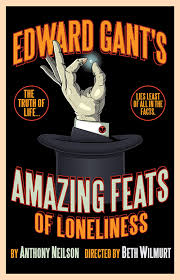
Christopher Bernard reviews the play Edward Gant’s Amazing Feats of Loneliness, by Berkeley’s Shotgun Players, that also illustrates in a fun way how our minds work to combine and synthesize narratives and information. As in Every Christmas Story Ever Told (And Then Some)?, characters make sense of interspersed, overlapping stories from various genres.

Some contributors describe physical journeys and explorations. Laurette Tanner shares vignettes from her time in San Francisco, and Berkshire, Massachusetts. Full of sensory details, her writing encourages readers to learn about and notice the details of their city and wilderness environments. ‘Enjoying nature’ becomes a lot more interesting when one knows what to look for.

Emily Burns, of the Save the Redwoods League, offers a portrait of California’s coastal redwood ecosystem, affected in various complex ways by climate change. As described by Cristina Deptula, her talk at Oakland’s Chabot Space and Science Center also focuses in on the ways nature can act as a storyteller, reflecting past events and broader changes through tree rings, geology, and the changing distributions of different plants and animals over time.

Mitchell Grabois presents poetry about a trip to France, where his narrator gets jolted by thoughts and encounters with people he’s met, along with the river rapids. Jeff Rasley’s travel essay about visiting Basa Village, Nepal also explores cultural dislocation, but in a gentler way by a narrator who desired a change of scene.

In poet John Grey’s work, the characters blend with the rough landscape, eking out existence amidst the rocky paths, crackling ice and coyotes. There’s a sense of isolation in Grey’s writing, of thoughts and desires unspoken, just out of reach.

Emma Bernstein’s lush piece about the light and sound of dawn, the natural environment, offers personal sanctuary and solace.

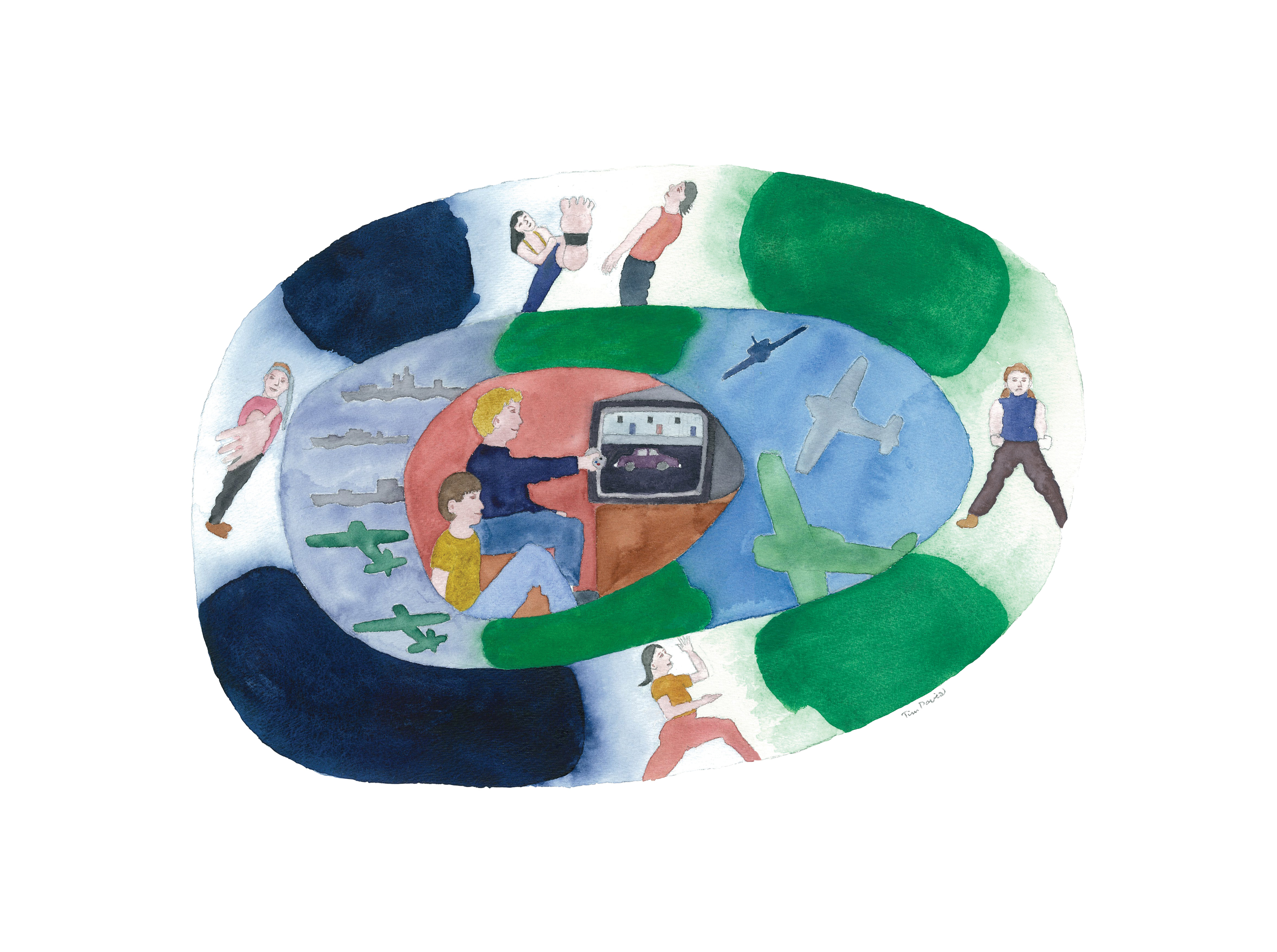
Artist Tim Davis turns in another direction in his quest for creative escape and inspiration, presenting work inspired by a video game.

It has been said that we should not turn to nature and imagination just to escape reality, but to create it. Hopefully, this month’s contributors will inspire a new and heightened world of enlightenment and beauty.

Happy New Year and enjoy the issue!

**San Francisco Bay Area folks** We have a get-together scheduled for the evening of Thursday January 23rd, 6-9 pm drop-in at San Francisco’s Cafe Enchante, 6175 Geary St. near the corner of 25th Ave. All welcome, please feel free to bring writing and art to share! Facebook event page coming soon, RSVP appreciated but not required.


NOAA National Archives Photo Library [LC-USZ62-24481]

NOAA National Archives Photo Library [LC-USZ62-24481]

Christopher Bernard reviews Berkeley’s Shotgun Players’ production of Edward Gant’s Amazing Feats of Loneliness


gant


Edward Gant’s Amazing Feats of Loneliness

By Anthony Neilson

Shotgun Players

At The Ashby Stage

Through January 12, 2014


AMAZING FEATS OF THEATER


A review by Christopher Bernard


Scottish playwright Anthony Neilson’s short omnibus of original fairy tales appears this season in a brilliantly imaginative production by the Shotgun Players at the Ashby Stage in Berkeley.

Edward Gant (a cunning and adroit Brian Herndon) is the impresario of a little band of wandering players, and our factotum and guide into Neilson’s maze of stories that are ghosted out of imagination, a few planks and thin air before the audience’s childlike eyes. The show, set sometime in the late nineteenth century, is part magic act, part vaudeville, part sideshow, part musical, part poetry recital, part comic existential quest, part tragic farce, as we are led into Edward Gant’s attempt to find an answer to what will turn out to be his own despair.

The production is an example of how little it can take a fertile imagination to concoct a world: the back of a truck, serving as a kind of stage-within-a-stage, a few lights strung up in the rafters, a papier-mache ball and a pulley and wire, and voila! There you have the Earth itself, spinning quietly in a theater suddenly become all of space.

A gentleman from Gant’s troupe walks about, carrying a stick from which hangs a white paper sphere: it is the sun. A lady traipses in with another stick from which hangs, like a fish frozen in astonishment at being caught, a pale crescent: the moon. Another gentleman walks by with two sagging rods from which are suspended little cages signifying the planet of war – Mars – and the planet of magic and mystery: Saturn. (Edward Gant’s troupe being limited to three, plus himself, the rest of the solar system must be left—to our imagination!).

Thus the setting of the loneliest planet in space is made the heart of the show, where we witness three stories that take us from Sicily to Vienna, from London to the Himalayas, from a boy’s lonely bedroom to a small stage in Berkeley. The first story, set in Italy, is centered in an encounter Gant once had with a young lady (Sarah Moser, who, like all the players, does multiple duty, and shows great variety and skill; this is her first appearance with the Shotgun players) suffering from a virulent form of acne that destroyed her prospects for romance and marriage. Amazingly, however, her acne has a miraculous side: each of her pimples, when pinched, yields a pearl, which would have made her fortune (if not her happiness) had not her own sister, a “beauty,” queen bee and alpha female, taken advantage of her.

The second story follows the attempt by a man (Ryan Drummond, very fine in his several roles, and especially in this one) to wipe out the memory of his great love and of her cruelly ridiculous and pointless death. The attempt leads him into the Himalayas to a holy hermit (Patrick Kelly Jones, a wonderful character actor), who convinces the poor suffering fellow that the only way to remove the memory will be by way of a primitive lobotomy: hammer, chisel, and drill, followed by removal of the offending area of brain. Very spiritual indeed! But the surgery has unforeseen consequences….

The third story brings us, by way of a farcically sappy story about a lonely teddy bear and an imaginary tea party, to the here-and-now with dramatic suddenness as one of Gant’s players, in an attack of sanctimoniousness, rebels against Gant himself, against the fairytales he is being made to perform, indeed against the entire project, which he sees as empty, pointless, “pretentious” drivel. “People come to see about real loneliness, real suffering, real poverty,” he shouts, while gesturing toward us, the audience. “Not this pompous, silly, made-up nonsense! You’re a fraud, Gant! And I’m not doing anymore of it!” And he threatens to stamp out of the theater in a huff, back to “reality.”

Just as the show threatens to fly apart at the seams, Gant himself pulls everything together – all three stories, with their elements of fantasy and reality, fairy tale and realism, dream and reality, fact and truth, of “imaginary gardens with real toads in them” (as Marianne Moore famously described poetry – for that is what this show is: the purest poetry), and even his rebel’s demand for authenticity, for “reality” – with a gesture and a word that complete the show with a hard, sharp click.

Beth Wilmurt provides the superb direction; the witty and atmospheric set design is by Nina Ball; the properties, of particular interest in this production, were by Kirsten Royston.

_____


Christopher Bernard is a poet, novelist, essayist, photographer and filmmaker living in San Francisco. He is author of the novel A Spy in the Ruins and the recent collection, The Rose Shipwreck: Poems and Photographs. He is a also co-editor of the webzine Caveat Lector.