Whose Brain Is It?


Presented within the flow of the lives of real people and fictional characters, this is a monthly exploration of how parts of the brain work.

Unpredictable

by Leena Prasad

Clyde is sitting in front of a large white canvas. He starts to throw random colors onto the canvas and within a few minutes, an image starts to emerge. Several hours later, a rough draft of a painting is taking shape.

“Clyde, honey, you have a doctor’s appointment in forty-five minutes.” His wife, Irene, stands at the door watching him for few minutes before she finally interrupts.

As he heads out the door, she wonders once again how her husband’s mind works. As a research scientist, her work is so different than his that she is often in awe of her husband’s casual creative leaps of mind.
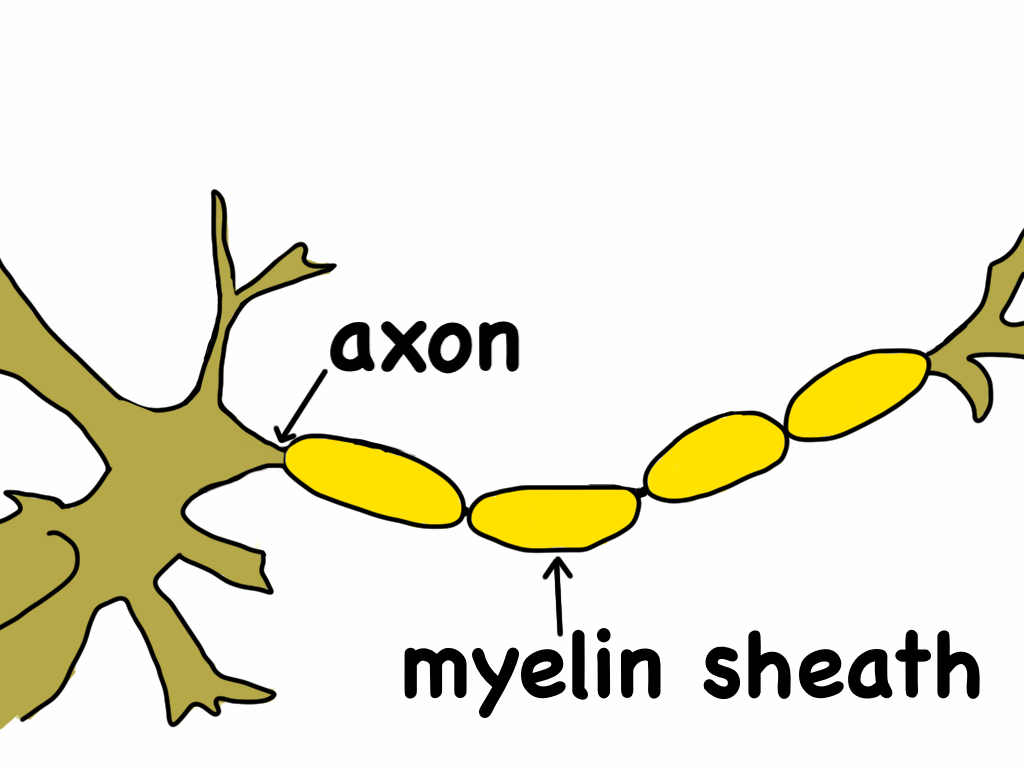
Illustration by Leena Prasad

Irene has read a little bit about how the brain works. She knows that axons are the transport lines between brain neurons and they are protected by a material called the myelin sheath. White matter is the collection of axons and the thickness of the myelin sheaths determine the density of the white matter.  White matter carries messages across the brain.

Irene reads about research done by Dr. Rex Jung, a neuroscientist who studies creativity. According to his findings, the white matter in the creativity circuits of the mind is denser in highly creative people, a similarity shared by people with bipolar disorder and schizophrenia. This is not to say that creative people suffer from psychopathology, rather that there are some similarities in the structure of the brain. Thicker white matter in some parts of the brain correlates to higher IQ whereas thinner white matter in other parts of the brain correlates to higher creativity (as defined by the researchers). Dense white matter carries information faster whereas thinner white matter slows down the transmission. This resonates with Irene because it seems to her that her thoughts travel in straight lines whereas Clyde’s mind sometimes takes loops and turns to go from one place to another.

Clyde is highly intelligent in addition to being very creative. So, this means that he has thick white matter in the IQ areas and thinner white matter in the creativity processing neurons. But there’s more to creativity than just the white matter. According to Jung, the prefrontal cortex, the brain’s planning and control center, takes a break when the mind is experiencing a creative moment. This clarifies how Clyde often forgets about practical matters when his mind switches to a creative mode. It also explains his ability to be playful without the pre-frontal cortex putting brakes on his uninhibited ability to have fun.

When Clyde walks through the door several hours later, he has a bagful of groceries in his hand and has remembered to bring everything on her list. Later, he pulls out a painting of a dozen yellow roses from his studio to surprise her.  His wife is happy that his thick white matter, thin white matter, and pre-frontal cortex are working as a team to create a pleasant day for both of them.


Leena Prasad has a writing portfolio at FishRidingABike.com. Links to earlier stories in her monthly column can be found at WhoseBrainIsIt.com.

Josh Buchanan, a UC Berkeley graduate, edits this column with an eye on grammar and scientific approach.

References:

  1. Jung, Rex., White Matter Integrity, Creativity, and Psychopathology:Disentangling Constructs with Diffusion Tensor Imaging, PLoS ONE | www.plosone.org, March 22, 2010
  2. Tippett,  Krista, host of Creativity and the Everyday Brain with Rex Young, On Being, May 2, 2013, http://www.onbeing.org/program/creativity-and-everyday-brain/1879
Sarah Melton on PB Gookenschleim’s Beanum Infinitum

BOOK REVIEW:  “Beanum Infinitum – Book 1” by PB Gookenschleim

– Reviewed by S. Melton

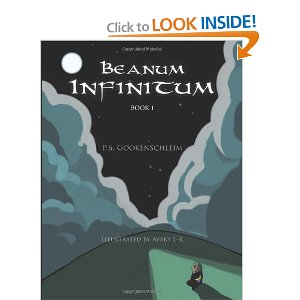
The premise of “Beanum Infinitum” is a unique and fascinating idea – to explain the basic concepts of existentialism, with references to advanced physics and astronomy and a sprinkling of absurdist humor throughout – and all in the format of a whimsical childrens book. While some aspects of the total creation are flawed, those who take the time to read this unique piece of literature may find it to be “A Legume in the Rough”.

A couple of things the reader will want to know before purchasing and/or reading this book on Amazon. First, while this story is in a 44-page childrens book format, it is not a book for young children. Or at least, not for children whose parents would mind reading the f-word occasionally interjected at somewhat random moments. Also, while the book is available as a self-published finished work via AuthorHouse, the author describes it as “more of a promotional issue”, which explains the intermixed pencil drawings and hand-written side notes alongside the cleaner-formatted text and color illustrations.  I would love to see this book re-imagined with a professional illustrator, for while the penciled-in doodles seemed to serve as more of a distraction than a descriptor of the story, you could also easily see what the author was portraying.

That being said, the premise itself was unique and engaging. A story within a story, an ancient storyteller spins the tale of Beanitrio, a tiny sentient pinto bean living on the planet Refry (in the Charro Way Galaxy – sensing a theme yet?), who is coming to terms with his own self-awareness and the world around him. His journey of discovery grew, as he discovered more each day about the world, the galaxy, the universe around him. His emotions ran wild with each new revelation, from joy and excitement to loneliness and desperation. Then, as the mysteries of “How” unfolded, the ever-looming question of “Why?” was revisited time and time again as he struggled to find his purpose and place in his strange and wondrous surroundings.

On a personal level, it almost felt as if there were two people writing the book – like the majority was painstakingly penned by a learned, highly intelligent and introspective philosopher, but with a nine year old child with a head full of poo and fart jokes (the kind that said child is convinced will NEVER get old) looking over their shoulder and interjecting his/her two cents every so often.  Sometimes this combination serves to add a little levity to an otherwise deep and intense existential dilemma – but more often it’s an unwanted (by this reader, at least) detraction from the flow of the prose and substance that kept it truly interesting.

All in all, “Beanum Infinitum: Book 1” is definitely worth a look for those wanting to dip their toes into the realm of existential philosophy without any of the stuffiness or forced intellectualism that sometimes runs hand in hand with it.  It’s definitely among the more ‘especial’ tales out there, and leaves the reader wondering what situations could possibly be in store next when Book 2 hits the shelves.

Beanum Infinitum may be purchased here: http://www.amazon.com/Beanum-Infinitum-P-B-Gookenschleim/dp/1477261095

Poetry from Evelyn Posamienter


SLOW MOVING CONTINENTS


turtle dreams stir the shifting moods

of clouds & sea.  was it you or was it me?

deluged by god thoughts

a city collapses beneath confetti.

turtle dreams shift like you or me.

come back to kite hill

where childhoods & strange architudes

emerge.  call god into question.

the landscape crawls toward the camera


CLUB DEAD


the deck chairs

the shuffleboard

& the bridge rounds

folks lounging in the sun

this is club dead

where grandmother’s

skin sheds itself

never mind the ashes

fallen in eastern europe

they don’t belong to you

or to me


PLAINCLOTHES


the emptiness of the world, i can hardly hold on

i walked side by side with my childhood

& a bitter wind knocked leaves around

how quickly one can pack a suitcase

as if there were somewhere to reach

on a park bench sat invisible friends

arguing, teasing, then refusing to speak

not much fun i grant you

but this is my train, along

tracks through inhospitable lands, where

at least one person in your car

carries a badge


Evelyn Posamienter currently lives in California. She has had work published in a wide variety of magazines, including the SoMa Review, Big City Lit, and The Mississippi Review Online. She recently read from her work at April’s San Francisco Synchronized Chaos reading event, and may be reached at 87evymail@gmail.com 


Rui Carvalho’s Photo Tour of Lisbon


Dear Friends,

The city of Lisbon makes me have so much to say that I really had a very hard time to decide what I should talk about. I thought about the places and the history, the river and the hills and finally decided to talk to you about the colors of my city, having inside my heart the secret hope to discover the exact things I should tell you in my next letter. Not surprisingly, I had the same problem selecting the photos to present to you. Nevertheless, I selected the photos you can see below. I really believe they portrait the very heart of Lisbon. Ok, some might say, watch out, where is a heart there is blood. But relax, that’s not the case here!

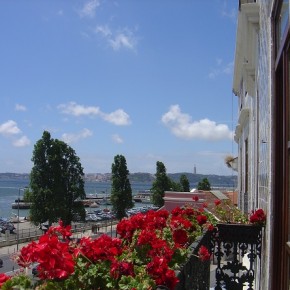
When I think about Lisbon I really can’t imagine a day when darkness completely covered the city, even during the winter. This is because the buildings have different colors and some of them are covered with glazed tiles or have a group of glazed tiles to make them more beautiful. This is true for old buildings but also new buildings. The first photo below shows the Tagus River on the left (in Portuguese: Rio Tejo) and blue glazed tiles on the right (in Portuguese: azulejos). The light over the river seems to come from him and not from the sun. In fact, the reflections from the waters in a summer afternoon make me feel a strange feeling: something in between the kiss of a mermaid and the astonishment of a child when he or she first contemplates the blue waters. The dry heat mixed with the blue of river mixed with the yellow of the buildings and the pink of the flowers are something that spreads over the air as a dream misplaced in time.

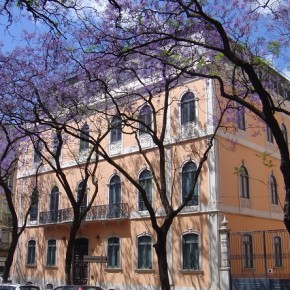
But this city is not only made with yellow buildings. Please look to the second picture bellow. There you can see the strange combination of the violet flowers of this tree, in June, and the color of this 18th century building. Please stare at the photo for a moment. Maybe you are understanding the city the way I did a few years ago… The old city is like a doll house where we can imagine ourselves as citizens of a neighborhood inhabited by real people and real ghosts. And everything in a day of Summer, in June or July, sees us surrounded with the pleasant and white smell of candles just snuffed by a mad person that likes smoke that is wholly and completely nonthreatening. To live in Lisbon and go to the center of Lisbon, to downtown, is like going back in time to the 18th century. Don’t worry, I will explain this to you in my next letter.

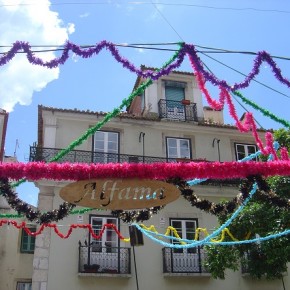
Now, I gently invite you to stare at the third photo. There you can see some colorful ribbons and a peace of wood that says “Alfama”. Alfama is the name of one of the most typical quarters of Lisbon. The ribbons are there because the photo was taken in June during the preparation of the most important party of the city, that takes place in June. Certainly, there’s a Saint involved in this party! Santo António de Lisboa, or Saint António from Lisbon, that is also Saint António from Pádua, in Italy, the city where he died in 13 June 1231. It is believed that this Saint can bring about good weddings and this is great news for you, my friend, because if you want to marry soon you just have to came to Lisbon on 13 June and pray! Yes, if you are in July you must wait all year… That might seem very unfortunate but you can start praying right now!

My dear friends, now I have to finish this letter and return to my colorful life, letting you behind, suffering the absence of my next words. You should wait for my next letter… Where I will explain you the recent past of this city. By recent past I mean the 18th century.

All the best,

Rui Carvalho


Rui is an app developer in Lisbon and may be reached at ruiprcar@gmail.com.


Paintings from Courtney Thiesen

Courtney Thiesen
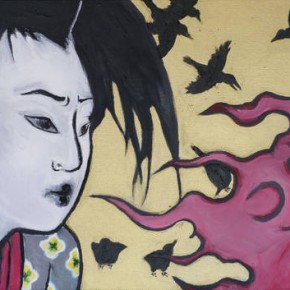
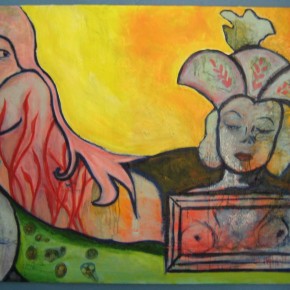
Paintings begin as grains of sand—questions or images stay with me, ideas and
feelings accumulate in my subconsciousness, shifting in around in my mind. While
asleep or awake, thoughts and images start repeating. Questions form from pictures
seen in a magazine, a strange experience or memory, often icons seem to present
themselves from out of nowhere. I am forced to ask- why these images, why this set
of questions? Artwork is the sieve, working to sort through these grains of sand to
find something whole. It is a method of discovery, a way of trying to understand my
connection with others, with nature, with our culture and shared history.
As an oil painter I am also interested in the brilliant color and tactile physical nature
of the paint itself. Whether trusting myself to dab thick textured relief, hurriedly and
greedily waiting to see a colorful bunch of blossoms, or patiently waiting days,
weeks, or even years as I layer glazes of paint- I feel connected to artists from the
past who have gone through this process. Like them, I explore issues of identity,
sexuality, and my relationship to society. Art creates meaning, reconciles differences,
and allows me to understand myself, to untangle the many threads of meaning
surrounding me. It is also exciting and fun, something I cannot live without.

Courtney Thiesen’s work is on exhibit at San Jose’s Cafe Frascati. She may be reached at csthiesen@yahoo.com 


Excerpts from Evelyn Posamienter’s poetry collection Brainiography

GENETICS
i’m contending with the girl in the photo.
it could’ve been the day she began menstruating.
brain aflutter with lesions, i watch a blood bubble
blossom from the injection site on my thigh.
in the photo the girl knows she will continually
evade averse events with minimal success.
who goes there, flirting with disability?
in some dreams, there’s nothing on the shelves.
at the injection site, curious spirits gather.
the girl in the photo, the lesions, all in collusion.

____________________________________________________________________________________

THE ALLEY
brain finds an alley to hide in.
no one knows which city lies ahead.
i am thinking of the city of my youth. this city
does not consider itself allied with me.
brain thinks about the lesions, sweet
white spots. brain thinks this looks good on me.
i am holding the city of my youth
& when you shake it, snow falls & settles.
truth talks to brain in alley.
alley trickles off map.

___________________________________________________________________________________

ELEVEN BRAINS
eleven printouts of my brain in an interoffice
envelope. eleven brains vying for my attention.
names crossed out, lists of undesireables.
days like this lie in wait.
eleven dreams stand at attention.
i know who they will become, if i look away.
i saw the brains myself emerge from the copier.
who will receive them, these flat brains.
sweet disease, said the maniac, as she struck
eleven brains from the invitation list.

These poems are excerpted from Evelyn Posamienter’s poem collection Brainiography, first published in 2006. The work is available here: 

http://www.argotistonline.co.uk/BRAINIOGRAPHY.pdf


From patches of light and a few clouds to a model of an atmosphere: UC Berkeley’s Dr. Adamkovics on Saturn’s moons


By Staff Writer Cristina Deptula

Earth is not the only body in the solar system with an atmosphere, so it’s not the only place with weather! Researchers such as UC Berkeley’s Dr. Mate Adamkovics, who came out to the Chabot Museum for June’s volunteer enrichment talk, predict weather on Saturn’s moons based on astronomical observations.

Titan, Saturn’s largest moon, takes 16 days to go around the planet, and 30 years to travel around the sun. Its methane and nitrogen atmosphere also experiences temperature inversions, where at some points air is warmer higher up, as opposed to the normal pattern of cooling with increasing altitude. On Earth, this pattern means that water reaches a triple point, where it can exist as a solid, a liquid, or a gas. So, scientists speculate that Titan may have a methane cycle, like our water cycle.

Astronomer Gerard Kuiper showed through mathematics that bodies with certain masses, sizes and temperatures are likely to have atmospheres. We have observed gaseous methane on Titan, so in turn we can infer the basics of the moon’s physical properties. We also can speculate about Titan’s atmosphere based on what we see through telescopes, especially with adaptive optics technology to correct errors and ‘noise’ and produce a highly accurate view.

On Titan, ultraviolet light breaks apart hydrocarbons such as methane, which become small particles that get absorbed into other substances. (On Earth, atmospheric oxygen absorbs the UV light). Titan’s methane does absorb infrared light, so astronomers can observe infrared images of the moon and estimate localized atmospheric concentrations. Generally, they find more methane lower down, where there’s less ultraviolet scattering.

The Cassini mission confirmed much of what we predicted about Titan’s atmosphere. Also, we noticed small, variable clouds scattered throughout the sky, and fog at the south pole, where there’s a ring of high altitude land. Fog differs from clouds because it touches the ground. Water ice also exists on Titan, and astronomers can predict the rates and amounts of past rainfall from the physics of what would be required to produce the observed rock shapes on the ground. However, we don’t know when the rain occurred.

Scientists previously thought Titan might possess a large ocean of ethane, since the light hydrocarbon is stable as a liquid there. Cassini did not find this ocean, but did suggest the presence of lakes, meters thick, of liquid hydrocarbons. These lakes humidify the air around them as they cool, creating ethane clouds, such as the one at the top of the moon.

Titan possesses some interesting features, such as a squall line, a long, streaky region of arrow-shaped clouds. And sand dunes in a pattern that resembles a cat scratch, from which scientists can ascertain which way the wind blows in those regions. Dr. Adamkovics wondered aloud if researchers could send a drone to Titan, as the cold, dense atmosphere would make flight aerodynamically possible.

He closed his talk with brief remarks on Enceladus, another of Saturn’s moons. Astronomers observe plumes, streaks, and geysers emitted from Enceladus, as well as cracks within its water ice. These cracks may come from cycles caused by Jupiter’s gravitational pull, occasionally heating parts of the moon. Or, possibly from radiogenetic heating, occurring as radioactive isotopes of carbon decay – although scientists think this would have stopped by now.

Dr. Mate Adamkovics’ talk illustrated how much researchers can determine and infer about bodies in space just from a few firsthand observations. In addition to showing us the worlds of Titan and Enceladus, he demonstrated some of the tools and methods of atmospheric science, which also help to predict and understand Earth’s weather.  

Cristina Deptula is a staff writer from San Leandro, California who would take a ride on Dr. Adamkovics’ airplane on Titan, if given the chance. She can be reached at cedeptula@sbcglobal.net

Oakland’s Chabot Space and Science Center’s located at 10000 Skyline Boulevard, deep within the Oakland Hills. It hosts free  public telescope viewings, from 8-10 pm every Friday and Saturday evening.