Christopher Bernard on Continua in Light: Three Acts, at San Francisco’s Mystery Venue


From Continua in Light: Three Acts

Hold On: Rehearsal at Mystery Venue in Dogpatch

Continua in Light: Three Acts

Cheryl Calleri and Thekla Hammond

Nancy Karp + Dancers

Music by Morten Lauridsen, Pauline Oliveros, Nik Bartsch and the Tin Hat Trio
Thekla Hammond, Soprano; Lucy Collier, Alto; Marguerite Barron, Alto; Griff Hulsey, Tenor;
Dean Fukawa, Tenor; Glen Leggoe, Bass; Richard Stanton, Bass.
At the San Francisco Performance Art Institute


Performance: May 4, 2013

By Christopher Bernard


I couldn’t make it to the performance of “Continua in Light” at the San Francisco Performance Art Institute, but was invited to the dress rehearsal the evening before.

The stars were in conjunction, the talents were promising, the evening was bright. I was ready for a little adventure.

The institute is housed in a big, blocky facility that looms at the edge of San Francisco Bay with a lonely and mysterious banality, like a building out of a de Chirico painting, in a part of the city I had never heard of: Dogpatch.

Hold on. Here was a moment of surprise, puzzlement, charm. I was intrigued: anyplace called “Dogpatch” has already half won me over.

I was instructed to take the “T” Metro line to 23rd and 3rd Streets. Hold on! Don’t numbered streets run in parallel – except, perhaps, when they meet in infinity?! Where, by all the stars, was this place?

Simple: tucked between the southern end of Portrero Hill and the bay, a mile or so south of AT&T Ballpark, this place where (it seems) all parallel lines meet is an old working class cum industrial neighborhood, made up of half-retired warehouses, abandoned wharves, a neglected electrical generation plant, acres of parking lots, and a string of residential blocks built in the early twentieth century that – partly because it’s so little known, and so comparatively cheap, and partly thanks to the new “T” line – has been discovered over the last few years by artists and the evening set. A dance studio, the aforementioned PAI, and live-work spaces, and a handful of wine bars, clubs and restaurants have made it their home. There’s even a Dogpatch Saloon.

I swallowed my skepticism (which I have found can be as useless as another person’s unquestioning faith) and, trusting my instructor, took the “T” down down down the rabbit hole of Third Street, miraculously, to the implausible intersection.

I’d been told to walk from there toward the bay, go to the second of three walk-in gates at the building’s address, wait to be let in, make smoke signals with my cell phone in case of distress, and, if my psychopomp to this new underworld showed up, accept from him further directions to the mysterious venue.

After walking down two long, lonely blocks through a wasteland of open lots, with a half-abandoned electrical generation plant in the distance, its enormous unused chimney stack, the color of blood-red brick, towering against the sky, I came to a warehouse-like building with the word “STORAGE” painted in huge letters across its western face.

An amiable white-haired gentleman greeted me as if he’d been expressly sent for me, and another invitee (who appeared mysteriously behind me – hold on: where in heaven’s name had he come from? but by now I was starting to get used to this) and I wound our way up to the second floor and through a cluttered maze of artist’s quarters to a dark, cavern-like space at the back, divided in two by a long white backcloth, in front of which was a performance area and a several rows of small pale chairs.

A muttering of greetings in the dark. A moment to find a seat. A quick look around at other shadowy forms come to witness the ritual of rehearsing. A little eavesdropping on furtive laughter and chatter between the women. Then a little flash of light from two hanging bulbs. A stringing together of two hauntingly lovely female voices. And two female dancers work through the motions of a delicate, highly formal dance in a pre-full rehearsal version of the performance to come.

Think of yourself as watching the tracing of a bare-bones sketch before you see the full painting. That is what I felt, though I didn’t realize it at the time.

The air of a rehearsal is often one of casual informality alternating with intense focus. Stagehands put up ladders, remove ladders, disentangle lights, confer, change their minds, try again. The choreographer (the warm, quietly intense Nancy Karp, one of the Bay Area’s most admired dancers and choreographers) suggests this, that, the other thing – sits on the stage with her dancers giving notes, advice, encouragement. 

Much of the music is staged live, and part of the rehearsal is strictly musical, with a small chorus singing in subvocalized polyphony off to the side.

As it turns out, only the first two “acts” are being rehearsed tonight. The first, “Gioia and Sine Nomine,” incorporates music and a large video projection. The second adds two graceful and tireless dancers, Diane McKallip and Randee Paufve. The third act, with its promise of audience participation, makes rehearsing it largely moot.

After half an hour, the rehearsal lights are finally disconnected, and a full dress rehearsal takes place. As so often happens, seeing and hearing the parts rehearsed separately gives no idea of the particular magic that will occur when the parts are finally blended.

What I then see is the final bit of mystery in an evening that has been, since its beginning, of a most lovely strangeness.

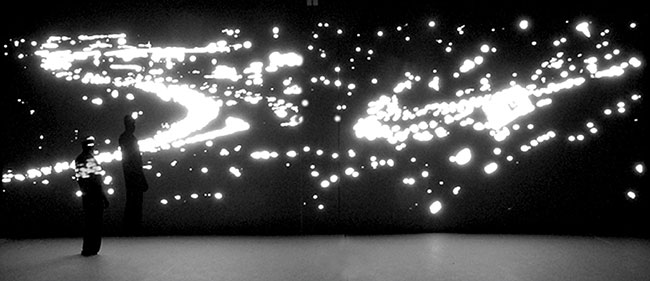
The opening act begins with a double projection against the large backcloth, of partly abstracted views of what I imagine are immensely long traffic flows at night along busy freeways, seen from a distance, the lights elongated through some sort of filtering, mingling and mixing, in long diamond shapes, pencils and pins of light, with starry foci generating them; the end result being an almost mystical play of light, random and yet directed, free yet orderly, bright and vague and shapely, created from the most ordinary of sources. Another projection includes a single light, stretched vertically so it looks like an electric candle flame. (This projection will return at the end, when the lights, stretched vertically before, will be stretched horizontally before re-emerging into their attendant darkness.)

With these projections are performed two pieces by Morten Lauridsen, “O Nata Lux” and “O Magnum Mysterium,” and the modern classic “Deep Listening,” by Pauline Oliveros, sung by a small, tight chorus and a soprano and alto duet.

There seems to be no break between acts one and two. In act two, the two dancers join the video projections, with piped-in music by Nik Bartsch. The dancers perform, stretch, turn, reach out, reach up, reach forward, turn toward one another, then away, summoning and rejecting, embracing, meeting, parting, on an almost entirely dark stage, with low lighting placed along the stage front that projects the shadows of the dancers against the back-projected screens, creating a complex, immersive fusion of light and shadow woven together by the mildly pop-jazz-flavored score. A strikingly beautiful effect results, as the dancers dance not only with each other, and with their own and each other’s shadows, but with the video projections, continua of light and shadow in darkness and light. It is especially fascinating when the shadow of one of the dancers momentarily disappears (while the other dancer’s shadow remains), and the dancer seems to dance, shadowless, with her darkly doubled partner, like a spirit, a ghost, against a backdrop of dazzling streams of brightness. At the end, I could hardly believe I had been watching only two dancers; the stage seemed to be occupied by a perfectly coordinated corps.

I think I detect a story I have often felt in Nancy Karp’s work: a story of independent inspirations working together almost by osmosis, but without willfulness or constraint, to create a mysterious whole larger, more ramifying, more suggestive, than the mere sum of its parts would suggest alone.

Out of the simplest of elements, and imagination, trust and skill, a “magnum mysterium,” truly, emerges.

The next night the show went up. For one night. Then, like a candle, went out. Hold on: you mean, that’s it?

Christopher Bernard is a poet, novelist and critic living in San Francisco. His novel A Spy in the
Ruins was published by Regent Press (http://www.regentpress.net/spyintheruins). He is also a
co-editor of the literary and arts webzine Caveat Lector (www.caveat-lector.org).
 

Generation After Generation, a prose sketch from Shaun Scruggs


Generation after Generation

On a map of the Chattahoochee River National Recreation Area, a thin, nationally protected line runs through a strip of green trees just north of Atlanta. As the winding curves pass water through a worn path in the Atlanta bedrock, it puddles at points and looks much like a vein, with its deformities and natural eccentricities, weaving its way around the terrain to find the path of least resistance. From its mouth at the Buford Dam, which is supplied by the northern Chattahoochee and the Chestatee rivers, it gulps the water that the turbines release during generation. The water is merely a trickle compared to what Lake Sydney Lanier has to offer, but the river continues to take all the water it is rationed.

The alarm sounds and echoes off the nearby trees and the massive concrete dam. All of the fly-fishermen and the screaming, splashing children, who enrage the sportsmen with their Trout scaring ways, disappear into the tree line as the dam releases rushing water. When the Buford Dam finally became operational in 1959, the waters within the manmade lake filled to the magnificent potential of 105,000 kilowatts, which is used for both power and to control the flooding of the river. Within minutes of the alarm, the shaped and dynamite blasted granite walls fill with this chilling, churning offering from the bottom of the lake and the water rises over ten feet. The clay colored, sandy beaches disappear under feet of brown water, along with the tall grasses surrounding the boardwalk, which sits safely above the rising levels. After the generating settles to a calm flow, at its new level, the coldness of the river eerily chills the air and sends a shiver down the spine, allowing the body to adjust to this new temperature. Before long, a dense fog settles in the valley of the dam, and the water’s temperature reacts with the condensing air, hiding the Chattahoochee under this blanket of smoky vapor.

During each generation, the water shoves its way through the dam, like passengers in city train station kept on time with the precisely calculated clockwork of the hydroelectric schedule. The dark water turns frothy as it churns its way into the accepting river, and comes out around fifty degrees Fahrenheit. This water has the ability to rage at an unforgiving 8,000-9,000 cubic feet per second. To truly realize the magnitude of this, picture a box that is able to snuggly contain a basketball, and think of it tumbling down a flight of stairs. Obviously, this image is nothing by which to be frightened. Now, picture 8,000 of these boxes rushing by in one second. This is the power of the dam and the waters it contains.

Nearly half a century after the dam’s first generation, I met the beautiful, manmade headwaters. Introduced, at seventeen, by some rowdy, boyhood friends, I began to spend afternoons casting lines for the beautiful pink and green Rainbow Trout. The river was illegally populated with these trout by my father’s father in 1961. By this transgression; he ended up a Chattahoochee hero. One night, my father told me the abridged story, after I came home from the river with friends and a fresh catch. “Your Grandpa and his friends thought it would be a terrific idea to introduce an invasive species in an unnatural habitat. Fortunately, they knew what they were doing and knew the water from the bottom of Lake Lanier would be cold enough for the trout. Still, he is so lucky he didn’t get in trouble,” he added with a breath of relief. Luckily, the area was not nationally protected by Jimmy Carter until 1978, or my grandpa would probably still be paying off fines, or constantly reminiscing on the prison sentence he would have undoubtedly received. My grandfather helped to make this river what it is today, and I didn’t even know it until I found the river for myself, as if I was supposed to find this river. This river flows in my blood and I didn’t know it until I was seventeen.

My grandfather has always been an aloof character in my life. When my older brother was born, grandpa showed up long enough to say, “Cute kid.” By the time I was born, my Grandma Carolyn managed to make him stay for a couple hours, before heading home to Ellijay, in the north Georgia mountains. As a young boy, he would tell stories that I was far too young to understand. I would sit on the wood floor of the cabin and play with vintage toy cars and rusty cap guns. My mother, who was born the same year Grandpa stocked the river, and father would break into smiles after Grandpa’s life stories, which were inevitably a product of his mischievousness or wayward friends. After the punch line, Grandpa continued laughing till his face turned as red as a tomato.

As I’ve gotten older, we have grown closer, and have hunted Quail, Dove and Snipe together, while he recited the stories I could not understand as a child. His face still turns just as red as it did when I was a toddler. He tells stories about his entrepreneurial conquest, his wonderful hunting experiences, and the fishing which makes up so much of his passion. On winter break, during my eighth grade year, Grandpa took me hunting with my Uncle John. I was just a lazy kid with a new pair of boots and a shotgun, but Grandpa let nothing slide. He was never mean or spiteful; he just sent whispered shouts my way, so as not to alert the birds while getting his point across. He breathily hollered, “Keep up in case of a covey flush!” or, “You stand back there and accidently shoot someone, I’m not gonna be happy.” He was a good teacher and I constantly think of those pine forests and dirt roads in south Georgia, where I did so much growing up in only a few days. Since I’ve grown up, Mom sees so much of him in me, and tells me with increasing frequency. Still, I wish I knew him better.

I used to think of Grandpa while listening to the generation schedule, with my friends, on the way down the winding river-park roads. We used to listen so intently, onlookers would have thought it was our religion. For the only time that day, all of the teenage boys would silence themselves and take heed of the electronic woman’s voice by leaning close to the nearest car speaker, which delivered the news and told us whether we would fish in calm or cascading waters. After unpacking rods and tackle, we always trudged our way through a worn dirt trail and fished off a cove in the bank. Watching the dam generate was one of those experiences that reminded me of how small I really was, with complete disregard for my overblown teenage ego.

Other than the story of Grandpa’s trout, I can only recall one other story my father told me about the Chattahoochee. When he was young, his group of friends used to drive down to the river at night and misbehave. They would drink cases of beer, squeal the tires of their ‘60s and ‘70s cars, and stereotypically make out with girls in the back seats. Turns out Alan Jackson was telling the truth when he sang “Chattahoochee.” Unfortunately, this was the story my father chose to use in the explanation of the birds and the bees. What my father didn’t seem to understand was, I had already fogged up my fair share of windows and seventeen was simply too late for the sex talk from dad. I am my father’s son.

My father has always been my conscience, telling me “I’m proud of you, you’re the kind of guy that sticks up for the little guys.” He tells me this all the time, since I got in a fifth grade fight to stick up for a bullied friend. We differ infinitely and I argue with him on most every subject. He can fix anything he sets his hands on, and fixes engines the size of my Ford Ranger, at his Ammonia Refrigeration Service job, while I don’t know how to change the oil in my truck. I will never understand how he stays so level headed while my mother and I are so emotional, but he has always kept me on the path to being a better man. I do know, however, that I will never be half the good man my father is, and I am fine with that, because if I even come close to half I will be better than the majority.

Sometimes while watching the dam generate, fishing, swimming, or kayaking I think of the destruction of 14,000 acres of forest and the required relocation of thousands of people, which was planned and carried out to allow for the dam. I think of all the old buildings and memories trapped under Lake Lanier, after its flooding. I think of the sacrifices that were made for this river which I love so much. Still, this allowed the growth of a new and lasting system, which flourishes while it provides drinking water and Electricity to many Atlanta residents, my family included. I owe this river.

The Department of National Resources protects the CRNRA. Their green and gray uniforms populate the boat ramps and banks of the river, as they stand with watchful, darting eyes, hidden behind their calm dark sunglasses. One day, while fishing during my senior year of high school, one male officer and his female partner approached me, in a canoe, and asked for my fishing license. Upon being told that I did not have the correct stamp to fish the river, I began to apologetically pack my pole and tackle, knowing there could be a serious fine. The officer stopped me. “A teenage boy like you, on a Saturday afternoon, could be out drinking, smoking, and breaking a lot worse laws,” he explained. “Enjoy your day of fishing and get that stamp before you come back. Have a great day,” he said as he paddled away. I released the sigh that was building up during my conversation with the officer as I cast out my line and waited for a bite. I belong on this river.

The summer I turned twenty, my friend Walt gave me a job lifting rafts and kayaks for a Chattahoochee company based in Roswell. It was further southwest on the river than I had ever ventured, but it was a beautiful place to work, as the main location was a huge open expanse where the river slowed and the other location was a beautiful collection of rocky shoals, where the CRNRA ends its forty-eight mile trip at Peachtree Street and meets the water treatment facility just around the bend. Still, the pay was horrible, and the work was worse. Belligerent bosses and customers filled each day with some new form of irritation to conquer, which sent me to the edges of my sanity. People constantly raved about refunds for malfunctioning floats, which they often sabotaged on the last leg of the journeys just to get their money back. Employers pushed me to my wits end by creating nonexistent problems regarding the treatment and organization of tubes and rafts.

The only factor that kept me from needing a padded cell and a strait jacket was that I spent that summer working with my girlfriend Kaleigh and our best friends Walt and Bridget, the couple that got us our jobs. My co-workers and I began sweating in the morning, the boats became heavy by the afternoon and the work didn’t cease until sundown. Still, I loved the time with them, near and in the water. Every day I stepped in the cold river and felt the calm of the water run against me. I spent the evenings diving across the rocks to rescue drunken middle-aged patrons and retrieving life jackets, which somehow managed to get away from the hands of tubers with increasing regularity. At night, we went to dinners with our best friends, smelling like sun burnt skin and river water. Between carbonated gulps of Fat Tire, Stella Artois, and Honey Brown we downed greasy, meaty bites of Fellini’s mushroom and pepperoni pizza or bacon and bleu cheese bison burgers from Cheyenne Grill in Buckhead.

Being that we worked for a rafting company, our only perks were the free trips down the river, which took my girlfriend and me the entire day. Putting our kayaks in the water, just beneath Holcomb Bridge, I found that Kaleigh had already applied her sun screen and failed to bring the bottle along. I figured my backpack of beer would numb the pain of the looming sunburn, since I had not applied a drop of sunblock to my skin before we shoved off the muddy bank. We spent the day paddling slow and laughing, while tossing beers and sandwiches from one boat to the other.

I wish I could remember the conversations we had that day, but I do remember that was the day Kaleigh fell in love with the river too, even though she flipped her kayak. After passing through some incredibly rocky shoals, I turned around to wait and saw her gracefully flip and awkwardly escape the mayhem of her sinking kayak and escaping paddle. I pulled up on a rock and snagged her paddle on my way to her. She simply sat there with a look of embarrassment and acceptance across her face. I looked at her and asked her if she was okay, as I drained the water from her overflowing kayak. “I’m okay, I just look like such an amateur right now,” she said with a sulk. I couldn’t help it and began to chuckle. She tried to be offended by my amusement, but broke into an unstoppable giggle, while the last few liters of water drained from her kayak.

The day was breezy, which allowed the sun to creep in and out of the cloud cover, providing us with cool relief as we baked atop the chilly water, yet the wind pushed us upriver at points and this slowed our eight mile trip, we welcomed the additional time this provided Kaleigh to dry her clothes on the top of her boat. By the time we arrived back at the boat ramp, my torso looked like a medium rare steak and Kaleigh felt awful for forgetting the sunscreen. That was the day realized why I put up with that job, why I dealt with the hard work, and why I enjoyed that summer so much. I love the river and so does my love.

After that summer, I decided I was growing up and I needed to make better money on my summers, between college years. So, the next year I took a job remodeling bathrooms at twice the pay, but I missed the river and I missed the calm. The work wasn’t as hard, the houses were air-conditioned, and the pay checks didn’t hurt either. yet, the money didn’t matter and my friends meant so much more to me. The river meant so much more to me. I need the river.

Lake Lanier is the heart of north Atlanta with the Buford Damn as its valve, pumping life to the lowlands at a prehistoric pace. It isn’t just a river for recreation or a resource for light switches and faucets. This river pulled me in and taught me so much. The river is not just a tie to the genes that made me; it is what shows me that I am tied to my Grandfather and Father through more than blood. Although they are these strong men, to whom I never see myself living up, I still have this in common with them. This river is a part of me as it is a part of them. We share this passion for a place and we found it individually. We came here over the years with our own groups and our own minds. We have our own memories of this place. Together we have seen the history of this river and how it grew. We know this river. We know its shoals, its trails, and its people. I did not know these men when they spent summer day at this river, in their youth. Yet, we are together here, generation after generation.

Piece by Shaun Scruggs, from Georgia Southern University. You may reach Mr. Scruggs at ss03952@georgiasouthern.edu


Potential and room for improvement: Stanford University’s Dr. Mark Zoback on hydraulic fracturing (fracking) techniques for natural gas extraction


Making hydraulic fracturing workable, for people and the environment: thoughts from Stanford’s Dr. Mark Zoback

by Cristina Deptula 

The term ‘fracking’, or the process of extracting natural gas from shale rock deposits more properly known as hydraulic fracturing, frequently gets slapped across news headlines and blogs. Before getting too excited one way or another, it makes sense to first understand the procedure.

Dr. Mark Zoback, a geophysicist at Stanford’s Precourt Institute for Energy, outlined how fracking works during his lecture for the Northern California Science Writers’ Association last month at San Francisco’s Thirsty Bear tapas restaurant.

Fracking involves pumping large amounts, up to 4 million gallons, of high-pressure water mixed with small amounts of sand and chemicals, underneath clay-rich sedimentary rock deposits. Gas bubbles up through the induced fractures, and then gets collected for energy production. An L-shaped well allows for the harvesting of natural gas from many small pockets within the rocks, rather than only tapping into what’s directly under the well.

Scientists in the United States and in China are interested in further developing natural gas as an alternative to coal power for economic and environmental reasons. Natural gas is cheaper to convert into energy and releases less carbon dioxide and fewer atmospheric pollutants than coal when burned.

“We have to get our energy from somewhere,” Zoback reminded the audience, “and saying no to fracking for gas is really saying yes to more coal.” However, he urged the scientists and journalists in attendance to use the time the natural gas power buys us to develop even more efficient and nonpolluting energy sources.

The USA possesses large reserves of natural gas. Within the United States, Zoback asserted, our shale deposits could contain enough to power all of our gas-burning devices for a hundred years. A recent Popular Mechanics article suggests the Marcellus shale, a large deposit between West Virginia and Pennsylvania, alone could cover our national gas requirements for 20 years.

However, fracking can pose safety and ecological risks. According to Zoback and other scientists, current concerns with fracking include possible surface contamination from spills, air pollution from the extraction process, methane leaks from fracking wells, the volume of fresh water required for the process, and the possibility of polluting groundwater and triggering earthquakes by destabilizing rocks.

A fairly recent report from several scientists, including the Environmental Defense Fund’s Fred Krupp, came to the conclusion that shale gas deposits could be extracted and used in an environmentally responsible manner. Still, the team prescribed 20 recommendations concerning how to make the process safer and cleaner.

Zoback does not oppose all fracking, only those projects which in his view pose a danger to the environment, workers or local residents. Yet, he often advocates for more environmental precaution and mitigation than the leading oil and gas industry advocacy group, the American Petroleum Institute (API) supports.

For example, he would like to see more attention paid to methane leakage from fracking sites than industry leaders recommend, as methane gas contributes more to the greenhouse effect, trapping heat within Earth’s atmosphere, than carbon dioxide. Zoback did say methane leakage could effectively be prevented through improved construction techniques, which should be implemented.

Zoback also supports full disclosure of the chemicals used in fracking fluid, although he emphasized how the chemicals comprised only half of one percent of the water solution. “These are common substances we use in our pools, detergents, glass cleaners,” he said, holding up a chart to illustrate consumer products containing the same chemicals used in fracking.

He made a valid point about the reduced dangers from a substance as its concentration becomes more diluted, and keeping things in perspective. After all, we do not need to live our lives in bubbles to avoid exposure to even one molecule of a potentially toxic chemical. More detail on the safety tests that had been done, and on how and why scientists felt these chemicals at these concentrations in our water supplies did not pose any danger to humans or ecosystems could have helped assure the audience here, though.

To minimize the amount of freshwater required, Zoback encouraged greater re-use of fluid from one drilling project to another. This could be made more feasible through pad drilling, he said, with many fracking wells located in one place. And known environmental restoration techniques can be employed to allow the area to return to its natural state after engineers finish the gas extraction.

As for earthquakes, Zoback pointed out that we’d seen only four small, non-destructive earthquakes triggered by our nation’s 150,000 fracking wells. We can also mitigate earthquake risk by avoiding injecting fracking fluid into known seismic faults, and by limiting the rate of injection.

Hydraulic fracturing technology, to Zoback and his Stanford colleagues, comes with its share of dangers and technical and environmental challenges. Yet, the procedure also could make available an accessible supply of energy that could prove more efficient and sustainable than its leading alternative, coal. Hence, he and others advocate intelligent, cautious, and responsible development of shale gas deposits, coupled with pro-active planning, monitoring, and the willingness to halt work at fracking sites where it would bring about safety or environmental problems.

“Fracking can form a blue bridge to a green future,” he said, “but non-carbon-based energy sources need to be on the other side of that bridge.”

____________________________________________________________________________________

Author’s note: Dr. Richard Muller, faculty senior scientist at Lawrence Berkeley National Laboratory, also presents a nuanced picture of fracking technologies in his book Energy for Future Presidents: The Science Behind the Headlines. If this article interests you, I would recommend his book.


Cristina Deptula is a writer from San Leandro, CA who helps edit Synchronized Chaos Magazine and may be reached at cedeptula@sbcglobal.net.


Article in Grist magazine about fracking technologies and their various impacts: http://grist.org/basics/fracking-faq-the-science-and-technology-behind-the-natural-gas-boom/


Popular Mechanics piece on the top ten misconceptions about fracking: http://www.popularmechanics.com/science/energy/coal-oil-gas/top-10-myths-about-natural-gas-drilling-6386593


Custom apps available for purchase to showcase your poetry, some proceeds going to Synchronized Chaos Magazine

Everyone, two people in the Synchronized Chaos family, columnist, poet and software engineer Leena Prasad and writer/software person Rui Carvalho, are offering to help our publication fundraise. They’ll create an app of your poetry for $200, with one-third of the proceeds going to Synchronized Chaos!
Mention Synch Chaos when you order an app and we’ll receive cash. Please contact us by commenting here or emailing us at synchchaos@gmail.com
 If your purchase more than five  iPhone/iPad or Windows apps, the maximum yearly fee will be $50. If your purchase two or more Android apps, the maximum yearly fee  will be $15.
Both Rui and Leena have experience and references regarding their software and development skills, and will provide work samples upon request.

From Leena Prasad, who specializes in haiku, senryu and other Japanese-inspired poetic forms: 

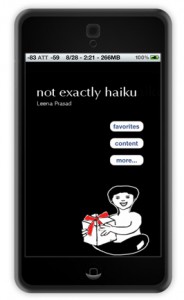
So, you have written several haiku, senryu, or tanka. Maybe you have a collection of haiga. Now what? You can publish them in a book but, really, smart phone apps are where people are spending a lot of their time and these Japanese inspired forms are well-suited for the small screen. I converted my senryu book ‘not exactly haiku’ into an iPhone/iPad app and can do the same for you. I can also create an Android version. Check out my app by searching for it in the Apple iStore or by following the links at ThinkersInk.com.

Basic app package for $200:

  • cover page with 3 menu items (Favorite, Contents, More…)
  • one author page
  • 20 pages (screens and menu similar to ‘not exactly haiku’)
  • ability to mark each page as favorite and  email and tweet the text content
  • a “more” page with six buttons, one of which links to the author page and five which can link to any url.

Yearly Fee: $5/year to keep the app in the online store.

Additional Items:

  • Additional static screens, $3/page:  screens and menu similar to ‘not exactly haiku’.
  • Additional dynamic screens, $TBD: customized screens with buttons, etc.


From Rui Carvalho, who handles all types of poetry, including short prose poems and flash fiction: 
I offer top quality apps for Windows Phone and Android. Each app is intended to be a valuable asset for poets who want to value their work and present it to friends and readers all around the world. The standard content is: i) 20 poems; ii) short presentation of the author with maximum of two screens and one photo (optional); iii) a link to an existing website of the author and iv) an inspiration photo per group. If desired, it is possible to add extra poems and/or a short quiz (an extra fee will be applied). The app will be available for countries as USA, Canada, UK, and many others. Additionally, it will be possible to produce apps for iPhone if the author needs at least one  app per platform. Also there is the possibility to have a small app, with link to your existing website and 3 poems, for just $45 and $5 as yearly fee. We can talk to know your needs and adapt our app.
Rui’s writing is available here on his website: http://talesforlove.blogs.sapo.pt

May 2013: Journeys through Time, Space, and the Mind

Happy Mother’s Day, Memorial Day, whatever you celebrate this May. Our monthly theme is journeys, travels of the body, mind and spirit.


Some journeys are literal, such as the fictional heroic journeys in Brant Waldeck’s novel Guardians of the Scepter (reviewed by Bruce Roberts), while others involve observations and conjectures, such as Geoff Marcy and other scientists’ search for faraway exoplanets.

Some contributors travel in time. Literally, as Christian Marclay does through freezing and recording daily moments in his clock installation at San Francisco’s MOMA, or through artistic tribute or empathetic imagination.

Several writers introduce elements of the old into the modern, providing comparisons and expanding the relevance of their works. Emily Allen brings older music into her modern afternoon in her prose sketch Four Chords and the Truth, and Christopher Bernard reviews a poetry collection from Ernest Hilbert, whom he calls the ‘Milton of the Alleys.’  Bruce Roberts reviews a chapbook from Mark Schwartz, entitled ‘On Third Street: Kerouac Revisited,’ which is intended to continue the 1940′s Beatnik tradition. Also, he examines a collection from Khary Jackson, ‘Any Psalm You Want, where in one notable piece Jackson superimposes a historical Civil War re-enaction onto modern-day violence in a poor Black neighborhood.

Leena Prasad, in her monthly neuroscience column ‘Whose Brain Is It?‘ explores the biological and psychological basis for health benefits from the old remedy of acupuncture.

Some contributors travel, not physically or through time, but psychologically, into others’ lives and experiences, through empathy. Randle Aubrey, in his critique of a recent environmental protest against the Keystone XL oil pipeline, points out the need for communication across class and cultural groups in order to convey the relevance of certain issues, such as ecological concerns, to a broader coalition of people. In other words, he encourages people to uncover the intersections between the issues affecting them, to blur the boundaries between ‘their’ issues and those of others. To find themselves in a broader narrative, to journey mentally beyond the bounds of their day to day experiences.

Dave Douglas explores the guidance and direction someone might need for a journey, literal or metaphorical, in his poem Radio Flyer.

And Alexandra Dean Grossi takes the landscape of our collective mind, the Internet, and renders it as a set of traditional paintings and photographs. Many traditional, Romantic and Surrealist artists and authors throughout history have drawn upon mythology and dreams as subjects (Salvador Dali, Paul Gauguin, Toni Morrison, Isabel Allende, and many others.) To an extent, Internet memes, jokes, conversations are becoming our dream-world, our subconscious, where we collect and percolate sentence fragments, thoughts, and unfinished ideas. We consider things by crowdsourcing them, spread the good and the bad around like recurring dreams/nightmares, and construct new narratives in cyberspace.

Some people decry the lack of civility, proper grammar, fact-checking etc on the Net, but perhaps cyberspace is more properly considered as a personal and cultural dreamscape than a component of our polished literary or scholarly output. The net is where we journey to in our off hours, where we catch up on what’s going on and what our friends think about it, where we find sometimes half-baked but cute and poignant pictures and inspirations, where we shapeshift and create new identities for personal exploration and transformation. It can be the scholarly library, but more often serves the role of the campfire gathering, the late-night cafe, the coming-of-age roadtrip. Where we formulate and test out ideas before presenting them to the public.

Like the hashish-influenced wanderings of French Romantic author Gerard de Nerval or the grotesque fantasies of E.L. Hoffmann, the Internet represents a space where we can let our minds wander. We can publicly pose our highest aspirations and darkest instincts under cover of disguises, and become beguiled by this semi-real world. So, the least polished parts of the Internet seem to fill a need within human nature, a psychic impulse that remains as our world develops more technology.

Not everywhere that we visit in our dreams is pleasant, and there are nightmares as well as scenes of fanciful inspiration. Rachel Mallino Fowley illustrates this through her essay “I Am Jane Doe’s Daughter,” pointing out the lingering effects of child abuse on adults and the difficulty in recovering and in holding perpetrators accountable. Michellina van Loder describes her narrator’s struggle with an eating disorder in a poem entitled ‘Milk and Honey,‘ drawing upon ancient concepts of provision and blessing to highlight the tragedy of the speaker’s being unable to meet his/her most basic needs. And Egyptian poet Jaylan Salah draws upon images from Western history, most dramatically the Salem witch trials, to communicate her observations of her home city of Alexandria and her wishes for a peaceful society respecting individual freedom and dignity. She conveys the power of personal independence by showing what can happen when a repressive society denies it, and celebrates the strength of those who hold to their convictions even at great personal cost.

We at Synchronized Chaos hope that your journey through this month’s issue proves more of a restorative journey or creative escapade than a nightmare. Please enjoy the works of our contributors, and thank you very much for reading!

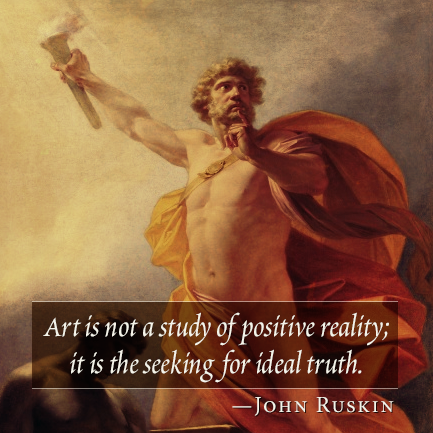
In keeping with the spirit of this month, we’re traveling back in time through this classical artist’s rendering of Prometheus, the mythical Greek bringer of fire and enlightenment to humanity. Icon courtesy of Finn Gardiner, a design collective in Boston.

____________________________________________________________________________________

‘Whose Brain Is It?” a monthly neuroscience column by Leena Prasad


Needle Pleasure
by Leena Prasad

topic acupuncture
region all regions
chemicals adenosine, dopamine


Adele’s eyes are closed. The music in the background slowly unties the knots in her muscles. She feels the tiny prick of the needles as they are inserted into her forehead, the side of her head, and near her eyes. A few needles are inserted near her ears while she lies face up on a massage table. Adele cannot see all the acupuncture needles that stick out from her face and does not feel any pain after the sensation of the initial prick.

Acupuncture releases a neurotransmitter called adenosine. One of the many roles of adenosine is to help in pain control. When the human skin is punctured with small holes, the body responds by preparing itself to manage the pain via the release of adenosine. This release of this neurotransmitter also acts on other pain in the body. Essentially, acupuncture coaxes the body into releasing a natural painkiller.

The acupuncturist places little fragrant eye pillows over Adele’s closed eyes, tells her to relax, and to not move her head. “It is best not to fall asleep,” she advises. She puts a small bell in Adele’s right hand and tells her to ring the bell if she needs anything. Adele hears soft footsteps moving towards the door, the flip of the light switch, and the door closing. She does not feel the needles at all. Instead, she feels relaxed and pampered, as if she is at a health spa.

After several minutes, Adele feels changes in the intensity of her migraine. The headache is not gone, but it is starting to wane in intensity. This makes her wonder if this is due to her psychological expectations or if there are actual physiological responses in her body. She knows that acupuncture works for many people but not everyone.

Adenosine attaches to receptors in order to transmit its message for releasing pain killers. It is possible to have insufficient or malfunctioning adenosine receptors. Thus, people with problematic adenosinereceptors will not have the same level of benefit from a treatment as someone with healthy receptors.

After several minutes, Adele starts to feel drowsy, but concentrates on staying awake, and using her mental energy to focus on chasing away the migraine. Adenosine slows down nerve signals thus causing drowsiness and relaxation. Eventually, the acupuncturist comes back into the room and removes the needles from Adele’s head. Adele can feel the change already. The migraine is not completely gone but it is much less severe. She feels happy and has to resist an urge to hug the acupuncturist.

Adele is in a great mood for the rest of the evening because the adenosine in her body causes a chain reaction of activating the feel-good neurotransmitter dopamine. Convinced about the results of the treatment, she calls the acupuncturist and leaves a message to request recurring weekly appointments. Although her decision for regular treatment might be motivated by the mood enhancing effects of dopamine, several studies show that consistent use of acupuncture is useful in reducing the intensity and frequency of migraine headaches.


This is a monthly column published in SynchChaos.com magazine and Leena is looking for other syndication opportunities. Leena Prasad has a writing portfolio at FishRidingABike.com. Links to earlier stories in her monthly column can be found here.

Josh Buchanan, a UC Berkeley graduate, edits this column with an eye on grammar and scientific approach.

Dr. Nicola Wolfe is a neuroscience consultant for this column. She earned her Ph.D. in Clinical Psychopharmacology from Harvard University and has taught neuroscience courses for over 20 years at various universities.

References:

  1. Vickers, Andrew J., et all, Acupuncture for Chronic Pain, JAMA Internal Medicine, http://archinte.jamanetwork.com/article.aspx?articleid=1357513, Oct 2012
  2. Goldman, Nanna., et all, Adenosine A1 receptors mediate local anti-nociceptive effects of acupuncture, Nature Neurosicence, http://www.nature.com/neuro/journal/v13/n7/full/nn.2562.html, March 2010
  3. Fredholm, Bertil B.,PhD; Svenningsson, Per MD PhD, Adenosine–dopamine interactions, Neurology, December 9, 2003 vol. 61 no. 11 suppl 6 S5-S9
  4. Takano T., Chen X., et all, Traditional acupuncture triggers a local increase in adenosine in human subjects. 2012 Dec;13(12):1215-23. doi: 10.1016/j.jpain.2012.09.012.

Stone villains and a talking squirrel: Bruce Roberts on Brant Waldeck’s middle-school adventure Guardians of the Scepter.


Guardians of the Scepter,

By Brant Waldeck: A Review.


My third grade granddaughter, Sophia, is excited. Weeks ago, she saw my copy of Secret of the Portals, the first in this kids’ adventure series by Brant Waldeck. Reading the cover, she was hooked, and begged to take it home to read—which she did.

Last week she spotted Guardians of the Scepter, second in the series, in the book pile on my desk, awaiting review. Her eyes lit up, and after reading the cover, wanted it: “Can I please, please, please take it home, Grandpa?” Well, no, because I’ve been busy, and hadn’t written the review yet. But here it is, and the book will soon be hers.

Kids need interesting, exciting books to read if they are to develop the lifelong reading habit. A book with heroes, villains, battles, superpowers, and of course a talking squirrel is just the ticket to grab kids by the imagination and pull them into a fantasy story that hones their reading skills. This series by Brant Waldeck, written to entertain his own kids, are such books.

The first, Secret of the Portals, introduces us to Tommy and Bruten and their families, two seemingly ordinary kids who grow and develop in new worlds, entered through magic portals from our world. In the World of Stone, especially, Bruten discovers near super powers battling stone villains, using a phenomenal weapon called the Scepter.

In the second, Guardians of the Scepter, we learn that this scepter has a long association with their families, and that as this history is revealed, the plot gets more and more interesting, for both good and evil powers want this mighty weapon.

Pursued by villains on Earth, bent on capturing the Scepter, Bruten and Tommy escape through yet another portal to Cerebra, a land where certain people possess amazing mental powers. Yet this time it’s Tommy, not Bruten, who develops in amazing ways that he never knew possible.

The plot twists and turns through surprise after surprise, as new heroes emerge to help them, battling villains that they never would have suspected, all obsessed with the power of the Scepter.

These books will not enthuse adult readers—too simple–but then adults are not the target audience. For kids though, say ages 9 through 12, who need to read everything they can, these are books that will hold their attention, pulling them to finish, and that’s how lifelong readers are developed.

“OK,OK,Sophie, you can have the book now!”


Bruce Roberts, April, 2013

 Bruce Roberts is a poet, artist and retired schoolteacher from Hayward, California. He may be reached at brobe60491@sbcglobal.net