Performance Review: Christopher Romaguera on the Berkeley and Oakland Poetry Slams

Having just moved to Oakland, when I was informed that I would be covering a couple of poetry slams for Synchronized Chaos, I couldn’t have been more excited.  The last poetry slam I went to in Miami (my hometown), masqueraded as a house party, with two happy pit bulls pacing back and forth on the patio.  When I walked in, a guy who looked like Cheech Marin but sang monotonously like Carlos Santana was at a microphone, surrounded by a couple dozen people, all with bongos and guitars, as Cheech Santana would adlib while the house band played anything and everything (which included Bob Marley’s “Jump Nyabinghi”).  Slams in Miami were a bilingual musical affair, half Def Jam, half Sandra Cisneros.

In New Orleans, my adopted home, slams were musical as well.  There was a rhythm to it, just like everything else in the city.  The last slam I went to in that town featured poets from Team SNO, an awarded poetry team, as well as a poet who was featured in the HBO Series Treme, and the main event of the night was a poet who finished his set dressed up as an alligator.

So I was curious what this slam by the bay would feel like, with every city I’ve lived in being completely different than the next.  And the West felt very different than the Caribbean/Southern mescla that I had experienced in New Orleans and Miami.

The slam I went to was the Berkeley Slam at the Starry Plough, right off Shattuck by the Ashby BART stop.  It was a cold night for this Cuban, and it definitely had me practicing the concept of layers, for the bar, which had a good population to it, was not cold at all.

The host of the Berkeley Slam was a poet who went by the name of Toaster.  Toaster is a high-energy host, which fit the setting well considering the buzz that was coming pre-show from the lively audience.  He was funny, got people’s attention, and whipped out a book of Alicia Keys’ poetry, which he painfully read from, when the crowd wasn’t responding fast or loud enough, as a form of torture (which, I might add, worked quite well).  The audience participates often in this slam, with the judges being volunteers, as well as coming up with the word of the day (which in this case, was “hamartia”).

I was impressed with the diversity of the poets who performed; with everything from letters to Rihanna to poems about admitting to your parents you smoke pot to the troubles that fifth graders in California have with a system that is stacked against them.  Many of the poets incorporated the word of the day without anything too cheap being invoked.  While half the poets were regulars, their names being called out and the energy in the building rocking with them, the other half seemed to be from out of town, or trying their luck out, with respect being paid to them as if they were an intimate friend.

The featured poet performs between the first and second round in this Slam, as well as at the end of the slam.  On this night, the featured poet was Carrie Rudzinski, who was wrapping up her tour on her way home.  Carrie’s poems are phenomenal, and the emotional intensity of them smacks you from the very beginning.  Carrie is a master at establishing the rhythm of her poems early, whether she is repeating lines such as “My God, My God,” or counting failed lovers, you can feel yourself bobbing your head to her beat, as you inch closer and closer to her and farther and farther from the back of your seat.  Whether it is stories of her road trips, running into security for the Governator, or stories about her grandfather and grandmother, Carrie transports you into her world.  And you won’t be leaving it anytime soon, with lines such as “I’ve eaten my reflection enough times, and I am still hungry” sticking with you long after you’ve taken the BART home and planned to go to sleep.

The Berkeley Slam is a fun experience, where you will see great featured poets, along with some regulars and some newbies.  The poetry will always be good, with cash incentives and good crowds fueling the machine that is this slam.  With thematic slams being prevalent, this slam never gets old.  Come to the Starry Plough on Wednesdays for a good time.

************

On October 25, 2012, I attended the Oakland Poetry Slam at Studio 1924.  Despite the fact that this Slam just so happened to occur during the Game 2 of the World Series, and on the one-year anniversary of Occupy Oakland being raided, I’m glad I went to this event.  The crowd was still really into it, with the poets who performed not being short on talent, intellect or emotion.

The host of the slam was Nazelah, a poet who had just gotten back with her team from Boise, Idaho, where they performed in a poetry slam competition.  After a quick dialogue with the audience, she started the night off with a poem of her own, introducing it as a “Poem for myself and for all of us.”

The moment she got into her rhythm, it was clear why she was the host of this event.  Nazelah’s poetry would set the table for the rest of the performers, as her spoken word had a good rhythm and would have themes that would intersect with the feature’s poetry.  With lines such as “I think of how expensive a shrink would be if I couldn’t write poetry”, the line being punctuated by her shrug, I knew I was in for a night of good spoken word.

After that, we would have everything from a young freestyling poet (“my mind speaks freely, which is why they call it freestyle”), to Patrick, who help runs the poetry slam at the Starry Plough in Berkeley, whose poem talked about “LSD mixers” that his mom and dad would meet at, to a young poet who plowed through her first performance to much applause (“Life is like a roller coaster, I just need someone to hold onto me during the scary parts”) and then couldn’t help but do two more, to a poem that was half sung about “Dancing naked in the rain.”

Then Dahled Jeffries, who runs the Oakland Poetry Slam, came out and performed two poems of his own, including one that he did at the slam competition in Boise last week.  His poems were poignant, with strong imagery and concepts that lead us to the featured poet for the night, such as when he preached a “colorblind state is white privilege defined.”

The featured poet was Marc Marcel, who is a native of Baltimore, Maryland.  Marcel has been touring for quite some time now; he is a published novelist, as well as a spoken word poet who has two CDs out.  Marcel’s poems revolve around a spirituality found in the self.  His slow and precise delivery emphasizes the importance he finds in the words he is speaking.  Lines such as “It’s rather simple, you don’t have to do this in a temple,” cannot be given its rightful justice by just having it put on the page.  You have to hear him perform it, with that perfect delivery, as he stares into the audience, to truly experience it.  When in the poem titled “Now”, he repeats the line “Just tell me you remember, no matter how long it’s been,” it resonated with me in such a way that the line kept humming in my head for the rest of the night.

The Oakland Poetry Slam I went to was full of talented poets who performed fantastically.  Just by staying and talking to them afterwards, I feel like I learned more about Oakland, the spoken word scene here, and what it means to be a writer, than anything else I’ve done in town.  A good group that is filled with substance, there was quite a few people in the audience who were inspired to do their own thing after seeing other poets come up.  A moving event that happens on the second and fourth Thursday of every month, the next one will be on November 8th, at the Spice Monkey.  Come out and see some good poetry; you’ll definitely find me there.
“Dream Girl”: A story by J’Rie Elliott

“Dream Girl”

By: J.B. Elliott


I would begin this short tale with the phrase once upon a time; however, this is no fairy tale, nor is it a story for entertainment. This tale is a warning; a warning for anyone who is under the misguided conception that ghosts are only present on the silver screen, and the chill on your neck is only a cool breeze from the fan.

I was crashing at my brother and his wife’s house one night while I was traveling for work; I am naturally a frugal person so a hotel was out of the question—also this is the only time I get to see my little nephew. That evening had been uneventful; I had been playing with Tucker with his fire trucks and Tonka toys after super. When it was time for everyone to turn in I assumed my position on the couch like I always do. Tucker is terribly afraid of the dark—a fear that is bordering on pathological, so the house is dim–never dark. With a night light in each room and a fish tank glowing behind my head in the den it was easy to see my surroundings; but this house was a second home to me, I know every nook and cranny with my eyes shut. This was the first evening, however, when the filter on the fish tank was turned off, ridding the den of the perpetual babbling brook that I was accustomed to rocking me to sleep.

As I lie there listening to my brother snore down the hallway a strange noise found my ear. It was not a noise as much as it was a conversation; a conversation I could hear, but not hear. It was as though they were in the room with me but their volume had been turned down. I strained to listen to their conversation but to no avail; I was staring in the direction of the voices—in the corner beside the front door. I know it sounds strange, but I was not frightened by the events taking place around me; perhaps I was not completely aware of what was taking place in the room with me—I do not know. However what I do know is what happened next during the course of this night changed me forever…

After a few minutes the voices I had been listening to silenced while my sixteen-hour workday caught up with me and sleep made me its willing companion. My dreams swam with the images of my wife, from a time before we traded rings and she changed her last name. We were in this ethereal world that was full of autumn colors and a cool nip in the air; her jacket was only half buttoned, revealing the sensual curve of her collarbone and the paleness of her skin—I was truly content.  As we ran and reveled in the freedom that is youth we tumbled down, falling into each other’s arms, “I love you” I told her.  She leaned in and kissed me deep—a kiss of a dream where momentarily two souls feel like one; in real life these kisses are rare; just a few times is a person granted this magnitude of passion. I pulled her close closing my eyes tightly to capture every sensation, relishing every moment, but then something was wrong—she felt different. She became cold as the grave and her skin turned damp; I pulled away opening my eyes, “Hold me, I’m so cold…” I was horrified; this was not my wife!  I jerked back, her hair was wet and long, it clung to her face and her arms like sea weed stuck to a pear; her skin was ashen gray with black under tones as though her blood ran tar black through her veins. She smelt of mold and mud; she wore only a tattered nightshirt. She reached for me, “I’m so cold…” as she touched my arm I bolted awake.

Relief washed over me as I woke in my familiar surroundings; that was until I touched my shirt–my shirt was damp. Had I sweated through my shirt? I wondered; I could not have—I was not sweating. I removed my shirt and tossed it towards the laundry room and lay back down; I was too exhausted to even think in any clear manner. I closed my eyes, hoping to recapture the image of my wife again—no such luck.  I was aware of the fact that I was dreaming, but the world around me felt like nothing the dream world should.  I was still on the couch, but now I was sitting up and this mystery woman was seated beside me—her eyes were silent pleas of complete and utter desperation.  “I’m so cold and scared—hold me…” A single tear ran down her cheek. I put my arm around her shoulder—I was not scared by her, but for her. She moved close to me and my body shivered with the cold that radiated off of her like that of a frozen pond; her dampness touching my bare side. She slowly and softly began to weep into my chest—I cannot describe how this hurt every fiber of my being; her cries were so tormented it was torture to my dreaming ears simply to hear them. The conversation in the empty corner began again, this time with just enough volume for me to make out a few words—the girl, trouble and fix it. “Leave me alone!” she screamed into the empty conversation-filled corner.  Her sobs now came in deep ragged gasps; I forced myself to hold her as tightly as I could, trying to calm her, to soothe whatever it was that was tormenting her so.  Her coldness had traveled to the very core of my body. I was drained of energy and was fighting the urge to lean to the side and lay down. Time had no meaning in this world of dreams and tears.  I finally lay to the side, lying behind her with my arms wrapped around her, “Don’t let me go—I’m so cold…” Her weeping had slowed but not stopped.  “Shut up!” she yelled at the low conversation—I bolted awake.

The part I am about to relay to you turned my skin to goose flesh and my stomach to acid—I was turned the opposite direction on the couch than I had been when I fell asleep. The sheet was beneath me rather than over me and I could still feel her lying on my right arm. Shivers traveled down my neck making my teeth chatter in my skull; I touched my arm—water—on my arm, my chest, even my pajama pants were wet; not only wet but muddy too—the conversation in the corner continued. I decided to go into work extra early that day and forgo any more sleep—I had slept with the dead once that night; I was not going to do it again.


Newspaper Headline:

DECEMBER 23, 1936

POLICE BELIEVE THEY HAVE IDENTIFIED THE BODY OF LAST WEEK’S MURDERED FEMALE.

It is believed by authorities that Iris Parker, age 26, a woman of unfortunate reputation, is the identity of the female that was found last Wednesday in Suttler’s Pond. It is not known if Miss Parker was the victim of a violent crime or the victim of an illegal medical procedure. As Miss Parker’s chosen profession brought her into contact with shady characters, it is not hopeful that the investigation will provide any leads. Miss Parker’s family is unknown–her body will be interred by the county within the week.


J’Rie Elliott is a mother, wife, daughter, and accomplished horseback rider from Alabama, USA. She can be reached at dixiepoet@gmail.com

“Sound Man”: A prose piece by Justus Honda

Sound Man

by Justus Honda

What if, sometime when you’re off-guard, when you’re walking with the purpose of doing
whatever it is you do, a peculiar ringing, something, a sound of some sort, emanates from
somewhere and floats through your head with your ears as doorways and in a second is gone?

And if you think nothing of it, later as the sun sets or rises or turns on, blazing warmth, or
whatever it does where you come from, you think of that sound you heard or witnessed before,
and you can’t replicate it in your mind’s ears with even the most powerful of your efforts,
and you know you must hear it again, so you wade through the auditory whirlpool of your
surroundings and individually test each ambient click from every corner and recess of the world
but find your search fruitless, and so unearth every object in your household and strike it pluck it
ring it cause it to make its natural sound.

But if no amount of attempts produce that elusive eerie ringing you once, maybe, might have
heard, then you may begin to accumulate objects, pots pans or any and all forms metal takes in
your world, making of each every combination of sound systematically, in a sort of auditory
alchemy, and thus your home may become cluttered with tiny and large singing things, an
orchestra of objects, perhaps, until every room and surface and cranny is occupied, and so you
must spread them out upon the sidewalk, crashing together each, taking each and attempting and
hoping to achieve that elusive sound. And though the ringings you create are not your ringing,
they are the ringings of other people, and they return to hear them each day, gather. And the
people they might call you the sound man.

And the children, maybe they stop by on their way to their tasks and toss you a fork or a needle
or a piece of sheet metal, copper steel silver brass gold, and smile and scurry off. Maybe
each time you take the new item of the sidewalk arsenal and hit the floor your skull the other
numerous bits of metal-ware, because you have been chosen to produce this one sound, that
sound you experienced, maybe, before, but no ringing of any of the objects creates the ringing,
that ringing you heard that one day,

And as you age the people they talk after gathering, they speak of the sound man and his
percussive obsession, his need to create what he calls the ringing, and far into your decline (your
nineties, maybe, or whatever old is wherever you are), they seem to all be telling you that you
will never hear the ringing you seek, and you never believe them until one day when you start
to think that maybe, just maybe, they are right, or, worse, maybe you wouldn’t recognize the
ringing if you heard it, or, worst of all, maybe, just maybe, you never heard the ringing at all—

If so, enraged, you’d heft a steel pot and throw it screaming at the sidewalk where it would crash
horribly, dent bounce scratch and skid on the pavement, and weeping you’d scatter your years of
accumulated metalwork and bend them and shatter them to shrapnel, and then collapse into the
wreckage of your world sobbing.

But maybe as you cry a little girl might approach and she might hold out to you a tiny silver
spoon (or any object or utensil created for someone small), and you’d hesitate, then take it and
flick it and hold it to your ear. And as you listen, what if you were to realize that this is the
ringing, and that you have been hearing it all your life?

Blue vs. Red: November’s Whose Brain Is It?, a monthly neuroscience column by Leena Prasad


WhoseBrainIsIt.com

Presented within the flow of the lives of real people and fictional characters, this is a gentle introduction to how some parts of the brain work.

Blue vs. Red

by Leena Prasad


topic politics
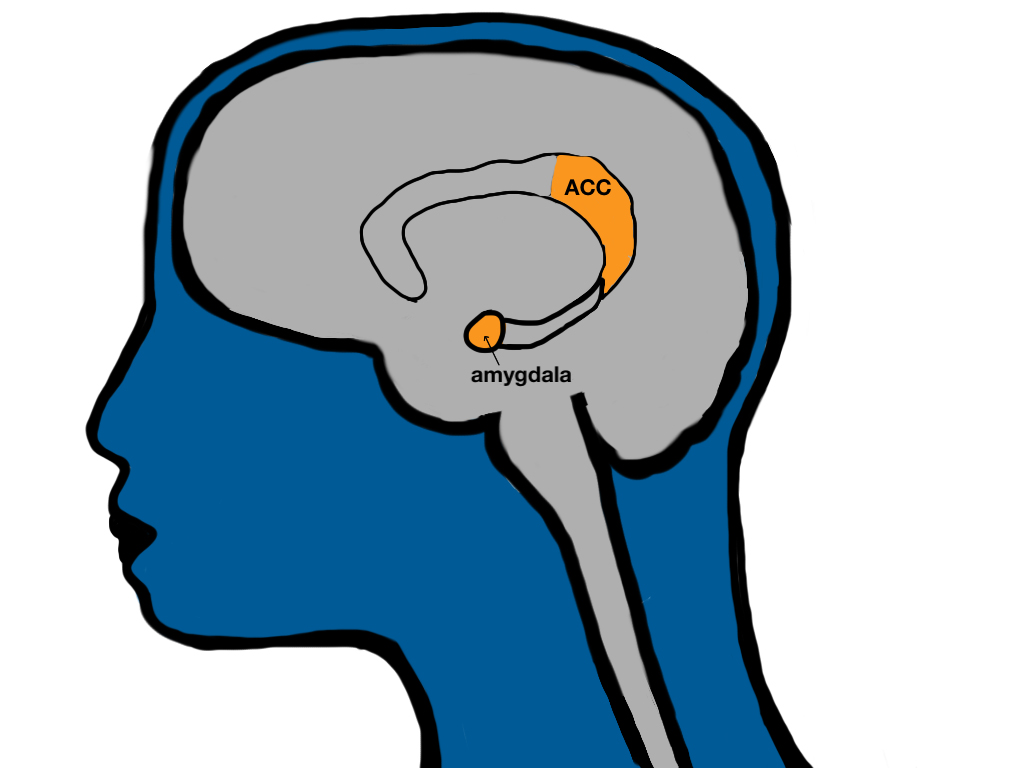
region amygdala, ACC


“…My plan will continue to reduce the carbon pollution that is heating our planet – because climate change is not a hoax. More droughts and floods and wildfires are not a joke. They are a threat to our children’s future. And in this election you can do something about it,” said Barack Obama. On the contrary, Mitt Romney said, “I’m not in this race to slow the rise of the oceans or to heal the planet.”

President Obama and Governor Romney’s views represent those of their constituency. According to a 2011 Gallup poll, 70% of Democrats “Worry a great deal / fair amount” about climate change, as opposed to only 31% of Republicans. This difference in the Democratic and Republican belief systems can have significant policy impacts regarding climate change.

From a scientific perspective, some of the general differences between Democrats/liberals and Republicans/conservatives can be observed in the workings of the brain. Much of the neuroscience research, however, that has been done in this area is inconclusive, and the results are controversial.  This article is not an exploration into the why or how these differences formed but it is an explanation of the differences that were discovered amongst the representative samples of subjects who self-identified as Republicans or Democrats or conservative or liberal.

A study conducted at University College of London in 2010 concluded that conservatives have a larger amygdala than liberals. The amygdala is responsible for emotional reactions that activate the fight-or-flight response. Other parts of the brain often moderate the primitive survival instincts of the amygdala and guide human behavior.  The methods used for the study and the results are highly controversial and have not passed the scientific rigor of replication and peer review.  Furthermore, there is no scientific correlation between the size and activity of the amygdala.

There are other studies, however, which found differences that have been replicated by many scientists.  A consortium of scientists based in San Diego, discovered that when participating in risk-taking behavior, Republicans show a higher level of activity in the amygdala than Democrats. Democrats, on the other hand, show higher activity in the Anterior Cingulate Cortex (ACC) when presented with the same risk-taking tasks. The ACC is involved in many functions, both cognitive and emotional, but one of its primary jobs is to resolve conflict. A study published in Nature Neuroscience also describes higher activity in the ACC when liberals made a mistake in pattern recognition. They were able to correct the mistake and improve performance at a faster pace than their conservative counterparts.

Other parts of the brain are also involved in processing information and issues on the political spectrum. As such, these differences are not sufficient to pinpoint brain dynamics.  More extensive studies are required to both understand the differences and the means for communication with brains that exhibit these differences.

For now, how do we negotiate the differences in the belief systems and find a common ground? That’s beyond the scope of this article. But, understanding some of the differences in brain structure can at least provide an insight that the differences are hardwired in the brain. There are many studies that demonstrate that brain chemistry can be changed. This means that communication and negotiation can serve a useful purpose. If Mitt Romney and President Obama cannot agree, perhaps they can find a way to talk to each other and negotiate differences with a common goal of creating a harmonious existence for all Americans.

Upcoming…

December: neuroplasticity, the brain’s ability to change

January: food for thought, i.e., the affect of food on your brain


Leena Prasad has a writing portfolio at http://FishRidingABike.com and a journalism degree from Stanford University. Links to earlier stories in her monthly column can be found at http://WhoseBrainIsIt.com.

Dr. Nicola Wolfe is a neuroscience consultant for this column. She earned her Ph.D. in Clinical Psychopharmacology from Harvard University and has taught neuroscience courses for over 20 years at various universities.


References:

1. Darren Schreiber, et al. Red Brain, Blue Brain: Evaluative Processes Differ in Democrats and Republicans, Emerging Politics, 2009,  [http://www.politicsemerging.com/Publications/RedBrainBlueBrain.pdf]

2. David M. Amodio et al. Neurocognitive correlates of liberalism and conservatism, Nature Neuroscience, September 9, 2007.

3. Mooney, Chris. The Republican Brain: The Science of Why They Deny Science–and Reality. John Wiley and Sons.

4. Mitt Romney’s Climate Change Remarks On ‘Meet The Press’ Outrage Environmental Activists, Huffington Post, Sep. 10, 2012

5. Obama Counterpunches on Climate Change, New York Times, Sep 7, 2012

6. In U.S., Concerns About Global Warming Stable at Lower Level, Gallup Poll, March 14, 2011 [http://www.gallup.com/poll/146606/Concerns-Global-Warming-Stable-Lower-Levels.aspx].

“Imagine a Woman”: A prose piece by Kim Brown

Imagine a Woman
by Kim Brown


Imagine a woman who trusts and respects herself. A woman who listens to her needs and desires. Who meets them with tenderness and grace.


You are that woman, full of knowledge, wisdom, understanding and grace. You are that woman who’s gone through trials and tribulations, yet you’re still able to face the day. You are that women, who breathes and has life, that woman who can make a difference regardless of your circumstances and strife. You are that woman that God has given a second chance, God has given you chance and chance and chance. You value you, you are valued, you are loved inside of homes, walls, and hubs, you are a shining star and your heart beats as bright as your smile, you are the wow factor, inspired, the center of attention in any crowd. You value yourself and others and you are always willing to commit to change. You are Globally known in your mind and that will never change. You Queen-being with the sound mind, continue to be productive, continue to lift minds, continue to be peace, continue to be love, continue to make an impact on the man up above. And because hes kept you safe, you are full of gratitude, you have favor where ever you roam, Your whole world is behind you. Your whole world is backing you, people of importance respect you, because of your milestone attitude they always love you. But Ms. You, keep doing you, you love you like no one will ever do, and when you love others the love that comes to you is a thousand multitude, and you have the God of peace upon you. Keep your spirit clean, keep your soul right, God has never lost sight on you, Ms Ruby, Ms Soothe because you are you, and no one can do you better, you will continue to be blessed by your very own Alpha and Omega.

Prose poetry from Ria Burman

Snap! We’re All the Same

The grey shooting pyramid’s point stands prominent against brilliant blue as tourists aim cameras by the transaction of Broadway and Columbus with the Condor on the corner and the flying books with fallen words in front of the blue jazz mural bricks above. Andes Cosmos pan pipes float from beyond city lights. Here journals leather bound and images on street wall hold great possibility in alley cat scent as beat poet, deep set wrinkle line face folds and creases with gentleness. Water puddles from street cleaning, reflects anger from a man who sits and spits his life in monologue to the audience of a thousand ghosts inside himself by the entrance of City Lights. All we need is love. Where is his? Does science rule over everything else? No. There are things unknown invisible which float and heal, which touch and moves us. One needs to want this though. No judgment. Is it in genes? So many men sleep on streets, dirty beards with eyes glazed ~ the crazy eye glaze of lost soul. Peer through these windows for a second chill, the mysterious draw, the unknown knowing that something isn’t right here, the window to a room of rewind, of ghastly sorrow, of brokenness, of no return, of door slam shut, no way home, ghoul shock, moment of horror, frozen in time, for nothing to be the same again. Schizophrenia becomes company, walking hand in hand with constant static sound. No rest. No happiness. No forgiveness. Crazy sits on the corner of the street, angry as music and art appears around him and grows, dancing in circles and waves. The water puddles evaporate with the morning sun, the interval between songs is still, void now of shout streams of insanity as the sun slowly swings around Vusuvio’s.

Mister Chris Jeffries arrives walking down the alley behind green shades and an accordion with two friends carrying guitars like desperados. Gypsy jazz unravels itself, with crowds stopping, clicking photos, swaying smiling, notes flutter down to open empty case with nods of thanks and singing smiles. A fusion of music and art brings attention from wine sipping lovers sitting by the window above in the bar looking down.

Unknowingly, I hear a thought and say pardon to a woman with a long brown curly mane.

“I did not say a word. I am from Spain. This is my last day. I had to come down. I was upstairs with my boyfriend.” She points up; my eyes follow to a man, his head cradled in his hand, his face obscured by the reflection of the glass, z’s float through the open window. I look away. “I had to come down. I am a dancer.”

Later, she requests Spanish music. I see her dancing in the street.

“This is my kind of music.” She says, shaking her mane.

Later still, she strums a guitar sitting on the floor. Musicians share music, attention and time, juggling, smoking, dancing and talking. A celebration of strengths rejoices in the alley. Before she leaves, she appears before me and directs enchantment into my ear. The surprise of her holding my hands and the look in her eyes stirs emotion within. Tears form in my throat, I swallow them done. She leaves.

A guarded Parisian’s walls melt through stomp flamenco dance groove spin boogie, impromptu sing jamming and days spent outside together. The bashful, delicate flutter blink of her eyes meets mine through spins and laughter. There is space between for trust to grow as subtle attraction stems. In these times, communication is seldom with words, instead another plain, where indescribable notions appear invisible, a magic Cosmo roll around, children know without knowing, it lies in the innocence of all of this as we move through neutrinos, listening without ears, absorbing sensations, discovering new language. She is gentle and timid like a deer, with one stumble or loud rustle, she would dart away.

As the sun sets and the street lights cast fuzzy yellow glows over the alley, I bid farewell to the remaining sweet souls of the travelling photoman’s show. The Parisian deer will leave in the night for home. We embrace. On parting, the world again slows, like in those magic moments, which surprises us by appearing in the smallest words, actions, gestures, which poof appear and swoosh are gone forever; time stretches to the plain of what is. Something holds our bodies close, the connection unbroken, now face to face, in this sweet embrace of space, the air whispers with no words, gently it cradles us for centuries, we remain in the harmony we create, peacefully. I draw away, the connection parts, seconds tick like thunder as my mind kicks back in, dashing like it slept in for work to reconfigure, to catagorise something it can never fathom. The street becomes loud with chitter chatter and the moment has passed, collected in an ethereal scrapbook of wow.

The next day, a distant land phones.

“What have you been up to? Nothing. Loafing.” Asked and answered in half a breath by a man who I still hanker after for some connection, for some affection, for some acceptance, forever chasing an elusive thread which would connect. I agree with him, tired of justifying my existence.

Here I realize that unless witnessed, unless times are shared and experienced together by past reruns with new faces and different places or shock start right now understanding  or from future endeavours then others will not know, will never grasp what it is, that all could be seen as wasted, that all could be gathered and held as priceless. That we ultimately stand alone in the company of those who have forgotten and are playfully nudged wink reminded by those who still remember.

****************************************

The Woman and the Wind

We dance and for a second she forgets and feels free.
I see the beauty that is in her breathe
before a rooted thought of wrong doing enters and she kneels down,
blindly searching for the chain to shackle herself back into the cage.
For she loves the ones who created the walls
and she hasn’t the strength to break those down,
not when it means destroying all she knows.

I watch her sit there and hum so sweetly,
changing tears to a tune,
distracting herself with so many other things
which fills her time and her space,
but there’s no stopping the racing of a heart,
it’s a magic science, a crazy chemistry,
which bolts thunder claps from the brain to the belly,
that moves the body quicker than lightning and the mind blinded,
cannot keep up with the heart of the body.

Flash!

Her body moves with another of the same form,
like an ocean with the shore, over and over,
it soothes as it moves.
The light is followed with a BANG!
The cell door clatters open and slams shut with a bewildered wind,
as she remembers that all she feels is not allowed
and retreats out of a cherished love for those who fail to understand.

The wind does not strike her; it is not angry, but gentle and warm.
It cradles her when she’s sad and lifts her high when she’s feeling blue,
it does not control her with fear, but with comfort and love.
It tickles her and makes her smile,
all the time misunderstanding the black shape which moves on the floor.

The wind wishes to blow it away, it uses bigger and bigger puffs,
and afterwards is left exhausted.
The black mark is unfathomable to the wind.
”It’s still there, that dirty black mark which follows you around.
Why can’t you leave her be?” It howls.
And she cries out with a muted voice,
which echoes the temples of distant lands.
“It is a part of me!”

The wind howls again, anguished and sad,
blowing the words spoken away,
unable to hear them through distortion of pain.
It picks itself up for another gust and another,

“Why won’t it leave? The place will look so much cleaner
without that black mark which keeps following you around.”
It blows unrelenting,
like a house proud mother wiping at a stubborn wooden table top stain,
unknowing that it is a knot, a natural pattern of the wood.
“Please, let it be. It is a part of me.” whispers the wood and the woman.

The wind slowly stops dancing and becomes heavy,
which sinks her radiant smile and twinkling star eyes to black holes.
I see the blindness of the wind, blowing at the black mark,
with more gust and enthusiasm at seeing improvement and progress,
as the mark moves away by the power the wind possesses, or so it thinks,
only it does not realize, that it is her beloved that it blows into a ball,
over and over, tied in knots, until she cannot breathe.

The wind does not see the position she is in.
It does not see the vases knocked over and smashed to smithereens,
like salt bubbles that explode from her eyes
when she loses control and snivel sniff cries,
“I don’t want to be so sensitive to this,
but it scares me so much to be cold and unaffected by it all.
When I think of homophobia,
I think of bullies spitting comments in a crowd or on a street,
of hate crimes and terrible things like these.
I never in my wildest dreams thought it could be like this.”
Flowers lay unnoticed on the broken glass ground,
trodden on by all those others who don’t look down.
(and jeez, there are many, too many for there to be more)

Hold up ~
For all the guns in the world, that ends a life with less than a thought,
could we not shoot each other a smile from time to time and try,
just try to get along, it is after all only love.
The rest doesn’t really matter,
it is only love that connects us all, that gets us through~
Thank you, now back to the poem…

As the wind blows unrelenting at her shadow,
wishing for it to not be there,
she stands up strong and bold through the blinding, deafening gale.
She does not move an inch by the gust, her hair wild like flames licking up to heaven,
she says, “My shadow exists because I have found light,
for it to disappear I shall live in darkness,
and like the bird set free from its cage,
it cannot return, once it knows what it has learnt.”

The thing which she needs now more than ever, is not shelter from the wind,
but for the wind to blow down the walls it has created over time,
and hold her in acceptance,
for no one knows more than the wind,
how wonderful and important it is to be free from all these things.

Performance Review: Christopher Bernard on the Cutting Ball Theater’s productions of the works of August Strindberg


CHAMBER MUSIC


Strindberg Cycle: The Chamber Plays in Rep

By August Strindberg

The Cutting Ball Theater

San Francisco

Through November 18


A review by Christopher Bernard


Curiously, Strindberg’s five chamber plays have never been presented before in repertory (not even in Sweden, which is something of a scandal), which is as remarkable as if Wagner’s “Ring” had never been done complete, or as if nobody had ever had the idea of doing Shakespeare’s Wars of the Roses plays as a series.

Because, though each of these short, darkly poetic plays can be presented alone, and at least one of them, “The Ghost Sonata,” has had a long afterlife on the stage, in combination they form a chain of theatrical experiences of a density of cross-reference and tortured poetry of ever-deepening resonance and power. Looking back over the past century since their creation, one can see the forest of much of modern drama and even cinema – from O’Neill to Pinter, from Victor Sjostrom to Ingmar Bergman – sprouting from their much turned-over soil  San Francisco’s Cutting Ball Theater, which, as part of the Strindberg centennial year celebrations, is producing the cycle in repertory this fall, is thus doing the entire theatrical world a service.

More than a service; more like a gift. At least in the three plays I’ve seen so far, under Rob Melrose’s canny direction, with handsomely appointed sets by Michael Locher, beautifully judged costumes by Anna R. Oliver, the subtle touch of lighting designer York Kennedy, and the superbly crafted sound design by Cliff Carruthers – and above all thanks to a fine cast, about which more below – this production promises to be one of the Bay Area’s theatrical events of the year.

No small part of the beauty of the project is that The Cutting Ball’s tiny theater on Taylor Street in San Francisco is almost the exact size these plays were written for, creating an intimacy and intensity that are rarely found outside the finest, subtlest and most profound chamber music.

The plays I have seen are the last three in the series, but I wanted to get the word out before the series closes in November: “The Ghost Sonata,” one of Strindberg’s most famous plays, a tale of revenge gone out of control among a household of people locked in the past, recoiling in the end even on the avenger;  the ironically titled “The Pelican,” the most typically Strindbergian of the series in that it dwells on the love-hatred, mutual incomprehension and unfaithfulness, that so often informs the bond between men and women, and that seems to be Strindberg’s final assessment of the war between the sexes – a necessary evil in the evil necessity of life and its procreative compulsion; and “The Black Glove,” the last of the series, and a sweeter, tangier, gentler, and wittier conclusion than one might have expected from the oft-gloomy Swede. Even he can’t quite reach the conclusion, despite having had a hard time avoiding it, that human life is at bottom a sham and a waste of everyone’s time: after all, without being alive, we would never have the pleasure of watching Strindberg dissect human existence and find it so wanting.

In any play, of course, the meat comes in two portions: the script and the acting. And in the case of a script written in a foreign tongue, the translator has at least as much responsibility as the author – and in this Paul Walsh excels in turning Strindberg’s perfervid Swedish into largely plausible contemporary American English, in spite of a few tonal anachronisms.

But who gives life to a play? Who makes it breathe and live, fascinate our minds, bond our souls, thieve away our hearts? The actors, of course. And this cycle tests an ensemble like few others. Several of the actors should be singled out: Caitlyn Louchard, who appears in central roles in all three plays, shows a light touch and charming variety; James Carpenter provides his dependably strong presence in “The Ghost Sonata” and “The Black Glove,” wily and wise, cunning and dotty as need be; Anne Hallinan is a delight in the smaller roles, and gives almost alarming weight to The Cook in “The Ghost Sonata.” Carl Holvick-Thomas is particularly strong as Axel in “The Black Glove,” though he doesn’t show quite so secure a grip on The Student in “The Ghost Sonata.” In fact, the actors taking on the ephebes often don’t quite ring true. Strindberg is partly to blame: the lines he gives them don’t always ring true either.

David Sinaiko steals most of his scenes as the Puckish spirit of mischief and reconciliation Yule-Tomte in “The Black Glove”: who knew Strindberg could be so endearing, so sweet, so funny?

Danielle O’Hare, with her dramatic beauty, spare features and command of a gesture at once richly suggestive and sharply defined, brings a furious intensity to her role as the mother in “The Pelican;” her presence in minor roles in the other plays is as memorable as it is welcome. She seems to have walked out of a Bergman film to grace the world of Bergman’s prophetic ancestor.


Christopher Bernard is a novelist, poet, and critic. He is author of the novel A Spy in the Ruins and co-editor of the online arts magazine Caveat Lector.