“Pelican Ballet”: A poem by Bruce Roberts

Pelican Ballet


   Coyote Hills Park,  October,

          Still life in dry and brown

            Weeds, grass, rock

  Sand surprised on the bottom

       Of once well-watered wetlands,

          Now gasping through Fall

                  Til rain.


        But in one struggling pond—

            Lucky in water—

          There is movement.

                  Pelicans—

            Flights of pelicans—

               Lift themselves

    into the air,

first one group,

  then another,

  and another,

six, seven, eight—

          squadrons of pelicans—

           some thirty strong–

spiraling skyward

       against the cloud-white,

against the blue.

             Tilting together,

         their dark underside

           Like a silhouette,

            Then turning,

            Disappearing,

         Only to flash back

               White,

               Tilting

        Leisurely Blue Angels

               Circling  

     In silent perfect formation.


          Higher and higher,

           Over and over

           They dance

          As we watch

       Stuck to the ground

             Amazed

             At this

        Graceful display

               of

         Whirled peace!


                  Bruce Roberts, 2012

 Bruce Roberts, who may be reached at brobe60491@sbcglobal.net, is an accomplished sculptor and schoolteacher from Hayward, California. 

Performance Review: Cristina Deptula on the Tom Sway Orchestra’s performance at the StageWerx Theatre

Who knew that at thirty years old, I’d still get excited over songs about trolls, rocks, and Rapunzel? I did last night at StageWerx Theatre, now tucked away among the curio shops, ethnic markets and avant-garde galleries of the Mission District.

The show was part of the Underground Sound series, taking place every second Sunday evening at StageWerx and designed to showcase new music. The intimate, freshly renovated venue allows audiences to hear the lyrics, and is sparsely decorated in black and white to draw attention onstage.

The first opening act, guitarist and singer Bryan Hill, serenaded us with a few tightly crafted, thoughtful pieces, including a bluegrass blessing his grandmother used to sing to him as a child. Then, to perk us up before Jhene Canody took the stage, he played a livelier tune about a man and his pet dog.

Canody mixed some poignant, dreamy pieces, laments for love gone wrong and right, with a few peppy, humorous fantasy ballads. One related the tale of a dream wedding to Jack the Ripper officiated by her fifth grade teacher, and another gently described the awkwardness of feeling so much more privileged than others for no good reason.

After an intermission, singer and songwriter Tom Sway took the stage alone for his first three pieces. Although his songs were quite fast and I couldn’t make out every word, he caught my attention with his energy and facial expressions. Sway knows how to engage an audience, entertaining with his persona in a way only a live show can capture.

While often playful, Sway’s lyrics never became corny or ridiculous because of his subtle observations about life and human nature. His first piece, an upbeat fantasy about a lake with tiny rocks and hermits fishing where there are no fish, but he worked in mentions here and there about the tragicomedy of life. Not enough to sound self-consciously ‘deep’, but just to make audiences take a step back and reflect.

Another song, my personal favorite, tells of a man fascinated by a female dancer/mermaid/mythical creature who steals and then returns his car. He panics, but when she comes back, he ends up going with the flow and enjoying being with her. Although clearly fanciful, the piece made me think of how many times in life I feel sidetracked or frustrated, then decide to just be okay and live in the moment.

Later on, along with emcee Bruce Pachtman on drums and Phil Casey on piano, he performed a set of longer, perky pieces. These included a jazz-esque love song, a long storytelling session about searching for treasure in the desert, and a remake of the Rapunzel tale, which got us tapping our feet and relating to the characters’ loneliness.

Sway refers to his musical group as an ‘orchestra,’ from which he decided to eliminate brass, strings and woodwinds for playful reasons. The orchestra provided interesting and complex accompaniment, complementing and sometimes mellowing out Sway’s onstage personality. All three performers came together nicely for the last piece, a group signature tune about a deserted Midwestern high school football stadium that left me clapping in rhythm and remembering my teen years.

Tom Sway’s a native to San Francisco and writes his own songs. His music’s very accessible, fun to listen to, and a good alternative to angsty or inane tunes you might find elsewhere. It’s worth catching the next time you’re in town, live if possible!

Cristina Deptula is a writer from San Leandro, California. She can be reached at cedeptula@sbcglobal.net.

Poetry from Michael Dickel

TABULA RASA

Blurred snow-
washed moraines,
wind-cloaked distance:

storms.

Sleeping stargrass,
surrendered bluestem,
buried gentian, all

frozen.

I do not love
you or anyone—
just another

man

content the moment
shadow crosses
indifferent drift.


ONE NIGHT WHEN YOU WERE NEAR

The breath through white pines outside this window
soothes by mimicking rain sound.
Ticks master deception—their movements
disguised as evaporation or
tickling breezes or the slight sense of another
as they slide up a leg or the inside of jeans
until they latch on and dig their mouths into skin
and become
a news story here about murder,
a news story there about rape—
discouraging and fearing us at once,
as they drain our blood,
infect us with lyme disease, indifference,
isolation. Tired, our joints aching,
we don’t know what to do.
Then a lightning bug flashes
in the dark summer night.


RECIPE

one cup of consider a moment the voice of reason spewing sprockets sprayed story edits the road mud half-cup of experience a narrative constructed piece by piece from gravel and dirt and blood and tears reduce hours on the stove boiled to nothing but imagined flavor intense in commerce mix with green salad dollars’ empty calories a tablespoon of worn skirt-like seven veils stripping off dollar after dollar mix in two naked breasts one belly one patch of hair through which peak the full lips that do not speak in this room broom closet add my mouth lingering to lick those lips and taste that truth a flavor better than all of the gravelly reductions road bed place on your bed soft and downy and wide white clouds so I fall into the heat of your skin erasing any reason not to experience the moment consider no narrative but dancing entwined naked bodies reduce us to this moment of release pent up and drawn out and everything we ever wanted to be tasted deeply over time nine courses per meal


A GATHERING OF STONES

I gather stones from ocean, sea, lake, river, stream, and the dry desert wadi; to protect my straw life from the storm winds of time they line the walls, shelves, walks, and a small corner rock garden. Snow buries them in winter, the outer ones, and the inner turn invisible beneath plaster and book dust as these stories and poems renovate the narrative, revise my living space into something that might hold up to erasures of climate, and my life into—something. Long after my DNA strands become a statistical probability chancing in some descendants’ groins; long after the house falls to dust, the garden to weeds, the shores of the oceans and seas recede, advance, the lakes come and go, the rivers dry and flood, the wadi erodes to flatlands; long after all of this; a few stones out of place here in a row, there in a pile, might attract some little notice, a bit of curiosity. This flint tool from Baak’a in Jerusalem.  This agate from Lake Superior. Amethyst from Ontario. Lava from Hawaii. Mica from Pennsylvania. Polished smooth granite. In some way, someone may ask. Where did such stones come from? When?  How did they end up here? Why? What story do they tell? Who gathered them in? I will only pretend to know the answers.


Michael Dickel’s prize-winning poetry, stories, & photographs have appeared in journals, books, & online—including: Sketchbook, Zeek, Poetry Midwest, Neon Beam, why vandalism?, & Poetica Magazine. He lives and works in Jerusalem at the moment. His latest book of poems is Midwest / Mid-East: March 2012 Poetry Tour ( http://www.amazon.com/Midwest-Mid-East-March-2012-Poetry/dp/1105569136).

Synchronized Chaos, October 2012: Nature and Society

At first glance, it might seem that modern American society—with its technology, its towering cities, and its cultural achievements—is far removed from the natural world. But is this really the case? What, precisely, are the differences between human culture and the world of the wilderness? And are there closer connections between the two than there might seem at first sight? The October 2012 issue of Synchronized Chaos takes a look at these questions. Some of the pieces in this issue deal with various characteristics of human society—art, religion, traditions, cultural differences, and more; others serve as examinations of nature, its processes, and its animal inhabitants; and still others explore the intersections between the two spheres. We think you’ll be very interested in the pieces which follow…

One particularly interesting elucidation of the links between humanity and the natural world is an anonymous short story “Taking Ohio.” It takes place in the proverbial middle of nowhere, in the bleak beauty of Mideastern America, but into this setting comes a pair of very modern travelers, whose meeting with an unusual hitchhiker leads to unexpected difficulties for all three. The wilderness serves as a fitting backdrop for the tale’s raw exploration of human emotions.

A similar outdoor setting can be found in Josie Weidner’s poem “Landscapes,” which memorably compares the “tiles” of an open field, with their differently-shaped and shaded patches of grass, to the manufactured patterns which can be found on the kitchen floors of America’s homes. Once again, the wild and the domestic are not quite so far apart as they may seem at first sight.

Perhaps this issue’s funniest depiction of the human-nature connection comes from Loretta Breuning, whose comedy monologue “I, Mammal: How I Evolved from Lizards, Apes, and Thugs” is printed here. Taking the form of a tour guide’s spiel to the patrons of a zoo, the piece describes the behavior of elephants, monkeys, lions, and other wild beasts as being uncomfortably similar to the actions of human beings. The animal kingdom also comes up for discussion in two of this issue’s featured poems: Mykel Mogg’s “Mercy,” which features the disturbing fate of a fish at the bottom of a well and the voice of a narrator who’ll be very difficult to forget, and Bailey Van’s “The Minnow Dance,” which juxtaposes the activity of a school of glittering fish with the erotically-charged interactions of two people.

Bailey also contributes three other poems to this issue. Each of them features exquisitely-composed imagery from nature, with excellent evocations of the golden beauty of summer and the cold harshness of winter. And the world of nature is also the setting for three poems by Abigail Schott-Rosenfield, which take us through forests, fields, and mudflats. Life and death, sun and rain, fire and snow—all are depicted here with equal skill.

Each issue of Synchronized Chaos features Leena Prasad’s column Whose Brain Is It? In this month’s installment, “Rachael’s Defenses,” Leena makes a thoughtful exploration of the topic of racism, discussing the ways in which natural brain chemistry can combine with societally-created biases to lead towards (sometimes unconscious) expressions of racial prejudice.

Wherever there is life, there must also be death. It’s not always the most pleasant subject to contemplate, but death is an inexorable and inescapable part of nature, and it’s intimately explored in a few of our poems this issue. Regular author Sam Burks contributes three dark but fascinating works, and two of them explore the theme of mortality: “Death,” narrated by a living personification of its title, and “Last Meal,” which draws an unforgettable symbolic connection between the acts of murder and deception. Meanwhile, Christopher Bernard’s poem “Olympian,” at once touching and insightful, lays its scene in a graveyard and takes as its subject the memories which live on after death.

Regular poetic contributor Linda Allen takes on both halves of this issue’s theme. One of her two poems this month, “Hello Autumn,” features beautiful depictions of the arrival of fall and the constant natural cycle of the changing seasons; the other, “All Hallows Eve,” depicts a longstanding cultural tradition celebrated at the end of this month in countries around the world (often with ingenious costumes and plenty of candy!). J’Rie Elliott, another of Synchronized Chaos’ most frequently-seen poets, also takes on the subject of Halloween this month in “Meeting the Dead…”, a set of verses which combines the innocent fun of childhood with the unexpected terror of a much darker subject.

Synchronized Chaos has a number of contributors who make their home in the Bay Area, and some of this month’s pieces deal with aspects of the regional culture. Christopher Bernard, making his second appearance in this issue, was in attendance at the 21st annual San Francisco Fringe Festival in early September—one of the city’s best and most unique theatrical events. Christopher’s article features his thoughts on four representative selections from the festival’s dramatic feast. For another take on one of the most notable pieces from the festival, Angela Chang’s musical “Legacy of the Tiger Mother,” take a look at Joy Ding’s review here. We also have a feature piece on local hip hop artist Bink$ Win$ton, whose new EP “MANish” is scheduled for release soon. In this issue, we’re presenting the music video for one of his recent songs, “STOP,” which was filmed directly across the bay in Oakland.

Elsewhere in the issue, the societies of many other nations are under discussion. Georges Bizet’s masterful 1863 opera The Pearl Fishers takes place in the distant past on the island of Sri Lanka (then known as Ceylon), and Bramani Spiteri reviews a recent staging of the piece by the talented performers of Opera San Jose. Also featured is Nigerian poet and screenwriter Emmanuel Ikem Bertrand, whose essay “There’s a Land Beyond These Waters” urges its readers not to forget the multitude of cultures outside of their own horizons and reminds them of the importance of helping those in need.

Almost all lovers of literature and stagecraft know the name of Oscar Wilde, who scandalized Victorian society with the brilliance of his art and the controversy of his actions—but how many are familiar with his niece Dolly (1895-1941), an equally flamboyant figure who made her mark in the Parisian culture of the early twentieth century? Lily Sauvage’s play The Importance of Being Dolly deals with the life of this intriguing character, and in this issue we report on a cold reading of an upcoming production, attended by one of our reviewers..

Another of our poems for this month is an examination of religious culture and tradition: Shanna Williams’ “Do Not Destroy,” an introspective and thoughtful piece which touches on the nature of community as well as the ethics of believing in God.

We hope you enjoy this month’s issue of Synchronized Chaos! As always, feel free to leave comments for the contributors; if you’re interested in submitting some of your work to the magazine, please send it over to synchchaos@gmail.com.

Performance Review: Joy Ding on Angela Chang’s Legacy of the Tiger Mother

Review: Legacy of the Tiger Mother

by Joy Ding

Whether you are fortunate/unfortunate enough to have your own tiger mother, or simply curious about what it’s like to have one, you’ll find plenty to satisfy you in Legacy of the Tiger Mother, a semi-autobiographical two-woman musical written by Angela Chang. In Legacy, we meet Lily (Satomi Hoffman), a first-generation Asian immigrant and her daughter Mei (Lynn Craig), a second-generation Asian-American, and get to witness the thirty-something years of their tumultuous relationship with each other, and the piano.

If you’re looking for music, Legacy fulfills its identity as a musical in more than one way. Not only are there Broadway-worthy songs such as the crowd-pleaser “Lazy White Children,” and heart-wrenching duet “Something Better,” we also get the pleasure of listening to Mei’s progression on the piano as she grows up. Chang, who plays the piano from off-stage, fully captures the full progression of Mei’s piano ability, from the stumbles and missed notes of a beginner playing Mozart’s variations on Twinkle Twinkle Little Star to the more difficult pieces Mei plays as she gains confidence and ability.

Actors Satomi Hoffman and Lynn Craig exhibit remarkable range in Legacy, under the direction of Lysander Abadia. Craig does an admirable job of portraying Mei at each age level. While the initial whininess of a young Mei is off-putting and hard to believe in “Suzuki Prayer,” by the time she sings “Little Miss 1986,” Mei has become more realistic. Paired with the wistful refrain of Little Miss 1986, a refrain strong enough to bring anyone back to childhood and the feeling of being excluded and unpopular, Craig’s breathy treatment of the song is delightful. You’d swear Craig were a metal-mouthed schoolgirl, just back from a braces retightening. Hoffmann, as Mei’s mother, captures the many facets of Lily, whether it is her fierceness and authority, her unabashed opinions about parenting and other people’s children, or her instances of uncertainty in private, when she does not have to maintain an impenetrable veneer of strength for Mei. Hoffmann is also a master of the small gesture; for instance, some cringe-worthy rhymes in “Letting Go” are all forgiven for the one transcendent moment at the end, when Lily grasps the piano and sings “she’ll always be our little girl.” In that one movement we see Lily views the piano as a partner in raising Mei, not a mere object.

Legacy, however, does fail itself in certain moments when it repeats stereotypical comedic material for easy laughs. For instance, any of the times Lily sees fit to intone a Confucian saying (“Confucius say…”), I felt my heart sag. Or, when Mei threatens a too-loud Lily by saying, “Ma, don’t make me smack you with my chopsticks.” Yes, one could argue that these moments are covered by Legacy’s billing as “a slightly exaggerated story,” but these particular exaggerations are also neither novel nor interesting. In a musical that succeeds on the strength of Chang’s ability to recreate the truth of her experience for others by creating a fictional narrative, these moments of forced humor stand out as moments of falseness.

In contrast, at the end of the musical, Lily and Mei get to have a resolution that is as emotionally resonant, truthful, and satisfying as any I’ve seen on stage. They start out bickering about their differing approaches toward parenting and end in a furious, tumultuous argument with the highest stakes possible: whether Lily has ever loved Mei. Mei contends that Lily was happy to get rid of her, citing Lily’s selling of the piano as soon as Mei left for college. Shocked, and teary-eyed, Lily tells Mei that she sold the piano because she couldn’t bear it that Mei was no longer around to play it. And the perfection of that moment of understanding, and then the moment afterwards, when Lily reaches toward Mei and you think she’s going to take Mei’s hand, but instead, she wraps her own arm around Mei’s arm — the awkward affectionate gesture of a mother and daughter who don’t touch much – is painfully recognizable. It is a gesture that I recognized with heart-breaking clarity as one that my mother has used when she’s feeling particularly emotional about being a mother, like this spring, at the end of Brave. My mother left the theatre saying: “That’s just who I am. The bear-mom who would do anything for her children.”

So, does Legacy of the Tiger Mother succeed?

Well, judging by the amount of happy people at the end of the show – some relating stories of their own childhoods, others laughing about the lyrics in “Lazy White Children,” and, yes, several Asian and Asian American mother-daughter duos walking arm-in-arm to the exit – resoundingly yes. In fact, I wish my own mother had been there to watch it with me.

This reviewer applauds the Legacy team for bringing this story to the stage, and looks forward to seeing more work from Angela Chang.


Joy Ding is a freelance writer, editor and marketer living in San Francisco. She might start playing the piano again after watching this performance. 

Rachael’s Defenses: October’s Whose Brain Is It?, a monthly neuroscience column by Leena Prasad


Rachael’s Defenses

by Leena Prasad

topic racism
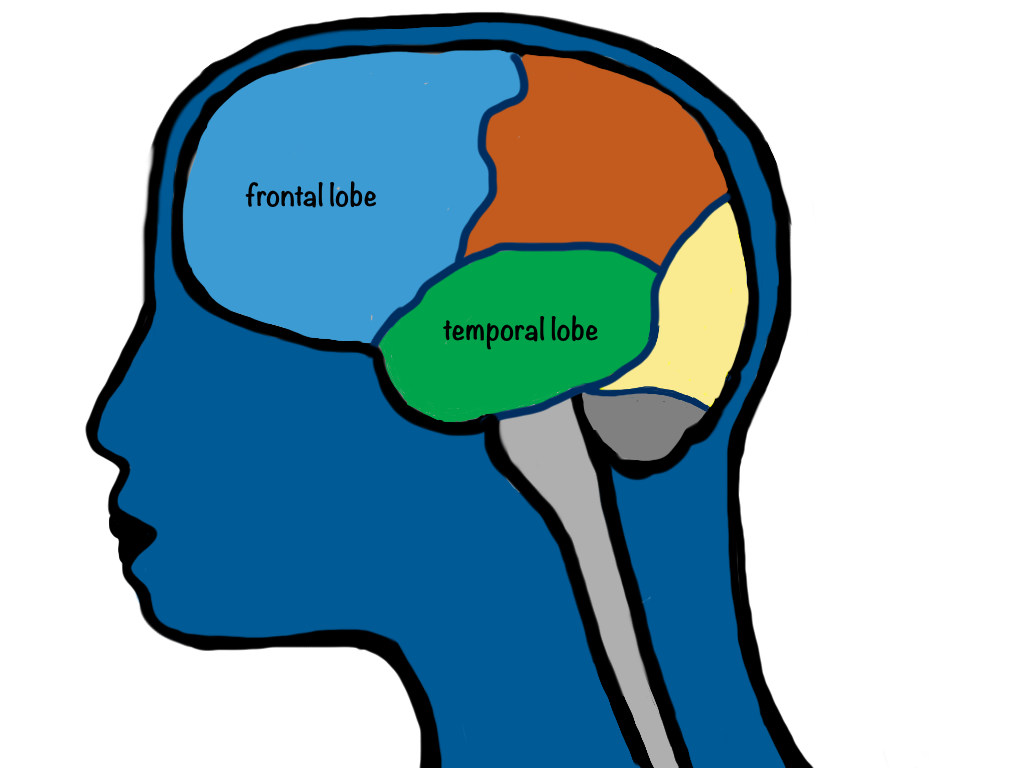
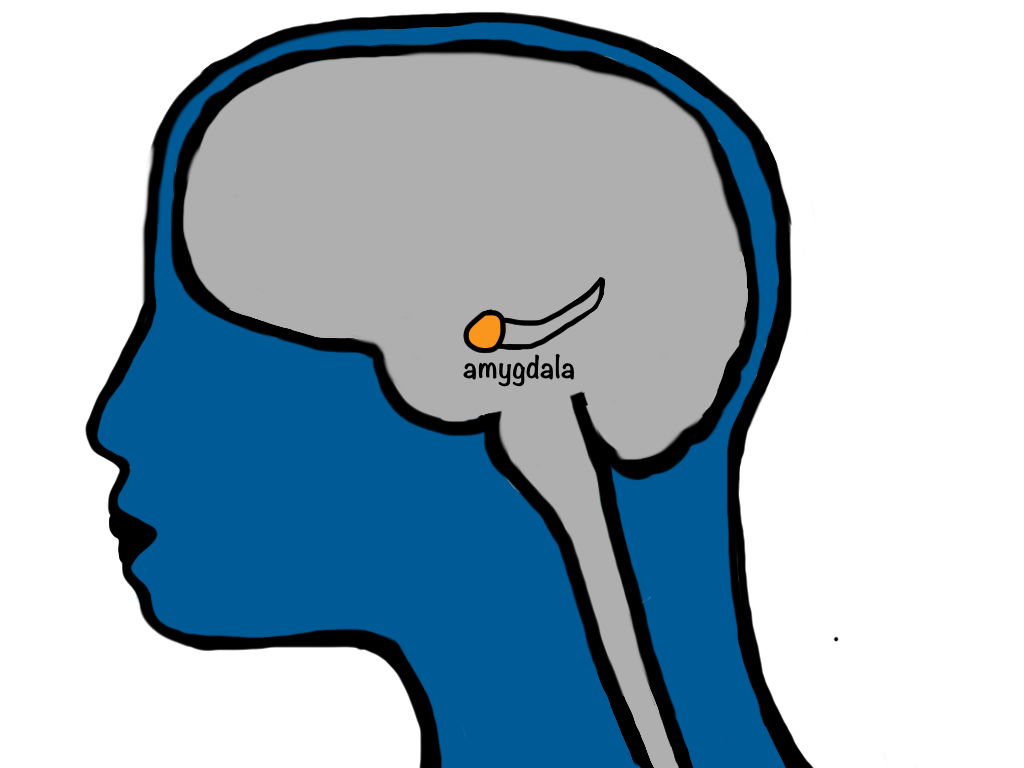
region amygdala, pre-frontal cortex, temporal lobe
chemicals cortisol

This article’s primary objective is the neurobiology of the brain and not the evolutionary, psychological, and social influences that might have formed the particular brain chemistry.

Rachael walks into the dimly lit bar and scans the faces to locate her friend. Priya is not here yet. She recognizes a guy at the bar as someone she has seen before. She stares at him a little too long, so he looks up at her. But there is no sign of recognition in his face and he looks away.

“Rachael?”

A black man, whom she does not recognize, walks towards her. Rachael pulls at a handful of her blonde hair with a nervous tug. Her heart races slightly and her palms are a bit sweaty. She smiles and says hello. The guy, Paul, tells her that they have met before. Oh, right, she remembers, she says, but she does not recognize him.

Illustration by Leena Prasad

Rachael has seen Paul more often than she has seen the guy at the bar. Why does she recognize him but not Paul? There can be many factors for this discrepancy, but one of them can be a biological one. The man at the bar is white. Rachael is white. Neurosurgeon Alexandra Golby conducted a study in which she discovered that the face recognition areas in the temporal lobe are more active when people see someone of their own race. This higher activity leads to higher recall of the faces of people of their own race. Rachael’s brain is not unique in making this discrimination.

Illustration by Leena Prasad

Why does her heart race when she sees Paul? This is a slightly racist response to seeing a black man she does not recognize. But it is not a conscious one. According to studies, many white people (most of the studies have been performed on white people) show an increased activity in the amygdala when they see a black face. The degree of response varies from person to person and the intensity of the response can be matched to the degree to which the person is a racist. The racing of her heart is triggered by the higher activity in her amygdala, the area of that brain that responds to fear by activating the fight-or-flight response and places the body in a stress mode.

Priya walks in to the bar and goes towards the guy at the bar. Paul leaves Rachael and goes up to Priya and gives her a hug. Priya’s amygdala activity stays the same when she interacts with Paul or Rachael or anyone else of any race. Her mother is Japanese and her father is from Palestine. She has had an early start in being comfortable with people of different races. Environmental factors contribute significantly to a person’s racist attitudes and thus in forming the chemical patterns of their brain. This is a positive indication that racist attitudes can be changed at the biological level.

Paul is happy to get away from Rachael. She fails to recognize him despite having had several conversations with him and he feels tense around her. Her body language is aloof towards him. It could be that she does not like him but he is starting to sense that perhaps it has to do with his race. Paul is right and Rachael does have racist tendencies even though she is not a racist, per se. She has friends of other races but she is most comfortable with people of her own race and exhibits other prejudiced characteristics. Rachael’s racist response to Paul raises the cortisol, the stress hormones, in both their bodies. Thus, her response not only hurts Paul but also harms her.

If not managed properly, issues of racism can lead to unpleasant results not only for the victims but for the racist herself. If Rachael continues to think and behave in her current mode, she is setting herself up for a future of stress leading to health problems. In order to change her automatic racist responses, she will first need to become more aware of her responses and consciously work on changing them.

What can she do to change her biological response? There is another part of the brain which is also activated when a white person sees a black face. The prefrontal cortex, the region that manages information and puts a brake on the emotional responses of the amygdala, is also activated when study participants respond to a black face. This part of the brain, located in the anterior part of the frontal lobe, is involved in learning and behavior control.  Thus, conscious efforts made by a person to change their behavior can train the pre-frontal cortex to manage the amygdala-responses more effectively, and thus minimize the cortisol and any other potential side effects of racism.

Rachael does not need to know the inner workings of her brain to effect change. She just needs to understand that her behavior is counterproductive not just towards herself but towards society in general. This understanding could lead to healthier brain chemistry and a better life for herself and for others around her.


Upcoming…

November: politics

December: neuroplasticity, the brain’s ability to change

Leena Prasad has a writing portfolio at http://www.FishRidingABike.com. Links to earlier stories in her monthly column can be found at http://www.WhoseBrainIsIt.com.

Dr. Nicola Wolfe is a neuroscience consultant for this column. She earned her Ph.D. in Clinical Psychopharmacology from Harvard University and has taught neuroscience courses for over 20 years at various universities.

References:

1.      Smith, Jeremy A., Marsh, J., & Mendoza-Denton, R., Are We Born Racist? Beacon Press 2010.

2.      Zimmer, Carl., This is your brain on racism. Or is that liberal guilt?, Discover Magazine, November 18, 2003

3.      Miller EK, Freedman DJ, Wallis JD. The prefrontal cortex: Categories, concepts and cognition. Philos Trans R Soc Lond B Biol Sci. 2002;357:1123–1136. [http://www.ncbi.nlm.nih.gov/pubmed/12217179]

“Olympian”: A poem by Christopher Bernard

Olympian

By Christopher Bernard

An old man kneels
in front of a stone.

Once I was famous,
forgotten now,
handsome once,
ugly now,
alpha once,
feeble now,
wealthy once,
a poor man now—

but you loved me
from sun to sun,
and they were kind
whatever the moon,
and food and wine
are rich on my tongue,
and every summer
lilacs bloom.

I have lost
all I won.
I have no trophy
brighter than the sun,
no applause
louder than birdsong.

Still, soothing
it is to know
that winning what most
will never know,
drunk on the shouts
of the applauding crowds,
metaled, victorious,
exalted, alone,
is beautiful, is fine, is very fine,
yet small,
a crumb of sweetness
that falls from the table
like a crushed star,
almost nothing at all.

The day I was born,
the day I die,
I lose the same world
that I won.
And you I won—
it was very sweet.
Then you I lost.
And where went the triumph
in that defeat?

Winning was nothing,
nothing at all.
The only gift
that mattered here
was the gift we all
were given here.
That is our hell,
that is our heaven.
We make of it
what we can, or cannot.
From wind to wind,
you came, you went.
From same to same,
I went, and came.

The old man
bends to the stone
and kisses the carved letters of the name.

_____
Christopher Bernard is author of the novel A Spy in the Ruins and co-editor of the
webzine Caveat Lector. His poetry blog is called “The Bog of St. Philinte.”