Survival of the Happiest: Joy Ding reviews Loretta Breuning’s Meet Your Happy Chemicals

Survival of the Happiest

 by Joy Ding

Who doesn’t want to be happy all the time? But as Dr. Loretta Breuning explains in Meet Your Happy Chemicals, constant happiness is simply not the point. The happiness reward system that we humans have inherited from our primate ancestors (and which we share with all mammals) is just that: a reward system meant to encourage us to take actions that promote survival. If it were always on, it would lose its effectiveness to flag survival-positive actions.

What, then, can we do about being happy more often, and less frequently unhappy? While happiness self-help books have often come up with lists of “good actions” such as the creation and maintenance of close and trustworthy relationships and the availability of meaningful work, Dr. Breuning puts it into a new context: that of brain chemistry.

The four happiness chemicals – dopamine, endorphin, oxytocin, and serotonin – are released respectively when we approach an award, are in pain, bond with and/or trust another, and accrue respect. While in prehistoric times, the chemicals may have released for more obvious survival needs such as hunting food (dopamine) or masking immediate pain from injury so we could escape a dangerous situation (endorphin), the release of the happiness chemicals in a modern life may seem more cryptic.

Here is where Dr. Breuning’s narrative really shines. The particular wisdom of the book is its ability to distinguish each of the four happiness chemicals, provide examples for when they are released, and how we can build new happiness circuits – basically new ways that we can be happier. While most triggers for happiness are built at a young age, adults are able to build more happiness circuits, it will just take a little effort. Specifically, 45 days. That’s the amount of time it takes to build a new and persistent neural pathway in the brain, one that will release happy chemicals when triggered.

Dr. Breuning also provides interesting material on the usefulness of unhappiness as nature’s alarm system (Chapter 2: Good Reasons to be Unhappy) and exercises to create more circuits for each of the happiness chemicals (Chapter 5: Building New Happy Circuits.) While a lot of these tips are not necessarily novel–for instance, one of the exercises for building new dopamine circuits is to celebrate small steps and adjust expectations so they are more realistic–the neurochemical context which Dr. Breuning uses to frame the exercises is very refreshing. In contrast to most self-help books, in which exercises for improvement are justified on the basis of anecdotal information, and a certain well-of-course reasoning, Dr. Breuning’s book grounds the exercises in neurochemical fact, giving exercises like “laugh” and “break an unpleasant task into smaller parts” new life.

In brief, the biggest gift that Meet Your Happy Chemicals gives us is a greater understanding of our own brains, the kind of understanding that will hopefully lead to happier lives: better acceptance of unhappiness, and ways to pave our own ways to more happiness.

As Dr. Breuning says, and I quote: “This brain we’ve inherited is frustrating. In its quest for survival it often turns unhappy chemicals on and happy chemicals off. When my neurochemistry frustrates me, I remind myself that it has succeeded at promoting survival for millions of years.”

Joy Ding is a free-lance writer and marketer living in San Francisco. You can reach her at joy.j.ding@gmail.com.

“Silent Requiem”: A short story by Joseph Johnson

Silent Requiem

By Joseph Johnson

The soft grass beneath my feet slightly tickled my senses. The light breeze brushed past my arms. I had never felt sensations like this before, nothing so real. I pushed myself past the field of marble slabs as I made my way to a small group of people. The senses that had become so prominent seconds earlier now faded with my focus on those who stood with solemn stares. These people felt great pain and sorrow.

As I came closer to the group I noticed that these were people I once knew. My family, my friends, and others I loved. They stood around a lifeless vessel that I once called home. Realization pulled me from the blissful ignorance; it was then that I remembered who I was, and what I had done. I realized that the soft grass was barely real to me at all, I could feel nothing.

It is such a selfish thing to die; to leave the ones I loved behind. The eyes of my mother were swollen and wet, while my father drew quick, angry breaths. What was the emotion that led me to my death? The sadness, the anger, maybe both; no, it was shame that brought me to the end. Shame in myself, or rather the self that society looked down on. People I thought cared, abandoned me for a life with those who would never accept me. I can’t blame them though, if on the other hand I would do the same. It hurts me to know that, but there is no reason to lie anymore.

A scream jarred me; it was a cry that shook the very foundation of my soul. No one took notice, and the scream had no origin. All mouths were still closed in that solemn silence, but the terror of the scream pushed me through the crowd. No matter how much I listened with no ears, and pondered with no mind, the screams evaded me. It was then that a force more powerful than fear propelled me. It was a pure force. The only way to truly describe the force would be angelic. I could believe in that; to believe in myself at that point would be to believe in some afterlife.

The powerful force led me to a familiar face. A young woman I loved, stood silently shaking. Her sobs made no sound, but the scream resonated through my core; such pain and anger. Did I ever forget her? Was she in my thoughts as I cut myself so deep? Regardless of my previous intentions, I had to do something to comfort her. So I reached, with a hand that I knew was not there. The hand slowly touched her and quenched her hungry spirit. The sorrow remained, but the screams slowly subsided. It is such a shame that this proud soul was crushed by such a selfish act. As she moved away and our souls parted, I remembered why I loved her. I was incomplete once again.

Instinct drove me to her. In her bedroom she slept with evil pressing ever closer. Unlike the force that pushed me toward her, this evil was present and visible. It was an ugly mass of darkness that hungered for destruction, and it was slowly inching toward her. The power of the mass mocked me with every move; it drew closer, but I could do nothing to stop it. So I let my tired soul sleep, and it wept with uncertainty.

When my soul regained whatever consciousness it could muster, I saw her again. When my focus was able to gather my surroundings I noticed that I was in our school. Darkness seeped through the windows and the doors, as if night had already fallen. The desk next to her was empty; it used to be my desk. I sat and watched her. Her hair was unkempt and her eyes sagged, there was no life left. Just as a tear started to streak down her face, a thin ray of light leaked through the room. As I searched for the source I realized that the darkness was moving, slowly letting light through. The mass I saw the night before was growing. The core of the mass appeared and stalked toward my love, the force that pushed me to her in the beginning now pushed me to fight, but I was afraid. The dark mass shouldn’t have terrified me, I didn’t even have a body. The fear was something I recognized; the evil was familiar.

It didn’t take me long to recognize the embodiment of shame, hatred, and torment. A grim fate of the spiritual world attacking the innocent; nothing could stop the omniscient power, especially not the feeble force that grew inside me. The force was love, but love could not save her. I needed anger, rage, and power. I needed to destroy this beast while it pushed closer to her. The more anger filled me, the farther I was driven from her. So I stopped; the anger subsided and was replaced again with hopelessness. The mass reached for her and the cry that hurt my soul before entered the small space of the classroom. More tears sprang from her eyes and she buried her shame in her hands. The beast grew in size.

As time went on and the beast grew even more menacing and thick with the fear of both my love and myself; hopelessness gripped at my soul, and I still watched, waiting for it to take her. It wasn’t until the next night that something terrifying happened. The mass was in a mad rage that caused it to move rapidly around her small room. She sat quietly on her bed, eyes closed and focused. My soul began to fret as her intent became clear. The raging essence of evil was excited and it raced around the knife on her bedside table. If a soul could weep mine did. Just as I heard her soul cry out, I believe hers heard mine, because she opened her eyes and clutched her heart. Doubt was setting in. Although the hope inside of me was small, it pushed me to her. The closest I had been since my death. I was hungry for her touch, or even the light scent that came from her hair. I could not experience such things anymore.

It was relatively easy to make my way to her while the darkness was distracted. It apparently had intent, and now so did I. Hope did not have to end with me; she could live a long, happy life as she was meant to. So I pushed toward her, full of ignorance and passion. The moment I came close enough to touch her; my soul began to tremble. I was there, able to feel the love I once felt again, but I knew it was impossible. At that moment my hand began to take form, and I began to sense a need for feeling within it. So I took that cold, dead hand and lightly brushed it on my loves dead cheek. What I felt was incredible. Her skin was ecstasy and it fed my radical desires. The implication of ever finding the sense again had evaded me to the point that the present feeling was obscured in uncertainty. My soul could only doubt the feeling. It couldn’t have been real.

I couldn’t stop there. My hand continued to caress her face lightly as other senses began to return to me. I cannot remember when my lips gained their feeling, but I remember the sensation when my lips touched hers. I kissed her deeply, but she made no advance to recognize my existence. For some reason I had hope that she felt me. Memories then filled her mind and my soul, such love that could not be broken by man or spirit. The mass became even more erratic and began smarming around me. I hated the spirit. I wanted it to die, but was powerless to stop it. We had the same power, to tempt the senses of those bound by physical bodies. It was a power that meant nothing.

Somehow I was being pushed. The spirit was advancing, and as it drew closer to my love I slowly drifted away. Soon my vision blurred and my surroundings became obscure. The physical vanished once again leaving me in the darkness, I could feel nothing. I was nothing. In that darkness I was wrapped in grief, misery, and anger. She was gone, and so I drifted farther and farther away from that life which I loved so dearly.

I could not stop. As much as it hurt I continued to hang on to that pain as I fell deeper and deeper, with no escape. That pain was life. No sense of time could dictate how long I fell in that pit, before the pain took me. So sharp and vicious was the knife that pierced my essence. At this point the prospect of letting go reached a new height, to fall to the bottom of that forsaken pit and end what life I had left. To give my life up would be to destroy everything I loved. She could not fight the evil alone, I saw that myself. She wouldn’t withstand the temptation without me. I needed to comfort her. I could not stop!

Light showered the darkness. Dare I say hope, entered what was left of my soul. After falling so far my soul was ripped to pieces, most of which still lay in the darkness, but I pushed forward. I made it through the breach of incredible light and found myself in darkness again. The mass was incredibly thick; no light anywhere, except one faint glow across the darkness. I stepped closer. The thick mass made it hard to traverse the room, but I still pushed forward. The enemy was all around me, it had consumed everything in her life, and all that was left was that faint light. The darkness wanted hope, to feed on it and destroy it. I extended myself toward the light; I felt the life, however faint, slowly shifting.

When I reached the light I found my love. She held a knife loosely in her hand while she gave off soft sobs. I reached for her but my broken soul could not comfort her. The darkness was taking on a somewhat human form. It circled her with lust and cruel intent. When it saw me the beast raised its dark hand. My love followed the motion blindly. The knife was then ready to take her life with the beast’s hand. Just as the darkness plunged its hand into its own heart, I threw myself at my love. I felt incredible pain reach every part of me. The knife ran through me, and into her. I was lost then. As the darkness engulfed her spirit I faded into my own darkness, but this time no hope remained. I let it take me deep, where I could never hurt anyone again.

Through the darkness I suddenly felt something I thought was lost. I could feel soft cotton on my feet, and the touch of skin on my hand. I opened my eyes to see darkness, but not the darkness I feared. I saw night. The body that lay unconscious next to me was cold and still. While my mind tried to regain consciousness I felt for my mortal wounds. I had no scars, except for those left on my soul. With new life I stood and walked out of my house. It was dark and cold, only a single orange light faintly glowed in the distance. The light was shrouded by a thick fog that made the darkness even more prominent. That is when I noticed that despite our efforts we were drowning; slowly suffocating in the thick omnipotent darkness.


Joseph Johnson is a senior English major at Georgia Southern University. His work has appeared in The Wiregrass, as well as in a previous issue of Synchronized Chaos.

Art review: Christopher Bernard on Cindy Sherman’s “The Vertigo of Identity”

THE VERTIGO OF IDENTITY

Cindy Sherman

San Francisco Museum of Modern Art

Through October 8

A review by Christopher Bernard


The largest show of this influential photographer’s work to appear in San Francisco opened recently after appearing at the Museum of Modern Art in New York to a complex response by East Coast critics, with a few questioners, if not quite dissidents, providing leavening to the otherwise universal praise. But a complex response never seemed more appropriate than here.Sherman’s work – often charming and witty, beautifully crafted, and slyly probing – is nearly impossible to dislike. And yet, it seems equally impossible, or even desirable, to fully embrace. Which may be the definition of contemporary artistic greatness.

We on the West Coast can now survey the career (up to now) of this popular, fascinating and troubling artist who has shown, with an almost unfailing sureness of touch, how to combine work of great lightness and skill with penetrating, even disturbing, questions, not least of which is “What is this baffling aberration in a seemingly heartless and mindless universe, a human being?”

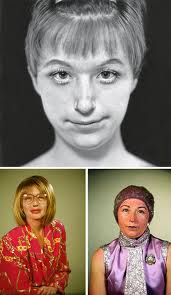
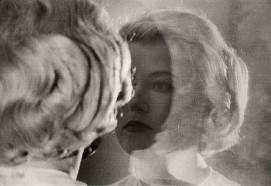
The greater part of Sherman’s work is made up of photographs of herself, usually taken in her studio, in costumes, wigs and makeup, depicting imaginary examples of well-known types, from characters in movies to figures from the history of art to eastern seaboard grandes dames. She works in series, her first, and still best known, being the “Untitled Film Stills” from the late 1970s: black-and-white, deliberately cheap-looking but highly evocative fictional stills from imaginary art, noir and B-movies from the ’50s and ’60s; her latest major series is of big, garishly full-color blow-ups of herself made-up as ageing doyennes of high-society. And in the great majority of the pictures,Sherman, like a great actress, a Meryl Streep of the black box, a Shakespeare of a thousand discarded selves, both appears, and disappears, in an imaginary space that recedes infinitely behind the photograph’s slick surface.

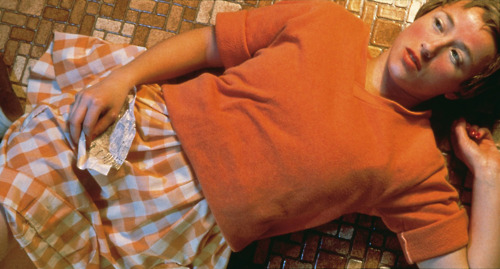
In the early ’80s Sherman created a so-called “centerfold” series, large color photos, based  on the centerfolds seen in men’s magazines, of reclining young women, fully clothed but in moments of great emotional vulnerability; examples, not of erotic, but of emotional voyeurism. In these pictures, curiously enough,Shermanis most readily identifiable as herself (as one can see from the occasional candid shots taken of her by other photographers at unguarded moments), with minimal use of costume and makeup, and little more defense than the mask of an expression.

Appearing in the show are also Sherman’s “fairy tale,” “disaster” and “sex pictures” (a peculiarly ugly series, though not surprising: how many artists have ever had a healthy, happy relationship with their own sexuality, candid yet discreet and kind, to themselves, their lovers, and their audience?), a “clown series” (perhaps the only weak images here; creating an artificial identity from an already artificial identity provides the show’s only shruggable moment), grand, booming large-scale photos based on old-master paintings (the so-called “History Portraits”),  a “headshot series” of “ordinary” women (and some males) hiding, so to speak, in full view, and a “fashion” series that sends up the very fashions and designers the pictures ostensibly advertise.

And all of these (except for the relatively few disaster and sex pictures) are of the photographer herself in a myriad masks, this woman of a thousand faces who would put Lon Chaney to shame: the opposite of self-portraits, these are pictures of an artist in full flight, apparently, from the self.

But are they?

It’s impossible to discuss Sherman’s photographs without immediately bringing up the issues of “identity” and selfhood, its continuity or lack thereof, its relation to image, its sabotaging by image, its relation to the construction, and deconstruction, of femininity, sexuality, gender roles, and other biosocial categories, its possible nonexistence outside the funhouse of psychosocial illusion, and so forth.

The very variety of her images – and the peculiar vulnerability that often peeks out through the impasto of costume and mask – suggests something else: the hiddenness of the self, the ego absconditus, behind its image; the image as protective covering, as camouflage, as shield, as tool and, when necessary, as weapon.

I had the unpleasant feeling, after looking hard at Sherman’s photographs for two hours while preparing to write this review, that everyone I passed in the streets outside the museum was wearing a costume. The whole world suddenly looked like a Halloween party. Was it even possible to decipher people based on how they appeared? If their image was so constructed, so contrived, how could I possibly get past it to their “real” thoughts, feelings, selves? Even when they spoke, how could I trust what they were saying? Not if course that they would deliberately lie – but then, how could they help it? Are we all just actors playing out a theatrical illusion of who we think we are, want to be, are afraid we might be?

If you leave the show a little shaken in your certainties about yourself and the world around you (I told myself), you’ve probably had the right reaction. Not thatShermanintends to shake us up. She just likes to dress up, according to her interviews, and always has.

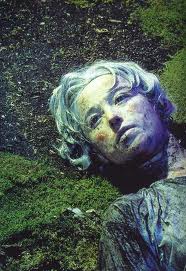
The ultimate photograph in this retrospective, the one that lingers more pertinaciously than any other, was one of the disaster series. At first it just looks like a big picture of a strip of dark red soil, soaked with movie blood or red paint. But then, as I looked at it, I saw it resolve into its actual subject: a crushed, skinned unrecognizable face.


Christopher Bernard is a writer, poet, and critic living in San Francisco. He is author of the novel A Spy in the Ruins and co-editor of the webzine Caveat Lector.

Newman-X: Excerpt from a novel by Peter Lynch

NEWMAN-X

by Peter Lynch

Chapter I:

Monday

     At 9:30, after everyone else has gone home for the day, I sit at my office desk and unzip the side pocket of my black man-satchel, where I keep my less scrupulous effects: an eighth of marijuana, my bowl, a pack of cigarettes, a lighter, my half-full flask (featuring Captain Morgan’s spiced rum), Prozac, and Adderall.

I twist off the child-proof lid to my Adderall bottle (they call them “Amphetamine Salts”), remove a 20-mg peach-colored pill, and put it on my desk. Then I place the bottom of the bottle over the pill, make a fist with my right hand, and come down on it hard. It crumbles under the force of the blow. I pull from my wallet my driver’s license, press it down on the chunks of amphetamines, and twist it back and forth until the grains constitute a fine powder before using my license to shepherd the powder into a fine line. I peel a sheet off the pink sticky-note pad on my desk and roll it into a tube, adhering it to itself. Leaning over the powder, I put the tube of paper in my right nostril, put a finger over my left, and track the line as I snort the powder. It tickles and itches like maggots in an open wound. Within seconds, I’m light-headed.

I wouldn’t recommend snorting amphetamines for everyone, but it’s always worked for me.

I’ve been using it to an unprecedented extent for the last three or four days, staying awake and reading, writing, and playing online poker.  Whenever I feel my eyelids getting heavy, I pull out another pill and in my nose it goes.

I collect the film of powder that remains on my desk with my index finger and place it inside my bottom lip.

My lip tingles.

I put the bottle away and take out the bowl, the lighter, and the eighth of weed. Then I open the window and the door to my office and I turn on the fan, as I have little interest in setting off the smoke detector. I pack the bowl and take a hit.  And another, pulling deep and holding it half a minute.  Tilting my head back, I do “The Dragon,” exhaling two streams of smoke through my nostrils. I do this again.  And again, and again.

Enough for now—everything in moderation, I remind myself.

I put the still-smoking bowl down on my desk and it slowly extinguishes.

Opening a new browser, I go to my calendar.  A little math informs me that today is the fortieth since my close friend since childhood, Tommy, was killed in Iraq.  Pulling out my flask, I take a shot in his honor.  Then I switch over to Google Reader. Scanning my subscription list, I see that there are a few new neuroscience articles: Prozac and neurogenesis, space-time synesthesia, and a story on attempts to give Jesus H. Christ a Meyers-Briggs Type Indicator (MBTI) personality profile.  The article’s conclusion is that his personality was too complex to label with any of the sixteen options.

I finish my bowl, then pack and smoke another before reading an article on the heightened pain tolerance in patients with Borderline Personality Disorder (BPD) and another on Joshua Norton, the mad “Emperor of the United States and Defender of Mexico.”

My reading material over the last few days has gravitated towards articles and essays on two subjects in particular: the “technological singularity” and secret societies (In particular, I’m reading about the Freemasons—I just have to know: What the hell is it that they actually do these days?  Are they still the international political force from which their reputation is derived?).

The technological singularity—the notion of exponentially developing emergent technologies and the emergence of some kind of superintelligence, causing a paradigm shift in human experience—fascinates me especially, as does the concept of intelligence itself. I’ve been feeling maybe a little grand and/or grandiose with regards to my own intelligence over the last few weeks; I don’t much like myself, but I do like my intelligence.  It’s what people tend to notice first when they meet me, and I’ve been noticing them noticing it more and more over the last month or so while I’ve been ramping up—my thoughts are racing, racing faster and faster, and I feel better, smarter, more capable than I’ve ever felt before.  It’s probably got something to do with all the amphetamines passing through my blood-brain barrier.  Maybe it’s rewiring my mind.  Or maybe my self-perception has been distorted by all the weed I’ve been smoking; but I choose to reject that possibility out of hand.

As the weed continues to kick in, I realize that I’ve lost track of the time. I check the display on my monitor: 10:25. Still enough time to make the 11 pm train and avoid having to walk the three miles back to my apartment. I finish the bowl and put it, the lighter, the bag of weed, and my bottle of Adderall back into the black satchel, then throw on my red college hoodie.

Two years ago, I graduated early with a respectable 3.22 GPA, but my parents, my professors, and I—we all knew how little work I’d done, how little time I’d left myself to write papers before their deadlines, and that I spent more time drunk or high than I did on my studies. I only started taking Prozac for my OCD as a sophomore, and I wasn’t put on Adderall until the summer after my college graduation. But, I think, even if I’d been on both from the beginning, I’d still have been weird, I’d still have done drugs, and I’d still have this nagging feeling that I’m not quite alright.

I make a trip to the bathroom. After taking a leak I wash my hands, then glance briefly at my tired but buzzing reflection in the mirror.  The young man I see is gaunt, with high and hard cheekbones, dirty blond hair, sideburns that come down all the way down to the corner of his short mustache, and big brown, dilated eyes, the whites of which are red.

Back in the office, I check the monitor display again: 10:50. Time to get going.

I think about the hour, the darkness, and the walk, and I get maybe a little paranoid: it’s late, the subway will be mostly empty—providing an ideal time for criminals to do their nefarious things—and then there’s the walk from the station back to my apartment.  What to do?

I think of ways to protect myself, things to use for defense.  There’s a black metal shaft from a broken microphone stand in the corner behind my desk.  I take it and, thinking about how to conceal it, come up with an idea.  I’ll tape the rod to my leg in two places.  I find the masking tape and jerry-rig the tape job so that I can slide the rod out easily.  Then I roll my pant-leg down over the apparatus I’ve created and pack up to leave.

Outside, I take the coiled ear buds out of my pocket and plug them into the little red IPod Shuffle clasped onto one of my belt loops with my one hand and put the ear buds in with the other. I hit play, and Neighborhood # 2 (Laika), by Arcade Fire, picks up where I’d left off before, with the line: “Our mother should have just name you Laika!”

I skip back to start over from the beginning. The song always affects me on a personal level—what gets me is the idea of an innocent dog sent up into space in an experiment for the furthering of mankind’s obsession with space travel. Laika’s sent off so that we might learn whether life in a manned spacecraft is viable.  But her survival is of no import to the cold scientists: giving her neither food nor a plan for return, the dog’s fate is known from the start. There’s something of me in it, something of my life, but it’s something I can’t quite put words to.  All I know is that I am Laika.

Down at the subway platform, I hear the low rattling and creaking of an approaching subway car. As it groans into the station, I gaze through the nearly empty and decreasingly blurry cars. I think of Heisenberg’s uncertainty principle.

The train slows to a stop and the doors open. I enter and sit in the closest seat on the left, across from a young couple and a few seats down from a homeless man sleeping with his chin on his chest. The couple looks at me and then they look away. People always look away.  And I don’t know why.

The doors close and the train begins to roll along, and I notice a pungent odor in the car. It smells like urine, and it seems to originate at the homeless man. Making a valiant effort to ignore the smell, I open the main compartment of my man-satchel and pull out my copy of Hesse’s Siddhartha. I open to the bookmarked page and begin reading, but before long start to feel drowsy. The amphetamines are still in my system, I can feel them, but the weed is taking over. Before the first stop, I’m already asleep.

I come to when a station worker gently nudges my shoulder. I glance around the car. The couple is gone. The homeless man is gone, too, save for the smell of piss he’s left behind. He must not have heard the PA system’s reminder to not forget your belongings.

Realizing I’m at the end of the line, I ask when the next inbound train leaves. The man shakes his head and says that the last train has already left.  It’ll start running again at 5:00.

I thank him and leave the car. I take the escalator up to ground level and study the map on a wall to get my bearings.

A heavy mist shrouds the streets outside. I can’t see more than twenty feet ahead of me.  My ears begin to ring and I wonder if maybe it has something to do with the weather. I start down the street that looks about right on the map, but soon it curves to the right and out of sight towards God knows where.  I turn onto another street, look up and, seeing that the night sky is completely obscured by a dark and heavy haze, realize that I won’t be able to count on the stars as reference points. And weed is not a navigational boon. Who knew?

The road soon forces a choice: Do I continue along the path I’ve followed, or do I veer off onto the grassy path to the left?  I choose the latter. As I walk, the metal pipe begins to chafe against my leg.

Just ahead, a white squirrel untangles itself from the brush to the right of the path, turns its head sideways, perhaps curious, and then freezes, staring at me. I stop walking, intuition telling me that there’s something wrong with this squirrel.  I see what looks like a bulge of fat protruding from its belly.

My mind races. There is something else uncanny about this squirrel. Though frozen and fixated, it isn’t even remotely anxious or fearful. Aren’t squirrels supposed to be afraid of people? I walk over to it, and even then it shows no sign of fear. Is it just sick? Injured? I crouch down and chirp at it, holding my hand out, and it approaches.  It reaches me and touches its nose to my fingers, and only then does it wander back across the grass and disappear into the brush. I continue down the road, puzzled. Squirrels aren’t supposed to act this way. What’s wrong with it?  And what the hell is with that bulge?

Around a bend, the road opens up onto a large, empty parking lot surrounded by big rectangular buildings. At the top of the largest building, a neon blue sign reads “Pfizer.” I’ve wandered into a pharmaceutical industrial park.

I start off across the parking lot, thinking that I just might be able to find a main road on the other side. But no such luck. Worse, the metal pipe is really harassing my leg now, and I feel a wetness trickling down my shin.  Past the other end of the parking lot is a road, and on that road there is a bus stop.  I head that way to see check the schedule and see whether there’s a late-night bus service.  There isn’t.  My leg is really starting to hurt now, so I pull up my pant-leg and see a trail of blood rolling down my shin and into my sock.  To stop the blood, I pull a few tissues out of my man-satchel and press them against the wound and hold them there for a few minutes.  Once the bleeding’s stopped, I remove the tissues and examine them.

It might be the weed, but the thought crosses my mind that maybe my arrival at Pfizer means something; maybe the bleeding does too.  And my next thought?  Pfizer must need my blood.  There’s something special about it, something that they need.  So, Good Samaritan that I am, I leave the bloody tissues on the bench to give them a free sample.  But more’ll cost ‘em.

I continue down the street and happen upon a y-intesection.  Left, and it runs around a bend and disappears into the woods; right, and it goes straight.  In the distance, along the path to the right, I see the florescent glow of streetlamps. So I choose right. As I approach the streetlamps, an intersecting road beyond them comes into view.

Walking under the streetlamps, I hear them make the whirring sound they sometimes do and I feel the sensation of being watched. Directly under the lamps the noise is loud—louder than I remember having heard it on previous such occasions, and my hairs shoots up on end.

I hear an engine start up.  A black Mercedes coupe turns on its headlights and rolls through the intersection, its headlights shining brightly, casting light across a sign: a capital “T” surrounded by a circle, and the words “Alewife Station” printed underneath. I’m relieved to see the familiar “T” symbol—soon I’ll be someplace recognizable. The coupe slows down as I approach, and now I know something’s off.  Looking at the passenger’s window, I see only black tinted glass and my reflection in it, my earring shimmering under the light of a streetlamp.  When I get a little closer, the coupe rolls off down the road, providing a touch of relief.

After about ten minutes I see another sign for Alewife Station. Then there’s one for the bike path between Alewife and Davisstations. I look at my watch. 2:00 am. Damn, it’s late. But it’s too early too. I’ll have to wait four hours for the first train toDavis, but I can be there within half an hour if I take the bike path.

I have some steam left—thanks to the slight buzz of the Adderall—and I decide to walk it. Arriving at Alewife, I follow the signs to the winding bike path just behind the parking lot. The path is flanked by fields of high grass held in by chain-linked fences on both sides. It reminds me a little of the corn “maizes” back in Vermont—they’re tourist traps, to be sure, but there’s a certain appeal to those labyrinths, and I’ve returned to one in particular every few years since childhood. They change the pattern every year, but there’s always a bell tower near the middle, providing a reference point for travelers, much as a lighthouse provides one for sailors. There’s usually a very simple, efficient route to the end of the maze, but it almost never becomes evident until after you’ve made it through to the other side and picked up a map to trace your path.

Soon, the chain-linked fences and grass give way to suburban Cambridge. The path crosses a road, and then another—they’re busy roads by day, but tonight there is only a single car idling with its headlights on. The path dips into a narrow, wooded area and, as I continue, I look into the back yards of the nearest inhabitants. In one back yard, I see tires—maybe fifty or sixty of them—and the tires are surrounded by a ring of traffic cones. I wonder, what do the details of their lives say about them?  Obviously, they’re hoarders. But why the tires and traffic cones? Noticing a rocking chair on the back porch, I wonder, who sits there? I slowly pass the yard, speculating about the people who live there.

Before long I reachDavis Square. From there, my apartment is only a four-minute walk. But thinking about how close I am only makes me more tired.

***

As I unlock the back door, I can feel my eyelids beginning to droop. I push open the door and walk into the dark entryway. I close the door and the last remnants of light disappear.  I lock the door.  Hands outstretched, I feel around for the banister and then, finding it, stumble up the stairs to the second floor landing. For a moment I feel the urge to go back and check that the door is locked, but the urge passes. Fuck you, OCD. I know it’s locked.

I look down the hall. My roommates’ lights are off and their doors closed.  Mine is open.  I reach around the frame and flip the switch, casting light on the clothes, half-empty vitamin water bottles, DVDs, half-unpacked boxes, and unquantifiable quantities of cigarette and marijuana ash.  I take off my satchel, kick off my shoes, and pack one last bowl before bed. I only manage two hits before passing out with my bowl on my chest.


Peter Lynch hails from Vermont and lists The Catcher in the Rye as his favorite book. Besides being a writer, he works as a data forecasting consultant; therefore he is able to describe his job as “predicting the future”! He can be reached at petersklynch@gmail.com.

Poetry from Linda Allen

Does Anybody Hear Me

Sometimes I sit here all alone
Thinking of a time when I will be heard
Can you help me?
Does anybody hear me?

Sometimes I just wish
Wish to be heard
Wish to be heard as a person in this world
Most days I sit here alone and unheard
I know I’m not six feet under yet
I am here
All I need is to be heard

Does anybody hear me?!
‘Cause I’m singing loudly here
Does anybody hear me?!
‘Cause I’m crying loudly here

Stop me from turning invisible
‘Cause I’m not heard, not here, not seen, and all alone
Please hear me!!!!
Please see me!!!!
I want to exist in this world
So please please
Stop me from becoming invisible in this (world)

Does anybody see me?!
‘Cause I’m standing over here
Singing at the top of my lungs
(I want to be heard, I want to be seen. Please don’t leave me alone)

Does anybody hear me?!
‘Cause I’m singing loudly here
Does anybody hear me?!
Does anybody see me?!
‘Cause I’m over here
And I am over this (hell)
Do you hear me yet?!

Do you see me yet?!
I am going BIG! Or I’m going HOME!!
Singing at the top of my lungs
Standing on the top of this table
(Wishing to be heard. Needing to exist in this world)
DOES ANYBODY HEAR ME!!!!


Have You Ever Been

Have you ever been                                        Don’t forget you’re not alone

Made fun of                                                         Don’t let them win

Abused                                                                 Don’t let go of yourself

Raped

Used                                                                       Well

                                                                                 Have you ever been

Well you know you’re not                             Made fun of

alone                                                                      Tortured

We’re all here for you                                     Abused

Give us a call                                                      Raped

                                                                                 Used

Have you ever been

Made fun of                                                         Victims unite

Abused                                                                 To be victims no more

Raped                                                                    To show them we can stand

Used                                                                       To show them we are survivors

                                                                                 STAND UP

When you need help                                              and

ask                                                                          FIGHT

We know your pain                                         AGAINST

You have a friend                                            THOSE WHO SEEK TO HARM

Have you ever been                                        Have you ever been

Made fun of                                                         Made fun of

Tortured                                                              Tortured

Abused                                                                 Abused

Raped                                                                   Raped

Used                                                                     Used

                                                                                ?

Someday

I’m gonna live like these years never happened
I’m gonna let you go
I’m gonna forget all about you
I’m gonna move on
I’m gonna get past this
I’m gonna be free to be me
I’m gonna be
I’m gonna be content with my life
I’m gonna get what I want and need out of life
I’m gonna learn to live
Live for me
I’m gonna be me
I’m gonna be rid of you once and for all
I’m gonna discover the real me
I’m gonna be and find what I have to be and find
I’m gonna learn to love again
I’m gonna be happy
I’m gonna cry less
I’m gonna smile more
It’s all gonna happen for me
Someday


The Hourglass

The hourglass is glued to the table
The sands of time running out
Not in our favor

The hourglass is glued to the table
The sands of time running out
Can’t break it, can’t stop it

The hourglass is glued to the table
The sands of time running out
The time is flying by, leaving me behind

The hourglass is glued to the table
The sands of time running out
Running out
Wasting to much time

The hourglass is glued to the table
The sands of time running out
Not in our favor

Oh oh
The hourglass is glued to the table
Oh oh
Glued to the table
The sands of time running out
Oh oh
The hourglass is glued to the table
The sands of time running out
Stealing all our yesterdays
Showings us all our tomorrows
Oh oh
The hourglass is glued to the table
The sands of time running out
No time to waste, no time to look back

The hourglass is glued to the table
The sands of time running out

Turns out it is in our favor


Linda Allen is an American from Oklahoma who may be reached at lindaallen4119@att.net and welcomes comments and thoughts on her writing.

Synchronized Chaos, July 2012: Growth and Development


Art by Laura Greengold (L) and Julian Raine (R)

Welcome, readers, to the July 2012 issue of Synchronized Chaos! Our poems, articles, and reviews form a particularly unique pattern this month: they portray a wide range of different stages in the growth and development of human life, from childhood to young adulthood to old age. Let’s take a look at the human lifespan as depicted by our contributors, as well as a few related subjects…

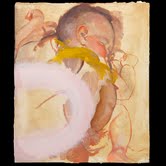
We begin our examination of the stages of life with a set of paintings and drawings by Laura Greengold. A number of her beautifully-composed works feature her own baby son, and her art is an excellent depiction of the wonders of very young childhood.

The later stages of childhood take on very different qualities, and they are also represented in this issue. One of the more eccentric modern depictions of the trials and tribulations of modern adolescence is William Finn’s 2004 musical comedy The 25th Annual Putnam County Spelling Bee, recently performed by Castro Valley’s Chanticleers Little Theatre. Bruce Roberts’ review illuminates the hilarity of the production—as well as the “childhood memories of pressure, of defeat, of humiliation” which it is sure to bring back to its viewers.

With adulthood comes the joy and heartbreak of romantic affairs, and Sam Burks’ poem “Memories (A Farewell)” is a poignant depiction of the latter state. Taking place after the dissolution of a relationship, it skillfully depicts both the inescapable memories of happier times and the necessity of letting go and looking forward. Read this, as well as three other equally-insightful poems by Sam, here.

Romances can certainly end happily as well. Perhaps the iconic novel of young love and courtship is Jane Austen’s Pride and Prejudice, which has been adapted numerous times to stage and screen. As Jessica Sims reports, the San Leandro Players’ recent production is a top-notch version of Austen’s tale.

This month’s final performance review examines a slightly less successful union than that of Elizabeth and Mr. Darcy. The French legend of Bluebeard, the notorious nobleman and serial wife-killer, dates back to the seventeenth-century work of Charles Perrault, but one of its most memorable adaptations is the Béla Bartók opera Duke Bluebeard’s Castle. Christopher Bernard reviews the San Francisco Symphony’s production here.

After romance and marriage, we can hardly fail to include an examination of parenthood, and J’Rie Elliott’s poem “To Be a Parent” takes a look at this very topic. It’s an inspiring and thought-provoking look at the responsibilities which parents must take on to ensure that their children can lead happy lives—as well as the sacrifices which must inevitably result from such an undertaking.

Another of this issue’s most memorable poetic pieces directly compares childhood with adulthood. In “Let’s Play Pretend,” Linda Allen looks back wistfully on the innocence of youth, juxtaposing it with the awareness of the world’s problems which inevitably arises from maturity. Sometimes, she points out, the hardships of modern life make one yearn for childhood’s joyous dreams of happiness and safety.

A further set of excellent poems in this issue comes from Julian Raine, whose works are relevant in several ways to the theme of human development. They include a vein of mature sexuality, as well as recurring depictions of youth in contrast with old age. Human aging and memory are well-employed elements of these works: in one passage, her narrator compares the present day with her reminiscences of her youth, musing on “the moments/in between [which] sort of bind together/the child to the old woman.” The influence of the past also comes through in another way, with references to the works of Whitman, Tennyson, and other poetic giants of previous generations. Julian also contributes a number of superb paintings, whose subjects range from gloomily-lit human faces to abstract figures to seemingly commonplace objects. Each one of them is quite unforgettable.

Another of our articles concerns itself not with the growth and change of one person, but with that of humanity as a whole. Michaela Elias profiles San Francisco’s legendary Modern Times Bookstore, a local symbol of progressive thought and a longtime center of equality, pro-labor, and anti-war movements. Recent rent troubles have caused Modern Times to move away from its long-established location, but it has found a new home in a shared space with the art gallery Galeria Paloma, and it will try to carry on its progressive work for the foreseeable future.

Similarly, Bruce Roberts’ second article of the month deals with yet another sort of growth: the achievement of new frontiers in scientific knowledge and patient care. He profiles Dr. J. William Langston’s Parkinson’s Institute, widely renowned for its innovations in both treatment and research.

And, as always, Leena Prasad’s monthly column Whose Brain Is It? demonstrates our growing knowledge of the intricacies of the human mind! This month, she examines the chemical factors which lead to feelings of joy.

We hope you enjoy this month’s issue of Synchronized Chaos Magazine! As always, feel free to leave comments for the contributors and if you’re interested in submitting to the magazine, send your work to synchchaos@gmail.com.