Harold’s Elephants: July’s Whose Brain Is It, a monthly neuroscience column from Leena Prasad


Harold’s Elephants


topic joy
organ  limbic system
chemicals dopamine, endorphin, oxytocin, serotonin, cortisol

The envelope has been lying on his desk for two days. Harold is unable to open it. There is too much at stake. The words inside that envelope will change his life.

It’s too thin, Harold thinks. It must be a rejection letter. That would mean that he’d have to go back to his life as a chef. He likes cooking but after ten years, he has become bored of doing it for a living. He took a five year break to try making a living as a sculptor. These five have been the best years of his life. He doesn’t want to stop but he has used up all his savings. Harold is engaged to be married and wants to start a family soon. He is 41 years old and wants to have a stable career soon, one way or another. This is his last chance to be financially stable while living his passion.

Harold opens the envelope.

Congratulation, it says. Harold stares. He reads and read again. “Congratulations. We would like to hire you to design and sculpt the elephant sculpture for the newest branch of our restaurant. You will also be designing unique sculptures for each one of our 21 restaurants worldwide.” There are instructions on going to a website to complete the paperwork.

Harold is too shocked to react. He hears the front door open. His fiancée walks in. She is sweating from her daily jog and is heading for the bathroom when he leaps up to go talk to her. He gushes out the news. He says it so fast that she has to ask him to repeat himself.

There are chemical activities in Harold’s brain causing his happiness. These chemicals are called neurotransmitters because they transmit signals amongst the brain’s neurons. The primary neurotransmitters spurting in Harold’s brain is dopamine and serotonin. The brain spurts dopamine when it gets what it wants. It secretes serotonin when it feels a sense of pride.

His fiancée is also happy. In addition to dopamine, her brain is spurting endorphin from the runner’s high that she has just had. It is possible that she might also be releasing serotonin via association with someone who has just established a job which will ensure survival related safety and security for her.

As mentioned in the book Meet Your Happy Chemicals: Dopamine, Endorphin, Oxytocin, Serotonin, Dr. Loretta Breuning talks about a fourth chemical, oxytocin. This is the neurotransmitter that Harold and his fiancée’s brains secrete on a consistent basis. Oxytocin is released as a part of developing a trust based relationship with another human being. Sexual intimacy and other bonding activities, like touching, also cause a spike in oxytocin levels. Harold and his fiancée have a healthy level of oxytocin in their system because they live together within the framework of a trusting relationship.

Harold and his fiancée are both experiencing a burst of many happy chemicals and thus a burst of joy. But the happy chemicals exploding in their brains are not all the same, so their happiness level is not exactly the same.

Earlier in the day, while Harold was teetering on the verge of opening the envelope, his brain was probably spiking with cortisol, a chemical produced by the brain when it feels stressed. His cortisol level is down but not completely gone and he has no reason to have endorphin in his system. His fiancée has endorphin in her system but no reason to have cortisol. They both have dopamine, serotonin, and oxytocin circulating around. The levels of the chemical might be higher in Harold’s system because he is directly affected by the news. Without sophisticated machines, it is not easy to say who is happier, but it’s easier to guess the comparative levels of chemicals in each person’s neural circuits.
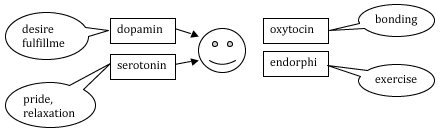
“Your brain is always seeking ways to get more serotonin without losing oxytocin or increasing cortisol,” says Dr. Breuning in her book. The brain does not want cortisol, the “unhappy” drug. Everyday life, of course, creates spurts of cortisol, and the brain struggles to lower the level. It is always trying to maximize its happy drugs and minimize the unhappy ones. But sometimes it has to negotiate. For example, in order to secure oxytocin from a bonding relationship, e.g., friendship, the brain might have to sacrifice serotonin that comes from pride. It needs to calculate whether the serotonin sacrifice is worth the oxytocin gain.

All these chemicals are managed by the brain’s limbic system, also known as the reptilian brain. The limbic system consists of the amygdala, hippocampus, hypothalamus, and other parts. All mammals have a limbic system and thus the ability to secrete these happy hormones. From an evolutionary perspective, these chemicals serve as a reward mechanism to train the brain. For example, romantic love and sexual intercourse produce dopamine and oxytocin. This trains the mind to seek love and sex and thus contribute to the propagation and survival of the species. Success at a job can produce serotonin and thus train the brain to seek more success and thus secure financial security required for survival. Exercise produces pain, which results in endorphin production. The pain is masked by the endorphins and the body is trained to seek more exercise, thus equipping the body with better survival mechanism.

Since the theory of evolution is widely accepted and relatively well understood in scientific circles, it seems to have become fashionable to explain the brain’s chemical secretions in terms of survival mechanisms. The explanations seem to fit and make sense, but human beings are different than other mammals and not necessarily at the mercy of evolution. In Harold’s example, if he feels stressed while designing the elephant structure, he can reduce the cortisol level in his brain by seeking his fiancée’s company, which could increase the oxytocin level. Or he can go for a run to increase the endorphin levels. He can also visualize what it would be like to see his sculptor inside the restaurant which could help increase the serotonin. Another option would be to increase his dopamine level by treating himself to a good meal or to something else that he wants. The more Harold knows about how the neurotransmitter can help him maintain a joyful life, the better he can manage them to negotiate happiness.


References:

1. Breuning, Loretta Graziano (2012-02-14). Meet Your Happy Chemicals: Dopamine, Endorphin, Oxytocin, Serotonin. System Integrity Press.

2. Ratey, John J. MD. A User’s Guide to the Brain: Perception, Attention, and the Four Theatres of the Brain. Random House, Inc.

Poetry from J’Rie Elliott


“To be a parent”

No town is so great, for its limits to bind me,

No state is so great, that its borders define me.

No past is so great, that my future is halted,

No fear is so great, that my heart’s not exalted.

No friends are so great, that I’d not say good bye,

No friends are so great, that I’d make my child cry.

No challenge so great that I cannot achieve it,

No dream is so great that I cannot believe it.

My life is in motion, not stagnant in time.

My children come first, and then I walk behind.

I put them first and I make it clear,

That nothing will stop me—I have no fear.

I will protect them, I will sacrifice,

I will walk the hard road for their happy life.


By: J’Rie Elliott

J’Rie Elliott is a mother, wife, daughter, and accomplished horseback rider from Alabama, USA. She can be reached at dixiepoet@gmail.com

Profile: Modern Times Bookstore and the Galeria Paloma

Modern Times Bookstore

by Michaela Elias

Modern Times Bookstore, which refers to itself as “a progressive resource for the Bay Area—a neighborhood bookstore for theMission,” is as exceptional as the area in which it finds itself.

The Mission district, located inSan Francisco,California, is a working class neighborhood bordering U.S. Route 101 and part of supervisorial districts 5, 9, and 10. But the Spartan perspective of map measurements cannot possibly convey the capacity of the culture that is packed into The Mission.

Thrift stores, whimsical art galleries, quirky bookstores, street vendors, and cafes line every block. The Mission is a center for contemporary music and art and, as Ruth from Modern Times Bookstore refers to it, “a wonderful mix of cutting-edge culture and activity.”

The signs in The Mission are in Spanish and English, since many of its residents are immigrants. The Mission has a tendency to be sunnier and warmer than the rest of the city, so people are always outside strolling, biking, and walking small dogs.

But The Mission also serves as the bedrock for many progressive political causes such as anti-racism, anti-sexism, anti-homophobia, pro-peace, anti-war, anti-discrimination, and equality movements. But for these movements to thrive, they require a hub, a resource for the information needed to power them, and for this job Modern Times Bookstore fits like a glove. The bookstore epitomizes both the political and cultural aspects of the Mission District.

Says Ruth, “We see ourselves as part of a progressive political community, and we serve the community so that we function as a kind of community center as well as a bookstore.”

Modern Times Bookstore was founded for the purpose of supporting and providing resources for the flourishing progressive movement in theMissionand Bay Area. The store also carries many books regarding world fiction, labor history, and the labor movement.

As for owner/manager Ruth’s favorite part of running a bookstore, she says it is the customers who are both shoppers in and supporters of the store. “We have wonderful, wonderful people who have been with the store for years and years and who are very loyal and do wonderful work in the world so the bookstore is an aid for them in whatever they want to do in the progressive projects they want to work on, and we try to help them find the books they need to do that.”

In the past the Mission District has been a less expensive community in relation to its surrounding areas, causing newcomers to San Francisco and America to populate the Mission and also creating an affordable location for community groups and nonprofits. Recently, many hipsters, students, artists, and political activists have moved in, further stimulating the vibrant and nonconformist nature of the Mission, but this new influx of inhabitants has also driven up property prices to an immense degree.

People from all over the Bay Area are flocking to the Mission District because it is seen as a really trendy neighborhood to hang out in. New restaurants and expensive apartments that are materializing as a result of this fascination with the Mission are causing its originators, and the people who brought all the culture to the Mission, to have no other choice but to leave.

As Ruth points out, San Francisco’s rent control laws apply only to individuals, with no protection provided for small businesses, which has caused a number of problems for Modern Times and other organizations of its kind. In fact, after forty years of existence and thirty years of residence in the Mission, Modern Times has recently had to vacate its very commodious space and relocate to the back of a gallery, Galeria Paloma, on 24th Street; rent troubles were at the root of the decision.

Galeria Paloma, owned and operated by paper-making artist and painter Shawn McFarland, showcases a unique collection of works. The paintings, clothing, stationery, and decorative objects which fill the close-knit space come from a variety of people, some local, some from friends and family of locals, some from creative people inMexico.

The space-sharing came about during a meeting of neighborhood business owners, when the management of Modern Times announced that they had to move. McFarland mentioned the back area of the storefront housing her gallery, and the bookstore relocated its inventory and operations within a couple of months.

At first glance the aesthetic style and feel of both places seems different. With its elegantly crafted collages and colorful doves, Galeria Paloma appears a gentle oasis, while Modern Times Books sports the hammer and sickle and Che Guevara quotes and seeks to provide a space to lay the intellectual framework for powerful social revolutions.

Yet the management of both places says coexistence is working so far. McFarland appreciates the bookstore’s customers’ passing through her exhibits on the way to Modern Times, and the co-op bookstore’s team of managers likes the chance to share space with a local independent business that features the works of some indigenous artists.

McFarland self-promotes Galeria Paloma through word of mouth, as she enjoys greeting guests who drop by and tends to have stories to share about the featured artists. And the neighborhood organizes street fairs and exhibitions to draw people downtown, and it attempts to assert and maintain a local culture despite the divisive effects of gentrification and the bleeding economy.

Modern Times also works not to let the downsized space diminish its character. The bookstore regularly holds events such as open mike readings, book readings by new authors, and a book club completely in Spanish. They have had to curtail these functions and make decisions as to which books to continue to carry with the decreased stocking capacity, but Modern Times is determined to develop and evolve to meet the changing environment and needs of the community.

Ruth asserts, “We are hoping we can keep going with the tangible bricks-and-mortar bookstore instead of having everything just virtual and online. We are trying to figure out how to survive in a new book economy, whatever that means; we are trying to figure that out. We hope to still serve progressive, curious readers.”

In all probability, with Modern Times’ devout mission and devotion to serving their community, they will manage to progress with the changes and stay afloat.

Still, though, McFarland and others in the area admit that the Mission District is changing, in large part because of the economy. Some customers of Galeria Paloma are moving out of their longtime Mission residences intoDaly City,San Bruno, and other cheaper locales south of San Francisco.

McFarland and others speculate that the next generation of new, visionary art and other forms of cultural creativity will be based in a place with lower rent for small businesses as well as residents, perhaps Alameda or another city across the bay with a well-traveled downtown but a lower cost of living.

Michaela Elias, a journalist and human rights activist from Teaneck, New Jersey, may be reached at mitabe@optonline.com

You may visit the Galeria Paloma online at http://galeria-paloma.com/ – the current exhibition showcases McFarland’s bird images on handmade paper.

Modern Times Books also has a website, www.moderntimesbookstore.com – visit for a schedule of events, workshops, classes, group meetings, shows, and book signings! 

Performance Review: San Francisco Symphony’s Production of “Duke Bluebeard’s Castle”


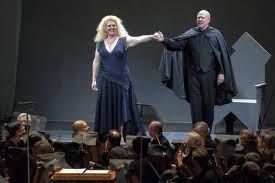
Michelle DeYoung and Alan Held accepting applause at the end of “Duke Bluebeard’s Castle”


THE DARKNESS BETWEEN THE SEXES

by Christopher Bernard

Duke Bluebeard’s Castle
An opera by Béla Bartók (libretto by Béla Balász)
A concert staging by the San Francisco Symphony

Sad stories bring forth shudders of delight.

— Bluebeard, in Béla Balász’s libretto for “Duke Bluebeard’s Castle”

Once in a great while, a rare and humbling experience happens that can be summed up only with that much-abused word I usually try to avoid, unless I am discussing chocolate chip cookies: “awesome.” Such was the San Francisco Symphony’s production of Béla Bartók’s only opera, “Duke Bluebeard’s Castle,” over the June 22nd weekend. I went twice; the first time I was so unprepared for the experience of an opera I thought I knew that I was left shaken and spent the next two hours walking it off through the late-night streets.

Performed in a half-staged version on a small area behind the orchestra and utilizing an array of vividly designed video projections, with expanded brass and full organ for the opera’s staggering climax, the concert, promising on paper, and far surpassing the promise in reality, proved to be one of the musical season’s peak moments indeed. An operatic season already flourishing with three brilliantly welcomed productions across the road at the San Francisco Opera, had, for a trio of nights, a fourth.

There are a number of versions of the Bluebeard legend, which first appeared in Perrault’s Mother Goose Tales. In the legend, Bluebeard has brought his latest, and probably last, wife to his castle, a windowless monument to male isolation, where she finds seven locked doors that, despite Bluebeard’s warnings, she insists on opening, with predictably tragic results. In most versions, the last door reveals the dead bodies of Bluebead’s previous wives. But not all of the tale’s versions involve gore – the version Bartók and his librettist Béla Balász created finds the wives in a state perhaps worse than death: a twilight of half-suspended animation, undead but unalive, immured inside a tomb within the tomb of Bluebeard’s castle, where Judith will also be buried in the end.

Bluebeard’s futile protests that have so little effect on his wife’s compulsive probing suggest a number of questions, above all whether or not he planned to send Judith to the conjugal dungeon from the beginning – or whether she only ends up there as a result of her obstinate, and in the end suicidal, need to know. For her fatal husband seemsto hope – even, however weakly, as in a dream he can’t wake from, to struggle and strive, haplessly – to redeem himself from his conjugal fatality; it is not something he accedes to easily, and certainly not something he rejoices in. His evil is a cause of ceaseless suffering for him; it is no occasion for joy. In the end, despite all of his struggling, he is defeated by the perversities, the love of self-destruction and self-defeat, of human nature, his own and Judith’s.

In its brief hour-long span, Bartok’s opera contains a profound contemplation of the eternal gulf, the willful misunderstandings and warring needs that separate the sexes: in the Hungarians’ Bluebeard we find, not a refined sadist or the monster of myth, a Gilles de Rais (the grotesque legend’s original), but an archetypal male, prisoner of his pride, of his grasping for an impossible autonomy, in conflict with a barely acknowledged need to love and be loved – a need that is poisoned by his equal and opposing need to reign, dominate and conquer. And in Judith, though clearly in the weaker position, we find an archetypal female driven by a self-destructive need to ignore every warning her despairing consort gives her, as this Bluebeard tries, futilely, to overcome his own need to dominate; to win, not just Judith’s love for him, but his ability to love her. In the past his love has always turned poisonously into a need to possess, to turn his wives, indeed anything alive and with a will of its own, into half-dead things – one of the perennial curses of masculinity.

What we see, starkly presented, is the war between masculine pride and will to conceal and conquer, on the one hand, and, on the other, feminine probing and the will to uncover, reveal and control. The result is a misery on both sides: equal folly, if not always equal fault. The end, like the beginning, is an impenetrable darkness that seems to lie forever between the sexes, a darkness that has no more powerful a metaphor than Bartók’s brave and honest opera, which excuses no one. Impenetrable indeed? The opera leaves the question open, but offers no easy solutions.

Mezzo-soprano Michelle DeYoung was luminous as Judith, and bass-baritone Alan Held turned Bluebeard into a profoundly tragic figure. DeYoung’s voice carried more effectively than Held’s to the rafters, though both voices carried with equal clarity to the orchestra floor. (Oddly, the sound of the woodwinds was clearer in the upper balcony, where the terracing of sound is also noticeably sharper. Davies Hall’s acoustics are a little fickle still.)

The projections, which probed the underlying psychology as door after door was unlocked, played always handsome, sometimes gorgeous, variations on the story’s themes; they were designed with a highly imaginative hand by Nick Corrigan. The overall staging was directed to lean and powerful effect by Neil Hillel.

A note on the projections: they were not always as effective when seen upstairs; important parts of them were invisible in the upper balcony, and what I could see of others (in particular the “treasure” room sequence) sometimes looked cheesy; their effect in the orchestra seats, however, I found completely engrossing. Annoyingly, the big climax, when the fifth door was unlocked and all of the lights in the hall suddenly blaze to momentarily blinding effect, was, paradoxically, more effective in the balcony precisely because the audience there was not blinded but could imagine the effect below: as most horror film directors learn, at the right moment imagining blows seeing completely out of the water. Ultimately, there was no ideal spot to both see and hear the goings-on onstage. Such problems might have sunk a less compelling production, but it’s a tribute to this one that, by the end, they were completely forgotten.

The opera opened with a brief spoken monologue, not presented in most productions; local actor Ken Ruta made an excellent case for it – indeed, the monologue, and his measured voicing of it, demonstrated how a short, quiet introduction can cast a deeply illuminating light over all that follows.

The San Francisco Symphony rose to the occasion, and more, under the tight, searching conducting of Michael Tilson Thomas. The cheering ovations the audience gave them at both performances I attended were certainly never more deserved.

The concert opened with the first piano concerto composed by Bartók’s fellow Hungarian, Liszt. Everyone tucked into Liszt’s florid bombast gamely enough; the diaphanous middle sections, which highlighted the symphony’s woodwinds, were woven with special gracefulness by soloist Jeremy Denk, who tossed off Liszt’s stormy demands elsewhere with élan.

But what haunted the mind for the rest of the night was the tragedy that followed.

Christopher Bernard is a novelist, poet, and critic. He is author of the novel A Spy in the Ruins and co-editor of the online arts magazine Caveat Lector.

Performance Review: Chanticleers Little Theater’s Production of “The 25th Annual Putnam County Spelling Bee”

REVIEW: THE 25TH ANNUAL PUTNAM COUNTY SPELLING BEE

By Bruce Roberts

My cheeks hurt from laughing so much. My hands hurt from clapping so much. It was one terrific show.

I just saw The 25th Annual Putnam County Spelling Bee, at the Chanticleers Little Theater in Castro Valley, California, and loved it. The show, of course, centers around a spelling bee, a fact that by itself is enough to make theatergoers cringe with childhood memories of pressure, of defeat, of humiliation. Other languages—German, for instance—have one system of spelling. If you can pronounce the word, no matter how long, you can spell it. German has not imported word after word from every spelling system in the world as has English. Thus, spelling auf Deutsch is not a challenge. (Ironically, the winning word in this play is taken from German.) English spelling, however, is a challenge, a big one; thus the existence of spelling bees—and this play.

The humor in this play comes at the audience from every angle. The spellers themselves are funny, using various bizarre strategies to come to the correct spelling. One character (William, played by Matthew Horry) even spells each letter out on the floor with his “magic foot” before getting it correct. Spellers are allowed to ask for the word in a sentence, and the vice principal (Ray D’Ambrosio) responds with ludicrous sentences that invariably cause hysterics.

More comedy is derived from people plucked from the audience to play spellers. The show’s real spellers get impossibly hard words—which they struggle over before getting them correct–while the audience members are given words like “cow.” “May I have that in a sentence?” “Spell COW!” Another comic showstopper is the song sung by the previous year’s champion (Chip, played by David Kelii Kahawaii) a uniformed boy scout expecting to win again, but who sings an entire lament to the untimely erection that caused him to be disqualified. He even works in a rhyme for “penis.”

The play, however, is not about spelling. That is merely the springboard to introduce us to this world of wacky characters and their equally wacky, or poignant, side stories. Every character is unique; every character is dysfunctional, and their dysfunctions are measured against the spelling bee as a symbol of success in their lives. Logainne (Kara Penrose) has two dads, and desperately wants to please them by winning. Mercy (Rachel L. Jacobs) is incredibly smart and talented, but wants freedom to fail. Leaf (Nicolina Akraboff), though dressed as a caped superhero, only reached the finals by default, and is sure she will lose, a fact reinforced by her siblings. William, the foot speller, fluctuates between being nerdy and bizarre, and being testy about most everything, yelling at others over the mispronunciation of his name (Not Barfy, it’s Barfee’!”) All do dysfunction wonderfully.

This is a musical, and Josh Milbourne—vocal director—and Willis Hickox—accompanist—have created a wonderful music experience. Songs—funny, angry, sad–are spread throughout, with every character singing well. The best voice might belong to Austin Scott III, playing Mitch Mahoney the comfort thug, as well as one of Logainne’s gay fathers. When he sings, besides being taller, his voice rises above too. Another fine voice belongs to Allison Mathiesen, playing Olive Ostrovsky, whose dysfunction reaches new lows with a father who can’t get off work, and a mother who’s “finding herself” in India. Olive has a lovely voice as she plaintively sings of loneliness, with parents always too busy to attend spelling bees—or anything else in her life.

Once again, award-winning director Sue Ellen Nelsen has assembled a superior cast and crew and harmonized them into excellent entertainment. If you’re ever in Castro Valley,California, for a truly wonderful theater experience, can you spell “Chanticleers?”

 Bruce Roberts, who may be reached at brobe60491@sbcglobal.net, is an accomplished sculptor and schoolteacher from Hayward, California. 

Performance Review: San Leandro Players’ Production of “Pride and Prejudice”

Pride & Prejudice, as performed by the San Leandro Players: Review

by Jessica Sims

With Hollywood turning out multi-million dollar-budget films quicker than I can run a mile (NOT quick at all), sometimes one can forget how magical live theatre can be. The San Leandro Players’ production of Jane Austen’s Pride & Prejudice reminded me of the magic. So often, adaptations of P&P leave out way too much of the plot and action, and this was the first adaptation (and having spent my youth in Northern England, I’ve seen more than your average) where I felt that someone who never read a word of Austen would actually understand what was going on. Director Hallie Lewis Hunt did an excellent job of adapting the novel to 1940s England, making it modern with the language and mannerisms while maintaining its regency-era charm. The characters weren’t as reserved as their regency counterparts, which I thoroughly enjoyed. And the music, oh, the music: the pivotal dance scene between Darcy and Elizabeth was made THAT much magical and romantic with “The Nearness of You” playing in the background. However (CRITICISM ALERT), one of my favorite characters was left out: the pernicious and rude Mrs. Hurst (and her bump-on-the-log husband, Mr. Hurst), the elder sister to Mr. Bingley (played favorably by Mr. Barry Eitel). Most adaptations leave out the Hursts, making Caroline Bingley the lone (and perhaps slightly misunderstood) female “villain” in P&P. What a villainess she was! Danielle Gray did an amazing job toeing the line between desperate single girl and Wicked Witch of the West—I actually empathized with Caroline a little: she had been putting in the work to be the next Mrs. Darcy, and here comes this upstart with her loud family and no fortune who steals him away. The Bennet family is just as it ought to be in the play: zany, inappropriate, and a lot of fun. Terry Guillory played Mrs. Bennet to the perfect (annoying) pitch and her comedic foil Mr. Bennet (Scott Van de Mark) was perfection as the father who puts new meaning into the phrase “my name is ‘Bennet’ and I ain’t in it”. All five Bennet sisters, Jane,Elizabeth, Mary, Kitty, andLydia (played by Elena Spittler, Rose Oser, Kristin Tavares, Rachel Olmedo and Taylor Melville, respectively) were superb. Jane and Elizabeth were respectable (as always), Mary was a stick in the mud (as always) and Kitty andLydia were out of control (as always). Although Olmedo’s Kitty was a bit on the “psycho” side, I liked it, and by the end of the play, I had (affectionately) dubbed her “psycho-Kitty”. Mr. Darcy (insert wolf whistle here) was played by a very handsome young man, Barnaby Williams. I wouldn’t usually put “Darcy” and “awkward” in the same sentence, but it worked for Mr. Williams and he had great chemistry with Oser’sElizabeth. Other notable performances include Sarah Asarnow as the “plain” Charlotte Lucas (who is gorgeous, by the way, if that’s plain, sign me up pronto), Julio Rafael as a sleazy and hygienically-challenged Mr. Collins and Sukanya Sarkar as a fiery Lady Catherine de Bourgh (she was channeling Eartha Kitt, circa 1953; I was waiting for her to break out with “Santa Baby” at any moment). The whole cast did an amazing job of bringing (what I consider to be) one of the most enduring and well-written love stories of all time, to life. Now excuse me, I have a mile to finish…but I wouldn’t hold my breath if I were you.

You can contact the reviewer, Jessica A. Sims, at jessica.sims12@gmail.com.