Profile: Parkinson’s Institute

PARKINSON’S INSTITUTE: UNPARALLELED!

by Bruce Roberts

Cassius Clay, later known as Muhammad Ali, was the epitome of grace and lightning-fast movement in his days as a boxing champion. He claimed to float like a butterfly, sting like a bee, and he was not exaggerating.   To see him today though, years later,  slow of movement, shuffling,  leaning forward, slurred speech, uncontrollable shaking, he has also become the epitome of a Parkinson’s Disease patient, a tragedy of which all should be aware.

Fortunately for the world in the year 2012, the Parkinson’s Institute—based in Sunnyvale, California—exists.  The brainstorm of its founder, Dr. J. William Langston, this institute stands out in its field because its approach to Parkinson’s is all-inclusive. Dr. Langston’s concept is “to take an integrated approach to basic clinical research and patient care” (PI website). In other words, other Parkinson’s sites are either research clinics or treatment clinics. The Parkinson’s Institute is both—world class research combined with top-notch patient care to put the research into practice.

All this from an equally world class staff. In fact, two of the PI’s doctors have recently won prestigious awards in their fields.  Dr. Caroline Tanner, the Director of Clinical Research, won the 2012 Movement Disorders Research Award from the American Academy of Neurology.  Significantly, she is the first woman ever to receive this award.   Also, Dr. Langston himself has been awarded the Robert M. Pritzker Award from the Michael J. Fox Foundation.  He received this honor “for his profound contributions to Parkinson’s disease therapeutic development and his exceptional commitment to mentoring the next generation of Parkinson’s researchers.” (MJF Foundation)

PI’s other emphasis, of course, is patient care.  Even Dr. Langston sees patients every day, indicating that PI has its feet firmly anchored in the real world.  Additionally, they offer a wide range of seminars to aid their patients—and their caregivers—in coping with Parkinson’s.  Patients can take seminars for those newly diagnosed, for medications and drug interaction, for social interactions, for financial planning, and even for dance and PD.  Many other programs are offered, and most of these seminars are free and available to caregivers too, a true community service.

Recently, PI has become the collaborative center for a 20 million dollar grant, together with Emory University and UCLA, to focus on epidemiological research—the environmental,  genetic, and age-related risk factors for Parkinson’s Disease.  Understanding these causes will improve PI’s ability to prevent and treat Parkinson’s, and indeed, that is their only goal:  to lick Parkinson’s Disease and make the world healthier.

They should be constantly commended and supported for their outstanding work. Just Google the Parkinson’s Institute in Sunnyvale and click DONATIONS on their website to offer your support.

Bruce Roberts, who may be reached at brobe60491@sbcglobal.net, is an accomplished sculptor and schoolteacher from Hayward, California. 

Poetry from Sam Burks


“Infinity”

Listening to the ocean speak
in tones of mercy, tones
of a tortured body
finally bigger
than all
of that pain

I sometimes
wonder
why
the same waves keep breaking
over and over
again and again
and why the sound
they make
consumes every lost
and incomplete idea,

consumes it all
like so many vessels before
into that endless mirror
of the heavens
on earth

listening to the pulses
of the universe
expressing its pace
in my own chest

I sometimes wonder
how
we can look so hard
in the opposite direction
and only glance
at infinity


“The sky is still there”

What happened
to the sky
and the clouds
that once made up
the dimensions
of that eternity?

Buried in my
tattered clothes and
bellow this hollow mattress
it’s kind of hard
to see what I
know
is there

and even though
the clock
screams at me
anonymously
telling me
everything
except
what I
want to hear
I hope that surely
the sky is still
big and blue and
still right there
right above
the roof

but in the warm
room, I can see
only patterns of the
days that I’ve been
counting down

The blurry scars
on my arm

Past thoughts
displayed
on yellowing paper
littering the room

Unread books

Half-smoked
cigarettes

Photographs of
the gone

The surviving words
of the dead

And if this
broken and scattered
history
laying around me
is trying to say
anything
at all

I hope
it’s that
somewhere
the sky
is still there
big
and blue


“The Network”

The shock that projects in waves-

The reflected vibrations of our collected selves-

Fills both hands with separate meanings

Contradicting black and white

Identifying good and evil

While remaining a singular expression

Of feeling, of color, of thought

Of the trembling of our presence

Within a deserted room

Who are you, who are we

But a change upon and within our selves

And our surroundings

And the common ground

We know as being right here

When the eyes have met

Maybe they’ll see a reflection

Of infinity upon infinity

To beyond our conscious fences

To nowhere at all

Sustained as a circle

A loophole in the rules

That guide so quickly to hate and fear

Which we as a being

Should learn to hate and fear in turn

I will not separate myself

From the seclusion

Of everything as one

And one as everything

I will not surrender

To the animosity of the unfamiliar

For I am one to think

That I am familiar too

I will not tolerate

Change as a means to an end

For the end is changing meanings

And happening all at once

The shock of being here

Dies with the realization

That here is being

And we will not keep ourselves

To ourselves anymore


“Memories (a farewell)”

Before we knew it
the time
was almost here
to say
goodbye

And how?
so unexpected,
long desired,
the light is finally
breaking shadows
on the horizon.
And amongst the joy and
the thrill and the sigh
of relief
is a small twinge
of selfish logic
breaking in
to our hearts

Somehow,
we know that we
don’t feel ready
just yet

But when will we?

Back in the warm
securing shadows
we watch the light drawing nearer
and we wait
and recollect

Everything
and
everywhere
holds
a memory:
this park bench
where a few summers ago
we met on our bikes
at four in the morning
to drink stolen wine
and laugh.
And oh, how we laughed
until we collapsed
into
each other.
Nothing but the dry
summer night,
the roof of stars,
and the perfume
of yellow grass-
the scents and
sensations
of what we were
that night.

Or that dark
stretch of sidewalk
leading from the echoes
of a house party.
You couldn’t make it very far
down that sidewalk
because
you were too drunk.
So I laid there with you
and we prayed
for the ground
to stop shaking.

Or that parking lot
where
your car got a flat,
and I broke the jack
and put a dent
in the asphalt
trying to put on
the spare.
And how we laughed
away the worry
until
we collapsed.

Or all those hangovers with coffee,
the miles that we
put on each other,
all the careless
and funny accidents,
all those memories
that made us
who we are.

Back on this park bench
where I held you
and fell in love with you
a few summers ago
I wrote down
a few things
that I
remembered
about us,
and how things
are so different now,
and how
I don’t
want to
let you go
just yet.

But if not now, when?

You are already
just a memory
of the laughter
and the stars,
and the booze,
and the dry grass,
and the relentless
summer nights,
and the sprinklers,
and the kittens,
and the dark sidewalks,
and the jealousy,
and the inspiration,
and the certain songs,
and the comfort
that I
once had.

And now, almost before
I knew
what hit me,
and long before
I’ve come
to accept it completely,
the time has come,
you are
already gone,
time to let the memories
be just that: memories.

Sam Burks is from the San Francisco Bay Area, in California, and can be reached at srburks@gmail.com

Poetry from Linda Allen

Let’s Play Pretend

by Linda Allen

Let’s play pretend

Let’s build a castle

Where a knight can keep us safe from the darkness

Let’s play pretend

Let’s build another Great Wall

That can block hate and pain and lead to light and love

 Let’s play pretend

 I can be me and you can be you

And we won’t care about race, sexual orientation, or what makes us different

Oh let’s play pretend

Let’s create a new world

Where we are all truly EQUAL and no one is better than we

Let’s play pretend

Let’s write a new dictionary

Where murder, rape, and abuse are just words with no definitions

Let’s play pretend

Let’s build a new life

Where kids can play without fear

Oh I wish we could just live in a pretend world

Where we are all safe, protected, and happy

Linda Allen is an American from Oklahoma who may be reached at lindaallen4119@att.net and welcomes comments and thoughts on her writing.

June’s Synchronized Chaos issue: Coping and Catharsis


Welcome to June’s issue of Synchronized Chaos International Magazine! Happy graduation, Father’s Day, and change of seasons.

Our monthly theme is Coping and Catharsis – using writing and storytelling to face and process personal and social suffering and alienation.

Our writers portray a mixture of individual, social and global wrongs and griefs. Having these pieces grouped together reminds us that at some level all suffering is personal, because it affects people and other living beings.

Catharsis is defined medically as purging, the removal of poison or waste or the excess of anything from the body. In ancient Greek and Japanese Noh theater, playwrights induce catharsis by showing intense drama or emotion so audiences can express and release the feelings along with the characters and afterwards return to psychological balance. Many of our writers’ work this month reflects great sadness but also represents the potential for healing in audiences by providing a venue for cathartic identification.

* Linda Allen creates vignettes of midwestern American life, with one of the most powerful a funeral from a child’s point of view, grief underscored by the contrast with the boy’s innocence and curiosity about the black clothes and other ceremonial details.

* Justin Karfs, Erin Rabon and Sam Burks all explore loss, longing and loneliness through distinctive poetic styles. Kurt Dunlap illustrates the confusion of some aspects of modern life and the challenge of developing an authentic relationship when people aren’t sure of their own and others’ motives through his tragicomic fictional piece.

*  Some cathartic works also serve to encourage audiences to harness their vicarious experience of anger and sorrow by doing something about social injustices. In fact, playwright Bertolt Brecht intentionally avoided reaching psychological conclusions in his dramas in order to leave audiences feeling inspired to complete the story arcs themselves by taking social action.

A few of this month’s contributors confront local and global social injustice through their writing.

Martin Sunnafrank illustrates systemic manipulation of society by the powerful, rich and selfish in his novel Three of a Humankind, reviewed by Bruce Roberts, and George Teseleanu reviews the writing of San Francisco Beatnik performance poet Mark Schwartz, who uses language in unique ways to protest and subtly mock war, racism, conformity and other wrongs he saw in post WWII America.

Poet J’Rie Elliott sublimates criminal violence into verse which derives its power from the intentional lack of a happy ending, thus refusing to mask or romanticize the brutality and senselessness of what happened. Leena Prasad discusses the physical and neurological response to a personal violation in her column, Whose Brain Is It.

The most direct, positive element of hope this month comes from an actual stage production, the comedy showcase Justin Alan attended in San Francisco’s Mission District. Alan describes the joy and comfort he experienced from the performance, comparing the show to a ‘warm hug from a friend.’ He points to one of the perhaps less high-brow, but still useful aspects of culture: to pull us out of dark moods so we can function and make it through the day.

An anonymous Bay Area writer, using the name ‘Quest Forself,’ also points to how people can learn to connect to and comfort one another, starting by looking within and overcoming personal barriers to empathic relationships. This can represent another pathway towards overcoming suffering, if we’re willing to put in the thought and effort.

And, finally, returning contributor Christopher Bernard reviews the Victorian Cult of Beauty (1860-1900) exhibit at San Francisco’s Legion of Honor, which shows the power of beauty to calm, inspire and renew us, taking us back to the idea behind the Ray Bradbury quote on our informational page:

Ray Bradbury

“And what, you ask, does writing teach us?First and foremost, it reminds us that we are alive and that it is gift and a privilege, not a right. We must earn life once it has been awarded us. Life asks for rewards back because it has favored us with animation.So while our art cannot, as we wish it could, save us from wars, privation, envy, greed, old age, or death, it can revitalize us amidst it all.”
Ray Bradbury, The October Country

NEW! Check out our Kickstarter Page and please help spread the word to others. While we’ve met our $300 goal, we can accomplish even more with additional funding, and can collect donations until June 19th. Your support will help us provide more resources for our international volunteer staff, encourage writing and visual art groups to meet within their own local communities, and allow us to bring in technical support to revamp and maintain our website. If you have any questions about this project, please email synchchaos@gmail.com with “Kickstarter” in the subject.

Thank you and happy reading!

Christopher Bernard’s review of the Cult of Beauty: the Victorian Avant-Garde (1860-1900) at San Francisco’s Legion of Honor


THE VICTORIANS’ BLISS


The Cult of Beauty: The Victorian Avant-Garde, 1860-1900


The Legion of Honor, the Fine Arts Museums of San Francisco


Through June 17


A review by Christopher Bernard


For a shining moment in the savage tale called history, pleasure was held as the highest good rather than as the road to damnation for a weak and sinful humanity. Happiness was seen, not only as a legitimate aim, but as the sole aim of human life. What was virtue without pleasure; what indeed is goodness without happiness?

We’re still not sure: our meaner impulses insist on what some may see as a preposterously heroic view of life in the pursuit of money, power, celebrity – if you’re not training for the Olympics, what’s wrong with you? “No pain, no gain” is many a person’s mantra; though to gain what, they don’t always say, or perhaps know. The pursuit of mere pleasure, the right to a happiness made of the sweetness of life, we darkly suspect are signs of laziness and a lack of courage, a romantic withdrawal from the Darwinian struggle, rather than the civilized repudiation of the mindless callousness of nature, of evolution and its economic incarnation, capitalism.
So it’s quite a revelation to be reminded of something many may remember from their art-history classes: in the middle of the era of those old, dull Victorians, the Aesthetic movement flowered for almost two generations, and pleasure, happiness, love, and their objective correlative, beauty, were honored, pursued, worshipped, even adored.

The very success of the movement led to its own repudiation by the early modernists, and much of the art and criticism of the last century dismissed many of its products as kitsch. Yet, as often happens, the impulses behind the repudiated style went underground, and continued to nourish arts less susceptible to public ridicule; in this case, the crafts, home decorations, fabric design – the domestic arts in general. In fact, the very idea of a beautifully designed home, of the “house beautiful,” with stylish but not costly furnishings, that people might actually be able to afford – an idea most of us now take for granted – originated during that time.

And now we have an ambitious exhibit of work from the Aesthetic movement and the sister movements that followed – from the Pre-Raphaelites to art nouveau – now at the Legion of Honor museum in San Francisco, that succeeds wonderfully, even spectacularly, in bringing back to the center of our attention this often-dismissed but enormously fecund movement in the arts. Not only is it about “the cult of beauty,” it is itself a feast of beauty and offers revelations around almost every corner.

The exhibit, a model in how to be richly informative and enlightening without condescension or dry academicism, unfolds historically, establishing immediately the harrowing social conditions and the peculiar circumstances that inspired, and made possible, the movement. For Aestheticism was a reaction to the industrialism of mid-Victorianism, to its ugliness and social carnage, and was one of the roots of the various progressive movements, from feminism to the trade union movement to socialism, that germinated in the rich humus of Victorian society.

One of the causes of the movement was sheer embarrassment and shame when, during the international exposition of industrial products presented at the Crystal Palace in 1851, English goods appeared shabby and poorly designed when compared to similar products from France and Germany. Well, the intensely competitive English would not put up with that. And there was, as it were, a national decision to make up for lost time.

In the following decade, such designers as Owen Jones, Edward William Godwin and Christopher Dresser were hard at work creating designs for the home meant to appeal to the eye as much as the pocketbook: wallpaper, cabinets, sideboards, chairs, tea services (regarding the last: some of Dresser’s are so remarkably sleek and functional they remind one of the height of the Bauhaus several generations in the future, and others are so avant-garde they wouldn’t see their like again until a century later, in the studios of Italian designers in the 1970s).

The early years also saw the paintings and poetry of Dante Gabriel Rosetti, the poetry of his sister Christina, the paintings of Edward Burne-Jones and Frederick Leighton, the domestic designs of William Morris (several spectacular examples of which are show highlights) and Frederick Hollyer, Thomas Jeckyll, Philip Webb, and Lewis F. Day, and later on the flowering of the greatest artist of the lot, James McNeill Whistler, two of whose “Symphonies in White” are on display along with a satisfying offering of work by artists and artisans already mentioned, as well as Whistler’s etchings (a deliciously sensual sleeping Venus rests permanently in the mind), and several of the famous Nocturne, Harmony and Arrangement series, not least the famous portrait of Thomas Carlyle.

One gallery is devoted to the influence of the newly discovered Japanese aesthetic and the ancient influence of classicism, now more frankly hedonistic than the usual nod to Roman virtue and Greek grace. Elsewhere there are small gatherings of photographs from the period, in particular the romantic portraits of Julia Margaret Cameron.

Some of the furniture deserves special mention, including “The Seasons” cabinet, by Godwin, of mahogany, satinwood, brass and ivory, with painted and gilt panels (of medieval peasants in seasonal poses of sowing and reaping, possibly painted by Godwin’s wife, Beatrice); the masterly “Ladies and Animals” sideboard by Burne-Jones in trompe-Renaissance style; a tall folding screen, decorated with images of cherry blossoms and birds, by William Nesfield; and another piéce de resistance of pre-emptive modernism, a grand, black Mondriaanesque sideboard by Godwin.

In fact, the most satisfying artwork in the show tends to be in the domestic crafts: a pair of cast copper candlesticks by Philip Webb, of a kind of stout elegance, colored like honeyed gold, and originally designed for William Morris’s Red House in Bexleyheath, Kent; a black wall clock of ebonized mahogany and pained en grisaille; Morris’s big, shimmery, almost statuesque tile panel for Membrand Hall, Devon, richly colored in dark and light greens with pale-brown branches woven among them; a hanging fabric by Lewis Day of faded yellowish narcissi (a favorite flower, emblem and motif of the Aesthetes) against an almost-black background; a nobly subdued study of lilies by Hollyer; simple but elegant, and reportedly comfortable and affordable chairs by Webb and Morris, and a throne-like armchair by Alma-Tadema; and swatchbooks and “grammars of ornament” and books of designs for wallpapers and other domestic uses.

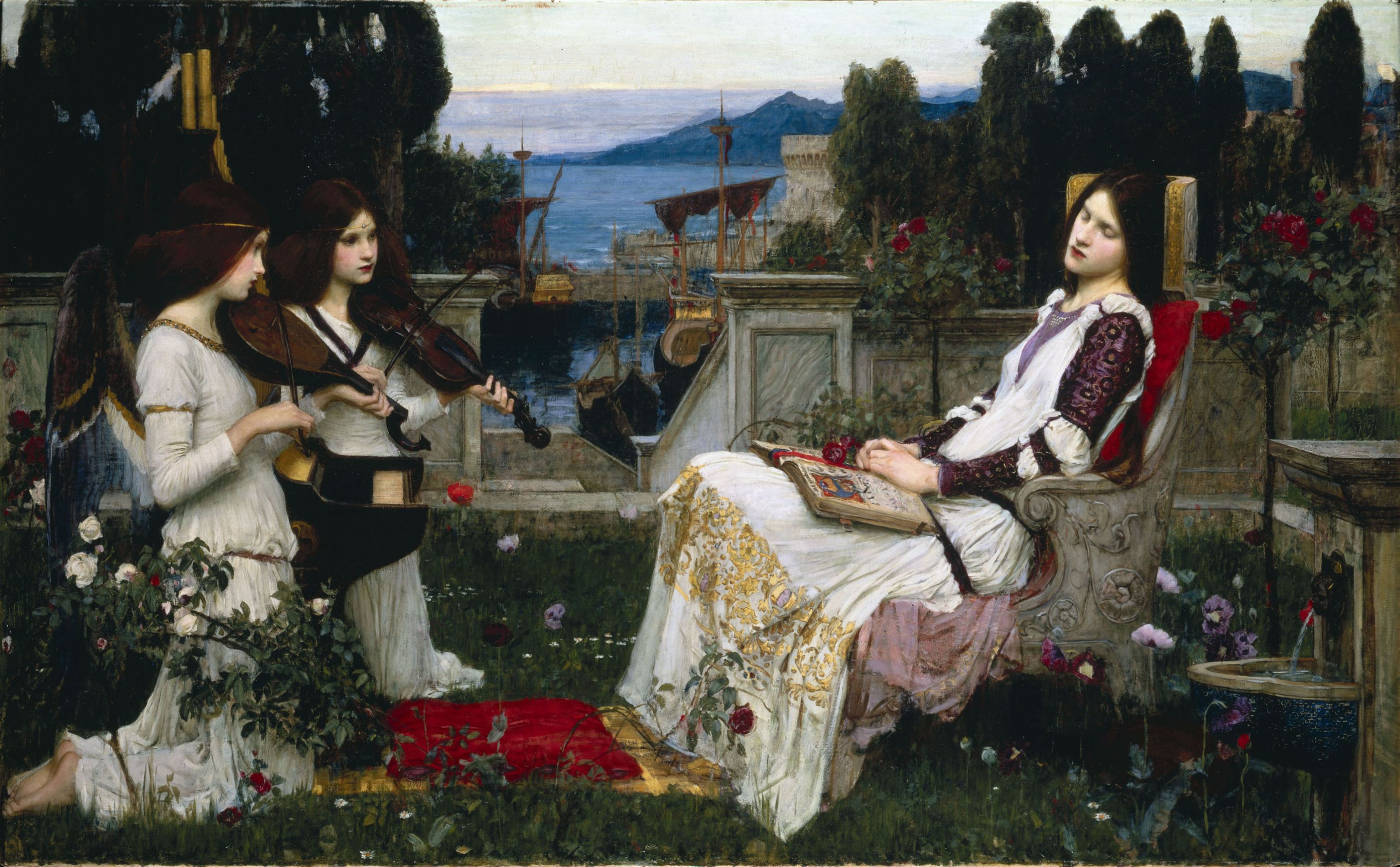
Not that the “high arts” are neglected: besides the Whistlers, there are some fine paintings, including Rosetti’s “Bocca Baciata”; a nude by George F. Watts that presents an Eros frank among the Victorians; Leighton’s study in serene sensualism, “The Bath of Psyche”; and John William Waterhouse’s sweet, if a little overly elaborated, masterpiece, “Saint Cecilia,” where two angels kneel, poised over their viols, wondering whether they should continue playing for the saint sitting in a chair across from them, asleep.

This wonderful exhibit is curated Dr. Lynn Federle Orr, of the Fine Arts Museums of San Francisco, and Stephen Calloway, of the Victoria and Albert Museum, in London (the exhibit was seen at the latter museum and at the Musée d’Orsay before coming to San Francisco, its sole U.S. venue).

After spending some time here, you may find yourselves agreeing wholeheartedly with the quote from Richard Jeffries: “The hours when the mind is absorbed in beauty are the only hours we live.”


Christopher Bernard is a San Francisco poet, critic and novelist (A Spy in the Ruins) and co-editor of Caveat Lector magazine (www.caveat-lector.org).

 

Poetic essay from a Bay Area writer

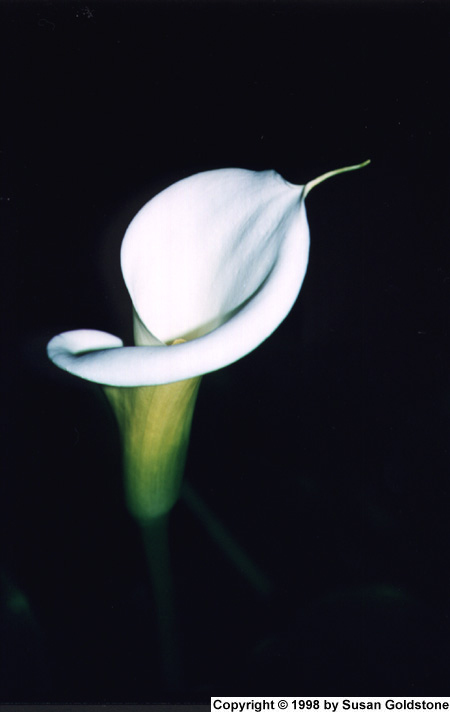
Look closely, judge what you think I am, hear clearly my voice, then judge once again, I’m making this noise, because I need a friend, who wont judge but accept, what I am in this world because, the glares from the ones, who appear to be them, burn deep in my soul and I cannot pretend, that this beam is just part of this strange alien, so judging, so smart, so feel my stem, the roots of my brain, we’re all the same lens, perceiving diversity and focusing then, on the adverse unity some let-be progression, when the lines between you and me are clearly prisons, and we’re all just prisms, so lighten your load my hands are your friends, and my smile’s the brightness through darkest tunnels, because all i promote, is energy, zen, and the peaceful zygote, regardless of race, gender or hope, all blossoms from one love-balancing flow, and the one who has written this piece has chosen this callous deceit & wrote with its feet for you to be freed, from violently hateful destruction & malice, because the you and the me that were once little kids, still have the same powers, imagination and time, but they’re memories not hours, so let’s set aside, the lack in our lives, that has drawn us to all this chaos inside, we can still seek and hide, just don’t loose the sight, of this vision of mine, for distracting the hunter, when peer prey falls behind, because my back is your back, we both have a spine, we’re all just friends here, the enemy’s mine, so the only war that exists is the one within mind, a vortex from our cortex where we share the same lives, how many times I’ll implore this, same state of mind, repeating ‘its formless’, before you begin to decide, that the dreams that you see, regardless of height, are the same as the difference, between wrong and right, or the end and the start, there really just isn’t, but a concept of time-timing constants, mere choices from which, beliefs have derived, and beliefs become real, but now these words have arrived, from your heart now ‘s the time, release all the pain that could ever reside, & you’ll find new loving-logic to lead you, extremely precise, to the dream that’s your life, where both spirit and science coexist throughout time, how do I know this? What are you, what am I?…

— From a San Francisco Bay Area writer who goes by “Quest Forself.”

Stop, Thief! May’s Whose Brain Is It, a monthly neuroscience column from Leena Prasad


Stop, thief!

topic anger
organ amygdala
chemicals adrenaline, dopamine, serotonin

The vibrant colors of the murals in Clarion Alley in San Francisco awaken my senses. The twilight is perfect for capturing the mood via photographs.

I finish planning a composition and am about to click when a man on a bike rides by and snatches the camera from my hand. For a few split seconds, I do not comprehend or accept what has just happened. Then I start to scream: He stole my camera! He stole my camera!

I feel violated. I have several months of photographs in that camera. My camera!

I run after him, screaming, as he turns right onto Mission Street. I realize that I have lost my photos and will not be getting them back but I am unable to accept this fact. I continue to scream. Then a strange and unexpected series of events occur.

The man who has stolen my camera comes back into the alley on foot. He holds up the camera as if he is going to give it back to me. I reach for it, unsure as to what is going on. He runs with the camera tightly held within his large hand. What happened to his bicycle, I wonder but I do not have time to consider this. He is running now in the opposite direction from Mission and towards Valencia Street. He is running towards the Mission Police Station! I doubt that he realizes this, however.

I start screaming at the top of my lungs and run after him. I am not saying anything this time. I am simply making a deep guttural sound, primitive language-independent screams of distress.

A policeman on a bike rides by me and asks what happened. He is headed from Mission to Valencia, the same direction as the thief. I tell him and he rides after the thief, who has already disappeared around the corner on Valencia. Another policeman on a bike also chases after the thief. I wonder if this might be why the thief has abandoned his bike, to perhaps find a route that does not allow a bike passage. Or, perhaps his bike is stolen also.

Then I hear sirens.

I slow down and start walking instead of running. I am out of breath and feeling calmer. A group of people walk towards me “You are lucky, they got him,” one of them says.

Why do I react with so much aggression and without any consideration for my safety?

Surprise or fear can trigger an adrenaline rush. The quantity of the adrenaline released and thus the degree of reaction is determined by chemical factors. A low quantity of the “happy” neurotransmitters dopamine and serotonin in the brain triggers a higher degree of adrenaline production. In other words, the less happy the brain, the higher the level of adrenaline it produces.

When the thief ripped the camera from my hand, my adrenaline level probably shot up. The level of adrenaline might have been exacerbated even further by the fact that I was in an unhappy mood. I had left my apartment a few hours ago in an angry mood because I was upset with my boyfriend. This would have resulted in a depletion of dopamine and serotonin.

In a different state of mind, would I have screamed less and potentially let the thief get away? Or would I have not made the primitive guttural sounds that, in retrospect, seem to be an over-reaction to the loss of some photos, as precious as they might have been.

Low dopamine and serotonin and high adrenaline do not activate a response but only contribute to the activation. The response is activated in the limbic system specifically in the amygdala. The amygdala is one of the major organs responsible for the perception of threat and for triggering an emotional response. It can hijack the potentially rational responses from other parts of the brain and cause irrational reactions. In my case, I did not consider my own safety because I was furious that my personal space and property had been violated.

Later that day, when I am in the Police Station talking into a tape recorder and going through the story of what has happened, the police inspector asks me if I want to press charges.

“It’s wrong to steal and he should be punished. But he must have been really desperate to want to steal a camera,” my thoughts tumble out of my mouth. I decide not to press charges. Technically, it is not my decision because the district attorney will press charges anyway because the man was arrested. I did not know this at the time, however, and despite my conflict, I made a decision to not punish the thief any more than he had already been punished.

Perhaps I was being kinder because the dopamine and serotonin levels in my brain had surged back up when I found out that justice had been done and that I would get my camera back. Also, my boyfriend came to the police station and held my hand and kept me company while the inspector was talking to me. His presence might have contributed to the raised levels of the “feel good” hormones.

This is all hypothetical, of course, based on my knowledge of neuroscience and research on the neuropathy of anger. I would have had to be hooked up to an fMRI (functional magnetic resonance imager) to prove my hypothesis about the actions of the amygdala and the levels of adrenaline, serotonin, and dopamine in my brain. Nonetheless, it is fun to try to guess the biological triggers for my actions when confronted with a “fight or flight” situation.

References:

Dr. Goulston, Mark,Usable Insight, The Neuroscience of Anger, Monday, April 18th, 2011, http://markgoulston.com/usable-insight-the-neuroscience-of-anger/