Performance Review: The Cutting Ball Theater’s Production of “Pelleas and Melisande”

[Reviewed by Christopher Bernard]

PUT A SPELL ON YOU

Maurice Maeterlinck was to theater what Debussy was to music and Mallarmé to poetry: one of the first explorers of the infinite universe of the indirect, the oblique – “the mystery that lies … just out of sight” – called Symbolism, without which modernism and its enormous and still flourishing progeny would have been inconceivable.

His play “Pelleas and Melisande” has had the status of a legend since its premiere in 1892, influencing musicians like Sibelius, Schoenberg and Fauré, as well as playwrights, and forming the basis of Debussy’s only completed opera. The title, in fact, may be more familiar to music mavens than theater fans.

And yet, without Maeterlinck’s foray into a form of drama that hints and feints at the splendors and horrors of human life (rather than barreling at them, bare-knuckled, gritted-teethed and glaring), suggesting depths of meaning and feeling through a balance of fairy tale, melodrama and a kind of naturalism of the dream – thus turning the modern soul into its own bravest spectacle – the modern dramatic tradition that began with Strindberg and late Ibsen, and continued through the surrealists, the absurdists, Beckett, Bernhard, and Kushner, would have missed half a continent of human experience. And it would have lacked much of the courage and power, the audacity and imagination it has shown ever since.

Which makes one all the more grateful for the often magical and wondrous production of the play by The Cutting Ball Theater in San Francisco. They have taken on the play’s considerable challenges of interpretation and emerged victorious, creating a spell that, once you have entered it, you may not want to leave.

The play’s storyline is simple enough, even slight: a tissue of allusions to fairy tales, folk tales and romance taking place in a nameless kingdom in a vaguely medieval era, following the plight of a young princess found in a dark forest by a middle-aged prince who bears her home and makes the mistake of marrying her when there is far more likely mate for her in the form of his own brother. What makes the play a masterpiece that, in the right hands, defeats the dangers of its own dating is the playwright’s approach: the oblique poetry, the elided psychology, the leaps in time, the dream-logic, the almost cinematic abruptness of scene changes. Maeterlinck’s means are sometimes too blunt or obvious (as in the many allusions to Rapunzel), but this production solves the problems thus caused by using, in ways one can only suspect the playwright would have applauded, indirect, “poetic” devices like pantomime rather than more “naturalistic” methods that might have broken the play’s delicate spell.

Indeed, throughout, director Rob Melrose wisely builds on the mysteries and obliqueness of the text, allowing the audience to dwell in its enchantment and never over-emphasizing either the romantic excesses or the peculiar psychology of the fairy-tale-like characters.

The small Taylor Street theater creates a warm intimacy. Most of the action takes place on a long, narrow platform with the audience seated along either side; a corner of the stage opens to a pool of water, water being both a potent symbol and a beautiful “objective correlative” of the world of the lovers, their passion and their fate. Precise and discreet lighting and a finely wrought web of music and sound perfect the mise-en-scène. The action is often, discreetly, choreographed, a ballet of gestures and brief tableaux.

But none of these efforts, beautifully worked out as they are, would be of any use without getting the acting right – and here the soul of the production goes from success to something more impalpably pure. Caitlyn Louchard’s Melisande is altogether admirable in a difficult role, built largely on reactions and silences, and her variety and sureness of touch make the lost princess entirely believable. Special kudos should also go to Paul Gerrior as Arkel, an old, king-like figure, whose sorrow is to be left at the end forlorn, with a baby in his arms, and his castle, with its surrounding forest of darkness and the poisoned lake beneath it, a mortuary. The supporting roles are also wrought with great sensitivity and care. Joshua Schell’s Pelleas and Derek Fischer’s Golaud are thoroughly worthy and avoid the pitfalls of sentimentality and melodrama the parts can easily slip into, though sometimes their brimming American “good health” in parts that need an evasive neuroticism to be completely convincing shows through despite their best efforts.

Gwyneth Richards’ two brief scenes (as Arkel’s wife and as head of the servants), not least because of a fine voice and meticulously gauged line-readings, were among the most memorable of a production filled with memorable moments.

The production is a triumph, though that sounds way too pompous for a piece of such intimacy and delicacy and grace. It’s a must-see for anyone in the Bay Area who cares about theater.

————————————————————————————————————————————-

Christopher Bernard is a San Francisco writer and founding editor of Caveat Lector magazine.

Performance Review: Opera San Jose’s Production of Leoncavallo’s “Pagliacci”

[Reviewed by Christopher Bernard]

VOICES IN JOY AND SORROW

Opera San Jose opened its twenty-eighth season with a brave choice. Their production of Leoncavallo’s “Pagliacci” – a passionate, brilliant and thrilling one – has been given an unusual partner, taken from the dark years of the mid-twentieth century.

Usually we get Mascagni’s “Cavalleria Rusticana,” its near-contemporary and thematic twin, coupled as “Cav and Pag.” Pag has more in common with Cav – the same heart, the same themes, almost the same brain – than is often realized: Leoncavallo wrote and composed Pag to prove he could beat Mascagni at his own game. Now the two competitors are performed together, joined at the hip, apparently forever.

Not this time. Instead we got a trickier proposition: the thorny desolation of Francis Poulenc’s tour-de-force for solo soprano: “La voix humaine.”

“Pagliacci” remains one of the world’s favorite operas. An ever-fresh object lesson in the endless reflections between life and art, it tells the story of an itinerant theatrical company arriving one day in a small Italian town around 1900, where the company’s leader, and stage clown, discovers his actress wife has taken a lover. The tragic outcome is then enacted in the guise of the play they perform that night.

This is an opera, with its much-loved aria “Vesta la giubba,” that is peculiarly dependent on its tenor, and in this case, the audience was swept, by Alexander Boyer as the tragic clown, time and again into the peculiar rapture only opera can induce.

Close behind Boyer in success was Jouvanca Jean-Baptiste as the wife, miserable in her unfaithfulness, whose voice, strong yet sweet, and delightful stage presence defeated one or two unwise directorial decisions, to create a character still sympathetic despite all her sins. Krassen Karagiozov did a fine job with the rather blank role of the lover Silvio, and Jason Detwiler was luridly grotesque as the randy hunchback Tonio and the Prologue’s tendentious Taddeo.

No notice of this production can be adequate without mentioning the superb chorus, under Andrew Whitfield: admirably warm and transparent and clear – a joy.

The handsome minimalist set is arranged like big children’s toy blocks set around the stage under a cerulean sky subtly darkening at key moments and raked with high-cloud lights imaginatively deflected from corner to corner to point up the fantasy at the heart of this archetypal verismo tale.

But there is a problem with this particular simplicity: it undercuts some of the story’s realism, and, as now designed, does not adequately separate the inner stage, on which the play within a play acts out the opera’s’ key drama, from the frame stage representing “reality.” This separation must be made graphically clear if the opera’s point is to be made effectively. If the entire set looks too artificial, there is nowhere for the mise-en-scene that becomes a mise-en-abime to go.

Oddly enough, a similar problem plagues “La voix humaine,” though here the problem is in Jean Cocteau’s libretto. This lengthy monolog amounts to overhearing half a late-night phone call, taken in a well-appointed apartment overlooking the rooftops of Paris, between a woman and her lover who is in the process, to be blunt, of dumping her. The trouble is that the monolog, opening on a note of desperation in the woman, has nowhere to go emotionally but down into despair: there was little drama for me, as I knew from the opening pantomime where the story was headed, and never suspected for a moment that I might be wrong.

This structural weakness creates a tedium at the heart of the opera that the jagged, recitative-like vocal line does not help, and not even the graceful singing of the principal, or the handsome music from the pit or the elegant set design (the window frames, doors, and the room’s broad lines are sketched in like a big-box Raoul Dufy in white on black) are enough to save it. The most persuasive music in the piece is, unfortunately for the singer, given to the orchestra.

Susan Hanson handled the part with great skill, not least because of her finely tuned acting. She is graced with a voice both winning and rich.

Bryan Nies conducted both operas stirringly. The orchestra, despite some weakness in the violins when exposed, did beautiful work. The oboist was especially fine.

Before ending, I should mention the intimate splendor of the California Theatre, which provides Opera San Jose’s home stage. Renovated a few years ago with many sensitive and brilliant touches (including an example of the original theater’s stage rigging, displayed in the back lobby), this ingenious jewel of a building, formed on an awkwardly shaped lot as an enormous L, is as much a stimulating, and inspiring, pleasure as the performances going on inside it.

————————————————————————————————————————————-
Christopher Bernard is a San Francisco writer and founding editor of Caveat Lector magazine.
Bio: Francis Tapon, World Traveler and Author

[Article by Rea Rivera]

Francis Tapon’s mother is from Chile and his father is from France. They met in San Francisco thanks to a slow elevator. His brother, Philippe Tapon, is the author of two novels: A Parisian from Kansas and The Mistress. Since writing rarely pays the bills, he is now a medical doctor. His family spoke Spanish at home, unless an English swear word was necessary.

Francis was born and raised in San Francisco, California where he attended the French American International School for 12 years. Native French teachers convinced him that France is the coolest country in the universe. He is fluent in English, French, and Spanish. He struggles with Italian, Portuguese, Slovenian, and Russian. If you point a gun to his head, he’ll start speaking other languages too.

He earned a Religion Degree with honors from Amherst College, and wrote his thesis on the Bahá’í Faith and the Worldwide Church of God. After working for Hitachi in Latin America, he earned an MBA from Harvard Business School. After Harvard, he co-founded SIGHTech Vision Systems, a robotic vision company in Silicon Valley. Then he decided to change his life forever.

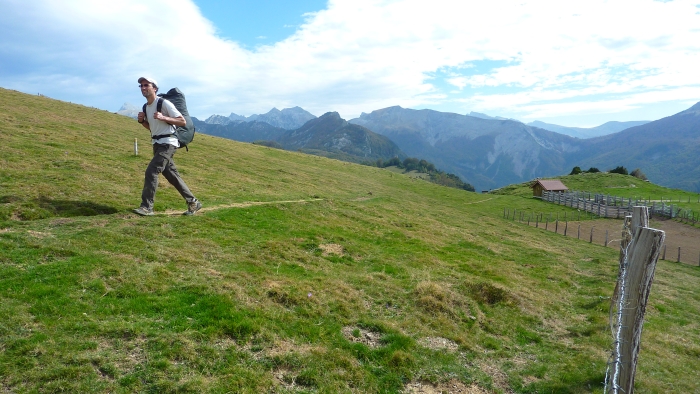
In 2001, he sold the little he had to hike the 3,000 km Appalachian Trail. Then, after consulting for Hitachi Data Systems, he visited all 25 countries in Eastern Europe in 2004. He consulted at Microsoft before hiking the 4,200 km Pacific Crest Trail in 2006. In 2007, he became the first person to do a round-trip on the Continental Divide Trail. This seven-month journey spanned 9,000 km. In 2008, he visited over 40 European countries. In 2009, he walked across Spain twice: once by traversing the Pyrenees from the Mediterranean Sea to the Atlantic Ocean, and then by hiking El Camino Santiago. In 2010-2011, he traveled in Eastern Europe and wrote The Hidden Europe: What Eastern Europeans Can Teach Us. He’s backpacked over 20,000 kilometers (12,500 miles) and traveled to over 75 countries. However, he still has never owned a TV, chair, table, couch, bed, or rocket ship.

He is the author of Hike Your Own Hike: 7 Life Lessons from Backpacking Across America. He is donating half of his book royalty to the Triple Crown of thru-hiking-Appalachian Trail, Pacific Crest Trail, and Continental Divide Trail. The Hidden Europe: What Eastern Europeans Can Teach Us is his second book of his WanderLearn Series. In 2012, he plans to spend two years visiting every country in Africa and will write a book about that in 2015. His goal is to wander to all 193 countries of the world, see what we can learn from them, and share it with the world.

There is a variety of ways to learn more. Start with http://FrancisTapon.com. It has over 250 articles and hundreds of trip photos. Sign up for his newsletter to get the latest updates and special offer or previews. If you have questions or comments, follow the Forum link to see if someone has had a similar thought. If not, start a new topic. Francis will give a better answer there than if you write an email. You can also connect with him on Facebook or Twitter. He’s also happy to receive hate email-it makes him laugh.

If you want to meet Francis in person, visit his website’s Events page, which shows where he will be next. If you want him to give a fun and informative speech or workshop for your organization, then contact him via the web page. He also offers individual life coaching if you want to recalibrate your life. He hopes to inspire you to learn more about yourself and the world.

You can reach Rea Rivera at gone2thebeach26@gmail.com.

Synchronized Chaos Magazine – Nov 2011: Opposing Concepts

In this November issue, Opposing Concepts, we present to you a mixture of poetry, photography, fiction, book reviews, and more! Many of these works present interesting antagonistic ideas or influences.

Dave Douglas’s poem is a flowing analysis of engrams:  waking life, sleeping life, memory, and reality.

Blanca Jones’ piece represents light and dark in terms of faith. Jones seeks to answer, How Can There Possibly Be a God?

We are excited to publish the work of new contributor Joseph Johnson. Johnson’s fictional work is appealing, and is as diabolical as it is suspenseful.

Liz Caruana’s photo series, She’s Leaving Home, is delicate yet bold in a quietly eager sort of way.

Whose Brain Is It? Presented as a mystery with fictional characters and clues, this is a monthly column with a journalist’s (Leena Prasad’s) perspective on brain research.

Book reviews this month include:

  • Deborah Fruchey on City of Stairways: A Poet’s Field Guide to San Francisco, edited by Milta Ortiz
  • Bruce Roberts on The Saint of Florenville: A Love Story, by Alfred J. Garrotto
  • Christopher Bernard on You Deserve Nothing: A novel, by Alexander Maksik
  • Marla Porter on A Dreamer in Egypt – The Poetry of Jaylan Salman

Bruce Roberts also reviewed the fabric and quilt art show at the Cinema Place Gallery in Hayward, California. Suzanne Birrell reviewed the gaming science lecture by Colin Milburn, which was held on Tuesday, October 4, 2011, in conjunction with the Northern California Science Writers Association.

Last month, we featured an article about Sarah Katherine Lewis’ new book, My Boring-Ass Rehab Diary. This month, Tapati McDaniels’ conversation with Lewis continues in Part II: self-publishing.

We also have a timely piece on the Occupy Wall Street movement, by Christopher Bernard.

Lastly, we recently announced ways that you can help support the flood relief effort in Southeast Asia. We would also like to mention the recent 7.2-magnitude earthquake in Turkey.  It is estimated that the death toll is now over 600 people. Click any of the following links to see how you can help: jdc.org, shelterbox.org, ifrc.org.

What Do the Occupiers Want? An Op-Ed Column by Christopher Bernard

[Article by Christopher Bernard]

What Do the Occupiers Want?

The news media seem confused about what the Occupiers of Wall Street, San Francisco and other cities around America, and now the world, have been demanding. The Occupiers are mad – they’re mad at Wall Street, and mad at the rich, and mad at Republicans and Democrats who have coddled the rich for decades. The pundits and reporters say the protests are all wonderful and signs of a vital and energized democracy – but what in the heck do these people really want?

Jeffery Sachs recently published a new book called “The Price of Civilization.”

Well, the answer is simple: They want the top 1% to pay their fair share of the price of civilization.

For the last thirty years the richest Americans, whether individuals or corporations, have taken for themselves everything they can get their hands on. They have not shared the spectacular gains our economy has made either with the people who work for them, or to pay for the collective actions that make up government, the services we all use, including police protection, transportation systems and the military.

This has resulted from the hyper-individualistic Reaganism that has dominated our national life since the 1980s. But Americans are not merely a collection of individuals seeking to maximize their returns. America is a society, not just an economy, and a society functions well only when everyone pitches in to make it work. The middle class has been doing its part from the very beginning, and over the last few decades has borne the brunt of the costs of our deepening economic and political dysfunctions.

Christopher Bernard is a novelist, poet, and co-founder Caveat Lector magazine. He is an active supporter of Occupy San Francisco.

Continue reading

Poetry by Dave Douglas

Engram (a pantoum)

“A hypothetical change in neural tissue postulated in order to account for persistence of memory-called also memory trace.” – Merriam-Webster Dictionary

amid the tunnel of yesterday and tomorrow
under pressure from wait and scurry
between sleep and wake, images borrow
and collapse under the weight of memory

under pressure from wait and scurry,
times past; built with a shifting foundation
and collapse under the weight of memory –
an awry mnemonic missing base isolation

times past built with a shifting foundation
face moments of persistent efface;
the mnemonic awry, missing base isolation
within the void – without a trace

face moments of persistent efface
as engrams are stacked to the sky
within the void, without a trace,
which oddly shifts the mnemonic awry

as engrams are stacked to the sky,
with numerous pathways of inception,
which shifts even the mnemonic awry
with levels of change and recollection

with numerous pathways of inception
from room-to-room evanescence,
with levels of change and recollection
who is the builder of reminiscence?

from room-to-room evanescence
between sleep and wake, images borrow;
who then is the builder of reminiscence
amid the tunnel of yesterday and tomorrow?

You can reach Dave Douglas at carpevelo@gmail.com.

Photography by Liz Caruana

She’s Leaving Home

Artist Statement:

Liz Caruana is a San Francisco based fashion, editorial, beauty, and portrait photographer.  Her work draws strongly on themes from cinema and she creates a full story by shooting several images.  Caruana’s work has been depicted as delicate, elegant and melancholic.

This particular photo series, She’s Leaving Home, is based on the 1967 song from The Beatles.

Email liz@lizcaruana.com for more info.