Poetry from Sam Burks

Highway 40 (going)

Finally,
the illusion
of freedom,
another renewal
of heart, of electricity
of the mind, neon colors
dancing behind the iris
and over
the evolving land

Finally,
another state
of convincing content
maintain the stretching
and shrinking shadows
over this landscape:

The winding veins
of America, a highway
stretching from west to east;

Flat rolling prairies with
their symphony of birds
and yellow grass rustling with
the sighs
of travel;

Little buildings popping up,
sheltered toilets and soda fountains,
nourishment for the blood
flowing through
these veins;

Brown and green signs
on either side
of our track marks
reminding us
that there is
such a thing
as somewhere
though, finally,
we are
where
we really are

Call it the road
or the way
or a dream
lost in the pages
of an unwritten diary

Call it the soul
of youth
searching, not settling,
but searching
perpetually
for settlement,

Call it the echoing of voices
from the walls
of an Arizona cave,
carried through the avenues of Albuquerque,
across the plains of North Texas,
and from there,
who knows?

This beautiful illusion,
that is life-
to solidify reality
would be a peace,
a quick peace,
a surrender
to silence,

But to fight,
dissect
the collage of noise
and color
is a long battle,
which we
can win
if we just
keep going

The Visitors Book

Listen:
The silence speaks
with a voice like thunder
lightning lambs electrifying neutrality
and every other
self-constructed image
tagged
on the wall
of silence, that ages old
visitors book
passing between hands and
in-between lands,
the words aren’t sounds
so much as sights and feelings
and memories projected
on the wall
of silence

Listen:
The conversation rolls like
rapids,
a distorted collage of
newspaper clippings,
solidified garbage decomposing neutrality
and whatever else
was left out
of the story,
the story tagged
on a wall in Nashville or New Orleans,
tales of ancient footsteps
now buried
bellow the wall
of silence
the steps aren’t movements
so much as words,
as sound images
tagged
on the wall
of silence

Sunburn

And it burns,
it kind of hurts sometimes
when we look at the sun
for answers, why and how
and then
the only answer we get is
pain

the pain we get
from asking
with our eyes
when the eyes are ears
are hands
are deep breaths
of understanding

the pain we get
is the obvious
to which we are oblivious

and that is why
it hurts,
it kind of burns me to think
that we are right up there
and blind in the wake
of infinite growth
but our eyes stay to the ground
and our hands at our sides

why?
why does it pain me so
to look to the sun
not with curiosity
but with thanks?
only to feel
the shuddering withdrawl
of ink blots dancing
back up into
the closing lids
of my eyes

from which we were born
we can never
return the love
we must settle
with the brutal hand
of guidance
and accept it
blindly

enjoy the burn

Our Atlas-Bible

We’re facing west again
as the beginning of it all
fades at the cross
and our veins pump our blood south
two white lines
in repetition
forever

One mad delusion
spanning the compass
one hand
washes the other
from the sky spicket
bearing the blood
red wine, while the hungry teeth
on our hands are so eager
to taste the madness
taste the smog
and the vapor trails instead,
eat the apple
with the serpent
still stuck inside

and look towards
the other end
with brand new eyes
perhaps there is some imprint
of that ghost
still crucified on the flowers
we picked that afternoon
in the east

Even one year later
the colors persist
an unbreakable daisy chain
blocking out the sun,
that sweet sugary white mass
dispensing water and life,
clouded
for generations to come

But we breathe it
all in,
the sweetness,
the apple,
the projected and
colorful vapor
of the awoken eye,
the shadow of that ghost
still persists
in the dried stems of
the dead flower still
sleeping ignorantly
in that vase, that old
whiskey bottle, that fresh
reminder that this vessel
was built
for a different sea

and we hung from the stem
with the vines holding our eyes
pointing to the west,
the pressure
built up in our veins,
the pull of gravity,
the fool of magnetism,
with such we danced
to the south,
the glum disappearing
like eyes of a hurricane
leaving a trail of fallen
notes of the sun
bleeding to death
on the ground

Jesus Christ,
what does it all mean?
the shifting of the moon,
the rotating of the stars,
the marching of the sun,
the falling of the cross….

Seven swastikas made of rotting wood,
minus one,
minus the twisted plot
to turn the beating of
our hearts
into a stabbing motion

wake up and
feel the pain
sucking pleasure
from the bone,
wake up
facing west,
facing
home
facing the crucifix
of the day
wake up
and say
goodnight
tomorrow is
a new day

Highway 10 (coming)

And as the sun set down
the heavens, placing infinity
at our toes
like a carpet of thorns
and dry sand,
we did tread light footed,
hugging the mountains
as much
as we could
in just two dimensions
(the to and the from,
The light coming
from the dark,
all singing and dancing
on the same stage)

the scene popped out
of the book
from which these letters
we torn,
two colors in 3D
and damn the rest
of the spectrum,
damn the dimensions
of this highway in Texas,
hugging the barbs on the wire,
sending whats left
of these pages
back west

and we caught heaven rising
again
over California,
seen in limbo
through two lenses-
the east and the west-
where somewhere
the highway ends,
the dimensions fall flat,
and the heavens are
still
on earth


Sam Burks is from the San Francisco Bay Area and can be reached at srburks@gmail.com
“Jesus Insert”: A poem by Kim Brown

Jesus Insert

by Kim Brown

He that lives, is right besides me.
His name is Jesus.
In Him I can depend, and in Him I can trust.
In Him I can do all things
Through Evil, there is torment, hate, envy, and strife
These People who serve the devil, want to steal your joy.
People with small minds discuss other people in a negative fashion.
Through Christ, I can move a mountain, with the faith of a mustard seed.
I will die for God, I want to live for God right now.
There is no peace in the world; only the peace that God gives.
The flesh will fail you, strain and drain you, God never will.
God will rejuvenate and spring you up, as a bountiful diamond.
With God on my side, I am victorious, I am indeed a winner,
Jesus you are King, Master, Captain, Peace, Comfort and my Savior
I am yours and you are mine forever!

Bay Area Artist Spotlight: Rezrection & Hitman

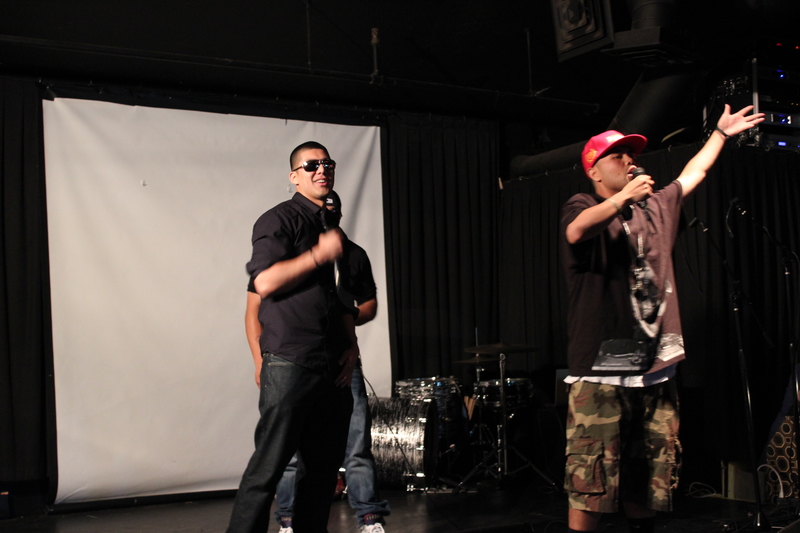
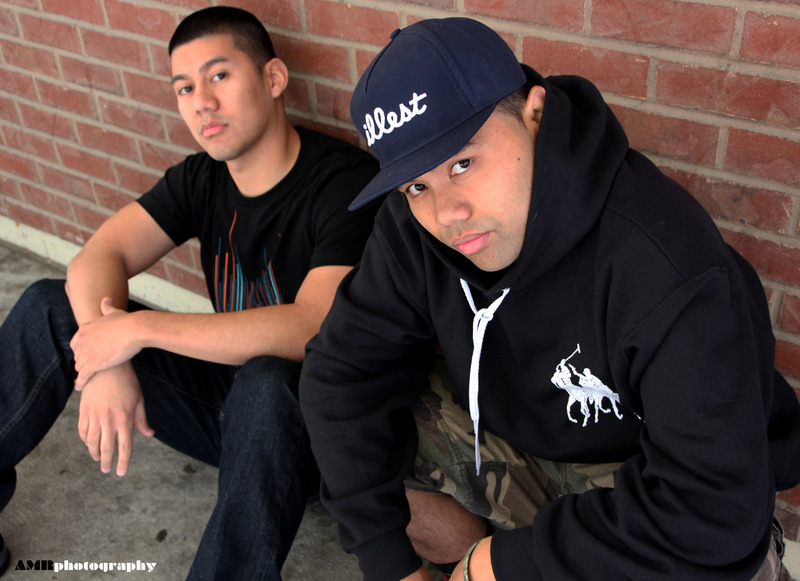
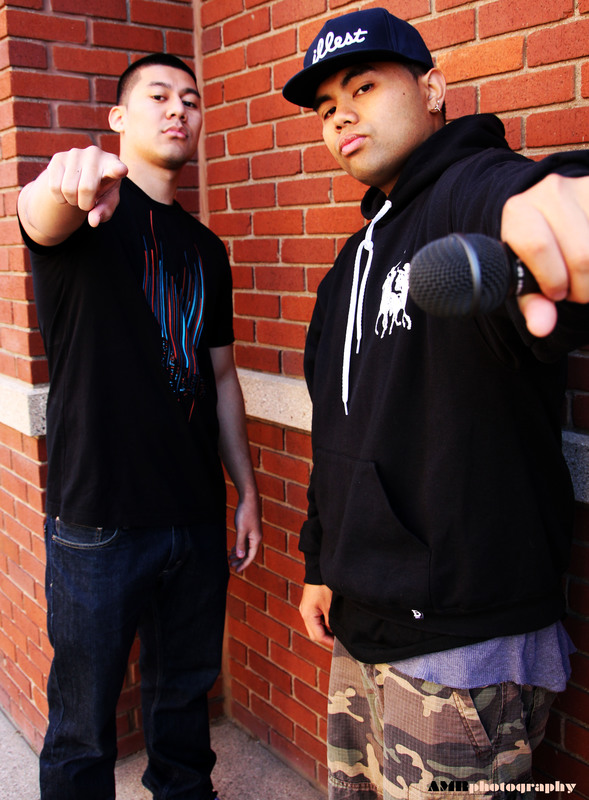
In this issue, Synchronized Chaos is happy to feature some of the music of two of the Bay Area’s most exciting young hip hop artists: Rezrection and Hitman, the duo featured in the picture above. Both of them are natives of the region (one hailing from San Jose and the other from Pacifica), and after they met as coworkers they quickly discovered that they shared a strong interest in hip hop. Born in the ’80s, they’d both had an opportunity to follow the art form as its mainstream popularity increased during the ’90s and ’00s, and they decided to work together to produce the music that they loved. Since then, they’ve  gradually become a force to be reckoned with in the local hip hop scene. Rezrection and Hitman have strong artistic principles, and they are dedicated to producing high-quality music from the heart, as their artists’ statement explains:

We are two MC’s that go by the names Rezrection & Hitman. We’ve been rocking crowds for about two years now and we have no plans on stopping any time soon! Our music is as diverse as our fan base, and we wouldn’t have it any other way. We are influenced from everything to Rock, Old school hip hop, R&B, techno, and alternative music. Not only do we have fans in the hip hop community, but we also have a lot of fans in other communities as well who appreciate quality beats with quality lyrics. We aren’t your typical rap artists who just rap about money, drugs, and women, as we feel like we have more to offer the world with positive lyrics and songs with messages in them. We put a lot of emotion in every song and in every verse, and we hope that our listeners feel everything that we’re trying to say. Thanks for listening to our music and a special thanks to Synchronized Chaos for featuring us in their magazine!

In this post, we’re featuring some of the highlights of “Combo Breaker,” Rezrection and Hitman’s new mixtape. The songs cover a variety of topics, from the benefits of a fast lifestyle to the indomitable will to carry on the fight and overcome one’s competition to the nature of hip hop itself. Simply click on the links below to start listening…

My Life

This Is My Moment

Hip Hop

If you enjoyed listening to these excerpts from “Combo Breaker,” you can find plenty more of Rezrection and Hitman’s music online at http://soundcloud.com/rezrection-and-hitman. Their songs are also available in their press kit at http://www.ourstage.com/epk/mmxeymxeynkq, which also features details about the duo’s future shows as well as their coverage in the press!

Also, feel free to check out Rezrection and Hitman’s social media pages:

Facebook: https://www.facebook.com/rezandhitman

Twitter: https://twitter.com/#!/rezandhitman

YouTube: http://www.youtube.com/rezrection

Alice, Lost & Found: August’s Whose Brain Is It, a monthly neuroscience column by Leena Prasad

Alice, Lost & Found


topic ADHD/ADD
region frontal lobe
chemicals dopamine


The sofa would be comfortable if only it didn’t have all those books, dishes, and DVDs covering the surface. Alice sweeps everything to the floor and stretches out within the soft green leather. She plays video games for a living—that is, she earns a six figure salary as a video game tester. After a non-stop workday of twelve hours, she is exhausted, yet unable to sleep as her brain is still on fire.

After an hour of rest, she rolls off the sofa, changes into dancing clothes and is out until 3am. When she shows up at work at 10 AM the next day, she has a hangover, but she will work late into the evening and then be out again until early morning. This is a normal pattern of life forAlice, and she is fortunate to have a job that allows for it. These unhealthy patterns in her work, social life, and sleep are typical for many professionals in their 20s, but Alice is 37 years old.

Her impulsive lifestyle extends to other areas of her life. Despite a weekly maid service, her place often looks like it has been struck by a tornado. This problem is exacerbated by the fact that she buys new clothes, shoes, and jewelry almost every week and is running out of space to put them. With dwindling savings and escalating credit card debts, Alice is aware that her lifestyle is not sustainable. She is unable, however, to modify her impulsive behavior in order to improve her finances and living conditions.

From an outsider’s perspective, Alice is an attractive, successful, and energetic woman. Her friends describe her as brilliant, impulsive, restless, funny, and kind. Nonetheless, they all complain that she never shows up on time. Her ex-boyfriends would probably say that she has poor listening skills and is quick-tempered. Despite having many friends, she is unable to develop lasting and intimate connections. Consequently, she has no close friends, has a superficial relationship with her parents and siblings, and her romantic relationships do not last beyond a few months.

Alice feels that she is always in a state of perpetual overdrive, yet unsatisfied.  She likes her job and is productive, but she often misses deadlines. The late-night dancing and drinking is emotionally unfulfilling. She fills her free time with shopping sprees which provide the instant gratification she craves but which have left her in debt. She is unable to organize her apartment, and the mess makes her feel overwhelmed. She realizes that this is not the life she wants, yet she feels helpless in her ability to change her patterns of behavior.

After an unusually heavy night of partying, Alice takes three sleeping pills instead of the usual one. She wakes up in the afternoon, shows up to work at 5 PM, and almost loses her job. This is a turning point for her. She takes the first step towards a better life and finds a therapist, which leads to a surprising discovery. Alice has ADHD: Attention Deficit Hyperactivity Disorder, also known as ADD. Her doctor also tells her that she is very fortunate to have found a job playing video games, because that is one of the few activities where an ADHD brain is able to focus for long periods of time.

Neurobiology research has discovered that an ADHD brain is sluggish in the part of the frontal lobe that controls impulses. The primary chemical implicated in the existence of this lack of activity is dopamine. Prescription drugs like Ritalin®, Adderall®, and Dexedrine® can be used to help the brain release more dopamine. This extra dopamine helps control the impulsive behavior which often leads to the other behavior problems associated with ADHD.

Medication does not work for everyone, but it is helpful for the vast majority of people with ADHD. Some ADHD symptoms often exist in people who do not have this disorder. Therefore, it is important not to self-diagnose. A critical part of ADHD diagnosis is that this disorder causes frustrating inability to function in two or more important areas of life such as education, work, finances, and relationships. Alice has started to take a medication that works well for her, and she is learning more about the disorder. Her therapist is helping her to learn and apply time and money management skills. Alice has also joined a support group for adults with ADHD. Medication itself is not sufficient; behavioral modifications and other therapies are also recommended to manage ADHD.

Attention Deficit Hyperactivity Disorder is a controversial subject. The medications have been overprescribed and abused, despite the possible side effects of high blood pressure and increased risk of heart attack and stroke. Some medical professionals doubt whether ADHD is a real disorder, even thought it has been formally recognized by the American Psychiatry Association. Thus, further research is important for understanding the neurological basis for ADHD.

As far as Alice is concerned, it is a very real disorder because her medication has started to make a significant difference in her life. She is making an effort to prioritize her work tasks, has cut down on her clubbing and shopping, and her apartment is slightly more organized than before. It will take some time to improve her anger management and listening skills but the awareness of the disorder combined with a better-functioning brain is a good starting point for her.

Leena Prasad has a writing portfolio at http://www.FishRidingABike.com. Links to earlier stories in her monthly column can be found at http://www.WhoseBrainIsIt.com.

Dr. Nicola Wolfe is a neuroscience consultant for this column. She earned her Ph.D. in Clinical Psychopharmacology from Harvard University and has taught neuroscience courses for over 20 years at various universities.

References:

  1. Ratey, John J. Md; Hallowell, Edward M. Md (2011-09-13). Driven to Distraction (Revised): Recognizing and Coping with Attention Deficit Disorder. Random House
  2. Boyle, Mary ET, Ph.D., Neuroscience of ADHD. Department of Cognitive Science UCSD.


Survival of the Happiest: Joy Ding reviews Loretta Breuning’s Meet Your Happy Chemicals

Survival of the Happiest

 by Joy Ding

Who doesn’t want to be happy all the time? But as Dr. Loretta Breuning explains in Meet Your Happy Chemicals, constant happiness is simply not the point. The happiness reward system that we humans have inherited from our primate ancestors (and which we share with all mammals) is just that: a reward system meant to encourage us to take actions that promote survival. If it were always on, it would lose its effectiveness to flag survival-positive actions.

What, then, can we do about being happy more often, and less frequently unhappy? While happiness self-help books have often come up with lists of “good actions” such as the creation and maintenance of close and trustworthy relationships and the availability of meaningful work, Dr. Breuning puts it into a new context: that of brain chemistry.

The four happiness chemicals – dopamine, endorphin, oxytocin, and serotonin – are released respectively when we approach an award, are in pain, bond with and/or trust another, and accrue respect. While in prehistoric times, the chemicals may have released for more obvious survival needs such as hunting food (dopamine) or masking immediate pain from injury so we could escape a dangerous situation (endorphin), the release of the happiness chemicals in a modern life may seem more cryptic.

Here is where Dr. Breuning’s narrative really shines. The particular wisdom of the book is its ability to distinguish each of the four happiness chemicals, provide examples for when they are released, and how we can build new happiness circuits – basically new ways that we can be happier. While most triggers for happiness are built at a young age, adults are able to build more happiness circuits, it will just take a little effort. Specifically, 45 days. That’s the amount of time it takes to build a new and persistent neural pathway in the brain, one that will release happy chemicals when triggered.

Dr. Breuning also provides interesting material on the usefulness of unhappiness as nature’s alarm system (Chapter 2: Good Reasons to be Unhappy) and exercises to create more circuits for each of the happiness chemicals (Chapter 5: Building New Happy Circuits.) While a lot of these tips are not necessarily novel–for instance, one of the exercises for building new dopamine circuits is to celebrate small steps and adjust expectations so they are more realistic–the neurochemical context which Dr. Breuning uses to frame the exercises is very refreshing. In contrast to most self-help books, in which exercises for improvement are justified on the basis of anecdotal information, and a certain well-of-course reasoning, Dr. Breuning’s book grounds the exercises in neurochemical fact, giving exercises like “laugh” and “break an unpleasant task into smaller parts” new life.

In brief, the biggest gift that Meet Your Happy Chemicals gives us is a greater understanding of our own brains, the kind of understanding that will hopefully lead to happier lives: better acceptance of unhappiness, and ways to pave our own ways to more happiness.

As Dr. Breuning says, and I quote: “This brain we’ve inherited is frustrating. In its quest for survival it often turns unhappy chemicals on and happy chemicals off. When my neurochemistry frustrates me, I remind myself that it has succeeded at promoting survival for millions of years.”

Joy Ding is a free-lance writer and marketer living in San Francisco. You can reach her at joy.j.ding@gmail.com.

“Silent Requiem”: A short story by Joseph Johnson

Silent Requiem

By Joseph Johnson

The soft grass beneath my feet slightly tickled my senses. The light breeze brushed past my arms. I had never felt sensations like this before, nothing so real. I pushed myself past the field of marble slabs as I made my way to a small group of people. The senses that had become so prominent seconds earlier now faded with my focus on those who stood with solemn stares. These people felt great pain and sorrow.

As I came closer to the group I noticed that these were people I once knew. My family, my friends, and others I loved. They stood around a lifeless vessel that I once called home. Realization pulled me from the blissful ignorance; it was then that I remembered who I was, and what I had done. I realized that the soft grass was barely real to me at all, I could feel nothing.

It is such a selfish thing to die; to leave the ones I loved behind. The eyes of my mother were swollen and wet, while my father drew quick, angry breaths. What was the emotion that led me to my death? The sadness, the anger, maybe both; no, it was shame that brought me to the end. Shame in myself, or rather the self that society looked down on. People I thought cared, abandoned me for a life with those who would never accept me. I can’t blame them though, if on the other hand I would do the same. It hurts me to know that, but there is no reason to lie anymore.

A scream jarred me; it was a cry that shook the very foundation of my soul. No one took notice, and the scream had no origin. All mouths were still closed in that solemn silence, but the terror of the scream pushed me through the crowd. No matter how much I listened with no ears, and pondered with no mind, the screams evaded me. It was then that a force more powerful than fear propelled me. It was a pure force. The only way to truly describe the force would be angelic. I could believe in that; to believe in myself at that point would be to believe in some afterlife.

The powerful force led me to a familiar face. A young woman I loved, stood silently shaking. Her sobs made no sound, but the scream resonated through my core; such pain and anger. Did I ever forget her? Was she in my thoughts as I cut myself so deep? Regardless of my previous intentions, I had to do something to comfort her. So I reached, with a hand that I knew was not there. The hand slowly touched her and quenched her hungry spirit. The sorrow remained, but the screams slowly subsided. It is such a shame that this proud soul was crushed by such a selfish act. As she moved away and our souls parted, I remembered why I loved her. I was incomplete once again.

Instinct drove me to her. In her bedroom she slept with evil pressing ever closer. Unlike the force that pushed me toward her, this evil was present and visible. It was an ugly mass of darkness that hungered for destruction, and it was slowly inching toward her. The power of the mass mocked me with every move; it drew closer, but I could do nothing to stop it. So I let my tired soul sleep, and it wept with uncertainty.

When my soul regained whatever consciousness it could muster, I saw her again. When my focus was able to gather my surroundings I noticed that I was in our school. Darkness seeped through the windows and the doors, as if night had already fallen. The desk next to her was empty; it used to be my desk. I sat and watched her. Her hair was unkempt and her eyes sagged, there was no life left. Just as a tear started to streak down her face, a thin ray of light leaked through the room. As I searched for the source I realized that the darkness was moving, slowly letting light through. The mass I saw the night before was growing. The core of the mass appeared and stalked toward my love, the force that pushed me to her in the beginning now pushed me to fight, but I was afraid. The dark mass shouldn’t have terrified me, I didn’t even have a body. The fear was something I recognized; the evil was familiar.

It didn’t take me long to recognize the embodiment of shame, hatred, and torment. A grim fate of the spiritual world attacking the innocent; nothing could stop the omniscient power, especially not the feeble force that grew inside me. The force was love, but love could not save her. I needed anger, rage, and power. I needed to destroy this beast while it pushed closer to her. The more anger filled me, the farther I was driven from her. So I stopped; the anger subsided and was replaced again with hopelessness. The mass reached for her and the cry that hurt my soul before entered the small space of the classroom. More tears sprang from her eyes and she buried her shame in her hands. The beast grew in size.

As time went on and the beast grew even more menacing and thick with the fear of both my love and myself; hopelessness gripped at my soul, and I still watched, waiting for it to take her. It wasn’t until the next night that something terrifying happened. The mass was in a mad rage that caused it to move rapidly around her small room. She sat quietly on her bed, eyes closed and focused. My soul began to fret as her intent became clear. The raging essence of evil was excited and it raced around the knife on her bedside table. If a soul could weep mine did. Just as I heard her soul cry out, I believe hers heard mine, because she opened her eyes and clutched her heart. Doubt was setting in. Although the hope inside of me was small, it pushed me to her. The closest I had been since my death. I was hungry for her touch, or even the light scent that came from her hair. I could not experience such things anymore.

It was relatively easy to make my way to her while the darkness was distracted. It apparently had intent, and now so did I. Hope did not have to end with me; she could live a long, happy life as she was meant to. So I pushed toward her, full of ignorance and passion. The moment I came close enough to touch her; my soul began to tremble. I was there, able to feel the love I once felt again, but I knew it was impossible. At that moment my hand began to take form, and I began to sense a need for feeling within it. So I took that cold, dead hand and lightly brushed it on my loves dead cheek. What I felt was incredible. Her skin was ecstasy and it fed my radical desires. The implication of ever finding the sense again had evaded me to the point that the present feeling was obscured in uncertainty. My soul could only doubt the feeling. It couldn’t have been real.

I couldn’t stop there. My hand continued to caress her face lightly as other senses began to return to me. I cannot remember when my lips gained their feeling, but I remember the sensation when my lips touched hers. I kissed her deeply, but she made no advance to recognize my existence. For some reason I had hope that she felt me. Memories then filled her mind and my soul, such love that could not be broken by man or spirit. The mass became even more erratic and began smarming around me. I hated the spirit. I wanted it to die, but was powerless to stop it. We had the same power, to tempt the senses of those bound by physical bodies. It was a power that meant nothing.

Somehow I was being pushed. The spirit was advancing, and as it drew closer to my love I slowly drifted away. Soon my vision blurred and my surroundings became obscure. The physical vanished once again leaving me in the darkness, I could feel nothing. I was nothing. In that darkness I was wrapped in grief, misery, and anger. She was gone, and so I drifted farther and farther away from that life which I loved so dearly.

I could not stop. As much as it hurt I continued to hang on to that pain as I fell deeper and deeper, with no escape. That pain was life. No sense of time could dictate how long I fell in that pit, before the pain took me. So sharp and vicious was the knife that pierced my essence. At this point the prospect of letting go reached a new height, to fall to the bottom of that forsaken pit and end what life I had left. To give my life up would be to destroy everything I loved. She could not fight the evil alone, I saw that myself. She wouldn’t withstand the temptation without me. I needed to comfort her. I could not stop!

Light showered the darkness. Dare I say hope, entered what was left of my soul. After falling so far my soul was ripped to pieces, most of which still lay in the darkness, but I pushed forward. I made it through the breach of incredible light and found myself in darkness again. The mass was incredibly thick; no light anywhere, except one faint glow across the darkness. I stepped closer. The thick mass made it hard to traverse the room, but I still pushed forward. The enemy was all around me, it had consumed everything in her life, and all that was left was that faint light. The darkness wanted hope, to feed on it and destroy it. I extended myself toward the light; I felt the life, however faint, slowly shifting.

When I reached the light I found my love. She held a knife loosely in her hand while she gave off soft sobs. I reached for her but my broken soul could not comfort her. The darkness was taking on a somewhat human form. It circled her with lust and cruel intent. When it saw me the beast raised its dark hand. My love followed the motion blindly. The knife was then ready to take her life with the beast’s hand. Just as the darkness plunged its hand into its own heart, I threw myself at my love. I felt incredible pain reach every part of me. The knife ran through me, and into her. I was lost then. As the darkness engulfed her spirit I faded into my own darkness, but this time no hope remained. I let it take me deep, where I could never hurt anyone again.

Through the darkness I suddenly felt something I thought was lost. I could feel soft cotton on my feet, and the touch of skin on my hand. I opened my eyes to see darkness, but not the darkness I feared. I saw night. The body that lay unconscious next to me was cold and still. While my mind tried to regain consciousness I felt for my mortal wounds. I had no scars, except for those left on my soul. With new life I stood and walked out of my house. It was dark and cold, only a single orange light faintly glowed in the distance. The light was shrouded by a thick fog that made the darkness even more prominent. That is when I noticed that despite our efforts we were drowning; slowly suffocating in the thick omnipotent darkness.


Joseph Johnson is a senior English major at Georgia Southern University. His work has appeared in The Wiregrass, as well as in a previous issue of Synchronized Chaos.

Art review: Christopher Bernard on Cindy Sherman’s “The Vertigo of Identity”

THE VERTIGO OF IDENTITY

Cindy Sherman

San Francisco Museum of Modern Art

Through October 8

A review by Christopher Bernard


The largest show of this influential photographer’s work to appear in San Francisco opened recently after appearing at the Museum of Modern Art in New York to a complex response by East Coast critics, with a few questioners, if not quite dissidents, providing leavening to the otherwise universal praise. But a complex response never seemed more appropriate than here.Sherman’s work – often charming and witty, beautifully crafted, and slyly probing – is nearly impossible to dislike. And yet, it seems equally impossible, or even desirable, to fully embrace. Which may be the definition of contemporary artistic greatness.

We on the West Coast can now survey the career (up to now) of this popular, fascinating and troubling artist who has shown, with an almost unfailing sureness of touch, how to combine work of great lightness and skill with penetrating, even disturbing, questions, not least of which is “What is this baffling aberration in a seemingly heartless and mindless universe, a human being?”

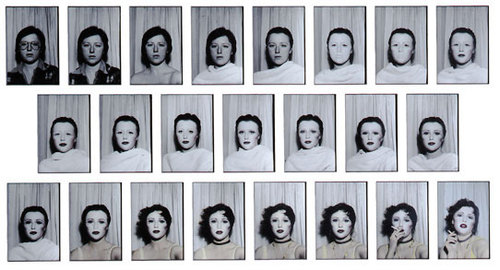
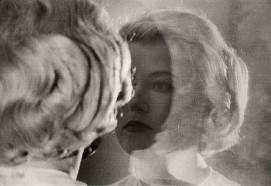
The greater part of Sherman’s work is made up of photographs of herself, usually taken in her studio, in costumes, wigs and makeup, depicting imaginary examples of well-known types, from characters in movies to figures from the history of art to eastern seaboard grandes dames. She works in series, her first, and still best known, being the “Untitled Film Stills” from the late 1970s: black-and-white, deliberately cheap-looking but highly evocative fictional stills from imaginary art, noir and B-movies from the ’50s and ’60s; her latest major series is of big, garishly full-color blow-ups of herself made-up as ageing doyennes of high-society. And in the great majority of the pictures,Sherman, like a great actress, a Meryl Streep of the black box, a Shakespeare of a thousand discarded selves, both appears, and disappears, in an imaginary space that recedes infinitely behind the photograph’s slick surface.

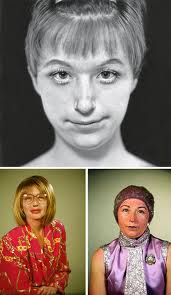
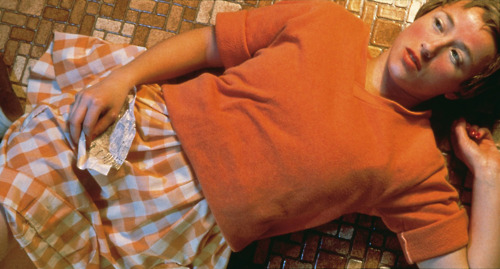
In the early ’80s Sherman created a so-called “centerfold” series, large color photos, based  on the centerfolds seen in men’s magazines, of reclining young women, fully clothed but in moments of great emotional vulnerability; examples, not of erotic, but of emotional voyeurism. In these pictures, curiously enough,Shermanis most readily identifiable as herself (as one can see from the occasional candid shots taken of her by other photographers at unguarded moments), with minimal use of costume and makeup, and little more defense than the mask of an expression.

Appearing in the show are also Sherman’s “fairy tale,” “disaster” and “sex pictures” (a peculiarly ugly series, though not surprising: how many artists have ever had a healthy, happy relationship with their own sexuality, candid yet discreet and kind, to themselves, their lovers, and their audience?), a “clown series” (perhaps the only weak images here; creating an artificial identity from an already artificial identity provides the show’s only shruggable moment), grand, booming large-scale photos based on old-master paintings (the so-called “History Portraits”),  a “headshot series” of “ordinary” women (and some males) hiding, so to speak, in full view, and a “fashion” series that sends up the very fashions and designers the pictures ostensibly advertise.

And all of these (except for the relatively few disaster and sex pictures) are of the photographer herself in a myriad masks, this woman of a thousand faces who would put Lon Chaney to shame: the opposite of self-portraits, these are pictures of an artist in full flight, apparently, from the self.

But are they?

It’s impossible to discuss Sherman’s photographs without immediately bringing up the issues of “identity” and selfhood, its continuity or lack thereof, its relation to image, its sabotaging by image, its relation to the construction, and deconstruction, of femininity, sexuality, gender roles, and other biosocial categories, its possible nonexistence outside the funhouse of psychosocial illusion, and so forth.

The very variety of her images – and the peculiar vulnerability that often peeks out through the impasto of costume and mask – suggests something else: the hiddenness of the self, the ego absconditus, behind its image; the image as protective covering, as camouflage, as shield, as tool and, when necessary, as weapon.

I had the unpleasant feeling, after looking hard at Sherman’s photographs for two hours while preparing to write this review, that everyone I passed in the streets outside the museum was wearing a costume. The whole world suddenly looked like a Halloween party. Was it even possible to decipher people based on how they appeared? If their image was so constructed, so contrived, how could I possibly get past it to their “real” thoughts, feelings, selves? Even when they spoke, how could I trust what they were saying? Not if course that they would deliberately lie – but then, how could they help it? Are we all just actors playing out a theatrical illusion of who we think we are, want to be, are afraid we might be?

If you leave the show a little shaken in your certainties about yourself and the world around you (I told myself), you’ve probably had the right reaction. Not thatShermanintends to shake us up. She just likes to dress up, according to her interviews, and always has.

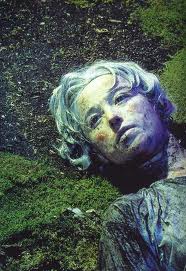
The ultimate photograph in this retrospective, the one that lingers more pertinaciously than any other, was one of the disaster series. At first it just looks like a big picture of a strip of dark red soil, soaked with movie blood or red paint. But then, as I looked at it, I saw it resolve into its actual subject: a crushed, skinned unrecognizable face.


Christopher Bernard is a writer, poet, and critic living in San Francisco. He is author of the novel A Spy in the Ruins and co-editor of the webzine Caveat Lector.