
going to the church of the wind
in the tops of the trees


        *


she comes to the window for the red fox at dusk


        *


he told himself not to stare at the newborn violets


        *


in the same photo,
the pacing cheetah and her grandfather's cane


        *


he gave no reason for wanting to soak his feet in the Lower Vistula


        *


when they tell you to dye your hair
and change the locks


        *


Elvis never borrowed my brother's comb,
but everybody loved the lie


        *


it was Frankie's job to doctor up the coffee
for the grumpy saints


        *


the world going back to ignoring the green forsythia


        *


my destiny is already on its third cup of coffee


        *


"the objective correlative"
must include the worn gray socks of Pete Maravich


        *


throwing a chunk of coal for a touchdown in Jim Thorpe, PA


        *


though he makes room,
the regulars on the city bus would rather stand


        *


Patrick Sweeney is a short form poet and devotee of the public library.
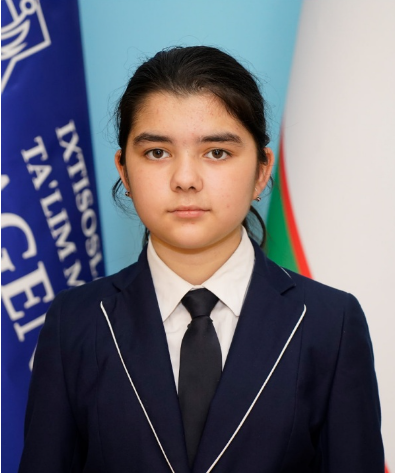
Poetry from Charos Ismoilova
Sunrise
Tell me sun, did you see the night?
Tell me sun, did you see the dark?
Every day you rise, giving us light.
Your warmth makes us bright.
Your light blinds us,
Yet we can’t live without you.
Your light keeps us alive,
Yet we never truly appreciate you.
Oh, dear sun, forgive us one more-
We blind people forget you some time.
Oh, dear sun, forgive us once more-
We deaf people can’t hear your love.
-Charos Ismoilova
I am Charos Ismoilova daughter of Ruslan, and was born on January 1st, 2013, in Shafirkan district, Bukhara region. Currently, I am studying at Bukhara Presidential School, 7th grade.
#charosismoilovaruslanovna
#uzbekistan
Poetry from Thi Lan Anh Tran
THE WAR THAT DOES NOT END
Thi Lan Anh Tran – Aschaffenburg, Germany
10.04.26
My mother never told stories
the way books do.
She would pause in the middle of words,
as if something beyond language
was heavier than memory itself.
There was once a garden—
not the kind you visit,
but the kind that remembers you.
The soil carried more than roots.
I grew up far from alarms,
far from skies torn open,
yet at night
I still feel a quiet pulse beneath the earth—
steady, buried,
refusing to leave.
They say time moves forward.
But memory stays still.
It waits.
Elsewhere in the world,
men sit across polished tables
carefully choosing their words:
ceasefire,
security,
shared interest.
Their voices are calm.
Somewhere, a child learns
the difference between thunder
and something that is not weather.
A city learns to dim its lights
without calling it fear.
A mother learns silence
so deeply
it becomes a way of breathing.
I stand between what has ended
and what is repeating.
Nothing returns exactly the same—
yet nothing truly disappears.
War does not always arrive in fire.
Sometimes it remains—
in the body,
in language,
in the hesitation
before trusting tomorrow.
If history breathes,
it does not speak in victory.
It exhales slowly
through those who remember
what others are still becoming.
CUỘC CHIẾN KHÔNG KẾT THÚC
Mẹ tôi không kể chuyện
theo cách của sách vở.
Mẹ thường dừng giữa câu nói,
như thể phía sau lời nói
có điều nặng hơn ký ức.
Từng có một khu vườn—
không phải nơi để nhớ,
mà là nơi biết cách nhớ lấy con người.
Đất ở đó
giữ nhiều hơn rễ cây.
Tôi lớn lên không có tiếng còi báo động,
không có bầu trời bị xé toạc,
nhưng trong đêm
vẫn có một nhịp đập sâu dưới mặt đất—
chậm, nặng,
không chịu biến mất.
Người ta nói thời gian đi về phía trước.
Nhưng ký ức thì không.
Nó chờ.
Ở một nơi khác,
những cuộc họp diễn ra sau những chiếc bàn dài
với những từ ngữ được chọn lọc:
ngừng bắn,
an ninh,
lợi ích chung.
Giọng nói rất bình tĩnh.
Ở đâu đó,
một đứa trẻ học cách phân biệt
tiếng sấm
với thứ âm thanh không thuộc về tự nhiên.
Một thành phố học cách tắt đèn
mà không gọi đó là sợ hãi.
Một người mẹ học cách giữ im lặng
đến mức
nó trở thành hơi thở.
Tôi đứng giữa điều đã qua
và điều đang lặp lại.
Không có điều gì lặp lại nguyên vẹn—
nhưng cũng không có gì thật sự mất đi.
Chiến tranh không phải lúc nào cũng đến bằng lửa.
Đôi khi
nó ở lại—
trong cơ thể,
trong ngôn ngữ,
trong sự chần chừ
trước ngày mai.
Nếu lịch sử còn biết thở,
nó không nói bằng chiến thắng.
Nó thở ra thật chậm
qua những người còn nhớ
những điều người khác vẫn đang trở thành.
Nr. 65 TÌNH YÊU KHÔNG CHỈ LÀ NỖI ĐAU
Tình yêu đâu chỉ sắc hồng,
Dẫu như cầu vồng sau cơn mưa bay.
Có cay mới hiểu vị say,
Có xa mới biết vòng tay cần gần.
Đường yêu lắm nỗi gian nan,
Nhưng đâu chỉ có khóc than một mình.
Sau đêm rồi sẽ bình minh,
Giữa đông giá lạnh vẫn sinh nắng vàng.
Nếu ai giữ mãi muộn màng,
Thời gian đâu phải chỉ mang phai tàn.
Mở lòng thay những cửa then,
Tim còn biết đập — còn quen yêu người.
Tình đâu chỉ tựa trò chơi,
Chia ly cũng để hiểu lời yêu thương.
Dẫu mai hai ngả đôi đường,
Gặp nhau vẫn nhớ một thời đã qua.
Tình yêu không chỉ lệ sa,
Có khi là cả bao la dịu hiền.
Ai còn tin sẽ còn duyên,
Yêu thương giữ lại — bình yên trong lòng.
Nr. 65 LOVE IS MORE THAN PAIN
Love is not just colors bright,
like rainbows fading after light.
Through bitter taste, we learn what’s true,
through distance, feel what love can do.
The road of love is steep and long,
yet not all hearts must grieve alone.
For after night, the dawn will rise,
and warmth returns beneath cold skies.
If hearts stay closed in silent fear,
time cannot heal what we won’t hear.
Unlock the door, let feelings flow,
a beating heart still longs to grow.
Love is not just a fleeting game,
nor parting hearts to shift the blame.
Though paths may part and drift apart,
they still remain within the heart.
Love is not only tears that fall,
but gentle light that warms us all.
For those who trust, love will remain—
a quiet peace beyond the pain.
Essay from Eva Petropoulou Lianou
Christ is Risen
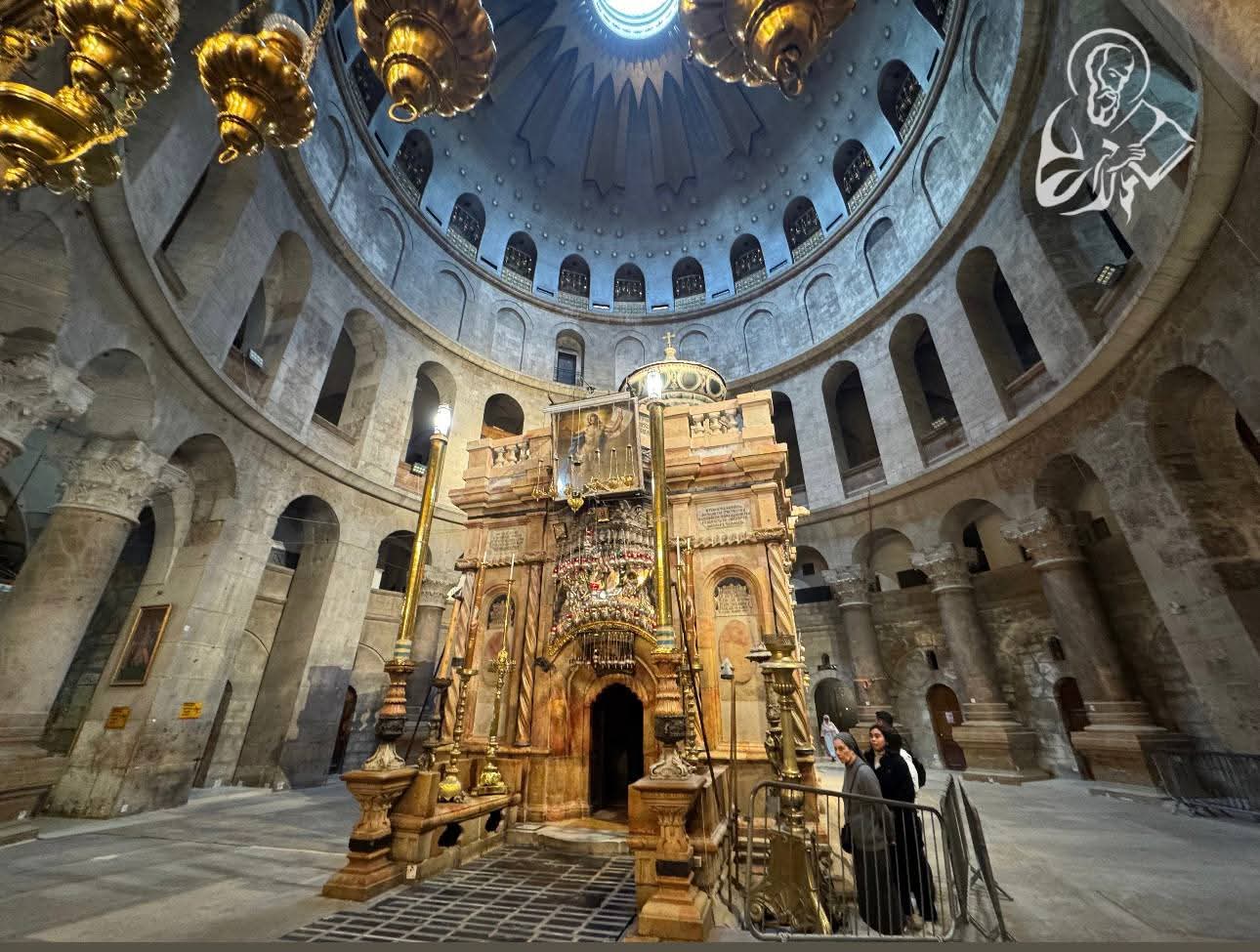
The Holy Fire (Greek ‘Αγιος Φως, literally “Holy Light”) is a miracle that occurs every year at the Church of the Holy Sepulchre in Jerusalem on Holy Saturday, the day preceding Pascha.
It is considered by many to be the longest-attested annual miracle in the Christian world, though the event has only been documented consecutively since 1106.
In many Orthodox countries around the world the event is televised live.
The ceremony begins at noon when the Patriarch of Jerusalem recites a specific prayer. The faithful gathered will then chant “Lord, have mercy” (Kyrie eleison in Greek) until the Holy Fire descends on a lamp of olive oil held by the patriarch while he is alone in the tomb chamber of Jesus Christ.
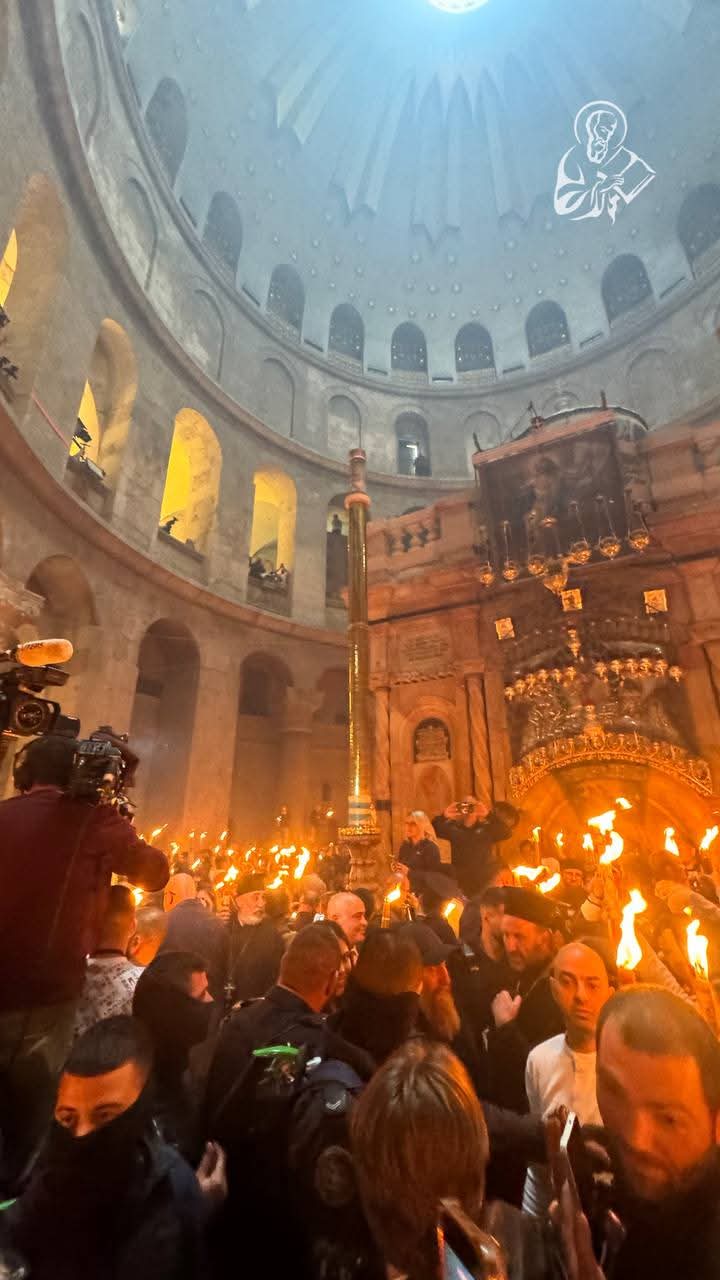
The patriarch will then emerge from the tomb chamber, recite some prayers, and light either 33 or 12 candles to distribute to the faithful.
The fire is also said to spontaneously light other lamps and candles around the church.
Pilgrims say the Holy Fire will not burn hair, faces, etc., in the first 33 minutes after it is ignited. Before entering the Lord’s Tomb, the patriarch or presiding archbishop is inspected by Israeli authorities to prove that he does not carry the technical means to light the fire.
This investigation used to be carried out by Turkish soldiers.
The Holy Fire is first mentioned in the documents dating from the 4th century.
A detailed description of the miracle is contained in the travelogue of the Russian igumen Daniel, who was present at the ceremony in 1106.
Daniel mentions a blue incandescence descending from the dome to the edicula where the patriarch awaits the Holy Fire.
Poetry from Bhagirath Chowdhary
Global Spiritual Unity
Humanity must have one God
Or do without God
Many Gods divide humanity
Humanity must stop dividing divinity
The divisions of divinity
Ultimately divide human minds and hearts in reality
Human hearts divided thus
Lead to divisions of one reality as such
Because of this divided reality
The human consciousness suffers duality
Divided human consciousness in reality
Condemns humanity to terrible suffering
When one hand doesn’t know what other hand is doing
To divide God is the greatest human ignorance
Dividing God is indeed no work of any prophetic intelligence
Proposing and having divided divinity
Leads to the greatest planetary confusion
Divided God is truly a grand illusion (Maya)
In fact many divisions of one divinity
Caused a terrible fragmentation of one reality
Aristotle talked about the holistic holon
Arthur Koestler talked about it in detail
Ghost in the Machine was soul’s hidden tale
David Bohm explained it by explicate and implicate order
Science and spirituality played with it at every corner
If we can’t recognize and realize this divine holon
Then humanity must leave the God alone
Humanity can’t reach ultimate truth without spiritual unity
Evolutionary wisdom shows the path to only one reality
Humanity must rediscover God
Through unity of spiritual diversity
All else shall lead to ignorant arrogance and vanity
God becoming many gods at the beginning of creation (एकोहम् बहुस्याम भवति।)
Needs to become One again at the apex of human evolution (बहुहम् एकोस्याम् भवति।)
But as great Aristotle said
The whole is greater than the sum of its parts
Through global unity of all spiritual paths
Humanity shall enjoy a far greater spiritual whole
The sum of whose parts will be greater than the prevailing mole.
Essay from Amina Kasim Muhammad
The world feels so loud sometimes,
So alive that you forget you’re running out of time.
Not today. Not tomorrow.
But someday, grief shows up one morning and just moves in.
And love?
Love stands by the curtains.
Not handing out comfort to everybody.
Just watching. Waiting.
Seeing what you actually need.
This isn’t a biography I’m trying to list its dates.
This is just a heart that kept going after it got broken.
A soul that figured out the ground is cold,
But still decided to sit in the chair anyway,
Behind the curtains.
This isn’t really about the chairs or the curtains.
It’s about how still you learn to be,
To sit in your grief without letting it crush you.
Like no matter what cracks underneath,
That chair holds.
Except, death…
We call it the uninvited guest,
A weight that settles in the hollow of the chest.
Death is the one crack that swallows everything.
No sounds.
Just a hole that takes the sorrow and the love both at once.
But here’s what I’ve learned:
Death took the person,
The creative mind,
The talented hands.
But it didn’t take what they left behind.
Grief teaches you something If you let it.
Not right away. It beats you up first.
But eventually,
It shows you how to pay attention.
How to hold things tighter without squeezing too hard.
How to sit in the quiet and still find something worth making.
Maybe we don’t get over it.
Maybe we just learn to build around it.
We take the loss and turn it into something.
A poem, a meal, a small kindness,
Or a minute of patience we didn’t have before.
And when the poem forgets it’s a poem
And becomes a room,
It becomes a room where loss finally takes off its coat.
Where love doesn’t just visit anymore,
It sits down to stay.
Where grief and gladness walk in together,
Like they always do, and for once,
They don’t have a single thing left to ask.
Except…
What does the poem say about us?
It says we are the ones who need it.
We’re the ones who take these little black marks,
These little arranged scratches on a page,
And we make them bleed.
We make them bleed with our own blood.
We make them sing with our own throats—
The ones that get tight.
The ones that crack.
We make them hold everything we cannot hold by ourselves.
And then… somehow… we can.
Because we are the creatures who build bridges out of breath.
We are the ones who go looking for our own faces in the ink.
We let the poem teach us death.
Not by lecturing.
Not by explaining.
But by showing us how to live.
And it’s not about filling the hole.
It’s about learning to live around it.
Knowing it’s there.
And still… still creating.
And maybe, that’s enough.
Amina Kasim Muhammad is a Nigerian writer and spoken word poet with a deep passion for storytelling. She finds herself drawn to the way stories can transport readers to different worlds and how ideas can be shaped and shared through the power of writing. Valuing her pen and book as essential tools of expression, she is also an advocate for the Sustainable Development Goals (SDGs). Amina is an active member of the Minna Literary Society (MLS) and Open Arts Kaduna, where she engages with fellow creatives and contributes to the literary community. Her work has been published; one of her poems appeared in Synchronized Chaos Magazine. You can connect with her on Instagram: @meena_kasim.
Essay from Shokhida Nazirova
In the New Uzbekistan, the Voice of a New Generation
Why should I not praise you before the wide world, calling you “my Uzbek,” When my era has granted me the chance to know my true self, my Uzbek.
— E. Vohidov
As I write these lines, two drops of pearl-like tears roll down beneath my glasses. Recently, I traveled to the Tian Shan mountains. Those three days felt like three years. On my way back, the very moment I set foot on my beloved Homeland, my chest filled with the scent of serenity. I felt the taste of peace and happiness. As I got into the car, these lines echoed in my heart:
My Homeland, you are my pride,
The soil where traces of my childhood remain.
You see me off when I leave and wait until I return,
I feel your love like a mother’s embrace.
I have seen many lands, I have seen the Tian Shan,
Yet I understood your true worth even more, my dear motherland.
I do not need Paris and its Eiffel Tower,
A handful of your soil is honor and glory for me!
With these thoughts, I continued my journey. At one moment, I noticed a girl sitting nearby, quietly reading a book.
Again, I sank into reflection:
In which country does a president give a car simply because someone reads a book?
In which country does the state reward you by funding six months of education if you learn a foreign language for just two months?
In which country is an entire Olympic town built freely, solely for young people?
The answer to all of these questions is one: Uzbekistan.
Indeed, today Uzbekistan is a country of youth. For the first time in history, practical solutions are being implemented to support the dreams and initiatives of the younger generation — solutions that nurture their pursuit of knowledge, creativity, sports, and a rightful place on the international stage. As a result, every young person today has the opportunity to make their voice heard, to present their ideas, national values, and identity to the world.
Yes, today’s generation is educated, healthy, and confidently proving itself on the global stage. Young Uzbeks are studying at the world’s most prestigious universities — Harvard, Oxford, Cambridge, Stanford, and many others. And if we speak of sports, you have surely seen our flag proudly waving atop the world’s greatest arenas at least once. Our young innovators, meanwhile, present their inventions at renowned platforms such as the International Innovation Expo and UN & UNESCO Youth Forums, consistently being in the spotlight of international investors.
Let us speak through simple facts from 2024–2025:
For the first time in history, UNESCO’s General Conference was held outside Paris — and that city was Samarkand. Uzbekistan became the first country to make this happen. Moreover, Uzbekistan became a member of the UN Human Rights Council.
International education standards were introduced. Transparency and openness were promoted in politics. For the first time in history, our female karate and judo athletes stood atop the podiums, bringing chains of medals back to the Homeland. For ten consecutive years, our boxers have once again proven that they are among the world’s strongest. In 2025, our footballers carried the Uzbek nation onto the FIFA stage. At just 20 years old, Sindarov once again proved to the world in 2025 that he is the “King of Chess.”
When we analyze these developments, it becomes clear that in recent years Uzbekistan has secured a strong position internationally as an open, reform-oriented country that ties its future to its youth. Remarkable victories in sports, achievements in science and innovation, young men and women studying at leading global universities, and active participation on international platforms are tangible results of this transformation. State-led youth policy, investments in education and sports, and cooperation with influential international organizations such as the UN and UNESCO have elevated Uzbekistan’s global standing.
Particularly, initiatives that bring youth rights and opportunities to the international level clearly demonstrate the country’s strategic vision.
Shokhida Nazirova was born on March 22, 2004, in Andijan.
She serves as a representative of Uzbekistan for nearly ten international organizations. She is fluent in German, Russian, Turkish, Italian and Kyrgyz. She is a young leader who has made nearly ten social projects in the region.