Lisa Amato: Photographs from a Beautiful World


“I was born and spent my early years in Niagara Falls, New York. I moved
to Northern California as a teen and found that, even at that young age, I
was in awe of the vast and diverse scenery. Now, along with my husband,
two sons and Bella, my beautiful dog, we enjoy hiking, going to the beach,
and anything that involves the great outdoors.

Living in the Bay Area, I am witness to this area’s ability to traverse
both the minute wonder of a ladybug resting on a sunflower petal to the
overwhelming expanse of a Pacific sunset. Everywhere I go, an opportunity
to capture a truly breathtaking moment presents itself; whether it be the
rugged peaks of the Sierras, the almost surreal Northern California shore,
or the opulent colors of the wine country.

It was the limitless beauty of the natural world that first inspired me to
pick up a camera, and thus began what came to be not just a casual hobby,
but a passion for capturing the world around me through a camera’s lens.

I am a self-taught photographer who has learned through trial and error,
taking untold numbers of shots to find that one that is just right.”

Lisa also creates cards designed to raise awareness and funds for breast cancer research.  It has pictures of all 5 cards included in the pack as well as a photo of the back.  All proceeds are donated to Susan G. Komen For The Cure. http://www.etsy.com/view_listing.php?listing_id=20548826

Lisa may be reached through her website http://photoamato.com Her work is also available on Etsy: http://photoamato.etsy.com.

First Exposures – creative projects of San Francisco photography students

First Exposures: Youth Opportunities

Through Photography


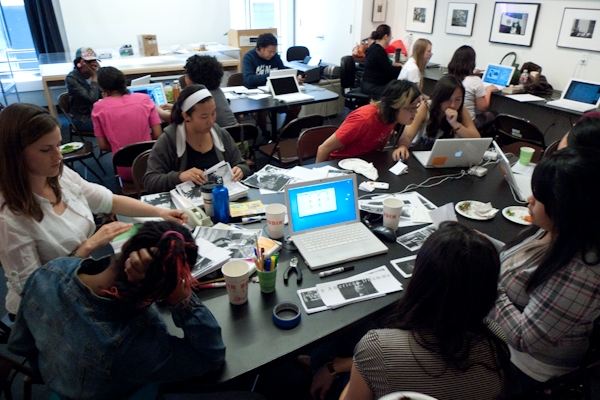
Group of aspiring photographers working with mentors to produce real zines with an authentic do-it-yourself feel. Each piece reflects a personal interest or theme: the experiences of an autistic brother, dogs, cityscapes, school, traveling. Photographers work on their pieces over several months, mastering the use of the cameras as well as stylistic compositional elements such as balance, contrast, foreground and background.


Artworks in themselves, the zines incorporate commentary and captions in the style of the photographs and their subjects. Adobe Books in SF’s Mission District, a musty old eclectic used-book store where people still make time to sit in armchairs and discuss Immanuel Kant and Goethe and modern politics and enjoy free pastries left as offerings to wooden figurines of Hindu and Buddhist deities, showcases the work of the First Exposures students.


From First Exposures:


First Exposures: Youth Opportunities Through Photography is a special interest mentoring program where academic skills and life skills are developed by combining the benefits of mentoring relationships with art education. The volunteer mentors are professional, commercial and fine art photographers with a commitment to youth and to education. Their students are creative young people, aged 11-18, with backgrounds that include homelessness, foster care or low-income living situations. The students and mentors work together in one-to-one partnerships in a group setting. First Exposures fosters supportive intergenerational relationships in a stimulating environment of active learning.


First Exposures is a demanding program. Both the students and their mentors agree to attend each Saturday class from 10:00 to 2:30 PM for at least one academic semester. Most students and mentors stay in the program for one year. Students develop photographic skills and get exposed to a larger world than they may otherwise know. We meet at either SF Camerawork (a nonprofit photography gallery) or RayKo Photo Center (an excellent community darkroom). We reinforce our class time spent in experiential learning environments: field trips to local newspapers, major museums, alternative art spaces, commercial photography studios, and local colleges or universities. Once each semester we go on a “Photo Safari” field trip to locations like San Francisco Zoo, Fort Point, the Hyde Street Pier, the Marin Headlands, or SF Botanical Gardens. The students use their cameras to explore and interpret these places along with sites and people closer to home.


First Exposures was initiated at Eye Gallery in 1993 and was redeveloped under SF Camerawork’s sponsorship in 1996. SF Camerawork is the base of a support network for the partnership between the student and his or her mentor. This network includes the support of the youth service providers who work collaboratively with SF Camerawork and First Exposures, Bay Area mentoring organizations, professional child care workers, and the student’s families or guardians.


For additional information, contact Erik Auerbach at 

(415) 512.2020 x10⁷


  Continue reading

The Terrorists: Short Fiction by Staci Ferrick and Edward Mock


The Terrorists
Staci Ferrick and Edward J. Mock
Copyright, January, 2009, by Staci Ferrick

“Heads up Jack!  Here come our friends out of passport control.  Hold up your Dallas Tigers pennants”.

“Thanks Tom, I’m all smiles for the FBI cameras.”

Holding up his Lubbock Lions pennant, Tom smiled.

“Over here fellows!  Baggage claim is this way.  Our bus is outside waiting for you,” yelled Jack.

The tired, weary young men followed the pennants and eventually claimed their luggage and soccer gear.  As prearranged there was almost complete silence among the soccer players.  They looked exhausted and bored.

Read more here: http://community.livejournal.com/chaos_zine/2858.html

Edward J. Mock resides at 2114 Spalding Dr., Maryville, TN 37803. His phone is 865-379-1708. Staci Ferrick is on the West Coast and may be reached by commenting to this entry.

Theano’s Day – tribute to resourceful philosophers

If you haven’t written a post for Theano’s Day please go ahead and write one when you see this, and comment to let us know!

For Theano’s Day, I’ll honor the contributions of women thinkers and researchers who kept their philosophical pursuits alive and lived out their values during tough financial times.

Anna Doyle Wheeler http://www.women-philosophers.com/Anna-Doyle-Wheeler.html left a bad marriage and made sacrifices afterwards for her daughters’ education, including not having a home of her own and trading services in exchange for room and board with various friends and family members. She translated major French philosophical works of her time into English and also wrote treatises on the nature and value of education and on women’s freedom and rights.

Laura Bassi http://www.women-philosophers.com/Laura-Bassi.html produced work in physics and fluid dynamics as well as theoretical philosophy. She lived in Italy during the 1700s and raised twelve children together with her husband, so probably had to balance time and money also. She lectured from home at some points when her children were very young.

Christine Pisan http://www.women-philosophers.com/Christine-Pisan.html was left a near-bankrupt widow with children, and supported herself through help from from family and friends and eventually through freelance writing 😉 She wrote on the nature of virtue and ethics, and created some stylized courtly love poems.

Theano, today’s namesake, was part of a larger group of women and men in the Pythagorean school: http://www.women-philosophers.com/Early-Pythagoreans.html Many of their writings survive to this day, and include work in geometry, mathematics, artistic proportion and balance, beauty, and the purpose and meaning of life. Theano had daughters who wrote philosophical documents also, and whose writings form part of the early Pythagorean works.

Theano’s Day Posts – as of 1:45 PM PST – will be updated throughout the day

Brandon’s post on the ideas and history of Socrates’ teacher, Diotima of Mantinea: Diotima introduced Socrates to a paradigm for finding and understanding beauty at higher and more abstract levels, starting with the physical world and going deeper into the realm of ideas.

Kristie LeVangie, creator of the Shades of K- podcast, writes to celebrate Margaret Fuller and educated, thinking, and hardworking women everywhere who balance the life of the mind with work and family responsibilities: http://blogs.myspace.com/index.cfm?fuseaction=blog.viewcustom&friendId=458113705&blogId=496569695&swapped=true

Callisto’s post on Simone de Beauvoir…she included the Wikipedia link to provide a comprehensive overview of Beauvoir’s life and works in terms of existentialism/freedom of choice and her feminist ideas, such as how she believed women should not be objectified as ‘other’ and ‘mysterious’ and should just be thought of as regular people: http://callisto24.insanejournal.com/42036.html

Valeria Holtz’ comparison of the ideas of Margaret Cavendish and Alfred Whitehead, in terms of the active role of the mind in generating and understanding knowledge of the physical world, and in terms of looking at patterns that emerge over expanses of space and time rather than separating and reducing observations to certain discrete units. Holtz argues that Cavendish’s ideas resemble Whitehead’s more so than currently thought, and that she certainly laid the groundwork for many of his seminal concepts. http://docs.google.com/View?id=dgzwhsd5_0j64qh2ss

I will add more as they come in, and will create one myself later.

Music for Theano’s Day: Eneida Marta’s Mindjer Doce Mel (Woman Sweet Honey) http://www.youtube.com/watch?v=ZFWwuNoFR9U From Africa’s Guinea-Bisseau (northwestern coast), Marta sings accompanied by a calabash water drum – a gourd placed in water – and the video shows girls and women dancing, swinging, and reading. And there are plenty of men in the band too, having a wonderful time singing and thinking.

Reminder – Theano’s Day (blog about a female philosopher) this Wednesday the 24th

Theano’s Day, the international day to blog about a female philosopher, past or present, of your choice, is this Wednesday, June 24th. If you would like to participate, simply write a post of any length using whatever blogging or social networking software you already use to talk about the contributions of any woman philosopher. You may comment here with a link to your post and we’ll compile all the posts together on the 24th into one place for easy reading.

The woman you pick does not have to be primarily known for her philosophical work – and Theano was actually picked as a mascot because she represents a work/life balance. As Pythagoras’ wife she helped him raise five children and put together writings on a wide variety of topics, including advanced mathematics, child-raising, and the role of proportion and balance in art/aesthetic theory. The point is that people who tackle the Big Questions – who we are as living beings, our place in the universe, theories of knowledge and how we know what we know, freedom and destiny, etc can still be people with lives and families and other responsibilities. They’re just people who chose to follow that intellectual path and extended the logical framework with some new ideas.

Theano’s Day is intended to honor the contributions of people throughout history who may have had some worthwhile or logical ideas but were not properly recognized for whatever reason. And to stimulate interest in the field of philosophy in general…with the world economic crisis people are turning away from financial/moneymaking enterprises and finding themselves out of work more often than before, and perhaps philosophy is a field which can continue to move ahead as it is dependent more on thought, study, and communication than expensive technology. There is more to life than financial success … coming back to valuing thought and philosophy might bring some balance back into our societies. With the world in the state it’s in, perhaps rediscovering old and unexplored, or looking into new ideas might lead us down different and better paths.

Anyway, everyone here is welcome to participate in Theano’s Day – you may visit the Pledge Bank site for more information or just simply blog on the 24th and comment with the link so we can compile the posts!

Pledge Bank site: http://www.pledgebank.com/theanosday

Here’s a list of a few women philosophers to get you started: http://www.women-philosophers.com/

Site about current women philosophers: http://portal.unesco.org/shs/en/ev.php-URL_ID=10740&URL_DO=DO_TOPIC&URL_SECTION=201.html

Some women to start with if you need help thinking of someone: Hypatia of Alexandria (mathematician and scholar), St. Catherine (mystic and humanitarian), Sor Juana (Mexican nun and intellectual) and Florence Nightingale and Jane Austen, each of whom developed a worldview and philosophy through their writings on various subjects.

Discovered the Box Project, community-based way to help rural families while facilitating cultural exchange


I would like to use this space to acknowledge the work and the simple, effective grassroots approach of the Box Project to helping rural families in the southeast/midwest United States. People and families sign up to be matched with a family living with an income below the U.S. government’s poverty level. Many families have several members who work full time, or who may be elderly or disabled…and sponsors continually comment on how strong, resourceful, and uncomplaining the rural families are.

People send periodic boxes of gifts…dishes, towels, socks, canned food, etc…things which would help out a family with few resources. And some families have gotten more education/better jobs and no longer need the boxes, but still value the friendship and letter exchange.

I’m spotlighting this organization as an example of a group which came out of a real, observed need ‘on the ground’ in the back country areas of the United States, and which has a practical, simple solution. Also, the low-cost grassroots aspect of this has worked well for them, as has staying adaptable (incorporating some aspects of long-term disaster response, focusing increasingly on education and school supplies, etc.) The relationship building and cultural exchange parts of the program…where people in different areas of the U.S. can educate each other about their locales and cultures also helps to educate people as we have a large, diverse country.

I know many of Synchronized Chaos’ readers come from outside the United States, and I spotlight American programs mostly because I am more familiar with them, but am very open to hearing about interesting humanitarian or other ideas elsewhere. We here try to uncover interesting models for getting things done which seem to be working and put them out there as possibilities to see if they might also work with some changes in other cultural contexts.

If people are interested in learning more about the Box Project’s approach, their website is available here: http://www.boxproject.org/index.html

They are also fundraising by selling lithographs from a Maine artist…so maybe some of the visual artists here might be interested in seeing if they could use more donated artwork.

Interesting commentary, taken from a featured letter from a family who sends boxes regularly: The kids’ schools are doing drives for food, clothes, hats, gloves, books, stuffed animals…you name it. The principal told the kids in an assembly that some of the things they donated would be used right here in our community. Later, some of the kids were talking to the first grade teacher and said that they didn’t know any poor people. My son said HE knew some poor people, and told about packing these boxes. He became the class expert, and he expounded on how some people are poor, but others are poorer and can’t even afford enough food or clothes, and that people are not poor because they don’t have money, they are poor because they don’t have opportunities to make enough money. Then he told them that once you have one kind of problem, you automatically get others along with it, like if you don’t have enough money to buy meat and vegetables, you eat a lot of cheap spaghetti and gain weight and get sick and then you can’t work anyway and you can’t afford a doctor and it gets harder to find clothes that fit and other things. He’s six, remember. I thought that was a pretty interesting understanding of poverty!

His teacher told me that the class was totally awed by the concept that it was possible to become poor, that poor people could be victims of circumstance and not just lazy people who didn’t want to get a job at McDonald’s or maybe people who weren’t born into poverty. The idea that you could become poor threw them for a loop, I think. One of the kids asked my son why our match family just couldn’t all go work at McDonald’s and get free food, too. So my son said there weren’t any McDonalds around them. When asked why, he had to think a minute, then he said “because no one can afford to eat there, so McDonald’s just built them where there were people with enough money to eat there.”

I didn’t tell them any of this stuff (well, not in so many words!), so you can just see how much they’re learning.