COMPARATIVE EVALUATION OF THE DIAGNOSTIC EFFICACY OF MICROSCOPIC ANALYSIS AND PCR METHODS IN THE DIAGNOSIS OF HELMINTHIASIS
Boymurodova Feruza Jumanazar qizi
3rd-year student, Faculty of Medicine, Karshi State University
ABSTRACT
This article provides a comparative analysis of the diagnostic efficacy of traditional microscopic analysis methods and the modern molecular-genetic method — polymerase chain reaction (PCR) — used in diagnosing helminth infections. Studies show that while the sensitivity of microscopy is 45–65% in low-intensity invasions and latent helminthiasis, this indicator reaches 92–98% with the PCR method. The article thoroughly covers the analytical sensitivity, specificity, execution time, and cost-effectiveness of both methods.
Helminthiases are among the most widespread parasitic diseases worldwide, particularly in developing countries and regions with tropical and subtropical climates. According to World Health Organization (WHO) data, more than 1.5 billion people are infected with soil-transmitted helminths (Ascaris lumbricoides, Trichuris trichiura, Ancylostoma duodenale).
Helminthiases constitute an important group of parasitic diseases affecting human health. Soil-transmitted helminthiases — specifically Ascaris lumbricoides, Trichuris trichiura, and hookworms — hold significant epidemiological importance in areas with inadequate sanitation. According to WHO data, these infections negatively impact nutrition and physical development in children.
In laboratory diagnostics, microscopic examination of stool has long served as a primary method. Identifying eggs, larvae, or other parasite stages based on morphological features is the main advantage of this technique. However, due to the intermittent shedding of parasites, low invasion intensity, and morphological similarities among certain species, a single negative microscopic examination cannot completely rule out infection. Consequently, molecular diagnostics — particularly PCR methods that allow direct detection of parasite DNA — have been widely applied in recent years. Nevertheless, implementing PCR uniformly across all laboratories requires specialized equipment, consumables, quality control, and qualified personnel.
MATERIALS AND METHODS
To evaluate the efficacy of diagnostic methods used in detecting helminthiases, parameters within the following two groups of methods were analyzed:
Microscopic methods:
Kato-Katz technique: Counting the number of eggs per gram of stool using the thick smear technique.
Ether-formalin sedimentation method: Concentrating parasite eggs and cysts.
Molecular-genetic method:
Real-Time PCR: Amplifying and identifying specific parasite DNA sequences (e.g., 18S rRNA or ITS2 gene regions).
Diagnostic efficacy was evaluated based on sensitivity, specificity, positive predictive value, and negative predictive value criteria.
RESULTS AND DISCUSSION
The turnaround time for results is 30–60 minutes per sample and 2–4 hours for large batches.
Microscopic examination of stool remains one of the most widely used laboratory methods for detecting helminthiases. Helminth eggs or larvae can be detected using simple smears, concentration techniques, and methods like Kato–Katz. The most significant advantage of microscopy is its low cost and technical simplicity under laboratory conditions. Furthermore, direct morphological examination allows for the visual identification of parasite eggs or larvae. The Kato–Katz technique, in addition to detecting eggs in certain soil-transmitted helminthiases, serves to assess the intensity of infection.
PCR is a molecular method based on amplifying a target-specific DNA fragment. The primary advantage of PCR in helminth diagnostics is the ability to detect parasite DNA in biological samples without waiting for a stage visible under a microscope.
This feature is particularly crucial in low-intensity infections and in the differential diagnosis of morphologically similar species.
Modern molecular diagnostic reviews describe PCR-based approaches for helminths such as Ascaris lumbricoides, Trichuris trichiura, hookworms, and Strongyloides stercoralis. Factors such as sample collection, DNA extraction, PCR inhibitors in stool, risk of contamination, primer specificity to the target, and standardization of laboratory protocols directly influence the final result. Additionally, since molecular methods detect parasite DNA, the clinical interpretation of results must be evaluated alongside patient symptoms and epidemiological data.
CONCLUSION
In the diagnosis of helminthiases, microscopic examination and PCR are not mutually exclusive but rather complementary methods. Microscopic analysis retains its importance as a primary method for mass screening and routine checkups due to its cost-effectiveness, lack of requirement for complex reagents, and simplicity.
Polymerase chain reaction (PCR) possesses high sensitivity and specificity, making it the method of choice in acute stages, latent infections, low invasion levels, and cases where differential diagnosis is challenging. However, its high cost, specialized laboratory infrastructure requirements, and high standards for quality control limit its widespread implementation. Combining microscopic and PCR methods in a phased approach improves diagnostic accuracy while ensuring optimal utilization of laboratory resources.
Zihad Hossain Rafi and the Growing Importance of Cybersecurity Awareness
Technology has become deeply connected to everyday life. People use websites, social-media platforms, mobile applications, and online services for communication, education, business, and entertainment. At the same time, this dependence on digital platforms has increased the importance of cybersecurity and responsible online behavior.
Zihad Hossain Rafi is a Bangladeshi cybersecurity practitioner, ethical hacker, and programmer from Rangpur. His work has centered on ethical hacking, website security auditing, recovery of compromised social-media accounts, and cybersecurity awareness.
Published reports about Rafi describe an early interest in programming and ethical hacking. He is from Durgapur village in Bhangni Union of Mithapukur Upazila in Rangpur District. According to media coverage, he began exploring programming and cybersecurity while he was still a student and used online resources to develop his technical knowledge.
His experience also reflects a broader characteristic of the modern technology sector: learning is no longer limited to classrooms. Online technical communities, documentation, programming platforms, and communication with other practitioners can give young people access to knowledge that was once difficult to obtain.
From Curiosity to Cybersecurity
Cybersecurity requires more than knowing how computers work. It also requires understanding how systems fail, how attackers exploit weaknesses, and how those weaknesses can be reported responsibly.
Rafi’s reported work includes identifying vulnerabilities in websites and notifying responsible administrators or organizations about security problems. This type of activity is commonly associated with ethical security testing and responsible vulnerability disclosure.
The distinction between ethical hacking and malicious hacking is important. Ethical cybersecurity work is intended to identify weaknesses so they can be repaired rather than exploited for personal gain or to damage systems.
For young people interested in cybersecurity, this distinction is fundamental. Technical ability alone is not enough. Permission, responsibility, privacy, and legal boundaries are equally important.
Helping People Recover Compromised Accounts
Another area associated with Rafi’s work is the recovery of compromised social-media accounts.
For many people, losing access to a Facebook or other social-media account can be more serious than it initially appears. An account may contain years of personal communication, photographs, professional contacts, business pages, and personal information.
A compromised account can also be used for fraud, impersonation, or further attacks against friends and contacts.
This makes account security an important part of digital safety. Strong passwords, unique passwords for different services, two-factor authentication, recovery information, and awareness of phishing attempts can significantly reduce risk.
Rafi has been described in published reports as helping users recover compromised accounts and sharing information about online security.
Cybersecurity Awareness
Cybersecurity is often discussed as a highly technical field, but many successful attacks begin with ordinary human mistakes.
A person may click a fraudulent link, provide credentials to a fake login page, reuse a password across several websites, or trust someone impersonating a legitimate organization.
For that reason, awareness is one of the most important aspects of cybersecurity.
Technical professionals can repair vulnerabilities, but individual users also need to understand the risks they face. Cybersecurity education can help people recognize suspicious messages, secure their accounts, protect personal information, and respond appropriately when something goes wrong.
Rafi’s online activities have included sharing information related to account security and cybercrime prevention.
The Role of Ethical Hackers
The term “hacker” is often misunderstood.
Popular culture frequently presents hacking only as criminal activity. In reality, cybersecurity includes security researchers, penetration testers, ethical hackers, incident responders, programmers, system administrators, and other professionals whose work involves protecting digital infrastructure.
An ethical hacker attempts to think like an attacker while operating within authorized and responsible boundaries.
For example, a security researcher may discover that a website contains a vulnerability. Instead of exploiting it, the researcher can report the issue to the organization so that developers can fix it.
This process can improve security for everyone who uses the service.
However, responsible conduct matters. Security testing should be performed with appropriate authorization, and researchers should respect applicable laws and disclosure policies.
Building Cybersecurity Skills
Cybersecurity is a field that changes constantly.
New software is released, old vulnerabilities are fixed, new vulnerabilities are discovered, and attackers develop new techniques. Anyone working in the field must continue learning.
Programming knowledge can help cybersecurity practitioners understand how applications work. Networking knowledge helps them understand how systems communicate. Web-development knowledge helps them understand website architecture, while operating-system knowledge provides insight into how computers manage users, permissions, processes, and files.
Equally important are analytical thinking, patience, documentation, and communication.
A cybersecurity practitioner who discovers a vulnerability needs to explain the problem clearly enough that developers or system administrators can reproduce and repair it.
Cybersecurity in Bangladesh
Bangladesh has experienced rapid growth in internet use, digital services, online businesses, social-media activity, and mobile financial services.
As more activities move online, digital security becomes increasingly important for individuals, companies, educational institutions, and public organizations.
Young people with an interest in cybersecurity can contribute by developing technical skills, learning responsible security practices, promoting digital literacy, and helping users understand common cyber threats.
The growth of cybersecurity knowledge is particularly important because attackers often target the easiest weakness available. Sometimes that weakness is a software vulnerability. In other cases, it is a person who has not been taught how to recognize a phishing attempt.
Improving cybersecurity therefore requires both technology and education.
Looking Ahead
Rafi has expressed an interest in cybersecurity education and in helping young people develop knowledge in the field.
The broader challenge is significant. Digital technology will continue to become more deeply integrated into daily life, and cybersecurity threats will evolve alongside it.
For aspiring cybersecurity practitioners, the path requires curiosity, discipline, ethical responsibility, and continuous study.
Technical skill can identify vulnerabilities. Responsible behavior determines how that skill is used.
The future of cybersecurity will depend not only on stronger software and more sophisticated security tools, but also on people who understand that protecting digital systems ultimately means protecting the people who depend on them.
Short author biography
Zihad Hossain Rafi is a Bangladeshi cybersecurity practitioner, ethical hacker, and programmer from Rangpur. His work focuses on ethical hacking, website security auditing, compromised-account recovery, online security, and cybersecurity awareness. His cybersecurity activities have been covered by several Bangladeshi news publications.
photo caption
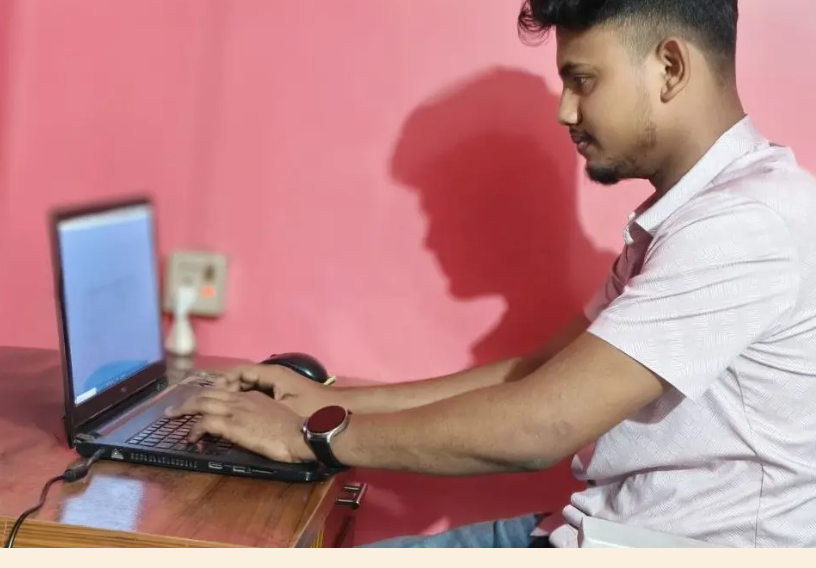
Zihad Hossain Rafi, a Bangladeshi cybersecurity practitioner, ethical hacker, and programmer.
fearless mothers feeding us, we eat from our yucca roots
and remedies swallowed below the moon growing
to make us stronger, to break down the walls
between us, turn our faces to see the world as it is
we find our goddesses prancing like peacocks in rain
with emerald eyes and feathers, salutations to the sun
we bow to our goddesses, slipping envelopes
under red doors. Our lineage, seven generations of loving
peacemaking, dancing, watching leaves turn gold.
Wishes of Goddesses
I wish for a song.
Do you know how to sing?
The way hummingbirds do
in my mind, with busy wings
on the other side of the windowpane.
I wish to wear a lavender night
gown. Do you know how to sew?
How to cut wild silk
without fringe floating in air
like godmother, hummed
when hemming?
I wish my fingers to reach the horizon.
Do you know how to dance?
To dance with abandon.
Lifting feet to twirl in cadence, listen
to silence, feel fingers of sun on skin.
I hunger for the body of a pineapple.
Do you know how to cook?
To fold herbs in bread? Marinate treasured
sea with soil, then kiss the hands that feed you?
Jerrice J Baptiste is an artist, poet, educator and author of nine books, Her watercolor drawings on paper have been accepted or forthcoming in MER, Synchronized Chaos, Saugerties Shout Out, Las Laguna Art Gallery exhibit in California, Spirit Fire Review, Jerry Jazz Musician Magazine. Jerrice has presented her art work at The Omega Institute in Rhinebeck, NY, in June 2025. She’s been featured as a solo artist at the Cairo Public Library in Cairo NY, in an art exhibit at The Mountaintop Library in Tannersville NY in August-September 2025, and also a solo Exotic Birds Collection on January-February 2026 at Mountain Top Library, She participated in an art show called Shout Out Saugerties, NY. Her most recent poetry book Coral in The Diaspora is published by Abode Press (August 2024). She is well published in Artemis Journal, The Yale Review, Mantis and hundreds of others. Jerrice’s collaborative songwriting and poems are featured on the Grammy nominated album: Many Hands Family Music for Haiti. She teaches Authentic Poetry workshops in The Catskills, NY.
Potatoes are an important crop in our daily diet. Although they may seem like an ordinary food product, their production requires scientific research, practical experience, and considerable labor. Today, science is playing an increasingly important role in improving potato production.
High-Quality Seed Material — The First Step
A productive harvest begins with high-quality seed material. The germination percentage, speed of shoot emergence, and early development of potato plants are important indicators of seed quality.
Laboratory observations allow researchers to evaluate these characteristics and compare different varieties. In our experiment, the potatoes were planted on February 18. The first shoot appeared after 15 days. Germination reached 70% on the 18th day and increased to 80% on the 20th day. Among the studied samples, the Gala variety showed good results.
These observations demonstrate that even simple indicators such as germination time and germination percentage can provide valuable information for selecting suitable planting material.
The Role of Science in Potato Production
Modern science is improving potato production in several ways. Efficient irrigation technologies help reduce water consumption, while soil monitoring supports better plant development. Plant breeding also plays an important role in developing varieties with improved resistance to diseases and unfavorable environmental conditions.
At the same time, traditional agricultural experience remains valuable. Combining farmers’ practical knowledge with scientific research can contribute to more efficient and sustainable potato production.
Conclusion
A potato may seem like a simple product, but behind every harvest lies a combination of science, labor, experience, and technology. Our laboratory observations — from the first shoot appearing after 15 days to 80% germination on the 20th day — show how scientific observation can help evaluate seed material and understand plant development.
Every new shoot is not only the beginning of a future harvest, but also a small step toward more scientific and sustainable agriculture.
Ibragimova Bikajon Ergashqizi, was born on April 28, 2002, in Khiva District, Khorezm Region, Uzbekistan. I have a higher education. Currently, I am a second-year Master’s student. My field of specialization is Agriculture.
At present, I am not employed. My academic and professional interests are related to vegetable crop production, agriculture, and modern agricultural technologies. I am also interested in sports and music. I have a B1-level English language certificate. During my academic activities, I have prepared and published several scientific articles.In the future, I aim to further develop my scientific and professional knowledge, conduct research in the field of agriculture and vegetable production, and become a qualified specialist in my field.
Dilxiroj Yangiboyeva was born on August 27, 2007, in the Khorezm Region, Uzbekistan. She is a second-year student at Urgench State University, majoring in Philology and Language Teaching: Uzbek Language.