I’ll be the wind that makes all the roofs shutter.
Don’t mind me, friends, I’m feeling blue,
And verses are born that don’t really matter.
Nigar Nurulla Khalilova is a poet, novelist, translator from Azerbaijan, Baku city, currently in the Kingdom of Saudi Arabia. She is a member of Azerbaijan Writers Union. Nigar N. Khalilova graduated from Azerbaijan Medical university, holds a Ph.D degree. She has been published in the books, literary magazines, anthologies and newspapers in Azerbaijan, Russia, Saudi Arabia, USA over the years. Nigar N. Khalilova participated in poetry festivals and was published in the international poetry festivals anthologies. Conducted data in the Austin International Poetry Festival (AIPF), 2016-2017.
imprisoned between the pages, in an eternal twilight.
A petrified heart, beneath cracked leather,
weak heartbeats, a distant echo of lost dreams,
hopes turned to ashes,
fears rooted in darkness.
GRACIELA NOEMI VILLAVERDE is a writer and poet from Concepción del Uruguay (Entre Rios) Argentina, based in Buenos Aires She graduated in letters and is the author of seven books of poetry, awarded several times worldwide. She works as the World Manager of Educational and Social Projects of the Hispanic World Union of Writers and is the UHE World Honorary President of the same institution Activa de la Sade, Argentine Society of Writers. She is the Commissioner of Honor in the executive cabinet IN THE EDUCATIONAL AND SOCIAL RELATIONS DIVISION, of the UNACCC SOUTH AMERICA ARGENTINA CHAPTER.
Lilian Dipasupil Kunimasa was born January 14, 1965, in Manila Philippines. She has worked as a retired Language Instructor, interpreter, caregiver, secretary, product promotion employee, and private therapeutic masseur. Her works have been published as poems and short story anthologies in several language translations for e-magazines, monthly magazines, and books; poems for cause anthologies in a Zimbabwean newspaper; a feature article in a Philippine newspaper; and had her works posted on different poetry web and blog sites. She has been writing poems since childhood but started on Facebook only in 2014. For her, Poetry is life and life is poetry.
Lilian Kunimasa considers herself a student/teacher with the duty to learn, inspire, guide, and motivate others to contribute to changing what is seen as normal into a better world than when she steps into it. She has always considered life as an endless journey, searching for new goals, and challenges and how she can in small ways make a difference in every path she takes. She sees humanity as one family where each one must support the other and considers poets as a voice for Truth in pursuit of Equality and proper Stewardship of nature despite the hindrances of distorted information and traditions.
The blood always stirs with this tune of the varieties of musical tastes
The nature itself a bond for love in every opposite the male – female
Everything sings together, sings for each other, the teaching of love
As the teacher always teaches us to be sympathized with the sorrowful
And be happy to see the other’s happiness
The eyes will come to close its sight
The world may say us ‘Good Bye’
We must smile over the last thought or sigh
The view may show the glory for both of us we live in love
In cry and laugh
What’s the most feature of the reality nowadays?
There is no water to play the boat
The view, not vivid can give us relief, the foggy night
The tigers do not the matter for eating their cubs
On the other hand the view of devouring humanity
What brings up the ending?
Chapainawabganj, Bangladesh
26 April, 2025.
Md. Mahbubul Alam is from Bangladesh. His writer name is Mahbub John in Bangladesh. He is a Senior Teacher (English) of Harimohan Government High School, Chapainawabganj, Bangladesh. Chapainawabganj is a district town of Bangladesh. He is an MA in English Literature from Rajshahi College under National University. He has published three books of poems in Bangla. He writes mainly poems but other branches of literature such as prose, article, essay etc. also have been published in national and local newspapers, magazines, little magazines. He has achieved three times the Best Teacher Certificate and Crest in National Education Week in the District Wise Competition in Chapainawabganj District. He has gained many literary awards from home and abroad. His English writings have been published in Synchronized Chaos for seven years.
To provide a bigger meal than the roadkill rabbit at the end of the drive.
UP ON THE ROOF
When my medications make me feel like jumping off a roof
I Can’t tell the difference between my emotions and the medications
How do I convince myself that it is
The meds not me?
That my feelings are a chemical reaction.
Not a true reflection
of my inner life
In time, after conversations with my wife, friends, and dog
I am able to distinguish my feelings from those generated by the drugs.
And I talk myself down
“Stay off the roof, stay off the roof.” I tell myself as I lie in bed under a cover.
When I realize a fall from the roof
will only make things worse
and require more drugs
I settle down with the dog,
Fall asleep,
and dream of flying.
ERIC BARR taught acting and directing at University of California, Riverside. He was the Founding Director of the UCR Palm Desert MFA in Creative Writing and Writing for the Performing Arts.
Barr has written in a number of different genres, from screenplays to poetry. His work has appeared in Connotation Press and The Journal of Radical wonder. He was a co-writer on the feature film, A Thousand Cuts.
In addition to his writing, Barr worked as a theatre director and acting coach. He was the Artistic Director of the Porthouse Theatre in Cleveland, taught movement for actors at the Stella Adler Conservatory of Acting in Los Angeles, and worked as an acting coach with the National Theatre of the Deaf.
Since surviving a series of strokes Barr has written and performed his one-man show, A Piece Of My Mind”, about his surgeries, hospitalizations, and rehab around the country. His podcasts on stroke recovery can be found at http/www.apieceofmymind.net
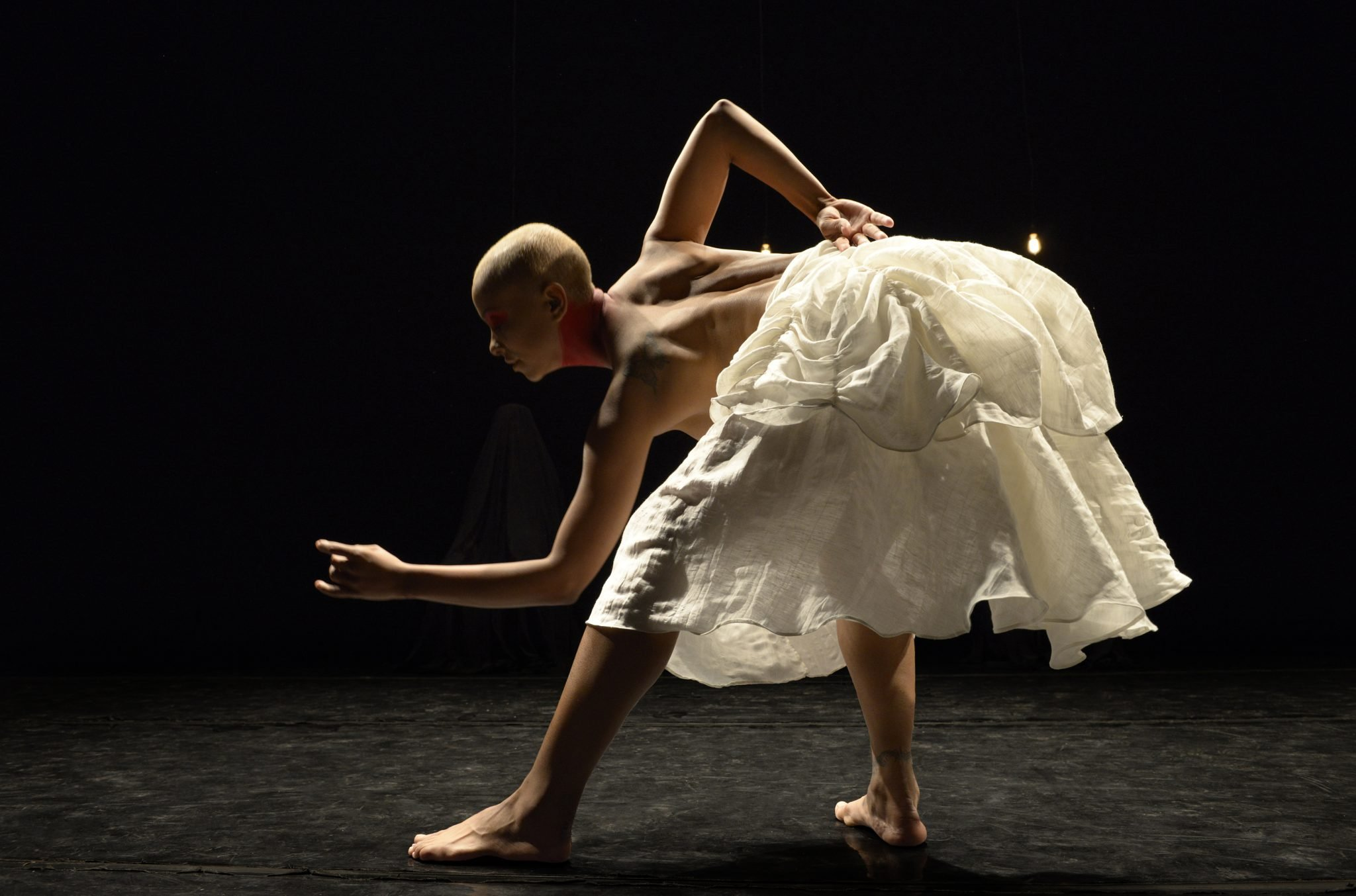
Still from Gira, by Grupo Corpo. Photo: Jose Luiz Pederneiras
21 and Gira
Grupo Corpo
Zellerbach Hall
University of California, Berkeley
Gyres of Eshu
A review by Christopher Bernard
Cal Performances (the Bay Area’s most adventurous promoter of dance, music and live performance) delivered once again one late weekend in April, as part of its Illuminations: “Fractured History” series: Brazil’s formidably gifted dance company, Grupo Corpo.
Based in Brazil’s legendary Minas Gerais, and founded in Belo Horizonte in 1975, the company is driven by the synergistic talents of two brothers, Paulo and Rodrigo Pederneiras, house choreographer, and director and set and lighting designer, respectively, who have created, with their collaborators, an aesthetic that blends classical ballet and the complex heritage of Brazilian culture, religious and ritual traditions, the whole leavened by a musical culture that is wholly unique.
The company brought two ambitious dances to Berkeley’s Zellerbach Hall. The first was their breakout dance, from 1992, which put the company securely on the international dancing “map”: 21, a number that retains an enticing mystery to it. It also introduced one of the company’s musical signatures: the music and instruments of Marco Antonio Guimarães and the artists of the Uakti Instrumental Workshop. These last not only have a unique armamentarium of instruments, but even use their own microtonal scales, unless my ears were fooling me—essential elements of what makes the company’s work uniquely engaging.
21 was groundbreaking: a slow burn that used the entire company in a processus of simple chthonic motives, closely gripping the floor like the movements of wary but defiant jungle animals, on dancers at first dressed entirely in yellow bodysuits against a pitch-black background, appearing at first behind a misty transparent screen that creates a ghost-like effect, and rising midway through the work as the dance moved to illumination from mystery.
The dance began with a hypnotic monotony of group motions with slight variations against a polyphony of percussion and string and blown instruments entirely new to this listener’s ear, and gradually morphed into a succession of solos and increasingly elaborate duos, trios, and corps, by turns haunting, raunchy, and carnivalesque, until its energies, long simmering, boiled over and broke out into a joyously orgiastic conclusion that brought the Brazilian gods to the stage and the local audience to their feet.
The imaginative use of lighting and color, as well as the costume designs (which transmogrified from the monotone to the wildly polychrome) of Freusa Zechmeister, were as vital to the overall effect as motion and music.
The second dance, Gira (“Spin”), from 2017, takes the elements of spiritualist rite suggested in 21 and brings them unapologetically to the fore. The dance is based on the rituals of Umbanda (a merging of West and Central African religions such as Yoruba with Catholicism and spiritism) to the music of the jazz band Metá Metá and vocals from Nuno Ramos and Eliza Soares. The dance is based on rituals calling forth the spirit of Eshu, a deity who acts as a bridge between humanity and the world of the orixás of Ubamba, Condomblé, and the spiritualities they have in common. Eshu commands and drives the rite of the giras, or spinning, whose motions, like those of the dervishes of Islam, open the dancers to the gods and the gods to the dancers.
Gira evolved as a series of variations on the motions of the ritual, increasingly fugal, danced by the performers as if in the trance that the ritual aims, paradoxically, both to create and to emerge from. Both male and female dancers wore long white skirts and were bare breasted in a show of a curious mixture of vulnerability, beseeching, and seduction to bring forth the divine.
It’s a beautiful and evocative work, if overstaying just a little.
Not to be forgotten is the technical brilliance of the dancers themselves: masters of their gifts, and sharpened by the equal mastery of the company’s leadership.
____
Christopher Bernard is an award-winning novelist, poet, and essayist and author of numerous books, including A Spy in the Ruins (celebrating its twentieth anniversary in 2025) and The Socialist’s Garden of Verses. He is founder and lead editor of the webzine Caveat Lector and recipient of an Albert Nelson Marquis Lifetime Achievement Award.