Essay from Ri Hossain

The Politics of Icon-Making and the Tragedy of a Manufactured Myth: Revisiting Sukanta Bhattacharya – By Ri Hossain 

In the history of Bengali literature, the portrayal of Sukanta Bhattacharya as the “rebellious teenage poet” has long been placed on an unquestioned and sacrosanct pedestal. However, stripping away the fog of sentimentality and examining the matter through the unsentimental lens of literary sociology, propaganda studies, and political history raises a fundamental and revolutionary question: was Sukanta truly an autonomous, singular literary genius? Or was he a tragic figure in a meticulously planned “icon-making project” orchestrated by the contemporary Bengali progressive family network and the Communist Party?

The foundation of this analytical critique solidifies when we examine Sukanta’s family structure and the extensive circle of influential communist political leaders and accomplished writers surrounding him. Analyzing his ancestral and family background reveals that he was by no means a teenager emerging from an isolated or marginalized household. His second elder brother, Ranadev Bhattacharya, was a prominent local organizer of the then Communist Party of India (CPI) and his political mentor. Top communist theorist Somnath Lahiri was connected to the family through kinship, and this same lineage later produced Buddhadeb Bhattacharya, the longtime Chief Minister of West Bengal and CPI(M) Politburo member.

On the other hand, the family’s influence within the progressive literary and social circles of contemporary Kolkata was equally far-reaching. The renowned writer Manish Ghatak (who wrote under the pen name “Yuvanaswa”) was his close relative. In the subsequent generation of this same family tree, we find Mahasweta Devi, a pioneer of human rights movements, and Nabarun Bhattacharya, the celebrated political writer of radical leftist sensibilities. In other words, the political and cultural ecosystem in which Sukanta was raised was not merely a middle-class household; it was one of the most powerful and institutionalized powerhouses controlling contemporary Bengali progressive politics and literature.

Placing this vast political and literary apparatus in context casts a deep and legitimate doubt on the “singular authorship” of Sukanta’s literary works. How plausible is it that a teenager aged between 17 and 20 could spontaneously compose poem after poem featuring flawless metric structures, complex Marxist philosophy, and nuanced political metaphors without it being the collective effort, ideological polishing, or ghostwriting of experienced party intellectuals? The cultural platforms of the era—such as the Anti-Fascist Writers’ and Artists’ Association, the editorial board of the daily Swadhinata, or the anthology Aakal—were essentially literary workshops run by party-controlled, skilled progressive writers. Consequently, a serious doubt arises: are works like Chharpatra or Purbabhas the output of Sukanta’s solitary pen, or were they a collective propaganda project by contemporary party writers?

The starkest contradiction and artificiality become evident in the social reality behind his poems’ “aesthetic rendering of hunger.” Historical facts confirm that Sukanta Bhattacharya’s family was neither impoverished nor destitute. His father, Nibaran Chandra Bhattacharya, was the founder of Kolkata’s well-known Saraswat Library and a successful book publisher, enjoying a established middle-class stability in the city. How does a poet who never personally experienced the desperate pangs of starvation write lines like: “In the realm of hunger, the world is prose-like / The full moon is like a burnt bread”? Parlor politics or political manifestos do not bring real hunger to the belly. The truth is that to construct an “Ostrovsky model” or a “party martyr” for the international communist movement, Sukanta’s middle-class identity was shrouded in an artificial persona. The imagery of hunger and deprivation in his verse was not born of personal experience but borrowed as a political instrument from the party’s proletariat ideological thesis.

One of the most successful international formulas of the Comintern (Communist International) was to elevate a physically and socially afflicted teenager facing premature death as a “party icon” to heighten emotional intensity and momentum in political struggles. Just as the blind and paralyzed youth Nikolai Ostrovsky was transformed into a miraculous symbol of communist resolve in the Soviet Union through the novel How the Steel Was Tempered, the exact same blueprint was executed in Sukanta’s case. Despite suffering from severe tuberculosis and malnutrition, Sukanta was denied proper medical care and instead subjected to a “suicidal routine” of grueling work in soup kitchens, political rallies, and newspaper editing day and night. The party calculated precisely that the tragic, premature demise of an ailing young poet serves as a far more potent manifesto for a political movement than any living senior theorist ever could.

Even from a literary critical standpoint, modernist intellectuals like Buddhadev Bose hinted that Sukanta’s poetry prioritized party slogans and manifestos over subtle poetic aesthetics. Had it not been for the party’s formidable machinery, his family’s cultural leverage, and the systematic political campaign to glorify his sacrifice after his untimely death, Sukanta’s standing purely on grounds of poetic merit would remain highly questionable.

Therefore, an objective review of history and literary politics reveals that Sukanta Bhattacharya is not the name of a singular literary genius; rather, it represents an institutional product of the party apparatus’s collective literary endeavor. The poems published under his name were essentially the fruit of collective deliberation, refinement, and strategic guidance by the party’s experienced intellectuals and progressive writers—where the name of the teenage Sukanta was utilized merely as a signboard for political propaganda. The time has come to dismantle the myth of the “solitary poet” and reframe Sukanta Bhattacharya’s body of work as the collective political manifesto of the Communist Party.


Ri Hossain is a prominent voice in Bengali poetry, recognized as a rebellious and resilient figure in the contemporary literary landscape. Born on August 19, 1981, in Rangpur, Bangladesh, with ancestral roots in Munshiganj, he began his literary journey in 1993. His poetry deeply reflects personal experiences, societal conflicts, urban alienation, and a steadfast commitment to free expression. Author of several works, including the poetry collection Kobitar Abhyutthan Chai (2024), his writing bridges social consciousness with profound psychological and intimate introspection.
Poetry from Mesfakus Salahin

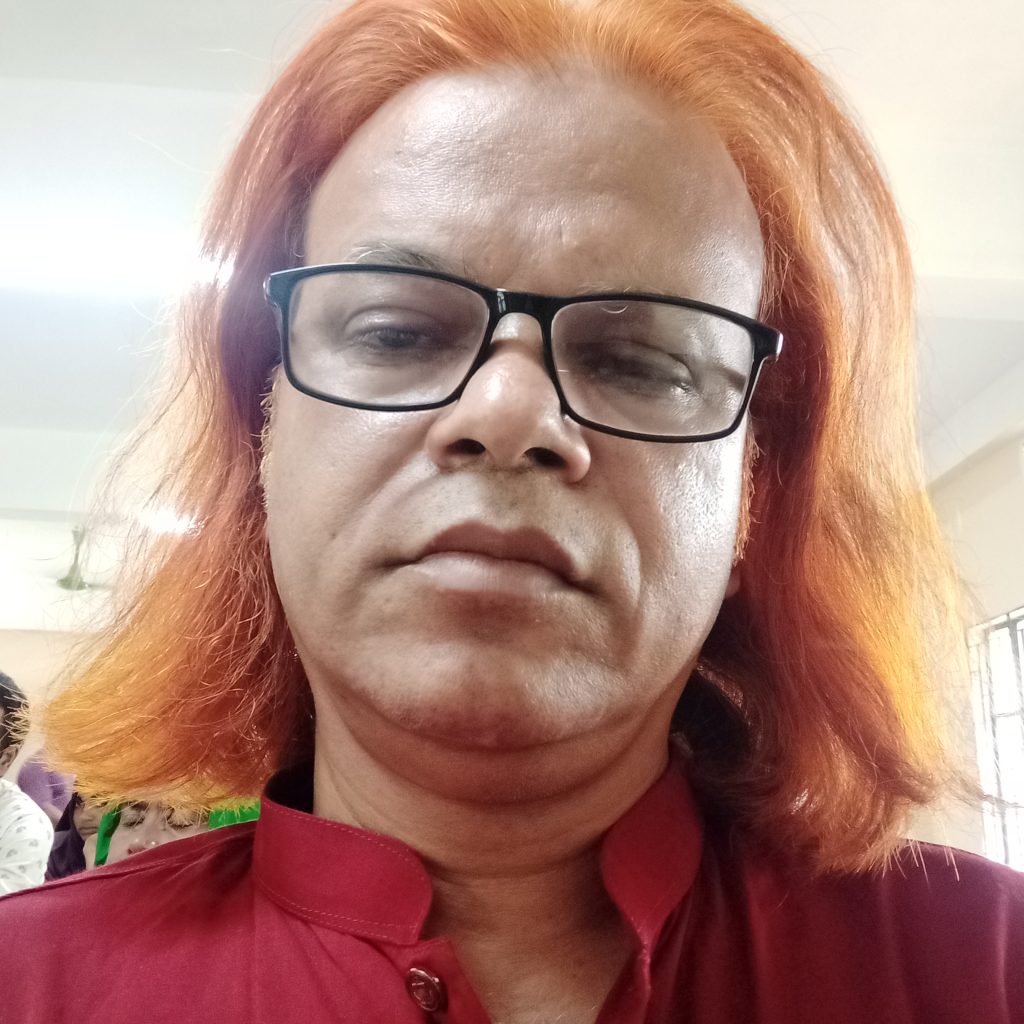
South Asian man with reading glasses and red shoulder length hair. He's got a red collared shirt on.
Mesfakus Salahin

How Lucky I Am
Kamal Salahin
Chapainawabganj, Bangladesh

How lucky I am—
I remain normal still,
I have not become intoxicated
Like those strange creatures
Who have nothing to offer
To my listless body.
I cannot recognize my home;
The rooms fall into disarray,
And the doors drift away
The moment my shadow touches the ground.

How fortunate I am—
That my love was not trapped
Within the covers of civilization.
I did not have to sniff the soles of shoes
To enter an earthly paradise,
Where painted affection
And factory-made love devour
The manuscripts of human souls.
And all the flowers keep burning
Amidst dazzling budgets.

I am truly very lucky.
I am the only customer of my own shop
I buy and sell whatever I please,
whenever I wish.
I do not run after a livelihood
In a line of rats,
Following the piper.
I do not have to eat poison-laced biscuits,
Nor do I have to buy a night’s sleep
At the pharmacy on the corner.

How fortunate I am—
My tattered clothes stand guard
Over my very being, fearless.
I possess no suit of thunder,
Nor a garment of lightning,
Like the Superman-gentlemen—
Who hawk sweets in Hell
And plunder everyone’s future.
The ants march in a line—
Along which path?

Poetry from Saeed Koushan

The Archaeology of Gravity

Love, he says,

sounds like a door

closing too carefully

not to wake the neighbors,

not to let the hallway know

that something has changed.

The room is small.

A single bulb hums.

Your name waits

inside his phone

unopened,

heavy as contraband.

Outside, a patrol passes.

Boots count the seconds.

He studies your hands

the way others study exits

how they hesitate

before touching the cup,

how the cup tilts

at a certain angle

only when you’re afraid.

On the table:

two chairs.

Only one used.

He deletes a message

before it finishes breathing.

The phone goes dark.

The silence stays.

Here, it holds two people

exactly where they are

standing inches apart,

unable to move closer,

unable to move away.

He still feels it

that bend in the air

when your shoulder brushed his

in the stairwell.

That quiet shift

when the world noticed

and looked away.

The way his breath changes

when you enter a room.

The way time slows

in the second before

you speak his name.

Gravity never stops.

Even when you leave

cross borders,

change your name,

delete the messages

the pull remains.

Invisible.

Constant.

Faithful.

Some nights,

he wakes

and checks his phone.

No new messages.

But the weight is still there

the archaeology of all the words

never sent,

all the touches

never risked,

all the love

never named.

Layer upon layer.

Heavy as galaxies.

This is what gravity does

in a place where love

is contraband:

It doesn’t bring you together.

It just makes you feel

the exact distance

between you

and you carry it

everywhere you go.

Without putting it down.

Without being asked.

Poetry from Brian Barbeito

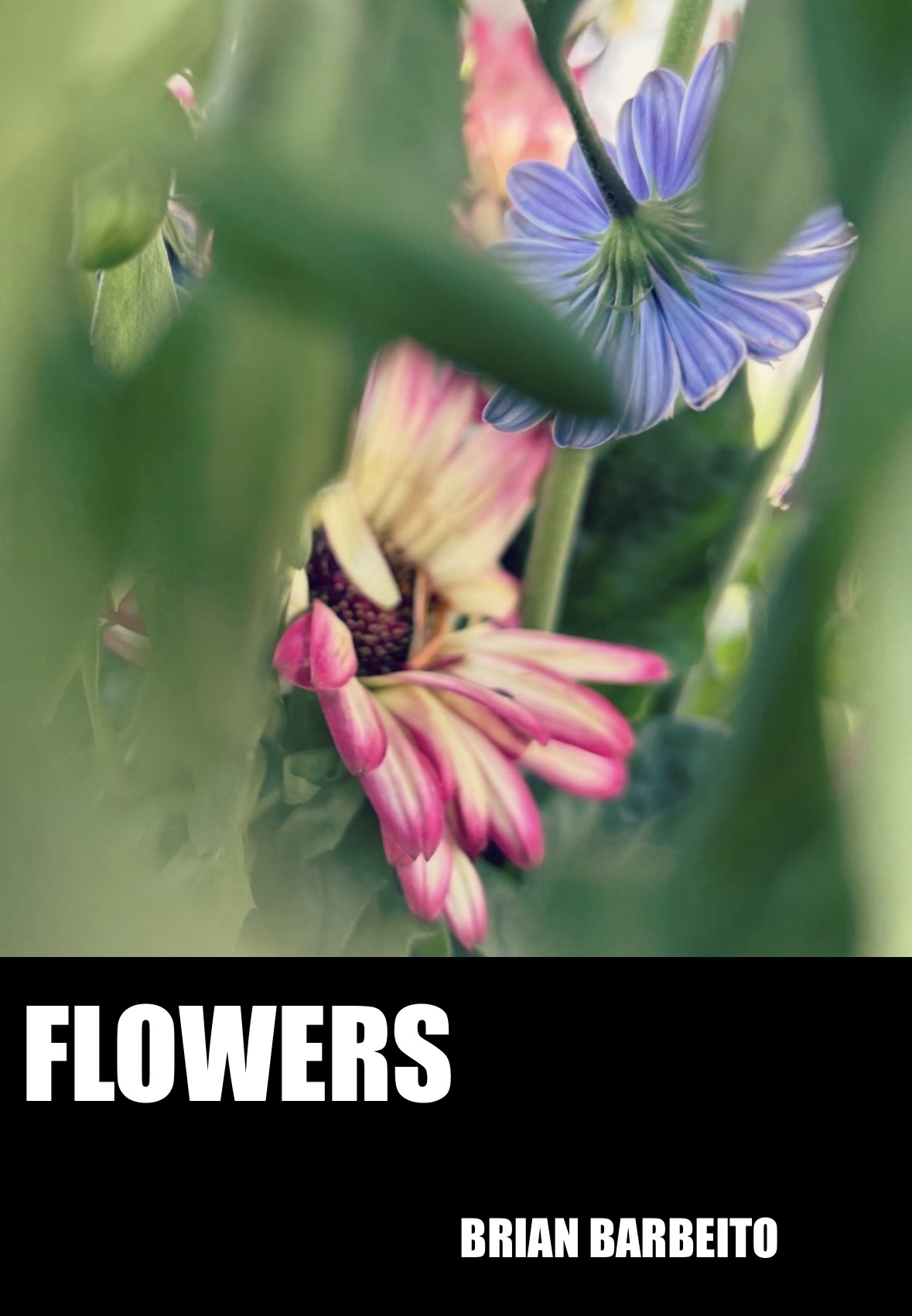
Flowers (for Tara)

Sometimes breezes visit the outdoor flowers and gently guide the petals this way or that. Red, blue, orange yellow. A bird in the rafters watches everything. Its head moves this way and that almost frantically but that’s just how it is built. Long steel rafters that support baskets and who made them all? If you walk through there it is another world. A great atmosphere for a poet or photographer. Clear honest light. Hope inspiration even love. The soil and dirt and root systems. The signs, such as, WATER WHEN DRY. Industrial grade hoses and many racks waiting for display.

But, just sometimes, irrigation systems. The world finally begins again after the longest worst winter. The old discerning gardener looks at the wares. The casual browser also. Flowers,- a universal language. There is a large hill on the outskirts of town, and below, a pond. Perhaps on that hill, alone, one of those blue or purple wildflowers have bloomed. That same breeze teases its petals to the side. There is warmth from the sun. Warmth from the new spring. The town had grown and was bursting at the seams. Many selfish souls lived there. Some good ones though. But the flowers often better than even the good souls. In the heavens they say, are often fields and fields of flowers and they often include colours not even known to the earth. Plus, many say the flowers are alive more than they are here- quite conscious. Ah look at the earth flowers for gardens and the feral ones too, whist thinking of the astral planes and what whimsical wondrous ones might live there. 

Poetry from Sana Jangeer Hamad

The Tragedy of a Woman

The tragedy of a woman is her strength

 hidden beyond broken walls.

The tragedy of a woman is her broken wings,

 framed like ancient pieces.

The tragedy is the belief rooted in her bones,

 yet she is silenced.

The tragedy can be her tears lying upon the pillow every night.

The tragedy is the nightmares embracing

 her innocent heart, burning her endless dreams.

The truth is a tragedy 

that exists beyond reality.

It is her definition.

It is the definition of her skin and bone,of her features.

They called her frail, with disbelief.

But it was never her tragedy.

It was theirs.

Sana Jangeer Hamad is a Kurdish author, poet, writer, translator, compiler, and final-year English student at Salahaddin University. From Kurdistan, she is a First-Place Winner of an International Poetry Competition, a Voice of Asia delegate representing Kurdish women, and a Model United Nations delegate representing Uruguay in UNESCO and UNDP committees. She has also been selected as a Model United Nations delegate for the UNDP Committee at an international MUN conference in Istanbul. She was selected among 40,000+ writers from across the globe at the Pan India Mega Pen Star Writing Event, organized by Epic Sphere Publication, representing Kurdistan, Iraq.

She has also been invited by Radio Aldora Argentina and television channels to discuss her literary work and achievements. Her poems have been published internationally by literary magazines, organizations, and initiatives, and she is a co-author of multiple literary anthologies. She has experience in translation, English education, literary compilation, and international youth initiatives. Her learning and professional development experiences include programs and initiatives connected with the United Nations, UNDP, OHCHR, HP LIFE, Google Cloud, Microsoft, the British Council, and Cohort. Aspire.

Poetry from Ashiqur Rahman 

A Day of Remembrance

On the twenty-fifth of August, these days.

The lives we lost, the tears we cried,

The homes we left, ones by our side.

May peace return to our homeland,

We remember mothers calling,

We remember children’s fear,

We remember those who vanished,

And the voices we still hear.

Our identity will never fade.

Our past will never be forgotten—

Our future will be free.

And peace will replace the night.

Let the world hear the Rohingya voice,

We ask the world to hear our story,

To stand for justice, truth, and right.

And those who died that day.

Though years may pass and roads may change,

The mothers, fathers, sons and daughters,

Not only sorrow, but our hope.

With unity, courage, peace, and justice,

May the world remember what happened,

Never forget the lives we lost.

Never forget the truth we carry.

May justice come, may peace return,

Your names are written in our hearts.

—————————–

1.2 Million People Cry.

Under the same sky.

Different villages,

different roads,

different houses.

From Maungdaw,

from Buthidaung,

from Rathedaung,

and from many other places,

we came with nothing.

A place where

a million people stand,

waiting, waiting—

only seeking peace.

No checkpoint.

No passport check.

No ID card check.

Why?

How?

How is it possible

for 1.2 million people

to suddenly become refugees?

We asked the border police officer:

“Where should we go?”

The boat suddenly came

to an unknown place.

The sea was behind us.

Our homeland was far away.

Then we heard a name:

Prime Minister Sheikh Hasina.

Hasina gave us

a place to stay—

Cox’s Bazar.

A small place

for people.

We ask for only one thing—

who had lost a whole homeland.

Some people said,

“She wants the Nobel Prize.”

How?

Why?

When?

I do not know.

I only know

that 1.2 million people

needed somewhere to stand.

“Where will I go tomorrow?”

No Questions.

No Answer.

We fled

An Unknown place.

2:00 AM Tonight,

1.2 million people

look at the faces.

And remember the villages.

They were forced to leave.

The cows are gone.

The villages are silent.

The borders remain.

A million hearts still cry:

“We are Rohingya.

We are human.

We want peace.

We want dignity.

We want to go home.”

— Asheqe

—————————-

Short Bio 

Rohingya Poet / Author

A dedicated student from the Rohingya community at IIUC, where I’m studying Electronic and Telecommunication Engineering (ETE). I have a strong interest in leadership and rights defense—Rohingya community development.

As part of my academic journey, I also studied for an Associate Degree in Political Science at the Rohingya Academic Research Institute. 

As a member of the Rohingya community, I’m passionate about education, empowerment, and creating opportunities for displaced people. Through my writing, I represent the Rohingya community’s engagement. I hope to contribute positively to society and inspire young people to pursue their dreams despite challenges.