—The Four Seasons Walking Out of Ancient Dongba Scriptures
By Lan Xin (Lanxin Samei)
Internationally renowned Chinese writer and poet, the only female inheritor of Dongba culture, Dean of China Yulong Wenbi Dongba Culture Academy, Winner of the Premio Letterario Internazionale Francesco Giampietri
Dongba’s Winter You walk out of the ancient Dongba scriptures The nimble-flying Alangji bird Perches on the treetop of a green tree Shakes its body three times upward Three pure white feathers float down The white feathers turn into white snow White snow is the messenger of winter Skylarks usher in the north wind Wagtails bring the dewdrops covering the ground White cranes summon the snowflakes filling the sky The diligent have shoes to wear The lazy walk barefoot This winter Is not the time to migrate home Shall we wait till the warm spring of the third lunar month?
Dongba’s Spring You walk out of the ancient Dongba scriptures The nimble-flying Alangji bird Perches on the treetop of a green tree Shakes its body three times downward Three emerald green feathers float down The green feathers turn into tender grass Tender grass is the messenger of spring Trees are clad in emerald gowns Cuckoos sing on the branches White muntjacs roar in the pine woods Pheasants and hill pheasants chirp in the forest
Valiant men lack food grains Virtuous women waste away This spring Is not the time to migrate home either Shall we wait till the midsummer of the sixth lunar month?
Dongba’s Summer You walk out of the ancient Dongba scriptures The nimble-flying Alangji bird Perches on the treetop of a green tree Shakes its body three times to the left Three jet-black feathers float down The black feathers turn into heavy rain Heavy rain is the messenger of summer Slopes are covered with dense grass and woods Even leopards and tigers with sharp claws Cannot wander out of the deep mountains and thick forests Beneath the tree roots down below Rainwater merges into a river Even otters and fish Cannot swim across the rushing gully This summer Is still not the time to migrate home Shall we wait till the golden autumn of the ninth lunar month?
Dongba’s Autumn You walk out of the ancient Dongba scriptures The nimble-flying Alangji bird Perches on the treetop of a green tree Shakes its body three times to the right Three golden feathers float down The golden feathers turn into yellow flowers Flowers are the messenger of autumn Yellow flowers, silver flowers and golden flowers Turquoise flowers and jet-black gem flowers Bloom everywhere across the land This autumn At long last Is the time to migrate home Chong Ren Li En, the ancestor of the Naxi (Nakhi) people
Takes his bride Chen Heng Baobai, whom he married in the heavenly realm Back into the long-missed embrace of Mother Earth Back to the home where humans dwell One mother gives birth to three sons And the three sons are all different from one another From then on Upon the land of humans Three ancient ethnic groups come into being They build a beautiful homeland together And live in harmony and happiness
ANNOTATION: The article will scientifically analyze the mastery of English and the influence of the native language on this process. The mother tongue is one of the most important aspects that affect the acquisition of English, and it determines how perfectly we master this language. The advantages or disadvantages that the native language creates during the process of learning a second language are also clearly illustrated with several examples. The result of the study provides a comprehensive statement of the advantages of the native language and the disadvantages of the learners’ language learning process for English learners.
KEYWORDS: mother tonguage, second language acquisition, foreign language teaching, pronunciation difficulties, grammatical interference, bilingualism, positive and negative development, learning strategies, English language learning.
ANNOTATSIYA: Maqolada ingliz tilini o’zlashtirish va ona tilining bu jarayonga bo’lgan ta’siri ilmiy jihatdan tahlil qilinadi. Ona tili ingliz tilini o’zlashtirishga ta’sir qiluvchi eng muhim jihatlardan biri bo’lib, u qanchalik bu tilni mukammal o’zlashtirishimizni belgilab beradi. Shuningdek, ikkinchi tilni o’rganish jarayonida ona tili yaratadigan qulayliklar yoki qiyinchiliklar bir qancha misollar bilan aniq yoritiladi. Tadqiqot natijasi ingliz tili o’rganuvchilarga ona tilining afzalliklari va o’rganuvchilarning til o’rganish jarayonidagi kamchiliklari haqida to’liq bayonot beradi.
KALIT SO’ZLAR: ona tili, ikkinchi tilni o’zlashtirish, chet tillarini o’qitish, talaffuzdagi qiyinchiliklar, grammatik aralashuv, ikki tilli, ijobiy va salbiy rivojlanish, o’rganish strategiyalari, ingliz tilini o’rganish.
АННОТАЦИЯ: В статье будет проведен научный анализ овладения английским языком и влияния родного языка на этот процесс. Родной язык является одним из важнейших аспектов, влияющих на овладение английским языком, и от него зависит, насколько в совершенстве мы овладеваем этим языком. Преимущества или недостатки, которые создает родной язык в процессе изучения второго языка, также наглядно иллюстрируются несколькими примерами. Результат исследования дает исчерпывающее представление о преимуществах родного языка и недостатках процесса изучения языка учащимися, изучающими английский язык.
КЛЮЧЕВЫЕ СЛОВА: родной язык, овладение вторым языком, обучение иностранному языку, трудности с произношением, грамматические помехи, двуязычие, позитивное и негативное развитие, стратегии обучения, изучение английского языка.
INTRODUCTION
Today, the desire to learn a language is growing, one of which is English. There are many problems that learners face on this path. For example, pronunciation problems, grammatical errors, difficulty understanding listening, low self-confidence, and inability to communicate freely. All of these problems are inherent in the native language of each learner, which means that the native language can have a positive effect on the process of mastering the English language and can help solve problems. It is clear that this article proves how effective the mother tongue is in teaching English and provides useful suggestions.
Nowadays, there are many opportunities for language learners, especially English learners. An example of this is that linguists who have achieved 7.0 and a high score in the IELTS exam in Uzbekistan have been reimbursed for the cost of the exam, and the opportunity for foreign universities to win a full grand can also open this very English. As our president explained: “it’s time to establish a new environment in which the future will be the foundation for teaching foreign languages.” Therefore, this article presents the results of effective, useful, and beneficial research towards creating this environment.
RESEARCH METHODOLOGY: The extent to which the native language affects the process of second language learning during this introduction has been determined through several methods:
Theoretical analysis: with the help of this method, an analysis of scientific works and articles, tutorials on the role and importance of the native language in mastering English was studied in depth. The research of researchers such as David Nunan, the valuable information they gave, the concepts were analyzed one by one.
Observational and applied research: the shortcomings or achievements of young people whose native language is other in the learning process of English have been meticulously observed, and the difference between the two has been clearly demonstrated.
Experimental group and control group: two other groups with the first language were selected and approaches and guidelines in their language learning process were established. The results shown were compared in each group.
Survey and evaluation: questionnaires were distributed and the results were compared to those who were knowledgeable and received about the impact of their native language on the second language learning process.
REVIEW OF USED LITERATURE
This topic is much more relevant now that the passion for learning a language is high. Also, the work of all the researchers who worked within the framework of this topic was analyzed one by one Also, the work of all the researchers who worked within the framework of this topic was analyzed one by one. Obviously, the problems of several language learners have also been solved in a positive way, but to this day no new ideas for the distribution of new methods, a separate group or teachers have been developed, depending on the native language of the students and to what extent they know the grammar of this language. It is very easy to find out from their result that the work of the researchers mentioned earlier was also thorough, consistent and negative.
Focusing on foreign sources Do Quoc Khanh, on the other hand, shares his experience with 100 readers in his article and touches on their origins, problems in pronunciation, grammar, vocabulary. Another researcher Kuldashev Rustambek Avezmurodovich mentions that the native language plays an important role not only in language learning, but also in teaching, and focuses more on the useful aspects of the native language that the English language gives to the learning process.
RESULTS
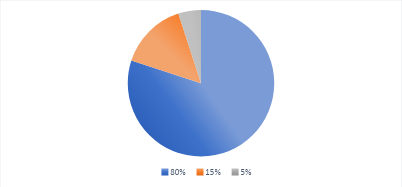
This section introduces the outcome of the above-mentioned experiences and compares young people with two different native languages. The results show that students who know languages whose grammar, position in the sentence structure English is the same, have a 20% higher language acquisition process efficiency than other learners. The role and significance of the first language is also felt when working with the group is given in this study. In addition, the results of a survey from teachers and students show that 80% of people have assessed that the learning process of English is influenced by the first language of the learner. The result of the study:
A total of 80% of people shown in blue and they consider their native language important in the language learning process. The people shown in yellow consider effort and exploration important in the process of learning a language. The percentage of people who prioritize motivation is in gray.
CONCLUSION
It is clear that the learner’s first language has an impact on their language acquisition process. The grammar, pronunciation, and word order of a learner’s native language can make learning a new language easier. It is clear that along with a passion for language learning, motivation, and relentless efforts, first language is important for language learning. The results of research, scientific works, and studies show that language is a social phenomenon, and the first language a learner acquires determines their subsequent language acquisition process.
We can say that the first language of the learner brings with it opportunities or challenges, depending on what it is. It is undeniable that each language has its own opportunities or challenges. If I offer suggestions and recommendations, the method of grouping learners based on their first language can facilitate the language acquisition process and provide several opportunities.
REFERENCES
Nguyen, M. T., & Do, Q. K. (2025). The influence of mother tongue on English language acquisition: A case study at Nguyen Tat Thanh University. American Journal of Psychiatric Rehabilitation, 28(1). https://doi.org/10.69980/ajpr.v28i1.38
Kuldashev, R. A., & Shabonova, S. B. (2024). The role of mother tongue in teaching foreign languages. Excellencia: International Multi-disciplinary Journal of Education. https://doi.org/10.5281/
Nguyen, D. T. T. (2020). The roles of mother tongue in enhancing English language acquisition in English-policy classes. International Journal of Applied Linguistics and Translation, 6(4), 109–115. https://doi.org/10.11648/j.ijalt.20200604.11
Raut, B. B. (2024). Influence of mother tongue on English language learning in the EFL context of Nepal. GS WOW: Wisdom of Worthy Research Journal, 3(2), 33–44. https://doi.org/10.5281/zenodo.14542586
Kotipalli, N. D. (2025). A study on the role of mother tongue in English language acquisition among rural learners. International Journal of Research Publication and Reviews, 6(8), 1499–1502. https://doi.org/10.55248/gengpi.6.0825.2914
Asad, M. (2025). The impact of mother tongue interference on English syntax: A case study of EFL students at Technical College, Saudi Arabia. International Journal of Language, Linguistics, Literature and Culture, 4(3), 13-30. https://doi.org/10.59690/ijlllc.v4i03.018
One season for clubs, for spades, diamonds, hearts:
one suit for every season.
One card for every week in the year:
each suit has a baker’s dozen.
One season for clubs, for spades, diamonds, hearts:
one suit for every season.
One card for every week in the year:
each suit has a baker’s dozen.
Stud poker is what we’re dealt these cards for:
clubs for the living, spades for the dead,
diamonds for the rich ones, hearts for the poor.
–Hurry up and deal, we all said,
and save the talk for later!
Sailors and gamblers all die between decks,
one suit for every season.
The sailor waits for his day of shipwreck,
the gambler plays for the losing.
–We’re dealt such a salty game of paker:
Here’s the salt for the baker’s bread
and salt for the wet grave of the sailor.
–Just pass the salt, is what we said,
and hold our snack for later.
Lawyers salt their brief times away at court,
one suit for every season;
laws just clubs and spades; they steal the divorced
diamonds, bury hearts with reason.
The dealer shuffles and his hands go blur
and he passes the blacks and reds
and fills our hands with clubs, spades, diamonds, hearts.
–Just deal me wild cards, we each said,
and leave justice for others.
One season for clubs, for spades, diamonds, hearts:
one suit for every season.
One card for every week in the year:
each suit has a baker’s dozen.
Stud poker is what we’re dealt these cards for:
spades to the living, hearts for the dead,
diamonds from the rich ones, clubs on the poor.
–Just deal those cards, we said, we said.
and keep speeches for later!
QUOTIDIAN
Nostalgia deferred.
We all live in tomorrow’s yesterday.
Somebody dies. Somebody enters our lives. The sky reddens. A fog sets in. Airplanes crash. A package arrives. Stock prices change. A buck crosses a brook at dawn. Cancer spreads. A sperm enters an egg. A poem happens.
Today’s guest is the distinguished young Uzbek poet, journalist, and translator Jakhongir Nomozov — a member of the Azerbaijan Journalists’ Union and the World Union of Young Poets, the Uzbekistan correspondent for Azerbaijan’s “Butov Azerbaijan” newspaper, a recipient of numerous international literary awards, and a devoted promoter of literature and cultural dialogue.
E. M: Esteemed Jakhongir, do you tell us about the beginning of your passion for the literary arts and where your first inspirations originated?
J. N: I believe that every human has an innate inclination and inner need for literature and art. For some, this need awakens early; for others, it emerges through certain life trials. For me, love for literature was strong from childhood. Nature, goodness, love — these are my main sources of inspiration. Rivers, sometimes calm, sometimes rushing; the infinite sky — all of these turned into poetry in my soul. Innocent childhood memories, the highs and lows of life, joys and pains — all shaped me not only as a poet but also as a human. Poetry is not a chosen profession for me, but an inner necessity, a spiritual need.
E. M: Is literature becoming a closed system where the “original voice” matters less than the right connections?
J. N: A very painful yet important question… Unfortunately, history shows that true talents are not always appreciated in their time. Many great creators were ignored during their lives, and their worth was recognized only after death. This bitter truth remains relevant today. In contemporary literary circles, sometimes a work’s inner power, artistic depth, or spiritual weight is overshadowed by the author’s family name, status, or connections. This makes the path harder for talented creators without influential support, slowing their voice. Yet, I still believe in the justice of words. True words withstand the test of time. A work unrecognized today will find its reader tomorrow. Literature is a marathon, not a sprint. The most important thing for a poet or writer is conscience and sincerity. Connections may give temporary advantage, but talent is eternal.
E.M: Is literature becoming a closed system where the “original voice” matters less than the right connections?
J. N: Partially, unfortunately, yes. Today, in some literary spaces, it seems that who opens the door matters more than the voice itself. This contradicts literature’s natural laws, as literature has never thrived in isolation — it always feeds on the hearts of the people.
Yet, I firmly believe that literature’s true domain can never be fully closed. It finds its voice through invisible paths. Even if platforms are closed today, time is the most just editor. A creator with a true voice will eventually be heard, because fake connections crumble, but genuine words endure.
E.M: How can an emerging author, lacking establishment support, break the wall of editorial indifference?
J.N: First of all, a young writer must not lose their inner independence. Editorial indifference is often not due to lack of talent, but fear of a bold voice, since new ideas always disrupt comfort. A new creator must understand that every rejection is not a stop sign but a direction marker. If one door closes, find another. Today, digital space, translations, international platforms, and independent publishing exist.
E. M: Is there a risk that this familiarity will lead to a homologation of style, punishing those who dare to innovate?
J. N: Certainly, the danger exists. In environments dominated by connections, courage is punished and flatterers rewarded. Consequently, literature can become a mechanical organism instead of a living being. Yet, history shows that the greatest literary breakthroughs came precisely from “incompatible,” “unsuitable,” and “uncomfortable” voices.
Stylistic uniformity may create temporary calm, but innovation always breaks through that calm. I believe true creators fear neither punishment nor recognition; their courage is measured by inner truth.
E. M: Why is art often seen today as a “hobby” and not as a profession that requires sacrifice?
J. N: Today, the world measures productivity by speed and value by profit. Art, especially literature, is seen as less “serious” because it does not immediately generate financial gain. Yet art is one of the most complex and responsible forms of human labor. Behind every line of a poet are years of accumulated knowledge, spiritual struggle, inner conflict, and moral responsibility. History shows us: Dostoevsky lived in debt, Kafka’s works went largely unnoticed in his lifetime, Van Gogh sold only one painting. They treated art not as a hobby, but as a matter of life and death. Today, the question “How do you earn?” shows a lack of understanding, not a denial of art.
E.M: In a world of “quick numbers,” have we lost the ability to recognize slow talent, the one that takes time to understand?
J.N: Unfortunately, yes. Today, talent is often measured by visibility: views, likes, quick spread. True talent does not always appear instantly; it often matures in silence.
Literary history gives many examples: Navoiy’s works were not written for a single day’s hype, Kafka and Borges were not overnight successes. Understanding their works requires time, preparation, and inner maturity. Today’s “fast-number” culture sidelines complex, slowly digested works. As a result, society is accustomed to quick consumption, which dulls discernment. Recognizing talent is not algorithmic; it’s a matter of cultural literacy.
E. M: What is the impact of digital gratuity on the perception of the value of literary work?
J.N: Digital free distribution is a double-edged sword. On one hand, it democratizes access: a young poet in a remote area can share their voice globally. That is positive. On the other hand, “everything is free” devalues literary labor. Texts become mere consumable content, read and forgotten. The work of a creator over years can feel equal to a single post. Literature demands not speed, but contemplation. If society forgets the value of time and effort, art becomes shallow.
E.M: Can a society call itself civilized if it doesn’t invest in less commercial but more visionary creative minds?
J.N: No, such a society cannot be called cultured. Culture is not today’s profit, but tomorrow’s future. If society supports only quickly consumable products, it trades its future for short-term gain.
E. M: The creative today must also be a “marketing expert”: how much does this take away from pure creation?
J.N: Creativity requires inner calm and concentration. If a poet or writer thinks about “how many likes” rather than their own words, their creative world becomes conditional and artificial. Shakespeare never worried about audience numbers; his world was linked to characters, words, and spirit. Today, algorithms favor short, digestible, viral content, pressuring creators to bypass their inner voice. The result: artistic depth declines, spiritual sincerity weakens. Yet, if a creator remains true to their voice, marketing is only a tool, not a master.
E. M: Is social media really atrophying the public’s ability to read complex works like novels or poetry collections?
J.N: Yes, social networks can weaken the ability to read complex works like novels or poetry collections. They encourage rapid consumption, shifting attention to short blocks.
Multi-layered works demand attention, patience, and internal rhythm, which social media reduces. Yet, these platforms can also attract new audiences. A young reader may discover a full book after seeing a short excerpt online. Thus, social media can both empower and weaken, depending on conscious engagement.
M. E: Is the algorithm the new literary critic?
How does it influence what we write?
J.N: Yes, algorithms have become an “uncertain critic,” shaping literary taste. They favor short, easily read, and widely spread texts. Creators may lose their personal voice, adapting to algorithmic rules. Instagram poems or Twitter micro-thoughts gain visibility, but complex philosophical works appear lower. This creates internal pressure: “what should I write?” An algorithm is not a critic; it is an interest gauge. True literary critique depends on time, philosophy, context, and depth. Adapting to algorithms increases visibility, not artistic truth.
E. M: Digital Ego Fragility: How Does Like Addiction Undermine Writers’ Resilience?
J.N: Likes, reposts, follows are stimulants for today’s creators but make the ego fragile. If a writer ties their value to external approval, rejection triggers depression, doubt, and creative blocks.
A young poet expecting 1000 likes but receiving 100 may feel inadequate. Motivation then becomes artificial, prioritizing likes over genuine voice.
E. M: Imposter Syndrome: How Much Does Comparison Affect the (Often Apparent) Success of Others?
J.N: Imposter syndrome forces creators to undervalue themselves. Comparing to famous writers can intensify internal critique, blocking creative flow. Creators must follow their own path and voice.
E. M: Does hyper-connection prevent us from finding the inner silence necessary for great writing?
J.N: Constant connectivity and rapid information flow disrupt inner calm, necessary for great literature. Complex philosophical works require deep thought and concentration.
E. M: Are fear of offending or “cancel culture” limiting the authors’ sincerity?
J. N: Yes, fear of offending or “cancel culture” limits sincerity. Creators restrict themselves, weakening creative honesty. True literature must remain free; self-censorship makes it artificial.
E.M: What impact have organizations like “World Talents” and “World Union of Young Turkish Writers” had on its growth?
J. N: These organizations not only provided a platform, but also expanded my spiritual space.
Every creator gains energy from attention, recognition, and encouragement; I too was inspired. Such external support fuels my future successes. Creativity cannot be measured by awards or membership; it is measured by the rise of thought, imagination, worldview, and finding one’s full voice. These experiences enriched my work, broadened my perspective, and shaped my voice.
E. M: What differences do you have between your role for “Butov Azerbaycan” and the Turkish magazine “SIIR SARNICI”?
J.N: Both serve the same goal: strengthening literary ties, promoting intercultural harmony and friendship — the main mission of my creative life. Through this, not only do connections form, but each creator finds a chance to share their voice globally.
E. M: Which of her many journalistic and literary affiliations was the most significant to her?
J.N: Each of my journalistic and literary roles opened a door to my heart. Most importantly, international projects allowed me to engage with people sincerely as a poet and journalist. Creativity and journalism exist not in solitude but as bridges between humans. This feeling makes all my roles meaningful.
E. M: He has received prestigious awards such as the “Abay” Medal and the “Guzel Alania Award”. Which of these has the deepest meaning for her?
J.N: Among prestigious awards, the “Abay” medal holds the deepest spiritual meaning. Abay symbolizes humanity, knowledge, philosophy, and literature. This award reminds me: creativity is not merely wordcraft, but enriching the human spirit. The “Guzel Alania Award” honors international recognition and dialogue, making both important, yet the Abay medal touches the heart most deeply.
E. M: How did your vision influence the “Amir Temur Fund Commemorative Badge”?
J.N: The “Amir Temur Memorial” inspired me profoundly. Temur represents not just empire-building, but a center of culture and spirit. This award is not just recognition, but dialogue with history and values. I aim to remain a creator true to myself, inspired but not imitating historical figures.
E.M: Tell us about his books: “Rebels in My Heart,” “Sacred Space,” and “Song of Awakening.” What themes unite them?
J. N: My books share themes of love, humanity, spiritual awakening, and the pure voice of the heart.
They are guides in the journey of self-discovery, not mere stories.
E. M: Does he change his creative approach between poetry, journalism and translation?
J.N: Poetry, journalism, and translation complement each other. Poetry expresses inner states; journalism develops observation and analysis; translation opens doors to other hearts, building bridges between languages and cultures.
The principle is always the same: sincerity and fidelity to one’s inner voice.
E. M: If he had to choose only one field of action for the rest of his life, which one would he choose?
J.N: If I had to choose one path for life, I would choose poetry. Poetry is the purest, truest, most beautiful expression of the human heart. Journalism and translation are valuable tools, but poetry awakens the soul and nourishes the heart. A single line can contain a whole world, history, and future aspiration.
E.M: His connection to Azerbaijan and patriotism: how does this theme shape his work?
J.N: Though I never lived in Azerbaijan, I feel close to its history, culture, literature, and people. Patriotism in my work coexists with universal human values. Literature and love know no borders.
E. M: At the end of this dialogue, what advice and messages would Jakhongir like to leave to those who read his thoughts, so that they can be welcomed as seeds of peace in the soul?
J.N: I want to tell readers: every word can plant a seed in the heart. Plant it with love, sincerity, and honesty. If seeds of peace, love, and conscience grow, the world responds in kind. Each person’s inner world is a garden. Nurture it with books, poetry, art, and sincere dialogue. Most importantly, preserve humanity; spread love and let your inner voice always remain true. Through that voice, humanity preserves its peace, culture, and future.
In the past, governance based on violence was understood as a regime where people were intimidated, arrested, and their freedoms revoked. Today, this form of control has evolved. Now, people are monitored through mobile applications, internet pages, and smart computer programs.
The most alarming part is that people are consenting to this themselves. No one is forcing them. They are submitting to this surveillance of their own free will. In today’s world, our lives are increasingly tied to the internet. Whom we talk to, what we see, what we hear, where we go—everything is recorded. With our own hands, we are providing governments and tech giants with information about ourselves that previously only secret services could access.
People perceive this not as a danger, but as a convenience. In reality, it is this very convenience that is the greatest threat. Because behind these comforts lies a hidden power of control—a power capable of manipulating people without them even noticing. In such a situation, an individual believes they are making their own choices. But in truth, the paths are shown to them by the system. This is control in the guise of freedom. On the internet, we express ourselves and voice our opinions. Yet, at the same time, we internally contemplate how we should present ourselves. This leads everyone to think alike and to behave not freely, but in a conformist manner.
Political control has also taken on a new form. It is no longer necessary to arrest someone; it is enough to make them invisible on the internet. Their written thoughts are pushed so far down that people never see them. Today, freedom of speech is restricted not through punishment, but through indifference.
In such conditions, what does freedom mean? Is it expressing an opinion? Speaking out? Or gaining people’s attention?
In today’s environment, freedom is defining who you are yourself, not fully submitting to computer programs, and understanding the nature of surveillance. This requires not only technical knowledge but also a courageous civic stance.
We have rights, but the culture of understanding and exercising them is weakening. Democracy does not just mean elections—it means conscious participation every single day. Therefore, every time we download an app, every time we give consent on a webpage, and with every action we take, we must ask ourselves: Is this action serving me, or is it controlling me?
Today, we are silent. We are saying nothing. But this consent is not eternal. It can change with an awakening.
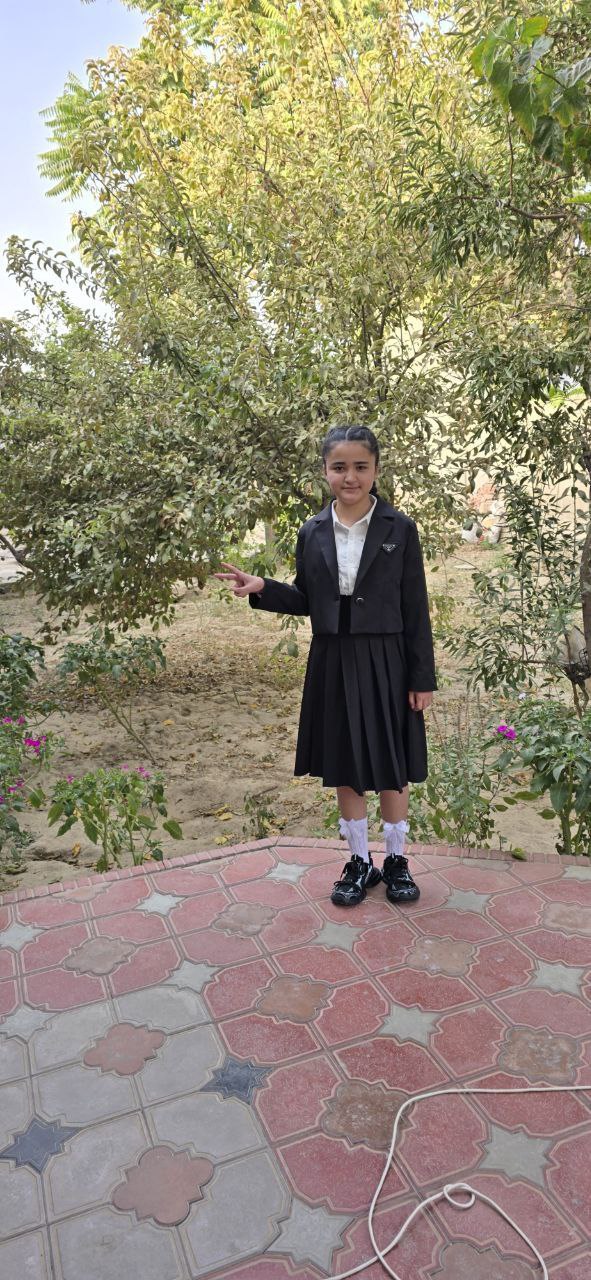
My name is Ro‘ziboyeva Asilakhon. I was born on September 17, 2013, in Nishon District of Qashqadaryo Region. One of my main hobbies is reading books; I also enjoy writing articles and poetry. My dream is to become a cardiologist.
U🇸 Article Package: Supply and Demand: The Core Mechanism of the Market Economy
Abstract
This article is devoted to a comprehensive analysis of the laws of supply and demand, which are the main driving force of a market economy. It examines in detail the theoretical foundations of both categories, the curves that reflect them, as well as the price and non-price factors that influence them. The central part of the study is devoted to market equilibrium, analyzing the formation of this equilibrium, the changes in equilibrium price and quantity (curve shifts), and the impact of government intervention (such as price controls) on the equilibrium from a scientific and practical perspective. The article aims to reveal the crucial role of the supply and demand mechanism in ensuring modern economic stability.
Relevance (Dolzarblik): The supply and demand mechanisms as the fundamental idea of the market economy.
Objective (Maqsad): To analyze the laws of supply and demand, and to determine their role in price formation and ensuring economic efficiency.
Tasks (Vazifalar): 1) To justify the laws of supply and demand; 2) To illustrate market equilibrium graphically and functionally; 3) To study the practical consequences of the theory.
Theoretical Foundations of Supply and Demand
1. The Law of Demand and Factors Affecting It
The Law of Demand: The inverse relationship between price and quantity demanded (under the Ceteris Paribus condition).
The Demand Curve (D): Reasons for the downward slope of the curve.
Non-Price Factors: Consumer income (normal and inferior goods), tastes/preferences, prices of substitute and complementary goods, expectations.
2. The Law of Supply and Factors Affecting It
The Law of Supply: The direct relationship between price and quantity supplied.
The Supply Curve (S): Reasons for the upward slope of the curve.
Non-Price Factors: Production costs, technology, taxes and subsidies, prices of other goods.
Market Equilibrium and the Price Formation Mechanism (1.5 Pages)
1. Determining the Equilibrium Point
The intersection point of the Demand (D) and Supply (S) curves (The Equilibrium Point).
The Equilibrium Condition: $Q_D = Q_S$.
Graphical Analysis: Equilibrium Price ($P^*$) and Equilibrium Quantity ($Q^*$).
2. States of Market Disequilibrium
Excess Supply (Surplus): When the price is above $P^*$ ($P > P^*$). The market automatically returns to $P^*$.
Excess Demand (Shortage/Deficit): When the price is below $P^*$ ($P < P^*$). Price increases due to competitive pressure.
3. Shifts in Equilibrium (Comparative Statics)
New values of $P^*$ and $Q^*$ resulting from shifts in the Demand (e.g., change in income) or Supply (e.g., change in cost) curves.
Simultaneous shifts of both curves (ambiguity of the outcome).
Practical Significance of the Supply and Demand Theory
1. The Concept of Elasticity
Price Elasticity: The responsiveness of quantity demanded and supplied to changes in price.
Practical Application: The role of elasticity in firms maximizing their total revenue.
2. Consequences of Government Intervention in the Market
Price Ceiling (Maximum Price): For example, rent control. Consequence: Artificial Shortage (Deficit).
Price Floor (Minimum Price): For example, minimum wage or minimum prices for agricultural products. Consequence: Artificial Surplus (Profitsit).
Conclusion
Brief summary of the main results studied.
Supply and demand as the most efficient mechanism for resource allocation in a market economy.
Suggestions regarding the importance of government intervention in cases of market failure (externalities, monopoly).
List of References (Foydalanilgan Adabiyotlar Roʻyxati)
Mankiw, N. G. (2021). Principles of Economics. Cengage Learning.
Samuelson, P. A., & Nordhaus, W. D. (2010). Economics. McGraw-Hill Education.
Oʻlmasov, A. (2009). Iqtisodiyot nazariyasi (Theory of Economics). “Mehnat” publishing.
Karimov, I. A. (2000). Oʻzbekiston XXI asr boʻsagʻasida: xavfsizlikka tahdid, barqarorlik shartlari va taraqqiyot kafolatlari (Uzbekistan on the Threshold of the 21st Century: Threats to Security, Conditions of Stability and Guarantees of Progress). “Oʻzbekiston” publishing. (As a source on the state’s economic policy).
Fisher, S., Dornbush, R., & Schmalensee, R. (2011). Economics. McGraw-Hill.
Smith, A. (1776). The Wealth of Nations. (As a source providing the classical economic foundation.)
Journal Article (Example): Stiglitz, J. E. (2017). Rethinking the Role of Government in the Market. Journal of Economic Literature, 55(3), 112-130.
At twilight, someone wipes the sweat from my forehead,
Someone sings the Song of Freedom in Saat Square,
Someone, in intensive care, is still breathing,
There is silence at the front…
Silence…
*
Per quale guerra i miei capelli indossano il sudario bianco?
Vivono ancora i soldati che gridano l’amore?!
C’è silenzio al fronte.
Mi dolgono i denti che innalzano la bandiera bianca,
Dà dolore la Patria,
Piange l’Uomo.
Le linee che solcano la mia fronte
sono i fili spinati di quale paese?
Separano l’amore dalla separazione,
Separano la speranza dalla morte,
Separano i giorni,
Separano le notti…
Nel crepuscolo qualcuno asciuga il sudore dalla mia fronte,
Qualcuno canta il Canto della Libertà in Piazza Saat,
Qualcuno, in rianimazione, respira ancora,
C’è silenzio al fronte…
Silenzio…
*
Voor welke oorlog dragen mijn haren een wit lijkkleed? Leven de soldaten die de liefde uitschreeuwen nog?! Er heerst stilte aan het front. Mijn tanden doen pijn terwijl zij de witte vlag hijsen, Het vaderland lijdt, De mens huilt. De lijnen die over mijn voorhoofd vallen — van welk land zijn dit de prikkeldraden? Zij scheiden liefde van afscheid, Zij scheiden hoop van de dood, Zij scheiden de dagen, Zij scheiden de nachten… In de schemering wist iemand het zweet van mijn voorhoofd, Iemand zingt het Lied van de Vrijheid op het Saat-plein, Iemand ademt nog steeds op de intensive care, Er heerst stilte aan het front… Stilte…
*
Pour quelle guerre mes cheveux revêtent-ils un linceul blanc ?
Les soldats qui crient l’amour vivent-ils encore ?!
Le silence règne au front.
Mes dents me font mal en levant le drapeau blanc,
La Patrie souffre,
L’Homme pleure.
Les lignes qui tombent sur mon front —
les fils barbelés de quel pays sont-elles ?
Elles séparent l’amour de la séparation,
Elles séparent l’espoir de la mort,
Elles séparent les jours,
Elles séparent les nuits…
Au crépuscule, quelqu’un essuie la sueur de mon front,
Quelqu’un chante le Chant de la Liberté sur la Place Saat,
Quelqu’un, en réanimation, respire encore,
Le silence règne au front…
Le silence…
Umid Najjari was born on 15th of April 1989 in Tabriz (Iran). After graduating from Islamic Azad University of Tabriz in 2016, he entered Baku Aurasia University to continue his studies in Philology in Republic of Azerbaijan. “The land of the birds” and “Beyond the walls” are among his published works in addition to some translations. His poems have been published in USA, Canada, Spain, Italy, India, Turkey, Uzbekistan, Iraq, Kazakhstan, Georgia, Chile and Iranian media. He was awarded the International LIFFT festival diploma in 2019. He achieved “IWA Bogdani” Award in 2021. He was awarded the “Mihai Eminescu” Award in 2022. He was awarded the International Prize “Medal Alexandre The Great” in 2022. He is Vice-President of the BOGDANI international writers’ association, with headquarters in Brussels and Pristina. and Turkic World Young Authors Association.