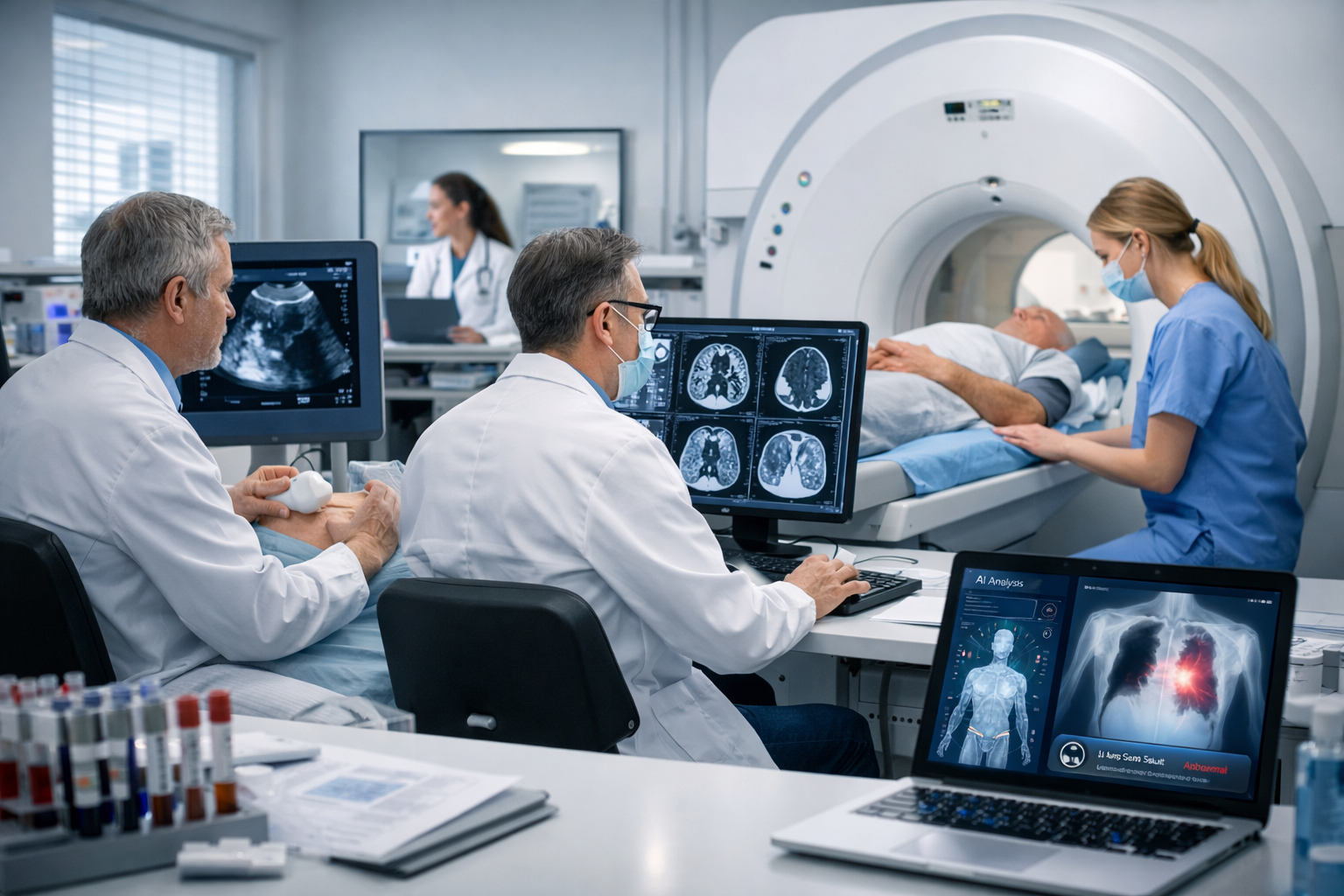
MODERN MEDICAL EXAMINATIONS: FROM TRADITIONAL METHODS TO DIGITAL DIAGNOSTICS
Bafoyev Mirzabek Mirvohidovich
2nd year student of the Fundamental Medicine Department of the Abu Ali ibn Sino Bukhara State Medical Institute.
Abstract: This article extensively covers the stages of development of modern medical examinations, processes from traditional diagnostic methods to digital and high-tech diagnostic systems. The study analyzes the historical and practical significance of clinical examination, laboratory tests and instrumental examinations, and discusses their integration with today’s digital medicine.
The article also emphasizes the role of ultrasound, computed tomography, magnetic resonance imaging, artificial intelligence-based diagnostic platforms and telemedicine technologies in improving the quality of medical examinations. Along with the advantages of digital diagnostics – increased diagnostic accuracy, saving time and resources, and the possibility of providing remote medical services – problematic aspects such as data security, technical infrastructure, and specialist training are also analyzed.
The article aims to reveal the strategic importance of modern medical examinations in the healthcare system and to scientifically highlight their contribution to the early detection of diseases, increasing the effectiveness of treatment, and the development of preventive medicine.
Keywords: modern medical examinations, traditional diagnostic methods, clinical examination, laboratory diagnostics, computed tomography, magnetic resonance imaging (MRI), X-ray examinations, functional diagnostics, biochemical analyses, hematological analyses, screening examinations, preventive medicine, early detection of diseases, digital diagnostics, digital medicine, artificial intelligence-based diagnostics, medical image analysis, telemedicine, remote medical examinations, medical database, health information systems, clinical decision support systems, diagnostic accuracy, integration of medical technologies, digitalization of healthcare, efficiency of medical examinations, medical information security, personal data protection, modern healthcare system.
Introduction
Today, the healthcare system is undergoing fundamental changes in the context of rapidly developing scientific and technological progress. The increase in the population, the increase in the share of chronic and non-communicable diseases, the widespread spread of diseases among young people, and the intensification of global epidemiological threats are further increasing the demand for the quality of medical examinations. In this regard, the role of modern medical examinations in ensuring early detection of diseases, accurate diagnosis, and effective treatment is of paramount importance.
Traditional medical examination methods – clinical examination, laboratory tests, and basic instrumental examinations – have been the basis of medical practice for many years. However, the complex tasks facing modern medicine, in particular, the detection of diseases at the early stages, the identification of latent pathological processes, and the provision of an individual approach, require expanding the capabilities of traditional methods. As a result, the medical examination system is moving to a new level, combined with digital technologies.
In recent years, the introduction of digital diagnostics, high-precision instrumental examinations (ultrasound, computed tomography, magnetic resonance imaging), artificial intelligence and machine learning technologies into medicine has significantly increased the accuracy and speed of the diagnostic process. These technologies allow doctors to analyze large volumes of medical data in a short time, reduce errors and help in clinical decision-making. At the same time, the development of telemedicine and remote medical examinations is becoming an important factor in ensuring territorial equality of healthcare services. However, along with the widespread introduction of digital diagnostics, urgent problems such as information security, protection of personal medical data, lack of technical infrastructure and training of qualified personnel are also emerging. Therefore, a scientific analysis of the capabilities and limitations of modern medical examinations, and an assessment of the compatibility of traditional and digital diagnostic methods are among the important tasks of today’s medicine. This topic is of particular relevance due to its scientific and practical importance in modernizing the healthcare system, improving the quality of diagnostics, and strengthening the health of the population.
Main part
Advantages
1. Practical significance and limitations of traditional medical examinations:
Traditional medical examinations – clinical examination, analysis of patient complaints and standard laboratory tests – form the basis of medical practice. These methods are characterized by their low cost, convenience and speed and are important in the initial assessment of diseases at the primary level. For example, simple clinical and laboratory examinations may be sufficient to detect common diseases such as arterial hypertension, diabetes mellitus or anemia.
However, the sensitivity and accuracy of traditional methods are limited in some cases, making it difficult to detect latent or early stages of the disease. For example, in the early stages of oncological diseases, due to insufficient clinical symptoms, diagnosis based only on traditional examinations may be delayed. This leads to a decrease in the effectiveness of treatment.
2. Modern instrumental examinations and diagnostic accuracy:
Instrumental diagnostic methods – ultrasound examination (UTT), computed tomography (CT), magnetic resonance imaging (MRI) and endoscopic examinations – play an important role in modern medical examinations. These methods allow for high-resolution imaging of the structure of internal organs and tissues, helping to identify pathological changes at an early stage.
For example, with the help of CT and MRI, cerebral circulatory disorders, tumors and traumatic injuries are detected in a short time. However, in practice, the possibilities of using these technologies are not the same in all medical institutions. Due to the lack of modern equipment in rural areas or the lack of qualified specialists, patients are forced to contact large medical centers. This leads to a loss of time and financial resources.
3. Digital diagnostics and artificial intelligence capabilities:
In recent years, the introduction of artificial intelligence (AI) and machine learning technologies has brought the quality of medical examinations to a new level. AI-based programs allow for the analysis of radiological images, automatic evaluation of laboratory results, and clinical risk analysis. For example, artificial intelligence has been proven to significantly increase the accuracy of diagnosis when detecting breast cancer or lung diseases using X-ray and CT images.
4. Telemedicine and remote medical examinations:
Telemedicine technologies have clearly demonstrated their practical importance, especially during the pandemic. The ability to provide remote consultations, analyze medical examination results, and monitor the patient’s condition has created convenience for many patients. For example, remote monitoring of patients with chronic cardiovascular or endocrine diseases helps prevent the development of complications.
Information security and personnel issues:
With the widespread introduction of digital medical examinations, the issue of protecting personal medical data has become an urgent issue. If the confidentiality of information stored in electronic medical records, online platforms, and databases is not ensured, there is a risk of violation of patient rights. At the same time, there are also problems associated with digital diagnostics. Incorrectly configured algorithms or insufficient clinical data can lead to errors in diagnosis. In addition, practice has proven that the clinical experience and individual assessment of a doctor cannot be fully replaced by artificial intelligence.
Telemedicine cannot be effective in all cases. Remote examinations are not enough in situations where a physical examination is required or in urgent cases. In addition, the quality of the Internet network and the availability of technical means are also important limiting factors.
Training qualified specialists for the effective implementation of modern medical examinations is one of the important tasks. Although modern equipment is available in some cases in practice, the lack of personnel who can fully and correctly use it reduces the effectiveness of diagnostics.
Conclusion
Modern medical examinations are an important component of the healthcare system, embodying a continuous development process from traditional diagnostic methods to digital and high-tech systems. The study revealed that traditional clinical and laboratory examinations are important in primary diagnosis, but their capabilities are limited in identifying complex and latent diseases. Therefore, the introduction of modern instrumental and digital diagnostic methods significantly increases the quality of medical examinations.
The analysis shows that ultrasound, computed tomography, magnetic resonance imaging, and artificial intelligence-based diagnostic systems are important tools for early detection of diseases, increasing diagnostic accuracy, and choosing the right treatment tactics. In particular, digital technologies support the doctor’s clinical decision-making process and increase the efficiency of medical services. Telemedicine, on the other hand, creates significant opportunities for reducing regional inequalities and developing remote medical services.
However, there are also a number of problems in the process of introducing modern medical examinations. Ensuring information security, protecting personal medical data, developing technical infrastructure, and training qualified personnel are the main problems of this area. It is also an important conclusion that digital diagnostic tools cannot be given priority over clinical experience, but should be considered as a means of complementing and supporting the work of a doctor.
In conclusion, modern medical examinations provide effective results based on the combination of traditional and digital diagnostic methods. This approach is of great importance in early detection of diseases, increasing the effectiveness of treatment, and modernizing the healthcare system. In the future, the scientific development and widespread implementation of modern medical examinations will serve to strengthen the health of the population.
References:
1.Abdullayev A.A. Fundamentals of modern medical diagnostics (Tashkent Uzbekistan Medical Publishing House 2019)
2.Karimov I.R., Ismoilova N.S. Clinical and laboratory diagnostics. (Tashkent: Ilm Ziyo 2020)
3.Khudoyberganov B.T. Instrumental examination methods (Tashkent: Yangi asr avlody 2018)
4.Rakhimov Sh.K. Preventive medicine and screening system (Tashkent: Science and technology 2021)
5.Ministry of Health of the Republic of Uzbekistan. Digital healthcare concept (Tashkent 2023)
6.Harrison T.R. Harrison’s Principles of Internal Medicine. (New York McGraw-Hill Education 2022)
7.Topol E.J. Deep Medicine: How Artificial Intelligence Can Make Healthcare Human Again. (New York Basic Books 2019)
8.World Health Organization (WHO). Digital Health Guidelines. (Geneva: WHO Press 2021)
9. McRobbie D.W. MRI from Picture to Proton. (Cambridge Cambridge University Press 2018)
10. Kahn C.E. Digital Radiology and PACS. (New York: Springer, 2017)
11. Dunn W.B. Laboratory Medicine: The Diagnosis of Disease in the Clinical Laboratory. (Oxford Oxford University Press, 2021)
European Society of Radiology (ESR). AI in Medical Imaging. (Vienna ESR Publications, 2022)