Can you speak or write in the absolute now, or is the now gone in the time it takes for the now to hit your senses and wind its way up our nerves into our brains and then for us to speak or write it on a page?
Can we overlook the micro-moments between perception and recording on the brain or on paper?
In this near to now my dog licks his black paw stretched out on the bed. The light streams in a side window into this darkened room onto this notebook page and a dove outside calls. Those nearly nows are receding as my pen moves on the page trying to pin them down.
The dove still calls. The air filter hums almost silently in this allergy season.
Now there’s the sound of a page turning as I write more in the nearly now. It is close to quiet in this nearly now. A top drawer in this old brown wooden desk is half open. There is a humming in my ears. I have a taste of tinnitus.
Here the nearly now is mostly still. Some might call it boring. So busy am I in recording that my thoughts are rare. My body feels a little tired. My sad bad knees are both aching. Should I be sorry this nearly now is not more dramatic?
Put down your cell phones, kids, and enjoy the silence. Learn to muse and think on your own. No bombs are falling outside but I know they are falling elsewhere. I hear the quite whir of a plane overheard. Rain is falling, a slow rain outside that my dog and I don’t hear, or maybe Coco dog hears.
It’s been peaceful to settle into this nearly now. I am content, and now I am thinking in this nearly now, of a thought I had yesterday.
Is that cheating?
Is that thought as much of the now as the tinnitus in my ears? You may disagree if you are here with me in the nearly now at a later date.
Yesterday’s thought is about the story of life’s beginning. I learned in school that life began with the mixing of chemicals in a warm body of water. The constant stirring in currents of the chemicals finally led to life. Perhaps it was a virus kind of life since a virus sits on the edge of life and nonlife.
But what if life bloomed in more than one place, here on this planet or elsewhere? What if life had multiple origins? Maybe there are aliens out there and distant planets we cannot travel to in multiple lifetimes. I am thinking of this in the nearly now. Any memory pulled from the past as thought is now in the nearly now.
And when I am thinking in the nearly now, am I not also thinking a bit in the future in a yearning for the future?
I’m thinking I may publish this rambling on the nearly now in the future. It is the possibility of sharing my thoughts with others that leads me to write them down. Nearly now thoughts of the future are pulling me forward.
So perhaps no divides exist between the past, the nearly now, and the future. Time, as the old metaphor said, is a flowing river and cannot be divided.
My hope is that some souls in the future will read this and the ideas will live again rolling through their nearly nows, and I will kind of live again.
It has stopped raining. My spouse is starting to move about, getting ready to check on the backyard garden. I give my love a quick kiss as she heads out the back door. I may feel differently tomorrow—what with the terrible calls coming out of the wider world—but how wonderful the gift of life seems in this nearly now.
Identifying Restricted Vocabulary in Literary Works
Author: Usmonaliyeva Bahora Abduvali qizi
Affiliation: Uzbekistan State World Languages University
Email: usmonaliyevabahora@gmail.com
Abstract
This article analyzes restricted lexical units utilized in literary texts, specifically focusing on the linguistic and stylistic properties of dialectisms, phraseological units, and idiosyncratic authorial expressions. The research explores the formation of phraseological units, their variation processes, and their functional roles within artistic discourse. Furthermore, through the analysis of works by Abdulla Qahhor and Tog‘ay Murod, the study demonstrates the significance of idioms in character development, psychological portrayal, and the enhancement of aesthetic impact. The findings provide valuable theoretical and practical insights into the study of literary linguistics.
Keywords: literary work, restricted vocabulary, phraseological unit, dialectism, literary text, stylistic features, lexical layer, imagery, individual style, language and society.
INTRODUCTION
Literature serves as a complex system reflecting human psychology, societal life, and an author’s aesthetic vision through linguistic means. Within this system, the lexical layer holds a distinct position, serving as a vital tool for unfolding content, animating characters, and intensifying artistic resonance. In particular, restricted vocabulary—comprising dialectisms, professionalisms, phraseological units, and socio-lectal markers—plays a crucial role in shaping an author’s individual style and realistically depicting the portrayed environment.
The study of the functional characteristics of lexical units in literary texts remains a prominent issue in modern linguistics. The purposeful use of diverse linguistic layers not only elevates aesthetic value but also provides a clearer illumination of a character’s social background, worldview, and emotional state. Consequently, analyzing restricted vocabulary in literary contexts is of significant scientific importance in revealing the profound link between language and society. This article examines the application, types, and artistic functions of lexical layers, specifically restricted vocabulary, supported by evidence from selected literary works.
Historical Context and Terminological Foundations of Turkic Phraseology
While phraseology as an independent branch of Turkic linguistics emerged relatively late, its scholarly roots trace back to the early 20th century. Initially, various terms were employed in place of “phraseology,” a process influenced by the linguistic traditions of that era. In early 20th-century grammatical works, the term “phrase” was often used to denote a sentence or clause, differing from its modern sense—a phenomenon attributed to the influence of Russian grammar.
Azerbaijani linguists B. Cho‘ponzoda and F. Og‘azoda, in their work Grammar of the Turkic Language, introduced significant terminological innovations. Alongside “Semasiology” and “Stylistics,” they utilized the term “Idiomatism,” citing Turkic expressions such as boshga solmoq (to explain/instill) and ko‘z ko‘rmoq (to witness) as primary examples. Systematic research into Turkic phraseology gained momentum in the 1940s and 50s. Prominent scholars S.K. Kenesboyev and Sh.U. Rahmatullayev are recognized as the founders of this field, having classified Turkic idioms and established the discipline’s theoretical framework.
Methodology
To determine the linguistic and stylistic features of phraseological units, the following scientific methods were employed:
Descriptive Method: Used to characterize the relationship between form and meaning, structural composition, and the position of idioms within literary norms. This method was particularly instrumental in detailing the variation processes of numerical components in idioms.
Comparative-Typological Analysis: Applied to identify commonalities and differences in phraseology between the Uzbek and Karakalpak languages. For instance, the equivalent forms of the idiom ko‘zi ilindi (to doze off) were examined through this lens.
Contextual Analysis: This served as the primary method for identifying the function of idioms within the works of Abdulla Qahhor and Tog‘ay Murod. Beyond literal meanings, the analysis focused on the specific emotional-expressive nuances (e.g., irony, sarcasm, or affection) these units acquired within the text.
Linguostatistical Method: Employed to validate the artistic impact of repetitions in Tog‘ay Murod’s style. For example, the repetition of the phrase mo‘min-mazlum (pious-oppressed) six times within a 33-word segment was analyzed statistically.
Literary Analysis I: Abdulla Qahhor’s Phraseological InnovationThe artistic mastery of Abdulla Qahhor is evident in his ability to create new, individualized idioms based on general phraseology. Qahhor crafts expressions so profound and ironically sharp that they often attain the status of folk aphorisms, making it difficult to distinguish his original creations from traditional idioms.
Every phraseological unit is rooted in a specific image or action. Qahhor leverages these foundational images to develop phraseological neologisms. For example, in the idiom og‘zi qulog‘iga yetdi (his mouth reached his ears), the physical imagery of a wide smile is used to convey intense joy.
Furthermore, he adapts metaphorical proverbs, reinterpreting existing imagery to instill them with unique semantic and stylistic functions.
Literary Analysis II: Variation and Structural RelationsAlthough phraseological units are stable, they undergo transformations in speech, leading to new variants. Substituting numerical components often intensifies the descriptive coloring without altering the core meaning. For instance, the common idiom biri ikki bo‘ldi (doubling one’s wealth) appears as biri besh bo‘ldi (increasing fivefold) in Cho‘lpon’s novel Kecha va kunduz to exaggerate the accumulation of wealth. Similarly, numerical variations in expressions like obro‘yi bir pul bo‘ldi (his reputation became worth one cent) versus uch pul (three cents) remain semantically equivalent, both denoting a total loss of dignity.
Literary Analysis III: Tog‘ay Murod’s Folk Mastery
Tog‘ay Murod’s novel Otamdan qolgan dalalar (Fields Left by My Father) is distinguished by its natural, folk-oriented language. The author skillfully employs idioms to reveal character traits and thematic depth, stating that he intended the work to be a linguistic monument to the spiritual identity of the Uzbek people. Murod utilizes the Surkhandarya dialect and colloquialisms to maintain authenticity. This is seen in the character Dehqonqul, whose simple nature is mirrored in the language used by his mother; instead of harsh rebukes, she uses affectionate scolding like “Oshingni yeyin sen tentakni”.
Repetition is another hallmark of Murod’s style, used to heighten emotional resonance. Statistical analysis shows that in one 33-word passage, the descriptor mo‘min-mazlum is repeated six times to emphasize the character’s plight.
Conclusion
Phraseological units manifest both as common linguistic units and as restricted vocabulary bound by dialect or individual authorial style. In the works of Qahhor and Murod, these units serve as essential tools for psychological depth and vivid imagery. Ultimately, the strategic use of restricted lexis enriches the linguistic map of literature.
References
1.Rahmatullayev, Sh. (1992). Phraseological Dictionary of the Uzbek Language. Tashkent: Qomuslar. 2.Kenesbayev, S.K. (1977). Phraseological Dictionary of the Kazakh Language. Almaty: Gilim. 3.Cho‘ponzoda, B., & Og‘azoda, F. (1924). Grammar of the Turkic Language. Baku. 4.O‘rozov, A.T. (2009). On the linguistic features of Tog‘ay Murod’s “Fields Left by My Father.” Language and Literature Education Journal, (5), 45-47. 5.Sadullayeva, D. Phraseological neologisms in A. Qahhor’s works and their semantic-stylistic functions. 6.Qahhor, A. (1987-1989). Selected Works. Tashkent: G‘afur G‘ulom. 7.Murod, T. (1994). Fields Left by My Father (Novel). Tashkent: Sharq. 8.Cho‘lpon. (2014). Night and Day (Novel). Tashkent: Yangi asr avlodi. 9.Ziyonet Educational Portal: https://api.ziyonet.uz/uploads/books/47828
INNOVATIVE METHODS OF WORKING WITH VOCABULARY IN MOTHER TONGUE LESSONS
Ahadova Feruzakhon
Kokand State University, Faculty of Primary and Technological Education, 1st year student of Primary Education
Annotation. This article scientifically analyzes modern and innovative methods of working with vocabulary in mother tongue lessons and their role in developing students’ communicative competence. It also highlights the effectiveness of increasing vocabulary based on interactive methods, digital technologies and creative approaches.
Annotation. This article analyzes innovative methods of working with vocabulary in mother tongue lessons and their role in developing students’ communicative competence. It also highlights the effectiveness of interactive methods, digital technologies, and creative approaches in enriching vocabulary.
Abstract. V state rassmatrivayutsya innovatsionnye metody raboty so slovarem na urokax native language and ix role v razvitii rechevoy kompetentsii uchashchihsya. The effectiveness of interactive methods, digital technology and creative approaches is clarified.
Today, at a time when fundamental reforms are being implemented in the education system, the use of modern approaches in teaching the mother tongue is of great importance. In particular, increasing students’ vocabulary, developing their speech activity, and forming independent thinking skills is one of the urgent pedagogical problems. Working with a dictionary is a key component of native language lessons, allowing not only to learn new words, but also to use them correctly, understand them semantically, and actively use them in speech.
According to modern pedagogical theory, it is necessary to use innovative methods in addition to traditional methods in developing students’ language skills. Because today’s student is being formed in an information technology environment, and his educational needs are also changing. Therefore, the introduction of interactive methods, multimedia tools, and creative tasks in the process of working with a dictionary increases efficiency.
Also, working with a dictionary serves as an important tool in developing not only students’ language skills, but also their thinking, logical thinking, and communicative competence. In this regard, this article studies innovative methods of working with a dictionary on a scientific basis and analyzes their practical effectiveness.
LITERATURE ANALYSIS
The issue of working on vocabulary in native language lessons has been studied by many scholars. In particular, A. Gulyamov, in his work “Methodology of Teaching the Native Language”, emphasizes that increasing vocabulary is the main factor in the speech development of students. According to him, through a deep understanding of the meaning of words and their use in speech, students learn to think independently [1].
Also, N. Mahmudov, in his work “Language and Speech Culture”, notes the need for a systematic organization of the process of working with vocabulary. In his opinion, each new word must be mastered by the student based on the context, otherwise it will not become an active vocabulary [2].
S. Matchonov, in his scientific works, specifically focuses on the importance of interactive methods in mastering vocabulary. According to him, methods such as role-playing games, clustering, and brainstorming naturally increase students’ vocabulary [3].In general, the results obtained scientifically confirm that innovative approaches in native language lessons significantly increase the effectiveness of working with a dictionary. This indicates the need to combine traditional methods with innovative approaches in the modern educational process, without completely rejecting them.
CONCLUSION
In conclusion, the process of working with a dictionary in native language lessons is one of the pedagogical areas that is of decisive importance in the formation of students’ speech development, level of thinking and communicative competence. The analysis conducted during the study showed that working with a dictionary is not just a process of teaching new words, but a complex methodological system that shapes students’ attitude to the language, develops their creative and independent thinking.
Traditional approaches – that is, methods of explaining, memorizing and translating words – although useful to a certain extent, cannot fully meet the requirements of today’s education. In a modern educational environment, it is necessary to involve students as active participants, increase their interest and direct them to independent research. In this regard, innovative methods significantly increase the effectiveness of working with a dictionary.
According to the results of the study, interactive methods (cluster, brainstorming, group work), digital technologies (electronic dictionaries, multimedia tools, mobile applications) and gamification elements contribute to the rapid and stable acquisition of vocabulary by students. In particular, these approaches increase students’ interest in the lesson, forming them as active participants and independent thinkers.
Also, the research revealed that when innovative methods are used, students develop not only their vocabulary, but also their speech literacy, level of logical thinking and creative approach. This directly affects the quality of education and the effective organization of the educational process.
In general, organizing work with vocabulary in native language lessons based on modern innovative approaches is one of the important factors in increasing educational efficiency. In the future, teachers should further improve these methods and widely apply them in the educational process. This will serve to form a high level of speech culture, independent thinking and creative approach in students.
REFERENCES
Gulamov A. Methodology of teaching the native language. – Tashkent: Teacher, 2010. – pp. 145–150.
Mahmudov N. Language and speech culture. – Tashkent: Science, 2018. – pp. 98–105.
Matchonov S. Interactive methods in native language education. – Tashkent: Innovation, 2020. – pp. 67–72.
Harmer J. How to Teach English. – London: Longman, 2007. – pp. 120–130.
In general, the results obtained scientifically confirm that innovative approaches in native language lessons significantly increase the effectiveness of working with a dictionary. This indicates the need to combine traditional methods with innovative approaches in the modern educational process, without completely rejecting them.
CONCLUSION
In conclusion, the process of working with a dictionary in native language lessons is one of the pedagogical areas that is of decisive importance in the formation of students’ speech development, level of thinking and communicative competence. The analysis conducted during the study showed that working with a dictionary is not just a process of teaching new words, but a complex methodological system that shapes students’ attitude to the language, develops their creative and independent thinking.
Traditional approaches – that is, methods of explaining, memorizing and translating words – although useful to a certain extent, cannot fully meet the requirements of today’s education. In a modern educational environment, it is necessary to involve students as active participants, increase their interest and direct them to independent research. In this regard, innovative methods significantly increase the effectiveness of working with a dictionary.
According to the results of the study, interactive methods (cluster, brainstorming, group work), digital technologies (electronic dictionaries, multimedia tools, mobile applications) and gamification elements contribute to the rapid and stable acquisition of vocabulary by students. In particular, these approaches increase students’ interest in the lesson, forming them as active participants and independent thinkers.
Also, the research revealed that when innovative methods are used, students develop not only their vocabulary, but also their speech literacy, level of logical thinking and creative approach. This directly affects the quality of education and the effective organization of the educational process.
In general, organizing work with vocabulary in native language lessons based on modern innovative approaches is one of the important factors in increasing educational efficiency. In the future, teachers should further improve these methods and widely apply them in the educational process. This will serve to form a high level of speech culture, independent thinking and creative approach in students.
REFERENCES
Gulamov A. Methodology of teaching the native language. – Tashkent: Teacher, 2010. – pp. 145–150.
Mahmudov N. Language and speech culture. – Tashkent: Science, 2018. – pp. 98–105.
Matchonov S. Interactive methods in native language education. – Tashkent: Innovation, 2020. – pp. 67–72.
Harmer J. How to Teach English. – London: Longman, 2007. – pp. 120–130.
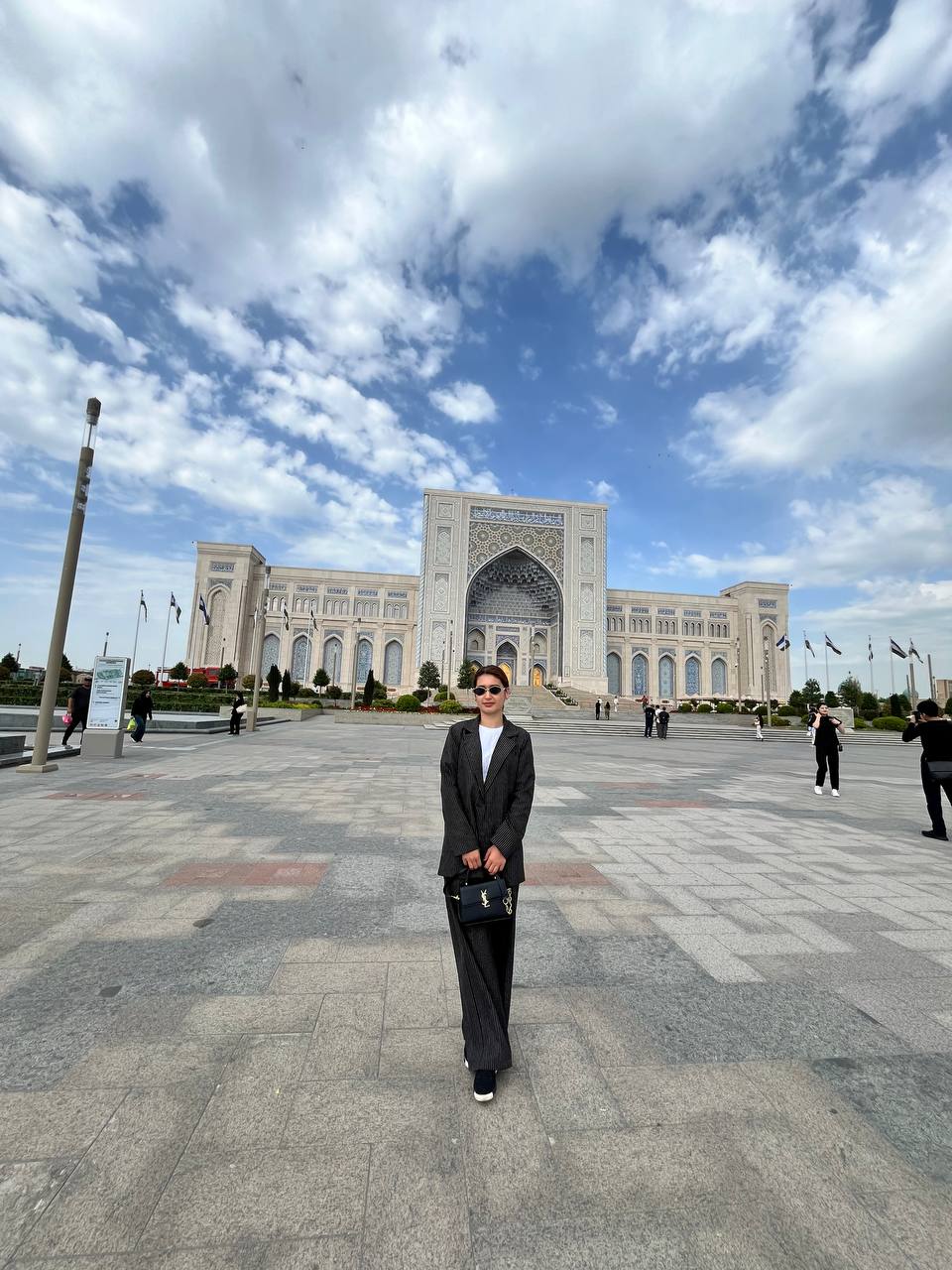
Sometimes, an unexpected “single day” can leave an indelible mark on one’s memory for years to come. For me, one such day began as a routine university lecture but transformed into a face-to-face encounter with history.
Our first class of the day was a lecture on “Historical and Cultural Tourism,” taught by our mentor, Akbar Nurmatov. I walked into the auditorium still a bit drowsy from the morning. However, my professor’s unexpected announcement instantly jolted the entire group awake:
“We haven’t been anywhere together this semester,” he remarked.
Shortly after, another piece of news followed: we would be continuing today’s lesson at the Center of Islamic Civilization. It turned out that special permission had been secured directly from the rectorate for our subsequent classes as well.
To be honest, I had been longing to visit this place for a long time. Hearing the news, my heart swelled with joy. One of the most heartwarming moments was when Professor Nurmatov arranged for us to enter the center free of charge. For us students, this was a wonderful opportunity.
As we reached the entrance, a wave of excitement washed over me. We were welcomed by Oktam Usmonov, the head of the center’s press service. Interestingly, he was also one of our professor’s former students. Truly, the saying “it’s a small world” felt more relevant than ever.
The moment I stepped inside, I froze in awe. At that point, Oktam Usmonov turned to our professor and asked:
“Teacher, do you have any students who are good writers or proficient in foreign languages?”
With a smile, the professor called me forward and said:
“For now, this girl is the one who truly holds her own.”
In that moment, a profound sense of pride filled my soul. A thought crossed my mind: “I wish my father could hear these words and feel proud of me…”
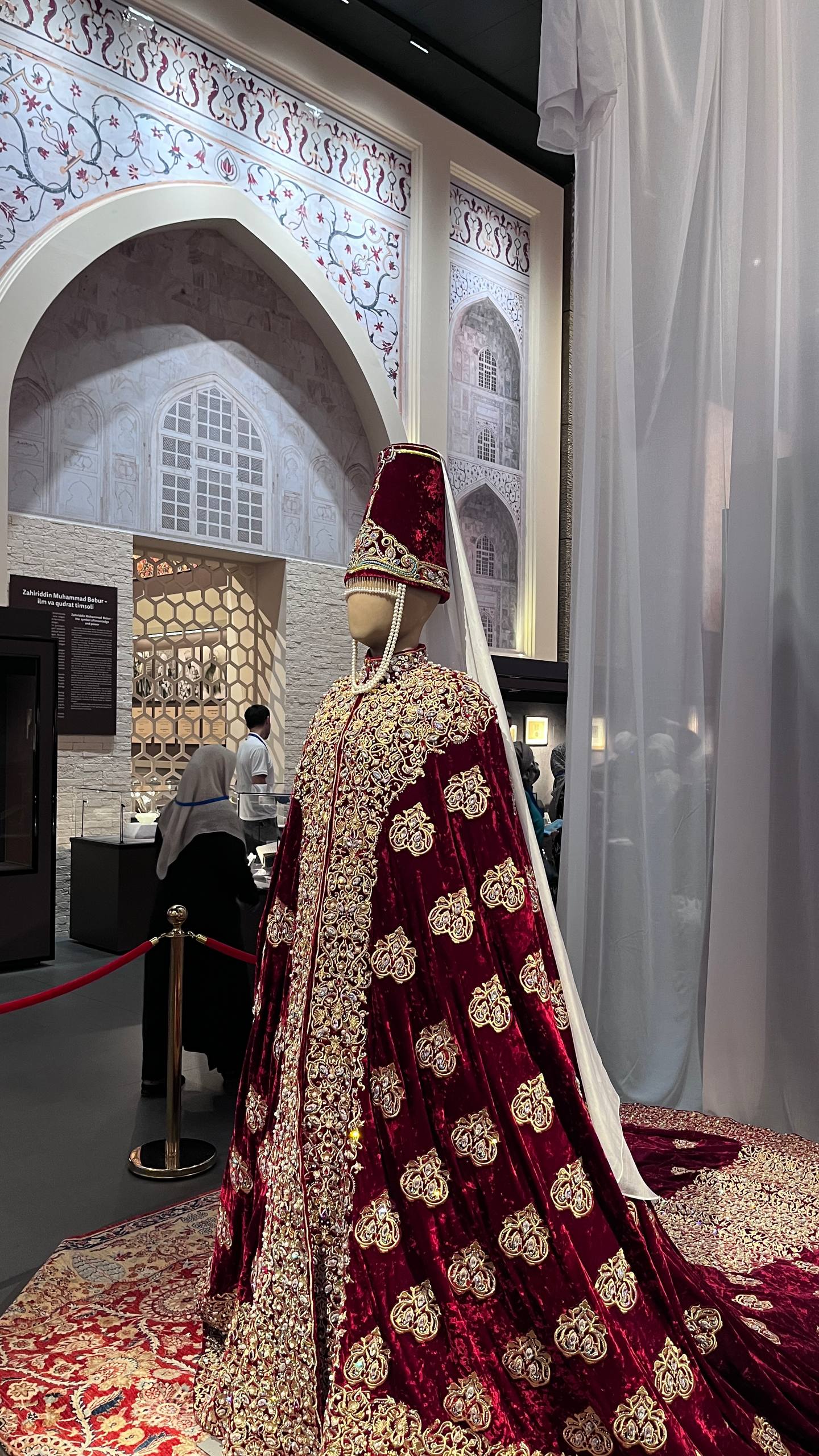
Our journey began in the first hall. Here, artworks crafted from colored stones delighted the eyes, seemingly transporting us into the past. As I climbed the stairs, my eyes fell upon the portraits of the Jadids. A shiver ran through my body not of fear, but of a deep sense of belonging to our national history.
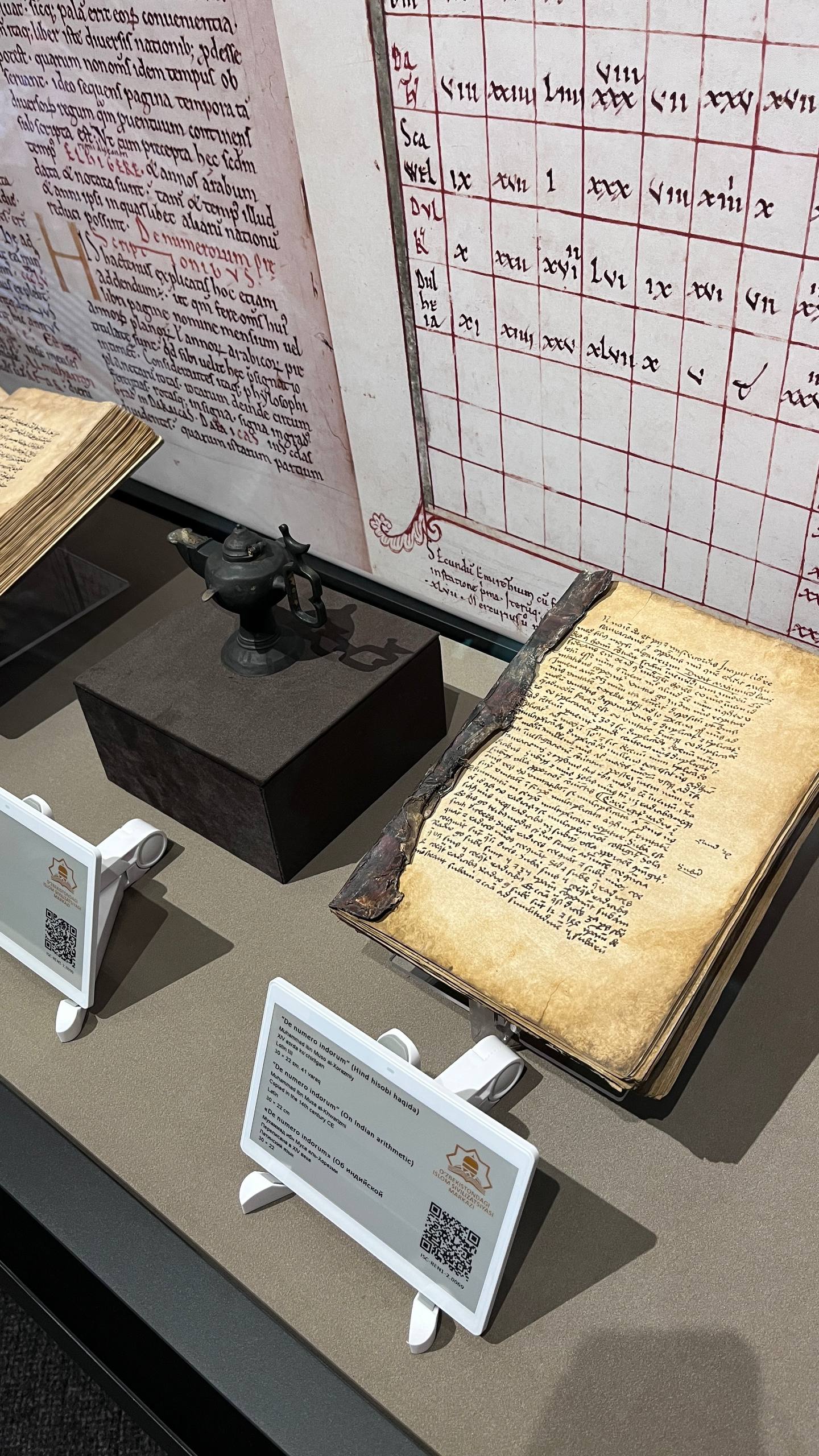
The exhibitions start from the First Renaissance. The history of ancient cities like Dalvarzintepa and Sopollitepa, along with archaeological finds, felt like silent pages of a thousand-year-old history speaking to us. Every exhibit manifested the intellect and spiritual wealth of our ancestors.
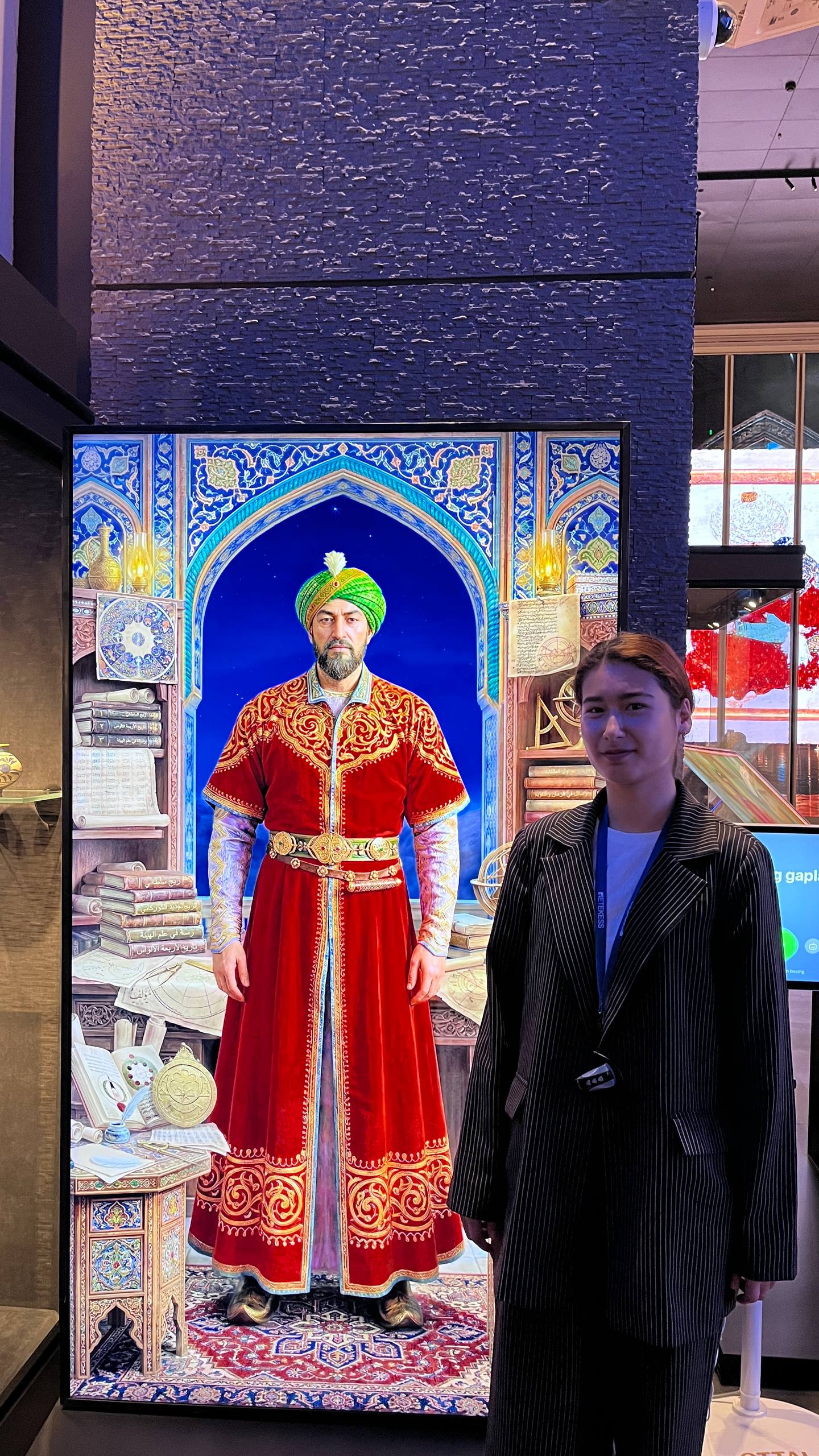
The next section was dedicated to the Second Renaissance an era where science, culture, and thought flourished. Witnessing that atmosphere, the thought “If only I had lived in that time” even crossed my mind.
The section that moved me most was the one dedicated to Imam Bukhari. Tears welled up in my eyes when I saw an ancient manuscript of “Sahih al-Bukhari.” It wasn’t just a book; it is a priceless heritage for the entire Islamic world. We also learned about the manuscripts and lives of great scholars like Ahmad al-Farghani, Hakim Termizi, Ibn Sino, Abu Mansur Maturidi, and Abu Rayhon Beruni. Seeing their legacy, the wisdom “Those who serve the people remain in the hearts of the people” echoed in my mind.
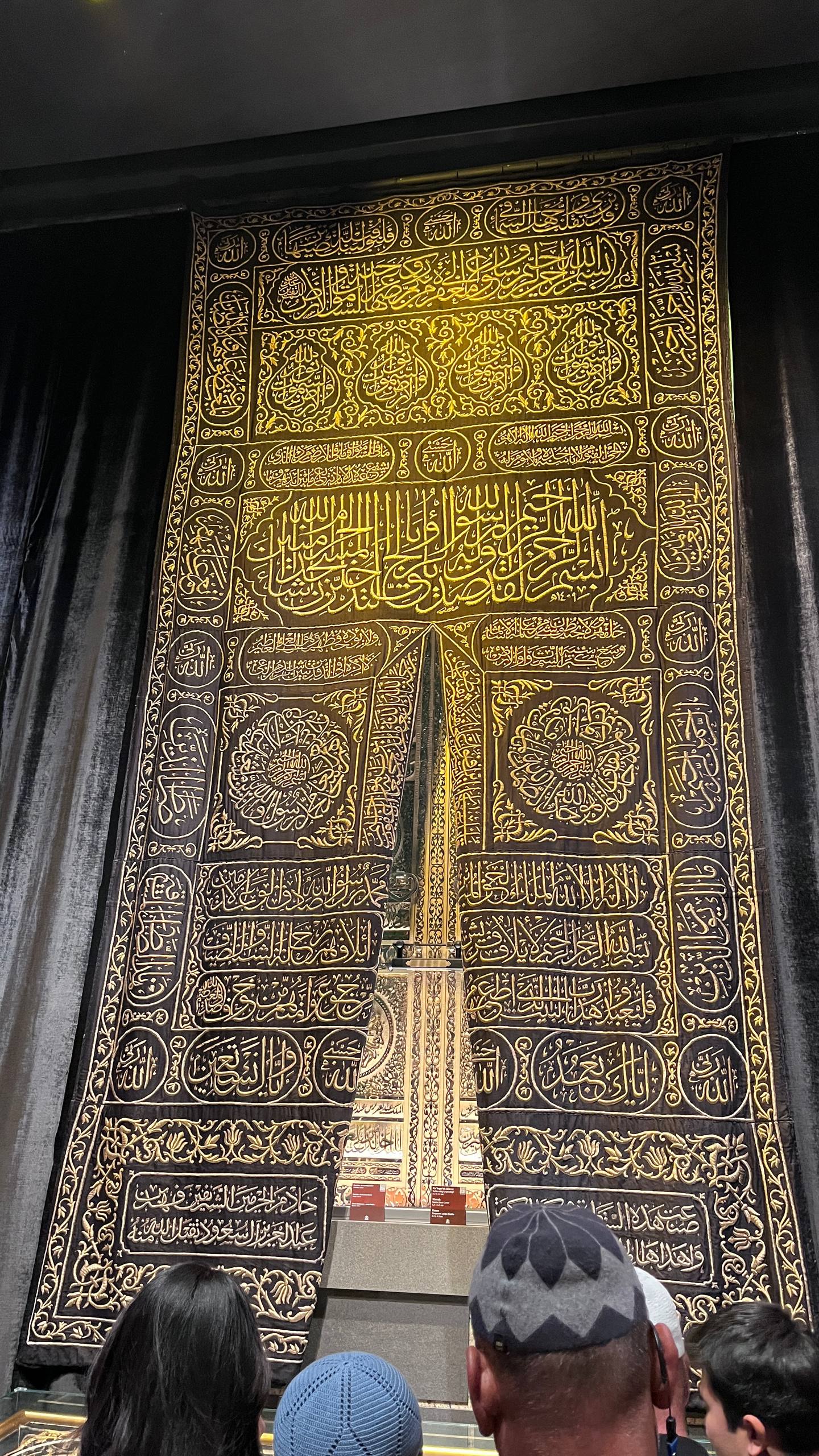
Next, we entered the Holy Qur’an Hall. It is difficult to describe the atmosphere there. It felt as if time had stood still, and my soul had finally found tranquility.
During our tour, we also visited the state-of-the-art library, which is awaiting its official opening. The head of the library served as our guide. Honestly, I had never seen such a sophisticated and perfect library before. It even features a specialized disinfection system for books; once a book is read, it is sanitized to remove viruses and microbes. Seeing such care only increased my respect for this sanctuary of knowledge.
In conclusion, of all the places I have seen in my 21 years, the Center of Islamic Civilization has become one of the closest to my heart. It is more than just a museum; it is a vast temple of learning that carries the scientific and spiritual legacy of our ancestors to future generations.
At this point, it is worth highlighting the creation of such a magnificent center in our country. This sanctuary brings our people’s history to life, reaffirming the truth that “a nation that knows its past shall have a bright future.”
Our profound gratitude goes to our President, Shavkat Mirziyoyev, for reviving our nation’s heritage and for bringing back ancient historical artifacts from foreign museums so that we may truly know our roots.
And finally, a huge thank you to our mentor, Akbar Nurmatov, who, much like parents who wish only the best for their children, provided us with the very best experiences and etched these unforgettable moments into our memories.