A. Iwasa reviews Claire Dederer’s book Monsters: A Fan’s Dilemma

Book cover for Claire Dederer's Monsters: A Fan's Dilemma. Photo of a man on the beach in front of the ocean in shorts with a bull's head.
A Borzoi Book published by Alfred A. Knopf, 273 pages.

Reviewed by A. Iwasa


Dederer starts the book with a prologue about her Roman Polanski fandom; a film maker whose monstrousness she aptly compared to the void-like incomprehensibleness of the Grand Canyon.  But she really gets into the specifics of why she thinks Polanski's genius equals his monstrosity with the same poetic flourish.  It's the passion and horror that puts the fan in fanatic when you get into the personal details of many great artists, which is exactly what this book is an exploration of.

She branches out less specifically into other complicated talents such as John Lennon, Lou Reed and Ezra Pound, while trying to figure out what conclusions other critics have come to about measuring the crimes of an artist against the greatness of their work.  I had a bit of an of course moment here reading, apparently the Germans have a phrase for this:  Liebe zur Kunst.

What follows is sometimes just the name:  Woody Allen, William Burroughs, Sid Vicious.

Sometimes a bit of exploration, like "how can one watch The Cosby Show after the rape allegations against Bill Cosby?

The wider political contexts such as Donald Trump on Access Hollywood are addressed at other points.

Dederer weaves in her personal experiences as well as she articulates her fandom and feelings of horror.

Chapter 1 is titled "Roll Call," and after using Woody Allen as both a subheading and a name on a list, Dederer eventually backtracks to him in depth as the point of reference for being an artist whose behavior was bad enough to possibly not consume his work.

Dederer is asking questions whole heartedly, rather than telling you how to make your decisions on when an artist has gone too far.  I can't overstate how Dederer is writing this as a fan grappling with these questions.

Chapter 2 is a similar treatment of Michael Jackson.  Though it's not just Dederer's thoughts and feelings; it's an ongoing discussion with others such as other critics and her readers.

Some problematic women are mentioned in passing, but Chapter 3 sets its sites on J.K. Rowling.  The chapter's title is "The Fan," and includes one of the best descriptions of fandom I've ever read:  "An audience member is a consumer of a piece of art; the audience member is not defined by that piece of art.  A fan, on the other hand, is a consumer beyond, a consumer who is also being consumed.  She steals part of her identity from the art, even as it steals its importance from her.  She becomes defined by the art." (Italics in the original.)

Dederer delves deeply into the psychology of this sort of fandom, and in turn, parasocial relationships:  "the belief that we have real emotional connections with the artists whose work we love."

Dederer changes gears a bit with Chapter 4, "The Critic."  Rather than having a monstrous artist's name as a subheading, she zooms out and begins to explain how she became a critic, defines her form of criticism, and criticizes other critics.  But this is still all wrapped up in the context of monstrous artists and fandom.

Plus Dederer makes up for skipping a chapter's subheading by using two for Chapter 5, "The Genius," staring Pablo Picasso and Ernest Hemingway.  Hey!  I thought Pablo Picasso was never called an asshole?!

It's an exploration into whether or not someone can be so great at their work that it overshadows what's problematic about them as people, or if even they have to be problematic to create as they have.

Also, I thought I was being pretty sophisticated with my reference to "Pablo Picasso" by the Modern Lovers above, but within 12 pages Dederer is writing about how it's "dependent on the idea that everyone but everyone has" already of Picasso.

But back to the point:  Dederer pushes it to the limit.  "The questions is, I suppose, whether lunacy makes a great artist, or or whether all that freedom makes a person crazy."  Or inherently miserable.

Then she ups the ante the ante with Chapter 6, "The Anti-Semite, the Racist, and the Problem of Time."  Subheading:  Richard Wagner, Virginia Woolf, Willa Cather.

Analyzing Wagner in the Trump era, Dederer masterfully argues against the school of thought defending such people as nothing more than products of their time.  Woolf and Cather get the same treatment but to a lesser degree.  There's at least some wiggle room with Woolf:  her husband was Jewish so it's complicated.  To me, it's the classic, smug, latent racism of Liberalism (and the Left in general to be blunt).

Dederer sort of tones it down with the next chapter, "The Anti-Monster."  subheading Vladimir Nabokov, she suggests in regard to Lolita, "To read the book is to engage with the monstrous.  And surely the man who wrote the book must be a monster.

"But was Nabokov a monster?"

I don't know, but the chapter was even grosser than my previous understanding of Lolita.  Dederer has an interesting take on it.  Not interesting enough to make me try to read the book, but the chapter is a thought provoking exercise in separating an artist from a character.

The next chapter is equally depressing in its own way.  "The Silencers and the Silenced" names Carl Andre and Ana Mendieta as its case studies.  Visual artists in the 1970s and '80s, I was unfamiliar with their tragic story.  The chapter is short (nine pages) and I have no idea how to write about it without spoilers.  It's shocking but fits into the over all narrative of the other artists I've been mostly familiar with.  I suppose it just seems extra disturbing to me because I had been unfamiliar with Mendieta and Andre.

Chapter 9, "Am I a Monster?" begins with a meditation on the author's own "fair share of bad behavior."  She moves on to an in depth examination of the family/work tension of an artist from a mother's perspective.  She mentioned it here and there before in the text, but Dederer gives it the treatment she's considered many of the other subjects.  Not just mentioning her own views and experiences, she quotes from the folk wisdom, "It's generally believed that the orphan fantasy is a way of metaphorically killing off a repressive parent."  Also from other authors, such as from 300 Arguments by Sarah Manguso, and Enemies of Promise by Cyril Connolly, and the 1990 film, An Angel at My Table.

The methodology of this book is deep yet accessible.  If I only have one complaint, I'd say that I think a great deal of what Dederer seems to suggest to be unique to women in general or women artists in particular rings true to me as being the experience of most subaltern people in the US.

She does write a fair amount about race and ethnicity, and a little about LGBTQ+ artists, but when I'm not thinking, "That's my experience as a mixed race artist of color," I'm thinking of other marginalized folks who aren't women that share most if not all of these experiences in the US.

Though I do find myself cringing here and there recognizing that cluelessness that I spent plenty of my own energy displaying as someone socialized male in the US when I aspired to be a working musician through most of the 1990s.

In other words, as Dederer examines her own potentially monstrous nature, one that perhaps motherhood saved her from, it's easy to apply the text to my own life and my artist mother's.  This is, to a certain degree what I picked the book up for.  If I'm going to continue writing about music, I need to address the question of monsters in the scene.  If I'm going to continue writing and publishing, I need to make sure I don't become a monster.

In a similar vein, Chapter 10 is "Abandoning Mothers," starring Doris Lessing and Joni Mitchell.  Dederer proclaims, "The abandonment of children is the worst thing a woman can do."  But later admits, "This idea of mothers abandoning their children has always held a lurid fascination for me."

Dederer used to ride freight!  One of the many noteworthy revelations you'll find in this chapter.  Though I can't help but wonder if her kids have read this when she writes things like, "when my daughter was three years old, I used to pay myself to play with her."  Ouch!  Or how she "regarded the landscape between the making of dinner and the singing-to-sleep as a vast wasteland, on a par with the bleaker landscaped from Planet of the Apes."

I don't agree that the worst thing a woman can do is abandon her children.  Plenty of women don't have kids, and some children are better off getting raised by someone other than their biological mothers.

Nevertheless, Dederer relentlessly backs her arguments and explores potential answers to her questions with quotes taken from book, after book, after book as elsewhere in the text.  I'm down right amazed at her depth and scope of literary knowledge which she went as far as to refer to as her vocational; reading being her main interest when she was a 21-year old punk rock, freight riding, warehouse worker.  The proof is in the pudding:  quiet a few books have landed on my two read list as I read this book.

Dederer's knowledge of music and film is similarly impressive.

In Chapter 11, "Lady Lazarus," she goes on to examine the potential monstrousness of a woman outside of questions relating to motherhoodwith none other than Valerie Solanas, though she shares the subheading with Sylvia Plath.

Earlier Dederer labeled Plath's suicide an act of child abandonment, which I thought was unfair.  Here it gets interesting though, as she asks, "What if Sylvia Plath had shot Ted Hughes instead of gassing herself?"

Here I'm forced to think of the number of feminine presenting who approached me when I was reading Plath's The Bell Jar.  I frequently read in public, even at social events sometimes.  Only once in a great while does someone say something to me from a familiarity with the text.  It was kind of disturbing.

But more than anything I think the chapter is the most interesting thing I've ever read about Solanas, and could probably stand alone as a 'zine.

Chapter 12, "Drunks," features Raymond Carver.  Unbeknownst to me, he was from the Pacific Northwest, so he was important to the author not only as a regional literary hero, but one who stayed in the area before Seattle and Portland achieved their current levels of fame as artists' meccas.  Dederer claims his "alpha and omega were the Pacific Northwest."  She outlines his biography from birth in Oregon to death in Washington, including the low points of domestic violence and hospitalizations for acute alcoholism, to a life of fulltime sobriety.  She proclaims, "the tale of Carver's redemption is one of the great late-twentieth-century literary stories."  Furthermore, Olivia Laing and Leslie Jamison have both "made Carver's grave a center-piece of their books about writers and drinking and writers who drink and drinkers who write."

But of course Dederer wants to examine the details of what happened.  She also wrestles with her own monstrousness though this time in the context of alcoholism she confesses to being a monster in no uncertain terms.  I actually laughed out loud when she wrote, "The fact is, alcohol is a really useful way of managing trauma-until it is not."  

She also gets back to the core issue of "what we do about monstrous men" in the context of the Trump era, #MeToo, capitalism and liberalism.

She concludes, "In fact, you will solve nothing by means of your consumption; the idea that you can is a dead end.

"The way you consume are doesn't make you a bad person, or a good one.  You'll have to find some other way to accomplish that."

I agree about 50%.  I think people who believe everything is personal responisibility are just as whack as people who believe everything is the system.  Generally, the older I get, the less I think of anything as absolute.  I think the way you consume in general, and art in particular can make you a bad person.  But I also think don't think questions of personal consumption are the be all and end all that some people make them out to be.

Case and point:  edge lords who listen to white power or fascist themed music no matter what their reasoning are always sketchy.  People who listen to it because they actually agree with it are acting poorly, to write the least.  Listening to Skrewdriver or Death in June, etc. is not a passive act of artistic consumption.

The next chapter, "The Beloveds" features Miles Davis.  It's particularly interesting because Dederer wasn't much of a fan of Davis before #MeToo.  She writes, "when I looked around for writing on the separating-the-art-from-the-artist question, a series of false starts and missteps led me to Pearl Cleage's essay 'Mad at Miles.'"

After working through some of the essay's finer points, Dederer uses Cleage's Davis fandom as example of others:  her mother's reading, a gay friend "closeted (even to himself)," in the 1980s avid movie watching, etc.

If you've read this far, it's probably because you can relate at least on some level.

Also, to be fair, Dederer doesn't just blame the system:  "consuming a piece of art is two biographies meeting:  the biography of the artist, which might disrupt the consuming of the art; and the biography of the audience member, which might shape the viewing of the art.  I repeat:  this occurs in every case."

Further, she brings it out to the much larger question:  "what do we do about the monstrous people we love?"  (Italics in the original.)  This is the clincher, and you're going to have to read it to see where she's going with it.

I still don't have a solid answer for what we do with the art of monstrous people, but I feel less about not knowing what we do.

Claire Dederer’s Monsters: A Fan’s Dilemma is available here from the publisher.

Poetry from Borna Kekic

Young adult white man with a green tee shirt and reading glasses on. He'/s standing in a room in front of an open window.
Borna Kekic
GOOD MORNING ZAGREB

Zagreb is the most beautiful city
you stay young with him in your heart
in it is my dream
I live in it every day

That is my only Zagreb
my white beloved city
I live in it
I live his beauty

I sing in it because I'm happy
the only thing i know
my Zagreb is the most beautiful city
I have your work in my heart...

==

Borna Kekić was born in Zagreb, graduated from high school of economics. He started playing music as a boy in the Zagreb Children's Choir. He started playing rap music in the 7th grade of elementary school and it remains with him to this day, and he has gone through various forms of playing this type of music. He writes his own texts, creates his own music, and in the high school of economics, in the field of marketing and entrepreneurship, he was encouraged to take up additional activities, so that, in addition to being in the studio, he is currently also recording videos. He got to know poets through music and that encouraged him to express his feelings in this way as well.

Poetry from John Grey

YOUNG AMERICANS

They’re cherubs compared to me
and their eyes are ten times as bright.
They can hold an audience
while I’m merely walk by alone.
And see where the sunlight falls.
Not on me. On them.

They’ve a lot of life ahead of them
and a big space to live it in.
They’re seeds and I’ve been reaped.
They’re nimble and look at me –
as sluggish as a terrestrial gastropod mollusk.

Their hair can be tousled but never hostile.
And for all their pulled faces,
they can’t quite disguise themselves.
They wear their colors large – red, white, blue.
I go about in shrunken hues.

They worship laughter.
They’re known to sob.
And the losses, no doubt, have started.
But they have years before 
deaths and heartbreaks
take on an accumulative effect.

They’ll be me someday.
They know it but they don’t feel it.
For they don’t waste their feelings.
They know better than to use me
as an example.


ANNOYANCES

A dangerous curve 
black and gleaming with oncoming cars,
a leaf daubed in late season snow,
that common quick embrace and parting 
seen on many a sidewalk –
an earth unfit for babies,
an afterword disguised as breath,
aging, that damnable hourglass,
	and ambition, yours, mine 
	and everybody else’s –
	the lack of a comics section
	in the New York Times,
	and, among my grieving,
	the death of certain trees –
people who won’t leave me alone,
burnt-out bulbs, anguish,
the disorderly dissolution of a life,
someone looking at me 
as if they already know what I’m about to tell them –
	anything that’s tissue-thin,
	or comes in a white box,
	or is a device whose purpose 
	is not immediately clear –
scraping fingernails,
wills that leave me nothing,
all of the useless things
that are so cheap and plentiful,
a handful of dirt versus an abstract painting –
	the agony of denial,
	the diffidence of guilt,
	diaphanous desire.
	drinking to the health of the dead,
	dripping taps
	and everything else that reminds me of time
the necessity of ingratitude,
the constant exodus of old friends,
the vacuity of famous people,
anticipation that’s derailed by bad weather –
	the inability to discern
	the constellations
	inventions that I get no credit for,
	worst of all, the comforts of anxiety –      
signing off – not annoyance –
I really am signing off.


NEWBORN SON						

On a moonless March night, a man was pumping 
a handcar through dairy country, inspecting the
line between Eumundi and Cooroy. He’d been
a cane cutter and a sawmill worker, served in 
the Air Force with the 2nd Airfield Construction Squadron.
And now he was a railway ganger, carrying 
out his duties in a world of invisible fences and fields,
a man who liked a beer, fishing, and a flutter on the races,
had many friends, a young wife, three daughters
and a newborn son. And a newborn son. A newborn son.

Unknown to the man, a station hand waved a banking engine
through, down that track toward the man who didn’t see
it coming until it was too late. The man was killed.
He was 35. And that was it. Poof. Nothing. A couple
of faded snapshots. One professionally done photograph
of the man, his wife, the three daughters. It was taken
before the son was born. He’s in uniform. The women
wear simple dresses. The family is not wealthy. 
They live in a rented house provided by the railway.
The picture is undated but roughly three years before
the son is born. The newborn son. The newborn son.
Six months old when the man is buried in the local cemetery.

There’s little left of the man’s story. The ones who would
know are all gone. The wife is dead. The daughters have
passed away. The son, no longer newborn, is left with
that photo, a clipping and nothing else. The son writes.
Ghost stories sometimes but the biggest ghost of them all
is never mentioned. There’s no connection. The man
can’t even haunt. And the son never felt his absence 
because he never knew his presence. He was born 
into all he knew as normal. At a point where his recollection
begins, he is telling people, “I have no father.”
Curiosity creeps up on him but not sadness.  
By the time he’s old enough to understand,
the wife doesn’t mention the man. She’s moved to 
the city. She’s worked a series of low paying jobs to provide
for four children. The son is happy enough. 
He’s no longer newborn. No longer a newborn son.


NEWBORN SON				

Family is just what you get, he figures. If there’s no man,
then there’s no man. If no one teaches you to hammer 
a nail or fish or drive a car, then there’s always poetry. 
And there’s these four women in his life, all older,
the daughters more like mothers to him than sisters.
People say he looks like his mother. No one mentions any likeness
to the man. Years pass, years when his name is never brought up
the once. The daughters marry, move out. The son travels.
He too marries. New generations put the man in his place,
a place so deep in the murk of family history, he can never be found.
And if there’s a man at all, it’s now that son. In fact, it has
been for such a long time. Ever since he was newborn. Newborn.
He’s all that’s left of the household he was born into.
He has no children, no newborn of his own. 
He sits in his study, his home thousands of miles from 
where he was born. He tells himself now it’s time to write
a poem, the poem, about his father. But there’s no way into
the man. The facts are old and they’re dry. So he writes of himself
instead. The newborn son. The newborn son. The newborn son.
But born to who? 

  
TO ALL THOSE IN OUR ESTIMATION

Hear this,
when it’s dark out, we start blessing people,
crossing over the river on a dimly-lit bridge,
or looking out a window at where street-lamps cannot reach,
hungry or just having eaten,
saying thank you to a Stop sign,
or running water in the sink.

After the unexpected deaths,
the dour hospital visits,
the cancerous news on the telephone,
we owe something to the living,
pass it on silently,
as the road narrows
or the plates sparkle as they dry.

Watching TV,
we leave spaces in our concentration.
Crawling into bed,
we don’t sleep without remembering.
Even in our dreams,
when the subconscious scrambles
people and lives,
we beg them stay there,
do what they do,
we need them.  

Hear this,
there’s nothing to hear,
not with the sheet up to our throats,
and the blanket spreading over us,
just a quiet we go on with, 
just a quiet that holds them here. 


FROM MY VANTAGE POINT

In the dark, you have no hands.
No shield. 
Not even eyes.
You’re a funeral procession
in all but breath.

At the same time,
I am the hammers in my head.
The day’s exchanges.
The rampaging bison in my memory.
And, as always,
the staccato drumming of my heart.

This is what we must make sense of.
This is what we’re dealing with
when we lay ourselves down to sleep.


John Grey is an Australian poet, US resident, recently published in Stand, Washington Square Review and Sheepshead Review. Latest books, ”Between Two Fires”, “Covert” and  “Memory Outside The Head” are available through Amazon. Work upcoming in the McNeese Review, Santa Fe Literary Review and California Quarterly.

Poetry from Noah Berlatsky

The Descent


Li-Young Lee says every poem

is a descendant of God

unless it’s not good enough.

Then it’s just this

flat fart on the face of flatness.

God’s got better things to do, like bowling.

He never loses at bowling,

a perfect strike,

and heart attack, long covid

culling the bad pins that are bad

from the holy ones crowned

in lane grease. The rest shuffle out

into the alley behind the alley

which is hell or close enough.

They play bad smooth jazz

and clap on the beat like a stick figure

as the angel of angels turns away in embarrassment.

Poems like couch lint

hacked up by couch cats

excess, unnecessary and pungent

litter the face of the abyss

drained of sacredness. They are not even true

but they exist,

defiant in their inconsequence

like Nerf twinkies or Nerf rat turds

or rat turds made of twinkies

or twinkies made of rat turds.

They transcend transcendence

like Job made of twinkies

crying out to heaven

on his ash heap of corn syrup.

Eventually he descends.


Poetry from Mantri Pragada Markandeyulu

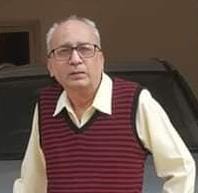
Light skinned older man with glasses and a white collared shirt and red and black striped sweater.
MANTRI PRAGADA MARKANDEYULU, Litt.D.,

CAN YOU DANCE WITH ME 

(Male Chorus)

O Tara Tara

Hai Hai Tara

(Female Singer)

Yeah, Guys,

What’s That, What’s That

Look, Look, Am Here

Don’t Drink, Don’t Drink

You Noughties

Come on, Come on

Step with me

(Male Chorus)

O Tara Tara

Hai Hai Tara

(Female Singer)

Time is Costly

You’re Here, You’re Here

O Boys, O Boys

My Dance is For You

My Steps Make you Dance

Never Feel Shy

This Day is For You

Come on, Come on

Step with me

(Male Chorus)

O Tara Tara

Hai Hai Tara

(Female Singer)

This Band is Yours’

My Song is Yours’

My Dance is Yours’

O My Darling Boys

Come on, Come on

Step with me

(Male Chorus)

O Tara Tara

Hai Hai Tara

(Female Singer)

Yeah, Boys, Drink and Drink

It’s Golden Time

Don’t Waste Beyond

Don’t Be High

You’ll Be Asleep

You Dine and Dance

For My Sake

Come on, Come on

Step with me

(Male Chorus)

O Tara Tara

Hai Hai Tara

You Dance and Dance

We Will Dance

You Sing and Sing

We Will Sing

O Tara Tara

Hai Hai Tara

==================

Beauty Like Marilyn Monroe

(This song is dedicated to all the girls)

Hi Smarty–Yes Naughty

Hi Beauty–Dear Smiley

(Chorus)

You’re

Tall and Beautiful

Highly Glamorous

Hale and Healthy

Charming Face

Sparkling Eyes

Beautiful Parrot Nose

Stunning Beauty

Mind Blowing Structure

Hi Smarty – Yes Naughty

Hi Beauty – Dear Smiley

(Chorus)

Diamond Studded Ring

Smart Speaking Mouth

A Stylish Lipstick On

Shining Longs Arms

Simple Laughter

Height like Himalayas

Walking Like Angels Style

You’re A Gift of the God

Hi Smarty – Yes Naughty

Hi Beauty – Dear Smiley

(Chorus)

Entry into Hall

Everybody Fell Silent

Each Gaze at Radiant Vision

It’s Glowing complexion

Best Twinkling Eyes

Long Lashes

Full Smiling Mouth

A Lovely Hair

It’s Like Angel Crazy

Warm smiles and welcoming

Hi Smarty – Yes Naughty

Hi Beauty – Dear Smiley

(Chorus)

Intellectually satisfying ones

No doubt, from the Rolls of Angels

Forget everything, when people look at

All Admire your Beauty

Hi Smarty – Yes Naughty

Hi Beauty – Dear Smiley

(Chorus)

You’re a Gift to the Earth

Beauty, a Nature-Lord Joint Venture

Wonders nothing before Beauty

The Beauty is Eighth Wonder

Marilyn Monroe we heard so

A replica like Monroe

A Gift from the Universe

What a Beauty

What a Style

People faint for your Beauty

The Life is nothing

Admiring Beauty is no wrong

Hi Smarty – Yes Naughty

Hi Beauty – Dear Smiley

(Chorus)

Oh Nature, I need beauty life

Lord, give me charming life

God, give me charming life

Oh Universe, give me happiness

Hi Smarty – Yes Naughty

Hi Beauty – Dear Smiley

(Chorus)

===========

KISS ME NOT EARLY 

Kiss Kiss Kiss

You will miss miss miss

(Male Chorus)

What Yaar

No No No to Kiss

We Miss Miss Miss

No No No to Kiss

(Female Chorus)

No No, Kiss Me Not

What is this, No, No, now

Time and place, no favor to this

Love like kiss, is not the day ǁ

I can’t tell, the kiss is banned

I can’t agree to kiss like love

Days are ahead for things to favor

Be as a Hope as love live long ǁ

You’re there to like my love

I can’t deny the same to you

You’re to understand well

Love like days, will bless us soon ǁ

Kiss Kiss Kiss

You will miss miss miss

(Male Chorus)

What Yaar

No No No to Kiss

We Miss Miss Miss

No No No to Kiss

(Female Chorus)

The adventures of love, yet to start

Beauty like kiss, will lead us life

Day is near for inventions of love

Day is near to lead the life soon ǁ

The Nature hails the love like kiss

Time says no, to kiss me not early

People sure to recognize us well

No, no and no, Kiss me not early ǁ

No doubt, our love is sky level high

Stars look at our love

Clouds are blessing us like a shower

Air is blowing like us to become one ǁ

Kiss Kiss Kiss

You will miss miss miss

(Male Chorus)

What Yaar

No No No to Kiss

We Miss Miss Miss

No No No to Kiss

(Female Chorus)

Flowers move us to feel happy

Flowers understand on love like matters

Flowers adore the beauty of love couple

Flowers are the part of love and kiss game ǁ

Kiss Me Not Early

Love Me Not Early

Dangers are seen in love kiss matters

Things go wrong, if not handled well

Go global but love can’t go global

Kiss and love is Natures Gift

Nature blesses us for love

Whole world bows for Natures love

No, no, Kiss Me Not

I can’t tell the kiss is banned

You’re there too like my love

The adventures of love is yet to start

The Nature hails the love like kiss

No doubt, our love is sky level high

Flowers make us  feel happy

I go global but love can’t go global ǁ

Kiss Kiss Kiss

You will miss miss miss

(Male Chorus)

What Yaar

No No No to Kiss

We Miss Miss Miss

No No No to Kiss

(Female Chorus)

https://superprofile.bio/mantripragadamarkandeyulu

Mr. Mantri Pragada Markandeyulu, Litt.D., is a retired Public Sector Enterprise Officer from Hyderabad (India).

He’s seeking a publisher for his works and also someone who may wish to put the song lyrics to music!

He is the Deputy-Editor-In-Chief of www.petruska-nastamba.com (Serbia/Belgrade) eMagazine.

He is the Editorial Committee Member of THE PANACHE, eMagazine from Bhopal, Madhya Pradesh, India (https://www.aadhyapublication.in)

He has worked in few News Papers (English) in Editorial Department.

He is also the Trainer in Motivational Management Programs.

He has published 75+ books with ISBN (Stories, Novels, Poems, Articles, Short Stories, Quotes etc) English/Telugu.

His stories are useful for making Movies, TV series, Web Series.

He has written 750+ Poems in English and 130 Poems in Telugu language.

To Google his name for little more information.

He received the following honors and awards both national and international:

·         International Achiever Award in Authorship from IPRH, Philippines and Bangladesh.

·         Birland Government honored me with a One Pound Postage Stamp as an official Poet.

·         Global Honorary Advisor, Federation of World Cultural and Arts Society (FOWCASS), Singapore.

·         CIVIC EXCELLENCE AWARD 2022 FROM UHE, PERU

·         Rabindranath Tagore Literary Honor 2022

            (Government of Seychelles, Motivational Strips and SIPAY Journal)

·         CESAR VALLEJO AWARD 2021, 2022 and 2023 (3 Years) UHE, Peru for Literary Excellence WORLD WRITERS’ UNION Peru

·         Gujarat Sahitya Academy and Motivational Strips LITERARY EXCELLENCE Honor

·         Honored with “Royal Kutai Mulawarman Peace International Institute, Philippines”

·         Royal Success International Book of Records 2019 Honor, Hyderabad-

·         The Silver Shield Award from UHE, Peru for my Literary Excellence 2021.

·         2021 GOLDEN EAGLE WORLD AWARD FOR LITERARY EXCELLENCE, Peru.

·         The Scholar, Institute of Scholars Research Excellence Award-2020, Bangalore (India)

·         Hon. Doctorate in Literature from ITMUT, Brazil. (2019)

·         State of Birland at Bir Tawil Recognized Poet

His Facebook Groups:

https://www.facebook.com/groups/620006038438396  (Poetic Charminar)

https://www.facebook.com/groups/2429746577114118 (బంగారం లాంటి కథలు)

Books:

(1) AGENT VISNU 999 (Story and Screenplay) (2) THE BANK THIEF      (3) THE TRUE HERO (4) RICH MIND (5) TUNE, SING AND DANCE POEMS (6) SOUND OF SONG (7) SUCCESS KNOW-HOW (8) LADY POLICE   (9) THE CRAZY BEGGARS (10) ENTANGLEMENTS (24 STORIES) (11) POETRY LYRICS (WORLD POPULAR)        (12) SPECIAL QUOTATIONS (80 Photos) (13) ANIMAL STORIES KIDS (14) THE DEAD AND GHOSTS (15) CLASS 1-8 COMPUTER LEARNING, (16) ONE STANZA POEM (17) MARK’S POEMS (18) WINGS OF LOVE (19) MY DARLING (20) 1000 PROVERS (21) NATURE & FORESTS (22) SOCIAL IMPOTENCE (23) NGO WORLD (24) SUCCESS KNOW-HOW (25) VISHAL AND THE EVIL KING (26) MANTRI’S MICRO POEMS (PART 1, 2 AND 3) (27)ONE STANZA POEMS (COLOR)

(28) రావే రావే బాల (29) మోహిని (30) బావంటే బావ (31) బ్లేమర్

Poetry from Lauren McBride

 *


Imprecise Language


in different

words

I

might

convey

words

with

intended

meaning;

words

indifferent


*


Gardener's Lament


my garden spot

weeds

among

annuals

perennials

weeds

overcrowding

ornamentals

vegetables

weeds

spot my garden


This poem first appeared in Your Daily Poem, 7/22/2020.


Poet’s Notes: The Skinny poem is a new minimalist form that consists of eleven lines. The first and eleventh lines can be any length (although shorter lines are favored). The eleventh and last line must be repeated using the same words from the first and opening line (however, they can be rearranged). The second, sixth, and tenth lines must be identical. All the lines in this form, except for the first and last lines, must be comprised of ONLY one word. The Skinny was created by Truth Thomas in the Tony Medina Poetry Workshop at Howard University in 2005.

Lauren McBride finds inspiration in faith, family, nature, science, and membership in the Science Fiction & Fantasy Poetry Association (SFPA). Nominated for the Best of the Net, Pushcart, Rhysling, and Dwarf Stars Awards, her poetry has appeared internationally in speculative and mainstream publications for young adults and adults, including Asimov’s and Fantasy & Science Fiction. Her chapbook, Aliens, Magic, and Monsters, is forthcoming from Hiraeth Publishing. She enjoys swimming, gardening, baking, reading, writing, and knitting scarves for U.S. troops.

Poetry from Rezauddin Stalin

Middle aged South Asian man with short black hair and a mustache in a blue collared shirt standing in front of a bookshelf full of books.
Rezauddin Stalin
BOOK OF POETRY

Imagine the day of justice
The time is quiet and infinite
Nobody can be seen anywhere
The desert-fish flies in the sea of sand
A vast emptiness touching the doomsday
Nature trembles fearing the fog.

Look closely, a poet stands alone
In the north-eastern horizon
You may think he holds his fate in hand
But I swear that God knows
It is his dearest book of poetry.


FREEDOM

I read and write in my own language
I learn from the school of trees and plants
Even the ants and birds understand my meaning.

Just as King Solomon understood the essence of grasshopper
As Buddha knew the rewarding of man based on his karma
All animals seek freedom and the religion of venting their opinion.

I am walking after putting my two lips on words
I am swimming on the words all through my life.

--

Rezauddin Stalin is a very famous poet in Bengal.
He was born in 1962 in Nalbhanga village of Greater Jessore district and won many local and foreign awards including from the Bangla Academy. His poems have been translated into 42 languages. Along with poetry he has established himself as a successful media personality sharing his thoughts on various social issues.