
I thank to independence

There are no sadness in the heart, only happiness,
The spirit of people rose from joy.
Their sorrows turned into blessedness
I thank to independence!

Gardens thrive in various streets,
The mountains are amazed at the patience of my nation.
Even the spot of moon disappeared from the face
I thank to independence!

We gratitude our president,
Our heads always be safe.
We are united, come to our weddings
I thank to independence!

My words are endless to describe my country,
My eyes shine with happiness every day.
My friends, protect our motherland like heaven
I thank to independence!

My Uzbekistan, you are new, raise your prestige,
You are my golden cradle, my heaven.
You are dear to my heart, every moment in my soul
I thank to independence!
Poetry from Sergio A. Ortiz
I Need A Lover


When you give me that Yes,
I approve of your fragrance look,
that flash tilted stare you so carefully hid
from others, you gave me the courage
to send you a drink. I wasn't ready to give up
and go home alone.

For years you gifted me snippets
of myself, happiness I will always remember.
Even when I forget your last and first name
those pictures won't vanish.

Driving you home on those treacherous
Puerto Rican mountains was like discovering
a stolen Van Gogh, a universe of revolutionary
starry nights and wild irises. A place
where nothing and no one could touch us.

It had to end. I wasn't ready to settle,
and you insisted on hiding
from macho eyes and their complaints.

But what the hell, it wasn't all a waste.
There was a lot of good sex and beer.


Photographs

I keep getting ass pics
when what I want to see
are you and me old together
like stale breadcrumbs

I gaze at the man
I'm with, my summer
climb, nothing to stop us
from trailblazing joy

We listen to a song
from Camila,
caliente, caliente
frío y caliente
Hot, hot, cold & hot

The beach & the daiquiris
are amazing


The Myth of a Piece of Paper


I never married but yes,
I'm divorced. Same-sex marriages
were not allowed in my time.
My Lord the Moon painted lust
on my face three times.

Mr. Moon knows
I cannot manage tempests
on my own. He sends
them to Her Majesty the Sun
who then lights up my thirst-filled
lips with fire & water.

In the garden of faith
& trouble all of us tread
uncertain of the hazards
lust might avail.  No
celebration, naive beliefs
blown away. A mixture
of dirt, wind, & rain.

moon's glint
the sun above
my ghost


The Stillness of the Moment


It's time for lunar silent men
to strike a pose. The ivy covering
men's eyes must come off.
The hour of kisses covered
with mud has ended. Dogs scurry,
hide in deep water.

Sleepwalking cats made of glass
perched on the tree
of my remembrance shatter.
Boys and girls without wings
or halos vanish.

I sit on a high chair
wearing crocheted roses like the ones
stretched out on the skin of my  drums.

Your ghost, clothed in musical silence,
watching.

Your conscience, a sore
that sways through Cocytus
staring at my face.


Sergio A. Ortiz is a retired Educator, Bilingual-Gay PRican Poet, Human Rights Advocate. Pushcart nominee, Best of the Web, Best of the Net. He took 2nd place in the 2016 Ramón Ataz annual poetry competition, sponsored by Alaire Publishing House.
Note from Jerrice J. Baptiste
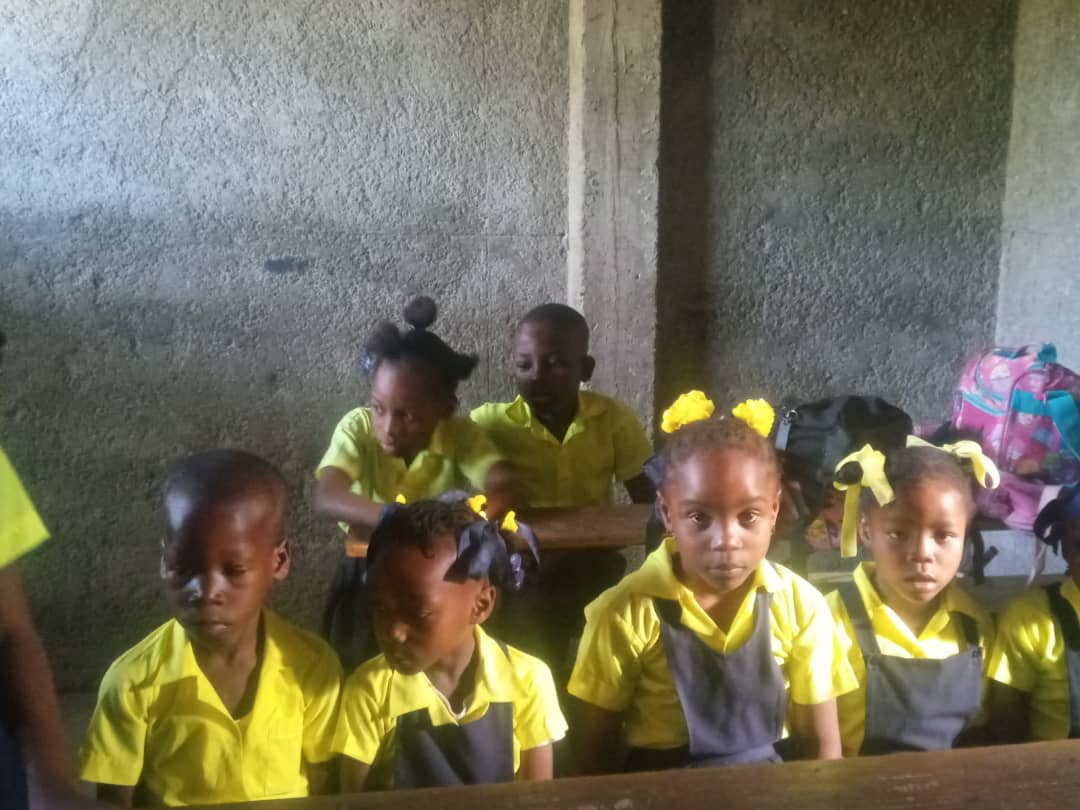
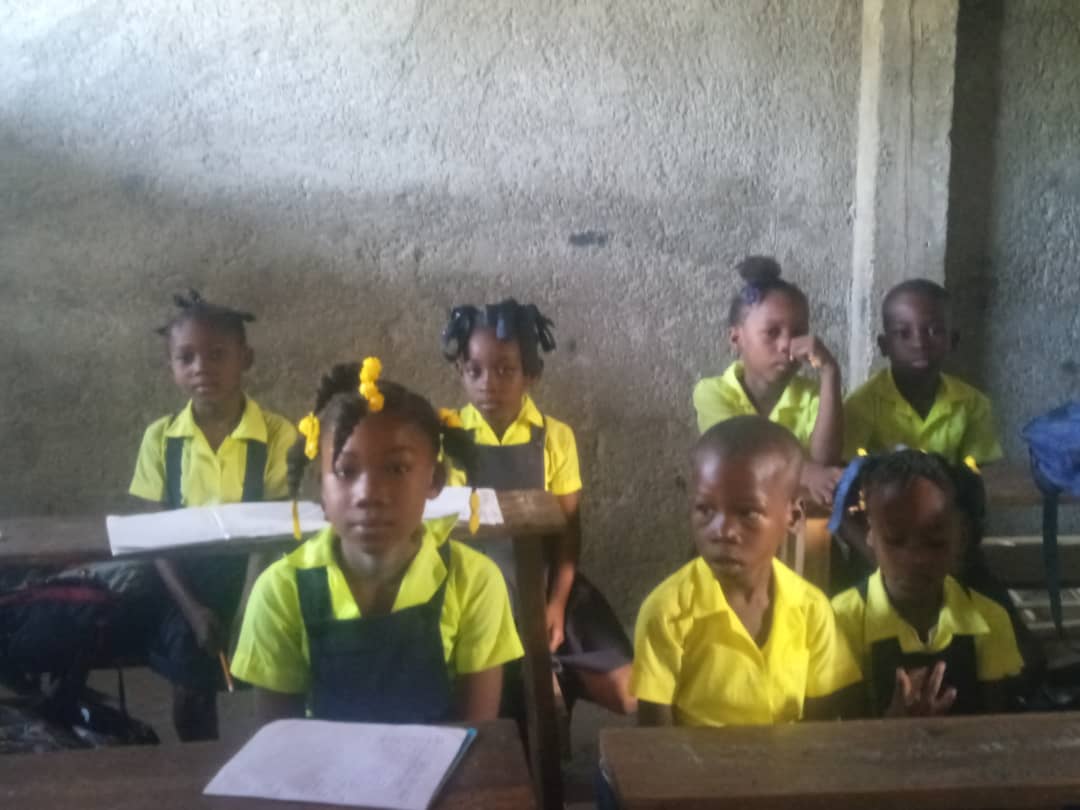
These are photos from Jerrice J. Baptiste of a school in Haiti run by the Souvenir Children’s Foundation where her aunt is volunteering. Jerrice is the niece of poet Roodly Laurore, whom we have published several times in Synchronized Chaos.
Please visit here to learn more about the Foundation’s primary schools and other humanitarian projects in Haiti, and please consider supporting them!


Short stories from Peter Cherches
The Picture of Peter Cherches
I was walking by the full-length mirror on the outside of my bathroom door when I did a double take. Instead of my mirror image, my face was a pastel portrait of me as a five-year-old; the rest of my body was as expected. I remembered that portrait. It was done in 1961, when my mother, my brother, and I spent the summer in The Catskills at The Tamarac Lodge.
One day a man came to The Tamarac to do portraits of interested guests. My mother had him do all three of us. The artist’s name was Charles Biro, and he had a history, a serious one, actually. He had been a comic artist earlier in his career, most famous for Daredevil Comics. But his pastel portraits weren’t in comic book style, they were realistic.
I hadn’t seen that portrait in years. How did a pastel of my five-year-old head replace my sexagenarian head in my mirror?
I went into the bathroom to look in the mirror above the sink. Same thing. Normal torso, pastel head.
This was really freaking me out. I couldn’t think of a plausible explanation. One mirror was bad enough, but two?
I’d have to leave my apartment and find an impartial mirror. I figured I’d go to the dry cleaner and tailor across the street. I knew they had a full-length mirror. As subterfuge, I brought a pair of pants for dry cleaning that I’d usually throw in a machine. I walked into the shop and put the pants on the counter. “Friday?” the Korean woman asked.
“Sure.”
I took my receipt, and then I turned to look in the mirror. Same thing. Pastel head.
“Excuse me,” I said to the woman.
“Yes?”
“Does my head look normal?”
She looked confused. “I don’t remember seeing you before, maybe you’re not a regular customer,” she said, “but you look fine.”
“So nothing strange?”
“You look like American,” she said.
Yeah, but did I look like an American of a certain age, or an American of a greatly reduced one? I didn’t want to bother her any more, so I called Allan Bealy, who lives a few blocks away. Allan, whom I’ve known for years, was editor of the downtown arts journal Benzene and the publisher of my first collection, Condensed Book. He answered. “Allan,” I said, “by any chance are you free for me to stop by for a couple of minutes? There’s something I need to ask you.”
“Sure,” he said. “I’m working on a new collage, but I can take a break. What’s up?”
“I’ll tell you when I get there.”
When I got to Allan’s apartment he asked me if I wanted anything to drink. “No thanks.” I said. “Tell me, how old do I look?”
He thought for a second. “Well, you don’t look your age!”
“How old do I look, five?”
“What? Of course not. Sometimes you act like you’re five, but I’d say you could pass for 58, 59.”
“So I don’t look like a kid, and my head doesn’t look like a pastel?”
“What are you talking about?”
I told him the whole story.
“That’s nuts,” he said, “are you sure this isn’t one of your stories?”
“I swear.”
“Let’s go into the bathroom and look into our mirror.”
I followed him into the bathroom. We both looked into the mirror. I saw Allan, normal Allan, and me with the five-year-old pastel head. “What do you see?” I asked.
“You and me.”
“And my head is normal?”
“As normal as it’ll ever be.”
“But I see the pastel head, the kid’s head.”
“Are you tripping?”
“Not for at least fifty years.”
“Do you feel OK?”
“I felt fine until I started seeing the pastel head in every mirror!”
“You might want to see a shrink,” he concluded.
I suspected he might be right. But maybe it was a passing hallucination. I figured I’d wait. If nobody else noticed, then it wasn’t such a big deal.
I went home and started reading a Val McDermid mystery. I got lost in the plot and forgot about my pastel-headed troubles for a while. Then I got up to make a cup of tea. I passed the full-length mirror on my way to the kitchen. I stopped and looked. Same thing.
This thing was throwing me for a loop. Was I really going crazy? I had to do something about it. I couldn’t go on this way, always seeing that pastel head in my mirror. So I went to my desk, and from atop the hutch I picked up the little bronze Buddha I had bought at an antique shop in Thailand. I smashed the mirror to smithereens with it. I’d have to sweep the shards up, but first I had to take care of the bathroom mirror. I was pleasantly surprised when I saw that my head in that mirror was now normal, so I didn’t have to smash it after all.
This was cause for celebration. I decided to go to the bar down the block for a drink. I’d take care of sweeping the shards when I got back.
When I got to the bar I took a stool and told the bartender, “Tanqueray on the rocks with a squeeze of lime, soda on the side.”
“Get outta here,” the bartender said. “You know we can’t serve little boys.”
Little Things
I generally avoid street fairs. I don’t get the point. Usually it’s the same mediocre food vendors at all of them, Italian sausages, Filipino lumpia, Colombian sweet corn arepas. Some people sell small craft items, handmade earrings, for instance, some sell scented candles and/or crystals, and there’s also lots of shoddy bed and bath products, like low thread-count sheet sets. The streets are clogged with people who consider this great fun.
I live off a main commercial drag in Park Slope, and there are several of these events every year on Seventh Avenue. If I’m heading north or south to the subway (the F is south of me, at 9th Street, and the Q and B are north at Flatbush Avenue), I have to walk through the street fair. That’s exactly what happened one Sunday in June, during the biggest one of the year, Seventh Heaven.
Sometimes during the fairs there are performances in front of certain businesses. The Brooklyn Conservatory of Music often has classical music, for instance. This time I also saw a small makeshift stage in front of the toy store around the corner from me, Little Things.
I was going to keep walking to Flatbush Avenue for the Q train, but then I noticed a ventriloquist with his dummy on the stage, sitting on a stool. I did a double take and saw that the ventriloquist was actually my next-door neighbor, and not only that, the dummy was a dummy of me, a little, bald Peter Cherches in a sailor suit. I had to find out what was going on. I waited about five minutes until his performance started.
“Hello, ladies and gentlemen,” the neighbor announced into a mic, “I’d like to introduce you all to my friend Little Petey. Say hello to your neighbors, Petey.”
Petey? I hate being called Petey. And what the hell gave him the right to appropriate me for a dummy without permission? I wondered if I could sue.
“Howdy, folks,” the dummy said. I had to admit, the neighbor was good at this; I didn’t see his lips move at all. And the voice was good, it really sounded just like me. “My name is Little Petey, and I’m tired of being a dummy. I want to be a man, a real man!”
Some people laughed. I wasn’t laughing.
The dummy continued. “I used to be a real man, but the guy who’s holding me now is my next-door neighbor, and this morning he kidnapped me and shrunk me and dressed me in this silly little sailor’s uniform and told me I was now his meal ticket, so please, don’t give him any money, it will only encourage him to keep me prisoner.”
The next thing that happened was the neighbor slapping the Petey dummy in the face. “Don’t you ever go rogue on me like that again, Little Petey,” the neighbor said. Some in the audience gasped, others laughed uncomfortably. “Now let’s give this another try, shall we?”
The Petey dummy spoke again. “Hello everybody, my name is Petey and I write funny little stories. Would you like to hear one of them?” Several in the audience let out a spirited “Yeah!” in unison.
The dummy started reading one of my stories from Masks, the one that takes place at the Key Food just down the block. This was unacceptable. Not only had the neighbor appropriated my physical likeness, he was using my material in his act.
“This must stop!” I yelled out.
Several people shushed me. One big muscular guy in a tight black T-shirt glared at me and said, “Let the dude do his act, asshole.”
Wait a minute, the neighbor plagiarizes my very existence and I’m the asshole? But I’m smart enough not to get into fights with guys like the asshole with the muscles, so I didn’t say anything else.
The neighbor now addressed the dummy directly. “We seem to have struck a nerve, Petey.”
“Don’t call me Petey. I hate being called Petey,” the dummy replied.
Wow, the dummy was becoming defiant again. I had to lend my support. “That’s telling him,” I yelled out. The guy with the muscles glared at me again.
“Well, what should I call you?” the neighbor asked.
“My friends call me Pete, strangers and readers call me Peter. Either one will do.”
“Well, then, why don’t I call you Pete?”
“That’s fine with me.”
“Well it’s not fine with me,” I yelled as I moved away from the muscle guy.
“Just who do you think you are?” the elderly woman I was now standing next to asked me.
“I’m the real Petey! I mean I’m the real Pete or Peter.”
“No, I’m the real Pete or Peter!” the dummy said.
“Thank you, ladies and gentlemen,” the neighbor said, stood up, and took a bow.
That’s it? That’s his whole act? People started applauding. Then a guy came out of the toy store and made an announcement. “Thank you all for stopping by Little Things. I’m happy to tell you we have plenty of Little Petey dummies in stock.” A bunch of people filed into the store.
I couldn’t believe it. I’d have to get a good intellectual property attorney ASAP and sue the neighbor’s ass. But I wasn’t going to just walk away without saying something.
I went up to the neighbor, who was packing up. “You bastard!”
“Hold on, hold on,” he said. “I was going to tell you. I’m cutting you in for a 50% royalty on every unit sold.”
A 50% royalty? Damn, I thought—being a dummy is a hell of a better deal than writing short stories.
Essay from Ayokunle Adeleye
Doctor of Medicine, or Interpreter of Results?
There is now a recalcitrant trend among our people. It is not new, but
it sure is growing. Before now, everyone knew to seek the (medical)
doctor out whenever they ailed. It was the doctor who then decided
what investigations to order, and what treatment to give, after
thorough history taking and relevant physical examination. What we
find now is rather different, the well-documented physician-apathy
(illness behaviour) nonetheless. Now, our people wake up with symptoms and head straight to the medical laboratory or diagnostic centre.
Between them and the technicians, somebody decides what tests to be done, what scans to be carried out — because medic no suppose chop — and then the inevitable happens…
Again and again, I have had to explain to patients that yours truly is
a Doctor of Medicine and not an interpreter of results. I am licensed
to treat patients who are patient enough to subject themselves to my
care, not those who already know what to do and merely need my medical licence and indemnity insurance to safeguard their rashness. I find myself in this situation when the laboratory technician (or scientist) sends them to me with a laboratory result I did not request, or the sonographer (or sonologist) urges them away with the report of a scan I did not order, and that is invariably not useful to the patient at that material time! This is even if the patent medicine seller had not emptied the patient’s pockets before Mr. No-Free-Consultations is remembered.
There have been instances where patients underwent absolutely
unnecessary investigations for want of physician guidance — outright
fishing expeditions, in fact. This middle-aged bricklayer fell off the
scaffolding and noticed a chest pain not amenable to the numerous
massages of the traditional bonesetter. He was advised (don’t ask by
whom) to go for an abdominal scan! And then the inevitable happened: they needed a “me” to interpret the useless report and prescribe medication. Needless to say, I sent him for a chest x-ray which expectedly revealed two broken ribs and lung contusion. And after specialist treatment, he was back on his feet in a week! The medical curriculum is there for a reason and that is the reason medical students stay the longest in the university! Everybody is important o, but if you did not spend seven to ten years studying Medicine and Surgery, chances are that you cannot know all of what “I” am expected to know. If e no be panadol…
Our people go to the pharmacy to ask what eyedrop to use. They do not know, or do not care, that there are more than half a dozen causes of ‘red eye’. Someone took her friend’s glaucoma eyedrop container to the pharmacy to buy, without any tests or diagnosis. The ophthalmologist must be avoided at all cost, and when they go blind it must be their village people, demons or arrows at work! The first aid for ear ache is olive oil. But no, our people must put ear drop (do not mind that there are various types), and even hydrogen peroxide with its exothermicity is not spared. The otologist is their enemy, and they only go to him for hearing aids — or polypectomy. Someone was taking his friend’s heart failure medication, never minding that the cause of his own chronic cough was tuberculosis! How many shall one recount? And when they complain to me and I say why not go to the hospital, they are quick to remind me that they are not sick; “they that are whole have no need of the physician, but they that are sick”. — Mark
2: 17.
Our people now only remember the hospital when they see the grave
approaching, but when they die after spending precious time going from one druggist to another, the medic must be held responsible for not performing magic. As I am writing this, a patient has come to complain of easy defatiguability after treating malaria and ‘typhoid’
exhaustively and undergoing self-prescribed blood work that confirmed nothing else. Guess what? He has simple old hypertension! He could have had a stroke or a heart attack if commonsense had not finally dragged him to the hospital…
Those are the things we see. And oh, let me not remember the
Google-said people. If Google is good enough to diagnose (not
diagonise, please) you, let Google treat you abeg. Do not endanger my medical licence with your recklessness; do not turn and say it was Dr. Ayk who managed you; we both know you had damaged your kidneys from consuming “mix” (a concoction of varied analgesics and steroids with or without vitamins and calcium tablets) from chemists for years. Hmm, all the roadside gbogbonise and homemade decoction nko — with and without alcohol? Perhaps in future we will discuss how some alagbo fortify their ‘natural products’ with conventional drugs!
It will take a lot of reorientation to even begin to scratch the
surface. For starters, let the relevant government agencies enforce
extant laws on what patent medicine sellers cannot dispense, let
pharmacies seize prescriptions, let medics stop over-the-phone
consultation AND PRESCRIPTION BY TEXTS, and let unlicensed health workers be dissuaded perceptibly. The Nigeria Medical Association should hasten doctor prescription stamps so our pharmacist siblings can root out fake prescriptions and save our people from themselves.
Let all genuine healthcare providers remember that customers may
always be right, but patients seldom are…
Ayokunle ADELEYE writes from Odogbolu LGA, holds an MBChB from Olabisi Onabanjo University, and is licenced by the Medical and Dental Council of Nigeria. He may be reached at adelayok@gmail.com.
Essay from Mykyta Ryzhykh
After 24 februar

It turns out that during the cannonade and explosions you can: try to work, dine, hang yourself, fuck, jerk off, use drugs, yell at a cat, beat your young son, take away your mother's pension, pack a suitcase for departure, do crafts for elementary school, defend a diploma in zoom, wipe snot, wash away blood, stand in line for bread, throw away bread, steal potatoes in a store, feed a homeless dog, feed a homeless person, look for a mobile connection, call, be silent, eventually die...

As a child, it seemed that war was something grandiose and unbearable. Today you begin to understand that war is the same as a vacation, going to the movies or the evening news.

What does my cat think about what is happening? nothing, the cat is sleeping. And the neighbor's dog clings to the owners during the explosion and whines. And the neighbor's dog of the neighbors opposite, during the explosions, runs to the front door and growls loudly at what is happening outside the apartment.

Now it seems that money is not important, nothing serious can be bought for money. But living without a mountain of money in your pocket is now even more difficult than before. When we were kids, we wanted to conquer the Alps. Now we want to conquer mountains of money. We want to take all the money that exists in the world for ourselves in order to buy out all the military factories in the world and destroy them to hell.

The old woman from apartment number twenty says that out of habit every evening at 20.00 she turns on the TV and waits for the series. Instead, 24/7 TV shows news and air raid charts.

I have no acquaintances who would teach me to laugh. I don't have siblings to teach me how to fuck at 12. Maybe at the age of 12 I would have fucked the war to death - it would be easier for everyone.
At the age of 12, it seems to you that war and the battle for peace are the lot of the elite. At 22, it begins to seem that there can be no peace after the war. At 22, you begin to forget your age because you understand: war is the lot of children who do not want to grow up. At the age of 6, I was given a set of toy soldiers. All soldiers had 2 arms and 2 legs. Childhood is a place of lies. At the age of 21, you understand that in reality, nothing remains of the soldiers after the battles, except for a photo on a cemetery grave.

I will soon be 22 years old. I do not understand anything...
Creative nonfiction from Leslie Lisbona

Puppy Love
Shortly before the pandemic, I adopted a puppy. She could fit in my cupped hands. She got fur on my camouflage dress, and it didn’t matter. I’ve had dogs before, large ones, when I was a kid in my parents’ house in Queens. I knew what it was to love a dog.
When I was in the sixth grade, we moved from an apartment to a house. Because we no longer had a doorman to protect us, we got a Doberman Pinscher a few months later. My brother, Dorian, was enlisted to pick up the dog from the breeder. He took a long time. I watched for him out the window with my friend Maya. Finally, Dorian walked in the door and put the new black puppy in my arms. The dog had giant paws, an oversized belly, short legs, and floppy ears that felt like velvet. We put him on the floor, and Maya put her hand out for him to sniff, and he sneezed in it. We fell back laughing. My sister, Debi, suggested the name Fonzie.
I cradled Fonzie in my arms, wrapped him in a blanket.
Dorian said, “Don’t baby him! He’s a guard dog.”
My mom said, “Don’t let him go upstairs!”
He was supposed to sleep in the little room off the kitchen, but at night I sneaked him up to my bedroom. I hid him under my covers, and we slept cuddled together, his little head on my pillow, while I breathed the sweet mustiness of his fur. In the morning, I brought him back to his room before my dad got up to make his Turkish coffee.
After my day at school, I rushed across Queens Blvd. and down the four blocks on 68th Drive. I couldn’t wait to see Fonzie and take him to the park. Often Dorian and I took him for long walks in the neighborhood and let him run free in the fenced-in track area of Forest Hills High School.
Even though I coddled him, Fonzie was a good guard dog. He didn’t let strangers ask me for directions; he made such a racket that they had to drive away. At Flushing Meadows, if a man walked towards me on an isolated path, Fonzie growled until he passed.
By the time I was 18, both my siblings had moved out to apartments nearby. When I was 20, my dad announced that we were getting another dog. One day, I came down to the living room and saw a very large mastiff puppy lying by the front door, with his chin on the beige tile. Upright, he was taller than Fonzie, like a colt with lots of loose skin. His body was the color of a lion, and his face was black. Debi suggested the name Cujo.
Cujo grew to be massive, broader than Fonzie. He weighed more than I did. When people saw me walking both dogs, they crossed the street.
But Cujo was a fearful dog with a look of worry on his crinkled forehead. He was startled when the traffic light on Jewel Avenue clicked from red to green. He was just as startled when a dry leaf blew by.
When I was 25 and still living at home, I went to Mexico on vacation. Dorian cared for the dogs while I was away. When I returned, only Cujo greeted me. I figured Fonzie, who was 13 then, was looking for his tennis ball, which he loved to have in his mouth when someone came home. “Fonzie!” I called. My mom was playing cards with a group of friends in the living room. “Where’s Fonzie?” I asked her. She stood up. “Call Dorian,” she said.
I ran to the kitchen phone that was on the wall. “Where’s Fonzie?” I said, instead of hello. After a long pause, Dorian said, “He died,” and started sobbing. He told me that they were at the high school. Fonzie had eaten something and came over to Dorian and lay at his feet. And then he stopped breathing. Dorian tried to lift him. He told me how he struggled to get Fonzie into the car while holding onto Cujo and crying all the while. Now I was crying, too. I coughed out sobs, twirling the phone cord around my fingers until my chest hurt.
Cujo and I became inseparable. I was able to give him my undivided attention, which he had always craved. I brushed his teeth, gave him medicine, cleaned his ears, bathed him. He was gentle and open to anything I suggested. When my nieces and nephews came over, he stood stock still while they petted him, staring down.
On one glorious spring day a few years later, I brought Cujo to Central Park, and he stepped on a shard of glass near the Bethesda Fountain. He held up his paw for me to look at. It was the size of my fist, with soft fur between each digit. When I found the glass and pulled it out, blood spurted. I didn’t know what to do. I ran with him through the park to 68th Street and Central Park West. With each step, he left behind a bloodied pawprint. On the street, no cab would take me with such a big animal. I finally spotted one at a red light and explained that my dog was injured. The cabbie said he would take us to an animal hospital on York Avenue. I held Cujo and clasped his paw in my shirt as we sped across town. He leaned against me, and I kissed his ear, whispering, “It’s okay, Cuji.” He got stitches while I sat in the waiting room for hours.
When he was 10, Cujo needed two surgeries on his hind legs; he could no longer support the weight of his body. I knew he was in pain. By then, Dorian had moved to California. After many discussions with him and the vet, I decided to put Cujo down. In the waiting room, they called his name. The aide took his leash and said I could go. But I wasn’t ready to say goodbye. I said I wanted to stay with Cujo till the end. The aide said I couldn’t. I got on my knees, hugged Cujo, and wept into his fur. I looked into his kind eyes, kissed him all over his grey speckled face, and told him what a good boy he was. When they led him away, all I had left in my hands was his leash and collar and no dog.
I thought of Fonzie and Cujo often. I missed them. Dorian and I talked about them. He said he was sorry that he’d tried to contain my love and affection for them. That they were probably such great dogs because I loved them so much. That my babying them the way I did was probably the best thing.
Decades passed. I got married and had two sons. I told them all about Fonzie and Cujo. I showed them pictures. I told them how I used to wrap Fonzie in a blanket and carry him like a baby. When Aaron and Oliver talked about Fonzie and Cujo, it was as if they had known them.
I never thought I would get another dog. My husband, Val, was allergic. We discussed getting a dog when our boys were small, but the allergy issue always arose, and we didn’t like the hypoallergenic breeds.
Then one day, out of nowhere, Val texted me a picture of a black lab puppy with the name and number of the breeder. He said that a work colleague had used this breeder and had forwarded him the picture. He said that he would love this kind of dog and that she was available. Black labs are not hypoallergenic, I reminded him: They shed; he would be ill; his eyes would itch. Val said he didn’t care. He would medicate himself and get an inhaler.
“Val, are we really doing this?”
“This is the dog I want,” he said.
Before he could change his mind, I arranged for the dog to be delivered from Pittsburgh to our house in Pelham.
That morning, I felt nervous and excited. I was jittery; I dropped things; a receipt I needed flew out the car window.
Then I was standing with my family on the curb waiting, as a guy with missing teeth pulled up in front of our house on Clay Avenue. In the back of his truck was a tiny puppy with the shiniest black fur, soft floppy ears, and caramel-colored eyes. When he handed the dog to me, I felt like I was going to burst. I couldn’t speak. By the time Debi came over from Queens that afternoon, my cheeks hurt from smiling so much. “Maybe I should get a dog,” Debi said. I looked at her, confused; I’d never seen her pet Fonzie or Cujo. When I asked her why, she said, “Because I want to be as happy as you are right now.”
I named the puppy Rhoda in honor of Valerie Harper, who had died that week. Harper had played Mary Tyler Moore’s Jewish friend Rhoda on a sitcom. Debi loved the show, and I watched whatever my big sister watched.
Aaron and Oliver babied Rhoda, like I did. I carried her around until she got too big. Val carried her around even when she was full-grown and was surprised at how much he loved her.
I sent Dorian a picture of me and Rhoda. “Lucky dog!” he said. He said that I looked just like I did when I was 12 – the same joy, “like the day we got Fonzie.”