
CHERRY BLOSSOM SEASON:  HAIKU BLOOMS IN THE UNITED STATES 1959--1961

The New York Times wasn’t ready to declare it a real craze, not yet, and it certainly wasn’t consuming the country the way coonskin caps, hula hoops and telephone booth stuffing did.  Still, there was something in the air as the decade of the 1950s faded, and other observers felt the same wind.

In January of 1959, The New Yorker noted a “current passion in the country for things Japanese, from A (for ‘Architecture’) to Z (for ‘Zen’).  H would be reserved for Haiku, described as the primary literary industry of the island nation.  “To the Japanese,” the magazine said, “the composition of these hauntingly vivid little poems would seem to be almost as natural, and necessary, as breathing, and every Japanese who is able to read and write is therefore likely to be a practicing poet.”

That same month, Dolly Reitz, writing in her “Occupation: Housewife” column, told of reciting haiku back and forth with a friend over holiday tea:

A childless housewife
How tenderly she touches little dolls for sale.

You hear that fat frog in the seat of honor singing bass?
He's the boss.

Swallows flying south
My house too of sticks and stones
Only a stopping place.


Cherry-Blossoms, the third in the series of haiku anthologies issued by Peter Pauper Press, was published the following year.  The poems were arranged in four lines to conform with illustrations on the margins of each page.  To follow through the seasons (New Years was considered its own season):

New Years

In the New Year Dawn
Solemn and
Deliberate
Tall cranes go marching
--Kikaku

From the mountain pass
See the sunlit
Castle town . . .
Flying new-year kites
--Taigi

Spring

Endless Maytime rain . . .
Sneaking back one
Night, the moon
Perched in the pine-tree
--Ranko

Dull dreary rain-day . . .
Dripping past
My gate a girl
Bearing irises
--Shintoku

Summer

Ah roadside scarecrow
We’ve hardly
Started gabbing . . .
And I have to go
--Izen

Stubborn woodpecker . . .
Still hammering
At twilight
At that single spot
--Issa

Autumn

On this plain of mist
Nothing but flat
Endlessness . . .
And red-rising sun
--Shiro

Within pale silence
Spreading from
Evening moonlight . . .
Sudden cicada
--Hajin

Winter

Bitter winter wind . . .
Won’t it blow
Right off the sky
That day-old crescent?
--Kakei

A harsh-rasping saw
Music of
Cold poverty
In winter midnight
--Buson

1960 also saw the publication of Harold Stewart’s A Net of Fireflies.  Stewart titled his translations and composed them as couplets.  The Baltimore Sun quoted eight for its review of the book.  Among the selections:

RETURN OF THE DISPOSSESSED

The same old village: here where I was born,
Every flower I touch—a hidden thorn.
--Issa

THE SILENT REBUKE

Angrily I returned; awaiting me
Within my court—the tranquil willow-tree.
--Ryota

MORE THAN FORGIVEN

Plum-blossoms give their fragrance still to him
Whose thoughtless hand has broken off their limb.
--Chiyo-ni

AND SO

And so the spring buds burst, and so I gaze,
And so the blossoms fall, and so my days . . ..
--Onitsura

A sixth-grader from Honolulu might have written the best haiku published in 1960:

The house on the hill
Is always full of laughter
Until the friends go

Elizabeth Gordon, the editor of the American interior design magazine House Beautiful, felt the Eastern wind blowing sooner than most arbiters of taste, fashion and literature.  Over the span of five years and seven trips, Gordon spent 16 months in Japan in the late 1950s.  Her travels there laid the foundation for a landmark two-issue report on Japanese culture published by the magazine in August and September of 1960.

Described as “[one] of the most influential issues ever by a design magazine,” the August issue carried articles on Japanese food, gardens, music, and other topics.  The magazine saw and felt haiku everywhere it went in Japan, and something of the enthusiasm for the 17-syllable literary form rubbed off on its American audience.

Haiku and Japanese poetry readings were held at coffee houses, libraries, and universities in California, Florida, Maine, Texas and other states. Speakers at the events included exchange teachers, Japanese wives of college professors, and domestic devotees of Japanese culture.  Flower-arrangement and origami were also presented at the gatherings.

Delayed a day by a snowfall, a writers’ club in Mason City, Iowa, studied haiku at a dessert luncheon.  Composing greeting card verse was announced as the subject for the club’s next gathering.

Scientists introduced six chimpanzees at the Baltimore Zoo to typewriters.  Most ignored the contraptions, but one named Spunky seemed to enjoy typing away with his two index fingers.  “He writes in short one or two-word phrases,” said one of the scientists, “jerky, unconnected, but deeply perceptive.”  Researchers tied together coherent strings of typing and compared Spunky’s results to the “fleeing, momentary, image of beauty” of haiku:

I am horrified
Could we die? Go
Deaf to joy.
Cry on . . . fighting.

Bess Hines Harkins of Oxnard, California, published three of her early haiku in the local newspaper on February 19, 1959, and was interviewed the next day on television. Ethel Herman of Fort Pierce, Florida, became known “the haiku woman” in the local press for her devotion to the form.

As far back as 1958, the California Federation of Chapparal Poets conducted a contest for the writing of haiku.  In 1960, the club added tanka to the category of Japanese poetry.

Later that year, the San Francisco Examiner would even quote two haiku from the crosstown Star:

Unexpected guests!
Close off our unmade bed!
There! But!
Dust under chair.
--“F. P. H.”

Circular prison
Street lamp has captured three
Busy moths
‘til dawn.
--Julie Harden

“Haiku,” the Examiner added, “are literary salted peanuts.  Start nibbling and you find it difficult to stop.”

Another commentator sarcastically labeled haiku as “the greatest thing since the sack dress” and then doubled down by attesting the sack dress had been the greatest thing since haiku.

A California writer tried without great success to place the debate within the fictional context of a haiku tournament between Japanese poets and American balladeers.  In a series of seven matches, the players eventually find common ground between Tokyo Bay and the Potomac in the timeworn and unsatisfying vision of a brotherhood of man based on the bonds of beauty, truth and good.

In an April 1960 interview with the Hartford Courant, Ambassador to the United States Koichiro Asakai called haiku one of Japan’s greatest inventions and then issued a note of caution.  “It is hard to see,” said the envoy, “how haiku can be written in any language but Japanese, since the harmony between the Japanese language and the haiku form is so amazingly high.”

Kenneth Rexroth tended to agree with the ambassador.  “American imitators of Japanese haiku . . . almost never come off,” said the designated spokesman of San Francisco’s anarchists and avant-garde artists, on whom Time Magazine bestowed the unwanted title of Godfather of the Beat poets.  “[They] miss the deep foundation of the culture.”

But by the spring of 1961, Americans reached for pen and paper when the cherry blossoms began to bloom.
Poetry from Scott Thomas Outlar
Halo Equated


I promised all my sevens
to the pattern

now I’m caught in its prism
blink twice for fusion

spin in the grasp of spent coding

untangling live wires
in the storm

You told me every dog
still has its teeth
from the hunt

now I’m warm in the forest
fur wrapped with worn blankets

coil through the night of rebellion

enticing compressed visions
from crystal


What Roars Below


brewing

not quite a boil … yet

churning underneath
a sure explosion
biding its time

constructing a blueprint
to rise without aggression

violet flames
liquid consciousness

a compulsion toward creation
unbridled human expansion

the artistic urge

self-actualization/individuation
finding cohesion with the collective

sacred space of duality
breather of light discovered in shadow

cynicism turned on its head
affirmation

the great yes to it all
flow/flux

gestation turnkey
an opening of eyes


Aborted Escapism


I wasn’t in a rush to be born

&

I took my sweet ass time
to garner any wisdom after

but God knows I ran
straight toward the grave
for so damn long

and each time
you refused me
and sent me back
with deeper patience
and buried scars

but if I disappointed you
I will make it up to them

because if there’s one thing
I’ve ever been sold on
it’s promises
Scott Thomas Outlar is originally from Atlanta, Georgia. He now lives and writes in Frederick, Maryland. His work has been nominated multiple times for both the Pushcart Prize and Best of the Net. He guest-edited the Hope Anthology of Poetry from CultureCult Press as well as the 2019-2023 Western Voices editions of Setu Mag. He is the author of seven books, including Songs of a Dissident (2015), Abstract Visions of Light (2018), Of Sand and Sugar (2019), and Evermore (2021 – written with co-author Mihaela Melnic). Selections of his poetry have been translated and published in 14 languages. He has been a weekly contributor at Dissident Voice for the past eight and a half years. More about Outlar’s work can be found at 17Numa.com.
Poetry from Henry Bladon
Do Nihilists?*

Do nihilists believe in God?
Do nihilists fall in love?
Do nihilists believe in love?
Do nihilists have morals?
Do nihilists want to die?
Do nihilists hate life?

And the ultimate -
what’s the purpose of nihilism?


*Google questions


Death to…

Death to poetry collections
Death to politics
Death to golf
Death to tea towels
Death to garden trowels
Death to tempests
Death to cheap wine
Death to digital self-optimisation
Death to tennis balls
Death to iPhones
Death to pornography
Death to weeds
Death to weed killer
Death to fresh fruit
Death to decaying fruit
Death to bigotry
Death to satellites
Death to aphorisms
Death to potatoes
Death to politics
Death to sunglasses
Death to gilded assertions
Death to magazines
Death to guitar picks
Death to clocks and watches

Death to death…

Amen.
Henry is a poet, writer and mental health essayist based in Somerset in the UK. His work has appeared previously in Synchronized Chaos.
Poetry from Cheryl Snell
Death of the Teacher

You make for the lobby’s tattered chair,
your spine’s ladder a leash for collarbones
and windmill limbs blocking out the sun
patched with glare that throbs against your eyes
filled with clouds and the shadow of a thread
endlessly snapping, the blinding light stinging
until you must drop your eyes to the stripe
glowing magenta on the rug which,
if you follow it, might take you out
of this hospital, however many
possibilities braid the unspoken
with the unexplained and hold themselves out
to you as you sit there, sipping the coffee
he left when his name was called, the last thing
he ever drank, and here you are, still drinking it,
cold, trapped inside your own geometry.


Calendar


It’s spring. A punk in a convertible lops off all the mail boxes, his tires blistering the road to the exit. It’s summer. The wrecked Mustang, tires blown, sinks into grass rubbery with snakes. A crystal bottle lolls under the front seat. Maybe it’s worth something. It’s fall. Trees have faded to an ambiguous yellow, and the color confuses those of us who have already given up. It’s winter. The car, rusted through. Grass, shagged with ice. There’s a drop of Scotch in the decanter so we’ll drink that first, before we feed the piano to the flames.


Connection

He reaches into the closet. Pulls out the pink silk dress. Takes her in the crook of his arm. Unfastens her robe. Pushes the fabric from her shoulders. Watches it fall to her feet. Sighs. Tugs her onto his lap. Eases her into the dress. Slides it over her lingerie. Zips it up. Notices his tie has come undone. Asks her to knot it for him. Thanks her. Brings her the leg braces to her. Fastens them. Hands her the forearm crutches. Says “you look beautiful tonight,” holding her hand against his chest. Briefly mistakes her fingers for his own.
Christopher Bernard reviews William Kentridge’s Sibyl at Zellerbach Hall (Berkeley, CA)
The Mouth Is Dreaming
SIBYL
William Kentridge and collaborators
Zellerbach Hall
Berkeley
A review by Christopher Bernard
The climactic event of an academic-year-long residency at UC Berkeley by the celebrated South African artist William Kentridge, was the United States premiere at Cal Performances of SIBYL, the latest example of his deeply witty, darkly lyrical, postmodernly brilliant, if intermittently satisfying (though the two last qualifiers are perhaps redundant), but exhilarating suspensions in organized theatrical chaos.
Beginning as a reluctant draftsman, and having gone through a succession of dead-end careers in his youth (as the artist has described in interviews), Kentridge finally embraced the fact that his deepest gift lay in drawing; in particular, his capacity to turn charcoal and paper into an infinite succession of worlds through the dance of mark, smear, and erasure, similar to those of a master central to him, Picasso. Through drawing, he was able to extend his explorations into other fields of interest, including sculpture, film, and theater, above all opera and musical theater, attested to by his celebrated productions of operas by Berg, Shostakovich, and Mozart.
The artist also realized that it was precisely this capacity for creation itself – though perhaps a better term for it might be perpetual transformation – that stood at the heart of what we must now call his peculiar, and peculiarly fertile, genius (a term I do not use lightly – Mr. Kentridge is one of the few contemporary artists whom I believe fully deserves the word).
The latest hybrid work combining his gifts is a theatrical kluge of disparate elements that meld into a uniquely gripping whole, though there are gaps in the meld I will come to later.
The central idea is the Cumaean Sibyl, best known from Virgil’s Aeneid and paintings by Raphael, Andrea del Castagno, and Michelangelo. A priestess of a shrine to Apollo near Naples, she wrote prophecies for petitioners of the god on oak leaves sacred to Zeus, which she then arranged inside the entrance of the cave where she lived. But if the wind blew and scattered the leaves, she would not be able to reassemble them into the original prophecy, and often her petitioners would receive a prophecy or the answer to a petition not meant for them, or too fragmentary to be understood.
The performance opens with a film with live musical accompaniment, called The Moment Is Gone. It spins a dark tale of aesthetics and wreckage involving the artist in witty scenes with himself as he designs and critiques his own creations (a key link in his own transformations), and, in two parallel stories, Soho Eckstein (an avatar of the artist’s darker side who frequently appears in his work), a museum modeled on the Johannesburg Art Gallery, and the Sisyphean labors of zama zama miners – Black workers of decommissioned diamond mines in South Africa; work that is as dangerous and exhausting, and often futile, as it is illegal. Leaves from a torn book blow through the film bearing Sybilline texts: “Heaven is talking in a foreign tongue,” “I no longer believe what I once believed,” “There will be no epiphany,” and long random lists of things to “AVOID,” to “RESIST,” to “FORGET.” The museum is undermined and eventually caves in at the film’s climax, leaving behind a desolate landscape surrounding an empty grave.
The film is silent, though its exfoliating imagery almost provides its own music, an incessant rustling of forest leaves like those of the original Sibyl’s cave. The live music is composed by Kyle Shepherd (at the piano) and, by Nhlanhla Mahlangu, choral music sung by a quartet of South African singers, including Mr. Mahlangu. The choral music is based on the hauntingly quiet isicathamiya style of all-male singing developed among South African Blacks in eerie parallel to the spirituals of American Black culture, and for similar reasons: to try to console them for a seemingly inescapable suffering caused by white masters in a brutally racist society.
The second half is called Waiting for the Sibyl, in six short scenes separated by five brief films. The live portion presents half a dozen or more singers and dancers in scenes from the life of the Sibyl acting out her half-human, half-divine mission. Several of the scenes also incorporate film projections of drawings in charcoal and pen and pencil, black-ink splashes dissolving into mysterious exhortations (some of the visuals are powerfully reminiscent of Franz Kline’s black paintings on newspaper and phone directory pages from the 1950s), and Calder-like mobiles and stabiles, the most powerful of which spins slowly for several minutes, turning from an ornate display of stunningly dark abstractions into a climactic epiphany of resplendent order: the divine oakleaves of the Sibyl upon which we can read our destiny if we are lucky enough to find the one meant for us. The claim “There will be no epiphany” is here startlingly, and definitively, denied.
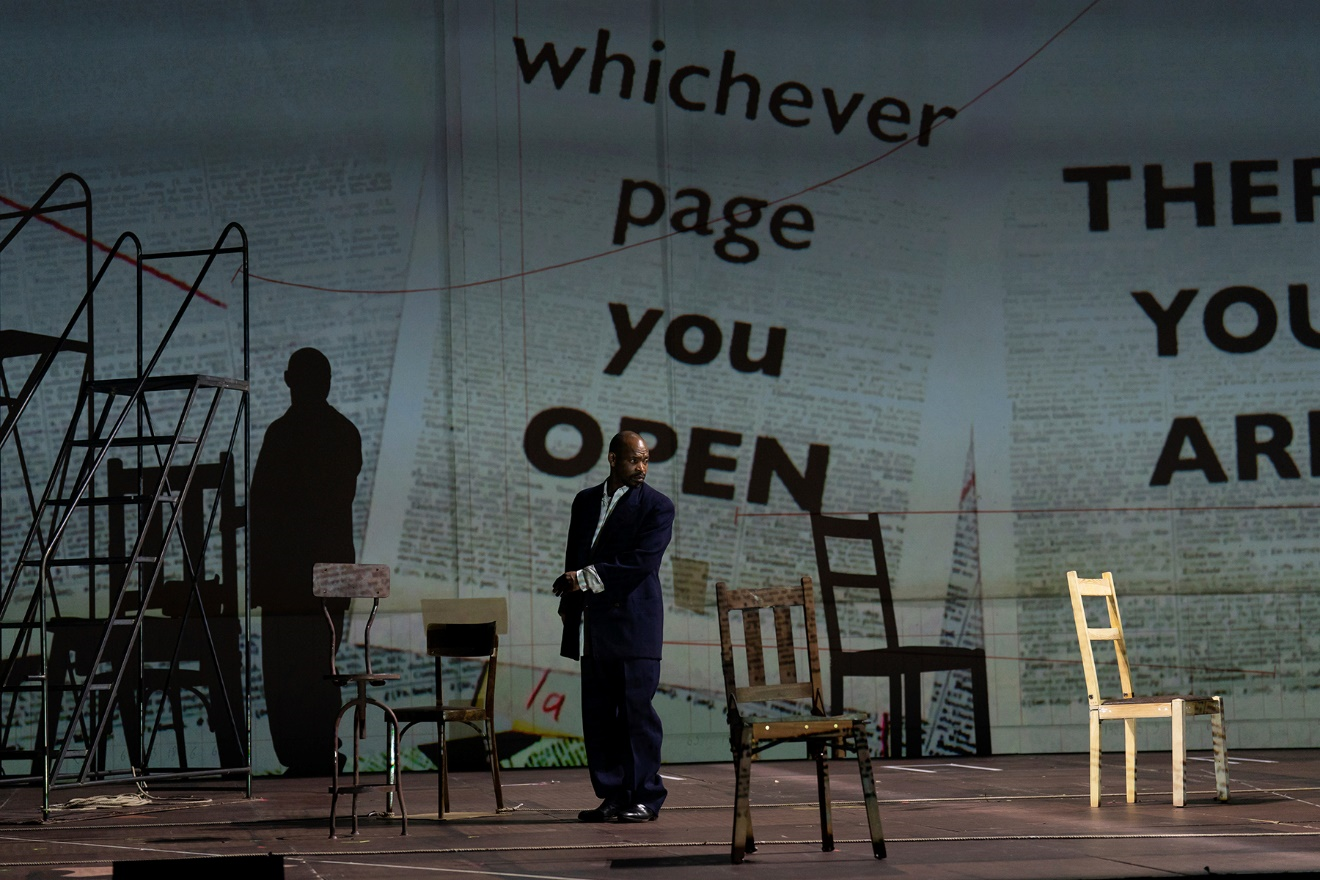
A line of bright lights along the front edge of the stage projects the shadows of performers and props against back screens and walls to effects that are both compelling to watch and symbolic of the dark side of every illumination. In several of the scenes, Teresa Phuti Mojela, playing the Sibyl herself, dances in magnificent passion as her shadow is projected grandly on the screen behind her to the right of which a flashing darkness of charcoal and ink from the artist’s hand dances beside her.
In other scenes, the treachery of the material order is allegorized in a dance of chairs moving apparently by themselves across the stage and collapsing just when a poor human being needs to rest on one from the unbending demands of the material order of living.
In another scene, a megaphone takes over the stage and barks orders across the audience, many of them transcriptions of the oracular pronouncements on the Sibylline leaves: “The machine says heaven is talking in a foreign tongue.” “The machine says you will be dreamt by a jackal.” “The machine will remember.” Though then the megaphone – stand-in for the machine – seems to turn against itself: “Starve the algorithm!” it demands, shouting over and over, to several unequivocal responses (“Yes!” “You said it!”) from the audience I was in.
One of the most dazzling of the short films is an immense one-line drawing that begins as a dense chaos of swirling squiggles in one corner that eventually builds into an elaborate, precise, wondrous, surreal but perfectly legible drawing of a typewriter. But the draftsman does not stop there, he continues drawing wildly, apparently uncontrollably until the screen is a thick liana, a fabric of chaotic twine, the typewriter slowly sinking beneath the chaos of a creation that cannot stop. This is a nearly perfect example of the perpetual transformation – one might say, of existence itself – that is one of Kentridge’s central themes.
SIBYL is filled with such brilliant and, for me, unforgettable moments, as I have learned to expect from this artist after he first invaded my mind in a retrospective I saw in 2010, and in the following years in such masterful creations as “The Refusal of Time.” But the piece is not without weaknesses. The artist admits, in interviews, that he does not know how to tell a story. And that is clearly true – and in most of his work, it doesn’t matter. But for a live performance, something like a narrative arc is required for a piece to cohere and satisfy at least this spectator. The arc can be as abstract as you please (such as in a Balanchine ballet), but it needs to be there. And it is not present in the second part of SIBYL (where it needs to be) nor, a fortiori, in the work as a whole. The production provides a fascinating evening, loaded with ore; my only complaint is that it could have been even better than it is. For example, I was expecting a fully climactic conclusion. There is none; it just stops. The ending is merely flat. Postmodernly unsatisfying.
Among the things that stay stubbornly in memory are the vatic sayings of the Sibyl herself, strewn across screen and stage as at the mouth of the priestess’s cave: “Let them think I am a tree or the shadow of a tree.” “It reminds me of something I can’t remember.” “We wait for Better Gods.” “The mouth is dreaming.” “Whichever page you open” “There you are.”
_____
Christopher Bernard’s third collection of poetry, The Socialist’s Garden of Verses, won a PEN Oakland Josephine Miles Award and was named one of the “Top 100 Indie Books of 2021” by Kirkus Reviews. He is a founder and co-editor of the webzine Caveat Lector.
Poetry from Roodly Laurore
Patience


The future hides, fades away

Gives way to doubt, doubt.

Sleep flees, appetite disappears

Body weakens.

Discouraged, takes refuge in the corner, saddened.

No more inspiration, shrouded in darkness

Desolation, last weapon

Last minute companion.

But in the end, the flip side

Leads the way, brings hope

that lasts forever

The fruit of patience.

_____________________

Patience


L'avenir se cache, s'efface

Fait place au doute, sans doute

Le sommeil s'enfuit, l'appétit disparaît

Ainsi, le corps s'affaiblit.

Découragé, se réfugie au coin, attristé

Plus d'inspiration, plongé dans l'obscurité

La désolation, dernière arme

Compagnon du dernier moment.

Mais en fin, le revers de la médaille

Ouvre la voie, apporte l'espoir

Qui dure à toujours

Le fruit de la patience.
Story from Richard Simac
In the Cool of the Day
The backyard was a confusion of Victorian classicism and Medieval cloister. With its 2-by-2’s painted like fluted columns and plywood painted with trompe d’oeil triglyphs, a crumbling shed stood like the cella of a long-abandoned temple. The half-caved roof let bits of light illume what was once hidden. In front of the shed’s doors, one missing, the other with sagging hinges, a concrete Venus standing on a seashell held a scalloped dry birdbath basin on her head.
In the opposite corner of the yard, the Virgin Mary, her heel on the head of a serpent, brooded with downcast eyes. Near the gate, St. Francis held both his face and his right hand aloft for a fluttering starling to perch. His left hand clutched a crucifix hung with a simple cord around his neck. Even what appeared to be the remains of a conciliation cross lay toppled among a patch of overgrown honeysuckle that conquered the eastern half and slowly worked its way across westward towards the setting sun.
As if the center of this known world, a peach tree with cankers on its trunk and scabs on the fruit completed the scene of apocalyptic desolation.
The house itself fared no better. Many of the windows were boarded. The screens all were ripped out. A partially shattered front window gaped with sharp edges, like the grin of a demon. Gaps in the roof tiles almost looked intentional, as if someone were making a found-object art piece. The front gutter hung crosswise. During heavy rains a torrent of water cascaded over the front steps, then pooled in the yard to flood both the street and the basement.
Big Bob lived there, with his dozens of cats that he never let out. On hot days, the smell reached up and down the street. No one ever saw him. He was like a god who existed only in fairy tales. Neighborhood parents warned their children, beware.
The boys used the shed as a clubhouse during the summer. Today, the sun began to set and the cool of the day descended upon the hot and humid earth. Rickie and Danny slid through the broken fence slats on the far side of the yard. When they entered the shed, Robbie was spread out length wise on the floor. He smoked a Camel.
“Benjie here says he has hair on his balls,” Robbie said. He was older than the other three. Much older.
Benjie stood on the other side of the shed with feet spread and hands on his hips. Robbie took a long drag then offered the cigarette to Rickie and Danny. Danny took the cigarette.
“You two talking about each other’s dicks?” Danny said between puffs.
“Only interesting thing to talk about,” Robbie said. He signaled for the cigarette.
Rickie sat on his haunches, took one last drag, then passed.
“I got a dick as big as yours,” Benjie said.
Robbie tossed the butt of cigarette through a tear in the back wall of the shed.
“Big as mine?”
“Bigger.”
Robbie stood, undid his pants, and flung his dick out. With a few shakes, he was hard. Benjie did the same.
“Lemme see your balls,” Robbie said.
Benjie dropped his pants to his ankles.
“Balder than a baby,” Robbie said.
Danny and Rickie laughed but when Benjie looked at them, they stopped.
“You gonna leave?” Robbie said. “Or you gonna watch?”
“Just watchin’ is gay,” Benjie said.
Danny stood, shrugged to Rickie, and took his dick out.
“Let’s go,” Robbie said and he began to jerk off. Benjie did, too. Danny tried but his dick stayed flaccid.
“Don’t leave me hanging,” Danny said.
Rickie unzipped his jeans and barely took the head of his dick out and just played with himself.
The afternoon air was quiet. A car passed a block away. Maybe there was the drone of a plane thousands of feet above. Or the deep moan of a truck horn. Besides those, no sound. Except the soft, mechanical, repetitive muffled movement of the boys masturbating.
“Jesus Christ,” Robbie said, “fuck me.”
He came on the gray pressboard floor of the shack. Robbie put his dick back in his pants and buckled his belt. He stood behind Benjie and rubbed his shoulders.
“Come on, you can do it,” Robbie said.
Benjie cried out, like a wounded animal, then dribbled a bit on his hands. Danny stopped. Rickie zipped up his jeans.
Robbie shook a cigarette out, put it between his lips, lit it, and took a long drag. He sighed and smiled at the three boys with him.
“Like what you see?” Robbie said. He stepped to the open door of the shed.
With their eyes opened, the other three boys turned towards the house. Danny covered himself in his shame. Big Bob stood in the shade of the peach tree. He wore stained jeans and a fraying sweater. The uncut grass reached to his belt.
“Perverts,” Big Bob said. He limped as he walked back to the house.
Richard Stimac has published a full-length book of poetry Bricolage (Spartan Press), over forty poems in Michigan Quarterly Review, Faultline, and december, and others, nearly two-dozen flash fiction in Blue Mountain, Good Life, Typescript, and three scripts. He is a poetry reader for Ariel Publishing and a prose reader for The Maine Review.