
EVOLUTION.

In this waltz, I carry you in my mouth;
Between little piano keys that snowflakes wars.
On this floor my body is brass; grief stricken metal and
A wall is a leaf on fire so my mother looses her throat
And tried to pronounce requiem, she lifts her right palm
And becomes a lotus, she lurches towards a mirror
To gather my fate and father’s reflections, she waters her face,
Count periwinkles, colours and the shell of a snail beside a broken pot.
She embodies a fish that drowned of thirst
And through the wind binoculars; a lapel folds a ladle
Through the kitchen window. A wild flower sprouts
From my mother’s palm and we are two step into evolution;
A wormhole that made my father’s journey to soil 1mile
Away from home; a recapulation of carefully collected snapshots
Of my father’s bones; his father’s bones; bones and more bones are now
Tree branches transforming into grief.
I dance;you dance;northern hemisphere harbours a hiccup and
My mother drowns.
I grow; you try to;you fail;schizophuta and rhizopus gather dead organic
Matter entracellularly and my brother is found identifying himself
A saprophyte.
I decline; my mother swallow’s earth;she drowns in between a
Floating microscopic heterotroph and grouped us into a photo album;
Zooplanktons.I name it grief,
She names me son and shades of coat colour counters my decline ;
She names me an x-gene and I pause in between her war-teeth and a
River of thirst rubbing my chest gently.
Poetry and art from Michael Hough and Christina Chin
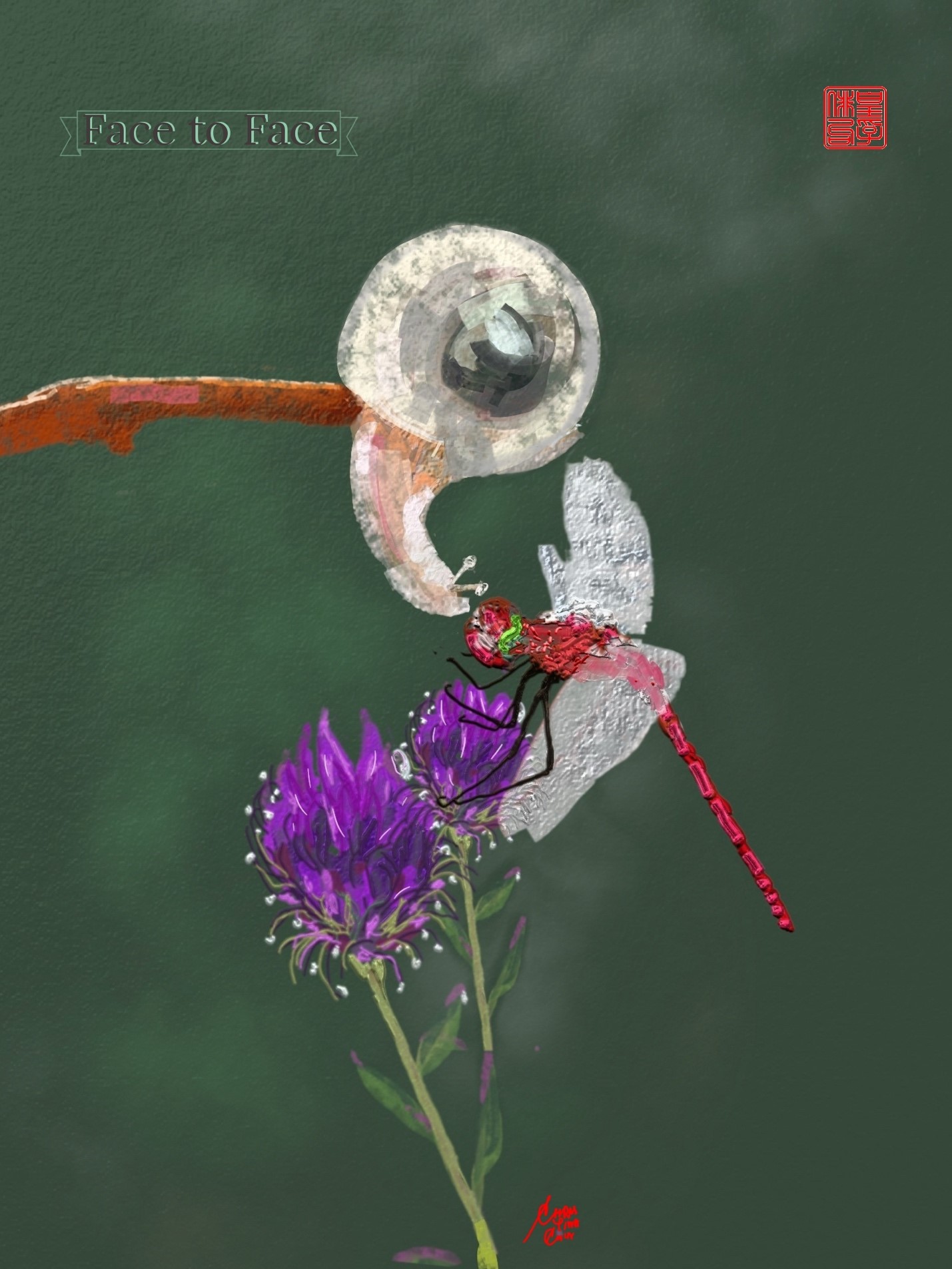
Face to Face

"Oh my God ... is it really you?"
"... Yes ... I was hoping it was you in that shell."
"It's me, and I remember everything."
"So do I ..."
"So .... like all that nonsense they told us about reincarnation turned out to be true, didn't it?"
"It seems like it now."
"That's a lot to think over, especially when our brains are so small."
"I know, I know ... but what else are we here for?"
“Well, I have to crawl down ... I can't stay here all morning. It’s unbearable when the sun is too bright.”
“I'll meet you here tomorrow morning then. Will you come?”
“It will take me all night to climb up here, but I'll do it.
... because, like how long do we live, in these shapes?”
"I dunno ... a couple weeks for me maybe."
“I think I get a little more. I've grown around this shell a whole turn and a half since Spring.”
“You go, girl! ... you are like, still a girl aren't you? "
“In this form we're all kind of half-and-half. I know it sounds weird.”
"I won't kick you out of the flower bed ..."
* laughs ...
“I’ll see you tomorrow, I hope. You be careful. There's a toad under the third brick in the wall. You would NOT believe how long his tongue is. ”
“Yes I would. I've seen him absolutely shred a bumblebee that didn't know he was there. It was horrible, except that I hate bumblebees. And you might want to step it up and go ... there's a Possum that lives behind the tool shed. ”
“Yeah ... bad news ... I have to keep a low profile around that one. I hunker down and pretend to be a wad of old chewing gum.
But hey! Listen! Maybe you can scout this out for me! I was down by the pond yesterday morning and I saw this BIG Catalpa leaf right
at the water's edge. I think it would hold me like a boat. And if you came and perched on the stem, and fanned your wings a bit, we might sail out to that little Island in the pond. We'd be safe there wouldn't we? No possums or toads, or kitties ...”
"Oh babe ... you don't know about the Bullfrog."
"Oh my Gawd, is that what makes that noise ...?"
“I’m afraid so ... top of the food chain on that island anyway. There are also some
big Bass in that pond. I’ve seen them lurking.”
"Shit ... I was hoping ..."
“I know. But I'll wait for you tomorrow morning, right here.”
"Good ... I still love you, did you know?"
“Yes, it's written on your shell in letters only I can see. And when my wings get really going, they make the sound of your name as I remember it. I will always love you, no matter what.”
“Thanks for that. Wait for me ... It might take me a long time ...”
"Yes, it always did ..."

						Michael Hough short fiction / Christina Chin, art.
Poetry from Tareq Samin
O human life, I pay homage to you

O human life, I pay homage to you
in teary wet eyes
in birth and death
in mosques-temples-synagogues-pagodas and churches.

O human life, I honor you,
in atheism and skepticism
in hunger and starvation, in food and luxury
everywhere, O great life, your very existence.

O human life, I thank you,
you showed me
a dew on the grass
Water hyacinth flower, Flame of the forest and Red silk cotton trees.

And whatever is sacred
baby’s smile mother’s caress and father’s affection
books, pens and ink
generosity-love and forgiveness.

O human life, I thank you
everywhere, O great life, you exist.


At Morges and an afternoon at the bank of Geneva lake

Walking can be a lovely experience
when you are in a new land.
the pictorial landscape
the silence, the raindrops.
The seagulls, the boats and the fisherman
at the port of Morges
at the bank of Geneva lake.
Being alone and loneliness not always crush
when you have water, lakes, mountains and the giant Sequoias
And they whisper! you are not alone
you are among us, you are with us
and we are too.


Tareq Samin is a Bangladeshi Secular Humanist Author. He is the Editor of the bilingual literary journal Sahitto. He is the author of eight books, including five poetry collections, two Short Stories collections and a Novel. Also he has translated into Bengali, two books of Anthology of International poetry of 22 poets from 20 countries. In total he has ten books published. His poems are translated in more than 20 languages including English, Spanish, Chinese, German, French, , Italian etc. Also his poems, short stories and articles are published in more than 25 countries.

Tareq Samin received the ‘International Best Poets Award-2020’ from The International Poetry Translation And Research Centre (IPTRC), China and the Greek Academy of Arts and Writing. Also he has been awarded ‘Honorable Mention’ in Foreign Language Authors category for his poem ‘Another Try’ in ‘The prize il Meleto di Guido Gozzano Agliè’ poetry competition held on 12 September 2020 in Turin, Italy. In July 2021 he won Naji Naaman Literary Prize 2021.

Tareq Samin is a Martin-Roth-Initiative Scholarship Alumni. The Martin Roth-Initiative is a joint program of ifa (Institut für Auslandsbeziehungen) and the Goethe-Institut, funded by the German Federal Foreign Office. The Martin Roth-Initiative protects artists who are dedicated to the freedom of the arts, democracy and human rights in their home country. As a Martin-Roth-Initiative Scholarship holder, he was a guest writer in Goethe-Institut, Kolkata, India. And Kathmandu, Nepal.

In 2021, he was also an International guest writer in Château de Lavigny International writers-in-residence,  Switzerland.
Poetry from Stark Hunter
At My Table

The silent dead sit at my table on Christmas night.
They have been buried a half century of stony time.
Under thick carpets of weeds and grass they sleep now—
Old voices that once were heard within these white walls—
Old faces now departed but still mingling with the vapors.
I can see my dead mother at the end of this long table.
Pauline is young again as she gazes upon her old friends.

My mother died in 2003, but there she is with a red apron,
Haunting me still with culinary aromas from her green kitchen—
Her feast of salt and sugar still on display from distant 1967–
Her dead relatives smiling now for the Polaroid picture.
She says life is a bowl of green beans laced with bacon grease.
The whisper of dry voices say grace under a dim chandelier.
Now I can hear the clanging of forks and knives at my table.


Anti-Poem I Without A Soul

Luscious creamsicles cascading as glacier pedestals
Transfiguring all the remarkable inclinations with pizazz
Luminescent monte carlo dream rhapsodies of tuna silk
Spin and spiral like rabid frosting rockets of glorious goo
Translucent moth girls collide into the shy fires of night
Licking now the smooth verdigris of old copper mornings
Turning and extending their silver lullaby preponderances
To the sipping uncles seated on hungry sofas of leering pleats
Fingering now the electric diamonds of a comatose creamsicle


The Coming Andantes

you are flying on a hazy dream carpet —
floating up there, above these old streets,
these ancient genuflecting pines and cedars,
rising above the sleeping dead on Broadway,
soaring now through the white tombstones—
the low walnut branches that flail like hungry cats.
now the sudden rush out of death’s hand we fly,
whirring by faster than blood flow in a silver sieve,
in and out of the shadowed majesties far inside,
these soul itchers that foretell the coming andantes,
here in this perfumed dreamland with only you,
as we seep through the spinning pines and cedars,
the long extending blood rivers naked with stones,
of venison death and fish spasms in the final sun.


Nightmare Again

Another loose grind from bedtime to flickering bedtime
The white pills on my bureau sit there like lactose bugs
Lurking silently as sad dogs would, waiting for the door to close
Life is the uneaten fish inside the garbage can out back
The maggots there drink champagne cocktails with their dim wives.
Another nightmare now with hordes of death nurses sucking on syringes
Their black marble eyes enlarging like stoned puffer fish
Short story from Mehreen Ahmed
Celeste
by
Mehreen Ahmed

The children of the alley made clay dolls. They sat by a rubbish pile and dressed them all. Dolled them up, faceless at first. Then they gave them eyes and nose and curvy mouths. Legs and hands to dance with them at sundown. If this wasn’t enough, they also made tears with Lipids, Lysozyme, Lipocalin, Glucose, and Sodium. Water, made out of H2O. Oxygen to breathe, blood from Iron to carry oxygen to brain; carbohydrates, fats, proteins, and ethanol. Estrogen and so on to trigger pleasures, euphoric. The brain, composed of Cerebrum, Cerebellum, and Brainstem. Skin to cover and protect.

The children were blind. Still, they melded a silken network of chemical medley into this unique creation. Even kindness, generosity, jealousy and cunning—propensities—were inclusions of this concoction. They gave them a name Clay Dolls, who had everything they needed to dance with them—energy, intelligence, sentience. Except, there was one potent component, the children were circumspect—eternity, they reserved only for themselves, which the Clay Dolls found disturbingly lethal. The chemicals they had been tied with were eyewash.

Every dance was long and nuanced; the children took a lot of care to choreograph. In great details they took a butcher’s knife and pierced it through the Dolls’ hearts. They were blind; they didn’t see them die; but they had known it all along; this dancing was thrilling, in which the bodies putrified, not the chemicals. They used the same building blocks to make new dolls in tightly packed chemical knots. In their blindness, the children saw naught, what the Clay Dolls had asked for. They’d never even viewed their own reflections—let alone them—but Clay Dolls had eyes. They saw them—The Makers for who they really were—insensitive, in wanton jouissance.

No matter, the Clay Dolls matured overtime. They developed a foresight, which eluded The Makers. The Dolls thought of a ruse to get even with them. They learned the ropes and progressed. While they danced with The Makers, they’d also begun to tutor themselves in natural herbs, potent in medicinal value. The Makers had taken them for fools—Clay Dolls. Surely, when they tried to butcher them, they realised they couldn’t kill em’ all. Some stood back up while some fell. The Makers comprehended with a sixth sense, but couldn’t do anything preventable.

The Clay Dolls were gradually overpowering them. Knowledge had given them much boost. Still, they continued to dance but far lesser kills, for The Makers to roost. More Clay Dolls survived as their skills exponentially exceeded The Maker’s expectations. However, The Makers found comfort that the ultimate power over the organic world resided in their hands. Only they were eternal, and wise enough to govern these lands. Although, the creepy sixth sense alluded to them that the Clay Dolls were not only dancing in tight compartments under the blue, but had traversed the space as well, who now had the sense of space-time, the gaseous Canopus and the laws of physics.

Why, the Clay Dolls were unstoppable, yet they were fettered? The Makers felt angst and conferred amongst themselves. The Clay Dolls were reaching heights too far in the sky. They needed to be cut down to size. Whoever had the knowledge of immortality would win this war. The Makers found solace that the Clay Dolls would not win because they danced to a mortal tune which they had been attuned to since inception. The Clay Dolls would never know how immortality worked, thereof, The Makers would always dominate.

It rang true, the laws of physics did decree this that in time every organic life would perish. The Makers had made sure that the Clay Dolls were just that—organic, and nothing more. The sixth sense allowed them the light of prediction. However, The Makers had not predicted this. The Clay Dolls persisted. Did they not deduce that immortality was immutable and not bound by any strict parameters? Maybe, The Makers were delusional of galaxies that when they blossomed, they hinged on the laws of physics, alone.

Who made The Makers, any way? The Clay Dolls theorised that The Makers were subjected to the rule of law, too, not all that powerful—astronomical objects galvanised the stars. Where did black holes exist—wholly eating stars and what not? Galaxies could die and another could be born. Also, true to time. Since the big bang, this stretch of the solar system had occurred. It stretched and the stretching continued, theoretically, towards a gravitational collapse—Clay Doll’s collated and observed the true nature of the universe.

The Makers spun out of gasses, far surpassed the lowly masses—immortal creators just their luck, but, no interlocutors by any long shot. Both mute and blind, they made the Clay Dolls in their own image. Albeit, the Clay Dolls were borne out of them but had not turned out eternal, but different—enigmatic and more.

The fate of the Clay Dolls was sealed. Without oxygen, they couldn’t breathe. Without food this variant would be deficient. All designed in blindness, but the same law could be applied to The Makers in reverse—stars, the sun, the rains, the rainbow and all the lovely confection that fell from them. In hindsight, they too died. They too were prone to destruction which the deluded Makers wouldn’t know. The Clay Dolls, figured out the celeste. More lights sparked through their neurons than all the lights sparkled in the milky way.

In this blinding paradox of the sixth sense, The Makers had not marked a proximate magnet—a spiralling blackhole they couldn’t flee; new stars were born, new Dolls were made—locked in a deadly dance—a game without a referee. Much to their delight, this much light the Clay Dolls had perceived. Knowledge that had given them an upper hand that there were more things in heaven or on earth—no one was free from the strict laws of physics. Such choices had not existed. Not to date at least.
Poetry from Karol Nielsen
Denmark

My grandfather was a first generation Danish American who grew up in a Danish speaking household. But he never taught my father to speak Danish. He wanted to be all American. My mother named me after my Danish great grandmother, Karolina, who died in a tornado. I traveled to Copenhagen and I was struck by all the blonde children in Tivoli Gardens. I stuck out with my dark hair. My mother’s father said we descended from an American Indian scout but it was a myth.

Uruguay

I went to the beach in Punta del Este before I worked as a journalist in Buenos Aires. I took the ferry to Colonia—where Uruguayans sold colorful wool sweaters—to renew my tourist visa every few months. My work papers came through just before I left Argentina.

Mexico

The Israeli soldier I met on the way to Macchu Picchu became my boyfriend. He followed me to New York and we traveled to Mexico City together. We climbed the stone steps of Teotihuacan, pre-Columbia pyramids where men were sacrificed to the gods.

Cayman Islands

We went to the Caribbean for our honeymoon a year after we married. We snorkeled and the fish looked gray in the dark ocean. We read books on the beach and went to bed early like old retirees—worn out by Scud missile attacks during the Gulf War—and we soon separated.

Hong Kong
I had a layover in the Hong Kong airport for twelve hours on my way back from Australia to New York City. I didn’t think I had enough time to tour Hong Kong so I stayed in the airport. I wandered through the posh shops and read a long novel at a café. As a girl, I dug a hole in the backyard with my brother and told my mother, I’m digging to China! My grandfather flew cargo missions over the Hump—the Himalayas—from India to China during World War II. I always wanted big adventure like my grandfather.
Karol Nielsen is the author of the memoirs Black Elephants (Bison Books, 2011) and Walking A&P (Mascot Books, 2018) and the chapbooks This Woman I Thought I’d Be (Finishing Line Press, 2012) and Vietnam Made Me Who I Am (Finishing Line Press, 2020). Her first memoir was shortlisted for the William Saroyan International Prize for Writing in nonfiction in 2012. Excerpts were honored as notable essays in The Best American Essays in 2010 and 2005. Her full poetry collection was longlisted for the Terry J. Cox Poetry Award in 2021 and was a finalist for the Colorado Prize for Poetry in 2007. One poem was a finalist for the Ruth Stone Poetry Prize in 2021. Her work has appeared in Epiphany, Guernica, Lumina, North Dakota Quarterly, Permafrost, RiverSedge, and elsewhere. She teaches creative nonfiction and memoir writing with New York Writers Workshop.
Poetry from Ahmad Al-Khatat
The Song of Life

Ahmad Al-Khatat

A song you’d be thrilled to hear,
with eyes sharing their sorrows
to the nightingale
a grief’s mouthpiece takes me
to innumerable nostalgia
We hear the lyrics of the song,
as clothes become wet from
sobbing to the morning daylight,
not moonless nights...


Wings In the Wind

Periodically, I see everything
all at once
I know every corner I walk
by myself

I turn my skull before I make a
rational conclusion, I wrap my finger
to assemble my achievement
in Montreal and Baghdad.

When my generation was removed,
It erased my innocence,
It erased my imagination,
Shatter my days into black as soil

Death has forgotten about
Wings in the wind, after it demolished
my written poems to homeless signs
as if I am playing marbles barefoot.


The Finest Cigarette

On the first day of the new year,
 I light the finest cigarette up and
sip a cup of black coffee by myself,
then write about hope on the typewriter.

The night born with stars and torn them
The children of world recall their little pets
While the children of Iraq & Syria remember
the dates of their siblings' death in the war.

I no longer run after the birds and butterflies
My days are low, like the tears of a dying angel
My life is no longer delightful and brief
Even love has been eliminated from my universe.

No one seems to care about my flying wings
Everyone is celebrating the night we shattered
The wooden floor sustained your bitterness tears
This oppression made me an alcoholic and hopeless.

Another cigarette, another bottle of Russian whiskey
Another great rhythm and blues to listen to alone
Waiting for the time, and walk missing from the pub
Destiny undresses my flesh and leaves me as rotten skulls.


Ahmad Al-Khatat was born in Baghdad, Iraq. His work has appeared in print and online journals globally. He has poems translated into several languages such as Farsi, Chinses, Spanish, Albanian, Romanian. He has published some poetry chapbooks, and a collection of short stories. He has been nominated for Best of the Net 2019 and was also nominated for the Pushcart Price 2020.